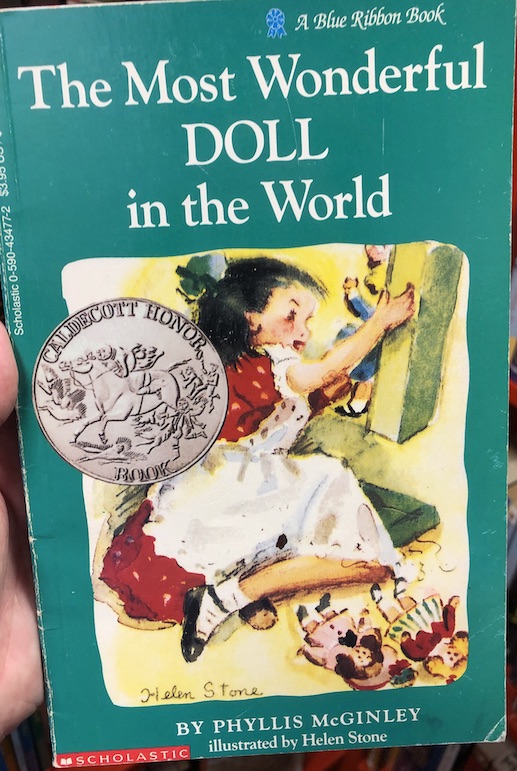
The Most Wonderful Doll in the World by Phyllis McGinley, 1950.
Dulcy is a little girl who is rarely satisfied by anything. She has a big imagination, and is always wishing for something better than what she has. Dulcy has an impressive collection of dolls, but even though she loves all of her dolls, she can’t help but think sometimes that some of them would look better with a different hair color or with different clothes or with some other small detail changed. No matter how good something is, it’s never completely perfect.

Then, one day, an elderly friend, Mrs. Primrose, gives Dulcy a doll named Angela. Dulcy likes Angela, although her immediate thought is that Angela would be even better if she had dark hair instead of blonde, finding a tiny fault as she always does. But, by accident, Dulcy loses Angela on the way home. She sets Angela’s box down when goes to help rake leaves into a bonfire, and when she goes to retrieve her, she can’t find her.
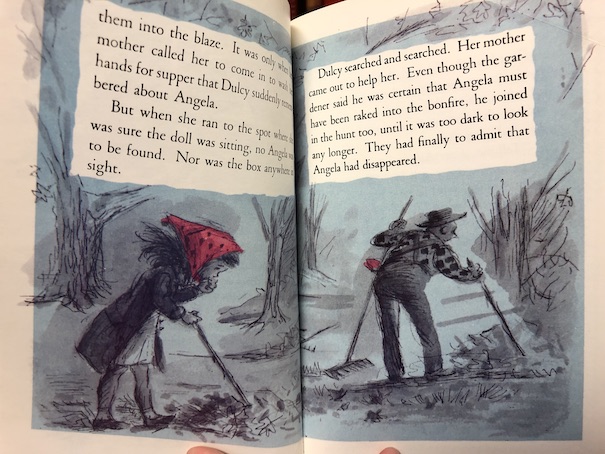
Once Angela is gone, Dulcy’s attitude changes. Dulcy is upset about the loss of Angela, realizing that Angela really was a precious and special doll. Her mother offers to get a replacement doll that looks like Angela, but Dulcy can’t imagine that any doll would be as special as Angela. As Dulcy describes the doll to her mother, she says that Angela was blonde with a blue dress and pinafore and eyes that could open and close. Those aren’t terribly unusual qualities for a doll, but Dulcy also adds that Angela had shoes with heels and could say “Mama” and “Papa” and sing Rockabye Baby. Those are more unusual, and Dulcy’s mother agrees that she probably won’t be able to find a doll that does all that.
However, readers soon begin to notice that Angela becomes increasingly wonderful each time that Dulcy describes her. When her father offers to buy her another doll, Dulcy adds that Angela could also walk and wave her hand. Dulcy tells her teacher about Angela’s little purse and gloves. She tells her friend Margery about Angela’s raincoat and umbrella.

The more Dulcy thinks about and talks about her wonderful doll, the less satisfied she is with her other dolls. None of them can compare to the amazing Angela! When her Aunt Tabitha gives her a skating doll, suddenly the missing Angela acquires the ability to skate as well. No doll that Dulcy has or ever could have could compare to the missing Angela!
Other children at school are fascinated by Dulcy’s descriptions of Angela and all of the marvelous things Angela had and Angela could do, which get more and more wonderful every time Dulcy tells the story. Then, people start getting tired of hearing about Angela. Dulcy’s friends don’t like hearing that their dolls aren’t as good as Angela, and people stop giving Dulcy dolls as presents because she always says that they’re not as good as Angela.
Then, one day, when Dulcy is playing with a new girl in the neighborhood, they find the box with the missing Angela. When Dulcy sees how the real Angela compares to the one that she dreamed about and imagined when she was lost, Dulcy comes to a greater understanding of the power of her imagination and the need to appreciate things being just the way they are.

Dulcy doesn’t completely give up imagining things and dreaming of perfection, but she does learn that part of growing up is remembering the difference between what she imagines and what is real. She realizes that when she was moping about the doll she didn’t have, she kept herself from having fun with the dolls she did have and discouraged people from giving her other nice dolls. Dulcy saves all the of the amazing qualities that she dreamed of for Angela and gives them to an imaginary doll called Veronica. Dulcy keeps Veronica as her perfect doll in her imagination, and she knows that Veronica is imaginary. As long as she can have her imaginary doll to be as amazing and perfect as she wants, she can be happy with her other dolls being just the way they are, and they make her happy, too.

The book is a Caldecott Medal winner. It is available to borrow for free online through Internet Archive.
 Jestress's Forgotten Books and Stories