
Tricky Pix: Do-It-Yourself Trick Photography by Paula Weed and Carla Jimison, 2001.
This book is part of the classic children’s hobby and activity series from Klutz Press and explains how to perform trick photography. Originally, this book came with a real camera that could be used to take trick pictures. The camera was a film camera instead of a digital camera, using 35mm film, but the film was not provided.

Now, digital cameras have almost entirely replaced film camera for popular photography, and film is actually much harder to come by, and not as many places offer film development services. In the very early 2000s, when this book was first published, digital photography was just starting to take hold, and digital cameras were more expensive, so a kid’s first camera was still likely to be a film camera. In just a few more years, that shifted abruptly with the increasing popularity of cell phone cameras and further developments that made digital cameras increasingly affordable for general use. The beginning of the book explains how the camera works and how to load the film.

The fact that this book was designed to be used with a film camera is important because this style of trick photography relies on physical illusions, not images that are digitally altered with Photoshop or similar software. In a way, this makes the pictures more interesting because they are largely unaltered from their original form. That is, you’re seeing what the camera saw at the moment that the picture was taken. The tricks involve using different perspectives and camera angles to achieve the illusions.

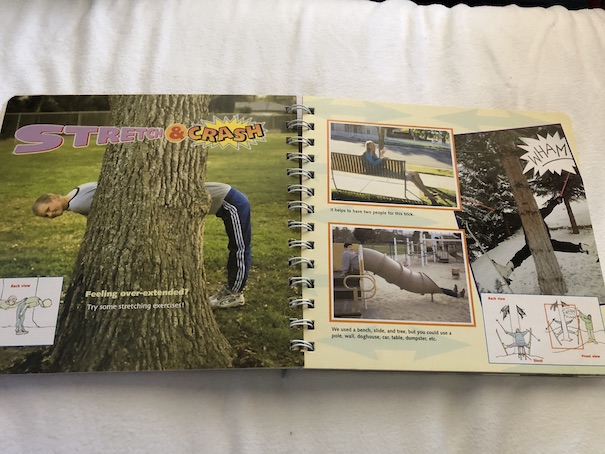
Strategic poses and the use of physical objects to block part of the scene can be used to create illusions like disembodied heads, people with extra limbs, or people with really long legs or bodies.
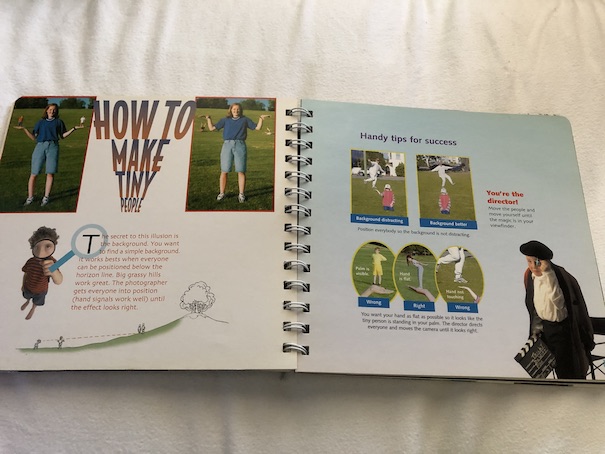
An often-used trick for making people look tiny enough to be picked up or stepped on by another person involves forced perspective – strategic positioning the subjects so that there is physical distance between them but no visual cues to indicate just how much distance there is between them so relative sizes are difficult to gauge.
When images in this book are altered, it’s with the old-fashioned method of literally cutting and pasting them onto each other, something that is now done digitally.

Personally, I enjoyed the fact that there was less of a reliance on software and digital technology in the production of these photographs. I think that learning how to do things without relying on technology to do most of the work can encourage creativity, and in particular, the use of physical illusions like forced perspective is also educational. Artists need to understand the use of physical space, perspective, and lighting, and these photographic tricks demonstrate these concepts well. Even though this book doesn’t make use of digital photography, any of the tricks in this book could also be performed when taking pictures with a digital camera.

The book is available to borrow and read online through Internet Archive.
 Jestress's Forgotten Books and Stories