Clifford
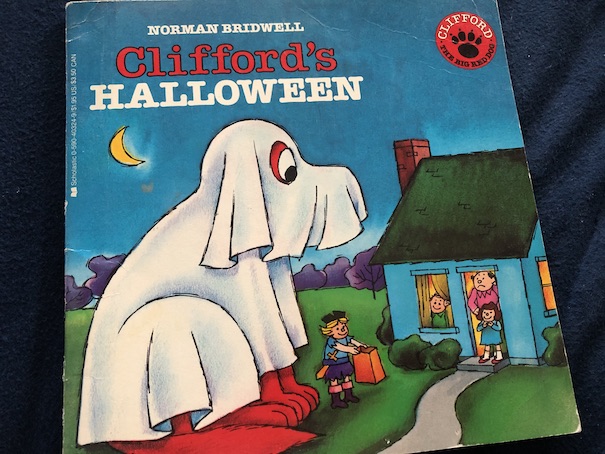
Clifford’s Halloween by Norman Bridwell, 1986.
Halloween is Emily Elizabeth’s favorite holiday! Emily Elizabeth talks about the various holidays that she and Clifford enjoy, but Halloween is the one they enjoy the most.

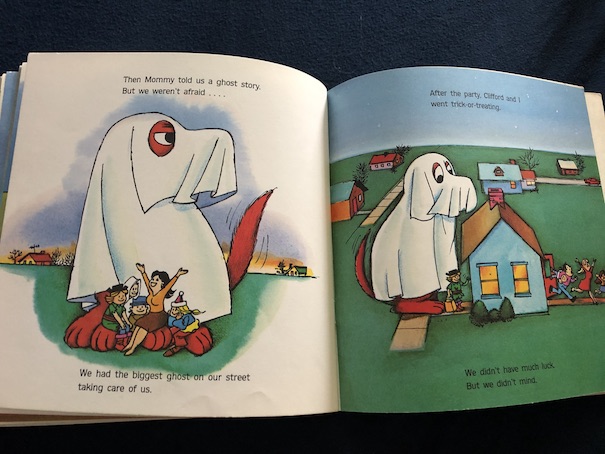
Last Halloween, she considered various costumes for Clifford, but Clifford decided that he wanted to be a ghost, covered with a giant sheet. (I love how they say that nobody could guess who the giant ghost is, like there could be someone else in the neighborhood that big.)


When you’ve got a giant dog, bobbing for apples doesn’t go the way you expect.

However, when you’ve got a giant dog, nothing else is very scary, either.
The book ends with Emily Elizabeth considering different costumes for Clifford for this Halloween, inviting the reader to think of other possible costumes.

I like the idea of letting kids consider which Halloween costumes they like the best from the ones that Emily Elizabeth considers. Kids like making choices, and trying to think of costumes that would work on a gigantic dog presents a creative challenge. When Emily considers dressing Clifford as a knight, they don’t consider where she’s going to get a suit of armor that size, but the books in this series don’t worry much about the logistics of caring for a dog the size of Clifford.
When I first read this book back in the 1980s (I was four years old when the book was new, although I can’t remember exactly how old I was when I first read it), I didn’t think too much about the Indian (Native American) costume with a pipe, although I wouldn’t think of suggesting that as a costume for anyone now. It’s partly because there’s something of a stigma against Native American costumes now. It’s not enough of a stigma to get people to stop wearing them and major costume retailers from selling them, but enough that some people raise eyebrows at them because of some of the connotations attached to them. If you read some of the reviews of Native American costumes on Amazon, like I did, it seems that more of them were purchased for school plays and projects or Thanksgiving plays than for Halloween. However, the part about this costume that particularly jumped out at me was the ceremonial pipe. Kids sometimes dressed as American Indians for Halloween when I was young, although the practice is discouraged now, but with all of the anti-smoking campaigns aimed at children when I was young, most of our parents wouldn’t have even considered giving us a peace pipe as part of a costume, even ignoring the social and cultural implications of that. I think that idea shows the age of the book’s creator. I grew up in the American Southwest, but I didn’t grow up on old western shows where peace pipes were a common feature. I didn’t see those shows until I was older, and by then, they looked pretty cheesy. I think that the book’s author was from the generation that was raised on those westerns and had nostalgic associations with them.
The book is available to borrow for free online through Internet Archive.
 Jestress's Forgotten Books and Stories