
The Silver Spoon Mystery by Dorothy Sterling, 1958.
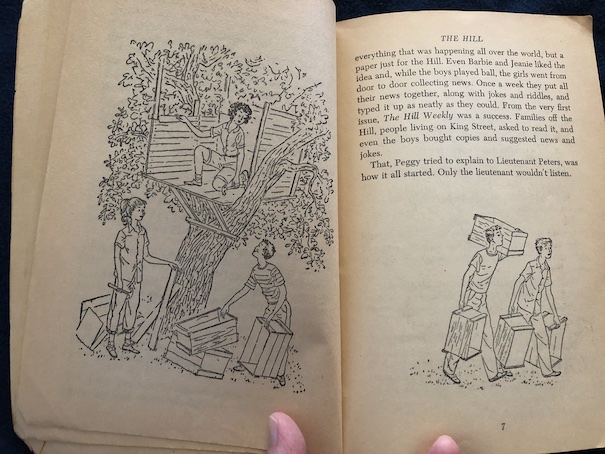
A group of families move into the new suburb built on The Hill overlooking the town of Dwighton. The kids in the new neighborhood become close friends, visiting each other’s houses, playing games, and running around town together. It’s idyllic, but then the boys in the group start playing baseball together, and they begin excluding the girls from the group, even though they’ve all played baseball together before and the girls are good at it. The boys also stop working on the tree house that the kids were all making together, taking some of the tools and materials and building themselves a clubhouse near the baseball field with a sign that says, “NO GIRLS ALLOWED.”
The girls are offended at suddenly being shunned by the boys, so they decide that they need to have some special project, something that will show the boys that girls are just as good as they are and that the girls don’t have to rely on the boys to have some fun. They decide to start a neighborhood newspaper, writing about local events and having fun stuff, like jokes. The newspaper is a success, and adult neighbors buy copies. Then, the boys decide to start a competing newspaper themselves. One of the girls, Peggy, is upset because she’s sure that the boys’ newspaper will be more successful. Some of the boys are older than the girls so they might write better, there are more boys than girls in the group so they have more people to gather news and sell papers, Davey is better at drawing cartoons than the girls are, and worst of all, the boys splurged to buy a hectograph, which uses a gelatin substance for making copies of writing and drawings (as in this video) and will allow the boys to print papers by the hundred (“hecto” means one hundred, and that’s how many copies a hectograph makes at a time). (This is before home computers, so the characters have to rely on manual printing methods. People used hectographs to make copies before modern copy machines, but modern hectographs still exist, and some people use them for artwork or tattoo stencils.)
Peggy’s afraid that the girls won’t be able to compete with the boys’ advantages and thinks that the boys are mean for trying to steal their business. Peggy’s mother tells her that she shouldn’t worry about being better than the boys but focus on being different. She says that the girls should make sure that their paper has different content from the boys’ paper so people will still have a reason to buy theirs even if they’ve already bought the boys’ paper. If the boys’ paper has cartoons, the girls’ paper should have things the boys wouldn’t think to include, like recipes, poems, and fictional stories that could be written and submitted by local people.
Peggy gets an idea from what her mother says, but it’s not a good one. Peggy still wants to show up the boys, and she thinks that the best way to do it is to get a “scoop”, meaning printing an exiting news story that the boys won’t have in their paper. The problem is that the girls don’t know where they’re going to get an exciting news story that the boys don’t know anything about. Nothing that exciting is happening in their town anyway. There haven’t been any shocking events, no murders, no robberies. Peggy tells the other girls that means that they have write about something that hasn’t happened yet. Peggy poses the idea of writing about someone stealing the silver on display at the local library that was made by the silversmith who was the founder of their town. Of course, the problem with that is that the silver hasn’t actually been stolen. One of the girls, Ellen, objects to writing a story about something that hasn’t happened because that’s not actually “news.” However, Peggy talks the other girls into it by saying that they would be writing about it as fiction because people write fictional books all the time, and that’s allowed. Ellen still isn’t convinced, but Peggy goes ahead and writes the story anyway. (Basically, she’s turning the girls’ newspaper into a tabloid, although the kids don’t seem to quite get the difference, even though Ellen can tell that this isn’t right for a newspaper.) The girls all discuss how they would go about stealing the silver spoons from the library, if they were going to do it, and Peggy writes the story from their speculations.
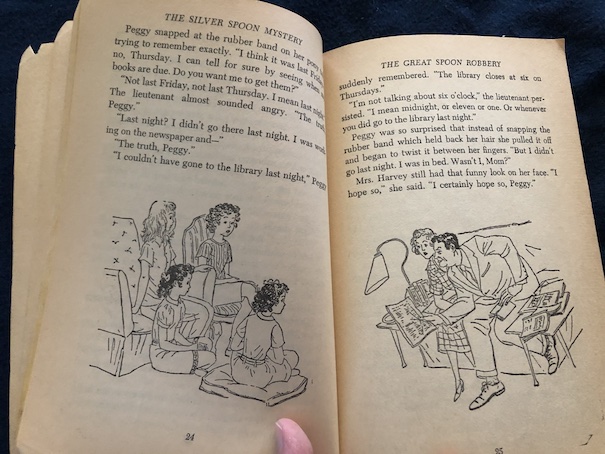
You just know that there’s going to be trouble with Peggy trying to sell a story that everyone knows didn’t happen, but what actually happens is even stranger. After the girls sell their paper with the spoon theft story, Peggy gets home to find a policeman, Lieutenant Peters, waiting for her with her mother. Lieutenant Peters wants to talk to Peggy about the robbery at the library because it turns out that the very night when Peggy was writing her big fictional scoop about silver spoons being stolen from the library, someone was in fact stealing silver spoons from the library, and this thief apparently did it the way Peggy described in her story. Lieutenant Peters wants to know everything that Peggy knows about the theft, and he won’t believe that Peggy wasn’t there to witness it because her description of what happened is so accurate. She even has a description of the thief in her story. Since the theft happened in the middle of the night, Peggy points out that she was asleep in bed, but even Peggy’s mother isn’t sure that Peggy didn’t sneak out. When Peggy’s friends show up at her house, Lieutenant Peters questions them too and comes to the conclusion that Peggy and maybe also her friends stole the spoons themselves to make their story true. Lieutenant Peters says that they’ll be forgiven if they give the spoons back, but the girls can’t do that because they don’t have them.
As Lieutenant Peters and Peggy’s mother continue to question the girls about their story, the girls admit that they made up the whole thing as a fictional story just to attract attention to their paper. Lieutenant Peters catches the boys listening in on their conversation and questions them about what they know about the situation. The boys don’t really know anything about the theft, either, but they were pretty sure that Peggy made up the story she wrote, and they’re fascinated that she might be about to be arrested and taken to “children’s jail.” Peggy’s mother believes her that she just made up the story and it’s all a coincidence that someone happened to steal the silver spoons from the library around the same time, but Lieutenant Peters isn’t convinced.

Word of the spoon theft spreads across town quickly, partly because of Peggy’s story in the neighborhood newspaper and partly because of the story in the regular news. People call Peggy’s house to ask for details, and kids at school look at Peggy and her friends suspiciously, wondering how much they had to do with the theft. Peggy is especially offended when Davey says that his father thinks that it’s an unlikely coincidence that Peggy would write a story about the theft and then the theft would just happen. Before the boys started their “no girls allowed” stuff, Peggy and Davey used to be close friends. However, Davey assures her that he doesn’t think that she’s responsible for the theft. He also tells her that he and the other boys are sorry about pushing the girls by trying to compete with their paper, and they’ve decided to give up theirs and let the girls use the hectograph. The kids discuss trying to investigate the crime themselves because, until the real thief is found, people are going to keep looking at the girls suspiciously.
Most of the neighborhood kids, both boys and girls, join the investigation as the “Hill Detective Club”, except for one of the older girls who is studying for exams and Davey’s older brother, Allen, the only boy who’s mad at the other boys because they don’t want to play baseball now. (Allen is apparently the one who started all the “no girls allowed” stuff because he didn’t make the high school baseball team and he’s been ultra-serious about practicing during the neighborhood games. He’s trying to organize a game between the boys in the neighborhood and their fathers. The book doesn’t explicitly say so, but there might also be an element of embarrassment for him that some of the girls play better than he does. Peggy is described as being the fastest runner in the neighborhood, and Ellen is a good batter.) As they begin their investigation, the kids visit the scene of the crime and study the ways the thief could have gotten into the library, starting to separate the made-up details from Peggy’s fictional story from the real facts and circumstances of the case. Peggy admits that her mind is biased because she still thinks of her story as the way things happened and her fictional suspect as the type of thief they’re looking for, but the truth is that they don’t know for sure how the crime actually happened or what type of person they’re looking for.
When the kids talk to one of the librarians, Miss Bancroft, they learn that the police did find a few sets of fingerprints on the case that held the silver spoons: Miss Lowell, the head librarian; Mrs. Simpson, a descendant of the town’s founding father and part of the local antiquarian society; and Mr. Weatherspoon, who owns a local antique store. Could one of these people be the thief?
The book is available to borrow and read for free online through Internet Archive.
My Reaction
To begin with, this book seems like it’s meant for fairly young elementary students. It tries to teach readers the meaning of some of the words in the story because some of the characters don’t know the meanings of various words the other characters use or words that they encounter in various places, like “descendant” or “optometrist.” The kids in the story are a variety of ages even though they all play together in the neighborhood, and I could understand why some of the younger kids would struggle with bigger words, but there were times when I thought that they were carrying it a little far. Peggy is twelve years old, so it seems like she should have been old enough to know what an optometrist is. Has she never had her eyes checked before? Actually, maybe she never has. If her vision is good or seems good, maybe her family just doesn’t bother. I guess it’s educational for young readers just branching out into chapter books.
I like books that bring up interesting historical topics. The parts about older printing/copying techniques and Mrs. Simpson’s old electric car with the steering stick instead of a steering wheel (possibly a Baker Electric, like the one Jay Leno owns, or something very similar – this video explains the history of the Baker Electric and shows what it’s like to drive it) were interesting, and one of the characters in the story explains more about the history of the town’s famous silver spoons to the kids. Although the town, its founder, and the spoons are all fiction, spoons of this sort did exist in real life. The silver spoons are specifically christening spoons. It used to be traditional to give presents made of silver to new babies and their parents for the child’s christening. One of the most popular presents of this type was small silver baby spoons, especially with special designs or engravings to remember the child’s birth. The character explains why this particular set of spoons is so distinctive, talking about their unique design, how antique dealers would be able to look them up in a reference book and learn their history, and how each of the of the spoons is marked with the maker’s hallmark, the special symbol that the maker would use to identify himself.
Part of the mystery hinges on the coincidence of the theft occurring just when Peggy decides to write a sensational story about an imaginary theft to get attention for her neighborhood newspaper. For readers, the question is whether the timing of the actual theft is really just coincidental or if there’s a direct connection between the story of the theft and the theft itself. I would have been very disappointed in the book if it was just a coincidence, so I immediately approached the story with the idea that the timing of the theft was a clue. I enjoyed considering different possibilities. My first thought, when the theft happened mysteriously immediately after Peggy and her friends invented their theft story, was that someone overheard the girls talking about how they would commit a theft like that and decided to use their imaginary scheme as their own. However, the conversation between Peggy and her friends took place in Peggy’s room, which was pretty private. For someone to overhear them, it would have to be someone in Peggy’s own house, possibly family or a neighborhood friend, or someone listening in from outside, probably one of the neighborhood kids. Those possibilities didn’t seem likely. Then, I remembered the Nero Wolfe murder mystery story Not Quite Dead Enough. What if the theft didn’t occur when the police thought it did (mostly because they believed Peggy’s original story) but actually at the point where the theft was supposedly discovered? The person who claimed to discover the theft was one of the people with the strongest motives to commit it, and this person could have done it after reading the fake news story, seeing an opportunity to make it true and cast suspicion on Peggy’s fictional suspect. The mystery is simple enough to figure out for an adult who likes mystery stories, but probably much more mysterious for kids. Once the kids realize who has the spoons, there is also the additional challenge of proving it and getting the spoons back without getting everyone in trouble.
I thought it was interesting that the story shows some of the problems with sensationalist or tabloid style “news” stories, or “yellow journalism“, as it used to be called. It’s the sort of “news” that relies on flashy and misleading headlines, buzzwords and catch phrases that appeal to its fans and rile them up emotionally, hyperbole and emotionally-charged language, conspiracy theories, pseudoscience, and poorly-qualified or debunked “experts”, to draw readership and advertising money. Basically, they aren’t really “news.” They don’t try to describe things as they actually happened for informative purposes. These are “news” stories that are less about fact than about entertaining their audience or shocking people and stirring up strong emotions to grab people’s attention. That’s basically what Peggy was trying to do with her fake news story, even if she wasn’t quite thinking about it in those terms. Just like tabloid or sensationalist news, Peggy’s story was almost a kind of fan fiction based on the real world. That is, she took real things and situations that she knew existed (the silver display at the library) and wrote an exciting conspiracy story around them that didn’t actually happen (the made-up theft) as a shocking, attention-getting entertainment piece to encourage people to buy the paper she and the other girls were selling. She thought what she was doing was like harmless entertainment, but it wasn’t because it was based on something real, and her made-up story had real consequences. Not only is there a direct connection between the fake story and the real theft, but Peggy’s fake story confuses people, including the local police and insurance investigator, because they have trouble telling how much of Peggy’s story is false, and it biases their minds and the direction of their investigations. Even Peggy herself sometimes gets confused during the investigation, mixing up details from her made-up story with real events. Even though she wrote the fictional story herself, knowing it was fictional, she gets hung up on the way she imagined things would happen when she invented the story and needs to be occasionally reminded to look at the situation as it actually exists, not as she imagined it would be. If the author of the fictional news story can’t even keep her own fiction and the real facts straight in her mind at first, how can the police or anyone else?
Sensationalist journalism can and has led to real problems in real life, setting up dangerous situations by stirring up the emotions of people who may already be unbalanced and suggesting unrealistic events or courses of action that interfere with people’s sense of reality and ability to make informed, reasoned decisions (something else that ties in with the story). In a famous real life case from the early 1900s, the famous newspaper publisher William Randolph Hearst had his own reputation seriously damaged when he published articles written by two of his columnists smearing President McKinley’s reputation and seemingly recommending his assassination. (“If bad institutions and bad men can be got rid of only by killing, then the killing must be done.”) These articles were published only months before President McKinley was actually assassinated. Hearst had used yellow journalism in his papers for years to manipulate public opinion to further his political causes and gain readership. (“War makes for great circulation,” Hearst said after successfully urging public opinion in favor of the Spanish-American War.) After the assassination of the president, people made a connection between the assassination the articles in Hearst’s papers seemed to be advocating (although they called it a “mental exercise” and a joke) and the assassination that actually happened. Whether Hearst actually wanted McKinley to be killed by someone or whether the man who assassinated McKinley was directly inspired by those sensationalist articles is questionable, but the suspicion that was what happened, in a sort of “Will no one rid me of this turbulent priest?” kind of moment, did seriously damage Hearst’s own political ambitions. Hearst did intentionally want to smear McKinley’s reputation, but his lack of consideration for the possible results of his stories, which seemed to be advocating an actual murder that did occur soon after, caused the public to turn against Hearst himself.
We frequently caution people to be careful of what they read because you can’t trust everything, which is sensible advice, but I’d go a little further and say, be careful of why you choose to read what you’re reading and why believe what you read. Was it because the information was presented logically and authoritatively, or is it because you decided ahead of time what you were going to read because of something you already believed or something you already knew you really wanted to do? Picking the right information source is good, but it may be even better to ask yourself what you, as an individual, plan to actually do because of the news sources you’re following. Is it a good thing to do that’s going to help someone or something that’s going to hurt people? Take a look in the mirror once in a while and question your motives as one of your own primary sources of information. You are the one who chooses what news sources you consume. You are the one who decides what you believe because you always have the choice to accept or reject anything you hear from someone else. You are the one who decides what your standards are and where your limits are set. You are the one person who knows exactly what you’re willing to do to accomplish your goals. You are the one who moves your body to the locations you decide to go and makes your mouth say the things it says and your body do the things it does. You are the one who has ability to say “yes” or “no”, not only to other people but yourself when necessary. Anything you may decide to do involves not just a single choice but multiple choices along the way that can only be made by you, so you’re going to have to be your own fact checker at every step, not just about what other people are telling you but what you’re telling yourself and why.
Sensationalist news stories are intentionally emotionally manipulative in order to get people hooked on reading that source, but you’re the only one who gets to decide if you’re hooked and what you’re going to do about it. The next time you read something that makes you really mad at somebody, before you do whatever you’re considering doing about it, pause a moment to ask, not just whether the source you just read might be wrong, but “What if I’m wrong? What if I’m wrong about this situation, and I’m about to do the wrong thing? Am I prepared to face the consequences for my actions if this turns out to be serious?” The reason for asking these questions is, if the consequences of what you’re planning to do are serious, there will be a point where people won’t want to hear about what you believed or thought you believed or what someone else told you earlier. If you’re the one who did the thing, you’re the one who’s going to be facing the consequences for that thing. There’s a point where everyone has to accept the consequences for themselves all by themselves. (To put a finer point on it, riot and people will riot with you, but you’ll be tried as an adult alone.)
 Jestress's Forgotten Books and Stories