The Children of Noisy Village

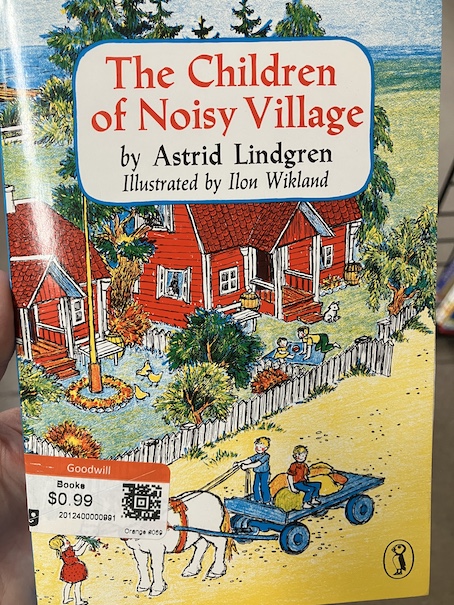
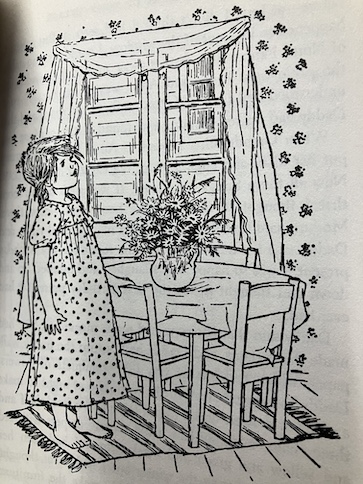
The story is told from the point-of-view of nine-year-old Lisa, a Swedish girl who has two older brothers, Karl and Bill. She and her family live on a farm that people call Middle Farm because it’s between two other farms, North Farm and South Farm. The three farms together are called “Noisy Village” because there are so many children around. The children who live on South Farm are Ulaf and his little sister Kirsten, who is only a year-and-a-half old, and North Farm has two girls, Britta and Anna, who are Lisa’s friends. Ulaf is friends with Karl and Bill. Sometimes, Lisa tries to play with her brothers, but they often tell her that she’s too little, and she sometimes thinks of the boys as a nuisance. Ulaf will sometimes play with girls, although Karl and Bill sometimes tease him about it, but there are also a limited number of children in the area to play with, so being willing to play with whoever is around is a good thing. Through the story, Lisa tells little stories and talks about the things that all of the children of Noisy Village do together.

When Lisa was younger, she used to share a room with her brothers before getting a room of her own. At night, Karl used to tell ghost stories, while Bill likes to talk about adventures. Lisa tells a story about how her brothers scared her one night with a ghost story and how they rigged up a trick to make it look like their room was haunted. Although Lisa sometimes misses the stories that her brothers used to tell her at night, she’s also relieved that she has a space of her own so she doesn’t have to put up with their pranks or them bossing her around all the time. Bill and Karl like their room because their window is close to Ulaf’s window, and the boys like to use the tree between their houses to go back and forth between the two rooms. The room that Lisa has now used to belong to her grandmother, before her grandmother moved in with an aunt. Lisa’s family remade the room for her as a present for her seventh birthday. Lisa’s room faces North Farm and Britta and Anna’s room, so the girls can send each other notes or signal to each other through their windows.

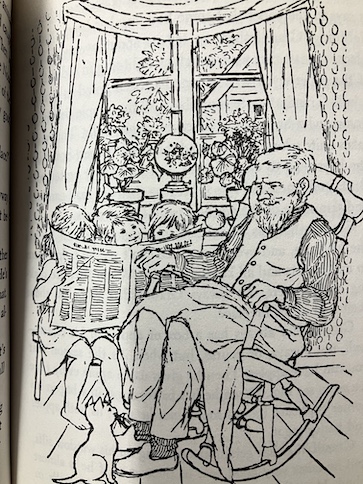
Some of the children at Noisy Village have pets, and Lisa explains how Ulaf got his dog, Skip, from the mean shoemaker, who was mistreating him. Britta and Anna don’t have any pets, but their grandfather lives with them, and the other children at Noisy Village like to visit him. Britta and Anna’s grandfather tells the children stories. One of his stories is about how he ran away from home as a boy. Inspired by the story, Lisa and Anna decide that they should have their own adventure, running away from home temporarily. However, they think that they have to run away during the night, and they both miss their opportunity because they fall asleep.

The children like to play games of pretend on their way home from school, which makes their mothers wonder what they’re doing and sometimes get them into trouble. Anna and Lisa accidentally get on people’s nerves one time, when they try too hard to follow their teacher’s advice about doing things to make people happy. They often end up doing the wrong things because they don’t know what other people really want or what people say they want doesn’t seem like enough. They finally succeed in making someone happy when they share some of their things with a girl from school who is sick.

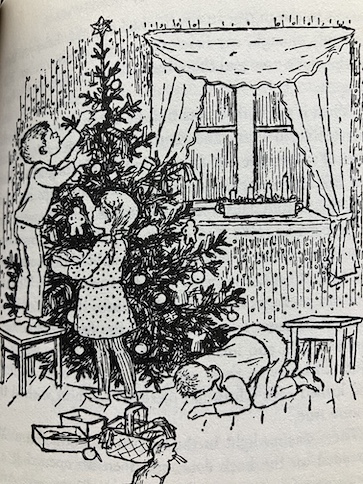
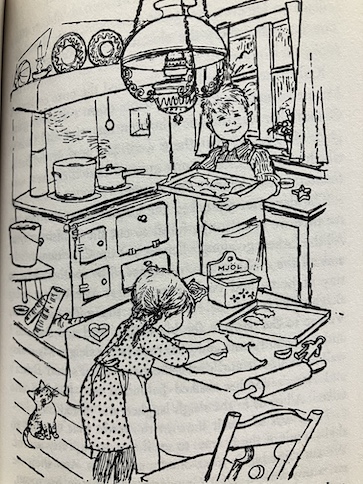
The children’s adventures continue through the year. The people of Noisy Village have a charming, old-fashioned Christmas. At a Christmas party at a relative’s house, they play old-fashioned party games and tell stories. Lisa also describes a Swedish tradition of finding an almond in porridge, which is supposed to be a sign of marriage in the coming year. The children are allowed to stay up late on New Year’s Eve. The boys scare the girls with some firecrackers, and Britta and Anna’s grandfather teaches the children the tradition of pouring melted lead into water to see what shapes it will form to predict what will happen in the new year. On Easter, the children paint eggs and make egg nog.

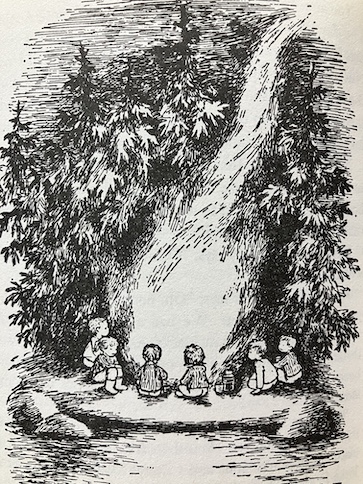
Eventually, school lets out for summer vacation. The children go swimming and catch crayfish during the summer. When they go fishing for crayfish, they camp out in the forest, near the lake, with Lisa’s father and the other men. The children make little huts to camp in. The boys try to scare the girls with stories about goblins. The children appreciate their idyllic lives in Noisy Village!
My Reaction

This book is a series of pleasant, gentle, slice-of-life stories about the children who live on a collection of small farms outside of a Swedish town, probably some time in the mid-20th century. Because there is little mention of any form of technology in countryside, it could set almost be any time in history from the 19th century to the time when it was written in the 1940s. The one thing that identified it as the 20th century for me is when they mentioned “turning on lights” in the house rather than lighting lamps. Even into the mid-20th century, not all farm houses had electricity, but it seems that these do. Other than that, these children seem to be living an idyllic, “unplugged” life in the countryside that people who are into cottagecore would aspire to! I think it would be a nice book to read children at bedtime because it’s very gentle.
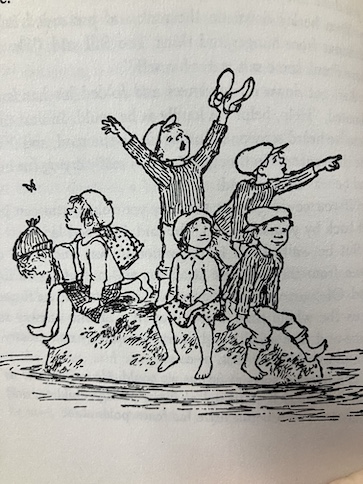
I enjoyed reading about the games that the children play with each other and with their families. The children like playing games of pretend that seem to be inspired by books they’ve read. The girls play at being princesses, while the boys play at being Indians, probably American Indians (Native Americans) because one of young Bill’s ambitions is to be an Indian Chief when he grows up. We don’t really encourage playing at being “Indians” today in 21st century America because that can devolve into caricatures of someone else’s racial group (cowboys are still fair game because that’s a profession, not an ethnicity), but that sort of thing was pretty common in the mid-20th century, even outside of the United States. I’ve read British books from around the same time period that also refer to children playing at being American Indians, so it was something that seems to have captured children’s imaginations, even internationally. The children also pretend that they’re marooned or shipwrecked on a rock at one point, something else that often appears in children’s literature and is based on older books.

I particularly enjoyed some of the descriptions of Swedish holiday traditions through the year. Some of them are very similar to traditions in the United States and Britain around this time and even earlier, like in the 19th century. They have a charming Christmas with friends and family and a party with old-fashioned parlor games. I’ve heard of the tradition of finding an almond in porridge or pudding before, but I think that’s more common in Scandinavian countries than in the United States. In Britain, there are traditions associated with finding things (like a coin or a bean) in porridge or pudding, but it’s not really common in the US. Another thing that stood out to me was that Lisa said they made egg nog at Easter. In the US, people typically have egg nog at Christmas, but when I thought about it, it does make sense for Easter because of the association with eggs.

One other thing that stood out to me in the book was the little huts that the children make when they’re camping out by the lake. It reminded me of the huts that children in The Secret Summer (Baked Beans for Breakfast) made.

The Flash Children

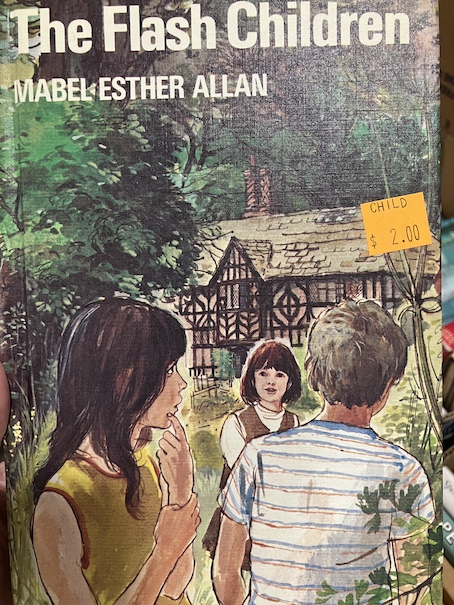
The Briggs family moves to a new house in July, and the three Briggs children are upset about leaving their old home and friends. Their father tries to reassure them that they’ll make new friends in their new home, but ten-year-old Dilys isn’t so sure. She knows that her mother is also not happy about the move, but it can’t be helped. Her father used to be a cowman on an estate in their old town, but the estate has been sold to be turned into an army training camp, so he has to go somewhere else for a new job.

Their new home will be a cottage near a “flash”, which is a kind of salt lake. Flash Cottage, as their new house is called, turns out to be an ugly modern brick house, not at all like the charming old cottage where they used to live. Their old cottage had a beautiful garden, but this little house doesn’t have much at all. Most of the views from the house are also ugly. The embankment behind the house, where the train tracks are, makes parts of the house dark and blocks the view, and there’s a chemical plant a couple of miles away. There isn’t much else in the area to see. The bright spots of their new home are the lake and the train tracks that run near the house. The fast-moving trains make Dilys a little nervous and they also make the house kind of loud, but eleven-year-old Arthur finds them fascinating. Arthur takes a yellow bedroom at the back of the house, where he can see the trains. Dilys shares a blue bedroom with their little sister, Megan, with a view of the chemical plant in the distance. All three of the children find the house strange and ugly and wonder how they’re ever going to feel at home there.

Dilys doesn’t think she’ll ever like the new house, although she thinks it might be nice if they could go rowing on the lake. Their mother worries about the children falling in the flash because they have to travel across an unfenced causeway when coming to or leaving the house. The children will have to catch a school bus to go to the local school, and Arthur wonders what the other children in the area are like. The children hope to find some friends because, if they don’t, they don’t really know what they’ll do with themselves. There doesn’t seem to be much in the area to do for fun.

The Briggs children meet a boy and girl about their age on their first day at the new house, but the meeting doesn’t go well at first. Arthur stops the other boy and girl from throwing rocks at some ducks. Dilys warns him about making enemies of people because they need some friends in their new home, but Arthur can’t stand to see people being cruel to animals. The other boy and girl already know who the Briggs children are because they were told they would be coming, but Arthur surprises them with a Welsh phrase. The Briggs children’s mother is Welsh, and they grew up near Wales. The boy, whose name is Dan Brown, thinks at first that Arthur was speaking French, but his sister, Edith, recognizes the phrase as Welsh because someone told her that the family was part Welsh. Dan and Edith argue about it, and Arthur asks them if they often argue with each other. The Brown kids admit that they do because there just isn’t that much else to do in the area. Boredom is also the reason why they tease animals, and because they tease animals, they’ve been banned from Colonel Melling’s farm, where Mr. Briggs will now be working with the cows. Sometimes, when they have money, they can take a bus to town to find other things to do, but they don’t always have the money to do that.

Mr. Briggs tells the children that the Brown children are the nearest children in the area. Their mother is dead, and they have an aunt looking after them. Their father also works at Colonel Melling’s farm. The Briggs children aren’t sure that they like the Brown children or want to be friends with them, but they might be their best or only option for friends at all. Their father persuades them to give the Brown children a chance, but Dilys wonders if, before long, they’ll all be so bored that they’ll start throwing rocks at ducks, too.

School isn’t too bad once it starts. Dilys meets another girl she likes, but unfortunately, the other girl lives too far away to see easily when they’re not in school. Some other kids at school tease another new boy named Brian because he’s partially blind. Dan and Edith turn out to be among the worst bullies, and Arthur and Dilys get so angry with them that they get into a fight. Dilys tells Edith that she’s ashamed of how she acts, she thinks it’s disgusting, and she wishes Edith would turn deaf so she can see what it’s like to live with a disability. The other kids back down rather than fight Arthur, and surprisingly, Edith is actually a little embarrassed when she sees how angry and disgusted Dilys is with her. It seems like the behavior of the local kids is as rough and ugly as the area where they live, but Dilys finds herself interested in Brian because he seems to be a different type of person.

Mrs. Briggs is as homesick as the kids for where they used to live, but she starts to make friends with Miss Brown, the aunt looking after Dan and Edith. Mrs. Briggs says that Miss Brown is a nice lady, but she doesn’t entirely know how to cope with the children, and Dan and Edith often misbehave and make trouble. She’s only been living with her brother and the children since their mother died last year.

One day, Dilys and Arthur go exploring, and they find an unexpected green area down a road that makes them feel more like home. They get caught in a sudden storm, so they take shelter under a railway bridge, where they meet Dan and Edith, also taking shelter. They start talking more about the area and places to explore, and Dan and Edith say that they can’t go down by Mr. Lowe’s farm anymore. Arthur asks them why, and they admit that they stole some plums from him and left his gate open, so the livestock got out. Arthur and Dilys can see why Mr. Lowe would be angry, but Dan and Edith defensively add that they didn’t leave the gate open on purpose. They just forgot to close it because Edith got stung by a wasp and was upset, but Mr. Lowe won’t believe them. They say it’s a pity because the area is much more interesting over there. There’s an old manor house, a stream, and a ruined mill over that way.

Things change for the children when Dilys, Arthur, and Megan befriend an artist who lives in a cottage nearby, John Zachary Laurie, and he’s a friend of Colonel Melling. He takes them out rowing on the flash and talks to them about how they like their new home. The Briggs children confide in him how unhappy they’ve been since they moved to the area because everything is so ugly, but the artist points out that it’s not really an ugly place. He says he finds it fascinating to paint because it has certain “dramatic effects.” When he shows them his pictures, they’re very different from the kind of pictures that the children are accustomed to seeing. Rather than conventional flowers and pretty landscapes, they are filled with angles and a lot of grays and browns, but with unexpected dashes of color. They’re unmistakably pictures of the area, but not in a way the children usually see it. The landscape in the paintings is familiar but strange, ugly but also oddly enchanting. John Laurie even gives them one of his paintings, the one he did of their new house, Flash Cottage. He says he knows the children hate the house now, but he thinks it has interesting angles, and if they learn how to look at things a little deeper, they’ll see more than they do now.

Although Dilys isn’t quite sure that she understands it, she begins to feel what the artist is talking about. Things that are strange start to feel familiar, and even in the ugliness of the landscape and the picture of their house, she begins to feel a sense of fascination and attraction. It’s not exactly pretty, but it is compelling.

When school lets out for the summer, the Briggs children once again find themselves bored and lonely. The few other children they like don’t live close to them, like Dan and Edith, and the Briggs children still think Dan and Edith are pains and troublemakers. Looking for something to do, Arthur, Dilys, and Megan decide to explore the old manor house that Dan and Edith mentioned.

It turns out to be a beautiful place, although it’s old and deserted. To their surprise, they discover that the property actually belongs to Brian’s family, the Pelverdens. They live in a little cottage behind the old manor house. Brian has a little sister, Mellie (short for Melinda), who would be a good friend for Megan, but Brian seems less than pleased that Arthur and Dilys have discovered where he lives. Brian’s father explains that they haven’t been living here long. The manor house has been in the family for generations, but it’s fallen into ruin because they haven’t had the money to maintain it for a long time. They only recently inherited the place themselves when Brian’s grandfather died. The Pelverdens don’t expect to ever live in the manor house themselves, but their hope is that, if they get it sufficiently repaired, they might have it registered and preserved as a historic building and get a grant to maintain it. The Briggs children eagerly volunteer their services to help with the project over the summer. They have nothing else to do, and they still miss the garden from their old cottage, so helping to replant the manor garden would be fun for them. The Pelverdens’ cottage and the crumbling old manor house are more beautiful to them than anything else they’ve seen since they moved, and they feel more like home.

Mellie is immediately happy to have found a friend in Megan, but Arthur and Dilys find it harder to make friends with Brian. Brian has known all of his life that he’s different from other kids because of his vision problems, and he’s used to people treating him differently or making fun of him. He tries very hard to be as “normal” as he can and prove to everyone that he can do things other kids can do. Because he feels like he has something to prove to everyone, he’s often less friendly than he could be, but Dilys is determined to earn his trust.

However, Dan and Edith are still problems. The Briggs children fight them off one day when they catch them teasing the Briggs’s cat. Edith is offended that the other kids keep telling them everything they do is wrong. Then, another day, they show up at the old manor house and break a window by throwing rocks. When the Briggs children and Mr. Pelverden confront Dan and Edith about what they’ve done, Dilys come up with a plan that might solve the Dan and Edith problem and prevent them from making further trouble.

The book is available to borrow and read for free online through Internet Archive. There is a sequel to this book called The Flash Children in Winter, which is about the children experiencing their new home in autumn and the lead up to their first Christmas there.

I thought this book was interesting because it has aspects of a cottagecore style story, but there are parts of it that contrast with the typical cottagecore aesthetic. The main characters in the story, the Briggs children, have come from an environment that would be like a cottagecore dream: an actual old cottage with a beautiful garden attached to an old manor house, where they were allowed to help out. Then, they have to move to a far more plain and conventional house in an ugly area with a view of a chemical plant. It’s understandable that they would feel badly about the move. Moving and starting over again would be difficult for anybody, but most people would find their new environment downright depressing, especially after hearing what their old home was like.

When they find out that Brian’s family lives in a cottage and is renovating their old manor house to turn it into a historic site, the story goes back to the charming sort of environment the children come from. However, it’s not just about the children finding a way back to the kind of environment that has the beauty and charm they crave but also learning to see what makes different types of environments fascinating, even enchanting. The Flash Cottage isn’t a real cottage, and it’s not as pretty as their old home, but after talking to the artist and looking at things from an artist’s viewpoint, taking into account the features of a place that make it unique, Dilys comes to see how a shift in perspective can make many different environments more attractive, in their own way.

Learning to get along with Dan and Edith also involves finding a different perspective and a different way of dealing with them. It’s not just about seeing the good side of Dan and Edith as they are. Frankly, the two of them are pain-in-the-butts. Dilys realizes that their problem is that they are thoughtless. They don’t think about other people, how the things they do affect anyone else or make them feel. Their thoughts begin and end with themselves. They’re bored and feel unwanted at home since their mother’s death, so they cause trouble because they just can’t seem to think anything else to do. Personally, I don’t think either Dan or Edith is very intelligent or imaginative because intelligence could be used to reason out why people react to them the way they do and a little imagination would help them put themselves in other people’s position or help them think of different things to do or ways to approach other people. However, Dan and Edith don’t do any of those things on their own. It never even seems to occur to them that they could. They only get upset when other people are unhappy with them and seem totally unable to understand why.

Even though Dan and Edith don’t seem either very bright or very considerate, it does occur to Dilys that they could learn to be helpful if someone actually set them tasks to do to keep them busy. At her persuasion, Mr. Pelverden and the other children allow Dan and Edith to join their efforts to clean up the manor. Dan and Edith are actually eager to accept the opportunity to help out with the others because they are incredibly bored and seriously need something to do and people to be with. When the others are dubious about whether they’ll actually do any helping or if they even know how to help, they try to prove that they can do things that are useful for a change. It also proves educational for Dan and Edith because, in helping to clean up the manor, they’re also forced to face damage they have caused themselves and begin to realize how things they’ve been doing have caused trouble and made extra work for other people. They’re not used to seeing themselves as other people see them or dealing with the consequences of their actions, and it’s an eye-opening experience for them. Later, they all have to face off against a motorcycle gang that comes to vandalize the manor, and Dan and Edith have come to see where their loyalties really lie and what menaces people can be when they act like they used to.

The story ends happily for the children and for the manor, which is going to be preserved. The Briggs children feel more at home in their new home, Dan and Edith have greatly reformed, and Brian has learned to be more open with people about his disability, so other people come to understand him better and treat him more kindly. Some of the people who made fun of him before admit that they didn’t understand just how bad his vision was, so they didn’t know why he seemed to struggle so much. Dilys still tells off those kids for not having figured it out, but at the same time, she is the one who tells Brian that he has to make things clear to people and not try to pretend that his condition doesn’t exist or that he doesn’t need some help when he actually does.

The author, Mabel Esther Allan is also a very interesting person. During her life, she wrote more than 100 books for children, under different pen names. She struggled with vision problems of her own when she was young, which was part of the inspiration for Brian in the story. During WWII, she worked was part of the British Women’s Land Army, and she also worked as a teacher.

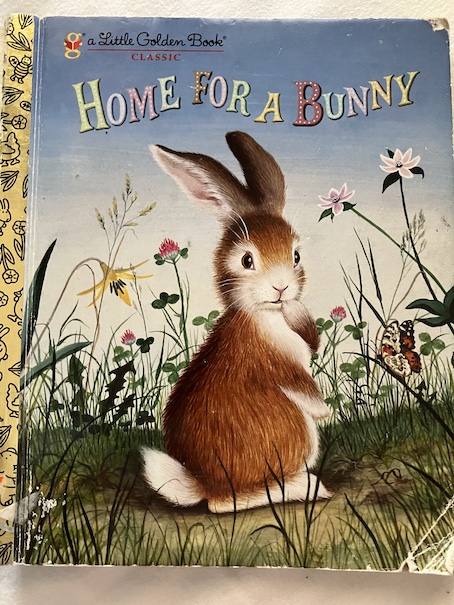
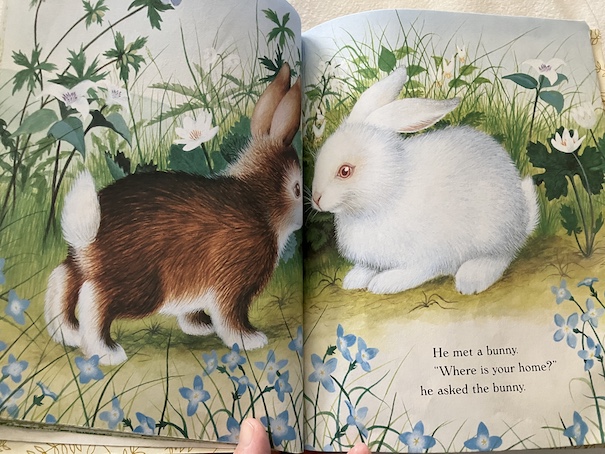
Home for a Bunny

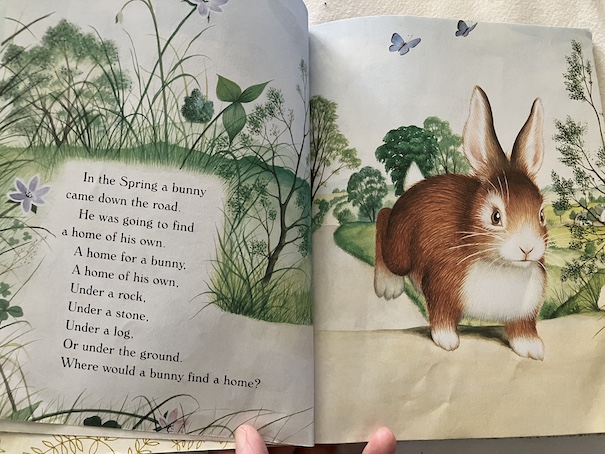
It’s springtime, and a little bunny is searching for a new place to call home.

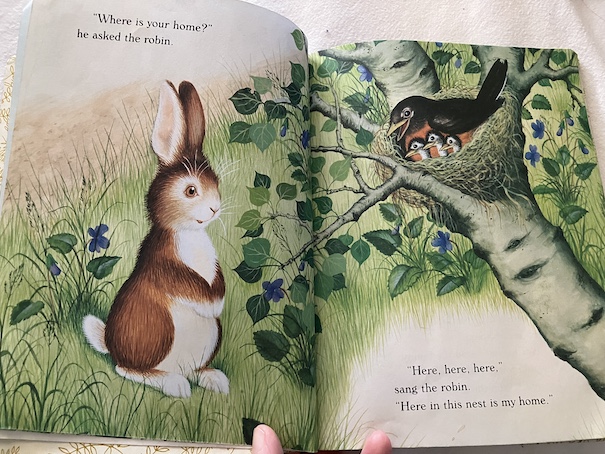
As he looks for a place that might suit him, he asks the other animals about their homes. However, most of the homes of other animals wouldn’t work for him. The bunny knows he couldn’t live in a nest like the birds or in a bog like a frog.

There is a point when the bunny thinks another animal’s home might suit him, when he talks to a groundhog who lives in a log, but the groundhog is not willing to have him as a housemate.

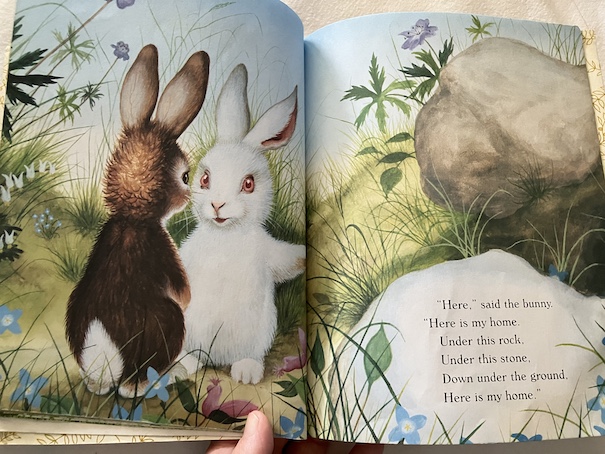
The bunny finally finds his home when he meets another bunny, who invites him to stay!

The book is available to borrow and read for free online through Internet Archive (multiple copies).

This vintage Little Golden Book is a calm and sweet story about a little bunny finding a home that’s just right for him. I liked how the bunny looks at other animals’ homes to figure out if any of them would be right for him because it shows young children how each animal’s home has conditions that are right for that animal but wouldn’t be right for a different type of animal. The bunny realizes that a nest in tree wouldn’t work for him because, unlike birds, he can’t fly and would fall out of the nest. Similarly, he can’t live in a bog with a frog because he’s not amphibious and would drown. (The book doesn’t use the term amphibian or amphibious, but I think kids would get the idea that some animals are better able to live in and around water than others.)

The story also includes the idea is that what makes a home is also who shares that home. The bunny thinks that the place where the groundhog lives could work for him, but he’s not a groundhog and the groundhog doesn’t want to share his home with the bunny. The place where the bunny eventually finds is rabbit hole he can share with another bunny, who is happy to have him as a companion. It’s a calm story with a happy ending because there is a home for everyone and someone for everyone.

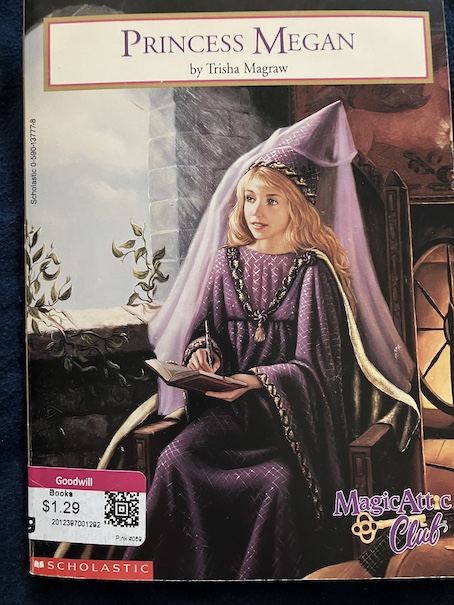
Princess Megan

The Magic Attic Club

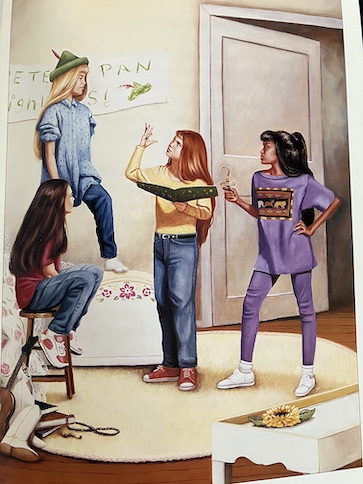
Meg and her friends are planning to perform a short play of Peter Pan at a local nursing home. Her friends chose her to be their director, and Megan is really looking forward to it. Then, her mother does something that threatens to derail the project.

Megan’s mother is a lawyer, and she frequently has to work late. The problem is that, this time, she’s going to have to work on Saturday, interviewing witnesses for a trial. However, that Saturday, Megan’s mother was supposed to be at the high school, receiving donations for a food drive. She asks Megan to take care of the food donations, but the problem is that the play Megan and her friends are supposed to perform is also on Saturday. Helping with the food drive would make it difficult for Megan to get to the play on time. Megan’s mother is tired and in no mood to listen to Megan’s objections that it wouldn’t be fair to derail her project with her friends. Her mother just wants Megan to take care of her obligations for her.

While Megan is fuming about the unfairness of the situation and worrying about what to do, she decides to visit their neighbor, Ellie Goodwin. Megan and her friends have a standing invitation to visit and explore her attic, which has the ability to send them to other places and times when they put on different costumes and look at themselves in the mirror.

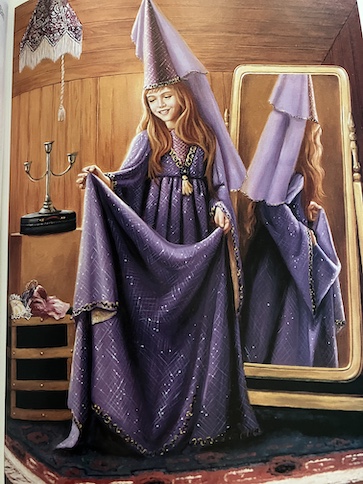
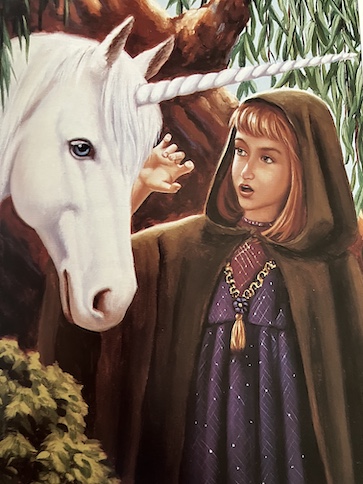
This time, Megan tries on a purple princess dress, and she finds herself in a Medieval village in France, near a castle. She meets a peasant girl named Michelle. Michelle tells her that there’s been trouble over the matter of the unicorn and the feast.

When Megan asks what she means, Michelle explains that Lord Claude and Lady Helene are hosting a feast and joust at their castle and that the king (who is supposedly Megan’s father in this world) has been invited as an important guest. At the end of the feast, they want to give the king a unicorn’s horn as a gift, but the problem with that is that they have to kill the unicorn to do that. Alternatively, it is possible to befriend a unicorn and get filings from its horn that also have magical powers, but Lord Claude and Lady Helene want to give the king the whole horn. Michelle confesses to Megan that her mother, who works in the castle’s kitchen secretly released the unicorn that they’d captured for the purpose. If they knew she was the one who did it, she would be in serious trouble.

Megan wants to help Michelle and her mother, and as someone who supposedly has the rank of princess, she should have some authority. However, she’s not entirely sure what kind of influence she can have because she knows that she’s not a “real” princess. Everyone thinks that she’s the king’s daughter, but Megan knows that she’s not. Can Megan find another way to save the unicorn’s life and Jacqueline from punishment, without revealing herself as an imposter princess?

The book is available to borrow and read for free online through Internet Archive.

Some children’s books that involve time travel have real, historical information for educational value, but this one, and others in the series, are pure fantasy. Megan doesn’t visit real Medieval France. This is a fairy tale version of the Middle Ages with a unicorn and an invisibility cloak. There are a few accurate details for the Middle Ages, like the practice of using straw or other plants on the floors and the fact that intricate tapestries took years of work to complete. However, the focus is definitely on fantasy.

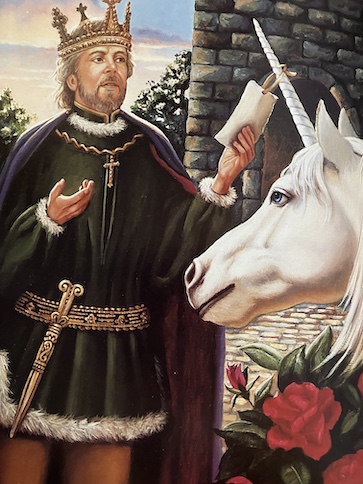
The invisibility cloak is critical to Megan’s plan to save the unicorn and make the king realize the value and beauty of the unicorn before someone can kill it on his behalf. When the king sees the unicorn for himself and reads the note that Megan wrote for him, he accepts the living unicorn and its presence as his gift instead of the horn. The problem with the unicorn is resolved pretty quickly, and so is Megan’s situation with her mother.

At first, I was expecting that the situation that Megan encountered in the fantasy world would have more of a direct parallel to Megan’s situation in her regular life, but it doesn’t really. It mostly serves as its own adventure, although it does highlight that Megan is creative when it comes to problem-solving and can be relied on in difficult circumstances. What Megan really needs to do is to explain to her mother why it would be difficult for her to take over her mother’s project without compromising her own. When Megan finally explains, it turns out that her mother didn’t know about her project with her friends. Handling both of their projects requires some careful scheduling and a little help from a friend, but they manage to work it out.

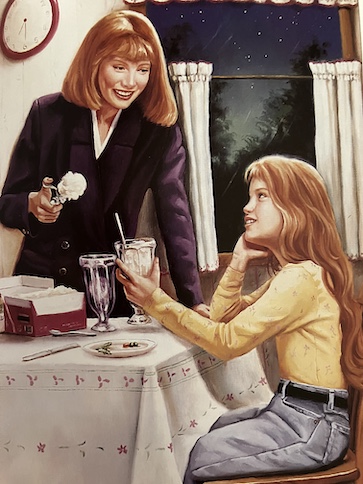
I really like the pictures in the Magic Attic Club books because they remind me of the ones in the American Girls books. They have a similar quality.

Madeline in London

This book is part of the Madeline series about a little girl at a small boarding school in Paris. The son of a Spanish Ambassador, Pepito, lives next door to the girls. He’s a menace to them at first, but the girls make friends with him. However, in this book, Pepito moves to London because his father has been relocated for his job.

When Pepito and his parents go to London, Pepito is unhappy there because he’s lonely for Madeline and the other girls from the boarding school. With Pepito growing thin and depressed from his unhappiness, Pepito’s father arranges for the girls from the boarding school to visit for Pepito’s birthday to cheer him up.

When Miss Clavel and the girls arrive in London, there’s a happy reunion, but then, they remember that they didn’t bring Pepito a present for his birthday. Madeline remembers that Pepito has always wanted a horse, and they find an old, retired army horse who is still healthy and gentle.

However, when they give the horse to Pepito, they quickly discover that there are complications to owning a horse as a pet. The horse hears a trumpet, and reacting to his army training, he runs off with Pepito and Madeline on his back to join a parade.

Then, they forget to feed him, so he eats everything in the garden, making himself sick. It seems like the embassy in London is no place for a horse, but Madeline and her friends may have room for one at their school!

The book is available to borrow and read for free online through Internet Archive (multiple copies).

Giving someone a horse for a present without checking with their parents or making sure that they have what they need to take care of a horse isn’t something that people realistically do, but the Madeline books rarely worry about the practicalities of a situation. It’s all fun and adventure!

I was seriously worried about the horse after they forget to feed him and he helps himself to random plants in the garden, especially when they find him with his feet up in the air. Fortunately, everything works out okay, which is characteristic of Madeline books, too. How the trustees of Madeline’s school will react when they find out that the girls now have a pet horse, since they raised a fuss earlier about the girls having a dog, is anyone’s guess, but the story doesn’t worry about that, either.

Like other books in this series, the pictures in the book alternate between limited color images, mostly in black and yellow, and full color images.

Madeline

“In an old house in Paris
that was covered with vines
lived twelve little girls
in two straight lines.”

The Madeline stories are considered children’s classics today, and these words, which are the opening lines in other books in the Madeline series, introduce Madeline’s school. Madeline is a little girl who lives in a small boarding school in Paris, tended by Miss Clavel.

Madeline is the smallest girl at the boarding school. She’s a brave girl, who isn’t scared of either mice or lions at the zoo, and she sometimes does daring stunts that frighten Miss Clavel.

One night, Miss Clavel wakes up because Madeline is crying. She calls the doctor, who examines Madeline and rushes her to the hospital because she needs to have her appendix removed.

After the operation, Madeline has to stay in the hospital for a while. Miss Clavel brings the other girls from the school to visit her, and they are impressed by all the candy and presents that Madeline has received from her family. Even more impressive, Madeline now has a scar that she shows to the other girls.

After the other girls return home and go to bed, Miss Clavel wakes up to find them all crying. Madeline has made having her appendix out look like so much fun, they all want to do it!

I wouldn’t say that I was a particular fan of Madeline as a kid, but I did read at least some of the books in the series. As an adult, I had forgotten that they were told entirely in rhyme, even though I still sometimes get those opening lines stuck in my head.

I remember thinking as a kid that I wouldn’t want to have my appendix out! Even if you get presents and an impressive scar, having an operation always sounded awful to me. It didn’t occur to me until I was older, but the Madeline cartoons and movie tended to portray Madeline as an orphan, but she isn’t. She’s just a student at a small boarding school. This book is one of the stories that mentions her family, with her papa sending her a dollhouse as one of the presents she receives while she’s in the hospital.

I also didn’t realize, until I was researching this series for the blog, just how old the first Madeline book was. It was originally published in 1939, on the eve of WWII. I don’t think the books ever have anything in them to tie the stories to any particular events, and they seem almost timeless, although I suppose that the girls’ school uniforms are a little old-fashioned. This timeless, idealized portrayal of Paris was popular with the book’s original audience of Americans during WWII.

I was curious about the author, Ludwig Bemelmans. He was born in Austria and grew up in Austria and Germany during the late 19th century and early 20th century. As a young man, he was apprenticed to his uncle, who owned a hotel, but Bemelmans was difficult to manage and got into trouble while working there. He later told a story about shooting and wounding a headwaiter who whipped him, although that might have been just a tall tale. Eventually, however, his uncle decided that he couldn’t deal with him, so he told him he would either have to go to reform school or go to the United States, where his father was living after having left him and his mother years before. He moved to the United States and lived there during WWI. He spent some time working in a series of hotels and restaurants. He eventually joined the US Army in 1917, although they wouldn’t send him to Europe because the US was at war with Germany, and he was German. He became a US citizen in 1918, and he developed an interest in art. He worked as a cartoonist before writing and illustrating children’s books. He wrote the first seven of the Madeline books, and the last one was published after his death. Since then, his grandson, John Bemelmans Marciano has written other Madeline books.

Meg Mackintosh and The Mystery at the Soccer Match

Meg Mackintosh Mysteries

Meg and her brother Peter play on opposing soccer teams, the Hawks and the Panthers. Peter is brags about how good he is at being a goalie, and Meg hopes that, in this game, she can score a few points off him. There are prizes for this soccer team, and the winning team will get to keep a medal that Coach Lee won playing international soccer until next year’s game. Everybody admires the medal, which is displayed on the awards table.

Meg’s teammate, Alex, is less thrilled about the game. He has an injured leg and can’t play, and his mother is busy campaigning against awarding prizes for children’s soccer. She thinks that giving prizes isn’t fair and hurts the feelings of kids who don’t get prizes.

It’s true that there is some pressure from the parents for their children to play harder to win prizes than the kids really want. Peter accidentally collides with one of his teammates, Heather, and they both end up with scrapes and are temporarily removed from the game for first aid. Heather’s father pressures her to get back in the game as soon as possible and win, but Heather privately admits to Peter that she doesn’t really feel like playing anymore. She only does it because she knows her dad would feel bad if her team doesn’t win.

It starts to rain during the game, and the adults and kids cover the awards table with a blanket. When they remove the blanket later, the gold medal is gone! Who could have taken it? Meg invites Alex to join her detective club and help investigate the mystery while she plays soccer!

The book is available to borrow and read for free online through Internet Archive.

Meg inviting Alex to help her investigate the case and consider motives makes this book a little different from other books in the series, where Meg usually does that herself. The mystery is good because there are several suspects to consider, each of whom was seen near the table and left signs of their presence there. Did Heather’s dad take the medal because he once almost won a similar soccer medal and was jealous that Coach Lee won the prize he didn’t? He certainly seems very prize-oriented. Did Alex’s mother take it because she disapproves of sports prizes and wanted to make a statement about it? Could one of the children have taken it, either because they wanted to claim the prize they didn’t think they could win honestly or because they wanted to impress one of their parents?

As with other books in the series, readers are given the chance to review the evidence Meg and her friends have collected and see if they can spot the clues along with them in pictures taken at the scene. There was a clue that I thought was pretty obvious in one of the pictures but which Meg and the other kids didn’t spot at first. They only notice it when another clue makes them take a second look at one of the pictures. I think many young readers might also spot the clue I did, although if they do, it might make them feel clever for noticing something before Meg and her friends do.

When I first noticed that clue, I was inclined to think the solution to this mystery was too obvious, but there is another twist to the story that makes it more interesting. The medal was actually stolen twice. After the original thief put it back, someone else took it again, so there are two thefts to figure out instead of one.

The Mystery of Castle Croome

Molly Stewart, an American college student attending Oxford, is an orphan who is barely scraping by when she suddenly receives word that she has inherited an ancient castle in Scotland from her great-uncle, who has recently died. Molly’s friends, a pair of twins called Pat and Penny Roderick (short for Patricia and Penelope), go with her to have a look at the place, but right from the beginning, it seems like nobody wants her there.

Although the lawyer, Mr. Harding, is aware that Molly has been attending Oxford, he also knows that she is planning to return to the United States when she finishes her degree. He also knows that her great-uncle, Sir Malcolm, disapproved when her father married an American and moved to the United States himself, so he was surprised when Sir Malcolm’s will left his estate to his nephew or his nephew’s heirs. Mr. Harding had expected that Sir Malcolm would leave the estate to Jamie Campbell instead because Jamie has been the caretaker for years. The estate doesn’t come with much of an income, and the farms attached to it don’t have tenants, so they’re not bringing in rent money. It would take a lot of work to restore the estate. Since Mr. Harding would rather deal with Jamie Campbell anyway, he thinks that Molly would find it a better deal to just sell the castle to Jamie and use the money to finish her degree and go back to the United States. Molly asks why Jamie Campbell would want to buy the castle if it’s not worth much and needs so much work to restore. Mr. Harding says he might buy it out of sentiment, but Molly wants to have a look at the castle before agreeing to sell it. After seeing it, she might decide that it isn’t the kind of place where she could live, but she won’t know for sure until she sees it herself. Mr. Harding agrees and says that he will tell Jamie Campbell that she’s coming.

When Molly arrives with Pat and Penny, they see that the castle is isolated and rather eerie. Inside, it is run down, and living conditions are primitive. Jamie Campbell, an elderly man, isn’t happy that they’re there. There is no other staff, and while Jamie was happy to serve the old laird and nurse him through his final years, he has no intention of serving this young American grand-niece. Although there is an electrical generator at the castle, Jamie says that it hasn’t worked in years, and he and the old laird used oil lamps and candles. If Molly and her friends think he’s going to go to special efforts for their comfort, they can think again. Molly refuses to be intimidated by his disrespect, and she tells him that, because this castle has been his home for years, he is welcome to continue staying there, although Jamie Campbell thinks that she’s only extending that invitation to get a free caretaker.

Molly is studying engineering at college, and her friends think that she could probably fix the generator, but Molly tells them that she would like to wait to look at it. She hasn’t had much practical experience yet, so she wants to take time to study the situation before she does anything. She also tells her friends not to mention to Jamie Campbell that she has any engineering knowledge. She doesn’t trust Jamie, and she thinks it might be better for him to think that they’re more helpless than they actually are.

Molly sees definite signs that Jamie Campbell hasn’t been honest with them about the real condition of the castle and about even the contents of the castle at the time that her uncle died, and she can tell that he’s deliberately trying to make life harder for them to drive them away from the castle. After Jamie Campbell tells them that there is no running water at the castle, the girls notice that soap next to a sink is still wet, indicating that Jamie has very recently washed his hands there. The girls think that he probably shut off the water right before they got there, and they also think there is probably nothing wrong with the generator, that Jamie probably just turned it off. He tries to keep them from even looking at it, and he’s reluctant to hand over the keys to the castle to Molly. Many pictures are missing from the walls of the castle, and Jamie says Molly’s uncle sold them for money, but another painting disappears during their stay, showing the girls that Jamie is the one looting artwork from the castle. Molly realizes that nobody seems to know exactly what was in the castle at the time her uncle died, making it difficult to prove that Jamie is stealing things. When Molly tries to search her uncle’s desk, she finds that it’s been completely cleared of even routine papers, and Jamie admits in a cagey way that he may have tidied up a little.

Things improve for Molly and her friends when they set out to buy some food and make contact with other people outside the castle. Jamie refuses to even feed them, saying that he barely has enough for himself. He says that he might have been able to provide something for Molly if she was alone, but he can’t be expected to feed her friends, too. Fortunately, the girls have some provisions with them that get them through their first night at the castle. When they set out in the morning to buy more food, they can’t take their care because there’s a large nail in one of the tires. They can’t prove that Jamie sabotaged the car, but they all suspect he did. They decide to set out on foot to find somewhere with a telephone or somewhere they can buy some food. They meet up with a scout troop camping nearby, and they save the girls from stumbling into a bog. They share a meal with the girls, and the girls tell them what’s been happening at the castle.

The scout leaders don’t like the sound of Jamie and the things happening at the castle, and they tell the girls that they will send a mobile shop to the castle to sell them food. There’s a van that travels among the farms in the area, selling groceries, sort of like a food truck, and it carries a surprising variety of goods. The scouts also tell the girls how they forage for wild foods, and they offer their services for changing the car’s tire and other things they might need.

That night, Molly has a frightening encounter with a ghostly white figure, although she believes that it’s just Jamie, trying to frighten her away from the castle. The next day, Molly and her friends confront Jamie about the missing painting, and he tells Molly that her great-uncle sold that painting years ago. He tries to convince her that the only reason why she thought she saw it is that she has “second sight.” He says that it was a favorite painting of her great-uncle’s and that she only saw it because she’s a member of his family and has psychically sensed the memory of the picture. Molly knows that can’t be true because her friends also saw the picture. Molly also asks Jamie about a strange roaring noise that she heard at night that sounded like machinery of some kind, and Jamie tells her that it’s the “Roar of the Stewarts.” He says it’s a bad omen, and that Stewarts hear it before something bad happens. Although none of the girls admits to having seen a “ghost” the night before, Jamie also tells them about the “Specter of the Castle”, and he insists that all of these bad omens are signs that Molly and her friends should leave the castle because it’s dangerous for them.

Molly and her friends know that Jamie badly wants to frighten them away from the castle, and part of that might be that he’s been looting objects from it since Molly’s great-uncle died, but what is the real cause of the machine noises in the night? Then, suddenly, Jamie welcomes a pair of unexpected guests into the castle as paying guests. Mr. and Mrs. Smith claim that they’re traveling tourists who think it would be exciting to stay in a real castle. Molly tries to discourage them from staying by charging them more than anyone might expect from staying in a run-down castle with primitive living conditions, but the Smiths insist that they would enjoy an authentic experience. Molly and her friends are immediately suspicious, especially when they realize that the Smiths don’t seem to have a car, and there’s no obvious way they could have even reached this out-of-the-way castle. Who are they really? Are they confederates of Jamie’s? What has Jamie really been doing at the castle, and what is he so afraid that Molly and her friends will discover if they stay?

The book is available to borrow and read for free online through Internet Archive (multiple copies).

I found this book recently at a used book sale, but I recognized the title because I tried to find this book when I was a kid. I wanted it because it was on a list of suggested books in the back of another mystery book I read and liked as a kid. Actually, I think I enjoyed it more as an adult than I would have has as a kid. As a kid, I would have liked the notion of a girl inheriting a spooky old castle that might be haunted, but in this story, it’s pretty obvious right away that Jamie is behind all the mysterious things happening.

This story is not like other mysteries where you have to wonder who among the suspects could be responsible for the mysterious happenings because Jamie is the only suspect from the beginning. The real mystery, for both the characters and the readers is why he’s doing it. It’s a “whydunnit” more than a “whodunnit.” Although it would have been fun and atmospheric if Molly and her friends believed that the castle was haunted and were scared, I have to admit that I loved how unimpressed the girls were when Jamie awkwardly makes up his spooky stories and excuses about “second sight”, the “Roar of the Stewarts”, and the “Specter of the Castle.” They know that he’s just making it all up. They just don’t kick him out of the castle immediately because he’s an old man who’s been there for years, and they also want to know that he’s up to.

It turns out that part of what he’s up to is obvious and part actually resembles the mystery book that had this listed as a recommended book. Readers can figure out the more obvious part themselves, but there’s a revelation later that Jamie is also involved in another crime that he can’t explain away as any misunderstanding. There’s a suspenseful part of the story where the girls are trapped in the castle with Jamie and his confederates and need to figure out how to escape or summon help. I thought that the ending part wrapped up a little quickly, but overall, I liked the story. I think I enjoyed the book more now than I would have if I’d found it when I was a kid.

Meg Mackintosh and The Mystery at Camp Creepy

Meg Mackintosh Mysteries

Meg Mackintosh is at a summer camp in Maine! The camp is called Camp Crescent, but it soon gets the name Camp Creepy because there’s a ghost story about the camp. The story says that an old man named Stuart once lived in the building that the camp uses for a boathouse and that he still haunts the camp. When people start hearing strange noises at night, the campers start thinking maybe the ghost story is true.

To celebrate the Fourth of July, the camp decides to hold a treasure hunt with puzzles for the campers to solve. Everyone is excited about the treasure hunt, but Meg is especially excited because she’s solved treasure hunts before. However, in her excitement to start the treasure hunt, she accidentally drops the first clue on the camp fire, and much of it burns.

Everyone is angry with Meg for messing up the treasure hunt because they’re supposed to solve it before nightfall to enjoy the prize. Although they don’t know what the prize is supposed to be, they’re told that it won’t be any good if they find it too late. While the others go on a hike, Meg fakes a stomach ache because she just can’t face the other campers again.

At the camp’s infirmary, Meg meets two other campers who are staying behind. Russell has a bad case of poison ivy, and Tina has been dealing with homesickness. They ask to see what’s left of the first clue, and Meg shows them. Something in the clue reminds Meg of something she saw at camp earlier, and the three of them begin thinking that they might be able to solve the after all. If they can just get past that first burned clue, they can continue the treasure hunt like normal.

Can the three of them manage to solve the treasure hunt and save the prize for all the other campers? Will they meet Stuart’s ghost along the way?

The Book is available to borrow and read for free online through Internet Archive (multiple copies).

I always enjoy treasure hunt stories, and like other Meg Mackintosh mysteries, this story gives readers the opportunity to figure out the clues and puzzles along with Meg. The information readers need is in the pictures of the story.

Most of the focus of the story is on the treasure hunt, and the ghost is kind of a side plot. Maybe the ghost would seem a little spookier to young readers, but I have to admit that I found it difficult to think of anybody named Stuart as sounding very sinister. The legend of Stuart doesn’t even seem to carry any consequences for people who see him other than it just being spooky, so I didn’t think the story was that creepy.

Cookies and Crutches

Pee Wee Scouts

This is the first book in the Pee Wee Scouts series. The children in Troop 23 meet after school on Tuesdays, and their leader is Mrs. Peters. One Tuesday, they meet at Mrs. Peters’s house to bake cookies. Mrs. Peters says that, to earn their cookie badge, they must each bake cookies at home without help and have their parents write a note that they have done it. She teaches the children an easy cookie recipe that they will use.

Roger White doesn’t want to bake cookies because he thinks that baking is for girls. Sonny Betz argues that it’s not just for girls, but many of the other children think that Sonny is a sissy because his mother still walks him to school. Sonny thinks that Roger is a creep. Mrs. Peters says that cooking is for everyone who eats. If boys can eat, they can also cook.

Mrs. Peters demonstrates making a recipe for chocolate chip cookies (and the book provides the recipe). Molly and Mary Beth ask if they can make their own batch of cookies for their badge together. They are not supposed to have adults helping them, but Mrs. Peters says that it is fine if they work with each other. In spite of their earlier argument, Roger agrees to make cookies with Sonny as a team.

However, when Molly and Mary Beth try to bake cookies by themselves, they don’t think the cookie batter looks right. It looks too pale, and when Mrs. Peters made her cookies, the batter was more brown. To fix the color problem, they decide to pour in some root beer, which is not part of the recipe. Then, they decide that the batter is too runny, so they add some gravy mix to thicken it. Because they added things they shouldn’t have, the cookies come out all wrong, and the girls worry that they won’t get their badge.

At their next meeting, though, they learn that nobody’s cookies look like they should. Mrs. Peters has the kids make cookies together while she supervises, although she doesn’t help them directly, so they can say that they did it themselves. This time, the cookies work out, although some of them are oddly-shaped. However, all of the kids get their cookie badges together.

The scout troop then organizes an ice skating party with the kids’ fathers. It’s a little awkward because not all of the kids have fathers living at home. Most of the kids without fathers bring an uncle or brother instead, but Sonny doesn’t have either, so his mom comes. The other kids tease him about it because they think he’s already too much of a mommy’s boy.

Some of the kids are also nervous because they don’t know how to skate, and they’re not even sure that their fathers know. Molly gets into trouble because Rachel makes a big deal about her fancy skates, which she owns so she doesn’t need to rent any, and about her dainty little feet. Molly rents a pair in the same size as Rachel’s, trying to prove that her feet aren’t too big, but they’re really too small for her. She has to take off her socks to put them on, and even then, it’s a hard squeeze. She ends up spraining her ankle badly because she’s wearing the wrong skates, and she has to use crutches. Molly doesn’t get her skating badge, but she does get one that’s almost as good as a consolation.

This is one of those children’s books/series where the kids in the story, although they are part of the same troop and seem to be friends for the most part, still say insulting things about each other, like when Roger called Sonny a sissy and Sonny called Roger a creep. I know that kids do things like this sometimes, but I don’t really like books that seem to promote or are permissive about that kind of talk. What bothered me is that, even though the boys were insulting each other in front of Mrs. Peters, she didn’t tell them to stop, which makes it seem like she tacitly thinks those insults are fine. I liked it that she contradicted Roger’s assertion that cooking and baking are only for girls, but I wish that she had said something about the way the kids were insulting each other.

I knew from the beginning of the story that the way Mrs. Peters was teaching these young children to make the cookies, just by watching her, and then expecting them to do it right completely on their own, with no adult supervision, was probably going to lead to a disaster of some kind. Of course, that’s because I’m reading this from an adult perspective. Nobody learns anything complex from only having seen it done by somebody else just one, especially if they just watched and didn’t actively participate. These kids are also young, just in the first grade of elementary school. They can read, but they don’t have advanced reading skills or much experience with cooking anything before. What I’m saying is that they really needed adult supervision, and I didn’t think that telling them that they had to do this completely by themselves wasn’t a great idea. Although, it’s possible that Mrs. Peters assumed that the kids would get more supervision than they actually got, even if the adults didn’t actively help. I think a lot of adults assumed that not helping meant no supervising and no advice or intervention when the kids were about to do something wrong. I have to admit, though, that there wouldn’t be much of a story if they did everything right, and this activity went as expected.

The story has two parts to it, which aren’t directly related. I thought, at first, that the kids would be serving cookies they baked to the dads, and that would be the tie-in between the cooking baking and the party with the fathers. They didn’t, though. The skating incident and Molly’s injury are unconnected to each other. The only connection I can see to the two incidents isn’t explicitly stated, but both of this incidents involve the kids doing something they’ve never done before and not really doing it right. They need to have experiences where things go wrong to start figuring out how to do things right. Although Rachel brags about her skating ability and her skates, after Molly is injured, Rachel admits that she fell down a lot when she was younger and was first learning. Molly feels a little better, realizing that nobody does things perfectly the first time. Although getting hurt isn’t great, learning to use crutches is also something new that Molly experiences that none of the other kids have experienced before.