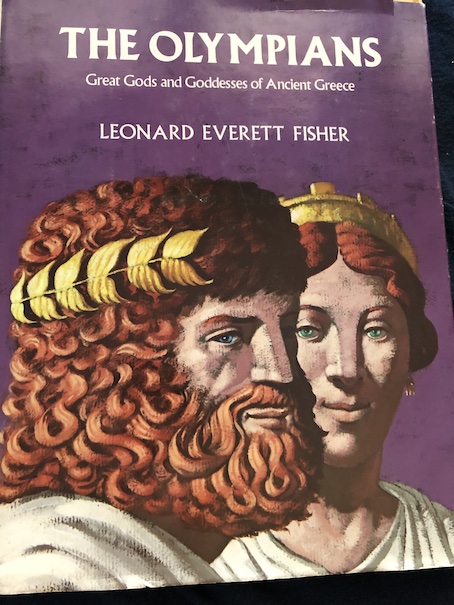
The Olympians by Leonard Everett Fisher, 1984.
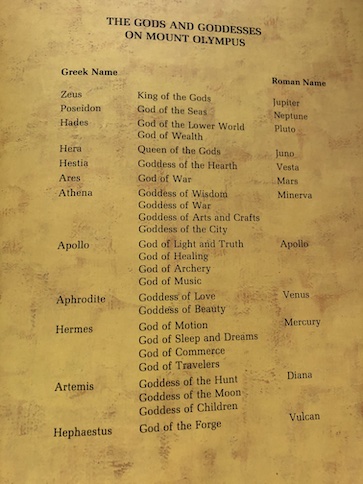
This picture book was my very first introduction to mythology when I was a kid! The book presents profiles of twelve Greek/Roman gods and goddesses. The Ancient Greeks and Romans worshiped the same gods and goddesses, but they used different names for them. At the beginning of the book, there is a list of gods and goddesses that gives both their Greek and Roman names. However, the rest of the book mainly uses the Greek names because the emphasis is on Greece. The gods and goddesses were called the Olympians because their legends state that they lived on Mount Olympus in Greece. It’s useful to know the Roman names, though, because the planets in our solar system were given the Roman names of gods.
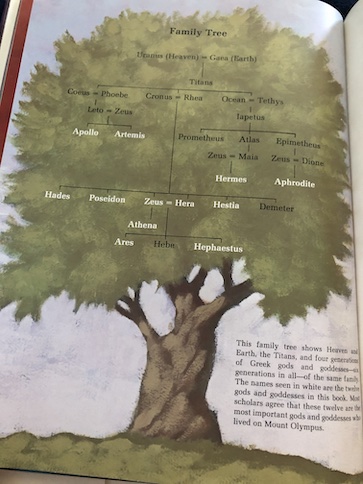
The back of the book has a family tree because all of the gods and goddesses were canonically related to each other. As a kid, I just accepted that. I don’t remember questioning it. The names of the gods and goddesses in the book are written in white.

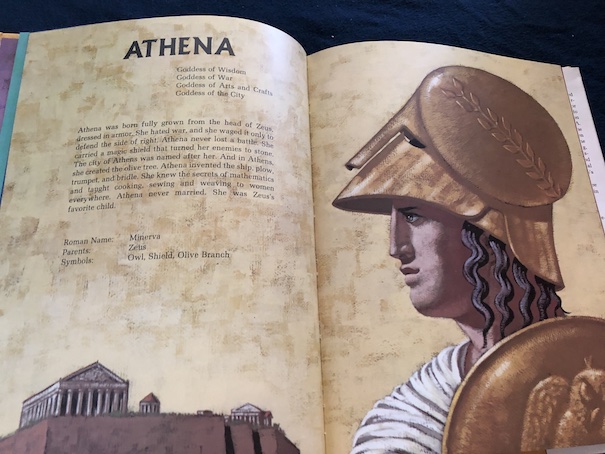
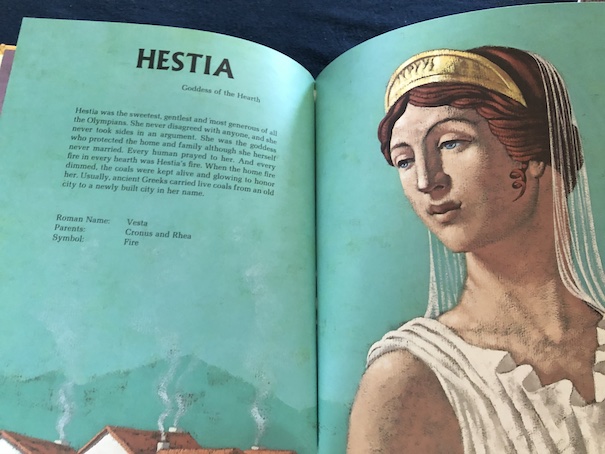
Each god and goddess in the book has a page of information and a full-page, full-color picture. Their profiles explain their personalities, their roles among the gods, and symbols that are commonly associated with them.
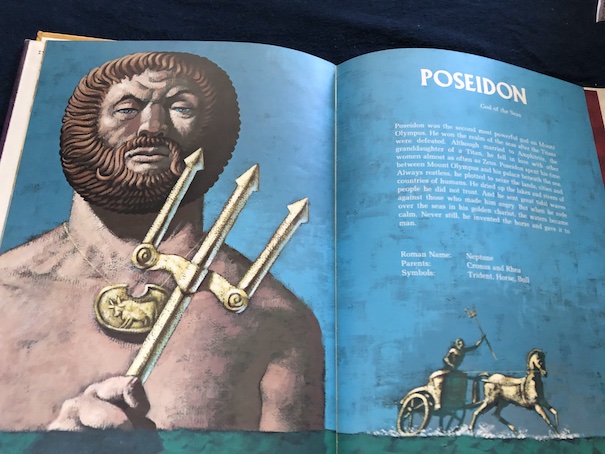
The pictures in the book are colorful. Although the faces of the gods and goddesses have a somewhat chiseled appearance, I like them.
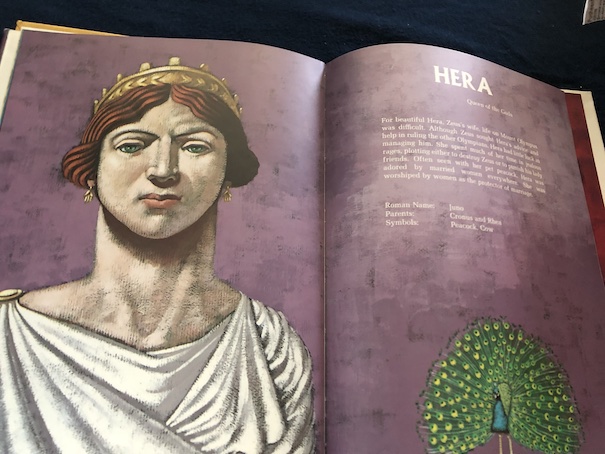
When I was a kid, I think I had a fascination for Artemis and Apollo because they were twins, and I found twins fascinating. Because I was a girl, I generally liked the female goddesses better than the male ones. I think I sometimes tried to imagine which one I would be if I could pick one. I think, for a time, I liked Athena because she was the goddess of wisdom and was represented by owls, and I also happen to like owls.
As I was rereading the book this time, I became more interested in the page about the goddess Hestia. As the goddess of the hearth and home, she might not seem as exciting and well-known as the others, but I like her picture, and her profile has some interesting facts. It mentions that Ancient Greeks would carry live coals from an old city to a new one that had been recently built in her honor.
The book is available to borrow and read for free online through Internet Archive (multiple copies).
 Jestress's Forgotten Books and Stories