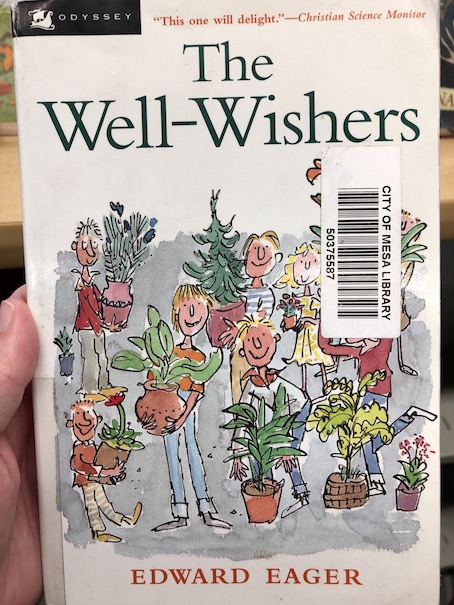
The Well-Wishers by Edward Eager, 1960.
This book starts up after the events in the previous book in the series, Magic or Not?, but one of the interesting features of this book is that each of the characters takes a turn in telling the story from the first person. As with the previous story, it’s ambiguous about whether or not there’s any magic involved, although the story implies that there is. In the previous book, the characters came to believe that an old well on the Martins’ property was a magic wishing well, leading them and their friends on a series of adventures over the summer. At the end of the summer, they were still uncertain about whether the well was really magic or if their adventures were just coincidence and maybe some playacting on the part of the adults around them. In this book, they investigate the well more, starting the process of making wishes again, partly because they’re bored and need some excitement, but also to find out whether the well really is magical or not.
When I give my opinion of this story, I’m going to do much o it within the summary itself because there are things that I really need to address within each section of the story. In particular, there are some historical circumstances that I need to explain.
The book is available to borrow and read for free online through Internet Archive (multiple copies).
The Story
James Martin begins the story in this book, starting by saying that he and his twin sister Laura normally can’t stand books told from the first person because they often contain characters lamenting “If only I had known …” or “If only I had” done this or that, and they think that the characters sound dumb for not thinking ahead more, realizing the significance of things happening when the reader can, and not taking appropriate actions like a real person would. However, they’ve decided that it’s okay to tell their story in the first person because they do realize the significance of things as they happened to them, and it’s Laura’s idea that each of their friends should tell their part of the story themselves because they all experienced what happened in a different way.
James Begins
James explains that he and his sister are in the same class at school, the one for more advanced students, along with their friends Kip and Lydia. Their other friend, Gordy, is in a different class at the same school because he’s a slower learner. It wasn’t easy for them to start being friends with Gordy in the previous book, but since then, they’ve tried to be especially nice to him … to varying degrees. (They don’t seem very nice to me.) Sometimes, they say that they still have to be firm with him on some things. In the previous book, he was a bit of a troublemaker because he is often thoughtless about his actions and has some rough tendencies. He comes from a wealthy family, and his mother is a fussy queen bee type, which has caused some awkwardness hanging out with him, which continues into this book.
In the previous book, James and Lydia moved to a smaller town from New York City, and they discovered that their new house has an old well on the property that the girl living nearby, Lydia, told them was a magic wishing well. James never believed that it was, but Laura did, and even James had to admit that the “wishing well” did give them and others things that they were wishing for. Or, at least, they got what they wanted in meaningful ways. It’s still questionable whether it was because of the well or not.
Since their previous adventures, the kids have settled back into ordinary life. They’re all getting used to their new school, and Kip and James try out for the football team. However, the kids soon start to feel that life is getting dull. The four main friends who are all in the same class start getting in the habit of leaving Gordy out of some of their activities, partly because he’s in a different class and partly because it gives them an element of secrecy that they feel like they’ve lacked since their previous adventures. They still do some things with Gordy and let him join them when he comes looking for him. Gordy isn’t the kind of guy to hold grudges, and that makes the others feel guilty about the times when they leave him out, which perversely makes them leave him out more because having him around reminds them that they feel guilty for excluding him earlier. James acknowledges that none of this is right or fair but says that it’s just a part of human nature and can’t be helped. He also says that they all genuinely like Gordy, but he often seems a bit childish, and there’s “something about him that makes people want to pick on him.”
(I genuinely hate people who have this attitude about taking advantage of others just because there’s “something” about them that just makes them want to, like it’s not self-entitled to feel and act that way. Besides, I know exactly what this “something” is, and that’s Gordy’s niceness. Other people might yell or complain at someone who’s being mean to them and tell them right to their face that they’re being a jerk, which can help put a quick end to their jerkiness or at least cause them to dump it on some other poor person instead. Unfortunately, the buck tends to stop with Gordy because he doesn’t lose his temper, doesn’t complain, and doesn’t tell others off when he should, and they’re the type who won’t change until someone does tell them off. They take advantage of Gordy’s niceness because he doesn’t stop them from taking advantage, and deep down, they know that’s what’s happening. That’s why they feel guilty, but not enough to stop what they’re doing. This really annoys me because it seems like they’re almost blaming Gordy for not stopping them from being mean to him, but yet, they totally know what they’re doing and could just stop it themselves. If you don’t like or respect what you’re doing, whose fault is that? You could just decide to do something different anytime you want. I found them annoying when they acted like this in the last book, and I thought that they’d learned something by the end of that story, but I guess not. It’s annoying when characters don’t seem to learn anything, especially when they’ve just been mocking characters in other books for being slow on the uptake. I also don’t like it when this type of character is one of the main characters in a story because, as readers, we’re expected to identify and sympathize with the main characters of a story, and in this case, I don’t want to do either. They’re just getting on my nerves at this point, and we’re not very far into the story. Fortunately, this does get better.)
One day, when the kids are sitting around on the porch of the cottage that they use as their clubhouse without Gordy, talking about how Halloween is coming but nothing feels exciting since their adventures with the wishing well, they start to consider wishing on the well again. They’ve thought of doing this before, but they hesitate to do it because they’re afraid of using up the “magic” (even though James claims he doesn’t really believe in it) or cause the well to become angry with them for making frivolous wishes. They decide to swear an oath to each other in blood not to wish on the well until the well gives them a sign that it’s time, although they don’t know what kind of sign they’re expecting. However, Gordy does not swear the oath because they left him out.
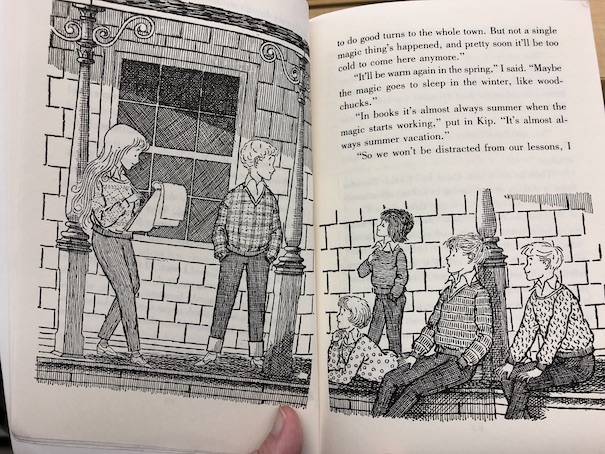
When Gordy comes along, he’s giving a piggyback ride to Deborah, James and Laura’s younger sister. Gordy is always nice to little Deborah and enjoys indulging her in small ways. Gordy’s niceness and the way Deborah gushes about it make the rest of them feel uncomfortable. (Enough to change your behavior and quit being such jerks about this? Hmm?) Then, Deborah happily tells the older kids that Gordy has “fixed the well” so it will give them “magic wishes all the time.” Laura, who is particularly protective of the well, demands to know how he “fixed” it, and Deborah says that he put a wish down the well, writing it down on her spelling paper, which had a gold star on it. When they ask Gordy what his wish said, he says that he wrote, “Get going, or else. This means you.” (That doesn’t sound like a “wish” so much as a threat. Admittedly, this heavy-handedness about Gordy is off-putting. I wouldn’t have blamed the others as much for avoiding him sometimes if that was their main motivation, but it’s not, so I still blame them.)
Laura is angry about that tasteless threat, feeling like it’s going to ruin everything. However, James reminds her that Gordy didn’t know about the oath that they’d just taken together and that he only did it to please Deborah. Besides, they’ve all also been more rude to the well in the past than Gordy was. However, Laura completely loses her temper, saying that the well and the magic belongs to them and not to Gordy. She tells him right to his face that he’s a pest, they never wanted him around, and he should just go home. James and Kip redeem themselves to me at this point by standing up for Gordy against Laura. The boys acknowledge that, although they’ve fought before, sometimes physically, Gordy isn’t a bad guy and doesn’t deserve this treatment. Gordy apologizes, saying he’s sorry if he’s caused trouble, but he felt like someone should do something, Deborah wanted him to, and nobody else seemed willing to do it.
(I liked the part where James says, “Stick and stones may break your bones, but names and plain truths and meanness can go much deeper and cut you to the quick.” I like that because I never approved of the usual saying that words can’t hurt you. Yes, they do. They’re often meant to. That’s the whole reason why people say mean things in the first place, to hurt or embarrass someone else in order to relieve their own feelings or settle a score which may or may not really exist outside of their own minds, and it’s just gaslighting to pretend otherwise. It’s just something that teachers and parents say when they want to ignore a situation instead of dealing with it or confronting someone else’s uncomfortable emotions directly.)
Laura goes into the clubhouse, upset, but Gordy and the others follow her inside. Gordy simply and directly tells her that he’s sorry, and if he did something wrong, it’s because he didn’t know better. James can tell that Laura really feels worse about her own behavior than about Gordy’s. She also apologizes, saying that the “magic” can’t be good if it makes her say mean things like that, and she doesn’t really mean what she said. (Nothing “made” you be mean but you, Laura. That’s just honest. It came from you, and that’s why you’re angry with yourself. Deep down, you know it. Now, learn to help it, so I can stop feeling like I need to explain it. Nobody can change your behavior but you. I do appreciate that the kids are now speaking more honestly and trying to work things out, though.)
James clarifies the situation for Gordy, who isn’t into reading fantasy stories like the other kids are. In fantasy stories, magic always operates by certain rules. If you break the rules, something bad might happen, and if it does, it would be his fault. To her credit, Laura says that if something bad does happen, they’ll all be in it together, but if the adventure goes well, Gordy should be the one in charge of it because he’s the one who started it. It pains Laura to admit that because the truth is that she had really wanted to be the one to make the wish herself, and that’s what’s really behind her temper tantrum. Gordy offers Laura the opportunity to be in charge, if she wants, but everyone agrees that it should be Gordy because it’s only right and in keeping with the “magic.” Gordy isn’t quite sure what being in charge means in this type of adventure, but the others say that they’ll be with him through the whole thing.
At that moment, somebody knocks on the door of their clubhouse, which never usually happens. The kids take that as a sign that the wishing well’s magic is starting, and they tell Gordy that he’d better answer the door as the leader of this adventure. The perspective of the story shifts to Gordy at this point.
Gordy’s Story
I actually enjoyed hearing Gordy’s perspective more than James’s. I hadn’t expected that at first because Gordy can be kind of rough and thoughtless, but he’s deeper than he lets on. Part of his difficulty is that he’s actually a very shy and nervous person, and that’s why he sometimes says dumb and awkward things; he just blurts things out from time to time because he’s nervous. Yeah, I’ve been there, too, kid. He’s worried about his friends seeing how scared he often is inside because he thinks that they won’t like him if they knew. His loud and rough manners are a cover for his shyness and nervousness. It pains him sometimes that he says or does things he shouldn’t, but he’s fully aware of what he’s doing and why. Like the others when they’re rude or mean to him, he can’t seem to stop himself. (There’s a lot of that going around.) He’s brighter than he pretends, and he knows that Laura lied to him earlier about having a dentist appointment so that the others could hang out without him. Even though he hasn’t confronted the others about that, he is hurt that they do these things and make him feel left out, and that’s part of what inspired him to make the wish on the wishing well. Even though they aren’t always as nice to him as they should be, he thinks they’re fun to be with, and he admires them for knowing what to do in different circumstances.
Gordy is nervous when he goes to answer the door of the clubhouse, not knowing who or what to expect. When Deborah sees who’s at the door, she screams, “Witches!” It’s a little old lady in a black cloak. She has gnarled hands and straggly white hair, and she does look kind of like a witch. For some reason, she’s also holding a bunch of branches and plant stalks. Gordy says the only thing he can think of, which is, “How do you do?”
It turns out that the old lady wants directions to Hopeful Hill. Gordy takes that as a bad sign because Hopeful Hill is a mental hospital. As Gordy describes it, it’s “a place where unhappy people come for the experts to make them hopeful again.” People from this mental hospital often walk up and down the road nearby for exercise, and mean kids from the area sometimes yell insults at them, calling them “loonies.” Gordy privately admits that he used to do that, too, when he was younger, but he’s ashamed of it now, and he hopes that his friends never find out about that, either.
Since Gordy knows that the wishing well magic is supposed to be based around doing good deeds, and he’s supposed to be the leader on this, he offers to show the little old lady the way to Hopeful Hill. As he walks with the lady, the others follow a little way behind them, which makes Gordy feel better. All the way, the woman creepily mumbles strange words to herself. Gordy isn’t sure whether she’s speaking in a different language that he doesn’t recognize, whether she’s a witch who’s casting spells, or whether she’s just a crazy person who’s mumbling gibberish. However, as he calms down a little, he starts to recognize what the woman is saying as the names of different plants. Relieved, Gordy starts talking to her about plants, and he starts liking her. Feeling a little bad that the lady would have mental problems, he politely asks her if she’d like to talk about her problems. However, the lady laughs and tells him that she’s not a patient. She’s one of psychologists. She’s also an amateur naturalist, and she likes to teach her patients about plants and birds. Gordy actually likes bird watching, but he doesn’t like to talk about it to other kids because he’s been teased about it before.
By the time they’ve arrived at Hopeful Hill, Gordy and the psychologist have become friends, bonding over their love of birds and nature. Before they part ways, the psychologist mentions that she has a patient named Sylvia who could use some help and maybe Gordy could be the person to help her. Sylvia is a little girl who recently lost both of her parents in an accident and has been having difficulty coping with the shock of it. Gordy understands, remembering how he felt when his father died. The psychologist thinks that maybe Sylvia needs other children to talk to, and she asks Gordy if he would be willing to talk to Sylvia. Gordy is often nervous talking to people, but he agrees to try.
There is an interlude in Gordy’s story where Laura explains how she and the others are still following behind Gordy and the old lady, still worrying about the old lady being a witch and what she’s going to do with Gordy. When he goes into the asylum with her, they’re still able to see them through a window, and they watch as the old lady introduces him to a pretty girl with blonde hair. Because they don’t know who Sylvia is and why Gordy is there, they think maybe the girl is under a spell.
Meanwhile, Gordy is surprised at what the asylum looks like on the inside. It sort of reminds him of a hotel. He meets Sylvia’s aunt, who is now her guardian and is an unsympathetic person. The psychologist, whose name is Doctor Emma Lovely, introduces Gordy to Sylvia. Sylvia is younger than Gordy (a sixth-grader) but older than Deborah (a first-grader). Gordy estimates that she would be in the third grade. At first, Gordy doesn’t know what to say to Sylvia, so he tells a dumb joke. He knows it’s a dumb joke, but it always makes him laugh, and it makes Sylvia laugh, too. The aunt is worried that Sylvia is becoming too excited, but Doctor Lovely says to let the children talk. Gordy later finds out that, up to this point, Sylvia had not spoken aloud for weeks, but she can’t resist asking him what “the third” at the end of his name means. Gordy explains that he was named after his father and grandfather, which is why he’s the third person to have that name. He tells her that his father is dead, too. He isn’t sure if he should say that, but he thinks it might be good for her to know that she’s not the only person who lose a parent. Then, he tells her a little more about his life, how he lives down the road, and what his friends are like. When it’s time for Gordy to go home, Sylvia doesn’t want him to leave, but Gordy says he has to go but maybe he can come back. Doctor Lovely says that she’d like him to come back.
It seems like their first good deed has gone well, and the kids go back to Gordy’s house for supper and to talk about what they should do next. However, while they’re talking, Sylvia suddenly shows up. She slipped away from the asylum and came to see Gordy because he mentioned to her where he lives. The kids invite her inside, although they’re concerned about what to do with her because she’s a runaway. Lydia’s impulse is to keep her, but James realizes that they’d have to make some special arrangements to do that. They consider keeping her at one of their houses, but they either don’t have the room or don’t think that their parents would let them. Gordy and his mother have the most money and space, and he’d like to have Sylvia stay there, but his mother is absorbed in all of her social activities and committees, and he doesn’t think that she’d have time or interest in Sylvia. (They also have a cottage that they use as a clubhouse, and I expected that they would consider keeping her there, but they don’t.) They end up calling Doctor Lovely and letting her take Sylvia back to Hopeful Hill, but Gordy doesn’t feel good about it because he doesn’t think Sylvia can really get better there.
The next day at school, Gordy is distracted, worrying about Sylvia, and does poorly in class. His teacher, Miss Wilson, keeps him after school to ask him why he’s been so distracted all day, so he explains the entire situation to her. Miss Wilson is moved by Sylvia’s story, so she gives Gordy a ride to Hopeful Hill, stopping by her house on the way to pick something up. When they get to the asylum, Miss Wilson gives Sylvia the box she got from her house, which contains a beautiful doll that Miss Wilson used to play with when she was young. Sylvia loves the present, and Miss Wilson invites her to come see her other dolls and dollhouses sometime.
While Sylvia plays with the doll, Gordy listens to Miss Wilson talking to Doctor Lovely, offering to take Sylvia. Miss Wilson has been teaching for many years and loves children. She’s wanted a child of her own, although she’s never had one, and she has the time to care for Sylvia because she works at a school, and her working hours would mean that she would only work when Sylvia herself is in class. Doctor Lovely says that could be arranged, if Sylvia is willing, and Sylvia agrees that she would like to stay with Miss Wilson for awhile and see if she likes it with her. (Sylvia’s aunt isn’t really discussed much, but since she doesn’t seem to want to be responsible for Sylvia, it seems that she’s willing to let someone else adopt her.)
Gordy is pleased because it seems like this little adventure is wrapping up nicely, and Miss Wilson even tells Gordy that she’s thinking of transferring him from her class to his friends’ class at school. His friends’ class is the more advanced one at school, and Gordy is a little more academically slow than they are, but Miss Wilson thinks that he can handle it and that being with his friends might motivate him to work a little harder and learn better. Gordy likes the idea, but he’s also starting to like Miss Wilson a little better now, so he says that he’d like to finish the semester with her before deciding. He hurries to meet his friends and tell them what happened with Sylvia, and Laura takes the story from there.
Laura’s Story
When Laura and the others hear Gordy’s story about Miss Wilson taking Sylvia, they’re a little disappointed because they had been planning to break her out of the asylum, and living with a teacher doesn’t seem like much fun, but Gordy says that Miss Wilson is really nice. Lydia is also dissatisfied because it seems like everyone was skipped over in this adventure but Gordy. Laura says that might be because she was so mean about it when they first found out about Gordy’s wish.
For a few days, things are pretty calm. They continue to visit Sylvia and are happy to see that she’s getting along well with Miss Wilson. Then, one day, James is reading a local paper, and he spots a letter to the editor that gets their attention. The letter wishes good luck to the new railroad station, and it’s signed “A Well-Wisher.” The kids are confused because they haven’t heard anything about a new railroad station in the area, and they wonder if it could be some kind of code. Then, they start thinking about the word “well-wisher.” It occurs to them that they are also well-wishers, both because they have a “magic” wishing well and because they wish everyone well.
The kids start wondering if anyone else in the area also has a magic wishing well, and if that’s what the “Well-Wisher” means. They start asking other people in the area who have wells if their wells are wishing wells, and they get a variety of responses, but nobody who sincerely says that their well is a wishing well. Since that doesn’t seem to lead anywhere, they decide to go down to the town’s railroad station and see what the letter means by “new railroad station.” They don’t learn anything there, either.
The kids stop to buy apples from a man selling them from a nearby orchard, and the man tells them that the orchard has been condemned, and this is his last crop. The town is forcing him to sell his property to the town so they can use the land for the new railroad station. The farmer is upset about having to move and seeing his beloved trees cut down.
At first, the kids think that their next wishing well mission is to prevent the new additions to the railroad station and save the orchard, but Kip points out that many commuters, like his father, rely on that railroad station, and the station has been getting more crowded and has insufficient parking. Just like the school the community decided to build in the last book, there is a community need for this expansion of the railroad station. Then, the kids wonder if there is a way to help the farmer keep his orchard even though he has to move it from its present site.

Fortunately, there is someone else who has an orchard and who could use an experienced farmer to help her manage it, and there might even be some romance in it!
Lydia’s Story
Dicky LeBaron has always been a rotten bully at school, particularly liking to pick on Gordy, although Lydia has had some bad experiences with him, too. The whole group has had a couple of run-ins with him just during the course of this book, and when it’s Lydia’s turn for a good deed, the first thing she thinks of is taking care of Dicky. Laura doesn’t think that the wishing well should be used for revenge, but Dicky keeps following them around, spying on them, and spreading mean rumors about what they do in their clubhouse. Lydia decides that she’s had enough of Dicky and is going to do something about him.
Lydia tells Dicky that what she and the others really do in the clubhouse is talk to ghosts, and she invites him to come see for himself. Dicky accepts the invitation, and Lydia feels a little guilty because she’s actually planning a trick on him. However, because Dicky has been so mean, she decides to go through with the trick anyway. There’s a hole in the floor of the clubhouse where an old furnace used to be. Normally, the kids keep the hole covered by an old chest so nobody falls into the basement, but Lydia moves the chest and covers it with a rug instead. Her idea is to trick Dicky into stepping on the rug and falling onto a pile of pillows in the basement. Then, while he’s trapped in the basement, she plans to scare him with spooky ghost noises, and then, when the rest of her friends come, they can all tell off Dicky for all the mean stuff he’s done to them and tell him that they won’t let him out of the haunted basement until he promises to behave better.
Of course, none of this goes according to plan. Instead, Lydia accidentally falls into her own trap, and when she falls into the basement, she hurts her ankle. When Dicky comes, she still puts on a ghost act, calling out from the basement in a ghostly voice and making a horrible face when Dicky looks down the hole. At first, Dicky really is scared, but then his older friends, who are even meaner, come along, realize that it’s a trick, and show him that it’s just Lydia in the basement. Dicky is mad at Lydia for tricking him, and he and the mean older boys talk about what they’re going to do to get even. However, when the older boys talk about doing something to little Deborah, Dicky draws the line because Deborah’s just a little kid. He and the other boys argue about it, and the older boys shove Dicky down the hole with Lydia.
Trapped in the basement together, Lydia and Dicky have a few honest words about what they’ve each done. Lydia apologizes for the trick, and Dicky reveals that he’s only been doing the stuff he’s been doing and sneaking around because he felt left out. Lydia asks him why he didn’t just ask to join in and be friends instead of acting like a creep, but Dicky cuts the discussion short while he figures out how to get out of the basement.
Dicky manages to climb out of the basement through a chimney, and when his “friends” try to stop him, they accidentally disturb a hornets’ nest, which drives them off. Dicky gets out and frees Lydia. Then, they go and rescue Gordy and Deborah from where the big boys had them tied up. Dicky gets a few hits from Gordy and from James and Kip when they come along because they all think he was one of the boys who attacked Deborah. Fortunately, they get the whole situation straightened out, and Deborah isn’t traumatized from the experience.

James admits that Dicky turned out better than he though under the circumstances, but he’s not sure he really wants him around because of the way he’s been acting toward them for a long time (a valid concern) and because he dresses like a juvenile delinquent (kind of shallow). Lydia tells James off for being a snob and not giving people a chance when they try to improve themselves (also a valid criticism). They all sit down with Dicky and explain to him what their group is really about, telling him about the wishing well and the good deeds and letting him decide for himself whether or not he’s interested in joining them. Even though Dicky is a bit superstitious, he thinks the wishing well sounds kind of childish and turns down the offer to join them. However, he thanks them for offering to let him join and seems to be fond of Deborah, and Laura thinks that he might help them out at some later point, if they need him.
Kip’s Story
Kip’s story in particular requires explanation because it’s topical for the time period when the book was written.
James and Laura’s family misses church next Sunday because they oversleep, but Kip is there, and he hears the minister giving the congregation a stern talk about a local issue. Apparently, there is a new family moving to the area, and some of the current residents disapprove and have been putting together a petition against the family. The minister tells the congregation that he disapproves of the petition and has written a letter of welcome to the new family, inviting members of the congregation to sign it as well.
The minister doesn’t say why people are against this new family, and this is the first that Kip has heard of it, but his parents are among those who sign the welcome letter. After church, Kip overhears some women talking about the minister, saying that he shouldn’t have brought up this issue in church and he “doesn’t know his place.” A couple of men are also talking, saying, “Once one gets in they’ll all come. We have to draw the line.” As far as lines go, I’m pretty good at reading between them, and I know that this book was published in 1960.
Even though nobody has openly said it, I knew at this point in the story that these people are talking about a black family moving to the area. The situation is like that of the Myers family in Levittown, Pennsylvania in 1957. I wouldn’t show the video I linked to kids because of some of the language involved, but the woman about 6 to 10:30 minutes into that video pretty much sums up her entire issue with having new neighbors who are black. She just “could never” accept them socially, like the snobbiest mean girl at the cool kids’ table in the middle school cafeteria, who thinks it’s weird and wrong that “uncool” kids want to be treated like human beings, too. She speaks like these people outside the church. I don’t know who the woman in the video is/was, but if she felt like she wasn’t being heard, I think that the way the characters talk in this book from 1960 show that people definitely heard her and others like her and noticed how they felt and what they said. Just because people don’t agree with you or even like you as a person doesn’t mean that they didn’t listen, hear, and understand. Understanding does not equal approval. It’s completely possible to understand someone else’s position yet not identify with it or approve of it, just like I felt irritated by the main characters in this story when they were being jerks to Gordy at the beginning, even though, as a reader, I was seeing the situation through their eyes. Seeing it through their eyes didn’t make me like it better. Sometimes, what you come to understand about a person is that they’re in the wrong or just being a jerk and you don’t want any part of their issues. That might sound harsh, but it’s true. It’s the risk we all take when expressing opinions, that when we get someone else’s attention, it won’t be the kind of attention we wanted but the kind that other people think we deserve.
In the story, Lydia’s grandmother calls the people against the new family “Philistines.” The kids don’t know exactly what that means although Kip vaguely remembers that the Philistines had “the jawbones of an ass”, which he thinks sounds like the situation here. (Actually, Samson killed Philistines with the jawbone of an ass, but I like Kip’s explanation because of the imagery.) Kip’s mother tells him that she doesn’t want to talk about the issue because it makes her “too angry”, so he talks it over with his friends instead. They still don’t openly say what the issue is with the new family because little Deborah is with them, and the older kids are careful about what they say around her, but Kip implies that he’s figured it out. They just refer to the disapproving townspeople as “snobbish”, which is true, although adults will recognize that it’s a particular kind of snobbishness.
I’d like to say here that I found it interesting that they never actually refer to the new family as black at any point in the story. I kept expecting that they would, but they never did. It’s all implied, and if you’re old enough to understand what’s going on, you get it. Deborah doesn’t get it at first, although she does when she actually sees the new family in person for the first time. They are never actually described, but the fact that their appearance makes Deborah immediately see the issue settles the matter.
The kids think that this issue with the new family in town might be their next mission and that Kip should be in charge of it, but Kip questions whether there’s anything for them to do because the minister has already been taking steps to deal with the situation. They consider signing the minister’s letter, if he’ll accept signatures from children, but they also wonder whether magic and their wishing well would go well with a church activity. They decide to go to the minster and ask him about it and if there’s anything they can do.
The minister is pleased that the children care and want to help, and he’s not overly concerned if they’re motivated by “wishing well” magic to do so. From the way he says it, it sounds like he regards the “wishing well” as a harmless children’s game or the product of overactive imaginations, which it might be, since the story never firmly settles it. The minister just appreciates that the children’s hearts are in the right place and uses the reference to fountains in Proverbs 5:16 as proof that a wishing well’s help is acceptable here. (Although, that verse is actually a metaphor for marriage and adultery, which completely goes over the heads of the children. He’s just humoring them here. Personally, I would have picked a reference to the story of Jesus and the Samaritan woman at Jacob’s well because that has an actual well in it and “living water”, but it’s not a detail that’s really important to the story. The important point is the minister is happy to accept whatever help these imaginative children are willing to offer.) He says that, since the new family also includes children, it would be fitting if they could collect a page of children’s signatures to add to the letter. The kids are all happy to sign the children’s page and say that they can get some other signatures as well. They also get more signatures from other adults, not just children.
When the children go back to James and Laura’s house, Kip’s parents are talking to James and Laura’s parents. The adults are worried about the children hearing about the problem, although James’s father says that they might as well know that the world isn’t a perfect place and has its problems. The kids walk into the room and tell them that they know what’s happening already. James’s father says that he’s not really worried about whether can get enough people to sign the welcome letter. He’s pretty sure that the majority of the people in the community will be willing to accept the new family into the community. What worries him is that the people who are unhappy about the new family might escalate their behavior into some kind of demonstration if they don’t get their way. The kids say that they’ve wished on the wishing well, and they’re sure that will take care of it. Their parents know what the kids think about the wishing well, but they urge them to be careful here because this is a situation that makes people emotional, and it could get out of hand. Still, the kids have faith in the wishing well and in the friends they’ve made through their various adventures.
I found it interesting how the kids describe the way other children at school have heard about the issue from their parents. If their parents haven’t all talked to them directly about it, they’ve at least talked about it in front of them. The kids at school generally side with whatever their parents say about the issue, and the ones that are against the new family are described as being “stuffy, hopeless, purseproud ones” (“purse proud” people are people who are especially proud of their wealth because they have little else to be proud of, basing their self-esteem on monetary wealth) or “feckless goons who’ll do anything for a little excitement.” They also mention that there are “mindless ones who never have any opinion of their own and have to borrow other people’s,” and those people are up for grabs for either side, so they manage to sway a few of them. At one point, a bully tries to take their paper and tear it up, but Dicky stops him. Dicky orders the bully and some of the other kids to sign the paper, too, so he’s finally using his powers for good. Gordy’s mother is very influential in the community, and the “intolerant ones” (as the book describes them) try to recruit her to join their cause, but she turns them down. She doesn’t sign the welcome letter either, though, because she considers the entire situation tasteless and undignified and doesn’t want to get involved in any way.
It’s a little worrying when they hear that the “intolerant ones” are planning some kind of demonstration, but Kip comes up with a good idea for a demonstration of welcome: they recruit a bunch of friends to do a nice garden for the new family. People bring all kinds of plants for the garden, and many children help. The presence of the children gets the demonstrators to back out of their demonstration. The new family loves the new garden, and it turns into a big community celebration.
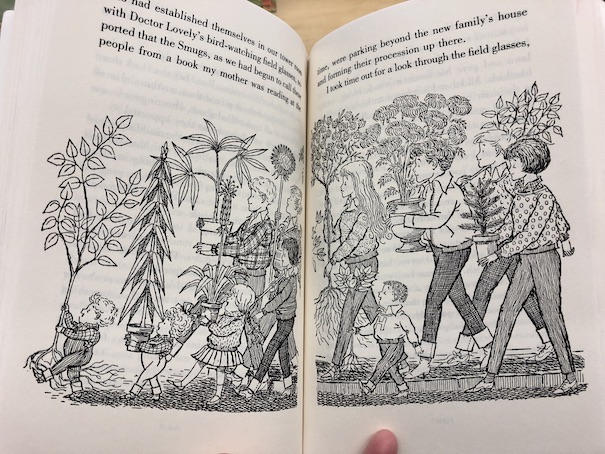
Before Kip’s story ends, he gets curious about who originally owned the new family’s house. After some research, he finds out that the original owner was an escaped slave who traveled through the Underground Railroad. Not only does it seem right that a black family should move to the property, but the original owner had a reputation for growing herbs in her garden that she used for magical cures, which seems to fit with the magic of the wishing well.
Deborah’s Story
I partly expected the story of the new family in town to be the climax of the book, but it’s not. They’ve safely moved in, but now, they’re going to have to live in the community, and there are still people who have bad feelings about that. This is where little Deborah gets a story in the book. The others hadn’t expected Deborah to get an adventure from the wishing well because she’s just a little sister of a couple of the main characters, but she’s in a unique position to do some good for the new family. Because Deborah is still only in the first grade, she dictates her story to another character, who doesn’t identify himself at first but who plays an important role in her adventure.
The three children in the new family are younger than most of the characters in the book so far, but the oldest, a boy named Hannibal, is six years old and in Deborah’s first grade class. Hannibal’s first day at school does not go well. He’s surly to his teacher and the other kids, making it clear that he doesn’t want to be there, and he doesn’t want to play with them. Hannibal’s behavior seems to confirm to the children whose parents didn’t want his family to move there in the first place that they were right not to want them, and some of the kids start teasing Hannibal on the playground at recess, making fun of his unusual name.
Dicky’s teacher has recently made him a playground monitor for the younger children in order to teach him some responsibility. Dicky (the other narrator who shares Deborah’s story and writes it down for her) knows that’s why he was given the job of playground monitor, but he finds that he actually doesn’t mind the job. When the other kids start teasing Hannibal and Deborah can see that he’s getting more upset, she runs to get Dicky. The mean kids are intimidated by Dicky and run away when he comes. At first, Dicky admits that he doesn’t quite understand the situation. Thinking that the other kids didn’t want to play with Hannibal, he calls one of his younger brothers over and tells him to play with Hannibal instead.
However, Hannibal says that he doesn’t want to play with anybody. He tells Dicky flat out that he doesn’t want to be there at this school and that the other kids don’t really want him. Dicky says that people do want him here, and that’s why they fixed up the garden and had that welcoming party. Hannibal is pretty sharp for his age, though, and he says that he knows that there are people here who didn’t want him or his family and the flowers in the garden aren’t going to fix that. He says he also knows that even people who do nice things often do them for their own sake, so they feel good, not because they really like or want to help someone else. Hannibal is also homesick for where they used to live in New York, and he wants to go back there.
Dicky can’t deny that a lot of what Hannibal said is true, but he also recognizes the emotional state that Hannibal is in. Dicky’s family has had a lot of problems, and even he realizes that’s why he’s often acted the way that he has. His family is poor, he has a lot of brothers, and social workers who have come to visit his family are often unhelpful because they don’t really understand the family or their situation. In the past, Dicky has often taken out his frustrations through vandalism and being mean to other kids, especially kids like Gordy, who have more than his family does. However, Dicky is now old enough to understand that breaking things and being mean don’t help anything and often make problems worse. He explains to Hannibal that making friends requires some effort from him as well as the other kids because they can’t be his friends if he won’t let them be, and even though he wishes he were back where he used to live, he lives here now, and he might as well make the most of it. Hannibal is too upset to listen, though, and when Dicky tells him to play with the other kids, he just starts shoving people around, pretending that he’s playing tag. Hannibal is so angry and surly all day that he really gets on everyone’s nerves, and when school’s out, he runs away from the other kids, some of whom are planning to get back at him for how he’s been treating them.
Deborah is worried about Hannibal, so she persuades Dicky to give her a ride on his bike while they go looking for him. Dicky is sympathetic and agrees. Deborah thinks that Hannibal is her mission from the wishing well, and even though Dicky doesn’t believe in it and thinks all the wishing well stuff is corny, he lets Deborah talk him into doing a ritual by the well where they wish that Hannibal would behave better and get along with others. Dicky does the ritual with Deborah to make her happy, although he worries that someone else might see them, and it will ruin his cool, tough guy reputation.

The person who sees them doing the ritual is Hannibal, who is hiding nearby. He is fascinated by the ritual that the others are doing and by Deborah’s “magic” wishing well. When Deborah tells him that they were wishing about him, Dicky expects that Hannibal will get mad again, but he doesn’t. Instead, Hannibal wants to make a wish of his own, wishing that he could be just like other kids.
Dicky tells Hannibal that he should learn to like himself and appreciate himself for being different because everyone is a unique person, and there will never be another person just like him again. Hannibal says that he likes himself just fine, but other people don’t, and that’s why it’s a problem. Dicky says that he can make the other kids behave themselves and play with him, but Deborah realizes that what Hannibal needs is someone to be nice to him for his own sake, because they want to, not because they have to.
Deborah invites Hannibal to come inside for some water, and when Hannibal notices that he’s ripped his clothes and worries about what his mother will say, Deborah suggests that her mother might be able to fix the rip. Seeing that someone is genuinely trying to be nice to him and that people will take care of him here softens Hannibal. The first grade teacher tells the other students to be nice to Hannibal on his second day because his first day was just really hard for him and that’s why he was behaving badly. The second day goes better, and Hannibal starts playing with the other kids and settling in.
The adventure does seem to do Dicky some good, too. He somewhat comes to believe in the magic of the wishing well, although he doesn’t like to admit it openly, and helping another troubled kid who reminds him a little of himself helps him to settle some of his own problems, teaching him the leadership and responsibility that his teacher hoped he would learn. He starts becoming more friendly with the other kids and hanging out with them more, although he also spends time with other friends or just by himself because he still likes being a kind of lone wolf. His personality grows and changes, but he also realizes that he can still be himself and his own man.
James’s Story
By this point, everyone has had an adventure of some kind except for James. Part of the reason why James is last is because he both believes in the magic of the wishing well and doesn’t. He likes fantasy stories and magic as much as Laura, but he also notices that everything that they’ve accomplished so far could also just be accomplished through kindness and thoughtfulness and that there doesn’t really need to be any magic. James likes facts and being sure of how things work, so for the last wish of the wishing well, he asks the well to give him some kind of evidence of whether or not there really is any magic.
One Saturday, the kids go on a long bike ride to just explore the area, finding a sign post that points to a place called Journey’s End Road. Curious about who would live on a road with such a strange name, they decide to check it out. At first, they’re expecting that they’ll find little cottages with elderly people in them, people who are at the end of life’s “journey”, so to speak. Instead, they find a mansion that looks like a castle.
While they’re admiring this castle-like mansion, a blonde girl in a blue dress steps out onto a balcony and calls to James for help, saying that she’s locked in and needs to get down. Laura thinks this is wonderfully romantic, rescuing a princess from a tower, and even James thinks that it seems pretty magical and romantic. Laura asks the girl if she’s being held prisoner by a wicked ogre, and she says yes. James doesn’t really believe that, but he’s more than willing to help. The girl tells him where to find a ladder, and he helps her to climb down from the balcony.

Once the girl is on the ground, she asks them to take her into town so she can get some important papers to the police and stop some international spies. James is still happy to help her, even though it’s weird that she’s now talking about spies. Gordy recognizes the girl as an older, teenage girl named Muriel who he’s seen at dance classes. Muriel tells them that her name is not her real name because she was stolen by the spies as a baby.
Her story gets weirder and more unbelievable, but James is enchanted by her because she’s pretty and gives her a ride on the handlebars of his bike, even leaving the others behind because she’s eager to get back to town quickly. She says that she needs to get to the town hall with the “papers”, but then, she says that they’re being followed, so they have to duck into a movie theater.
Of course, it turns out that she actually wants to meet another boy at the theater. She had a date with him to see the movie, but her father didn’t approve, and that’s why she was locked in her room. James is offended that she lied to him, let him pay for the tickets, and even referred to him as a “little boy.” Angry and humiliated, James hangs around in the theater’s lounge, afraid to face his friends and feeling let down by the “magic.” Then, he smells a gas leak in the lounge and warns the ticket seller. Seeing it as his opportunity to rescue Muriel from something that’s actually dangerous, James also goes back into the theater and makes Muriel leave with him.
Muriel is angry with James for interrupting her date, and then, he’s confronted by Muriel’s angry father, who mistakes him for Muriel’s date. Fortunately, James’s sister and friends come and explain all of Muriel’s lies to her father. Then, the movie theater is evacuated, and the ticket-seller and police praise James in front of Muriel’s father for saving everyone, pointing out that he personally saved Muriel and calling him a hero. Muriel’s father admits that he made a mistake thinking that James was the hoodlum that he didn’t want his daughter to date and says that they can see each other any time they want. James isn’t interested in seeing Muriel again, but he’s pleased at being a hero. He and his friends get their picture in the local paper.
James’s conclusion is that the wishing well proved that there is magic. His reasoning is that, if all he was supposed to do was to find the gas leak and be a hero, there were other ways he could have done it. He thinks that the wishing well directed him to Muriel so he could have the experience and excitement of rescuing a “princess” (or as close an approximation as they could get).
However, James does feel a little disillusioned, thinking about what “princess” Muriel is actually like, and he sees the need to grow up and see people and things for what they are. On the bright side, James has started to see the appeal of girls, and he’s learned to recognize that there are better girls than Muriel. He starts seeing a girl named Florence, and he sees his relationship with her as a kind of magic, so he’s satisfied, even though he now doesn’t have as much time for secret meetings with his friends and the “magic” wishing well.
The End
The book ends around Thanksgiving, with some final comments from everyone about how their adventures affected them and what they’re thankful for after their experiences.
 Jestress's Forgotten Books and Stories