
The Mysterious Christmas Shell by Eleanor Cameron, 1961.
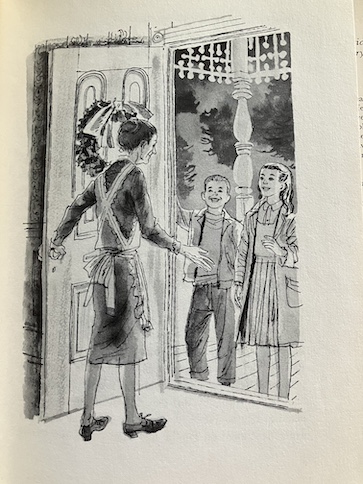
Tom and Jennifer are visiting their grandmother and their Aunt Vicky and Aunt Melissa Vining in Monterey for Christmas while their parents are in New York, taking care of Aunt Winny, who is sick. However, the children can tell that something is wrong as soon as they arrive because Mrs. Nipper, their aunts’ housekeeper, seems upset, and the house isn’t decorated for Christmas like it usually is. They have a Christmas tree, but there are no ornaments on it yet, and the Christmas greenery hasn’t been laid out.
The children hear their aunts talking about a letter that their father (the children’s grandfather) had written before he died. They know that he wrote the letter, but they’re upset because they can’t find it. The aunts explain to the children that they had to sell Sea Meadows, the wooded lands that they own, to a man called Theodore Bidwell. It’s a deep disappointment because Sea Meadows is full of ancient sequoias, and the children always liked to go camping and exploring there. Originally, Mr. Bidwell told them that we was only planning to put a few houses on that land that wouldn’t require removing many of the old trees, but now, they’ve learned that he’s actually planning on creating a large summer resort town. The aunts are upset that Mr. Bidwell lied to them to get them to sell the property, but there wasn’t much they could do anyway because they badly needed money to settle debts they had after their father died. The saddest part is that the family business has improved since they made the sale, and the aunts could now afford to buy back the property, but Mr. Bidwell refuses to sell it back to them.

There is one thing that might change the situation. Before the aunts’ father died, he discussed changing his will. He decided that, rather than leave that land to them as he originally planned, he wanted to leave it to the state of California to be turned into a state park. He thought it was the best way of ensuring that the natural beauty of the land would be preserved, and his daughters approved. The aunts already had the family business, and they didn’t need the land for their own sake. However, for some reason, his lawyer never got the letter their father said he was going send about the change in his will. The aunts are sure that he actually wrote the letter, but they think it got lost or mislaid instead of being mailed. If the aunts can find the letter that their father wrote, it would prove that the land actually belongs to the state of California and that it was never really theirs to sell. They’d have to refund Mr. Bidwell’s money, but they’re prepared to do that. It’s more important to them that the land would be preserved from development. Even local people have been angry with the family for selling the land to Mr. Bidwell because they don’t want the development, either.

When Tom and Jennifer begin helping with the Christmas decorations, and they start reminiscing about the Christmas before, the last Christmas when their grandfather was alive and he wrote his letter about the land, they remember that their cousin Elsa was also visiting. Elsa is about Jennifer’s age, and she and her parents are living in France now, so she doesn’t come to visit very often. The mention of Elsa makes the aunts remember that there was something that their father wanted to tell them about Elsa. He mentioned a funny thing she did, but then, they were interrupted, and he didn’t finish telling them what it was before he died. Everyone starts to wonder if Elsa may have done something with the important letter, but they can’t ask her because they know that she and her parents are visiting friends somewhere in France for Christmas, and they don’t know where or how to get in touch with them. (This is the 1960s, pre-Internet and pre-cell phones, so there are no methods of communication they can use that are independent of also knowing their physical location. They have to either know the address or phone number of where they are staying, and they don’t.)
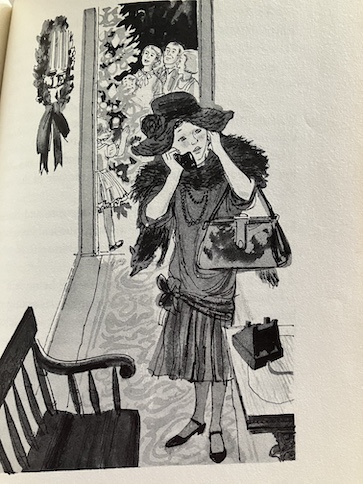
The children’s grandmother recalls that Elsa was still with them even after Tom and Jennifer left with their parents, and they talked about Sea Meadows and showed her the deed to the land. Elsa had been helping to put away Christmas decorations at the time, and while the adults were talking, she suddenly started to cry. She had cut her finger on something, but they were never sure how she did that because none of the decorations were broken. Elsa was also upset because she had done two things earlier in the day that had caused trouble: she’d broken a little figurine and she’d forgotten to tell her grandfather about a phone call from a friend. She seemed worried that she had done yet another thing wrong, but her grandfather told her not to worry because troubles come in threes, and if the cut finger is her third trouble, she has nothing more to worry about. However, their grandmother recalls that Elsa didn’t seem reassured by that. Rather than being the third trouble of last Christmas, Elsa’s cut finger is a clue to a bigger problem that Elsa was afraid to admit, and that’s the clue they need to solve the problems of this Christmas.
The book is available to borrow and read for free online through Internet Archive. There is an earlier book with the same characters, a mystery about a sea monster in the same area of California, called The Terrible Churnadryne, but I haven’t read it and haven’t been able to find a copy.
My Reaction and Spoilers
I read this book years ago, and I remember liking it, but for a long time, I couldn’t remember the details of the story. I only remembered bits and pieces. I didn’t remember that it was a Christmas story, which would have helped. I remembered that a girl did something with an important paper, but until I reread the book, I couldn’t remember why the paper was important. What stayed with me the longest was the solution to the missing letter and the cut on Elsa’s finger. But, because I forgot that this was a Christmas story, I misremembered exactly what Elsa put the letter in.


I also remembered that one of the aunts had a secret hiding place in a cave when she was young, and when they revisit the cave, they find cave drawings done by Native Americans. I also remembered that the cave is dangerous at certain times because the tide comes in. Years ago, Aunt Melissa was almost trapped there because she stayed too long and was caught by the tide. When her father found out, he refused to allow her to go there alone again. Since her mother and sister didn’t like going to the cave at all and she and her sister soon went away to boarding school, she gave up going there entirely for a long time. She was always sad about the loss of her secret hiding place. However, when she returns there as an adult, it contains part of the secret to unraveling what happened to her father’s letter last Christmas.


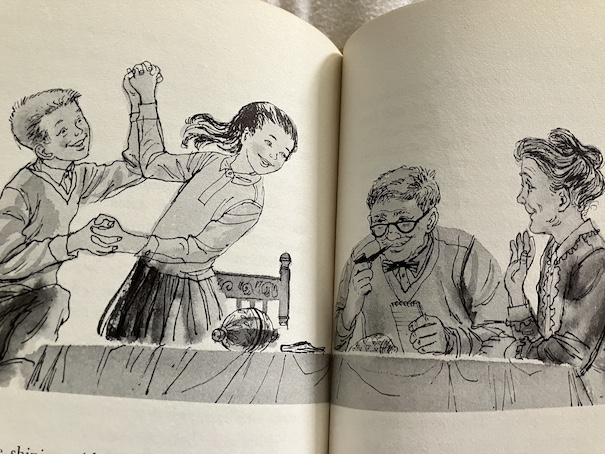
At one point in the story, Jennifer finds a very distinctive seashell with red and green colors. Everyone is amazed because it’s a court cone, not a shell normally found on the shores of California, and it also doesn’t normally appear in those colors. This is the shell that Jennifer calls the Christmas Shell. This shell doesn’t directly contain the solution to the mystery, but its shape and something Jennifer does with the shell awaken some of Aunt Melissa’s memories. I also remembered that Jennifer was the one who figured out what Elsa did after watching her brother fiddling around with a napkin in a napkin ring.
While I was rereading this book, I was happy to see all the bits and pieces of my memories of this book fall into place alongside the clues to the mystery. Stories with secret hiding places are always fun, and this one has two – Aunt Melissa’s old secret hiding place in the cave and the place where the missing letter is hidden.
There is also a reference in this story to the Elsie Dinsmore books, a children’s series from the late 1800s and early 1900s.
 Jestress's Forgotten Books and Stories