The Dark is Rising Sequence
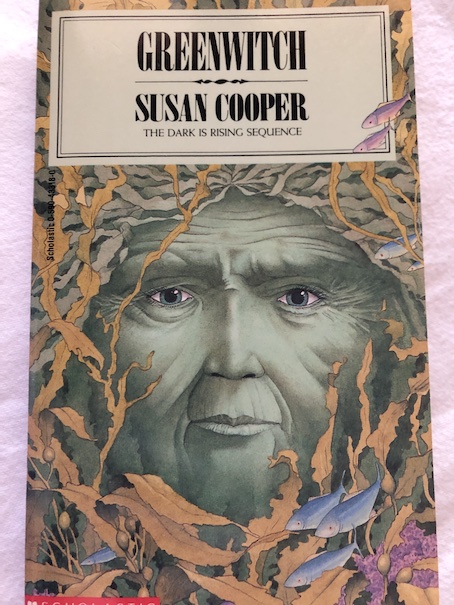
Greenwitch by Susan Cooper, 1974.
This is the third book in The Dark is Rising Sequence, and it brings together the two sets of characters who have already been established in the series: the three Drew children from the first book and Will Stanton and the Old Ones from the second book.
The story begins with the theft of the grail that the Drew children found in the first book with their Great-Uncle Merry, otherwise known as Merriman Lyon. The grail was stolen from the museum where it was being studied, and Merry wasn’t there because he was supposedly on an extended trip to Greece. However, when word of the theft spreads, Merry comes back to see the children. He is the only person other than the children who know that the thieves who took the grail were not ordinary thieves but agents of the Dark, the forces of evil. Merry say that he believes that they took the grail because it will lead them to something else that they’re seeking. He says that he will need the children’s help again and asks them to trust him. There will be danger, but he promises them protection. The children agree and accept Merry’s invitation to spend their holidays in Cornwall with him again.
Meanwhile, Will Stanton is bored because his older brothers and sister are off doing other things. Even though he is secretly one of the Old Ones and has great powers, he is also still the youngest in his family and feels left out of things that his older siblings are able to do. Then, a mysterious stranger arrives and introduces himself as Will’s Uncle Bill. Will was named after Bill, who is one of his father’s brothers and has been living in the United States for as long as Will can remember. Will’s parents are glad to see Bill, and Bill offers to take Will with him on a trip to Cornwall because a friend of his who is also staying there will have a couple of nephews about Will’s age staying with him. Will is eager to go, and his parents agree to let him.
Of course, the friend that Uncle Bill is talking about is Uncle Merry, and the nephews are Simon and Barney Drew, along with their sister Jane. At first, the Drew boys don’t like Will much because they think he’s going to interfere in their mission with their Uncle Merry, not knowing yet that Will has special powers and is directly involved in the fight against the Dark as their ally.
Shortly after they arrive in the village where the Drew children stayed in the first book, Will and Uncle Merry mention a pagan ceremony that is still being practiced in the area called the Greenwitch. Uncle Merry says that Jane may watch it, but not the boys because only women are allowed to attend the ritual. However, the dog Rufus that the children befriended on their last visit is kidnapped, and they are given the warning that the captain who owns him had better stay away from the Greenwitch if he wants him back. Unbeknownst to the children, the captain, who is the man who owns the house where they stayed last time, is another of the Old Ones.
Still, Mrs. Penhallow, the wife of a fisherman they met in the first book, invites Jane to come with her to see the Greenwitch being made. Jane doesn’t know what that means at first, but she goes to the ceremony anyway. Jane watches the local women weaving branches together to make a strange figure. It makes Jane uneasy because it doesn’t seem human but it has a kind of power. The women tell her that few people can sense its power but that people make wishes on it before tossing the Greenwitch into the sea for luck. Jane is given the opportunity to make a wish herself, and she finds herself wishing that the Greenwitch could be happy because she senses a loneliness about the figure. She feels a little silly for that wish after she realizes that she could have wished to find the grail again instead. One of the women there approves of the sentiment of Jane’s wish although she notes that it’s also a dangerous one because it’s difficult to know what might make someone happy. Some people find happiness in dark or dangerous things, but in this case, it might be a very good wish.
However, the forces of darkness are also targeting Barney. Barney has recently been developing artistic skills, like the children’s mother, and an artist who serves the Dark steals one of his drawings to gain control over him. The Dark needs Barney, at least for a short period, because he can do something that none of them can; Barney can look into the grail and tell them what he sees.
The book is available to borrow and read for free online through Internet Archive (multiple copies).
My Reaction
There are even more pagan references in this story than in the previous two. The Greenwitch is a fictional ceremony, but it seems like it’s based on or inspired by a kind of folk magic. It might be that the local women who make the Greenwitch are meant to represent a coven performing magic. I’m not going to go too deep into the history pre-Christian traditions because this isn’t a real ritual that I can trace and the history of neo-paganism is complicated. If you’re curious, I recommend watching this documentary about the life of Gerald Gardner, the founder of Wicca. I don’t really believe in Wicca myself, but I think Gerald Gardner is a delightful eccentric and fun to hear about. (Just don’t show the documentary to kids without watching it yourself. There are a couple of things in there that night not be suitable for young kids.)
It’s not all focused on the folklore of the British Isles, though. At one point in the story, the characters seek the help of Tethys, a figure from Greek mythology. The Greenwitch is meant as a tribute to her, so she has power over it, and the characters need something from the Greenwitch. This story introduces the idea that, although the stories are about the struggle between good and evil, Light and Dark, there are also some powerful, ancient forces that are not part of this struggle, including Tethys and the Greenwitch. These forces are neutral, and their neutrality requires that they neither help nor hinder either side in the struggle. Tethys and the Greewitch are among those neutral forces.
Part of this story also involves characters doing things they shouldn’t because they don’t have all of the information they really need to make better decisions. Ignorance and half-knowledge are annoying parts of stories like this, plot devices to allow characters to get into dangerous situations. It all works out for the best in the end, though.
 Jestress's Forgotten Books and Stories