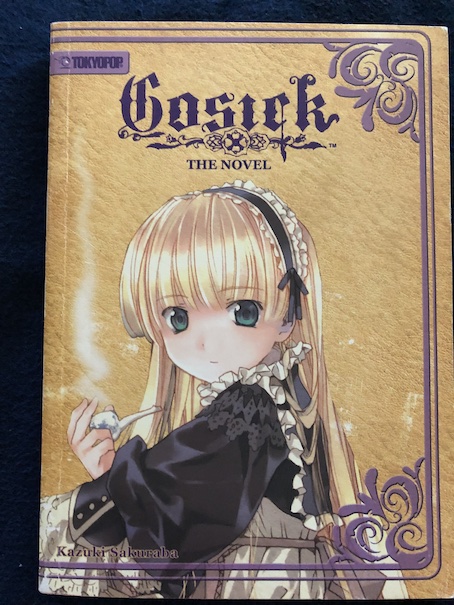
Gosick: the Novel by Kazuki Sakuraba, illustrated by Hinata Takeda, 2003.

The year is 1924, and a boy from Japan named Kazuya Kujo is attending a prestigious boarding school called Saint Marguerite Academy, in the small European country of Sauville (fictional). The students at this school have an obsession with ghost stories. Kazuya is a very serious boy, and he doesn’t see the appeal of all of these gruesome stories, although his friend, Avril Bradley (an international student from Great Britain) loves them and insists on sharing scary stories with him. Part of the reason why Kazuya doesn’t like all the scary stories is that other students insist on calling him “the Reaper” based on a character from one of the more popular ghost stories. However, he’s not the only student at school who stands out, and some of the school’s ghost stories have more truth behind them than Kazuya would have dreamed.
There is one seat in Kazuya’s class which is always empty. That seat belongs to Victorique, and Kazuya is one of the few people at the school who has ever seen her. Victorique never comes to class, preferring to spend her time reading and studying by herself in the conservatory at the top of the library. One day, when their teacher gives Kazuya some papers to take to Victorique, Avril tries to ask Kazuya what Victorique is like. Kazuya doesn’t want to explain much about Victorique, just saying that she can be blunt and kind of mean, which is true. Victorique is brilliant, a child genius, and she looks like a little china doll, but she’s not easy to get along with. She’s temperamental and not used to dealing with other people in general. She smokes a pipe, like Sherlock Holmes, and makes deductions using her “fountain of knowledge”, even about places she hasn’t been and things she hasn’t witnessed, like Nero Wolfe.

Victorique is not allowed to leave the school grounds (for reasons which are explained as the series continues), and aside from Kazuya, there’s only one other person who visits her: her older half-brother, a local police detective. He never admits that he gets help from Victorique on his cases, and he typically prefers to act like he’s talking to Kazuya rather than speak to Victorique directly. Victorique, who is often bored, enjoys solving puzzles and mysteries, so she does give her brother help, although there is little affection between them.
One day, Victorique’s brother, Grevil de Blois, comes to consult with her, through Kazuya, about the murder of an elderly fortune teller. After hearing a description of the murder, Victorique correctly realizes that the fortune teller was killed by her maid. However, that isn’t the end of it. Kazuya thinks that it’s unfair that de Blois always takes the credit for Victorique’s solutions to mysteries. This time, when he finds out that the grateful family of the fortune teller has given de Blois a yacht as a present and that he’s planning to spend the weekend on it, Kazuya decides that he’s going to make de Blois share this present with Victorique. Victorique is normally forbidden to leave the school grounds, but with Kazuya threatening to reveal the true secret of his success, de Blois agrees to take Kazuya and Victorique with him on the weekend yachting trip. Neither of the two kids really likes de Blois, and the thought of spending an entire weekend with him, even aboard a luxury yacht isn’t great, but it is one of the rare opportunities Victorique has to leave the school.

Victorique has rarely been anywhere other than the mansion where she was born and the school, so everything is new and fascinating to her as they take a train to the seaside to meet de Blois at the yacht. When they get there, de Blois informs them that they’ve been having trouble understanding the maid who murdered the fortune teller because she only speaks Arabic, but apparently her motive was revenge for something she calls “the box.” Then, de Blois suddenly gets word that the maid has escaped. He has to leave the kids aboard the yacht, but he tells them to just stay there and wait for him.
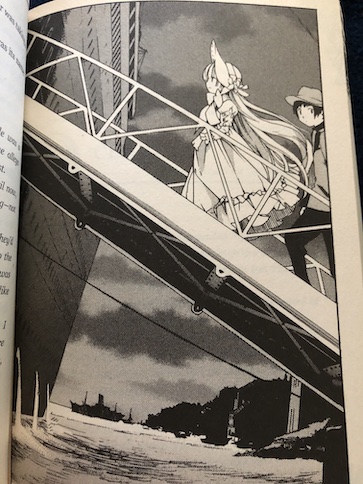
Victorique realizes that the yacht once belonged to the fortune teller and that some of her belongings are still on it. Among them, they find a strange invitation to a dinner party called “Evening at the Bottom of the Box” on a luxury cruise ship anchored nearby. The invitation also mentions that the main dish will be rabbit. This is chilling because it is known that the fortune teller kept rabbits and periodically allowed her dog to hunt them. It was part of her fortune telling – she would predict things based on which rabbits survived the hunt and which did not. (There is a graphic description of this at the beginning of the book that I hated. Although I found the overall mystery intriguing, there are some very gross and violent things in it.) Since they are bored and want to learn what the mystery is about, Victorique and Kazuya decide to use the invitation and attend the dinner in the fortune teller’s place.
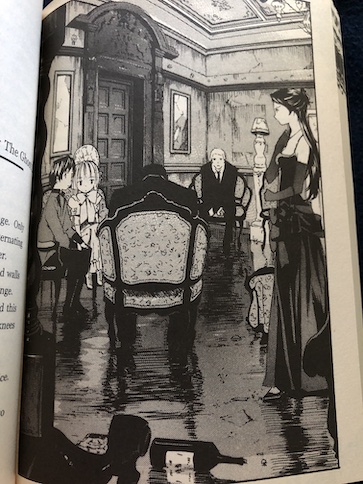
When Victorique and Kazuya join this mysterious dinner party on the luxury ship, Kazuya suddenly recognizes that the name the of ship is the same as the one of a ghost ship in one of the scary stories that Avril told him at school! The ghost stories that have been going around the school have more truth to them than Kazuya or even the students who are obsessed with them have guessed. Some dark things have happened in the history of Sauville which have become part of its local legends. Events that resemble the ones that happened years before and are described in the ghost story are starting to repeat themselves. There is at least one murderer among the dinner party guests, and someone is playing a deadly game. Now, Victorique and Kazuya will have to play along to find the answers and save their own lives!

This is the first book in the Gosick series of Japanese light novels and one of only two that were published in English. There is a full set in Japanese, of course, and I think the German language translation is also a complete set. There is an English translation of this first book available to read for free online at Internet Archive. Because not many copies were published in English, English copies are collectors’ items and can be expensive. As of this writing (September 2023), the cheapest copies on eBay are about $30, and they can go for much higher on Amazon. All of the stories in the series have been made into an anime, and that is available in the US on Amazon Prime. Because of the violence in the story, I would recommend this book and the anime for teens or young adults. It’s not for young kids!
My Reaction
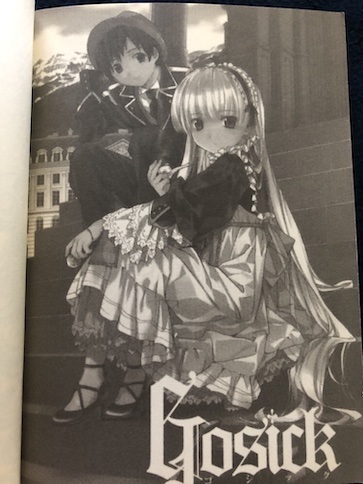
This was the first book in this series that I read, one of only two published in English. The first time I read it, I was surprised at how many tropes of old ghost stories and detective stories that the series references. Victorique uses a pipe, which is an obvious reference to Sherlock Holmes and his famous pipe, but Victorique is also frequently a Nero Wolfe type of detective, relying on an assistant to go places that she can’t go and give her information. She spends most of her time amassing knowledge through reading, and she is able to use that knowledge to make order out of the “chaos” of a mystery.
The basis of this mystery is in fortune telling, and at the beginning of the story, Victorique is reading a book about fortune telling. She explains to Kazuya Kujo how fortune telling actually works. Basically, it’s all about psychology. People think that fortune telling works because they believe it will work, and they make things happen to cause the predicted future to happen. It’s like all prophecies are self-fulfilling prophecies – they may or may not have happened except that people believed that they would, so they made sure they did. People remember and record accurate predictions because those are the most exciting and amazing, and they forget all the inaccurate ones. Fortune tellers are also good at reading people and telling people what they want to hear, which is what they already think will happen or what they’re hoping and working to make happen.

Fortune telling is at the heart of the mystery. Mysteries in this series tend to have over-the-top plots, and this one is no exception. The grudge against the fortune teller and the other guests invited to the dinner goes back to when the fortune teller staged a very large experiment in fate at the request of some very wealthy and influential clients. This past fortune telling experiment was along the lines of the ones that she did with rabbits, only it was with human children. As I said, there are violent and gruesome aspects of this story, and in this case, they were playing with human lives.
As with other books and stories in this series, the ghost stories that the kids pass around at school turn out to have at least some basis in fact. Sauville (remember, it’s a fictional country) and some of its leading citizens have violent histories. There is a long history of conspiracies, power struggles, and general skullduggery in this place. Because of the citizens’ long obsession with stories and legends, much of what has happened there has become legendary, and important people have used the citizens’ superstitions and stories to obscure the truth. Solving the crime means exposing what really happened and the truth behind the legends.
What I found most interesting about this story was its references to some classic characters in detective fiction and ghost stories, and I appreciated Victorique’s thoughts on the nature of fortune telling and human expectations. In the end, it may be more important what people believe and work to make true than what was actually predicted. However, I have to admit that the over-the-top plots of these mysteries are probably a large part of why this series wasn’t printed beyond the second book in the United States. In the beginning of the book, there is also a reference to Kazuya being suspected of a crime. This incident was in the Gosick manga, not the light novels. It is shown in the anime, but I don’t think the manga was printed in English.
 Jestress's Forgotten Books and Stories