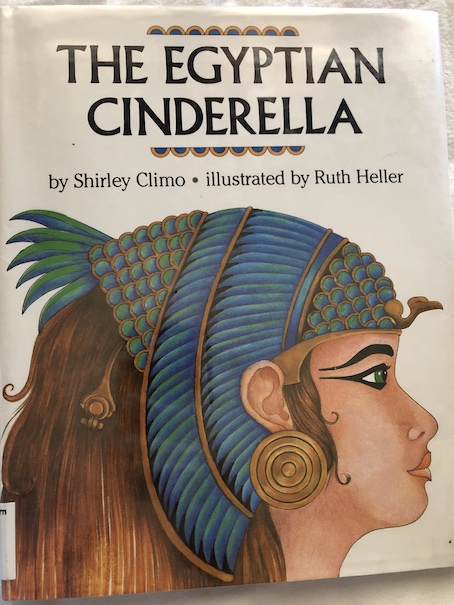
The Egyptian Cinderella by Shirley Climo, illustrated by Ruth Heller, 1989.
Rhodopis is a slave girl in Egypt. When she was young, she was abducted from her home in Greece by pirates, who sold her into slavery. Her blonde hair and green eyes make her look very different from the Egyptian servants, and none of them like her.

Most of Rhodopis’s friends are animals, and in the little free time she has, she likes to dance. The elderly man who owns her sees her dancing and has a special pair of rose-red gold shoes made for her so she can wear them while she dances. However, the Egyptian servants are all jealous of her for getting this special gift.
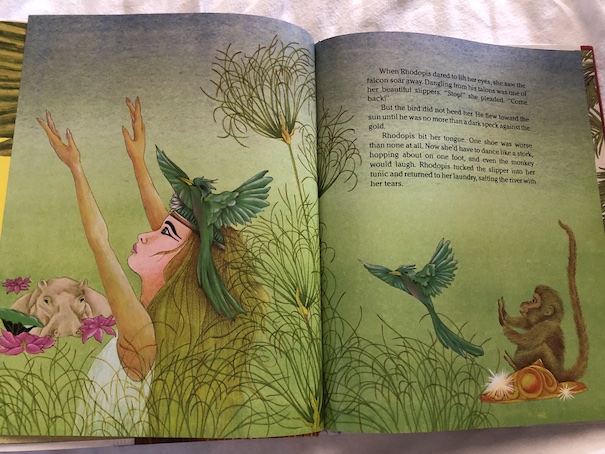
One day, the servants all leave her behind when they go to a special court held by the Pharaoh. While they are gone, a falcon snatches one of Rhodopis’s slippers and flies away. The falcon flies to the court and drops the slipper in the Pharaoh’s lap. The Pharaoh takes this as a sign from Horus that the girl who owns that shoe is destined to be his wife and immediately begins searching for her.

When he finds Rhodopis, the servant girls protest that she is not Egyptian and is only a slave, but the Pharaoh compares her green eyes to the color of the Nile, her light hair to papyrus, and her pink skin to a lotus flower. In his eyes, there could not be any other girl who could represent Egypt, and her slave status doesn’t matter.

The book is available to borrow and read for free online through Internet Archive (multiple copies).
My Reaction
I remember loving this book when I was a kid! I always liked fairy tales and folktales, and I think this was one that was introduced to me by our school librarian, probably around the time it first came out in 1989. For a long time, I was unaware that the same author also wrote other books based on variations of the Cinderella story: The Korean Cinderella, The Persian Cinderella, and The Irish Cinderlad. One of the fascinating things about the story of Cinderella is that variations of the story about a girl (usually, it’s a girl, although there are some variations with a boy) who is abused by her stepmother and stepsisters but who triumphs in the end when she marries a king or a prince, who identifies her as the girl he loves by a lost shoe, have appeared in cultures around the world. The classic one that most of us know is the French version by Perrault, but there are other versions of the story that are older.
There is an author’s note in the back of the book that explains that this Egyptian version of the Cinderella story is one of the oldest known Cinderella stories. The Roman historian Strabo recorded the story in the first century BC. The story is legend, but according to the author, Rhodopis was a real slave girl who married the Pharaoh Amasis in the sixth century BC (although accounts of her vary, and it can be difficult to separate history from legend).
 Jestress's Forgotten Books and Stories
2 thoughts on “The Egyptian Cinderella”