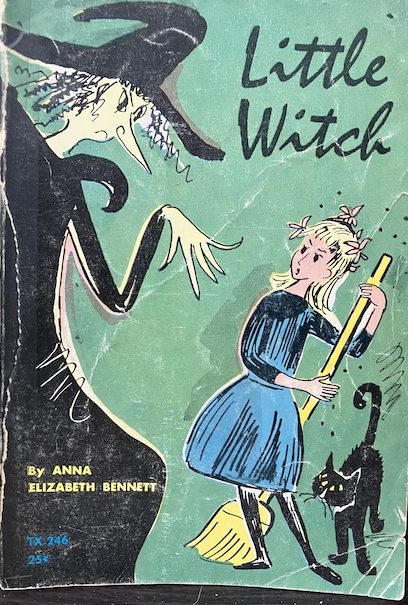
Little Witch by Anna Elizabeth Bennett, 1953.
Little Minx isn’t happy living with her mother, the witch Madam Snickasnee. Minx hates it that Madam Snickasnee enchants the human children of the town, turning them into flowers. She’s lonely and has no one to play with, and everyone around is afraid her because of Madam Snickasnee. Madam Snickasnee is also critical of her, telling her that she had better improve or she’ll never make a good witch because she would rather sleep at night than ride around on a broom or brew evil potions.
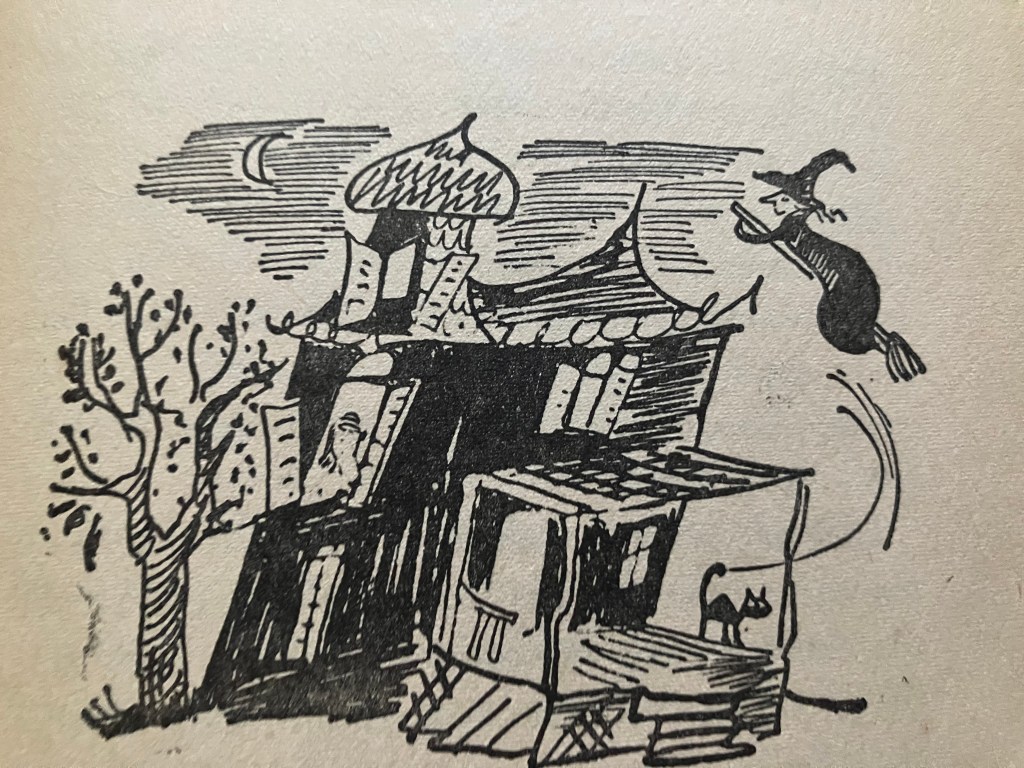
Whenever Madam Snickasnee leaves her home alone, Minx has a secret experiment. More than anything, she wants to see a fairy, so she keeps brewing potions to try to summon one. Unfortunately, it never seems to work. Whenever she tries, instead of a fairy, she gets balloons, toads, or a different type of mythological creature, like a centaur. Minx also has another secret. Whenever she looks in a mirror, she sees the image of a beautiful lady, even when no one else is in the room with her. Minx has no idea who the lady is, and the lady only seems to appear in the mirror.
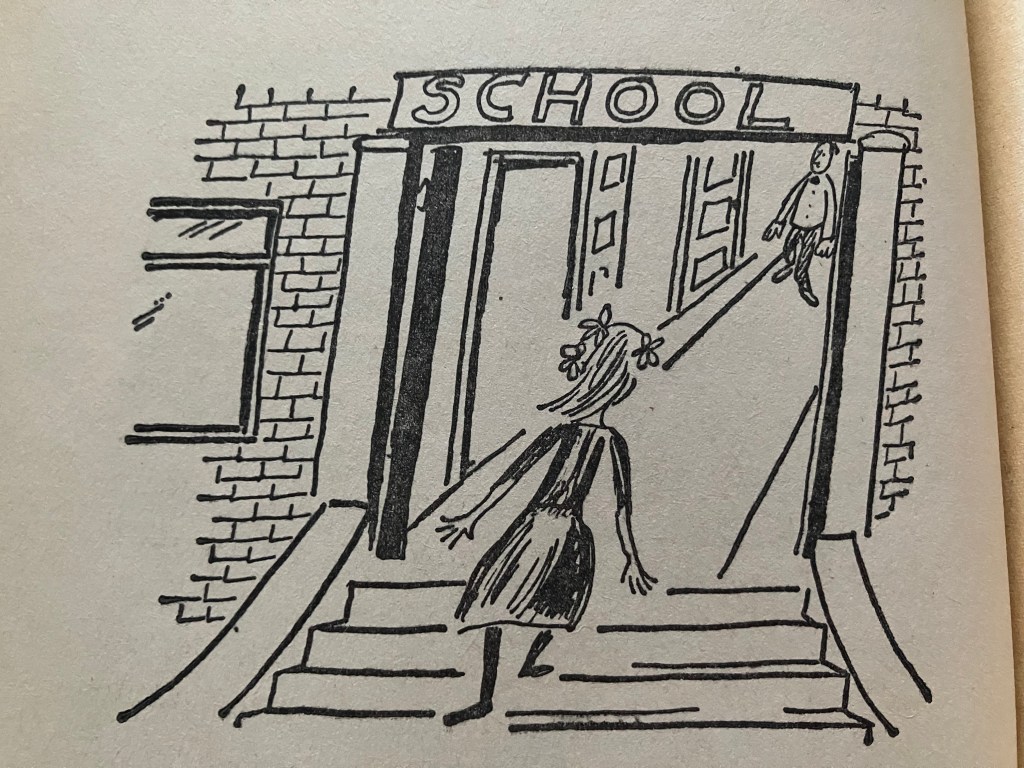
One day, when Madam Snickasnee punishes Minx for not brewing the black spell brew that turns children into flowers by refusing to feed her, Minx decides to take her life into her own hands and do something that Madam Snickasnee has refused to allow her to do: go to school. At first, when Minx reaches the school, she hesitates to go inside, but she hears a little voice telling her to go anyway. A kind janitor takes her to the principal’s office, and Minx tells him that she wants to enroll. When the principal finds out that she’s the witch’s daughter, he is both frightened of her and indignant that she has never been to school before when she is nine years old. Again, Minx hears the little voice telling her not be intimidated. Minx explains that her mother has never allowed her to go before, but now, she’s insisting that she wants to go to school, and it’s her right to go. Because the principal can’t argue with that and because Minx doesn’t know how to read, he sends her to the first grade with much younger children. Everyone at school is a little afraid of Minx, and Minx gets upset, but she meets a kind girl named Frances who shares some cookies with her.
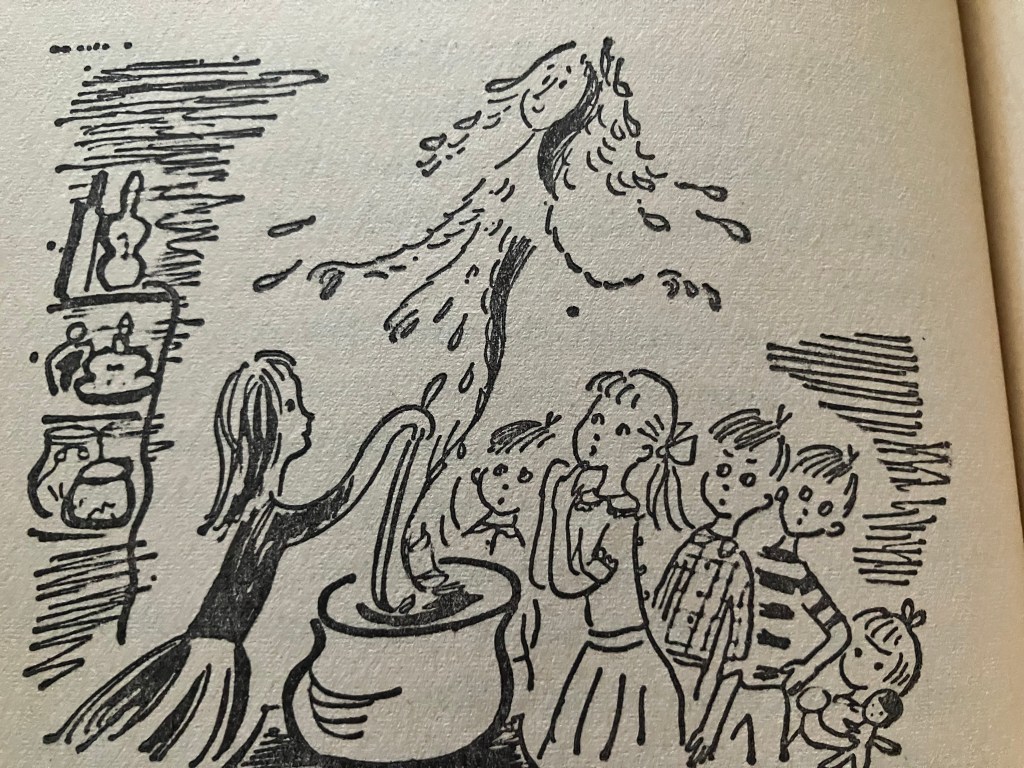
Frances becomes Minx’s first friend, and she invites Minx to her house after school to meet her great-grandmother and her siblings. Frances and her siblings are orphans, and they’re being raised by their kind great-grandmother. Her great-grandmother feeds Minx, and Frances’s siblings find Minx fascinating. When Minx tells them about her experiments to summon a fairy, they want to see her do the next one. Minx sneaks them into the house when the witch is out. They try to summon a fairy, but this time, they get a nixie. They’re thrilled to see a nixie, but Minx still wants to see a fairy. The nixie is about to offer advice for summoning a fairy, but then, the spell ends, and she fades away.
Minx continues to sneak away to school when the witch goes to sleep in the day, but she is approached by a strange man called Mr. Beanpot. Mr. Beanpot is a detective who is investigating the missing children in the town. He strongly suspects that Madam Snickasnee is responsible for the disappearances, and he says that, if she has taken the children, he’s going to send her to jail. Minx is seriously worried because she knows that Madam Snickasnee is guilty, and she doesn’t know what to do about it.
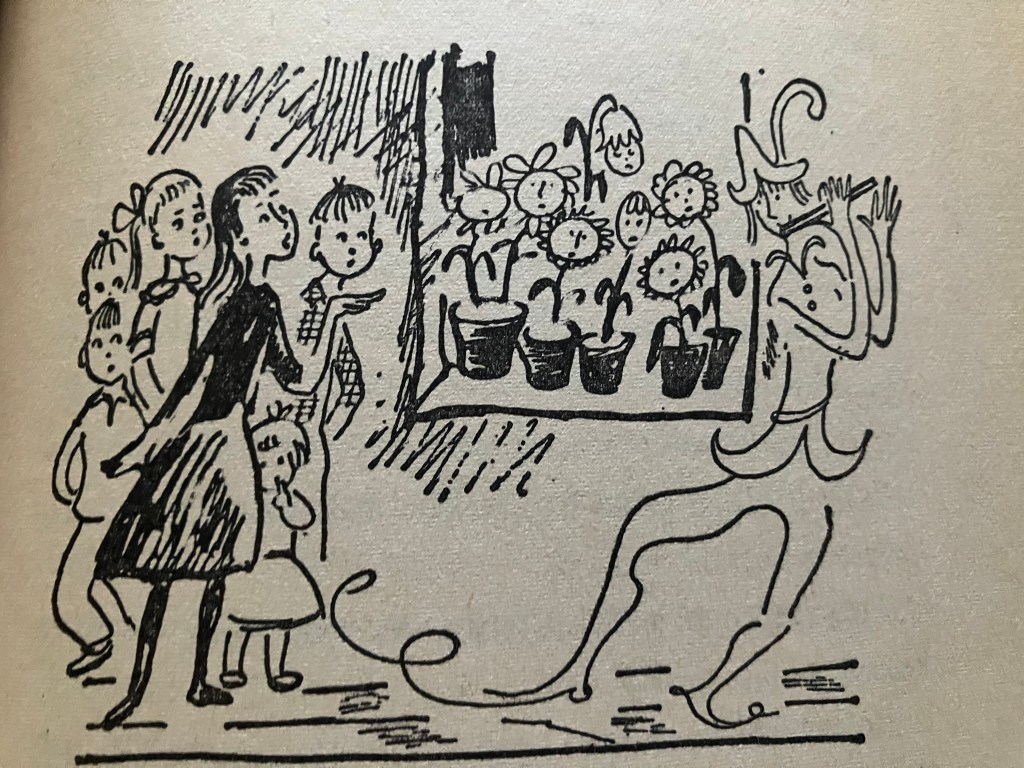
Minx gets a chance to fix things when her next summoning effort brings the famous Pied Piper. Since he knows how to use his own magic on children, Minx asks him if he can break the witch’s spell on the children she has turned into flowers. He does, and Minx lets the children return to their families. Minx hopes that, by letting the children go, the detective will stop his inquiries, but she’s wrong. Mr. Beanpot is still suspicious of the witch. Although the missing children have returned and don’t remember being flowers, those children know that they came from the witch’s house.
Minx worries about what the witch will say when she notices that the flowers are missing, and she worries that Mr. Beanpot will arrest her for being involved in the children’s disappearance. Minx doesn’t know how to handle the situation, so she decides to ask Frances’s great-grandmother about it. Frances’s great-grandmother doesn’t think that Minx will be arrested because she’s just a child. However, when the head of the PTA, Mrs. Sputter, decides to visit the witch to insist that, like all the other mothers of students, she join the PTA, Minx’s secret trips to school are exposed, and the witch turns her into another plant! When Madam Snickasnee confronts Minx about the missing flowers, Minx tells her that she’s hidden them because the detective, Mr. Beanpot, has been snooping around. With Madam Snickasnee suspicious about what Minx has done with the flowers, yet another mysterious disappearance for Mr. Beanpot to investigate, and Madam Snickasnee plotting what she’s going to do about Mr. Beanpot, Minx doesn’t know what to do! The only person she has to talk to is the mysterious, beautiful lady in the mirror, and although Minx doesn’t know it, she’s the one who has the answers to her problems.
My Reaction and Some Spoilers
Part of the twist to this story is that the little witch herself turns out to be the child of a fairy. She was kidnapped by Madam Snickasnee as a baby. When I was a kid, I read a different book with a little witch who turned out to be a fairy called Weeny Witch (that book is very difficult to find these days), but this book is older, and there’s much more to the plot. There are also other books about little witches who go to school, but this book adds in the police and a detective who are very interested in what’s been happening to the local children.
It’s bad enough when the kids disappear, but even turning them back into children and sending them home doesn’t solve the problem. Minx hoped if the children returned home, the police might forget about her and Madam Snickasnee, but that’s not the case. The detective still wants to know where those kids have been and why they can’t remember where they’ve been or what happened when they return home, and the disappearance of the PTA lady is also something that needs investigation. That’s pretty realistic for a fantasy story where people just seem to accept the idea of witches.
I also enjoyed the appearance of different fantasy characters during Minx’s experiments to summon a fairy. Creatures like nixies are less common creatures of children’s fantasy literature, and I appreciated the author adding them to the story instead of just sticking to the most common creatures.
One thing that did bother me about the story is that this is one of those stories that makes it a point that the good characters are fair-haired and have blue blue eyes, in contrast to the Madam Snickasnee, who is dark. I never liked that when I was a kid because I have dark hair and dark eyes, but it’s a particularly common feature of stories from the 1950s. There’s a long history of blondes being idealized. Fairy tales and traditional children’s stories often featured “golden-haired” princesses and heroines (see Alice’s Adventures in Wonderland (shown in illustrations, although the real-life Alice was a brunette) and The Princess and the Goblin) in contrast to dark villains as a kind of shorthand way to use their appearance to contrast between good and evil as part of the “beauty equals goodness” trope. The trope was often found in children’s literature of the 1950s as both a callback to these traditional fairy tales and nostalgic stories and a return to “normalcy” after the chaos of WWII and changing social conditions during the Civil Rights Movement. I find it stereotypical, annoying, and eye-rolling, though. If I had to pick the color of the fairy’s hair in the story, I think I’d give it a real fantasy color, like pink, blue, or lavender.

