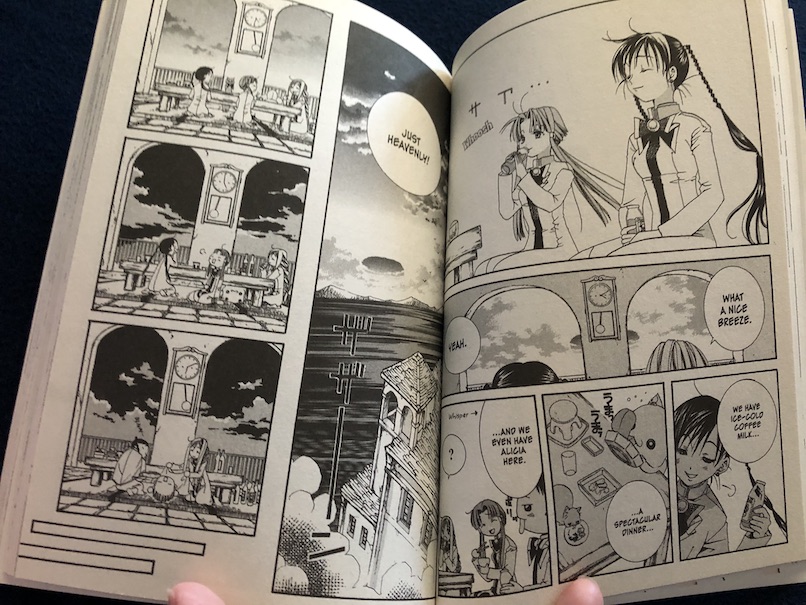
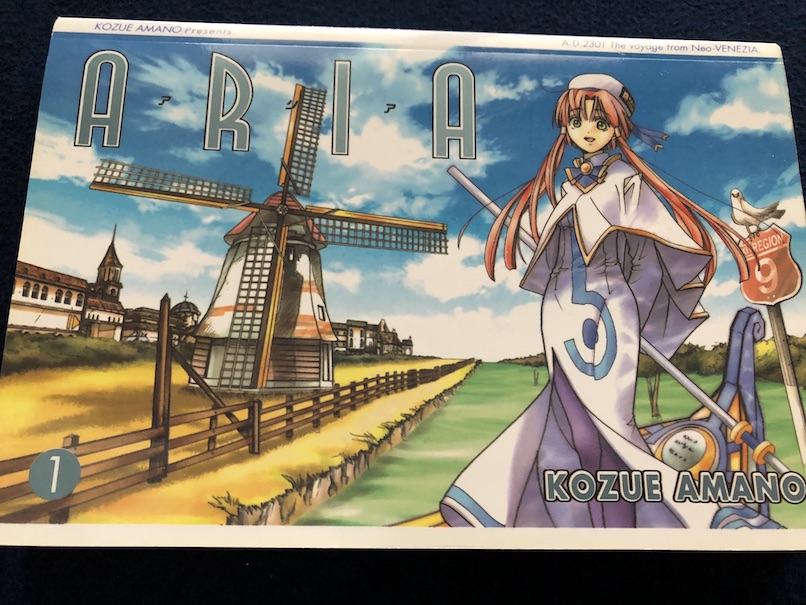
Aria Volume 4

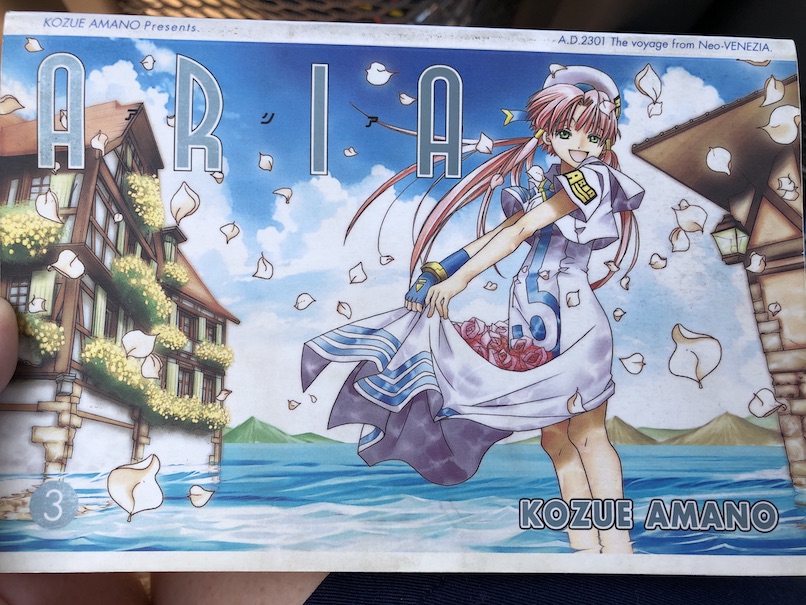
Aria Volume 4 by Kozue Amano, 2004, English Translation 2008.

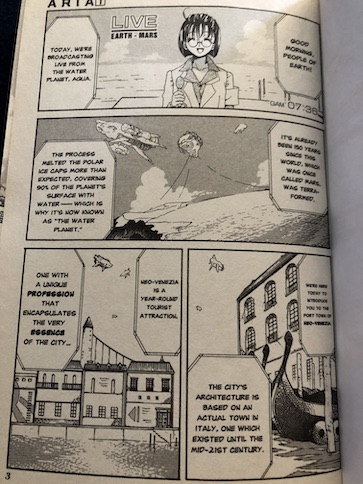
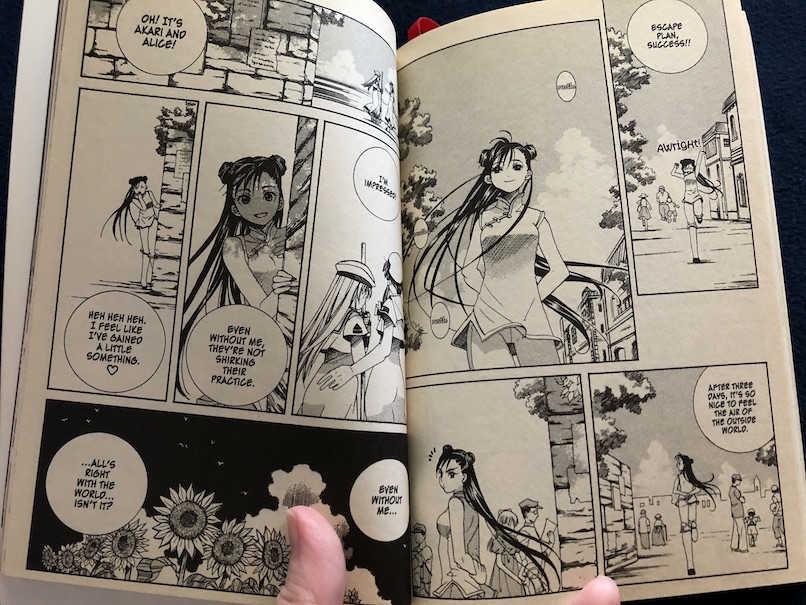
This is the fourth volume of the second part of a fascinating manga series that combines sci-fi, fantasy, and slice of life. The series takes place about 300 years in the future, when Mars has been terraformed and renamed Aqua (because of all the water on its surface). The human colonies on Aqua are designed to resemble old-fashioned cities on Earth (called Manhome here). The people of Aqua prefer a much slower pace of life than people on Manhome, and aspects of life on Aqua more closely resemble Earth’s past.

The series is divided into two parts. The first two books are the Aqua volumes and introduce Akari Mizunashi, the main character, a young girl who came to Aqua to learn to become a gondolier in the city of Neo Venezia (which resembles Venice). Female gondoliers, called Undines, give tours of the city, giving Akari plenty of time to admire the beauty of her new home and meet interesting people. The two Aqua books are the prequel to the main series, Aria. Aqua covers Akari’s arrival on the planet, her introduction to life on Aqua, and the beginning of her training. The main Aria series show Akari’s continuing training, her progression to becoming a full Undine, her evolving relationships with her friends, and as always, her delight in learning more about her new home and admiring its beauty.

The series has received some criticism for being slow and lacking danger and adventure, but that is not really the point of the series. The main purpose is to show people how to appreciate the small pleasures of life. The sci-fi and fantasy elements (the spaceships, advanced environmental controls, intelligent Martian cats, and even the occasional appearances of the legendary Cait Sith) are mainly background to the stories about the magic of friendship and simple pleasures. Each volume contains a few short stories about Akari and her friends and the little adventures they have on a daily basis and the life lessons they learn. It’s a great series for relaxing when you’re stressed out.

The stories included in this volume are:

Neverland

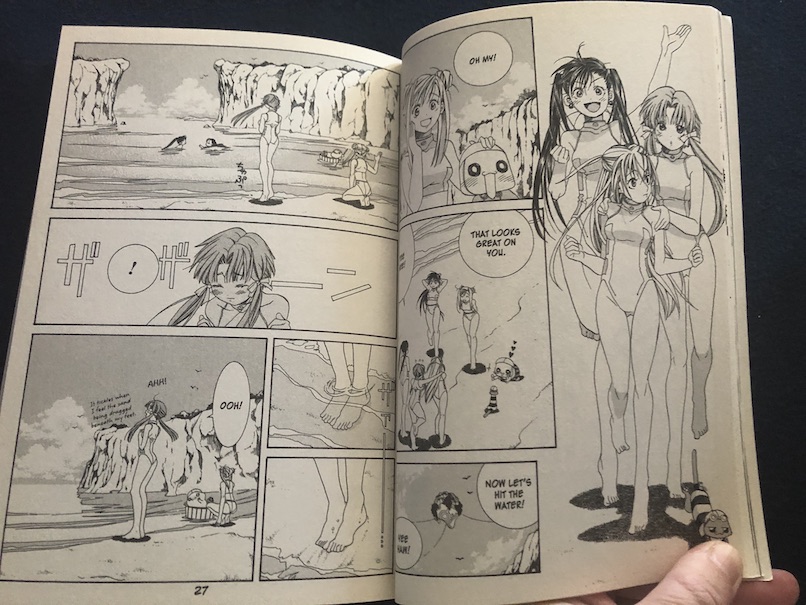
Alicia and Akira arrange a special, surprise trip to the beach for the trainees, a happy day that reminds Akari of Neverland. It starts out with an invitation for each of the trainees that supposedly comes from Peter Pan, inviting them to Neverland, but it turns out to be a fun day at a beach that President Aria found.

Akira wanted the day to be a day of training, but Alicia convinced her that a day of rest and relaxation would benefit the trainees more. The girls put on their swimsuits and enjoy a day of swimming.

Akari thinks that the beach and their day there really is like Neverland, and Alicia realizes that it is because of the way that Akari looks at things. Akari’s strength is the ability to enjoy the simple pleasures in life for what they are, finding the magic in daily life.

This story emphasizes the theme of the series, which is that the most important thing is to choose to be happy.

Traveling Water

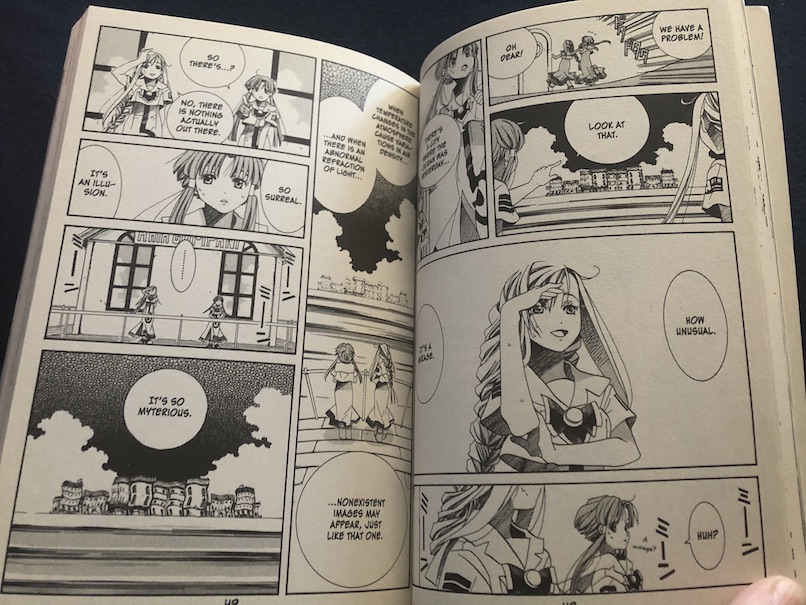
Summer on Aqua is very hot, and Akari experiences her first mirages. People on Aqua sometimes call them “traveling water” because they can look like water that you can never reach. (I grew up in Arizona, and I grew up seeing that. On a straight road, the heat waves will look like distant water, waving and reflecting the scenery, but they appear to dry up or move further away as you go toward them.)

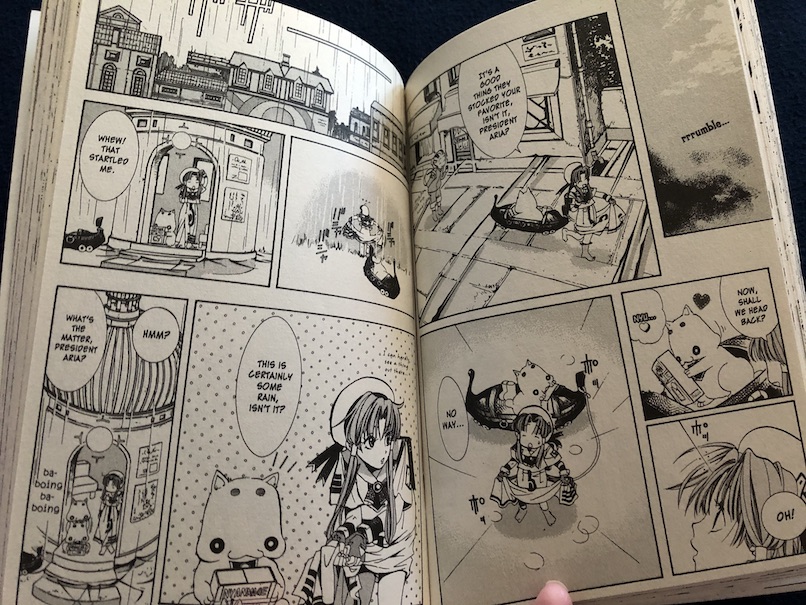
On a very hot day, Akari sets out to buy a night light chime and, oddly, seems to find herself all alone, except for President Aria. She follows President Aria, hoping that he will lead her to a place where she can cool off.

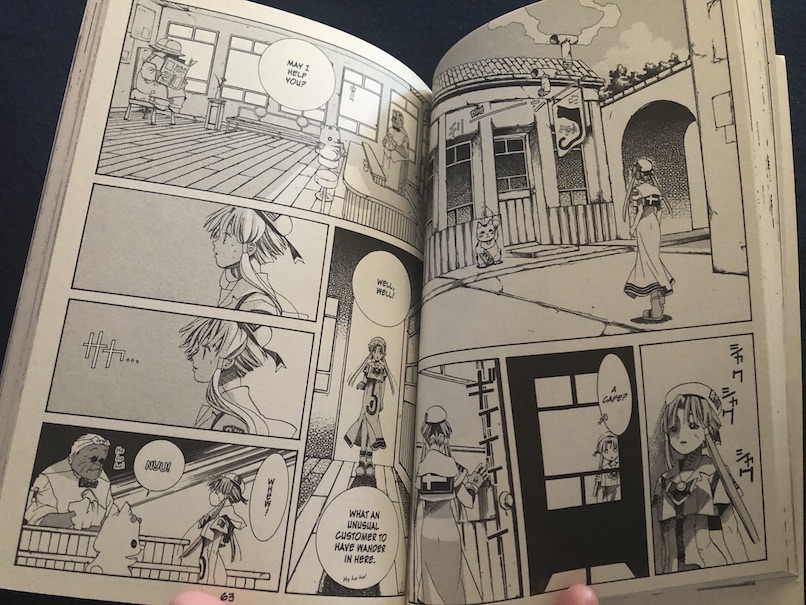
Akari finds herself at a mysterious cafe, which is nice and cool. The server gives her and President Aria ice cold milk, and Akari feels better, but the cafe is no ordinary cafe.

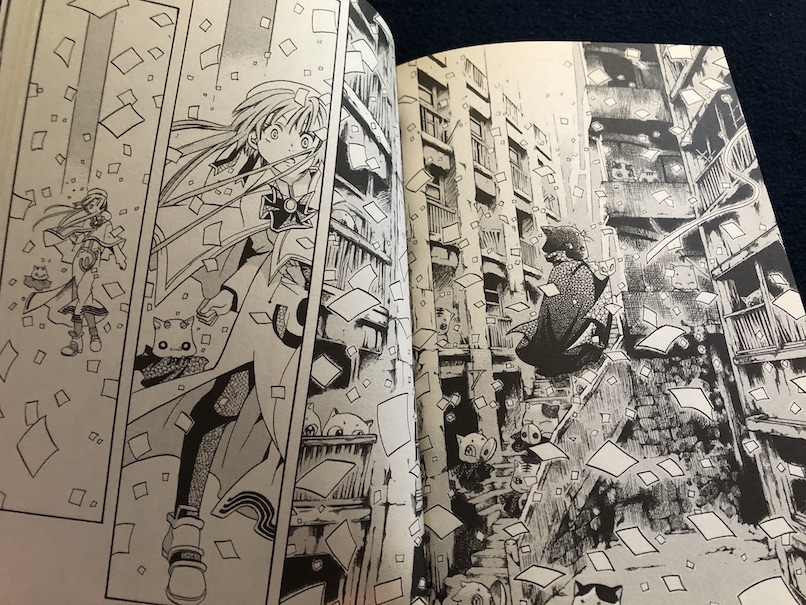
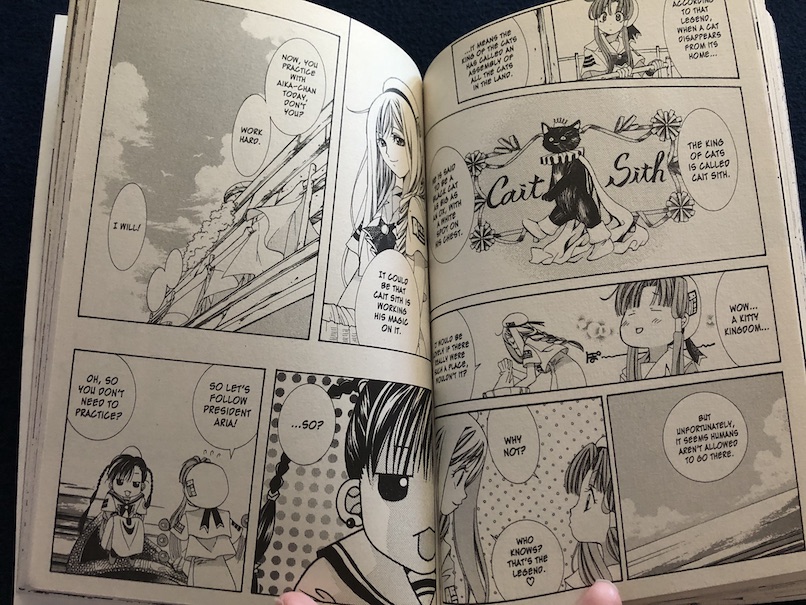
It turns out that the cafe is a secret hangout for cats and their king, Cait Sith. Humans do not ordinarily find their way there. They give Akari a special night light chime and urge her to go on her way …

Unless it was all just another mirage.

I love this story for its “was it all a dream” theme and for the cat-shaped chime that helps confirm that it all really happened. I also like the idea/warning that the server offers to Akari, that maybe it’s a good thing not to completely catch up to a mirage. Akari is sometimes a special guest of the magical characters that inhabit their world, going to places and seeing things that others don’t, but she can’t stay among them because her life is in the human world, and she has to let the fantasy elements slip away to return to her ordinary life that is a little less ordinary for the experiences she’s had.

Flying Fish in the Sky

Akari notices that some of the professions on Aqua relate to the four elements: water, fire, earth, and air. The Undines represent water because they spend their time rowing their gondolas, the Salamanders represent fire because they control the heat levels in the atmosphere to control the weather, and the Gnomes represent earth because they work underground to control gravity. The fourth element-based profession is Sylph, which represents air. They are flying deliverymen.

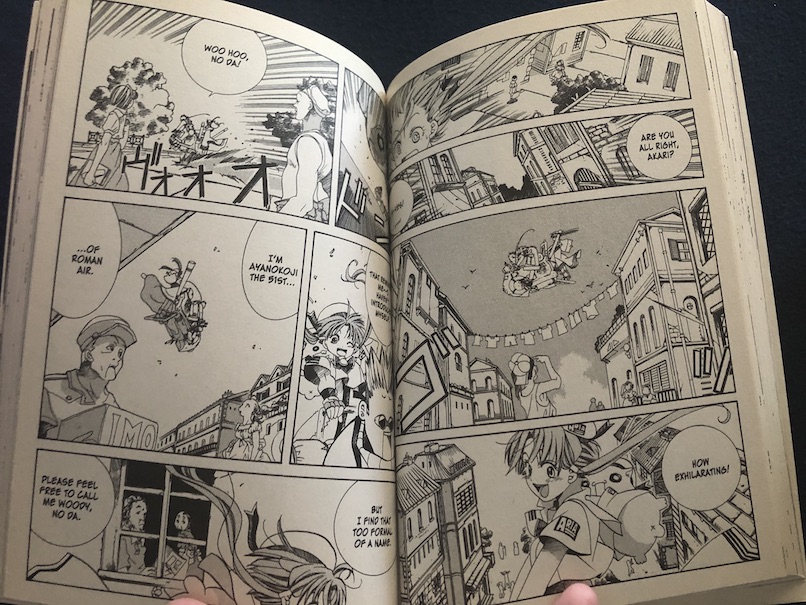
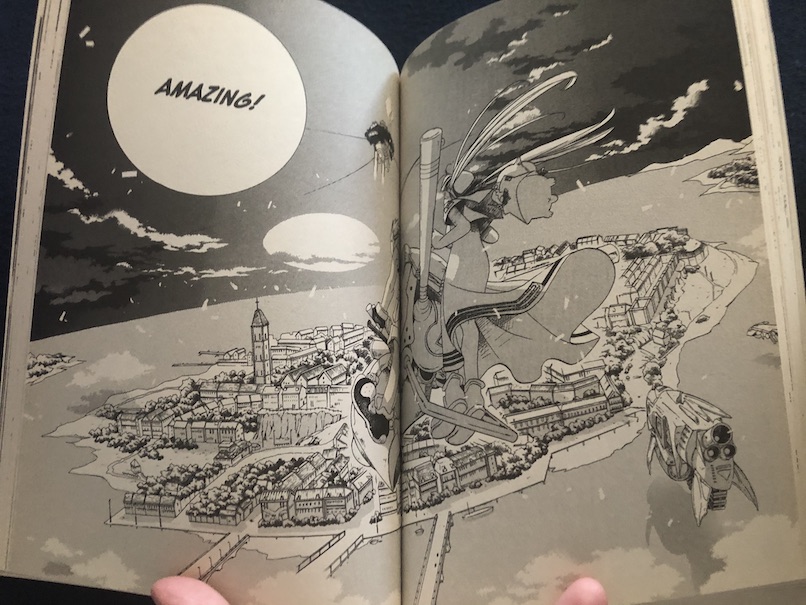
Akari helps a sylph called Woody, a flying deliveryman with a poor sense of direction, after he falls off his flying bike and loses the map he depends on in order to make his deliveries. It’s kind of a scary ride, but it’s also exciting, and Akari gets a bird’s-eye view of her city.

Woody also appears in later stories.

The Legendary Major Fairy

The trainees go to meet the founder of Aria Company, who is considered the Legendary Major Fairy, the grandmother of the younger Undines. She now lives in the countryside, and as the girls help her with some chores and enjoy other activities, Aika keeps looking for hidden tests of their skills or lessons slipped into the activities.

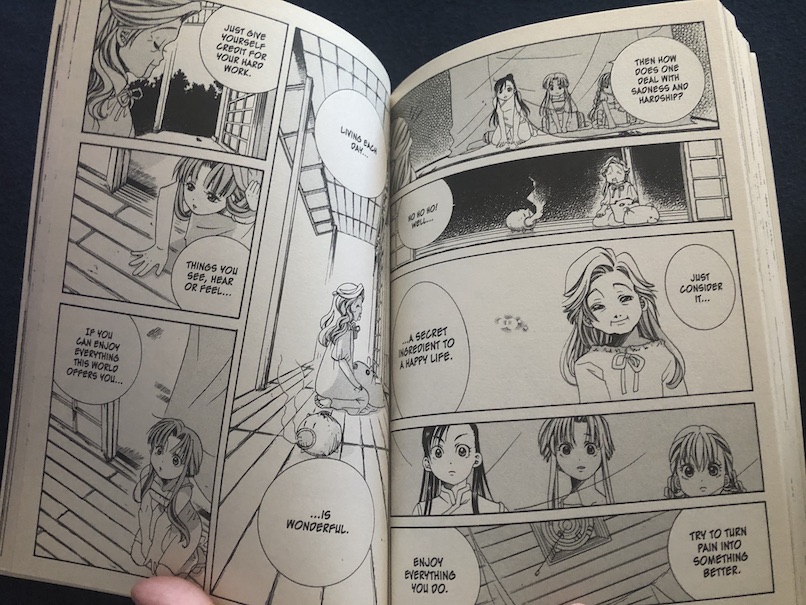
When hidden tests and lessons don’t seem to be in these activities, and the activities just are what they appear to be, Aika gets impatient and worries that maybe the older woman thinks that they’re hopeless and not worth teaching. She asks the Legendary Fairy, who asks them to call her “Grandma”, directly for some advice about being a great Undine, and what she tells them is both simple and yet something that is easy for people to forget.

Grandma’s advice is another repetition of the themes of the entire Aria series, but it’s worth repeating. She tells the girls to enjoy themselves in everything they do (the activities she gave them earlier were for them to enjoy, nothing more), remember that the world and life itself is full of things to enjoy, give yourself credit for your hard work, and when you encounter pain and sadness, try to turn it into something better.

The Redentore

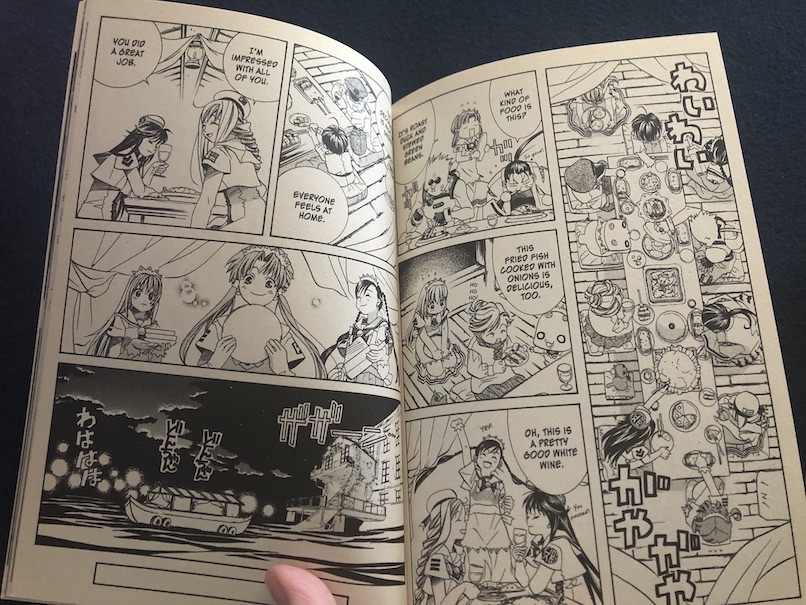
The Undines celebrate Rendentore, a special festival of thanksgiving, with a party on a boat for all of their friends, organized by the trainees. In keeping with the tradition, the trainees invite special guests and use the opportunity to improve their hostess and entertaining skills, designing invitations and planning the meal and entertainment.

The party is a success, and one of the best parts is that the girls have brought together a group of people who otherwise would not have spent time together, except they are tied together by their roles in the lives of the girls.

Aria Volume 3

Aria Volume 3 by Kozue Amano, 2003, English Translation 2004.

This is the third volume of the second part of a fascinating manga series that combines sci-fi, fantasy, and slice of life. The series takes place about 300 years in the future, when Mars has been terraformed and renamed Aqua (because of all the water on its surface). The human colonies on Aqua are designed to resemble old-fashioned cities on Earth (called Manhome here). The people of Aqua prefer a much slower pace of life than people on Manhome, and aspects of life on Aqua more closely resemble Earth’s past.

The series is divided into two parts. The first two books are the Aqua volumes and introduce Akari Mizunashi, the main character, a young girl who came to Aqua to learn to become a gondolier in the city of Neo Venezia (which resembles Venice). Female gondoliers, called Undines, give tours of the city, giving Akari plenty of time to admire the beauty of her new home and meet interesting people. The two Aqua books are the prequel to the main series, Aria. Aqua covers Akari’s arrival on the planet, her introduction to life on Aqua, and the beginning of her training. The main Aria series show Akari’s continuing training, her progression to becoming a full Undine, her evolving relationships with her friends, and as always, her delight in learning more about her new home and admiring its beauty.

The series has received some criticism for being slow and lacking danger and adventure, but that is not really the point of the series. The main purpose is to show people how to appreciate the small pleasures of life. The sci-fi and fantasy elements (the spaceships, advanced environmental controls, intelligent Martian cats, and even the occasional appearances of the legendary Cait Sith) are mainly background to the stories about the magic of friendship and simple pleasures. Each volume contains a few short stories about Akari and her friends and the little adventures they have on a daily basis and the life lessons they learn. It’s a great series for relaxing when you’re stressed out.

The stories included in this volume are:

First Gale of Spring

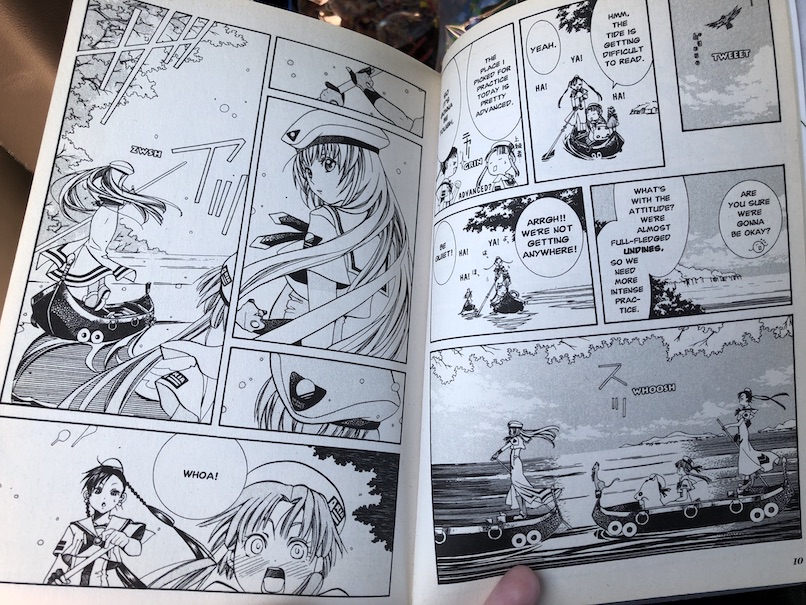
It’s been a full year (full Martian year, which is equal to two Earth years) since Akari moved to Aqua and began her Undine training, and she’s happy that it’s spring again! While Akari and Aika are practicing their rowing one day, they meet another trainee Undine, Alice.

Alice is a young prodigy, only 14. Even though she is rather young and still in school, she’s really good at handling a gondola. However, Aika takes an instant dislike to her, partly because she belongs to Orange Company, a rival of Aika’s gondola company, Himeya. Akari tries to be friendly to Alice and tries to invite her to join them for lunch, but Alice is rude and unfriendly to them.

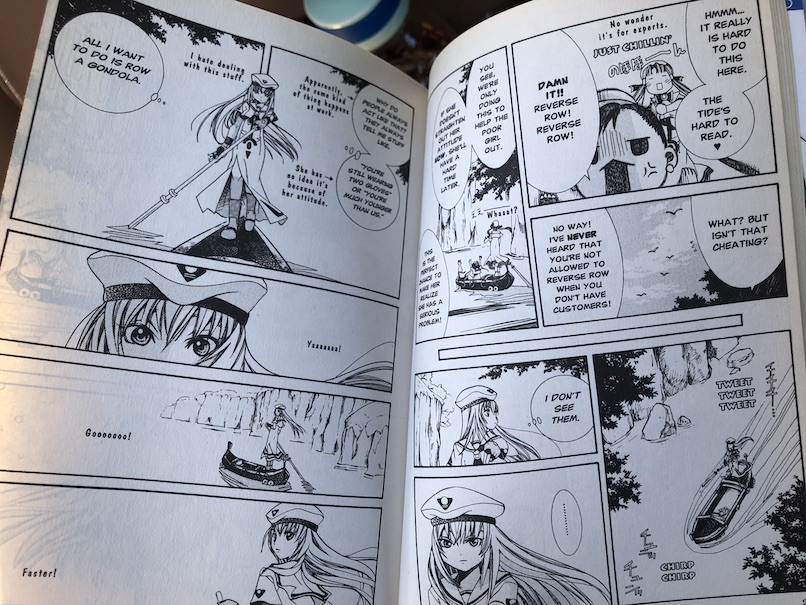
Aika thinks that Alice has an uppity attitude and is disrespectful to them even though they’re higher level trainees than she is. (There is some mild swearing in this part of the story. Most of the Aria series doesn’t have any swearing at all.) To prove her point and put Alice in her place, Aika decides to challenge Alice to a race.

Part of the reason why Alice is so prickly and unfriendly is that she thinks that people look down on her for being young and because they’re jealous of her skills , but she doesn’t realize how her abrasive attitude affects the people around her and their perceptions of her.

Aika has Akari row their gondola in the race, partly so she can use her secret ability to row a gondola backwards really fast, but Akari has her own ideas of how the race will end. Akari is still thinking of the beauty of spring, and even though she makes sure that her gondola will come in second by stopping to pick flowers (the fact that they had time to pick an entire boatload of flowers indicates just how much of a lead they had), she uses them to remind the other girls

Alice actually appeared in one of the prequel books to the Aria series, Aqua Volume 2, as the friend who went with Akari to visit Aika when Aika had a cold. It was the only Aqua story she was in, and this story in the third volume of the Aria series is the true introduction to her character.

Under the Cherry Blossoms in Full Bloom

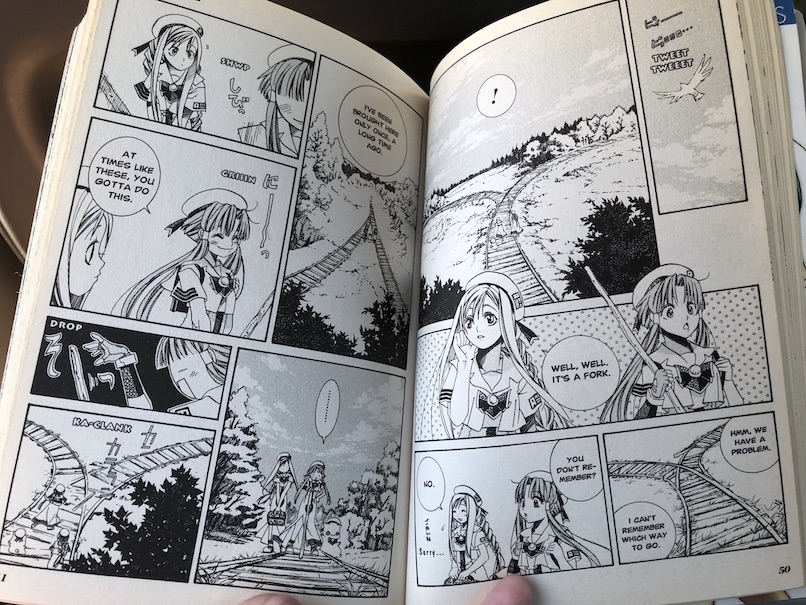
Alicia and Akari decide to go on a picnic to enjoy the beauty of nature in spring. Alicia has a special place in mind for a picnic, but the two of them get lost on the way. Although Alicia remembers that getting to her special spot involves following some old train tracks, when they split off in different directions, she can’t remember which way to go.

Akari picks a random direction. It turns out that the direction she picks doesn’t take them to Alicia’s special place, but they find something else interesting: an abandoned train car underneath a cherry tree in full bloom.

The girls explore the train car and find that part of the roof is missing. They lie in the train car and enjoy the cherry blossoms raining down on them. Akari apologizes to Alicia for not finding her special place, but Alicia says that’s fine because this place is nice, too. She says that sometimes, you have to get a little lost to find something new.

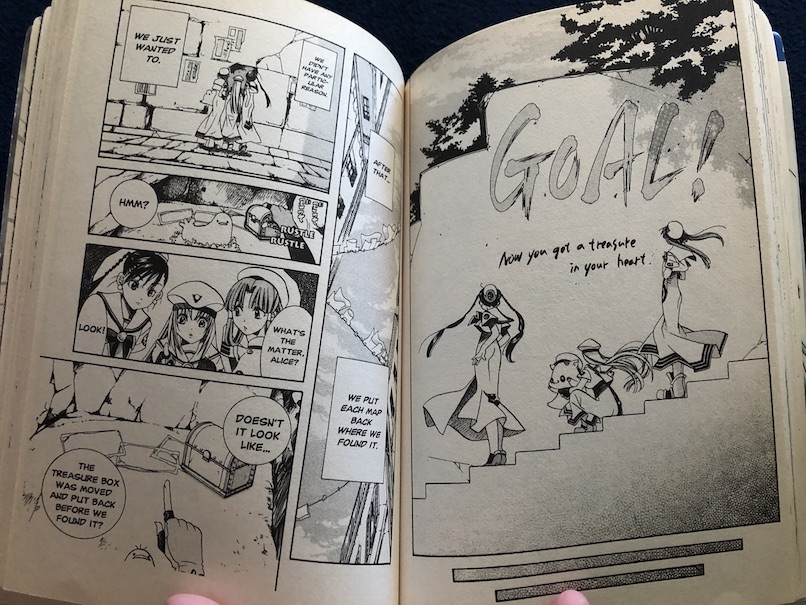
Town Treasure

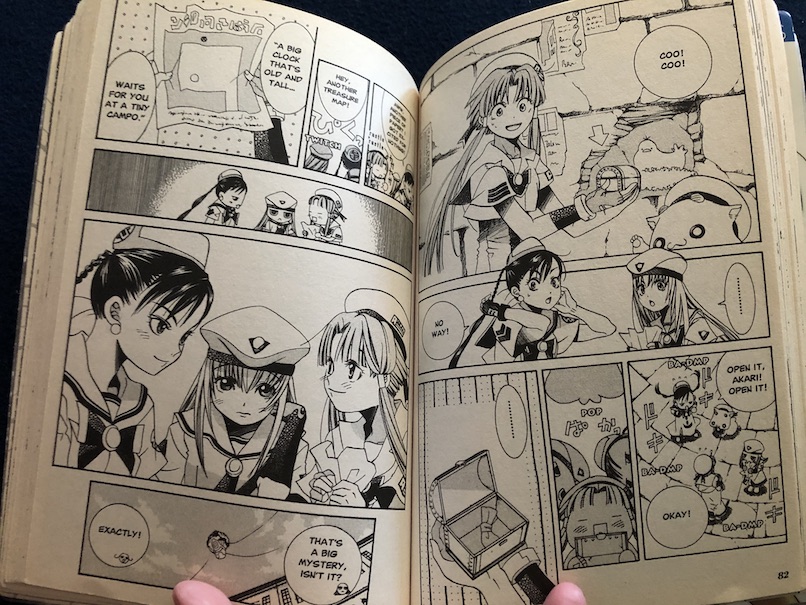
Akari, Aika, and Alice find a message in an old gondola that they borrow from the gondola repairman while Aria Company’s gondolas are being service. The message is in a small box in a hidden compartment of the gondola, and it turns out to be the first clue in a treasure hunt with a special surprise at the end.

Curious to find the treasure, the girls follow the clues through Neo Venezia, and their search leads them to take a second look at places they pass by all the time with little notice and takes them to lesser-known parts of the city that even Aika and Alice, who were born there, haven’t seen.

The treasure hunt finally ends on an often over-looked stairway that actually provides an excellent view of Neo Venezia, and the treasure they find there is the one that made Akari enjoy the treasure hunt from the very beginning.

The girls decide to put all the clues back where they found them, and to their surprise, they notice that there are marks that indicate that many other people have done the same.

Three Water Fairies

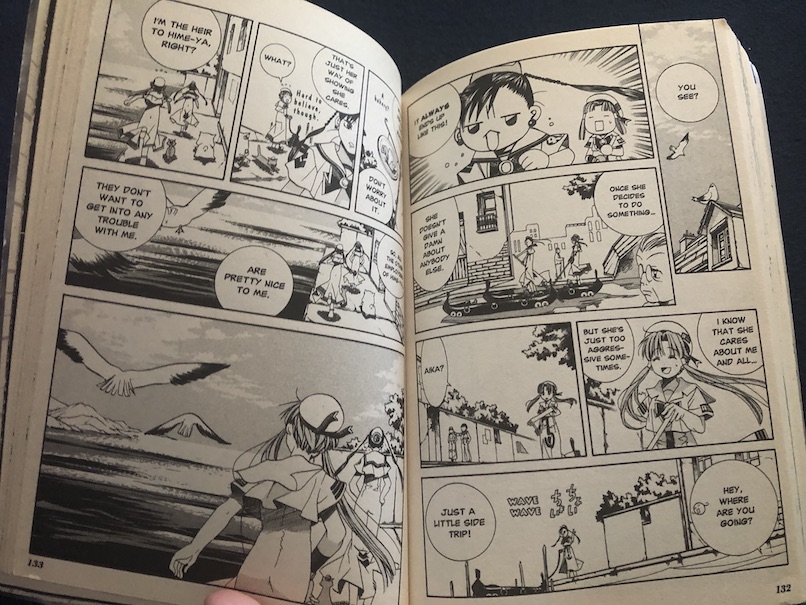
Akari and Aika are training under two of the Three Water Fairies, the best-known Undines on Aqua. However, Aika’s mentor, Akira, is much more strict than Alicia. One day, Aika gets fed up with Akira’s strictness and decides to run away and train under Alicia.

When Akira shows up to reclaim her wayward trainee, Akari learns more about Alicia, Akira, and especially about Aika. Akira was seen briefly in Aqua Volume 2, when Aika snuck out of her room to go buy some pudding, and she was the person Aika was trying to avoid because she was the one making her rest from her cold. However, Akira wasn’t actually introduced until this book, like Alice. This story reveals that Alicia and Akira were friends as trainees, like Akari and Aika, and have had a bit of a rivalry, being considered among the three best Undines, but they haven’t seen each other much in recent years.

Aika had reveals that the reason why she admires Alicia so much is that Alicia was nice to her when she was a child. One day, when she was upset about something, Alicia found her and gave her a ride in her gondola and cheered her up by trying different hairstyles with her hair. This experience is what made Aika want so badly to become an Undine herself. However, Aika could not train under Alicia at Aria Company because her parents actually own Himeya Company, something that Aika has never told Akari before. Aika’s family expects her to work her way up through the ranks as an Undine and eventually take over Himeya Company.

To settle the matter of Aika’s future training, Akira proposes a contest, a race between Aika and Akari, to determine whether Aika will become Alicia’s student or return to Himeya Company with Akira. As Alicia guesses, the “race” between their trainees gives Aika an opportunity to return to Himeya without sacrificing her dignity. It also gives both Akira and Aika an opportunity to consider how they really feel about each other and how much they appreciate each other.

While Akira and Alicia talk about Aika and how she’s both similar to and different from her mentor, Akari and Aika aren’t really having a race. Instead, they talk about how Aika feels about Akira.

Aika says that her position as the future heir of Himeya Company doesn’t matter much to her because she just wants to be an Undine, like Alicia, but she admits that people at Himeya treat her differently from the other trainees because they know who she is. They are extra nice to her and try to avoid getting on her bad side because they want to be friends with the boss’s daughter, who will be their future boss someday. Aika admits that, strict as Akira is, she’s also the one who’s the most honest with her, correcting her when she needs it and not worrying about making her angry. Aika realizes that she needs that honesty in her life and that Akira’s training is helping her. At Aika’s insistance, the girls end their “race” and go buy some walnut pastries for Akira, which Aika offers to her as an apology before returning to Himeya with her. Akari realizes the the bond between Aika and Akira is stronger than either of them wants to admit, and she hopes that, someday, she’ll have a bond that strong with Alicia.

This story is important for explaining more of the backstory of the characters and how they relate to each other. There is a running theme in these stories of having characters whose names begin with the letter ‘A’. In most cases, I don’t mind because the names are usually different enough that it doesn’t matter, but Akira and Akari are rather close.

Festa del Boccolo

Festa del Boccolo is the time when men give red roses to the women they love. Akatsuki has had a crush on Alicia for a long time, and he enlists Akari’s help to give her a boatful of roses to impress her. He needs her help because the town is flooded during high tide again, as it is every year during late spring.

Unfortunately, his elaborate gesture doesn’t go as planned because Alicia has already received many other roses from other people, and she assumes that Akatsuki has bought all of his roses for Akari.

Akatsuki accidentally spills the roses in the water, while trying to get Alicia’s attention. He thinks that he’s completely screwed everything up, but Akari points out that his gesture wasn’t futile because, like the roses floating on the water, his love for Alicia spreads out around him and touches everyone, and one day, Alicia is bound to notice. Akatsuki gives Akari a single rose to thank her for her help, and the two of them enjoy a walk together through the flooded city.

Aria Volume 2

Aria Volume 2 by Kozue Amano, 2003, English Translation 2008.

The is the second volume of the second part of a fascinating manga series that combines sci-fi, fantasy, and slice of life. The series takes place about 300 years in the future, when Mars has been terraformed and renamed Aqua (because of all the water on its surface). The human colonies on Aqua are designed to resemble old-fashioned cities on Earth (called Manhome here). The people of Aqua prefer a much slower pace of life than people on Manhome, and aspects of life on Aqua more closely resemble Earth’s past.

The series is divided into two parts. The first two books are the Aqua volumes and introduce Akari Mizunashi, the main character, a young girl who came to Aqua to learn to become a gondolier in the city of Neo Venezia (which resembles Venice). Female gondoliers, called Undines, give tours of the city, giving Akari plenty of time to admire the beauty of her new home and meet interesting people. The two Aqua books are the prequel to the main series, Aria. Aqua covers Akari’s arrival on the planet, her introduction to life on Aqua, and the beginning of her training. The main Aria series show Akari’s continuing training, her progression to becoming a full Undine, her evolving relationships with her friends, and as always, her delight in learning more about her new home and admiring its beauty.

In the second volume of the Aria series, winter comes to Neo Venezia, and Akari experiences the delights of the changing season and the celebration of a New Year as well as continuing to learn more about her new home.

The series has received some criticism for being slow and lacking danger and adventure, but that is not really the point of the series. The main purpose is to show people how to appreciate the small pleasures of life. The sci-fi and fantasy elements (the spaceships, advanced environmental controls, intelligent Martian cats, and even the occasional appearances of the legendary Cait Sith) are mainly background to the stories about the magic of friendship and simple pleasures. Each volume contains a few short stories about Akari and her friends and the little adventures they have on a daily basis and the life lessons they learn. It’s a great series for relaxing when you’re stressed out.

The stories included in this volume are:

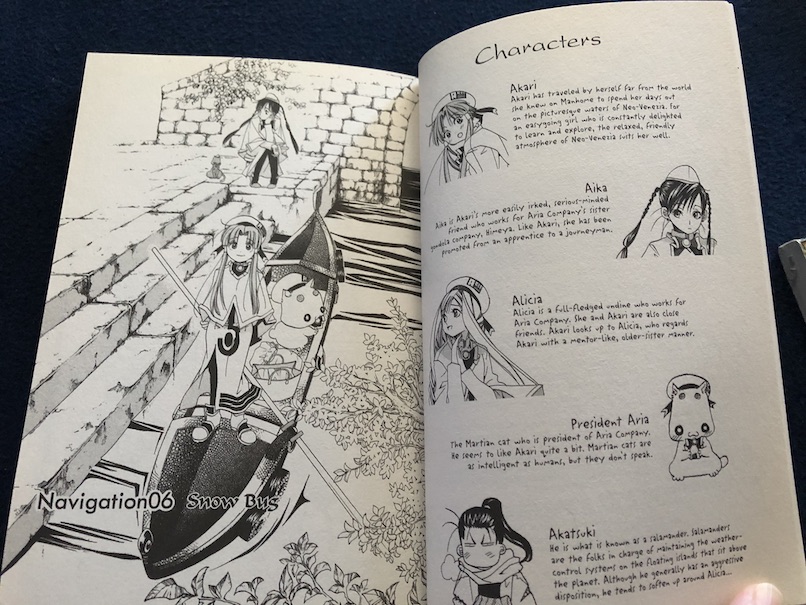
Snow Bug

Snow Bugs (a kind of fluffy aphid) appear on Aqua at the onset of winter. They are larger than Earth aphids, and they look like cute little puff balls with eyes.

Akari makes friends with one of them when she and Alicia go out to gather some firewood, and she brings her Snow Bug friend home with her for awhile.

However, the Snow Bugs appear at this time of year because they are migrating to their winter home, and as snow comes to Neo Venezia, Akari has to accept that her little friend must move on with the other Snow Bugs as it gets colder. Fortunately, Snow Bugs have long life spans, so Akari can count on seeing her little friend again next winter.

Utopia

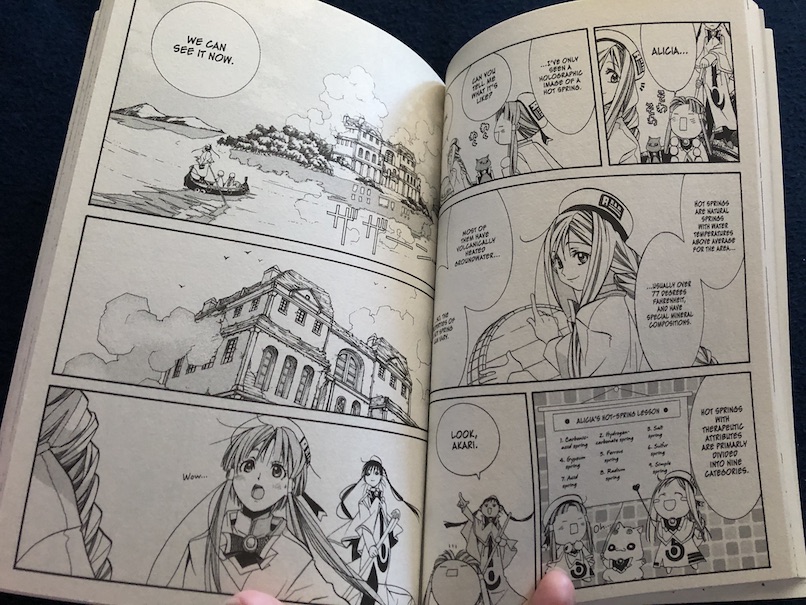
Akari has trouble adjusting to the winter in Neo Venezia because it’s much colder than the winters she is accustomed to on Earth. Aika suggests visiting a hot spring, which Akari has never done before because people on Earth are more technological and not so much into the beauties of nature. Alicia takes Akari and Aika to visit a very special hot spring where the baths are built into a magnificent old mansion.

The mansion has been there for years, and parts of it are now crumbling with disuse, but the hot water from the spring beneath it is now allowed to flow through the lower floors of the old mansion, giving it a mysterious atmosphere, yet it’s still a very relaxing hot bath.

The girls indulge themselves in the baths and have dinner on one of the upper floors with a grand view of the ocean. (Alicia is older than the other girls and a legal adult, so she drinks alcohol. She lets the teenage trainees try a small amount to see what it’s like, but mostly, the younger girls have iced coffee milk.)

After the younger girls have a nap, they go back in the baths, and Alicia shows them a special part of the hot springs. Akari feels a little guilty for taking the day off and indulging themselves, but Alicia says that a break now and then is good.

This is one of my favorite stories in the Aria books because I just like the idea of a mansion being turned into a giant hot spring bath, with water flowing through it. The crumbling bits look a little dangerous to me, but it’s fun to imagine what the rest of the house might be like.

A Day in the Life of the President

President Aria may be an intelligent Martian cat, but he is still a cute kitty. He does cute kitty things, like climbing into bags and boxes, worrying about Akari’s hair dryer, and fighting with a hair brush. It even says that he doesn’t like baths, although he didn’t mind going to the hot spring in the previous story.

Martian cats are supposed to be as intelligent as humans, and it’s established in the series that President Aria and other cats have their own community with Cait Sith, the king of the cats, sneaking off sometimes to meet with each other, but President Aria also does things that people would expect from ordinary pet cats, and it’s not clear why. Then again, it might not matter. The Aria stories are mostly atmospheric and about emotions, so not everything has to be completely explained.

Voices of the Stars

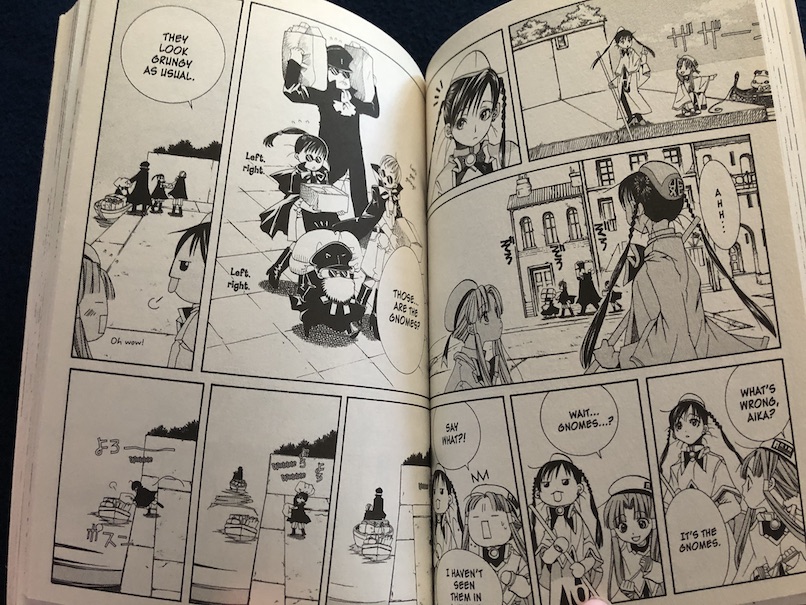
Akari learns about the Gnomes, a group of people who control the gravity on Aqua. Alicia tells her about the gnomes one day when she explains why the gravity on Aqua seems to be the same as on Earth even though its natural gravity would be much less strong. The Gnomes live in their own community underground and only come up to the surface from time to time to go shopping.

One day, Akari and Aika see a group of Gnomes shopping. They help one of them, who is having trouble loading his supplies into his boat. Akari offers to take him home in her gondola, and he accepts, taking her and Aika to see where the Gnomes live underground.

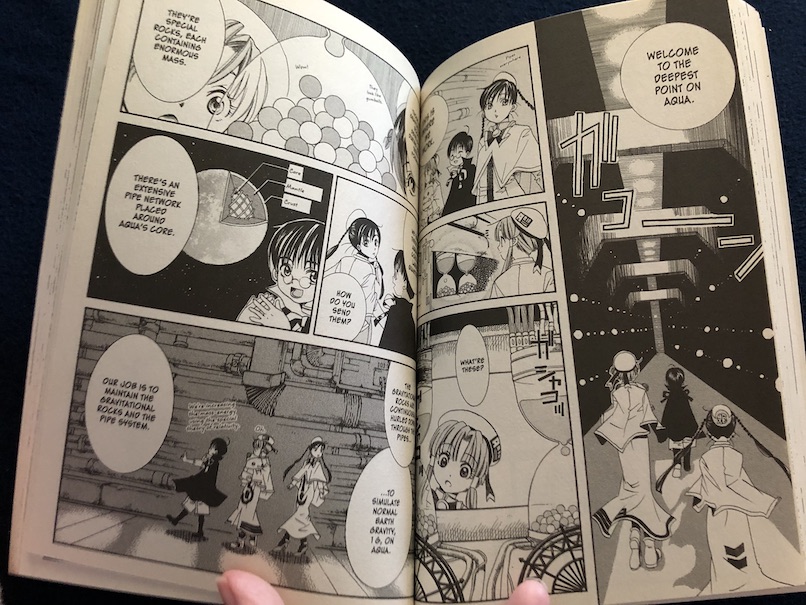
The Gnome, Al, is a trainee Gnome, just a few years older than Akari and Aika, although he is short and looks younger and, oddly, speaks like an older, old-fashioned man. He explains to the girls how the Gnomes control the gravity on Aqua by conducting special high-mass gravitational rocks through a network of pipes surrounding Aqua’s core. As always, the science and technology on Aqua are borderline magical.

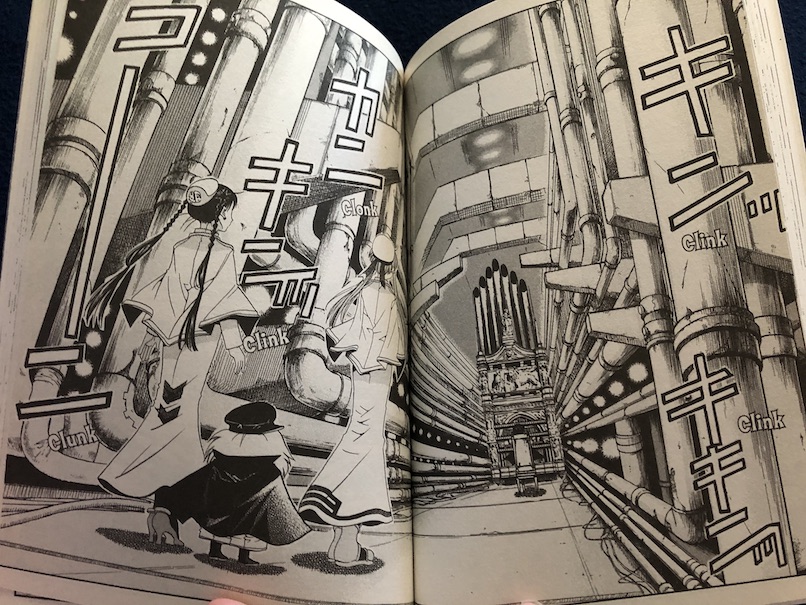
Al shows them where he works, and the machinery that controls the sending of rocks through the pipes is like a large pipe organ, making beautiful musical sounds as it works. Al becomes a recurring character in the Aria stories.

Auguri Di Buon Anno

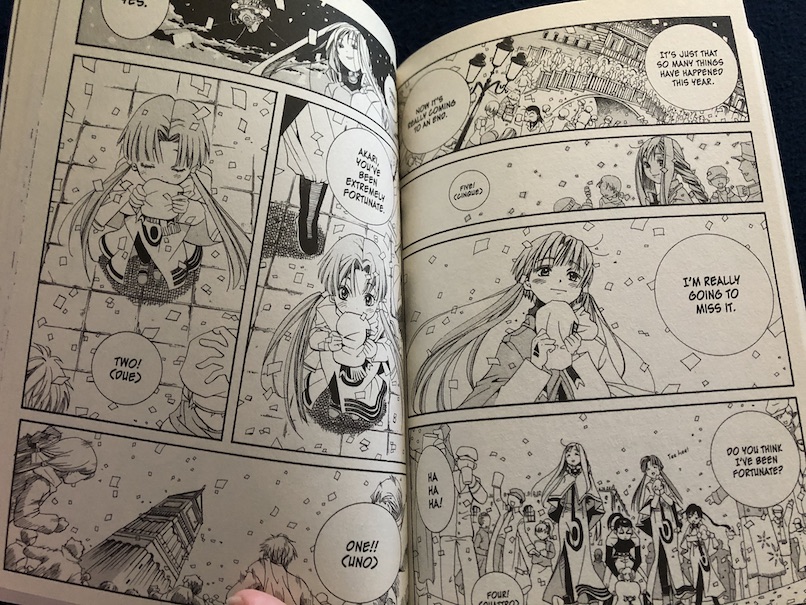
Akari celebrates New Year’s Eve with her friends. It’s interesting how they compare Japanese New Year’s traditions with ones from Venice, from the types of food eaten during the holiday to the way that Japanese people traditionally consider New Year’s Eve a family holiday, while Akari’s friends consider it a holiday to spend with friends in public. Alicia explains to Akari that one of the traditions of Neo Venezia is similar to a traditional Italian custom of throwing out old things on New Year’s Eve as a way of throwing off bad memories from the previous year.

Akari and Alicia join their other friends in the public square on New Year’s Eve, and Akari reflects on how much her life has changed during the last year, since she came to Aqua. During that time, she’s had many new experiences and made many new friends, and she’s grateful for everything that’s happened and all of the good memories she’s had.

Akari and her friends stay out all night and see the sun rise on the first day of the new year.

Carnival

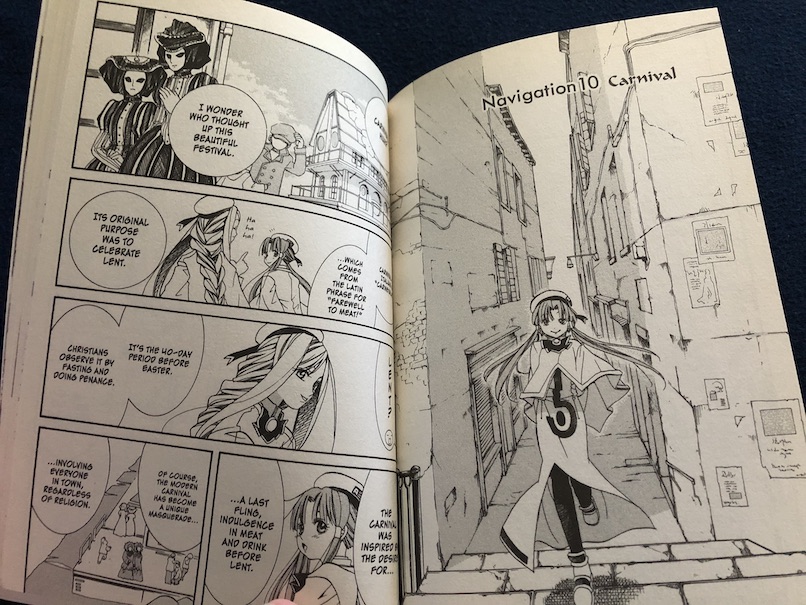
Akari is introduced to the traditions and wonders of a Venice Carnival! Alicia explains the origins of the tradition to her.

However, Akari becomes intrigued by mysterious figure dressed as Casanova. Rumor has it that the same person has played the role of Casanova for 100 years, but no one knows who it is.

Aika and Akari try to follow a member of Casanova’s entourage to see if they can find out who Casanova really is. The two girls get separated, but Akari meets up with Casanova, and he invites her to join his entourage to parade through the crowd.

In the end, Akari does get a look at Casanova without his mask, and it’s a magical end to Carnival!

Aria Volume 1

Aria Volume 1 by Kozue Amano, 2002, English Translation 2004.

The is the first volume of the second part of a fascinating manga series that combines sci-fi, fantasy, and slice of life. The series takes place about 300 years in the future, when Mars has been terraformed and renamed Aqua (because of all the water on its surface). The human colonies on Aqua are designed to resemble old-fashioned cities on Earth (called Manhome here). The people of Aqua prefer a much slower pace of life than people on Manhome, and aspects of life on Aqua more closely resemble Earth’s past.

The series is divided into two parts. The first two books are the Aqua volumes and introduce Akari Mizunashi, the main character, a young girl who came to Aqua to learn to become a gondolier in the city of Neo Venezia (which resembles Venice). Female gondoliers, called Undines, give tours of the city, giving Akari plenty of time to admire the beauty of her new home and meet interesting people. The two Aqua books are the prequel to the main series, Aria. Aqua covers Akari’s arrival on the planet, her introduction to life on Aqua, and the beginning of her training. The main Aria series show Akari’s continuing training, her progression to becoming a full Undine, her evolving relationships with her friends, and as always, her delight in learning more about her new home and admiring its beauty.

The series has received some criticism for being slow and lacking danger and adventure, but that is not really the point of the series. The main purpose is to show people how to appreciate the small pleasures of life. The sci-fi and fantasy elements (the spaceships, advanced environmental controls, intelligent Martian cats, and even the occasional appearances of the legendary Cait Sith) are mainly background to the stories about the magic of friendship and simple pleasures. Each volume contains a few short stories about Akari and her friends and the little adventures they have on a daily basis and the life lessons they learn. It’s a great series for relaxing when you’re stressed out.

The stories included in this volume are:

Neo-Venezia

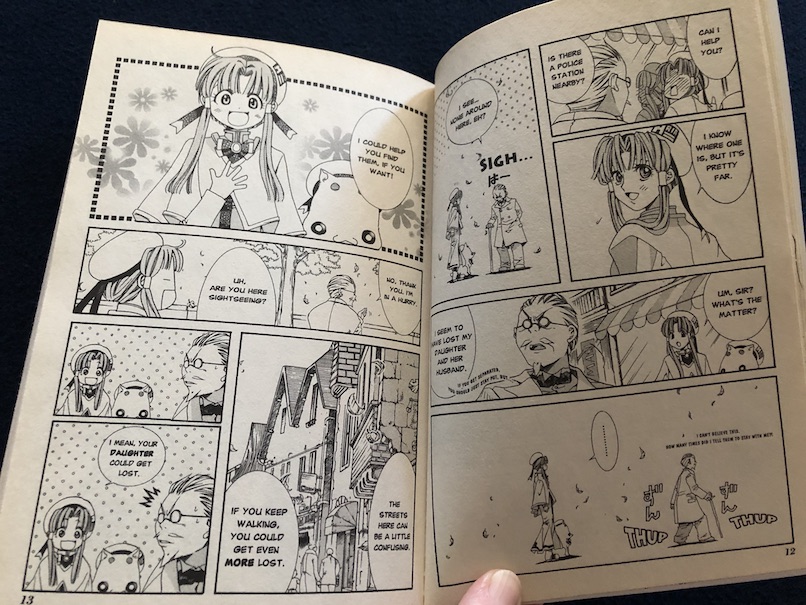
As autumn comes to Neo Venezia, Akari encounters a grumpy old man, a visitor from Earth, who has gotten separated from his daughter and lost in the city. He is frustrated with the confusing and inconvenient nature of Neo Venezia.

Akari says that she can help him find his daughter and gives him a tour of the city, showing him the beauty of the city and changes his mood with the help of some baked potatoes and green tea. A slower pace of life and appreciation for the little pleasures has benefits.

Drydocking

It’s time for the gondolas to be cleaned, so they are moved onto dry land. Akari and her friend, Aika are in charge of the cleaning, but it is Akari who makes it fun.

The Bridge of Sighs

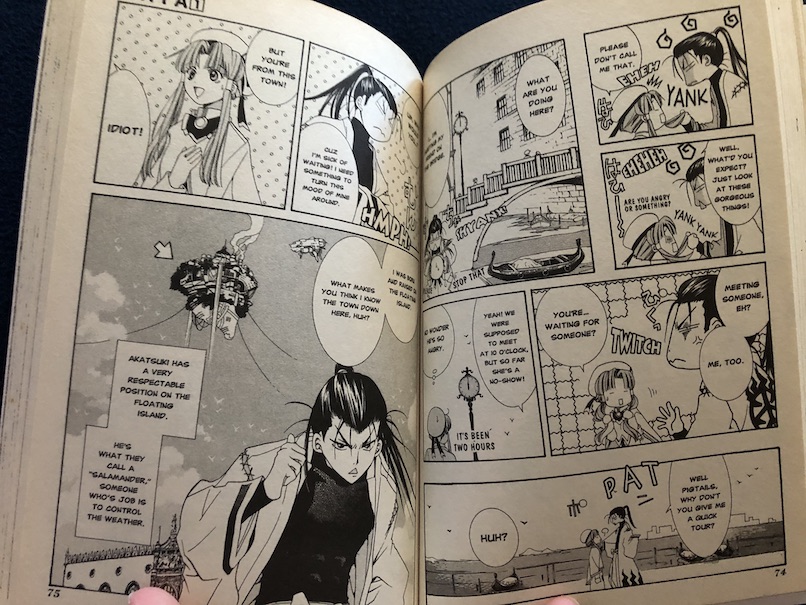
Like the original Venice, Neo-Venezia also has a “Bridge of Sighs.” Akari goes there one day to meet Aika and finds her friend, Akatsuki, waiting for someone. Akatsuki is impatient while he is waiting, so he convinces Akari to give him a short tour to pass the time. Akari tells him about the original Bridge of Sighs and how she thinks the name is still appropriate but for a different reason.

The original Bridge of Sighs, as Akari explains, was between an old courthouse and a prison, and the prisoners were said to sigh as they crossed the bridge because they were being led away to be incarcerated. However, Akari sighs because she likes living in the beautiful city of Neo-Venezia and feels like she’s lucky to be there. Her sigh is a sigh of contentment.

When the person Akatsuki is waiting for shows up, it turns out to be his older brother, who also appears in later stories.

Sun Shower

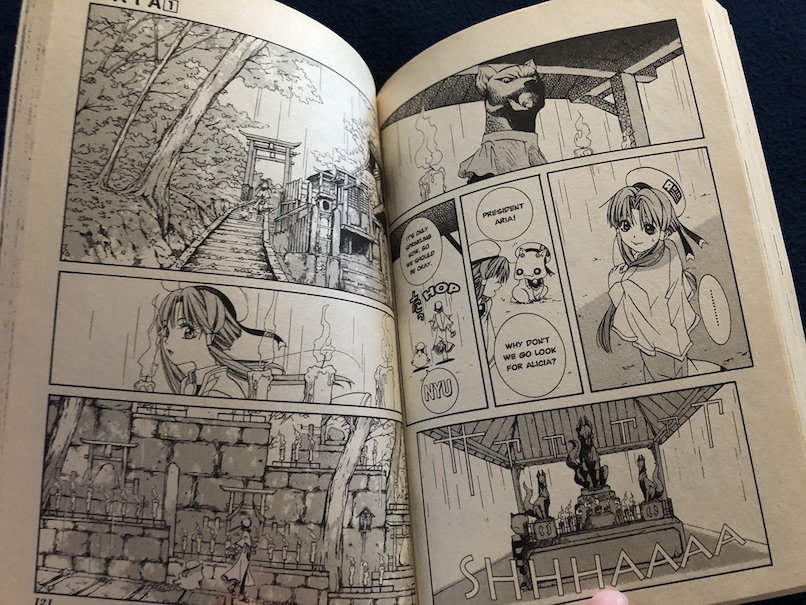
Although Akari lives in Neo-Venezia, which is designed to look like Venice, there are other parts of Aqua designed to look like different parts of Earth. Alicia takes Akari to an area much like Japan to see the changing autumn leaves and get some inarizushi.

They see a shrine on the island, and the woman at the sushi shop tells them a Japanese legend about the fox’s wedding, giving them a warning that the Inari fox might spirit them away to another world.

While admiring the red autumn leaves, Akari finds herself separated from Alicia, and she witnesses a strange wedding procession. When she seems to be invited to join it, she thinks quickly and gives the procession her inarizushi instead.

The story explains that a Japanese term for a sun shower (when it rains while the sun is still shining) is “the fox’s wedding.” Sun showers happen quite often when it rains where I live in Arizona, and I now think of this when I see one. I also know where to get some inarizushi. The Aria stories are good for making me want different types of food, whether it’s inarizushi or baked potatoes and green tea or pudding (from a previous book).

Vogare Longa

This story is based on a real gondola race that takes place in Venice.

Akari and Aika are told about the Vogare Longa gondola race, which all of the gondoliers, including the trainees, will participate in. Aika is determined to make a good showing in the race because there’s a rumor that it is used to judge trainees, but Akari gets caught up in the beauty of the day.

In the end, Akari admits to herself that she never forgot what Aika said about the race being used to judge trainees, but she just didn’t want to hurry because she was enjoying herself, and that’s the way she feels about her training in general. Akari wants to become a full Undine, but she wants to do it at her own pace and enjoy herself along the way.

It turns out to be just as well because the rumor about the race being used to judge trainees was only a rumor.

Aqua Volume 2

Aqua Volume 2 by Kozue Amano, 2003, English Translation 2008.

The is the second volume a fascinating manga series that combines sci-fi, fantasy, and slice of life. The series takes place about 300 years in the future, when Mars has been terraformed and renamed Aqua (because of all the water on its surface). The human colonies on Aqua are designed to resemble old-fashioned cities on Earth (called Manhome here). The people of Aqua prefer a much slower pace of life than people on Manhome, and aspects of life on Aqua more closely resemble Earth’s past.

In the previous volume, a young girl, Akari Mizunashi, came to Aqua to learn to become a gondolier in the city of Neo Venezia (which resembles Venice). Female gondoliers, called Undines, give tours of the city, giving Akari plenty of time to admire the beauty of her new home and meet interesting people.

The two Aqua books are the prequel to the main series, Aria. Aqua covers Akari’s arrival on the planet, her introduction to life on Aqua, and the beginning of her training. The series has received some criticism for being slow and lacking danger and adventure, but that is not really the point of the series. The main purpose is to show people how to appreciate the small pleasures of life. The sci-fi and fantasy elements (the spaceships, advanced environmental controls, intelligent Martian cats, and even the occasional appearances of the legendary Cait Sith) are mainly background to the stories about the magic of friendship and simple pleasures. Each volume contains a few short stories about Akari and her friends and the little adventures they have on a daily basis and the life lessons they learn. It’s a great series for relaxing when you’re stressed out.

The stories included in this volume are:

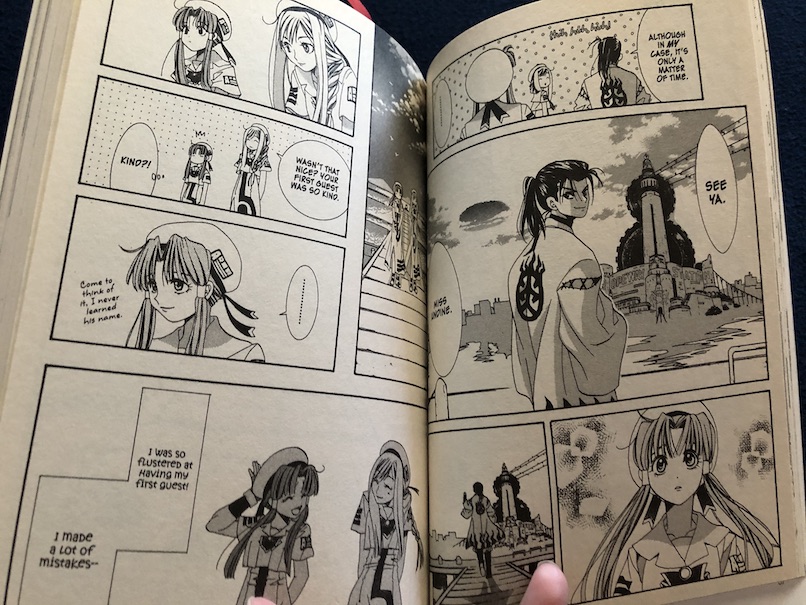
My First Customer

Akari gives her first customer a ride in her gondola. Although she makes mistakes, it is still a memorable experience, and she makes a new friend. Her ability to row a boat very fast backward even comes in handy!

It’s good to read the books and stories in this series in order because characters reappear. Akari’s first customer is Akatsuki, who is a trainee “Salamander” who lives on the floating island of Ukijima above Neo Venezia, which is reached by cable cars. Because Akatsuki spends most of his time on Ukijima, he tends to get lost when he comes into town. He becomes an important character who makes regular appearances through the books. There’s a story later in this book that explains more about his job.

It’s Hard Being President

President Aria feels useless because he can’t help with the spring cleaning. He decides that he isn’t a good president to Aria Company and tries to run away from home but learns that there is nowhere else where he is happy and that his friends still love him.


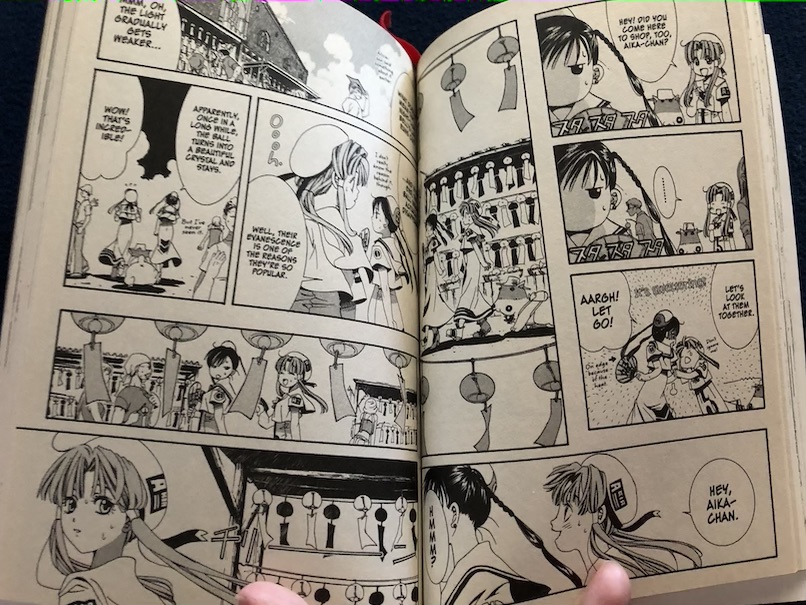
Night-light Bells

In the summer, people in Neo Venezia buy special night-light bells, chimes that glow in the dark.

These bells do not last forever because the glowing center eventually falls out, but sometimes they leave something special behind besides happy summer memories, a tiny crystal.

Akari goes to a night light bell festival and gets a night light bell of her own. The night light bells are a cheery part of summer, and when it’s time for them to expire, the people of Neo Venezia have a special ritual to return the glowing centers to the water when they fall out. However, Akari is lucky and gets one of the bells that has a tiny crystal when the center falls out.

I like this story because I think that the idea of having glow-in-the-dark wind chimes is really charming.

Enter the Hero!

President Aria dreams of being a super hero, like the hero of his favorite television show.

His attempts to be an ally of justice aren’t very successful until he discovers that even doing something small can make a big difference, returning a lost toy to a grateful child.


Fireworks

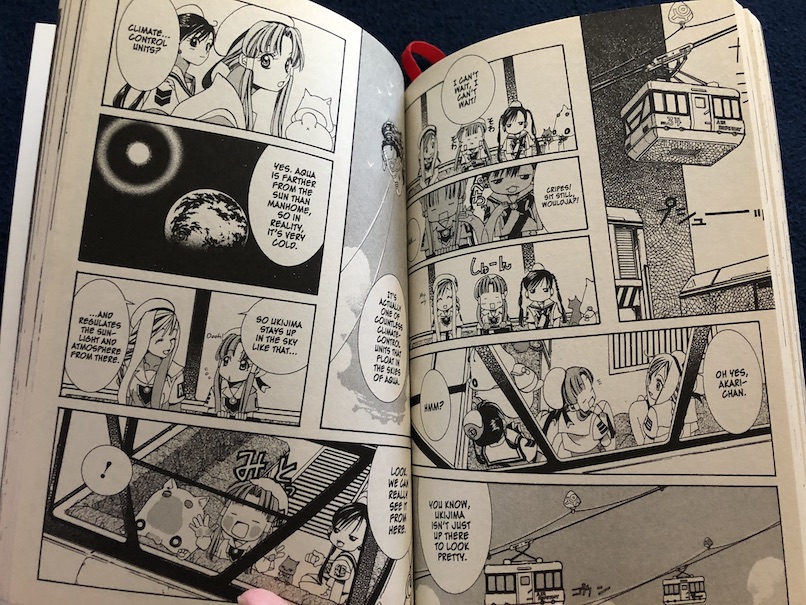
Akari and her friends visit the floating island of Ukijima where her friend, Akatsuki, is learning to be a Salamander. Salamanders help control Aqua’s climate. Because Ukijima is anchored above Neo Venezia, they have to use a cable car to get there, and Akari thinks that the view is amazing, like she’s flying when she’s there.

Akari and her friends have dinner wtih Akatsuki, and he shows them around and explains more about how Ukijima works and what his job as a Salamander involves. Neo Venezia experiences different seasons and different types of weather, but the Salamanders help to regulate it and keep it safe for the residents by controlling the amount of heat released into the atmosphere. The processes behind some of the technology on Aqua sound almost magical.

There are many amazing things on Ukijima, but Akari is most entranced by her first fireworks show. Even though Akari has never seen fireworks before, she finds herself connecting with the nostalgia surrounding them, which she realizes is a feeling that surrounds everything on Aqua and in Neo Venezia because the style of living is more old-fashioned than on Earth/Manhome.


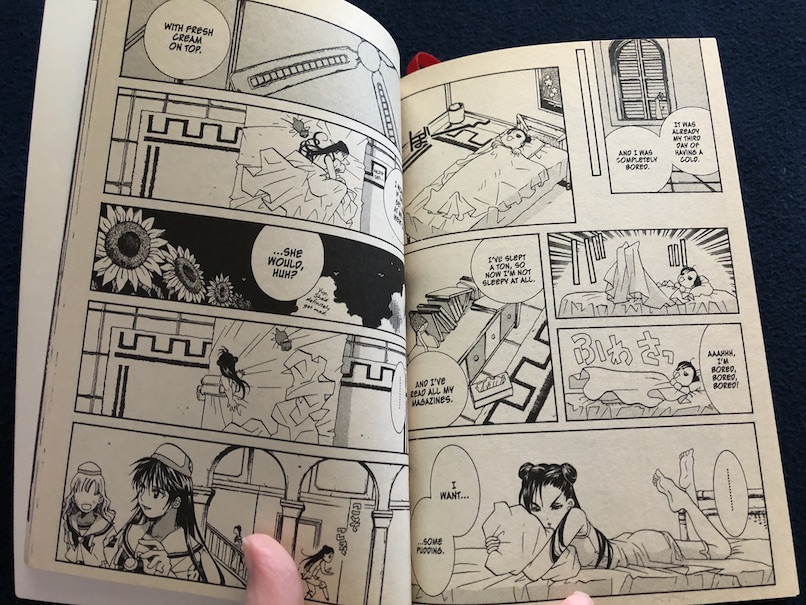
Colds and Pudding

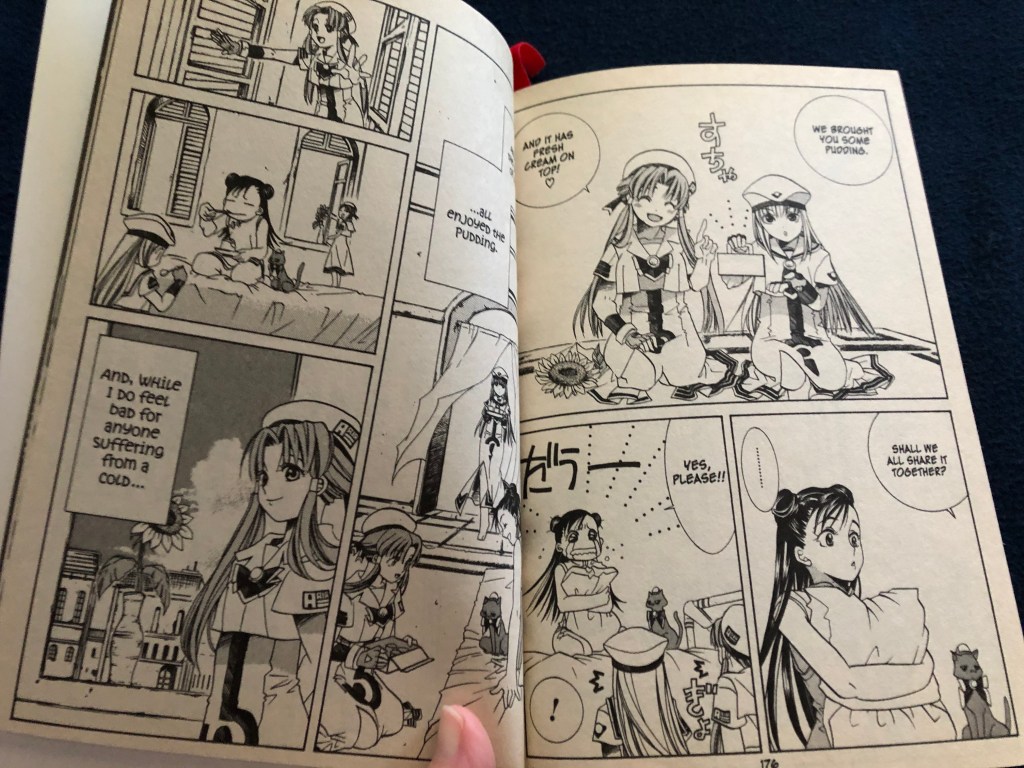
Akari and another friend, Alice (who you don’t really get to meet until the Aria series begins – she’s another trainee Undine), go to visit Aika, who is sick with a cold. They find her upset and learn how a simple trip to get some pudding led to a disturbing epiphany for her.

Aika was bored, hungry, and tired of staying in her room, so she decided to sneak out to get some pudding.

While she was walking through the streets, enjoying her freedom without anyone knowing she that she was gone, she caught sight of Akari and Alice practicing their rowing. At first, Aika is amused that she can spy on them without them noticing her, but then, she gets a strange feeling, realizing that, under normal circumstances, she would be practicing with them, but she can’t be with them now.

It feels eerie to her to see people going on with their day without her, as if she didn’t exist or that her absence doesn’t matter. Aika gets so spooked by the feeling that she runs home and goes back to bed, crying.

However, Aika’s friends do miss her and are thinking about her while she’s sick, and they know exactly what she needs. Trust your friends to help you feel better (and bring you pudding) when you need it!

This is the story that convinced me to learn how to make pudding from scratch one day when I was sick at home. You don’t have to go out and get creepy feelings when you know how to make pudding yourself! Pudding is an easy dessert to make; it just takes awhile to thicken on the stove.

Aqua Volume 1

Aqua Volume 1 by Kozue Amano, 2003, English Edition 2007.

I debated at first about whether or not I wanted to include any Japanese manga or light novels in this blog. When I was in high school and college, I knew a lot of people who were really into anime and manga, and I know that there are teens who still are, and my overview of children’s literature in different decades wouldn’t be complete if I didn’t mention that. However, the variety is pretty extensive, some of the series run very long, and it’s impossible to just skip around in some series because the story-telling is very linear, and I didn’t want them to take over the blog. Also, I tend to like the less popular ones, so I’d be bound to get some grumbling from manga fans about why I chose these when there are so many others that are more exciting or more iconic. Notice that I didn’t say “better.” “Better” is subjective, and I like what I like. I decided to go ahead and make an exception in this case because this is one of my favorite manga series and because I think this is something that people could really use right now. The stories are very calming, and they’re good to read during stressful times.

This book is the first volume of a series. I don’t have them all because they haven’t all been published in English yet, but know how it ends, and it’s a really good series with a happy ending. If you’re not familiar with manga, they’re basically graphic novels from Japan. I can’t read Japanese, so I rely on the English translations. However, manga like this typically follow the Japanese format of reading from right to left instead of left to right, like in English, so the books open and the pages flow in the opposite direction. When you look at the panels on a page, remember to look at them in right to left order.

The Aqua and Aria series is unusual because it combines elements of science fiction and fantasy, but most of the stories themselves aren’t really either science fiction or fantasy. That’s just the setting for the stories. The stories themselves are more slice-of-life, about daily events or small adventures in the lives of the characters and sometimes lessons they learn from them. There is a lot of emphasis on slowing down and enjoying the simple pleasures in life.

The series takes place in the future, when Mars has been terraformed and renamed Aqua (because of all the water on its surface). The human colonies on Aqua are designed to resemble cities on Earth (called Manhome here). The people of Aqua prefer a much slower pace of life than people on Manhome, and aspects of life on Aqua more closely resemble Earth’s past.

A young girl, Akari Mizunashi, comes to Aqua to learn to become a gondolier in the city of Neo Venezia, which resembles Venice. Female gondoliers, called Undines, give tours of the city, giving Akari plenty of time to admire the beauty of her new home and meet interesting people.

There are two parts to this series, called Aqua and Aria. The two Aqua books are the prequel to the main series, Aria. Aqua is only two volumes long, and it covers Akari’s arrival on the planet, her introduction to life on Aqua, and the people who will be her friends. In the Aria books, Akari progresses in her training as an Undine. All of the books in both series contain several short stories.

This book, the first one in the Aqua series, focuses on Akari’s arrival on Aqua and her friendship with Aika, the first fellow Undine trainee she meets.

The stories included in this first volume are:

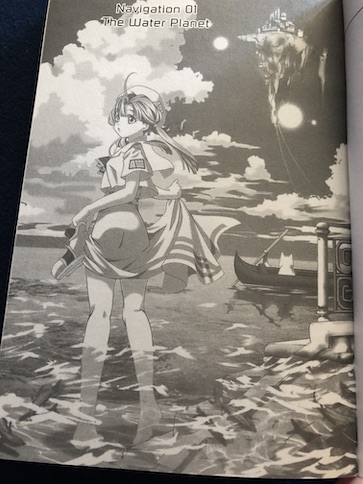
The Water Planet

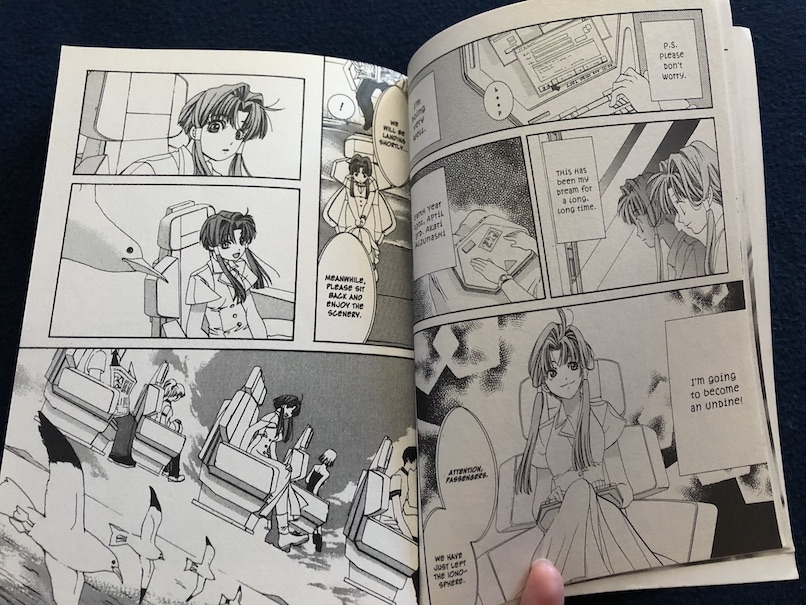
The series begins with Akari Mizunashi on the shuttle carrying her from Manhome to Aqua. She is typing a message to someone on her computer, but there is nothing to indicate who she is writing to. This is a running theme throughout the series, but the identity of Akari’s pen pal isn’t revealed until the very end of the series, and it wouldn’t make sense if I told you who it is right now. Akari explains a little about the history of Mars/Aqua, and how the melting of Mars’s polar ice caps during the terraforming of Mars 150 years earlier has turned it into a water planet, earning it the name Aqua. Currently, the year is 2301.

One of the nice things about the Aqua/Aria series is the imagery. As Akari’s shuttle arrives at Mars/Aqua, the walls of the shuttle turn transparent, so the travelers can feel like they’re flying in with the seagulls.

On Earth/Manhome, Akari lived in Tokyo, Japan. The modern cities of Manhome are very tidy and convenient, with people able to work and shop from home. Still, Akari has felt like something is missing from her life in all the convenience and tidiness. In Neo Venezia on Aqua, people rely on boats constantly to help them get around town, which is inconvenient, but Akari finds it calming and peaceful, which is why she wants to become an Undine, one of the female gondoliers who act as tour guides and help travelers to navigate Neo Venezia. Overall, life on Aqua and in Neo Venezia has a much slower pace than that on Manhome.

Akari arrives on Aqua and meets a friendly mailman and the only two employees of the gondola company she will work for: her mentor, Alicia, and the company’s president, a Martian cat named Aria. All gondola companies on Aqua have a Martian cat as their mascot/president. Alicia explains that Martian cats are as intelligent as humans, even though they can’t talk, but in many ways, President Aria still acts like a very large kitty.

The Guide on the Water

Akari wakes up on her first morning at the gondola company Aria, and she meets Aika, who is a trainee at Himeya, another gondola company. She catches sight of Aika hanging around, watching Alicia, and Aika witnesses Akari’s first time practicing in a gondola under Alicia’s watch.

Akari is embarrassed to learn that when she practiced rowing on Manhome, she was doing it backwards, standing in the front of the boat, which would block the view of her passengers. Because Akari practiced the wrong way on Manhome, she can row very fast the wrong way, but is clumsier when she tries to row the correct way.

However, Aika tells Akari that Alicia is the best of the Undines, and Akari is reassured that under Alicia’s guidance, she will do better. Aika hero-worships Alicia (for reasons that are explained further in later books), and she agrees to become Akari’s friend partly so that she can see more of Alicia. Aika and Akari become best friends through the course of the books, sharing their training and adventures.

The City Submerged

Akari wakes up one morning and is shocked to find that the lower floor of Aria company has flooded, but Alicia explains to her that this is a natural phenomenon in Neo Venezia in Spring.

Much of the city is flooded during this high tide, causing many of the businesses in town to close temporarily and making it unsafe to go out in gondolas. However, when President Aria needs more of his favorite food, Akari decides to venture into the city on foot.

On the way home, Akari and Aria are stranded when it starts to rain and travel become more dangerous, but Aika sees them and invites them to spend the night at Himeya Company with her. Himeya Company is a much larger gondola company than Aria Company, with many more employees living there.

Aika and Akari have a sleepover in Aika’s room, and Aika asks Akari who she’s always writing to, but Akari tells her that it’s a secret. When the rain stops, Akari admires the view of the water by moonlight. (There are two moons in the sky because this is Mars.)

The Kingdom of Cats

President Aria sometimes ventures off alone, and Alicia tells Akari the story of Cait Sith and the mythical kingdom of cats.

When Akari and Aika practice their rowing together, Akari convinces Aika to help her follow President Aira to see if there’s any truth to Alicia’s story perhaps get a look at the kitty kingdom ruled by the legendary king of the cats, Cait Sith.

However, the trip is stranger than they bargained for. The girls find themselves on a strange waterway through apparently abandoned buildings, going around in circles until President Aria points the way out. Akari only gets a glimpse of the cats before they leave.

The Hill of Hope

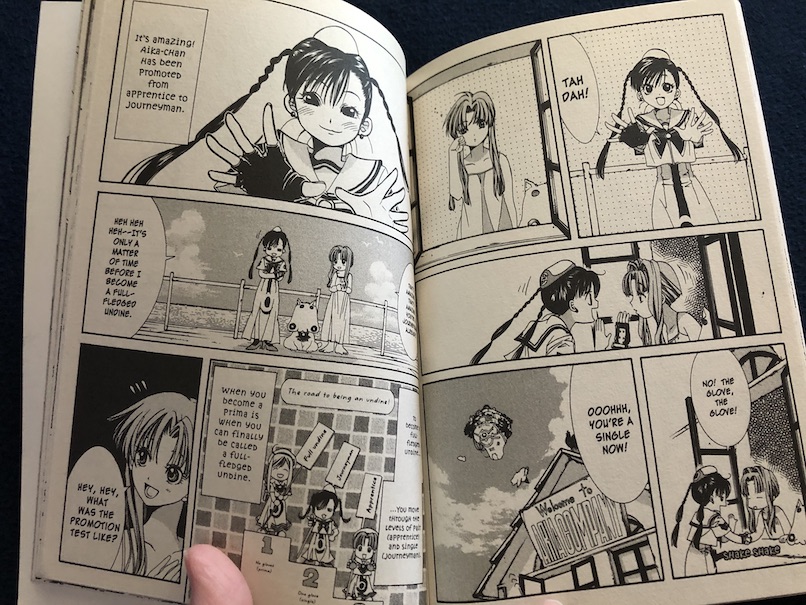
Aika shows up at Aria company one morning to brag about how she has been promoted to single (the next step up in gondola training, as shown by the gloves that the girls wear – as the trainee Undines learn the techniques to row their boats more skillfully, they get fewer callouses and need their gloves less, removing them one at a time as they are promoted to new levels).

Akari tries to ask Aika what the promotion test is like, but Aika refuses to tell her. The Undines traditionally keep the test a secret from their trainees until they pass the test. When Alicia hears about Aika’s promotion, she decides to take Akari on a special picnic, giving her the opportunity to prove her skills and introducing her to the concept of aquatic elevators, or canal locks. There is a special surprise for Akari at the end of the journey.

Betsy-Tacy

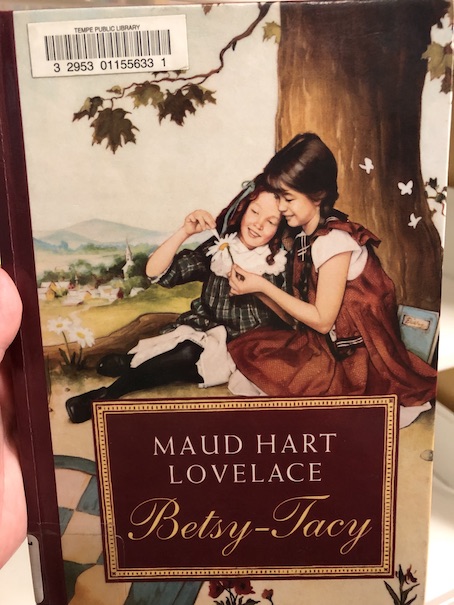
Betsy-Tacy by Maud Hart Lovelace, 1940.

This is the first book in a series about two best friends growing up in Minnesota around the turn of the 20th century. The stories in this book and the rest of the series are based on the author’s own childhood experiences with her best friend.

At the beginning of the book, Betsy meets her best friend, Tacy (short for Anastacia), for the first time after Tacy’s family moves into a house nearby when the girls are both about five years old.  Tacy is very shy and doesn’t want to talk to Betsy at first.  It isn’t until Betsy’s fifth birthday party, a short time later, that the girls really get to know each other and become friends.  After that, they are inseparable, almost to the point where people begin to think of them as one person, Betsy-Tacy. 

Each of the chapters in the book is a short story.  Some of them are about everyday things, like how Betsy would make up stories about her and her friend, how the girls would play dress up and paper dolls, or how they would have a “store” and sell bottles of colored sand to their friends.  Some of the stories are touching, as the girls help each other through some of the most important times of their young lives.  Betsy, the more out-going one, helps shy Tacy through the trauma of their first day of school.  Tacy, who has many brothers and sisters, reassures Betsy that everything will be alright when Betsy’s younger sister is born.  Both girls struggle to come to terms with the death of Tacy’s baby sister. 

At the end of the story, the girls make a new friend when a family moves into the chocolate-colored house with the stained glass window that the girls had always admired.

In the 60th anniversary edition of the book, there are pictures of the author and her best friend, Bick, who is the model for Tacy in the stories, and pictures of the author’s family.  There is also a description of the author’s early life and how the stories were based off her recollections of her own childhood.

This book is available to borrow for free online through Internet Archive.

Rosy Noses, Freezing Toes

Pee Wee Scouts

#13 Rosy Noses, Freezing Toes by Judy Delton, 1990.

At one of the scout meetings, Mrs. Peters, the troop leader, says that her antique vase is missing. It’s a family heirloom, and Mrs. Peters wants to ask the scouts if they know anything about its disappearance or if they have any idea of what could have happened to it. None of them knows, but they’re fascinated by the mystery. After they search the house and can’t find it, Mrs. Peters says that she’ll just have to report its disappearance to the insurance company. Mrs. Peters is willing to let the matter go at that, but the scouts keep wondering what happened to the vase and if one of them could have taken it.

Mrs. Peters tells the scouts that the next badge they will earn will be their music badge. To earn the badge, the children will have to sing or play an instrument or tell the group about the life of a composer. Some of the children already play instruments and know what they’re going to do, but others aren’t sure. Since it’s December, Mrs. Peters suggests that some of them could sing popular Christmas songs or a Hanukkah song.

Sonny Betz declares that he doesn’t want to participate because he can’t play an instrument and over the next few days, he seems upset and nasty with people. Molly asks him what the matter is, and Sonny tells her that his mother is forcing him to take violin lessons. Mrs. Betz has always wanted Sonny to learn to play the violin, and his new violin teacher has assured her that Sonny will be able to learn the first line of Jingle Bells in time for the scouts’ music show, even though it’s coming up fast. Sonny isn’t happy about it, and to make him feel better, Molly tells him that he’s lucky because nobody else will be playing the violin and it will make him different. Unfortunately, the other kids tease him and call him “Maestro,” so he starts feeling bad.

Molly doesn’t like the way the others keep teasing Sonny, and when Tracy says that Sonny is a baby, Molly tells her that it’s not his fault because his mother is the one who makes him take violin lessons and keep the training wheels on his bike even though he’s in the second grade and all the other things that people tease him about. Mrs. Betz doesn’t realize how much Sonny hates some of the things that she makes him do and how much the other kids tease Sonny about these things. Molly overhears her mother saying that Sonny will “be a handful by the time he gets to high school,” probably because she’s imagining that Sonny will rebel against all things his mother has been making him do once he’s a teenager. Actually, it’s not going to take that long.

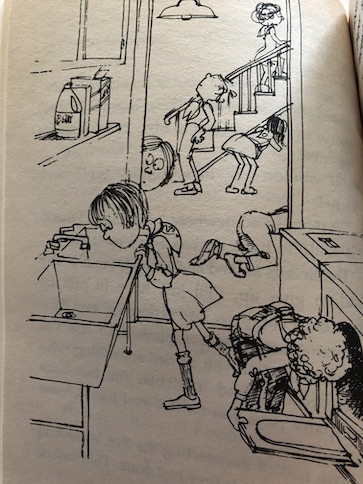
Mrs. Peters uses the insurance money from her vase to buy a piano. The scouts’ music show goes okay at first, although none of the kids are spectacular at music. Molly, Mary Beth, and Lisa paint their noses red and sing Rudolph the Red-Nosed Reindeer. Kevin whistles. Roger plays White Christmas on the drums with no other accompaniment, confusing everyone about what song he’s actually playing. Poor Sonny has to go last, when everyone is starting to get tired of the entertainment, but he doesn’t play well. The other scouts cover their ears, and the screeching of the violin makes the dog bark and Mrs. Peters’s baby cry. Sonny is so upset that he runs away from the show and has a fit.

The next day, Molly learns that Sonny has run away from home completely, leaving behind a note that he’s heading to Alaska. Everyone is searching for Sonny and getting worried about him being outside alone in the snow. However, Molly soon discovers that Sonny hasn’t gone as far as everyone fears and he’s certainly not on his way to Alaska. She discovers Sonny hiding in her family’s bathtub. Sonny explains to her that he didn’t have the money to go to Alaska, but he couldn’t bring himself to go home, and he picked Molly’s house to hide in because Molly is the only one who didn’t tease at him. Molly promises not to turn him in, but she says that he won’t be able to stay in her bathtub forever. His mother has called the police to report his disappearance, and Molly’s parents are bound to find him eventually. Sonny swears that he can’t go home because he hates playing the violin so much. What can Molly do to help him change his mind?

I didn’t like the way the other scouts were so mean to Sonny in the book. Sonny does do childish things, like being mean to the younger kids on the playground when he’s upset and throwing fits when things go wrong. However, Molly tries to be understanding with Sonny, even when he’s being fussy and whining, and she recognizes that Sonny is in a difficult position. His mother has certain expectations of him, and Sonny doesn’t think that anything will change her mind. The way things work out, though, makes it seem like Sonny never really explained to his mother how upset he was about the violin lessons and maybe not even how upset he’s been about some other things. Part of Sonny’s difficulty and the reason why he seems babyish to the other kids is that he seems to have trouble managing and articulating his emotions, including standing up for himself and what he really wants. Some of the other scouts help Molly to convince Sonny that running away isn’t the solution, and Molly calls Mrs. Betz to tell her that Sonny is okay but won’t come home until she promises that he can stop playing the violin. Sonny declares that he wants to see that in writing, and his mother gladly writes him a note that says that he doesn’t have to play the violin again.

So, what about the antique vase mystery from the beginning of the story? Before the end of the book, they do locate the missing vase (not really stolen, more misplaced and forgotten), but Molly accidentally breaks it. Mrs. Peters says that it’s okay because, with the vase broken, she doesn’t have to give the money back to the insurance company, and she gets to keep her new piano. She’s been wanting a piano, and the truth is that she never really liked the vase, even though it was a family heirloom. Yay? Merry Christmas!

The book is available to borrow for free online through Internet Archive.

The Day of the Ogre Kachinas

The Day of the Ogre Kachinas by Peggy D. Spence, 1994.

My Dog, Betty

First, I would like to apologize for the cover picture above. This book was in better condition when I first got it. Then, I accidentally left it where my dog could play with it. Oops. She greatly enjoyed this book, which was printed on high-quality and apparently tasty paper, and thought it was a lot of fun, although she found it very difficult to get through. In fact, she did not get past the cover. (Thank goodness.) I enjoyed it much more.

The story is set in a Hopi town in Arizona (my home state!) and features Hopi traditions about kachinas. The introduction to the book explains a little about kachinas, which are spirits that represent concepts in the natural world. In Hopi ceremonies, men dress up as these spirits and dance or act out certain rituals. The ritual in this book is that of the Ogre Kachinas, which is meant to influence children’s behavior, teaching them what their community views as right and wrong and letting them know when they have overstepped the boundaries of their community. (I don’t know if eating the cover of a book counts as overstepping, but I promise that no doggies were harmed or even frightened as part of this book or the reading of it.)

Judson Honyouti, a young Hopi boy, is not a bad kid, but sometimes, like many other kids, he does things that he shouldn’t do. Sometimes, he forgets things or loses his temper and fights with people. His parents and the other adults in his village try to teach him the right things to do, but sometimes, he needs a little extra help to remember.

Judson is nine years old, and he knows that when he sees kachinas in a ceremony, it is only some of the men in his village, wearing costumes. He hopes that when he is old enough, he may become one of the kachina dancers himself, but for that to happen, he must follow his people’s ways and be a good member of his community. To be a good member of his family, Judson helps his father to take care of their cornfield and helps to look after his little sisters, but he still sometimes gets into trouble.

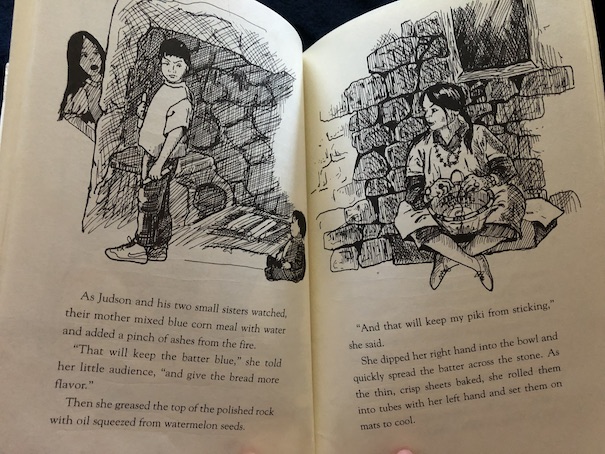
One day, Judson falls asleep while tending his family’s sheep, and most of them wander off. His father has to help him find the sheep again. Then, when his mother asks him to take some stew to his grandfather, Judson drops the bowl because he is playing and not paying attention. To make up for losing the stew, Judson gives his portion to his grandfather. Then, when Judson is supposed to be helping his mother to make piki (or paper bread) so that she can use it to trade in the market, Judson gives into temptation and eats too much. He has to help her make more.

In the market in the plaza, the Ogre Kachinas (really, men dressed up in costume), frighten the children and warn them that they must obey their parents. The Ogre Kachinas like to eat naughty children (but not really), and they say that they will return again soon to see if the children have been good. If they have been bad, the Ogre Kachinas might carry them away!

Even though Judson knows that the Ogre Kachinas are just human beings, their warnings worry him because he knows that he has been doing things wrong and has been getting into trouble. In spite of Judson’s attempts to do better, he still keeps getting into trouble. He fights with his sisters and even hits two other boys when he gets into fights at school. His father warns him that the ogres might come for him if he doesn’t behave, and sure enough, the Ogre Kachinas come one night.

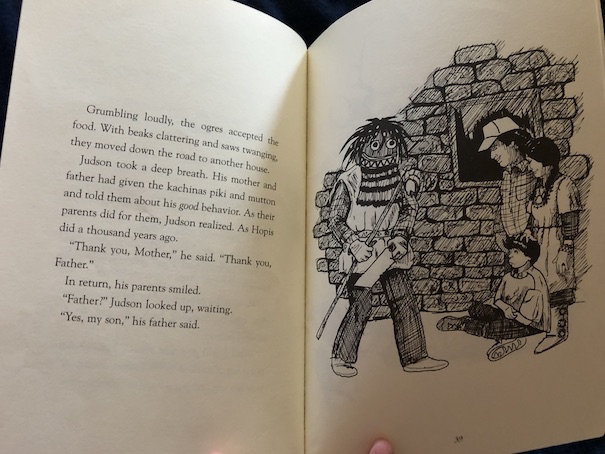
The Ogre Kachinas dance around Judson and his parents and confront Judson with their knowledge of all of the things that Judson has been doing lately. They threaten to take Judson away and eat him because they like to eat bad boys! Even though Judson knows that the kachinas are just ordinary humans in disguise, it’s an alarming performance! However, as part of this tradition, Judson’s parents speak up for him and tell the Ogre Kachinas to leave Judson alone.

It’s true that Judson has done things that he shouldn’t have done, but in many cases, he also did something to try to make up for what he had done wrong, like when he gave his portion of the stew to his grandfather to make up for the portion that he had ruined. He gets into trouble, but he is also polite and helpful in many ways. His parents say that he is actually a good boy and would make the ogres sick if they tried to eat him. Judson is relieved to hear that his parents love him and value the good things he does, even when he isn’t perfect. The Ogre Kachinas not only remind children of what they are not supposed to do but provide an opportunity for the parents to explain that they value their children and what the children do right. As Judson’s parents give the kachinas gifts of food and send them away, Judson realizes that their parents must have done the same for them when they were children and that the same thing has also happened for all Hopi children for generations.

I like books that include a little history and interesting information about cultural practices, but I also like this book for its understanding of human nature. First, I grew up in Arizona (in the American Southwest, for those who live outside of the United States), where this story is set. Although I am not Native American and didn’t grow up on an Indian Reservation, like Judson, I knew about Kachinas and was fascinated by them when I was growing up. I read books about Kachinas, and I loved the display of Barry Goldwater’s Kachina doll collection at the Heard Museum when I was a kid. I used to remember more of the individual names of different kinds of Kachinas and could point out the different ones in the Goldwater collection, but I’ve forgotten some of them as an adult. These things slip away if you don’t reinforce them. The book describes how Kachinas function in Hopi culture. There are different kinds that perform different ceremonial functions, but the main ones in the story are the Ogre Kachinas, which are meant to help frighten children into good behavior.

The need for both positive reinforcement and negative reinforcement is a real part of the human condition. Negative reinforcement has a bad reputation in modern times for making people feel scared or ashamed, and I think that it isn’t enough to have just negative reinforcement (punishment or criticism for things that a person has done wrong) or just positive reinforcement (praise for doing things right) by itself; I think they function best as a pair, the way they do in this story. It isn’t enough to just tell people what not to do (negative reinforcement) because it often leaves them wondering what they should have done instead, and it’s not enough to just give them praise with no criticism because it leaves them with the feeling that they do nothing wrong, and they’re often surprised later when they find out that things they’ve been doing have been seriously getting on everyone’s nerves all along. I think an over-reliance on positive reinforcement alone is part of the modern phenomenon where people don’t realize that they’ve been acting like bullies or saying really inappropriate things for years because, somehow, no one clued them in earlier in life. I’m pretty sure that I know why that is: it’s difficult to be the bearer of bad news or criticism that someone has gone too far with their behavior, to play the role of the disciplinarian, the “rules police” who has to stop the game to tell someone they’re not playing right. In an odd sort of way, the Ogre Kachina costumes probably make it easier for the elders of the community to dish out the criticism and discipline because they’re not quite doing it as themselves; they’re doing it in disguise as the horrible “ogres.”

To help people understand how they’re really supposed to behave in society, they need to know both what they’re not supposed to do and what people really want them to do instead. Judson gets both kinds of feedback in the story during the Ogre Kachina ceremony. First, he is confronted by what he has done wrong, and then he gets to hear his parents explain what he has done right in order to emphasize both what they love about him while helping him to realize what he needs to fix in order to be a better person in their society. Having a child confronted by scary ogres that threaten to eat him for doing things wrong sounds pretty scary, but the book does note that Judson is old enough to know that the Kachinas are just people in costume. Even though he’s kind of scared at being confronted by them, and for a moment, he does feel like they’re really threatening to eat him, he is aware that they are not what they appear to be and realizes that it’s all part of the ceremony. It also means that he is old enough to accept the rebukes as the consequences of their behavior, and he finds his parents’ praise of his good deeds as a motivator to do even better next time, not as an excuse for the things he did wrong.

By the way, Betty the dog was not punished for eating the book cover. I just took the book away from her and gave her a toy she could chew on instead. She is a good doggy, and I should not have left the book where she could get it. Bad Tracy!

The book is available to borrow for free online through Internet Archive.

So Dear to My Heart

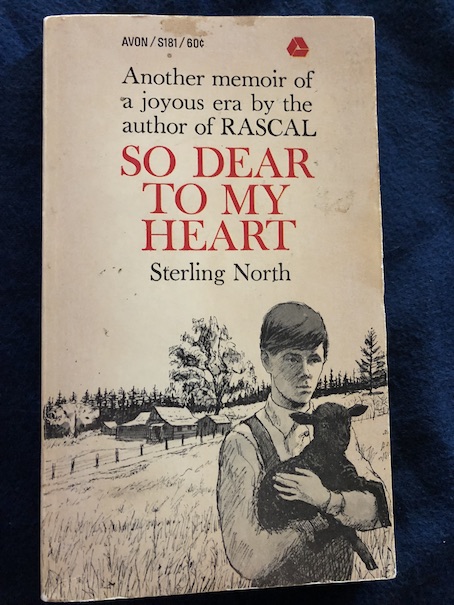
So Dear to My Heart by Sterling North, 1947.

The original form of this story was actually from 1943, when the book was called Midnight and Jeremiah. In that book, the black lamb was named Midnight, not Danny, and many of the subplots that came to dominate this edition of the book didn’t exist. This edition of the book was rewritten and published after the Disney movie of of the story, which is why it was given the same name. The Disney movie was half live-action and half animated, and it made some changes to the story that were reflected in this rewrite/reprint. Naming the lamb “Danny” after the race horse Dan Patch was Disney’s idea. I actually think that I would have liked the original book better because I didn’t like the way some of the characters were portrayed in this book.

I have to admit that I was really frustrated with one of the characters in the story, and because of that, I found it difficult to wade through the parts dealing with her. However, it is important to actually finish this story once you begin because, otherwise, you won’t get the full picture of the story. It’s not that the ending is particularly surprising, and I can’t say that I ever really became fond of the character I didn’t like, but the more you pay attention to how the story gets to the ending, the more you realize what the one of the points of this story really is. This story is about the love between a boy and an animal. It has Christian themes and themes about hatred, prejudice, and loss. However, what struck me the most in the end is that this is also a story about knowledge and perspective. Knowledge and being open to knowledge can change a person’s perspective, but also having a different perspective in the first place can give a person knowledge or leave them more open to gaining it.

I’ll warn you that this is going to be a rather long review, and parts are going to seem a little repetitive because the way my review is organized is based somewhat on the way this book was organized, giving bits and piece of information about the same underlying situation accompanied by reactions to it. At the end, I’ve also included some odd historical information that relates to things mentioned in the story.

Jeremiah Kincaid, called Jerry, lives with his grandmother on the Kincaid family farm in Cat Hallow outside of the small town of Fulton Corners, Indiana in 1903. His parents are dead, having died in a fire when he was young. The full circumstances behind their deaths are not explained until the end of the book, and there are a few things in the book about their deaths and some current happenings that seem a bit mysterious. This book is not really a mystery story, but in way, parts of it play out a little like a mystery because there are missing pieces of information that need to be filled in before you really understand what’s going on. Knowing exactly what happened to Jerry’s parents and why eventually helps Jerry and his grandmother to resolve some of their feelings about their deaths and their relationship with each other. For most of the book, Granny Kincaid thinks she knows what happened, but it doesn’t take long for readers to realize that she’s unreliable as a narrator. Jerry’s Granny Kincaid is a very strict and strongly religious woman, and she is the character I did not like, who almost discouraged me from finishing the book. It wasn’t being strict and religious that made me not like her. I wouldn’t have minded that so much by itself; it’s the rest of the story of what she is that got to me. In a way, that feeling of not wanting to look further also plays into the story and the desire of whether or not you want to know more about what is behind a bad situation. In an odd way, Granny actually did remind me of something, but I’d like to save what she reminded me of until near the end because it will make more sense then.

When the book begins, Jerry is angry with Granny for selling his beloved bull calf to a butcher. Jerry loved the calf because he had raised it himself, but to Granny, it was just part of the routine of farm work. To Granny, animals are meant for food unless they are specifically work animals. Jerry feels more of a personal connection to the animals, which is also important to the story. Jeremiah longs for an animal that he can actually keep and love. This is what guides Jerry throughout the story.

Jerry gets his chance of an animal to love when the new lambs are born and one of them is a black lamb, rejected by its mother. Granny would be content to let the little black lamb die, thinking of it as an evil omen. Her casual cruelty and callous attitude when Jerry points out that it’s just an innocent lamb who couldn’t help being born black and is scared and hungry and will surely die without care were, frankly, pretty disgusting from my perspective. Granny is very religious but without compassion or empathy. For her, animals are to be used, and whatever or whoever is meant to die isn’t something she’s going to bother herself about. Not only that, but part of her callous, unfeeling nature is based on bitterness toward events in her own past, which are clarified through the story. There is/was a bitter history between the Kincaids and the Tarletons, who owned the next farm over, and Granny knows that the little lamb was sired by the Tarletons’ old black ram. Even though I didn’t like Granny, I kept reading because the most compelling part of the book is learning the full history of the Tarletons and the Kincaids, which comes out bit by bit as the book goes on. The way that this knowledge of the family’s history is given to the readers, piece by piece, is important. Each time that Jerry learns a little more about his family’s history, the story changes a little, giving not only Jerry, but the readers, a slightly different impression of what happened and why.

To help explain it, I’ll give you a kind of summary of what Jerry learns in the first chapters of the book. In her youth, Granny Samantha Kincaid married David Kincaid, Jerry’s grandfather, who is now deceased. David’s rival for her affection was Josiah Tarleton. Before Samantha and David were married, the two men had a terrible fight over her which had left David the victor but permanently injured. Following the marriage of the Kincaids, Josiah settled on a farm near theirs. Over the years, the Kincaids experienced hardships of various kinds, while Josiah became a wealthier man and flaunted that wealth at the Kincaids to show Samantha what she had missed by not marrying him. Even after Josiah married a woman named Lilith, things were still bitter between the two families. Samantha became convinced that Lilith was a witch who cursed their sheep with illness, although David said that was only superstition. Although Lilith is now dead (as are Josiah and David), Samantha is still afraid of anything associated with the Tarletons, thinking of it as evil. That is Granny Samantha’s frame of mind, as it has been for years, and that is the basic reason why she regards the black lamb as evil, because of its association with the Tarletons. As far as the beginnings of the bitter Kincaid/Tarleton feud goes, it’s an accurate description of the situation. From this basic description, it sounds like the Tarletons were mean, greedy, and vindictive, lording their better fortune over the Kincaids and maybe even doing things to make life harder on them. However, that is not the entire story. That description barely scratches the surface of the real situation.

Granny is a callous person with some vindictiveness of her own. Jerry himself has been on the receiving end of Granny’s callousness, and the story mentions that his birth was “unwanted,” like the lamb’s, something that he senses from his grandmother (a major reason why I didn’t like her). Part of the reason why Jerry craves love in his life and shows it to the animals is because he doesn’t get it from family, what’s left of it. Jerry insists on taking care of the little unwanted lamb, naming him Danny. He persuades his grandmother that the lamb will give good wool. As the lamb grows and gets into trouble, Granny says that it’s proof that she was right to think of the lamb as evil. However, Jerry defends the lamb, saying that Danny is just an animal that doesn’t know what it’s doing and forbidding his grandmother to turn Danny into food, a sentiment echoed by Uncle Hiram.

“Uncle” Hiram Douglas is the local blacksmith, a family friend, not related by blood to anyone else in the story, although he acts as a father to Jerry, having no children of his own. Uncle Hiram knew both the Kincaid and Tarleton families for years, observing their feud from a different, more distant perspective, and his account of what happened is more reliable than Granny’s. He was careful not to involve himself directly in the families’ troubles because their situation was toxic, and he knew it. Early in the story, Uncle Hiram sees the parallels between Jerry and his lamb, both of which have been deprived of love and proper care through no fault of their own. He tells Jerry that both of them are from good stock and not to pay attention to the superstitious nonsense that Granny tells him. It is Uncle Hiram who suggests to Jerry that he should take Danny to the County Fair when he’s bigger and show him off because Danny has the potential to be a champion. Jerry seizes on the idea, and it gives him hope. For much of the story, saving his lamb from Granny and taking Danny to the fair are his main goals.

It is Uncle Hiram who tells Jerry more about his grandmother’s long-standing feud with Lilith Tarleton and how she blamed Lilith for an unexpected flood that almost drowned his grandfather and killed some of their sheep (one of many unrelated things that Samantha blamed on Lilith). Samantha had been so sure that Lilith was a witch and caused the disaster with a curse that she actually hid in a place where she knew Lilith would go and waited for her to come along so that she could throw rocks at her, stoning her as a “witch”, and this incident is generally known in the community. Josiah Tarleton may not have been a nice person, but for all of her Bible-quoting, Granny Samantha has a fierce temper and an unpredictable nature. The picture of what happened between the Tarletons and the Kincaids changes a bit with the added information of Samantha’s sneak attack on Lilith.

The book continues like that, shifting back and forth between things happening in the present and Hiram’s explanations of the past. As the descriptions of the past become more detailed, Granny’s views are increasingly shown to be wrong, and her behavior more erratic and hateful. I did not find Granny a likeable or sympathetic character, to say the least. She struck me immediately as callous and unhinged, and that image stayed with me throughout the story. She is unfair and has double standards for how she views the world and human behavior. When misfortune happens to someone else, like an innocent black lamb (as well as other people, as described later in the story), Granny says it’s just the will of God and she doesn’t care, but if misfortune happens to her, it’s evil black magic and she’ll stone the first person she doesn’t like as the one responsible for it. This is how her mind works. When Jerry interacts with the people of the nearby town, readers discover that Granny is hardly seen as a pillar of the community. In fact, she hardly interacts with the community at all. Even the men down at the general store joke about Granny Kincaid being a witch herself. Jerry hears them joking, and it leads him to talk to Hiram more about his family.

When Uncle Hiram explains about the jokes the men make that both of Jerry’s grannies were possibly witches, more of the conflict between the Kincaids and the Tarletons is revealed. Samantha Kincaid doesn’t like to talk about Jerry’s father, who is her dead son, or his wife and is often deliberately callous with Jerry because Jerry’s mother was actually Arabella Tarleton, Lilith’s daughter. Up until this point in the story, Jerry was completely unaware of this or the fact that Lilith was his grandmother, too. Now, Jerry knows that Samantha’s son, Seth, married Arabella, and both of them died in a fire, something which Samantha blames on Arabella. With this information, the story shifts again, looking a little like a Romeo and Juliet type of situation.

Uncle Hiram doesn’t believe in witches at all, and he explains the truth about his grandmothers to Jerry. He says that, whatever Granny Kincaid says, Lilith was never an evil person, and he doesn’t really think that Granny Kincaid is, either. I’m still a little less charitable toward Granny here. Granny’s behavior and attitudes show a definite sadistic streak. I’m not talking about the way she sees animals mainly as food because that’s just a natural side of farming. Samantha is a vindictive person, with an inability to put blame where blame is due, choosing instead to take it out on an innocent victim, possibly because the innocent victim is more vulnerable to attack or because she can’t handle the thought of what or who is really at fault for a situation. In her attacks, she frequently resorts to physical violence, even inflicting harsh physical punishment on Jerry and also some twisted psychology, when you consider some of the things that Granny says to him.

As even more of the history of these two families comes out, you learn that there are pieces of the story that Samantha is deliberately ignoring or distorting in her accounts of what happened. First, Samantha blamed Lilith for Josiah’s jealous vindictiveness, rubbing his successes and the Kincaids’ hardships in her face because she refused his “love.” At least, he did this up until he also suffered hardships and lost much of his money later in life. This is another part of the story that is revealed later. At first, the characters make it sound like Josiah was more prosperous overall and had less hardship than the Kincaids, but it was more the case that his hardships came a little later in life, something that changes his story a bit. The reality of the situation is probably that the families were more equal in terms of their wealth and luck than earlier described. Their farms are literally right next to each other, outside of a small town where nobody is truly rich. Also, one of the misfortunes Josiah suffered was the early death of his wife. It turns out that Lilith died much earlier in life than any of the older generation of adult characters, not even living to see her own children grow up. Samantha and Lilith actually knew each other for far less time than it would sound from the way Granny talks. After Lilith’s death, Josiah seemed to kind of give up on life and generally let his children run wild because he didn’t quite know how to deal with them. In spite of Lilith’s death, Samantha continued to blame Lilith for everything that went wrong in her family’s lives. None of it was Lilith’s fault, but Samantha decided it was because she could not or would not see Josiah, or even members of her own family, for what they really were and Lilith for what she was. Lilith was a gentle soul who died relatively young, but she remained the evil witch and lurking spirit that haunted Samantha’s own troubled mind.

So, what was Lilith really like, and how do I know that she was a gentler person? Uncle Hiram explains that, unlike Granny, Lilith actually loved animals, just like Jerry does. Her father in Kentucky knew the famous Audubon who studied birds, and Lilith was also something of an amateur naturalist. People in Indiana distrusted her because she was more educated than most, and they thought it was weird that she knew all the “fancy names” for different birds and plants. Hiram understands the names that Lilith was using because he actually interacted with Lilith as a friend, and hearing her explanations broadened his experiences. The people who just thought Lilith was strange and “witchy” never figured it out. If I had to live with people like that, I’d probably be more trusting of animals than my fellow human beings, too. Hiram suspects that Josiah may have harbored feelings for Samantha even after his marriage to Lilith (the fuel for his vindictiveness, wanting to see his former love suffer for rejecting him) and that Lilith indulged her love of nature as an escape from her husband’s uncomfortable preoccupation with a woman who never returned his affections (and who lived on the next farm over and liked to call her a witch and throw stones at her like a crazy person for things she never did and possibly knew nothing about before the sneak attack – no, I just can’t let that slide – going out into nature to escape from her husband and study the plants and animals was what Lilith was doing when Samantha violently attacked her), leading to Lilith’s reputation for being a bit strange and possibly a witch.

This picture of Lilith is vastly different from the picture that Granny had given Jerry and even what other townspeople say about her, and it is much more truthful. (There is also more evidence that supports it later in the story.) Lilith was a spirited and loving young woman who defied her father to marry Josiah. She was loyal to him in spite of his obsession with Samantha, and she ran a tidy household, educating her children herself as best she could and teaching her daughter to play the violin. This was the person Granny considers to be evil, even beyond the grave, in contrast to herself.

At one of the points in the story where they discuss Seth and Arabella’s wedding, Granny says that deceased Lilith’s spirit was angry because Josiah, who was still alive at the time, kissed her hand at the wedding. Josiah was a drunkard who had taken a liberty, by Granny’s description, but poor dead Lilith was still the bad one. (Another thing we learn along the way was that Josiah’s mind deteriorated in his final years, an apparent combination of drinking and stress from the early loss of his wife and other hardships his family suffered. This comes from Hiram, not Granny, whose own mind I found suspect from the first.) Possibly, Granny could not bring herself to fully label Josiah has the bad one because he always liked her. Granny is actually somewhat vain and self-centered, and although she was not in love with Josiah and would never return Josiah’s feelings, I get the impression that she was flattered by them. That two men fought over her, even though she had a clear preference for one of them, and that one of them continued to follow her and dwell on her made her feel good, if a bit awkward that Josiah was the more prosperous of the two for a time as well as somewhat vindictive. Lilith, as Josiah’s wife, took at least some of Josiah’s attention away from Samantha when she entered the picture, and I suspect this was probably the basis for her becoming the bad one in Samantha’s mind, for representing a competitor for Josiah’s feelings, even though Samantha was married to the man of her choice and wouldn’t have wanted Josiah anyway. Sometimes, even people who do not want something in particular for themselves still feeling strangely resentful when someone else gets it, especially if the other person seems to benefit from it. Early on in their marriages, Lilith seemed to have gotten the better deal by marrying the richer man … until more of the story is told, and you find out that wasn’t quite the case. It didn’t take that long for things to turn rough for the Tarletons, and Lilith’s life didn’t have a very happy ending.

Uncle Hiram says that he has tried to explain all of this to Granny for the last 30 years, but “She don’t listen, or she don’t understand, or she don’t want to know-cain’t quite figger it out.” (This is one of those books where the author uses misspellings to convey accent.) My theory is what I said before, that Granny blames the wrong person for the source of problems and that blame is based solely on personal dislike. Lilith got the man Granny could have had, even if he was a self-centered jerk who Granny didn’t really love, and a more comfortable, prosperous life (at least, for a time, in a way, on the surface), while Granny’s husband was injured by Josiah and constantly struggled to make a living in the face of repeated misfortunes that were mostly random chance. The longer Granny harbored that irrational hate, nursed it, and indulged it, the more difficult it was to let go of it, not only because it had become habit but because of what it would mean to her personally to admit that she had done something horribly wrong. If Lilith was really her opposite in everything, and it turned out that Lilith was a really good person and a good mother, educated and nature-loving, what would that make Samantha? It would mean that she was not “on the side of the angels” and righteousness, that she was the one causing harm to the innocent rather than being the poor, injured party herself. (I still remember that Samantha is the one who hides in bushes and throws rocks at unsuspecting people, not Lilith. Once you know certain things, you can’t un-know them.) It would be a difficult thing for her to take, the realization that she might be more witch than the supposed witch and hardly an angel. As I said, people in the community have noticed it, too. Lilith may have seemed “witchy” to them because, as Hiram said, she was a little different and they didn’t really understand her, but Granny is witchy for much more obvious reasons.

At one point, Hiram tells Granny directly that she’s being unfair to Jerry and not raising him with the love he really needs, and she angrily tells him that she has to be this tough to keep Jerry from going the way of his parents, whose souls she considers sinful. During the course of the story, she actually tells Jerry that his parents are not in heaven, making up a song about them and how their marriage lead to hell. This is a terrible thing to tell a child and a twisted upbringing to give an orphan! Hiram tells Granny that, while she’s had to struggle and work hard all her life, she’s not the only one who works hard, suffers hardship, and is a good person and that the way that she’s behaving is unfair, but she only responds by both complaining and bragging at the same time about how hard she works and how often she prays and how much she’s done for Jerry, as if that entitles her to behave the way she does. Samantha is stuck on herself but can’t see it because she phrases her vanity in terms of her hard work and personal suffering, which she considers virtues, ignoring the bad behavior she has indulged in and the suffering she herself has caused. The book calls it her “proud bitterness.” (Insert wordless scream of frustration here.)

Because Jerry is Lilith’s grandson as well as hers, Granny Samantha sees evil in him, like she does in the lamb, and Jerry senses that she does not really love him. That is the strongest reason why I dislike Samantha as a character, plus her vindictiveness toward the innocent and helpless and inability to establish limits on how she indulges her vindictiveness. Although I think the author meant us to see her more as sad and warped by sadness than bad, I didn’t really see her that way myself. To me, she was irrational and possibly dangerous, given her history of physical attack, not “purely on the side of the angels” as Uncle Hiram characterizes. Seriously, hiding in the bushes to throw stones at a “witch” is not a healthy coping mechanism. The guys down at the general store know this and that is why they make witch jokes, but Granny doesn’t seem to have grasped how this looks even to people in her own town. Living alone with her grandson on their isolated farm has kept her steeping in her own bitterness and out of touch with reality. Only Uncle Hiram’s influence has allowed Jerry to get in touch with the truth of his family’s past and situation, and this is a central part of the plot.

I’m down on Granny Kincaid a lot, as you can tell by my repeated rants against her, but part of what makes characters like this so frustrating is that they are so obvious as plot devices. If Granny were a kinder, more reasonable person, this book would both be much less frustrating and much shorter. She is deliberately uncaring and unreasoning because she has to be in order to complicate the plot. She is one of the obstacles that Jerry must overcome. There’s no use arguing with Granny because she will and must remain resistant to persuasion, providing necessary plot tension, until the point in the story where the other characters either find a way to get around her or she has a change of heart and redeems herself. Given that Granny is Jerry’s grandmother and that this story has religious themes, I guessed that we would be going the redemption route eventually. However, I also knew that, with about 200 pages in the book, I’d probably have had more than enough of Granny by that point, which made me wonder if it would be worth it. I wouldn’t say that the redemption was worth it for Granny’s sake because I still didn’t really like her at the end, but by the time I got through all of the information that I’ve provided so far about the Kincaid and Tarleton families, I began to notice how the story about the families shifts slightly with each new piece of information about them, as seen from Hiram’s more neutral perspective. There is a larger point to be made here as the story continues, and Jerry learns more about the circumstances of his parents’ deaths, clearing up some additional plot holes that have been left hanging.

What’s left to tell? Notice that, while I told you that Jerry’s parents died in a fire, the Kincaid farm is obviously still standing and so is the Tarleton farm. They have not burned to the ground. So, where was this fire that killed Jerry’s parents? Also, if Josiah, Lilith, and Arabella Tarleton are all dead, who is running the Tarleton farm? Remember, Danny the lamb was sired by the Tarletons’ old black ram. Who owns that ram? Keep these points in mind for a moment.

Getting back to Jerry’s goal of taking Danny to the fair to win a prize, Granny is naturally resistant to the idea of going to the fair at all, but Hiram starts to win her over by suggesting that she show some of her weaving there (a successful appeal to her vanity), and Jerry promises to earn the money they need to go. Earning the money to go to the fair provides another obstacle for Jerry to overcome. Jerry begins hearing violin music at times, although he’s not sure where it’s coming from. He begins to think that it might be his mother’s spirit, trying to encourage him in his goals. There is also a scare when Danny is lost during a storm, and Jerry fears that he will never see him again.

The loss of Danny during a terrible storm is the turning point in the story and the real beginning of Granny’s redemption. Jerry doesn’t know whether Danny is surviving the storm or not, and Granny becomes truly worried about how upset that Jerry is and how she is unable to comfort him. She tries to tell him that whatever happens to Danny is the Lord’s will, and Jerry stuns her by saying that the Lord can’t have his lamb. Granny chastises him for blasphemy, but he refuses to take back what he says. Granny worries that Jerry might feel the wrath of God for what he says, and she actually tries to say that it’s her fault that Jerry says these things, that maybe she hasn’t raised him right, in the hope of sparing him from God’s wrath. This is the most concerned that Granny has been for Jerry since the book began. Jerry says that love isn’t evil, and for the first time, Granny admits that it isn’t, unless a person loves himself more than God. When Jerry asks how he can love a God who took away both his parents and his lamb, Granny is at a loss for an answer. She tries to explain that God is both all-merciful and all-powerful, but Jerry says that if God was really all merciful, He wouldn’t have let his parents die, and if He was all-powerful, He could have saved them. This is part of the age-old problem of why bad things happen to good people. Was there something wrong with God, perhaps even his non-existence? There are some who would argue that. Or was the fault with the people involved in the story, that their fate was punishment for their sins or brought about by their wickedness, as Granny has always believed? Granny has always believed that her son died because of his sins and that Arabella was the one who led him into sin. This belief has been the basis of all of her harshness with Jerry. However, there is another possibility, that is it all more a matter of perspective, that there is more information missing from this story which would make the situation more clear.

Granny’s inability to answer Jerry’s questions about the nature of God and prayer and why bad things happen to good people are what bring about a change in her. The older I get, the more I think that a little uncertainty in life, and even in religious faith, can be a good thing. Uncertainty is what keeps people open to knowledge because they feel like there is more that they don’t know. People who think they know everything they need to know tend to close the books because they don’t feel the need to learn more. People who are sure that they are doing everything that God wants don’t ask themselves what more they need to do, whereas people who aren’t sure are open to improvement. Some of the least confident people in life are the ones who are actually doing the most and trying the hardest because they constantly question what they’re doing, check themselves, and are the most open to learning and improvement along the way, the exact opposite of the Dunning-Kruger Effect. There have been many famous people who have experienced severe self-doubt, and sometimes, that’s what pushes people on to greatness. Even saints, viewed by others as having a special relationship with God and providing others with help and a sense of peace, often experienced their own dark times, self-doubt, and even doubt in God and their service to them. The great thing about saints isn’t that they were superior humans without flaws and human troubles but that they didn’t let those things stop them from doing the great things that they were meant to do. Perhaps the key is in seeing doubt not as defect but as a tool and uncertainty not as a failing but as a guide to learning and improvement.

Up to this point in her life, Granny Samantha felt absolutely certain about everything. She was as certain of Lilith’s wickedness as she was of her own faith in God. She had thought of all of the family’s misfortunes only in terms of what had happened to her, and now she realizes that Jerry was the one who was truly punished by the loss of his parents while being just an innocent baby, with no sins that needed to be punished. Now, Granny is confronted by the fact that she really doesn’t know everything and that some things may not actually have a definite explanation, or at least not one that is easy to find. Granny experiences doubt for the first time. It affects her so deeply that she tells Hiram that she told God that it’s about time that He answered her prayers about something or she might stop believing in the power of prayer and that He should really let Jerry find his lamb. She feels a little odd about saying this to God, even though she felt strangely better after saying it, but Hiram tells her that he doesn’t think it’s so bad. He says that he’s experienced his own doubts over the years and that he thinks that prayer is basically a way of telling God how you feel and letting him share the burden of worries. It’s natural for human beings to feel things like doubt, worry, and anger when things are going wrong and everything seems unfair. Granny admits that she has felt better since she has admitted her true feelings to God, like she truly has left the problem with Him, instead of keeping all of those negative feelings to herself, as she has for years.

Fortunately, this story does have a happy ending. Jerry does find Danny again after he is lost, and they do manage to go to the fair. Danny does not win the livestock competition because, as a black lamb, the judges decide that he is in a class by himself, but noting his quality, they give Jerry and Danny a special award for being unique. But, what’s important happens while Jerry is still searching for Danny and how he learns the final pieces of the puzzle concerning his parents’ death.

While Jerry was searching for Danny, he also met and connected with his Uncle Lafe, Arabella’s brother and Danny’s only other living relative besides Granny. Lafe is somewhat slow mentally, what the other characters call a “moonling.” He is referred to in passing a few times earlier in the story, but no one explains much about him other than his mental slowness. His slowness was considered one of the misfortunes of the Tarleton family because it caused his parents some worry. Even though Lafe is still living on the Tarleton farm next door and is the owner of the black ram, Jerry has not seen or spoken to him up to this point. However, like Arabella before him, Lafe knows how to play the violin and has kept the violin that once belonged to his sister. Jerry had heard him playing at other times earlier in the story, taking comfort in the playing and believing that it was his mother’s presence, trying to communicate with him. Lafe doesn’t talk much, and although he can read and write a little, he’s not very good. He shows Jerry Lilith’s old collection of books, showing that she was an educated woman, as Hiram said. Lafe cannot read well enough to read all of the books, and Jerry admits that he can’t read that well yet, either. Lafe also shows Jerry where he recorded Jerry’s birth in their old family Bible, a common practice in old times, before modern birth certificates. Jerry realizes that, in spite of the rift between the Tarletons and the Kincaids and the fact that Jerry has never really met his uncle before, his uncle has always accepted him as a full member of his family, giving Jerry an unexpected feeling of belonging.

Before the story is over, Uncle Hiram tells Jerry the final truth about his parents’ deaths. Both Seth and Arabella were fed up with life in Cat Hollow. They were tired of their parents’ feud and the limited opportunities for life there. Arabella loved horses and had real skill with them, so they took a horse with racing potential and tried to start a life in horse racing in Kentucky, where Arabella’s grandfather lived, where both of their families had lived before coming to Indiana. Their involvement in horse racing and gambling was what made Granny decide that they were sinful people. They later died in a burning stable in Kentucky. Granny told Jerry that she believed that Arabella had sent Seth into the burning stable to kill him on purpose, using their race horse as an excuse. She said that they had been living apart before that and that Arabella probably just wanted to get rid of Seth. When Jerry asked her how Arabella managed to die in the fire as well, Granny says that she could never figure it out.
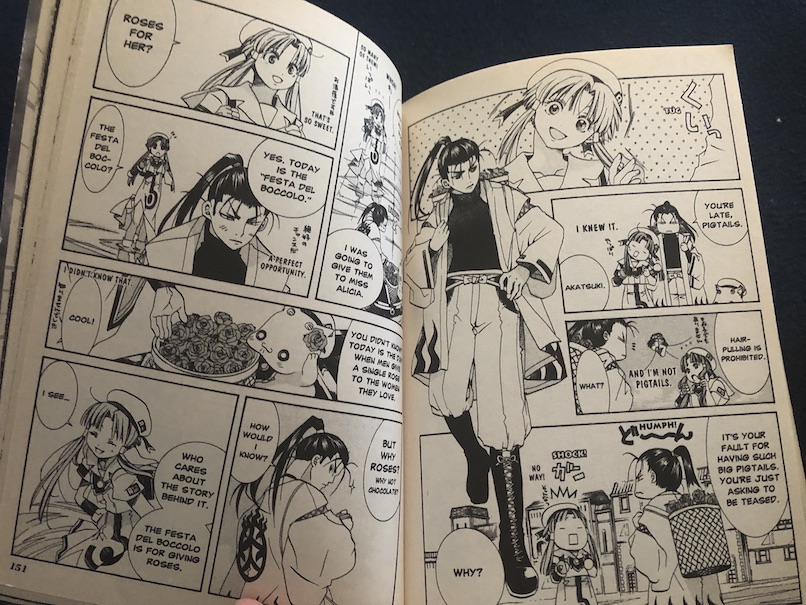
This final piece of the puzzle is solved when the man who managed Arabella’s grandfather’s horses explains the night of the fire to Granny and Jerry. Seth had temporarily gone to Chicago to find a job to support his wife and child, but he had returned to where Arabella was staying with her grandfather to visit her. The fire broke out at night, and when Seth realized that his wife’s beloved horse was in danger, he insisted on going into the barn to try to save it. Arabella actually tried to stop him, but he ran in anyway. Arabella ran into the barn after him to try to save him, and they were both killed. After her earlier humbling at Jerry’s unanswerable questions, admitting her true emotions about the family’s misfortunes, and the victories of both Jerry’s lamb and her quilts at the fair, Granny is finally in a state of mind where she is able to except the truth of her son’s death. It was not caused by his sinfulness, but his love and a set of unfortunate circumstances, and Arabella had tried to save him at the expense of her own life. This knowledge helps Granny to make peace with the ghosts of the past.

I do feel like Granny receives this new picture of what happened to her son with less comment and emotional release than I would have expected. For most people, this would have been a very emotional moment, perhaps with crying or a sense of guilt for having put all the blame in the wrong place for years. Granny even made a quilt depicting a demonic marriage and writing a song to sing to her grandchild about how his parents were wicked and in hell, for crying out loud! So, what does Granny actually say about this final revelation?

“Wal,” said Samantha, “it jest goes to show. Cain’t never tell about true love. Guess I’ll have to change the last few verses of my song ballad.  Burned to a crisp in each other’s arms, no doubt.  It’s a real sad story.”

And that’s her final word on the matter. Great. I guess it just “goes to show” why I really don’t like Granny: she doesn’t have much emotional range or empathy even after her redemption experience. All through the story, it was all about her: her husband who was hurt by the rival for her affections, her husband who was almost killed in a flood, her son who was taken from her, and her duty to raise her grandson. When it was all about her, she had her deepest emotions and was wrathful and vengeful, and after she is made to realize that it’s not really all about her and never was, all we get is, “it jest goes to show” and “it’s a real sad story.” On the plus side, she did demonstrate some real caring for Jerry’s welfare before the end, but she’s never going to really feel bad about all the bad things she did or show a sense of regret, and that’s all there is to it. It’s good for Jerry because the past finally seems to be dead and behind them, and Hiram comments that, one day, Jerry will also inherit the Tarleton properties from his Uncle Lafe as well as the Kincaid properties, which will put him on a much better footing in life. But, somehow, it just seems unfair that Granny never seemed completely sorry for her role in all of this misery that went on for years, and I was left feeling it more than she was.

Something that I didn’t mention earlier, that I was saving for the end and my final reaction, is that Granny’s obsession with the supernatural and her belief in Lilith as a witch/witch’s ghost may not be based not only on her upbringing and religious beliefs but also in an odd human phenomenon that even modern people experience. People expect the world to make sense, and we are all hard-wired to look for cause and effect. Granny has a long history of misinterpreting cause and effect, but she’s not the only one. A few years ago, I attended a lecture given by a group of ghosthunters in my home town. This group said that they are sometimes called in to investigate people’s homes when they think that they are being haunted. In one of their explanations, they implied, although did not explicitly state, that there are psychological roots in much of the haunting phenomena that they investigate. What they actually said was that most of that people who called them in to investigate hauntings were people who were already in very troubled circumstances in their lives. These were people who had suffered financial problems, work problems, marital problems, health problems, or problems with their children, and often some combination of these. Then, in all of these cases, something mysterious happened that they couldn’t explain, and it was just the last straw. People in a happier, healthier, and more stable frame of mind might shrug off something unusual that happened as just momentary bad luck or coincidence, but when someone is already on edge or paranoid, they begin to notice more and more odd things happening that they would otherwise ignore, drawing connections between them in their minds to the point where they become convinced that they are haunted and/or cursed. The ghosthunters did not call these people liars or delusional, and from the way they told their stories, they suggested that, because these people believed that they were haunted, in a way, they became haunted. For example, one man suffered a series of disasters after buying an odd mask at a garage sale to use as a wall decoration, and he became convinced that the mask was cursed. One of the ghosthunters actually said, “I don’t think this mask was cursed before he bought it. I think it became cursed because he bought it.” The disasters that befell this man would have happened to him anyway, with or without the mask, but because they happened around the time when he bought it, he kept attributing every bad thing to the mask, and it did take on a negative influence in his life. It even began to affect the ghosthunters in a negative way after they removed it from his house because they were influenced by the negativity that this man had associated with the mask, making them wonder if some problems they experienced around that time were also associated with it, even though they said that they really didn’t think so. In an odd way, the man actually became the curse on his own cursed mask because of his attitude, just as Granny may actually have been the witch that she always claimed Lilith was, even though she couldn’t see it herself. From this psychological perspective, Granny Samantha’s weird witch obsession becomes more understandable, and she does look a little more like a sad victim of circumstance. Josiah Tarleton set up a toxic situation in the beginning with his early rivalry with the Kincaids, rubbing his early successes and their misfortunes in their faces, so when bad things happened that might have happened anyway, whether the Tarletons had bought the farm next door or not, Granny developed an association between them and her misfortunes that she interpreted as cause and effect. Although, I kind of suspect that Samantha may have been a little unbalanced even before all that, making her more of a candidate for going superstition crazy than her husband, who tried to tell her that it was all just coincidence. Still, I can see that repeated misfortunes can have a negative affect on someone’s view of the world. I have to admit, even now, thinking about it from that angle, I still don’t like Granny for the way she affected innocent people around her and didn’t seem to show remorse for her actions, but this explanation for Granny’s thinking does make sense.

However, I think that the overall message of the story was a good one. Life doesn’t have convenient, tidy answers that can just be summed up in one brief paragraph of explanation. There is no short, easy answer to the question of why bad things happen to good people, and much of the time, we don’t get the full story of what actually happened in the first place because we can’t see it from every perspective, from all of the people involved. I had wondered how the Tarletons responded to Samantha throwing rocks at Lilith, but the story never said. Did they just let the matter slide because the townspeople had also been whispering that Lilith was a witch? Did Josiah actually stand up for his wife in some way? Did David tell Samantha to back down because he didn’t really believe in superstition, and she was acting crazy? At the end of the story, we still don’t know what actually caused the stable fire that killed Jerry’s parents. Was it a human accident or negligence, deliberate arson, or a lightning strike? Even the man who was there at the time doesn’t know or doesn’t say. By that point, it doesn’t matter, because what the characters were most concerned about was the relationship between Jerry’s parents and the character of the the Tarletons, especially Arabella. Having established that, they feel no need to inquire further into the matter. What happened in the past was a combination of bad luck, random chance, and personal choice on the part of the people involved, when they decided how to respond to the emergency. What mattered in the end was how everyone felt about it and what they decided to do because of it. When their feelings and circumstances changed, they were free to make a different choice of what they would do. Being open to new information is key to considering a situation from a different perspective, and a different perspective helped them to gain the new information they needed.

In the original book, Midnight and Jeremiah, the family’s money troubles and the fair are more the central plot than these family issues. Also, the lamb, Midnight, doesn’t get lost until after the fair is over. Uncle Hiram (who is apparently really Jeremiah’s uncle in the original book) and the town decide to celebrate the lamb’s victory at the fair, but the celebration startles the lamb, so it runs off in fright. Jeremiah eventually finds him near the nativity scene at the church on Christmas Eve.

The book is available to borrow for free online through Internet Archive.

As a historical footnote to this story, Jerry mentions early in the book that his family and some others in their little town have Scotch-Irish ancestry and that they migrated into Indiana from Kentucky. This is something that older families in Indiana did during the pioneering and homesteading days of the 19th century. Another book that I reviewed earlier, Abigail, is about a family who traveled to Indiana from Kentucky in a covered wagon, which is what both the Kincaids and the Tarletons did when the grandparents in the story were younger, actually around the time when Abigail takes place. Their circumstances would have been very much like the people in that story, and the girl in the story of Abigail, Susan, also learns how to weave using a loom very much like the one Granny uses in this book.

Scotch-Irish (sometimes called Scots-Irish) is not a term that is generally used outside of the United States because Scotland and Ireland are separate countries. Basically, what it refers to is people with ancestry from Scotland (largely Presbyterian) and Ireland (more specifically Ulster Protestants, who also had some Scottish and/or English ancestry) who came to the Americas in the 18th and 19th centuries, settling in the upper parts of what is now the southern United States but ranging as far north as Pennsylvania, generally covering the Appalachian region and states like Kentucky and Virginia. Regardless of which wave of immigration in which individual families first arrived or what mix of ancestries they had at that time, having settled in the same regions of the United States, families intermarried. If an individual has one of those factors in their background, it’s highly likely that they also have the other somewhere in their family tree. Even those with mostly Scottish or English ancestry tended to come to the Americas by way of Northern Ireland, which is why they and their descendants are often referred to by this combined name. Even though England isn’t mentioned in the term Scotch-Irish, these families also often have English ancestry, which you can see in many of their surnames. In fact, some argue that they may be ultimately more English in their origins than anything else. It would take closer examination of an individual’s family tree to mark their exact ancestry or combination of backgrounds, and in casual daily life in the United States, it wouldn’t really make a difference. The communities they formed in the United States lived basically the same sort of life, making them virtually indistinguishable and often interrelated. Sometimes, this name has been considered somewhat pretentious in its use, partly because one of the purposes behind its adoption was to distinguish people with Protestant ancestry from Irish Catholics who came to the United States later. Irish Catholics represent a different group of immigrants here. In spite of that, Scotch-Irish is a commonly-accepted description in the United States and gives a fair explanation of an individual’s family history when you understand basically what it means. Many of their descendants still live in the Appalachian region, but others have branched out to different parts of the country, as the families in this story did. They can be found everywhere in the United States in modern times.

Throughout the story, characters sing old folk songs and hymns, some that are traditional and some that they made up, sometimes accompanied by playing a dulcimer, a folk instrument found in many forms that is also used in Appalachian folk music. The Appalachian dulcimer is probably the one that the characters in the book used, given their background. One of the songs that stood out to me was Putting on the Style. This song comes in different versions, and I’d heard of it before seeing it in this book. It’s basically about how people play roles when they’re out in public and how the way they behave is partly because they’re fond of the image, not because it’s how they actually are in private. As the characters head to the fair at the end of the book, they sing this song and make up some verses of their own.
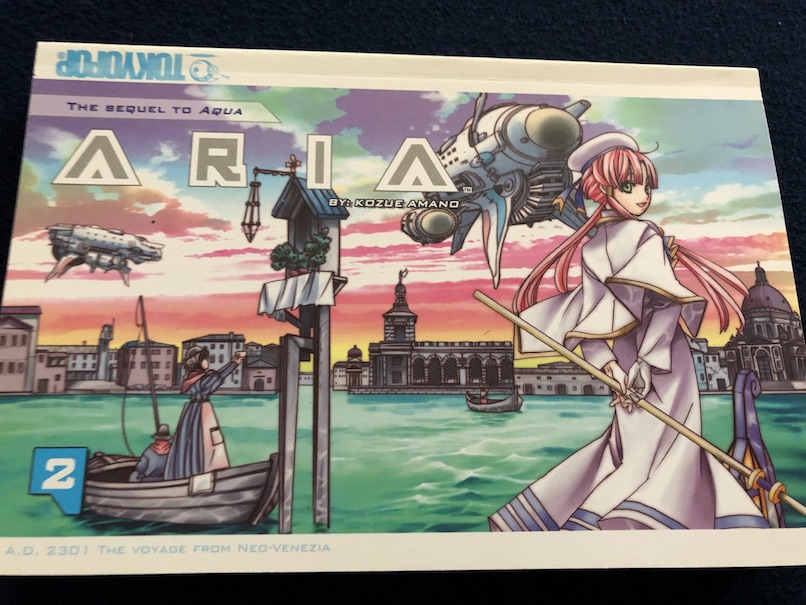
As another odd historical note, early in the book, when Jerry thinks about and describes the small town of Fulton Corners and how it is more exciting to a young boy than most people would think, he mentions the “haunted graveyard” because it looks old and creepy and is the kind of thing that a child might imagine to be haunted. He mentions that the monuments in the graveyard have different shapes and that the shapes mean things, like a lamb for a dead baby. This is true, and I’ve seen graves like that, even in Arizona, where I grew up. Modern American graveyards don’t do this and tend to have simpler markers, but in the 19th century, people used certain shapes to explain something about the deceased person. Lambs were for babies and very young children because they symbolized innocence and youth, and broken columns indicated a person who died unexpectedly in the prime of life. Jerry mentions other symbols in the story. Part of the reason why I know this is because I took a historic tour of the local pioneer cemetery in Phoenix, and also because there was an article in the local paper awhile back about some hikers who stumbled across an old graveyard that was once part of a ghost town, and they helped themselves to a lamb statue that they thought would make a good lawn ornament. At the time, they didn’t know the significance of the statue, but to anyone who realizes what they took, it’s horribly creepy. The author of the article told them to put it back. This is kind of an odd digression from the story, but since this is one of few books that mentions this odd historical detail, I decided to explain it here.