Tomorrow’s Wizard

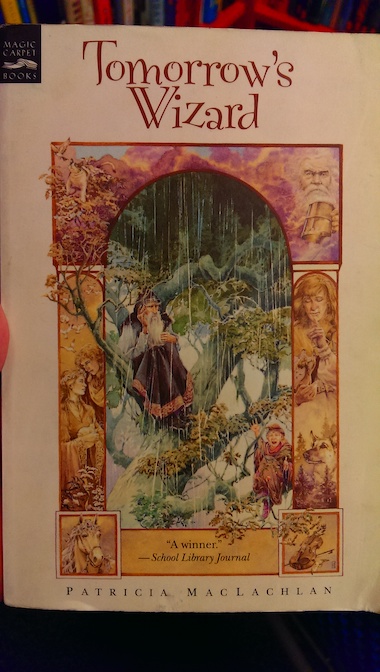
TomorrowsWizardTomorrow’s Wizard by Patricia MacLachlan, 1982.

In a way, this story is a collection of shorter stories, but they are all tied together. In the beginning, Tomorrow’s Wizard (that’s actually his name, he’s also called Tomorrow) has just been given an apprentice wizard named Murdoch. Their job is to listen for important wishes to grant. Each of the shorter stories in the book involves a different wish and how Tomorrow and Murdoch grant it.

The First Important Wish – Rozelle is a pretty girl but wild and given to fits of temper. Her parents had her later in life and never disciplined her, so she has never had a reason to learn to control herself. However, her tantrums drive everyone else crazy. Rozelle’s father, acknowledging how difficult it is to deal with Rozelle, wishes that he could find a man who was willing to marry her. Tomorrow hears the wish and sends a variety of suitors to meet Rozelle, but she doesn’t like them, and none of them really like her, either. Then, another possibility occurs to the wizards: the villagers have been complaining that they are afraid of a nearby giant. Tomorrow knows that he giant is really harmless and gentle, just lonely. Could it be possible that Rozelle is the company that he needs?

Three-D – Miller Few and his wife, Mona, are nasty people, two of a kind. Because he’s the only miller in town, Miller Few (known to his neighbors as Three-D for Dreadful Dastardly Demon) freely cheats his customers. He and his wife have no friends because they’re so awful. Then, one day, Three-D saves Murdoch’s life. To reward the miller, Murdoch agrees to grant him a wish. The miller and his wife decide that they want a nice, sweet child who would do their work for them. The child Murdoch grants them is indeed sweet. A little too sweet. Not only does little Primrose look pretty and do the housework, but she helpfully reminds the miller about his debts and the other things her parents do wrong. The miller and his wife become more careful and agreeable and gain new friends because of Primrose, but they aren’t very happy. They aren’t really being themselves, and they’re tired of being on their best behavior all the time. But, perhaps there is one thing that can stop Primrose from being overly sweet: the miller’s old cat, Clifford.

The Comely Lady and the Clay Nose – Geneva is a very beautiful young woman and has many admirers, but she knows that they are more in love with the way she looks than with who she is. It worries her, and she wishes for someone who would love her for the person she is. To help solve her problem, Tomorrow makes an ugly clay nose for Geneva to wear, telling her that it will help her to find the person she is looking for. When she puts it on, her former admirers flee, and for awhile, Geneva is very lonely, but she perseveres and ends up finding the love that she is looking for.

The Perfect Fiddle – Bliss, the fiddle-maker, is ironically an unhappy man. The reason is that, no matter how good his fiddles are, he can never make one that’s completely perfect. After Bliss tries several crazy schemes to capture perfection in his fiddles, Tomorrow goes to visit Bliss’s wife, Maude. Like Tomorrow, Maude has seen the problem with Bliss’s approach to his fiddles and finally asks Bliss the question that makes him reconsider whether perfection should be his goal.

The Last Important Wish – Although Tomorrow is impatient with his apprentice, Murdoch, he does like having him live with him, and he has also grown attached to the horse that lives with them both. However, he has come to see that the life of a wizard isn’t the one that Murdoch is really suited for. More than anything, Murdoch wants the experience of being born and living among humans. The horse, too, wishes for a kind master and a family. Tomorrow sees that it’s time to grant both of their wishes, giving the horse and Murdoch (as a baby) to a kind farmer with a wife and other children.

The book is currently available online through Internet Archive.

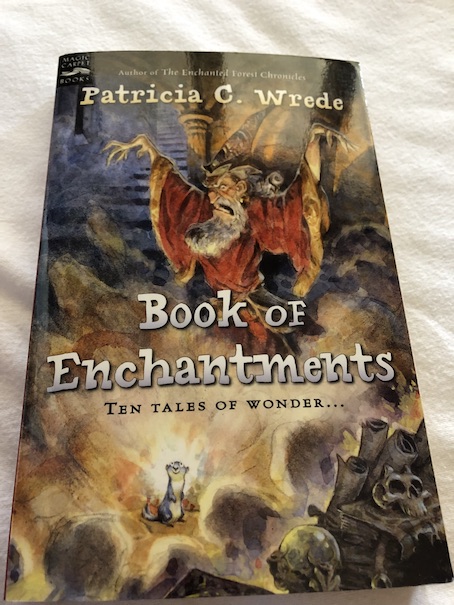
Book of Enchantments

Book of Enchantments by Patricia C. Wrede, 1996.

This is a collection of short fantasy stories, some of them based on other writings and series by the same author.  Many of them are also humorous. There is a section in the back of the book that explains the stories behind the stories and how they relate to her other works.

The stories included in this book:

Rikiki and the Wizard – A greedy wizard, unsatisfied with his success in life, attempts to summon a god to make him even more wealthy and famous so that he will never be forgotten. In exchange, he offers his daughter in marriage to the god who will help him.  Most of the gods recognize the wizard’s greedy and selfish purposes and refuse to cooperate, but Rikiki, the blue chipmunk god, is rather absent-minded and shows up to answer the summons. However, Rikiki, although having the powers of a god, is mostly obsessed with finding nuts, and how he interprets the wizard’s wishes (in exchange for the nuts the daughter feeds him, not for marrying the daughter) technically fulfill the requests but not in the way that the wizard had hoped.

The Princess, the Cat, and the Unicorn – This story takes place in The Enchanted Forest from one of the author’s series.  Things don’t go as expected for fairy tales in the fairy tale kingdom of Oslett, and it often bothers the king’s councilors.  Even though the princesses of the kingdom have a stepmother, she is a very kind and motherly person instead of the wicked stepmother usually found in folktales, and the princesses love her.  The princesses even get along well with each other instead of having the usual rivalries and jealousies between the oldest princesses and their pretty younger sister.  The middle princess, Elyssa, gets tired of being nagged about what the councilors think she should do and says that she’d like to go out and seek her fortune.  It’s not usually a thing for the middle princess to do, but well in keeping with what goes on in their kingdom.  She is accompanied on her journey by a talking cat who directs her to The Enchanted Forest, where the stuff of fairy tales happens.  There, the princess must escape the clutches of a vain unicorn, who is looking for a princess to adore it, and help the cat, who is not quite what he seems.

Roses by Moonlight – A modern retelling of The Prodigal Son story in a modern setting and with sisters instead of brothers and a fantasy twist.  Adrian is jealous of the party that her family is giving for her sister Samantha, the prodigal daughter returned.  As she sulks outside, her mother talks to her about her sister and the choices people make in life and enigmatically says that, while she is satisfied with her own choices and life, it occurs to her now that there may have been other choices that she had never considered before.  Instead of asking Adrian to come back inside and try to enjoy Samantha’s party, she asks her to stay outside for a while and see if someone shows up, mysteriously adding that if she is offered a choice, she should be careful and not choose too quickly.  Adrian does indeed meet a strange woman who offers her the choice of her destiny.  In a magical rose garden, Adrian may pick a rose which will represent the course that her life will take.  She is allowed to smell each one first and see what they have to offer.  Given the choice of any possible future, what will she choose?

The Sixty-Two Curses of Caliph Arenschadd – Also in A Wizard’s Dozen.

Earthwitch – A king whose kingdom is besieged appeals to the Earthwitch for help. He learns that the current Earthwitch is his former lover, and while the magic of the earth can help solve his problem, it will cost him to use it.

The Sword-Seller – A strange merchant gives a swordsman a free sword at a fair and recommends a woman to him who needs to hire a swordsman to accompany her on a journey to see her aunt, apparently fleeing problems with her other relatives. Her other relatives seem to behave oddly about the journey, and the swordsman isn’t sure why. He agrees to take the job and discovers the real reason why the merchant was willing to give him the sword.

The Lorelei – On a class trip, a girl has to save her classmate from the call of the Lorelei.

Stronger Than Time – This story is about what would have happened if the prince had been killed before rescuing Sleeping Beauty.

Cruel Sisters – A retelling of an old folk tale about jealous sisters, one of which evidently killed the other.  The story is told from the point of view of their other sister.

Utensile Strength – The last story in the Enchanted Forest Chronicles. When an enchanter makes a mistake while trying to make a magical weapon and accidentally casts the spell on a frying pan, the king and queen of the Enchanted Forest hold an unusual tournament of warriors to find the person who is destined to wield this very strange but powerful weapon.  The story is followed by the winning recipe from the cooking portion of the tournament, Quick After-Battle Triple Chocolate Cake.

The book is currently available online through Internet Archive.

The Practical Princess

PracticalPrincess

The Practical Princess and Other Liberating Fairy Tales By Jay Williams, 1978.

PracticalPrincessSilverWhistleThe modern fairy tales in this book (these are not traditional stories or folktales, although they are written in the style of old fairy tales) feature brave and clever girls. These are not just damsels in distress who need to be rescued, but girls who play heroic parts in their own stories. However, I don’t want you to think that the stories get too preachy about girl power. Some of the men in the stories may seem less than heroic at, but each of them is clever in their own way, and they are sometimes the main characters in the stories as well. The stories don’t lecture you about how “girls are just as good as guys and maybe even better“ or try to make the girls look smarter by making everyone else look dumb or things like that (in spite of the name, “Stupid Marco”, Marco really isn’t all that bad). They’re just fun stories in a fairy tale style with interesting heroines. The best part is that the stories also have a sense of humor.

There is only one full-color illustration in the book. The other pictures are done as silhouettes.

The book is available to borrow and read for free online through Internet Archive.

The stories in the book:

The Practical Princess

When Princess Bedelia is born, she goes through the typical fairy tale ritual of having fairies give her gifts. One of them gives her common sense. When she grows up, she uses it to devise a clever plan to free her kingdom from a fearsome dragon. Unfortunately, she attracts the attention of the evil Lord Garp, who tries to force Bedelia to marry him. When Lord Garp tries to cheat at the tasks she sets for him to prove his worthiness and she catches him doing it, he imprisons her in a tower, and she must use her wits and the help of his other captive to escape.

PracticalPrincessMarcoStupid Marco

People think that Prince Marco isn’t terribly bright because, instead of applying himself seriously to his studies as his brothers do, he has a habit of spending his time daydreaming and writing poetry, and he can never remember how to tell left from right. However, he has three major accomplishments: he is an extremely likeable person, he can whistle very loudly, and he can cure even the worst case of hiccups. In his kingdom, it’s a tradition for princes to win their future brides by going out and rescuing a princess from something (how do all these princesses get into that much trouble anyway?). To make this task easier for Marco, his father tells him about a princess he can rescue and gives him a set of simple instructions to follow. Of course, Marco loses his way and the instructions. He meets a nice young woman named Sylvia who offers to help him, but still, nothing goes as planned. However, there’s more than one princess in the world and more than one type of rescuing, so things turn out well in the end.

The Silver Whistle

When Prudence comes of age, she sets out in the world to seek her fortune. Before she leaves home, her mother, the Wise Woman of the West, gives her a magical silver whistle. If she blows it once, birds will come to her. If she blows it twice, insects will come. If she blows it three times, animals will talk to her. However, she cannot blow it four times because it will break. Prudence finds employment with an old witch who has a plan to make herself beautiful so that the prince of her kingdom will want to marry her. Although Prudence has doubts about her plan, she uses her magical whistle to help her, but only to a point. Besides, people have different ideas about what beauty is.

Forgetful Fred

Fred works as kind of an odd job man for a very wealthy man named Bumberdumble Pott. However, he tends to be somewhat absent-minded because his real love in life is music, and he’s often thinking about that when he should be focusing on what he’s doing. Bumberdumble Pott continues to employ him because he’s pleasant, kind, and likable. In spite of his wealth, there is something that Bumberdumble Pott wants that he can’t buy: the Bitter Fruit of Satisfaction. It’s a rare fruit found a long way away, across mountains and deserts and is guarded by a dragon-like create, the Fire Drake. Bumberdumble Pott knows that he’s too old to undertake the quest for the fruit, so he asks among his servants if someone else will go on his behalf. The only person willing to try is Fred, and Bumberdumble Pott promises him half his gold if he succeeds. It’s a long journey, and Fred has a map to keep him focused on his task. In the end, it’s no fault of his when he isn’t able to bring the fruit to his employer for his reward, but Fred attains his own kind of satisfaction when he is able to live the kind of life he likes with the nice girl who tried to help him and is able to play his music as often as he wants.

PracticalPrincessPetronellaPetronella

For generations, the royal family of Skyclear Mountain has always had three princes, who are always given the names Michael, George, and Peter. When the princes come of age, they all go on a quest. The two eldest princes go out and seek their fortunes elsewhere, never returning to their kingdom, but the youngest always comes back with a bride to continue the royal line. When the current king and queen have a daughter instead of a son for their third child, they’re not sure what to do. They name her Petronella instead of Peter, but what’s the point of sending her out to seek a bride when she’s older?  As a princess, she should wait for a prince to seek her as a bride. However, when the time comes, Petronella insists that she wants to continue the tradition by going out to seek her fortune and find a prince for herself. Even though it seems oddly backwards from how things are supposed to go, her family agrees. When she and her brothers come to a road that divides three ways, they ask the old man sitting nearby where the roads go. He answers their questions, but Petronella asks him the correct one to release him from the spell that had kept him there. In return, he tells her that if she’s looking for a prince, she should try the house of Albion the enchanter, and he gives her advice about completing tasks that he will set for her and the rewards she should ask for, which will allow her to escape from the enchanter when she decides to flee with the prince. Petronella follows his advice, but the situation isn’t quite what Petronella thinks it is.  Like Petronella’s own situation, circumstances at the enchanter’s house are . . . oddly backwards. In the end, she ends up saving an enchanter from a prince.

Philbert the Fearful

Most knights can’t wait to charge into battle or undertake a dangerous quest, but Sir Philbert is different. He prefers to stay home, read good books, and look after his health. However, his doctor recommends that he undertake a quest because he needs the fresh air and exercise. Whether he really wants to or not, Philbert finds himself going on a quest with three other knights to save the emperor’s daughter from the fearsome enchanter, Brasilgore. The journey is dangerous, and two of the knights are killed, but Sir Philbert does return with the emperor’s daughter. When the other surviving knight complains that Philbert used more trickery than true bravery to defeat his enemies, the emperor explains the value of prudence. Philbert uses his wits to take care of himself and the princess, and there are benefits to staying alive rather than losing your life in a foolhardy stunt.

The Ninth Jewel of the Mughal Crown

BirbalTales

The Ninth Jewel of the Mughal Crown: The Birbal Tales by James Moseley, 2001.

BirbalTalesRealBirbalThe characters in the stories, Emperor Akbar and his friend and advisor Birbal (birth name Mahesh Das) were real people who lived in India during the late 16th century. Over the years, stories and legends have grown up around them, although the truth is pretty incredible by itself.

This book, which is a collection of some of the stories about Akbar and Birbal, begins by explaining a little about their history, and there is another section in the back that explains more about their lives.  The book’s introduction says that Akbar’s father died when he was young and that Akbar’s reign was considered a Golden Age in India’s history, although it mostly focuses on his “Nine Jewels.”  The section in the back gives a little more context.

To begin with, Akbar was one of the Mughal Emperors.  The book doesn’t explain much about what that means, but understanding it helps to set the stage for the stories.  The Mughal Empire consisted not only of modern day India but also some of the surrounding countries.  The empire was first established by Akbar’s grandfather, Babur, through conquest.  Babur was born in the region that we now call Uzbekistan, although his family’s origins were Mongolian.  They were distantly descended from Genghis Khan.  They were also descended from Tamir (sometimes called Tamerlane), giving them Turkic and Persian connections.  The early years of the Mughal Empire were unstable, but when Akbar’s father died and Akbar became emperor at a young age, his regent helped him to stabilize the empire and expand it through a mixture of further conquest and diplomacy.  The reputation of wealth and power in the Mughal Empire eventually led to the adoption of the word “mogul” in English to describe a wealthy and powerful person, especially one who has high standing in a particular field of expertise (something which, as you’ll see, was of particular importance to Akbar).  Using the riches and resources gained through his territorial expansion, Akbar worked to develop the economy of his empire and to support the arts and learning.

BirbalTalesRealAkbarAkbar had a great love of learning, but unfortunately, was dyslexic at a time when people didn’t understand the condition very well.  (To put it into context, Akbar was a contemporary of Elizabeth I of England.)  Even though, like the European Emperor Charlemagne (who lived much earlier but was also apparently dyslexic), he wanted to learn to read, he struggled with it throughout his life because of his condition.  Akbar didn’t want his reading difficulties to interfere with his learning or his love of the arts, so he found another way around the problem.  In a way, it’s similar to what Charlemagne did, surrounding himself with learned advisors who would read to him and discuss important topics with him, verbally teaching him whatever he wanted to know.  Akbar chose his advisors very carefully, seeking out people who had demonstrated excellence in subjects that were important to him. Akbar’s advisors became famous for their fascinating and unusual skills and personalities.  He had nine special advisors who were close to him, which is why they were called, “The Nine Jewels of the Mughal Crown.”  Legends grew up around these men and their abilities:

Tansen – An expert in music, whose singing voice was said to be so amazing that he could make candles burst into flame with a song.

Daswant – A master painter.

Todar Mal – An expert in finance.

Abul Fazl – A great historian.

Faizi – Brother of Abul Fazl, a famous poet.

Abud us-Samad – A master at calligraphy, he also designed the imperial coins.

Man Singh – A great military general.

Mir Fathullah Shirazi – A man of many skills, including the fields of medicine, astronomy, philosophy, and finances.

Birbal – Akbar’s Minister or Raja, who had a reputation for cleverness, quick wit, and the service of justice.  He was the “Ninth Jewel”, and his stories are the focus of this book.

BirbalTalesMeetingThere are many more stories about Birbal than the ones included in this book, but they are all about how Birbal uses his wits to serve Akbar and aid the cause of justice.  Like all good legends, the stories are partly based in fact, but have grown with each retelling to the point where it can be difficult to say where the real people leave off and the legends begin.

In the first story in the book, Akbar meets Birbal when he is still a child.  Fascinated by the boy’s combination of courtesy and boldness and his unusual wit, he gives the boy a ring and tells him that when he is grown, he should come to his palace at Fatehpur Sikri.  Years later, Birbal does go there, but when he shows the ring with the emperor’s seal on it to the guard on duty, the guard refuses to let him in until he promises to give him half of whatever the emperor gives him.  When Akbar sees Birbal, he is pleased to meet him again but stunned when Birbal asks him to give him 100 lashes.  When Birbal explains the reason for his bizarre request, it not only gets the laughter of the court, but the approval of Akbar, who appreciates this bold approach to the problem of bribery.

BirbalTalesPortraitFrom then on, Birbal gains a reputation for his ability to mediate disputes and find unusual solutions to problems.  His favored position at court gives him some jealous enemies, but he handles them with the same cleverness that he uses to solve every problem.

In one of my favorite stories, one of the noblemen at court attempts to cheat Daswant out of his rightful fee for painting his portrait by changing his appearance (shaving his beard, shaving his mustache, etc.) after each portrait sitting and then claiming that the portraits Daswant paints do not really look like him.  When Daswant explains the situation to Birbal, he gets the nobleman to promise to pay for an “exact likeness” of himself in the presence of Akbar.  Then, Birbal shows him a mirror, which Akbar agrees contains an exact likeness of the nobleman and deserves payment.

BirbalTalesCoinPurseIn another of my favorite stories, Birbal determines who is the true owner of a coin purse when a flour merchant and an oil merchant each claim that it belongs to them.  He pours the coins into a pot of boiling water and notes the oil that bubbles to the surface.  Because the coins are covered in oil, they obviously belong to the oil merchant.  If they had belonged to the flour merchant, they would have been covered in flour.

One of the interesting aspects of Akbar’s friendship with Birbal was their religious differences.  Akbar, like the rest of his family, was Muslim, and Birbal was from a family of Hindu Brahmins. The Mughal Empire was a multi-cultural society, and Akbar was aware of it.   At one point, he attempted to develop a new religious movement that combined aspects of Islam and Hinduism in order to further unite his subjects, but it never caught on as a mainstream religion, possibly because Akbar’s own strong personality as its leader was one of the most attractive features.  Akbar did seem to genuinely believe in religious tolerance and promoted widespread education among his subjects.

Birbal, the historical person, was eventually killed in battle, and Akbar greatly mourned his loss.  The Mughal Empire continued for generations beyond Akbar, although it eventually collapsed through a combination of military, administrative, and economic decline; the decentralization of power in the empire; internal discord; and interference from outsiders that paved the way for the British colonization of India.  That’s kind of a simplistic description of a long, complicated period of history, but the end of the Mughal Empire was marked by the beginning of British rule in India.  In 1858, the British East India Company deposed the last of the Mughal emperors, sending him into exile, around 300 years after the reign of Akbar began.

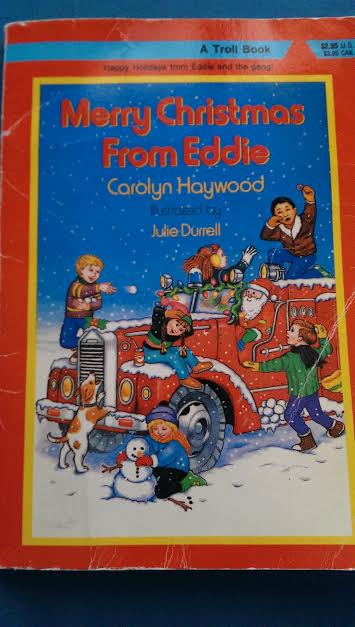
Merry Christmas From Eddie

MerryChristmasEddie

Merry Christmas From Eddie by Carolyn Haywood, 1986.

This is a collection of short stories, most of which involve one of Haywood’s favorite characters, Eddie.  Eddie is often full of big ideas and is eager to get involved in new projects.  Although this book was written in the 1980s, aspects of it seem more like Christmas in the 1950s in a fairly small town.  A few of the stories at the end focus around a special children’s program that the kids take part in.

The book is currently available online through Internet Archive.

Stories in the Book:

Merry Christmas from Eddie Fire EngineEddie’s Christmas Card

Eddie loves the decorations down at the used car lot, especially the fire engine with Santa Claus at the wheel.  Eddie thinks it would be great if his father could take a picture of him sitting next to Santa Claus so he can use copies of it as Christmas cards, but a surprise snow storm changes his plans.

How Santa Claus Delivered Presents

Every year, there’s a large public Christmas party at the town hall, and children from the local children’s shelter are invited and given presents.  This year, Eddie’s father is in charge of the celebration. Mr. Ward is loaning the fire engine from his car lot for transporting the presents, but they need some extra help transporting the extra-large Christmas tree.

Christmas Is Coming

Eddie and Boodles go Christmas shopping.  Boodles wants to get a pet bird for his mother, and Eddie has decided to buy a small present for a little boy on his street who has a broken arm.  Then, Eddie ends up winning a prize for being the ten thousandth child to enter the department store.  It solves the problem of what to buy for the little boy, but getting it home isn’t going to be easy.

Merry Christmas from Eddie TreeHow the Christmas Tree Fell Over

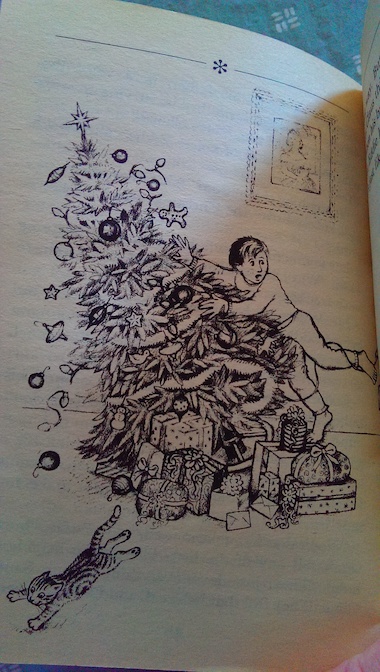
Eddie is old enough to figure out that his father is the one who puts the presents under the Christmas tree on Christmas Eve, eats the cookies they leave out, and leaves a thank you note from Santa.  This year, he gets a funny idea: he’ll leave extra presents under the tree for everyone and a second thank you note for the cookies and make everyone wonder where they came from.  But, his brilliant idea doesn’t quite go as planned.

Christmas Bells for Eddie

Eddie regrets that he never joined the school orchestra now that he’s learned that they will be performing for a Christmas program on television.  His mother suggests that Eddie could sing, but he says that the singing parts have gone to Anna Patricia’s cousin, L.C..  Then, Eddie’s father gives him an early Christmas present that will allow him to join the orchestra after all.

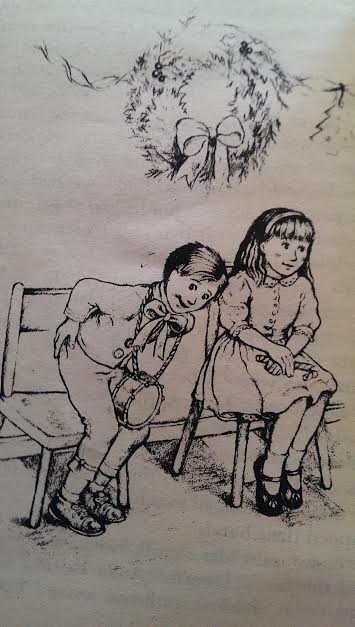
Merry Christmas from Eddie Christmas ProgramThe Christmas Concert

L.C. is spoiled and refuses to sing unless they give him chocolate-covered marshmallows.

New Toys from Old

Eddie’s third grade class is collecting and repairing old toys to be given as presents to the children at the children’s hospital.  Boodles has some fun making Anna Patricia think that Eddie painted the wrong colors on a doll’s face, and people question whether it was such a good idea to turn a nice white horse into a zebra.

The Christmas Program

Eddie has to be Little Boy Blue in the program that his class is putting on at the children’s hospital, but he has doubts about whether his old costume fits him well enough to get through the program.

The Mystery of the Christmas Cookies

Eddie’s mother plans to make some cookies for Eddie to give to his teacher, Mrs. Aprili, for Christmas, but a series of mistakes prevents him from giving those cookies to Mrs. Aprili.  Eddie finally gives up and orders some cookies from the bakery for her.  However, unbeknownst to Eddie, someone else tries to correct for his mistake and ends up creating a mystery for both Eddie and his teacher when a second batch of cookies unexpectedly arrives that is very different from both the cookies he ordered from the bakery and the ones his mother baked.

Halloween Treats

HalloweenTreats

Halloween Treats by Carolyn Haywood, 1981.

This is a collection of short stories with the usual Haywood characters as they celebrate Halloween.  These stories have a tone that’s more like Halloween of the 1950s than the 1980s, when they were written.  In this neighborhood, everyone seems to know each other, and parents are unafraid to let even young children go out on Halloween without an adult along.  It isn’t even a problem when older children invite young trick-or-treaters into their Halloween party on a whim to participate in bobbing for apples.

The book is currently available online through Internet Archive.

Stories in the Book:

HalloweenTreatsPic1The Witch and the Balloon

Katie and Mark, a set of twins, believe that the old woman who lives next door is a witch.  She has a black cat and just seems odd, banging on the wall whenever she thinks the twins are being too noisy.  But, one Halloween, when they hear banging on the wall in the middle of the night, they realize that she needs help.

Anna Patricia’s Costume

Anna Patricia loves Halloween, and she especially loves planning new costumes.  By the time Halloween actually comes, she’s changed her mind about her costume many times over.  However, there is still one change more because a surprise invitation to a Halloween party while trick-or-treating causes her to change costumes once more.

The Two Halloween Bears

Penny (a boy) and Patsy (a girl) are best friends, and they have identical teddy bears.  On Halloween, the two of them think it would be fun to wear identical bear costumes to look like their teddy bears, but they’re so much alike, even their mother have trouble telling them apart.

HalloweenTreatsPic2Monkey Business

After Eddie buys an old grind organ at a second hand shop, he realizes that he has the basis for a great Halloween costume: he’ll be an organ grinder with a dancing monkey.  He manages to persuade the girl next door to dress up as his monkey, but the long tail on her costume causes them problems.

Trick or Treat

Eddie likes old Mr. Timkin, a retired sailor, but when Mr. Timkin forgets that it’s Halloween and has no treats for the kids, they feel obligated to play a prank on him. Eddie only hopes that Mr. Timkin won’t be too mad.

Billy’s Halloween Party

When Billy holds a Halloween party only for kids in his grade at school, the younger children in the neighborhood feel left out.  Eddie recruits Betsy’s younger sister and her friend to help him play a prank on the older kids that makes the party more memorable for everyone.

HalloweenTreatsPic3Jonathan and the Jack-o’-Lantern

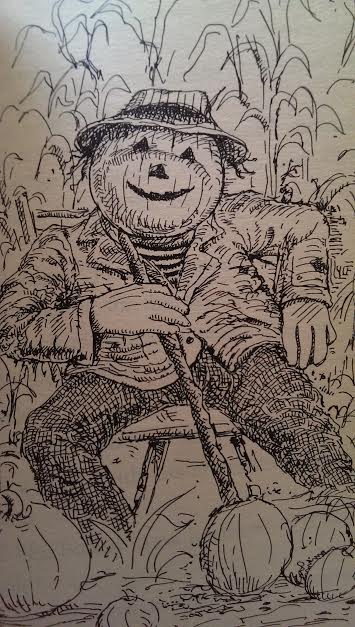
Jonathan’s family has moved from the city to the country, and he’s excited that he can see all the pumpkins growing before Halloween.  Then, some dummies with jack-o’-lantern heads give him the idea for the best costume to wear for the Halloween parade.

Who Scared Who?

Donald and Ronald, another young set of twins, are fascinated by the scary Halloween masks in the stores.  Even though the masks scare them, they think it would be funny if they could buy some really ugly masks to scare the neighborhood policemen.  However, the policemen also think it would be fun to give some of the neighborhood kids a fright.

Pennies for UNICEF

There is a contest for children collecting pennies for UNICEF.  The child who collects the most will win a trip to New York to visit the UN.  As an avid coin collector, Eddie is eager to win the contest, and he makes a special discovery among the coins that he collected on Halloween night.

Summer Fun

SummerFunSummer Fun by Carolyn Haywood, 1986.

This is a cute book of short stories featuring favorite Haywood characters, including Betsy and Eddie.  The children spent their summer in different ways, having fun summer adventures.  None of the adventures is particularly scary.  Although a couple of the kids find themselves in semi-dangerous situations, everything is resolved pretty quickly, and the rest of the stories are more slice-of-life style stories about fun and funny things that the kids do or lessons they learn.

The stories are very easy to read and great for children beginning chapter books or for some light bedtime reading for younger kids.

The book is currently available online through Internet Archive.

The stories in this book are:

Bears and Blueberries

Peter is at summer camp, and when he goes on a hike and camp-out with his camp friends, they have encounters with wildlife.

SummerFunPic2The Watermelon Party

Betsy’s father tells her that he used to have watermelon parties with his friends when he was young, and that the person who had the most watermelon seeds at the end of the party would win a prize.  Betsy decides that she wants to have a party like that, but her friend Rodney learns why cheating takes all the fun out of a contest.

A Bell for Jim Dandy

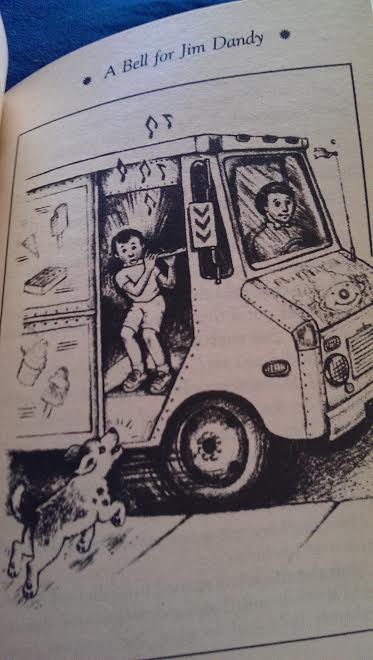
Jim Dandy is a brand of ice cream that comes on a stick.  When the bell on the ice cream truck is broken, Billy gets a job trying to help the driver attract customers in exchange for free ice cream.  But, without a bell himself, how will he get people’s attention?

Betsy’s Property

While Betsy is visiting her aunt and uncle at their summer home by the beach, she discovers a special rock a little ways out from the shore that she likes to think of as all her own.  She likes to sit out on the rock and read with her aunt’s dog, but what will she do when a sudden storm leaves her stranded?

SummerFunPic1Betsy’s Hammock Club

Betsy loves the hammock that her father bought for her, but so does every other kid in the neighborhood!

Eddie and His Hermit Crab

Anna Patricia buys a couple of hermit crabs at the beach as pets.  When she gives one to Eddie, he decides that his crab will win the hermit crab race at the beach!

Eddie and His Money Sheet

Eddie sets out to make some money with sand sculptures and ends up convincing Anna Patricia to adopt a stray cat.

The Picnic

Eddie and Anna Patricia find out that her new cat actually belongs to someone else.  But, they become friends with the cat’s owners, who take them out for a sailing trip and picnic.  When the kids’ parents are late arriving with food for the picnic, Anna Patricia tries to let the kids into the house and discovers how different the Goldilocks story would have been if the bears had a security alarm.

An Afternoon on the Farm

Teddy and Babs visit a farm with their parents and make friends with the grandchildren of the owners, Mark and Sarah.  While the children are playing at being explorers one day, they find a dead animal they’ve never seen before.  When they bring it back to show their parents, they learn why you shouldn’t mess with a skunk, even a dead one. (No mention of disease, just smell, although I’d think that would be a more serious issue.)

End of Summer

It’s time for Mark and Sarah to go home after visiting their grandparents.  With all of the things they have to remember to take with them and all of the things they forget, will they actually make it to the train on time?

A Wizard’s Dozen

WizardsDozenA Wizard’s Dozen: Stories of the Fantastic edited by Michael Stearns, 1993.

This is a collection of fantasy stories (roughly middle school level) by different authors.  The tone of the stories varies from light and humorous to dark and serious.  The stories in this collection are:

The Sixty-two Curses of Caliph Arenschadd by Patricia C. Wrede

Caliph Arenschadd has a temper, but unlike other rulers, who have been known to cut off people’s head when they’re angry, Arenschadd is also a wizard.  Because he likes to show off his magic, he has thought of something more creative than executing people: a list of curses to inflict on those who anger him.  As people get him angry, he progresses through the curses in the order that he thought of them, each one worse than the last.  Worse still, he also inflicts the curses on the families of people who annoy him, which is how Imani, the young daughter of the caliph’s vizier has experienced so many at her young age.  However, the caliph has made a serious miscalculation in his latest curse.  This time, he has turned the vizier and his family into werewolves without being able to remove the curse.  As far as anyone knows, it’s impossible to cure lycanthropy.  As the vizier and his family find themselves becoming a threat to those around them, can Imani and her friend Tumpkin find a way to break the curse?

Fairy Dust by Charles De Lint

When Marina’s friend Jason manages to catch a real, live fairy in a jar, she tries to convince him to let it go, but he refuses.  He wants to keep it, just overnight.  But, the fairy ends up dying, and suddenly, Jason himself is severely ill.  Marina is sure that Jason is suffering from a fairy’s curse, but is there anything she can do to save him?

This experience touches on Marina’s absent father, an impractical dreamer, although it does turn out that he has taught Marina an important lesson, and she learns for herself that when she sees someone doing something that she knows is wrong, it is also wrong for her to keep silent.

The Princess Who Kicked Butt by Will Shetterly

In a mystical kingdom, people’s names tell everyone something about their destiny and character.  When a new princess is born in the kingdom, the Fairy Who Was Good With Names comes to bestow a new name on her.  However, the fairy sneezes and no one clearly hears the name that the fairy gave her.  Thinking that the fairy said the princess was “the Princess Who Read Books,” the king and queen make sure that she has plenty of reading material while she’s growing up and don’t give it much more thought.  Later, when the Evil Enchanter tries to force the princess to marry him and her parents to hand over the kingdom, the princess’s true name and her real skills become known.

The Sea Giants by Betty Levin

A great-grandmother translates whale songs for her family to tell them an ancient story: There was once a family that was barely surviving on small fish, small prey, and the little berries that they were able to forage for themselves.  The father wished that he were bigger, stronger, and more powerful so that he could catch bigger prey for his family.  One day, the father and mother paddled out to sea in search of food, and they met a group of giants in their own canoe.   The giants took them back to their own village and gave them food, but although the food they were offered was much larger than anything they could catch themselves, next to the giants, it was about as small as the small prey that the people ate back home.  After while, the couple returned home to their children, guided by a strange gray dog which turns out to be a porpoise.  From then on, the family’s luck begins to change, and they do become more prosperous.  However, the father is unable to forget about the giants, and he feels called to join them again.

Efrum’s Marbles by Joy Oestreicher

Efrum is a giant, but he’s no ordinary giant.  Although Efrum is big (being a giant), he hasn’t grown at all since the age of six.  He is over 30 years old, and he is still a child, which is weird, even for a giant child.  He spends his days playing with other giant children, and his favorite game is marbles.  In fact, he has a favorite marble.  No one knows quite what this marble is made of because no one has ever seen another like it.  It’s strange, and it kind of looks like . . . an eye?  Then, a young giant girl named Brinda plays marbles with Efrum, and for the first time ever, Efrum is tempted to let someone else win his precious, mysterious marble, which clever Brinda realizes may be the first step in helping Efrum to grow up.

“Come Hither” by Tappan King

Meg hates being the middle child in her family.  Her older sister is praised for being responsible, and her younger sister is pampered.  Meg feels like getting into trouble is the only way that she can get attention.  When she gets into trouble and is grounded from her older sister’s birthday party, she decides to amuse herself by messing with her sister’s computer.  She makes a mistake while typing and ends up receiving an invitation from a mysterious elf to join her for a party in his land.  Has Meg just made a serious mistake?

With His Head Tucked Underneath His Arm by Bruce Coville

In a kingdom constantly at war, few young men survive to become old.  Young Brion escapes for a time by pretending to be crippled, but one day, his pretense is exposed, and he is executed for refusing to fight.  However, Brion’s death doesn’t prevent him from returning to end the suffering of his land and hopefully save more people from his fate.

The Queen’s Mirror by Debra Doyle and James D. MacDonald

This is a re-telling of the story of Snow White.  An older servant tells the young princess about the history of the magic mirror, which belonged to the princess’s grandmother, who ordered her own daughter’s death because she feared and resented her beauty.  There are no dwarves in this version, and it’s a slightly different take on the story.  There are hints that the events in the story repeat with the generations.

The Breath of Princes by Alan P. Smale

When Stephanie is kidnapped from her town by a dragon, the dragon tries to convince her that being a dragon’s prisoner is a much better fate than the one that awaits her in small-town life: drudgery, boring marriage, children, etc.  Of course, he plans to eat her eventually, when he gets tired of her.  Young men try to rescue her, but in a way, Stephanie fears that one of them will succeed.  If they do, she will no doubt be obligated to marry the rescuer, and considering what some of them are like, it might even be worse than being eaten by a dragon.  The man she has always dreamed about is a prince she was lucky enough to meet once, but no prince has come to save her.  There may be a way for Stephanie to save herself from either fate, but she has to sacrifice her innocence in the process.

Harlyn’s Fairy by Jane Yolen

Harlyn lives with her Aunt Marilyn, and when she spots a fairy in the garden one day, her aunt begins to worry about her.  Harlyn’s mother is mentally unstable and prone to paranoid delusions, so Aunt Marilyn keeps a close eye on Harlyn.  She discourages her from reading fantasy stories (although Harlyn loves them) for fear of the effect they might have on her mind.  But, Harlyn really did see a fairy.  The question is, what is she going to do about it?

Lost Soul by Vivian Vande Velde

A young man meets a beautiful, mysterious woman by a stream.  She charms him so much that he no longer loves the woman he was going to marry.  In fact, he is so obsessed with her that he can think of nothing else.  What will he do when he realizes that she doesn’t feel the same?  Is she even . . . human?

The Way of Prophets by Dan Bennett

The royal family of the Stuard Isles has a tradition.  At the age of seventeen, each of them must make a journey alone along an old road known as The Way of Prophets.  The things that they see and the things that happen to them along their journey tell them what their destinies are.  They learn what really matters to them and find a focus for their time as rulers.  So many centuries have passed that no one can be quite sure where the original Way of Prophets was, so mostly, the journey takes on a kind of symbolic meaning, but there are stories that say that, every once in awhile, a young ruler finds their way to the true Way of Prophets, and the kingdom changes in some important way.  When Prince Ransom sets out, he hopes to find the true path himself.  However, when he does, it doesn’t turn out to be quite what he imagined, and it makes him question what he really wants most from his destiny.

I love this story for what the prince’s father told him, “When I am gone, when you take the throne, you will be powerful.  That is guaranteed.  Your knights and armies will make sure of it.  And you will be loved and respected.  That, too, is guaranteed.  No matter what you say and do, there will always be those ready to smother you with love and respect, if you let them, simply because you wear the crown.  Because of who you are, Ransom — because of who you will become when I am gone — you need never be hungry or alone.  But there is no guarantee that you will matter.”  If what Prince Ransom wants most is to matter, can the Way of Prophets make it happen?

Faith by Sherwood Smith

Faith tells her friends fantastic stories all the time.  She comes from a poor family with a lot of problems, so most people assume that she just makes up stories to try to make her life sound better than it really is and avoid thinking about the problems.  Usually, her two best friends don’t mind much, but lately, Melissa has been getting tired of hearing Faith talk about how her dog can talk or how her radio can tune in to Middle Earth.  She’s growing up and losing patience with fantasy stories.  Even the girls’ other friend wishes that Faith would stop asking them to believe these wild stories.  Then, after a visit to the trailer where Faith lives, she begins to change her mind.

The book is currently available online through Internet Archive.
A Year Down Yonder

YearDownYonderA Year Down Yonder by Richard Peck, 2000.
This is the sequel to A Long Way from Chicago. The story takes place shortly after the Great Depression, in 1937.

Times are still hard, and a recession has left a lot of people out of work again. Mary Alice’s father is out of work, and her brother Joey is out west working for the Civilian Conservation Corps. Because her family has to move to a smaller apartment, fifteen-year-old Mary Alice leaves Chicago to stay with her Grandma in the country for the year. Times are hard in Grandma’s small town as well, but Mary Alice’s Grandma is as wily and eccentric as ever.

Like the first book, this book is really a series of short stories about Mary Alice’s adventures with her Grandma during their year together. The stories generally have a hilarious turn as Grandma gets the better of everyone, often in the name justice or a good cause.  (Although, Grandma’s sense of justice is debatable since it involves “borrowing” pumpkins from the neighbors in the dead of night and other questionable activities.)

These stories present a detailed picture of rural life during the 1930s, from pranks played on Halloween to how Armistice Day was celebrated in the years following World War I, when people were still alive who had strong memories of that war. The stories also capture some of the personalities and politics of life in a small town, from a disreputable family of outcasts to the local elite, who have more money than the others and brag about having ancestors who fought in the Revolutionary War (which may or may not be so).

Rich Chicago Girl: Mary Alice arrives in Grandma’s small town and is enrolled in the local school.  She meets the class bully, and Grandma helps her to deal with her.

Vittles and Vengeance: At Halloween, Grandma gets revenge against a group of pranksters and raids her neighbors for ingredients to make the school Halloween party better.

A Minute in the Morning: Armistice Day, November 11, has more meaning for people who have actual memories of The Great War (World War I).  Grandma makes sure that those who can afford it pay what they owe to the veterans of that war and shows Mary Alice the price that some soldiers paid for supporting their country.

Away in a Manger: Mary Alice is picked to play Mary in the school’s Christmas Nativity play.  The baby Jesus turns out to be a surprise for the whole town, and Grandma arranges a special surprise for Mary Alice.

Hearts and Flour: The head of the local branch of the DAR pushes Grandma to make cherry tarts for their annual tea in honor of George Washington’s birthday.  Since she will neither allow Grandma to join the DAR (because Grandma doesn’t have the proper lineage) nor pay Grandma for her work (she thinks Grandma should ‘volunteer’ her services as part of her patriotic duty), Grandma insists that if she bakes, she must host the tea as well . . . with a couple of special surprise guests.  Meanwhile, a handsome new boy named Royce joins Mary Alice’s class at school.

A Dangerous Man: An artist working for the WPA rents a room from Grandma, treating Mary Alice and Royce to a scandalous but hilarious sight when his subject matter gets out of hand.

Gone with the Wind: A tornado sweeps through the town, and Grandma and Mary Alice go to check on residents who live alone.  Mary Alice also prepares to return home to her parents in Chicago.

Ever After: The final story in the book is about Mary Alice’s wedding, years later, toward the end of World War II.

This book is a Newbery Award winner.  There are multiple copies currently available online through Internet Archive.

A Long Way from Chicago

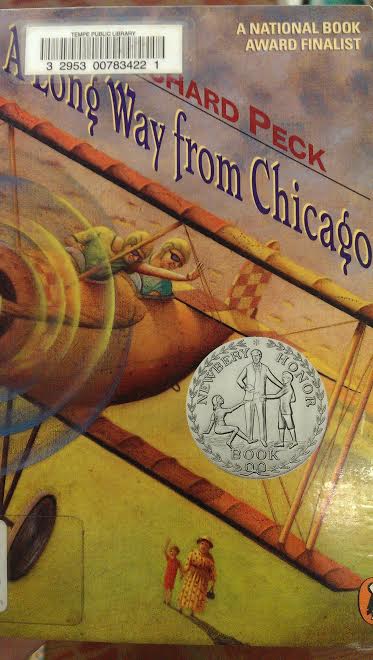
LongWayChicagoA Long Way from Chicago by Richard Peck, 1998.

Joey and Mary Alice live in Chicago during the Great Depression, but every summer, they go to stay with their grandmother in a small town in Illinois. At first, the kids think that staying with their grandmother will be boring, but they soon find out that Grandma is anything but. She’s an eccentric woman who doesn’t let anyone boss her around and doesn’t have much respect for any rules but her own. Although she’s pretty tough, Joe and Mary Alice learn that, deep down, Grandma really does care about other people and tries to help them, even though she often gets into a lot of trouble in the process. Each chapter is a short story from each of the summers that the kids spend with their grandmother, from 1929 to 1935:

Shotgun Cheatham’s Last Night Above Ground (1929): When a reporter comes looking for information about a recently deceased local character, Grandma volunteers to hold a wake for him in order to teach everyone a lesson about truth and gossip.

The Mouse in the Milk (1930): When a group of local pranksters needs to be punished, Grandma decides to play a little trick of her own to get even.

A One-Woman Crime Wave (1931): Grandma turns to trespassing and illegal fishing in her quest to feed the hungry.

The Day of Judgment (1932): Grandma enters a baking contest at the county fair for the glory of her home town and a chance to ride in an airplane.

The Phantom Brakeman (1933): Mary Alice tries to help a young woman escape from her abusive mother, and Grandma brings a ghost story to life for the sake of young love.

Things with Wings (1934): Effie Wilcox, a neighbor of Grandma’s, loses her house to the bank, but Grandma comes to the rescue by demonstrating the power of rumors.

Centennial Summer (1935): As Grandma’s town celebrates its centennial, Grandma decides that uppity Mrs. Weidenbach, the banker’s wife, needs to be taught a lesson.

The Troop Train (1942): Joe, now much older, has enlisted in the Army Air Corps during World War II. As the train taking him to his basic training passes Grandma’s town, she’s there to wave to him.

During the course of the stories, the author includes details about how Prohibition and the Great Depression affected people and other details about life in the early 1930s. This book is a Newbery Honor Book.  There are multiple copies available online through Internet Archive.