Triple Trouble in Hollywood by Michael J. Pellowski, 1989.
This time, Randi and Sandi to go Hollywood to visit their cousin Mandy. Mandy is no longer the same snobbish girl that she was the last time they were together, but she still has ambitions. Right now, she’s trying out for a part in a commercial, but she’s up against some stiff competition.
The commercial requires the girl to sing a jingle and do a back flip. Although Mandy has an excellent speaking voice, the other girls know that she’s terrible at singing, and Mandy doesn’t think she can do the back flip, either. Her main competitor, Tara, can do both of those things. Tara is a wealthy girl whose parents hired coaches to teach her singing and gymnastics especially for this role.
The three girls don’t think it’s fair that Tara has such advantages, and she’s an even bigger snob than Mandy ever was. Then, Randi suggests that they use their similar appearances once again to turn the situation around. Randi is athletic enough to do a back flip, and Sandi is an excellent singer. With all three of them working together, the try-outs for the commercial would be a snap!
Sandi doesn’t want to do it because it would be dishonest, but Randi and Mandy talk her into it. It’s partly to help Mandy, partly to get back at Tara for her rotten attitude, and partly for the chance to meet the heartthrob Judd Morrison who will also be in the commercial. Of course, as is always the case when the girls switch places, nothing goes as planned. But, to the girls’ surprise, their younger brother Teddy helps to make things better in the end.
Randi and Sandi Daniels have a cousin named Mandy who is only slightly older than they are and who looks very much like the two of them. Their two fathers were brothers, and their two mothers were sisters, which is why they look so much alike. When the three of them were young, they used to get along well and they were almost like triplets. However, when Mandy comes from California for a visit, it becomes apparent that she’s changed a lot.
The three of them still look a lot alike, but Mandy has become stuck up and snobbish. More than anything, she wants to be a big Hollywood star. Because she’s an only child, her parents have indulged her, but now they’ve become concerned that she’s become too wrapped up in her ambitions. She doesn’t really have any friends and isn’t interested in anything besides acting. They think that if Mandy spends some time with her cousins, it will encourage her to slow down and act her age more.
But, Mandy’s snobbish attitude rubs Randi and Sandi the wrong way. Mandy doesn’t want to do anything because she might get dirty or break a nail, and she keeps bragging about how grown up she is compared with her not-much-younger cousins. The twins argue with their cousin, and they play tricks on each other. When Mandy takes advantage of acting skills and her similar appearance to the other girls to try spending time with a boy they like by pretending to be them, Randi and Sandi decide it’s the last straw! They decide to show Mandy that playacting is a game that three can play at.
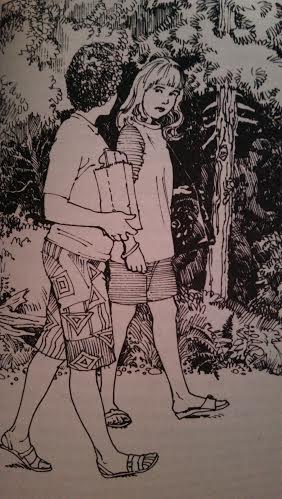
Like the first book in this series, this one is also filled with black-and-white drawings.
Sandi and Randi Daniels are identical twins with a younger brother, Teddy, who is in his Terrible Twos. Although Sandi and Randi look alike, they are still very different people. Sandi loves to read and is a good student, and Randi is loves sports, especially soccer. The problem is that Randi’s place on the soccer team is in danger because of her poor grades. Their father has told her that if she doesn’t improve her spelling, she won’t be able to play soccer anymore, and the championship game is coming up!
The two girls come up with a possible solution to the problem when Teddy accidentally mistakes Sandi for Randi one day because Sandi is wearing her sister’s favorite shirt. Since Sandi is much better at spelling than Randi is, Sandi will dress as Randi and meet her teacher for her special tutoring in spelling while Randi goes to play soccer with her sports team.
But, everything goes wrong when Randi’s coach talks to her teacher about the championship game, and it turns out that her teacher is secretly a soccer fan. When Sandi arrives for the tutoring session and the teacher and coach tell her the happy news that “Randi” can play in the championship game, Sandi has no time to tell Randi about it and switch places with her again. Will their hoax be exposed? Will the girls be able to switch places again in time to save the championship?
There are black-and-white drawings throughout the book. This is the first book in a series.
The Secret of Roan Inish (aka The Secret of the Ron Mor Skerry) by Rosalie K. Fry, 1957, 1959 (first US edition), 1995 (movie tie-in).
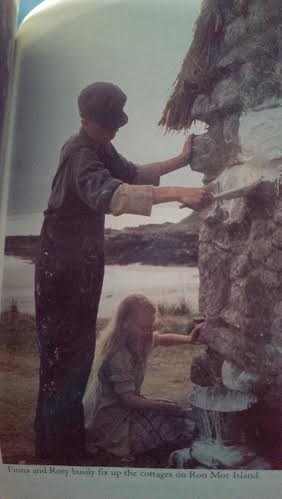
This is the book that the movie The Secret of Roan Inish is based on. The movie tie-in book contains the text of the original book, which was called Secret of the Ron Mor Skerry (Child of the Western Isles), and pictures from the movie (the original book had black-and-white drawings). The movie follows the plot of the original book fairly well, although the location was changed to Ireland and some of the names were altered to reflect the change in location. For example, the family name in the book was McConville, not Coneelly, and Fiona’s cousin was Rory in the book and Eamon in the movie. My book, like the original, takes place in Scotland, and notations under the pictures call the characters by their original names.
Ten-year-old Fiona has been living in a big city ever since her family left the island of Ron Mor about four years earlier to seek new jobs and new opportunities. However, Fiona’s health has been poor, and her doctor has advised her to return to the seaside for the healthier atmosphere. The book begins with her journey to stay with her grandparents who still live close to Ron Mor. Fiona’s homecoming is tinged with both sadness and hope, as she reflects on the mysterious disappearance of her baby brother the day that her family left the island.
Although her brother apparently floated out to sea in his cradle after being left unattended on the beach, Fiona has the feeling that he is still alive somewhere close to the island. She learns that her cousin Rory also believes the local rumors that the boy is still on Ron Mor in the company of the seals that populate the area around the island. Moreover, Rory and other family members share Fiona’s longing to return to their old home and their family’s traditional way of life as fishermen. Fiona’s determination to find her younger brother and bring him and the rest of their family home to the island is touching and emphasizes the importance of family ties.
There is also an element of fantasy because of the story that Fiona’s grandfather tells about the family’s heritage, which helps explain their special connection to the sea and seals around the island. He and other members of the family believe that one of their ancestors was a selkie, a magical person who could change into a seal. The story is gentle and upbeat, which makes a nice change from a lot of modern children’s books. I think that it’s just plain magic.
Something that the book clarifies, which is more vague in the movie, is that everyone in Fiona’s family, except for her little brother, has red hair. All of the McConvilles always have red hair, except for those who are apparently closer to their Selkie ancestry, who have very dark hair. They couldn’t clarify that point in the movie because the girl playing Fiona is blonde, and everyone else has different hair colors, but that’s why her brother is so markedly different in his appearance.
Physical copies of the original book are expensive collectors’ items, but there is good news: it’s now available on Kindle and through Internet Archive (where you can borrow an electronic copy for free), so if you’re nostalgic or just curious, it’s easier to read it now!
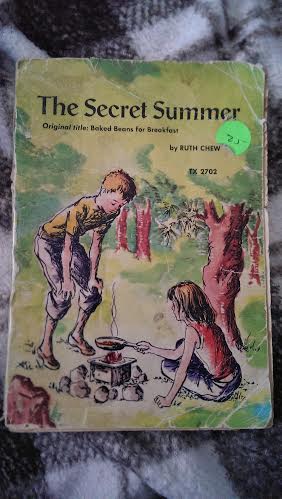
This was one of my favorite books when I was a kid. Its original title was Baked Beans for Breakfast, but I think the paperback copies are mostly under this title.
Joe and Kathleen, who are brother and sister, are disappointed because their parents are taking a trip to Europe without them instead of taking the whole family to the lake like they usually do in the summer. Worse still, their babysitter favors their younger siblings and is very hard on them. The babysitter is even cruel and neglectful by making the older siblings sit outside in the heat all day while she played with the younger siblings inside, not even allowing Joe and Kathleen to come inside for water. Finally, Joe comes up with a plan for himself and Kathleen to escape their babysitter by going to the lake by themselves.
They leave a note for the babysitter saying that they are going to visit their grandmother and take a bus to the lake. Thus begins the adventure! The children camp out in the woods, trying to avoid people who know them and might tell their parents or babysitter where they are. They do make some new friends, including a nice older lady who hires them to help her with chores in her big, old house. However, as well as Joe and Kathleen take care of themselves, they can’t plan for everything. What will happen to the children when an emergency rescue means that their secret will be discovered?
Ruth Chew may be better known for her fantasy stories, but this was the first book of hers that I encountered. It would especially appeal to fans of The Boxcar Children, another story about resourceful children who are trying to survive without help from adults.
Jenny Blair is a gloomy gus who often gets premonitions of impending doom, much to the annoyance of her siblings. They poke fun at her pessimism, but some of those premonitions start to come true when her youngest brother falls ill on a family vacation to the beach and needs to be taken to the hospital.
Jenny and her twin brother, Chris, accompany their older teenage brother and sister as they start the long drive home while their parents tend to their younger brother at the hospital. On the way home, the kids accidentally become stranded during a storm and seek out help from a large old house that they had mistaken for a hotel. With a fallen tree blocking the road, the inhabitants of the house reluctantly agree to take them in until they can continue their trip home, but all of the kids can tell that there is something sinister about their hosts. Miss Cliff makes it obvious that she resents the children’s presence, and Dr. Cliff is a peculiar kind of scientist working on . . . something . . . in the basement.
They tell the kids that the house is supposed to be haunted and people can often hear the ghost of Andrea Cliff calling out in the night. The kids soon hear this spooky voice themselves, calling for help. Trapped in the house with the ghost and unfriendly people, the Blairs decide that they have to figure out what’s really going on, but the danger is worse than they know, and Jenny’s premonition of doom is getting stronger all the time . .
The book is available to borrow and read for free online through Internet Archive, but the version there does not have pictures.
My Reaction:
This creepy little book has been a favorite of mine for years!
Young people trapped in a spooky old house with a ghost story during a storm is a common trope of spooky stories, but this one is a particular favorite because of the way it’s done. I like the implication that Dr. Cliff might be some kind of mad scientist. Mad scientists appear in other books in children’s literature, but it’s an element that provides a nice twist on the ghost story and allows readers to wonder whether Dr. Cliff or the ghost might be the bigger threat.
The ghost story and the mysterious voice the kids hear is also well done, and they confront the problem very practically. For those who like the Scooby-Doo style of mystery, where the “ghosts” turn out to be people, and there’s an explanation for everything . . . you’ll love this story. Not all copies of the book have pictures, but my book contains a few black and white illustrations. The one I used in my review is the scene where the kids hear the ghost’s voice for the first time.
There is one final twist at the end of the story that readers might see coming if they pay close attention to the story. There’s even a clue to this twist that is shown in pictures if you have a copy with pictures, but I’m not going to spoil it here.
The Mystery in Dracula’s Castle by Vic Crume, 1973.
This is a novelization of a live action Disney movie of the same name and contains photographs of scenes from the movie. The title of the book and the movie is a little misleading because, although the main characters are unaware of what is going on for most of the story, the audience finds out pretty quickly who the bad guys are and what they’re doing. In a way, it’s kind of like a Columbo story where the suspense is in watching the hero figure it all out. Also, there is no real castle or Dracula. Sorry. 😦 In spite of these short-comings, it’s still a fun story, and although the movie has not been released on dvd, it is possible to see it on YouTube (as of this writing).
Alfie and Leonard are spending yet another summer at their family’s beach house in a small town while their mother works on the new book she’s writing. They think this summer is going to be dull, but with jewel thieves in town, it soon becomes apparent that it’s anything but!
Alfie is an aspiring film maker. Specifically, he wants to make horror movies, and he talks his younger brother into playing the part of Dracula in his latest Super 8 film. Leonard is only a reluctant vampire because he doesn’t like horror movies. He really wants to be a detective, like Sherlock Holmes. Back home, he and his brother saw police investigating the scene of a robbery at a jewelry store, and he’s decided that he wants to investigate crimes like that. Soon after they arrive at the beach house, Leonard adopts a stray dog and names him Watson so that he can be his sidekick.
Alfie laughs at his brother’s detective fantasies, but Leonard gets his chance to prove himself when they become involved with the thieves who robbed the jewelry store. The location that Alfie has picked for his movie is an old lighthouse, which he thinks looks like Dracula’s castle, and that is where the thieves are staying. With the sheriff’s daughter acting as their baby-sitter and the heroine of their film and the necklace ending up in Leonard’s hands by accident, the thieves struggle to get it back before Leonard realizes what it is and where it came from.
This book is currently available through Internet Archive. When the movie first aired on tv, it was shown in two parts. Internet Archive also has the second part of the movie, but not the first (at least, not right now). Sometimes, you can find part or all of the movie on YouTube.
I would dearly love to see this book in print again! It’s a charming modern fairy tale about a young princess who learns what beauty and happiness really mean.
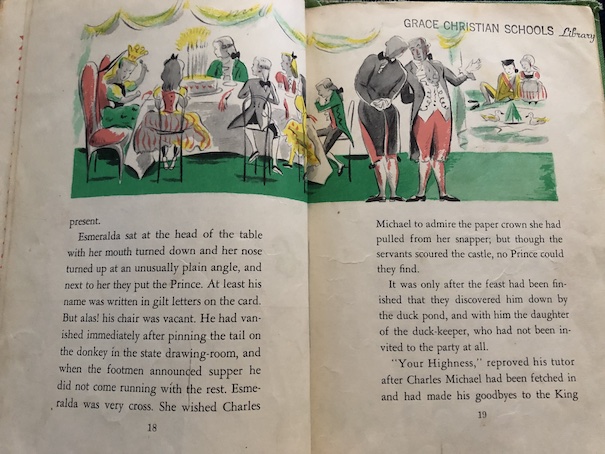
Esmeralda is the only child of the king and queen, and she has just about everything that a girl could want. The author paints a pretty picture of Esmeralda’s charmed life at the castle and all of the beautiful things she has.
However, Esmeralda has one serious problem: she is plain. In her kingdom, in order for a girl to be considered beautiful, her nose must turn down, her mouth must turn up, and her eyes must have a twinkle in them. Esmeralda’s appearance is exactly the opposite. It is a serious problem because her plainness causes people to lose respect for her, and the prince that she is betrothed to refuses to take much of an interest in her.
Although her parents consult the finest physicians and wizards available, none of them can provide any solutions for Esmeralda’s condition. It is only after the king places an advertisement in the newspaper that a widow, Dame Goodwit, with five daughters of her own comes to the castle and offers a solution. However, she insists that Esmeralda must come and live with her family for nine months. At first, Esmeralda is distressed at leaving her home and living in much simpler circumstances that she is accustomed to, but the reasons soon become as plain as the princess herself.
As Esmeralda interacts with and becomes friends with Dame Goodwit’s daughters, Annabelle, Christabelle, Dulcibelle, Floribelle, and Echo, she comes to see herself and her old life at the castle differently. At Dame Goodwit’s, she is expected to take care of herself and her belongings by herself, for the first time in her life. She is given chores to do and becomes responsible for herself in ways that she never was before. She also comes to see that, even though Dame Goodwit’s daughters are not princesses, in many ways, they are more knowledgeable and accomplished than she is, able to do many things that Esmeralda has never even tried before. Little by little, Esmeralda learns and tries new things, even coming to enjoy her time with the family and becoming especially fond of little Echo, the youngest girl. Her new experiences change her, her behavior, her attitudes, and eventually, even the way she looks.
The book is available to borrow and read for free online through Internet Archive.
My Reaction
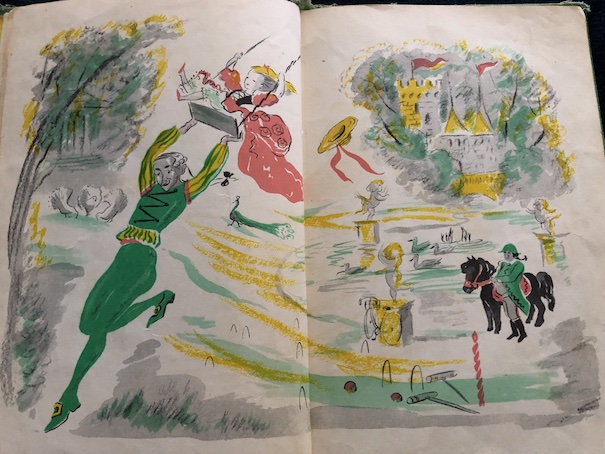
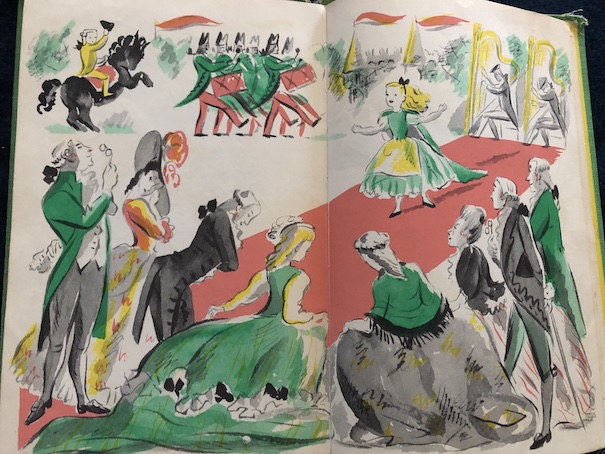
In spite of the fairy tale atmosphere, there isn’t really any magic in the story, as the widow herself points out. The real magic of the story is in the lessons that Esmeralda learns: that beauty and change come from within and that the way we see ourselves and those around us is important. For those who might be concerned at the emphasis on “beauty” and “plainness”, it soon becomes apparent that the outward signs of beauty really stand for positive character traits: humility, pride in one’s own talents and accomplishments, and unselfish caring for other people. The book also has some very pretty illustrations, some of which are wide scenes taking up two pages. It’s a beautiful book and a beautiful story for any young girl.
I don’t think that the book was ever made into a movie, but there are multiple versions that are stage plays (the link is to a video clip from a stage version of the story), including some that are musical. I have seen a script for one of them that has added religious themes that weren’t in the original book, but the site has since been removed. I’m sure that the script still exists, I’m just not sure where to find it now. Some of the narrator’s and characters’ dialog was taken directly from the original book, but the religious parts were added. As I recall, it implied that the princess’s personality changes came through the grace of God or developed as her religious side also developed, but I can’t remember now exactly how they said it. I think it may have included some Biblical quotes related to the personality traits the princess acquires. At one point, it was the only script that I could find available for free online. There are other play versions that are available for purchase elsewhere, such as Dramatic Publishing and Steele Spring Stage Rights.
The story begins with Flee Jay talking about how she fell in love with mystery stories when she was younger after she found a mystery for adults that had accidentally been shelved in the children’s section of the library. Although the book was about a murder where the body was hidden inside a snow man and was really too scary for a girl her age, she was captivated by it, wondering what was going to happen next. It was a shame that the librarian caught her reading it, so she never got to find out how it ended. But, it does inspire her to find part of the solution to this mystery, a part that stumps even Clarice.
The mystery that confronts Flee Jay and Clarice this time concerns a fortune teller and her nephew. The fortune teller used to live in their town, and the girls’ parents even went to her to have their fortunes told when they were teenagers. Now, she’s returned along with her nephew in order to revive the health club that her late husband owned when they were living in this town. When the girls go by the health club to take a look at it, they find the fortune teller unconscious on the floor. She says that there must have been something in the tea she was drinking and that “the spirits” have been trying to convince her not to get involved with the health club.
Flee Jay thinks this is spooky, but Clarice doesn’t believe in spirits. In order to investigate further, the two girls accept part time jobs helping the fortune teller and her nephew to clean up the building so they can move in new exercise equipment. “The spirits” continue sending warnings in the form of red dye in the Jacuzzi and threatening messages. Clever Clarice uses logic to point out how most of these things were accomplished but is surprised when Flee Jay reveals something that she overlooked.
Although I like the first two books in the series better, the ending of this one makes it worth reading. Clarice may be the genius who usually reveals the solution to the mystery, but Flee Jay is a girl detective after all!
This book is currently available online through Internet Archive.
The Case of the Lost Lookalike by Carol Farley, 1988.
“I want to swoop in and spout out the answers to baffling mysteries while everyone around me blinks in befuddlement. I want to reveal the amazing solutions to puzzles while everyone gasps in admiration. Except the criminal, of course, who gasps for other reasons.”
— Flee Jay Saylor
In The Case of the Lost Lookalike, Flee Jay and Clarice are spending the summer at a lake with their aunt, and someone there says that Clarice is the very image of a little girl named Caroline who was apparently kidnapped 40 years ago. Little Caroline disappeared from her own bedroom one night after her mother died under rather suspicious circumstances. Most people assume that Caroline is dead, too. The girl’s father is now a strange recluse who lives on an island in the middle of the lake.
But, as the girls puzzle over this old mystery, other mysterious things begin to happen. A woman produces pictures of the missing girl which look nothing like Clarice. Then, her shop is broken into, and the pictures of Caroline disappear.
When someone persuades their aunt to let the girls visit the old recluse on the island, the man’s reaction is surprising, and they come to realize that Caroline’s disappearance might not be the real issue at all. Clarice takes some frightening risks to get to the bottom of the mystery!
My Reaction
In a way, this story is two mysteries in one because Clarice figures out what really happened to Caroline when she disappeared years ago at the same time that the girls unravel the mystery that is affecting people who live in the small town by the lake now. The mystery of what happened to Caroline would not have resurfaced at this particular time if someone else hadn’t brought up the issue as a distraction from something else.
What I like best about this series is the sense of humor and the way that Flee Jay says things as she narrates the story: “I mean, new cottages and magic lakes are terrific and all that, but nothing can ever take the place of a peanut-butter, brown sugar, and banana sandwich.”
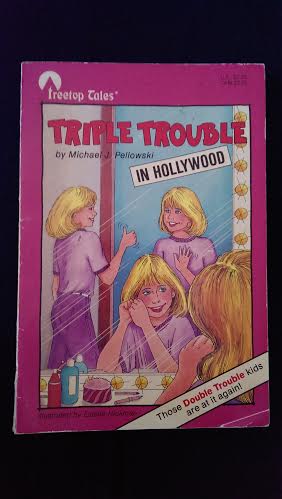 Triple Trouble in Hollywood by Michael J. Pellowski, 1989.
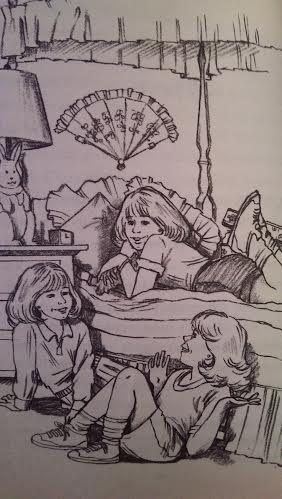 Sandi doesn’t want to do it because it would be dishonest, but Randi and Mandy talk her into it. It’s partly to help Mandy, partly to get back at Tara for her rotten attitude, and partly for the chance to meet the heartthrob Judd Morrison who will also be in the commercial. Of course, as is always the case when the girls switch places, nothing goes as planned. But, to the girls’ surprise, their younger brother Teddy helps to make things better in the end.
 Triple Trouble by Michael J. Pellowski, 1988.
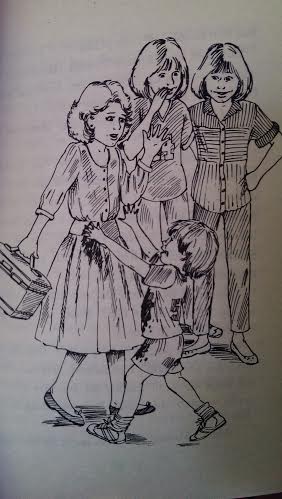 But, Mandy’s snobbish attitude rubs Randi and Sandi the wrong way. Mandy doesn’t want to do anything because she might get dirty or break a nail, and she keeps bragging about how grown up she is compared with her not-much-younger cousins. The twins argue with their cousin, and they play tricks on each other. When Mandy takes advantage of acting skills and her similar appearance to the other girls to try spending time with a boy they like by pretending to be them, Randi and Sandi decide it’s the last straw! They decide to show Mandy that playacting is a game that three can play at.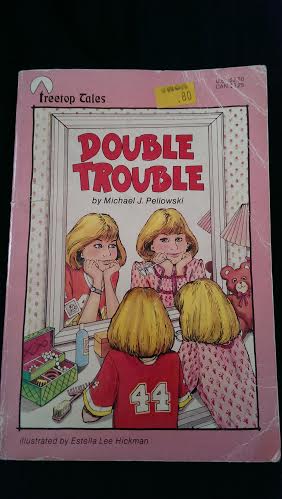
 But, everything goes wrong when Randi’s coach talks to her teacher about the championship game, and it turns out that her teacher is secretly a soccer fan. When Sandi arrives for the tutoring session and the teacher and coach tell her the happy news that “Randi” can play in the championship game, Sandi has no time to tell Randi about it and switch places with her again. Will their hoax be exposed? Will the girls be able to switch places again in time to save the championship?
 The Secret Summer by Ruth Chew, 1970.
 The Ghost that Came Alive by Vic Crume, 1975.
 They tell the kids that the house is supposed to be haunted and people can often hear the ghost of Andrea Cliff calling out in the night. The kids soon hear this spooky voice themselves, calling for help. Trapped in the house with the ghost and unfriendly people, the Blairs decide that they have to figure out what’s really going on, but the danger is worse than they know, and Jenny’s premonition of doom is getting stronger all the time . .
  The Mystery in Dracula’s Castle by Vic Crume, 1973.
 Alfie is an aspiring film maker. Specifically, he wants to make horror movies, and he talks his younger brother into playing the part of Dracula in his latest Super 8 film. Leonard is only a reluctant vampire because he doesn’t like horror movies. He really wants to be a detective, like Sherlock Holmes. Back home, he and his brother saw police investigating the scene of a robbery at a jewelry store, and he’s decided that he wants to investigate crimes like that. Soon after they arrive at the beach house, Leonard adopts a stray dog and names him Watson so that he can be his sidekick.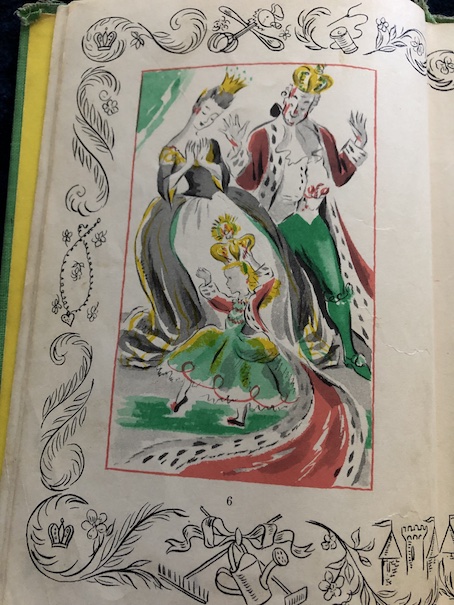


 The Case of the Haunted Health Club by Carol Farley, 1991.
 Flee Jay thinks this is spooky, but Clarice doesn’t believe in spirits. In order to investigate further, the two girls accept part time jobs helping the fortune teller and her nephew to clean up the building so they can move in new exercise equipment. “The spirits” continue sending warnings in the form of red dye in the Jacuzzi and threatening messages. Clever Clarice uses logic to point out how most of these things were accomplished but is surprised when Flee Jay reveals something that she overlooked.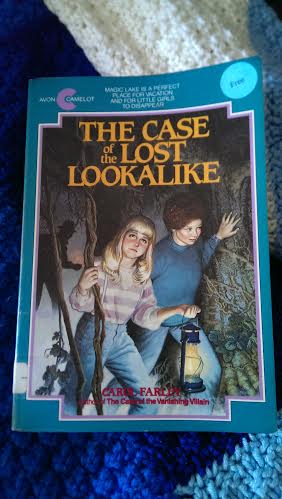
 Jestress's Forgotten Books and Stories