The Dancing Goat

The Dancing Goat by Bonnie Book, 1966.

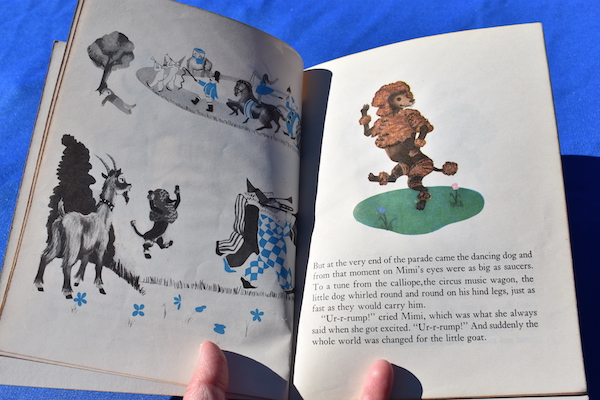
Mimi is a good little goat who lives with a poor farmer and his wife.  They like her and take good care of her, and in return, she provides them with milk that they sell to help make their living.  However, things change for Mimi when she happens to see a circus parade with a dancing dog.  From that moment on, all Mimi wants to do is to dance!

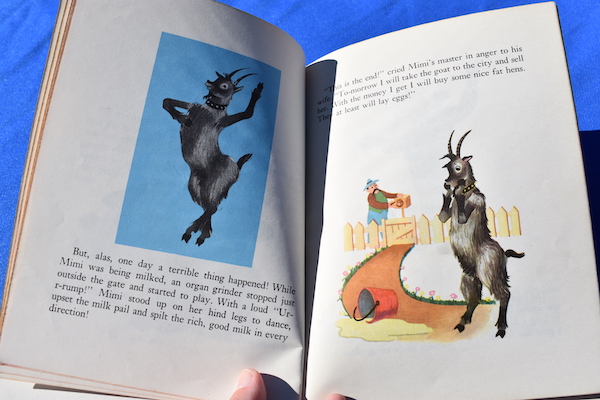
It wouldn’t matter so much except that Mimi develops a bad habit of dancing when the farmer is trying to milk her, spilling the milk.  Eventually, the farmer concludes that he can no longer afford to keep Mimi, even though he and his wife don’t really want to part with her.  Mimi is upset at the thought of losing her home, and when the farmer takes her to the market to sell her, she starts to cry.

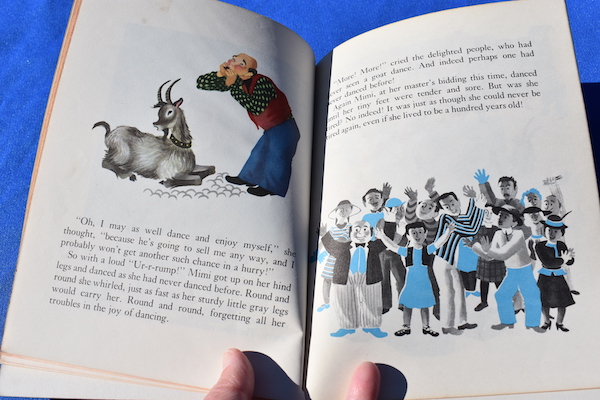
The people at the market don’t want to buy a crying goat and think that something is wrong with Mimi.  To cover up the noise of Mimi crying, the farmer starts to blow a tune on his comb.  Hearing the music, Mimi starts to dance again.

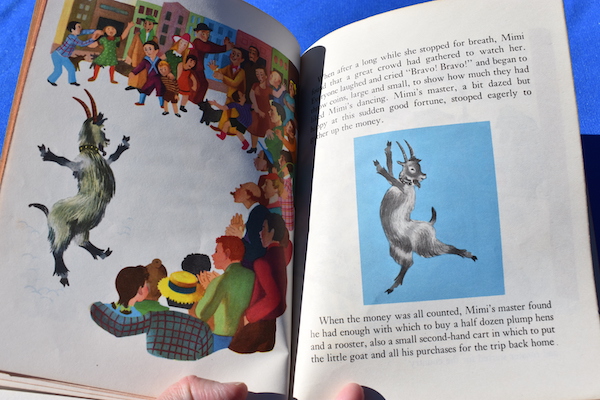
To the farmer’s surprise, everyone in the market loves Mimi the Dancing Goat, and they throw coins.  With the money that Mimi makes with her dancing, the farmer can now only afford to keep her but buy other livestock as well.  From then on, the farmer regularly takes Mimi to the market to show off her dancing and earn some extra money.  He plans to buy another goat to keep Mimi company, and he hopes that the new goat turns out to be a dancer, too!

I usually don’t like “animal almost loses their home” type stories because I always feel too sorry for the poor little animal, but the risk in this story is over pretty quickly, which helps. It also helped that the farmer and his wife genuinely liked Mimi and were only going to part with her reluctantly, so it wasn’t difficult for the farmer to change his mind as soon as Mimi showed that she could bring in money to help earn her keep.

The Cookie Tree

CookieTree

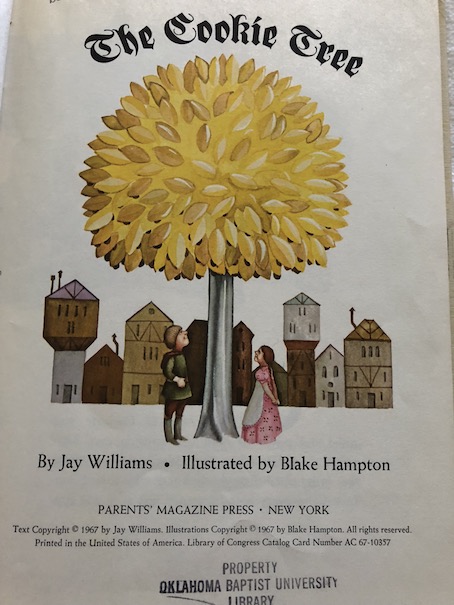
The Cookie Tree by Jay Williams, 1967.

Owlgate is a very orderly little village.  Everything has a purpose and a place, and nothing unexpected happens . . . until the day the cookie tree appears in the middle of town.  The tree is silver and gold and has chocolate cookies.

CookieTreeOwlgate

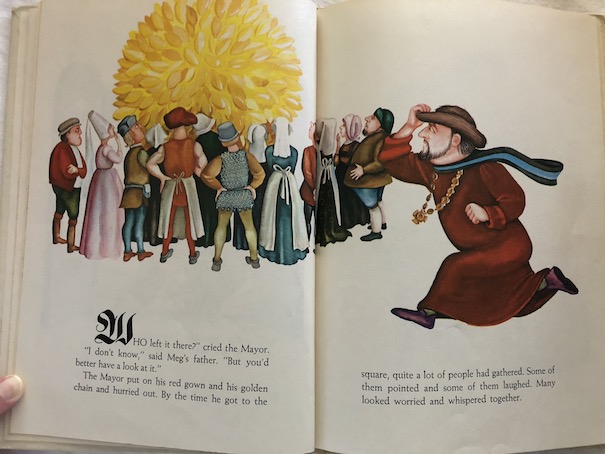
A girl named Meg notices it first, but her parents refuse to allow her to pick a cookie from the tree because they’re worried about where it came from. For all they know, the cookies could be poisonous!  Meg’s father gets the mayor to come look at the tree.

CookieTreeTownspeople

Eventually, everyone in town comes out to see the tree.  The miller thinks that the whole thing is probably a big joke, but most of the other adults are worried because it’s weird.  Some of them think maybe it’s some kind of bad omen.  Little Meg’s theory is that a magician sent it as a present for the village, just to give them cookies.  However, the adults reject that explanation, saying that it doesn’t make sense and they don’t any reason see why a magician would send them a cookie tree.

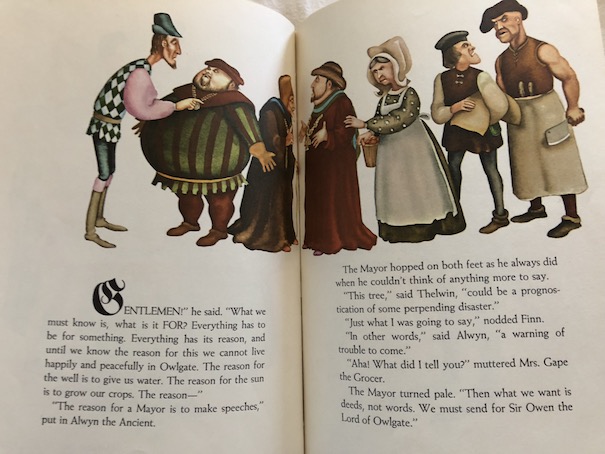
The mayor consults with the Village Councillors, but they don’t accomplish much other than to establish that there are indeed chocolate cookies growing on the tree when one of them samples a cookie.  The adults argue back and forth about what to do about the tree, but by the time they come up with a plan, the tree has vanished!

CookieTreeDebate

While the adults’ backs were turned, the children of the village ate all the cookies, and once the cookies were gone, the tree disappeared.  Apparently, Meg’s theory about the magician sending the tree just to give them cookies was correct.

One of the things that people sometimes praise children for doing is seeing things for what they are. Adults have a tendency to over-analyze things, looking for hidden meanings that may or may not exist. Sometimes, things really are just what they appear to be, and over-analyzing just confuses the issue. It can be like that with children’s books. Adults worry about every little thing in stories and possible messages being sent to children, but when people start over-analyzing stories, they can find themselves making up hidden messages and reading things into stories that aren’t really there.  Sometimes, stories and other things are just for fun, and you might as well simply enjoy them for what they are!

The book is currently available online through Internet Archive.

The White Marble

WhiteMarble

The White Marble by Charlotte Zolotow, 1963.

WhiteMarbleGoingToPark

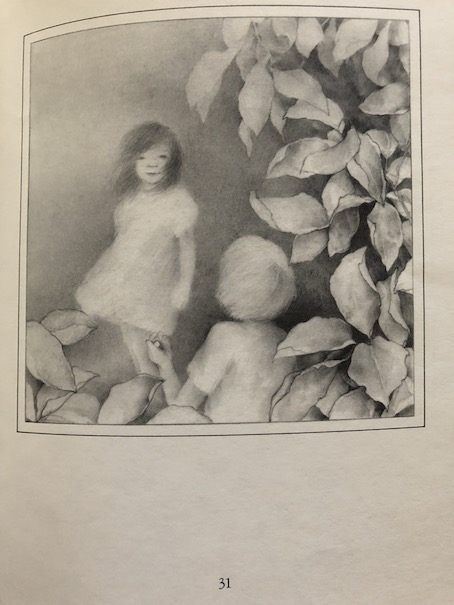
It’s a hot night in the city, and John Henry’s parents decide that they should go to the park to cool off.  John Henry is a little thrilled to be out with his parents at night, stopping to pick up a beautiful white marble he finds as they enter the park, but disappointed when he realizes that he is the only child there.

Then, a little girl he knows from school, Pamela, comes to the park with her mother.  John Henry is pleased to see her because only another child could understand how magical this night in the park really is.  He calls to her to come run with him, and the two children run off to play in the park together.

WhiteMarbleTwoKids

The children kick off their shoes and run barefoot in the cool grass.  They lie in the grass for awhile, drink water from a fountain, and have ice sticks (we always called them popsicles when we were kids) from the ice cream man.

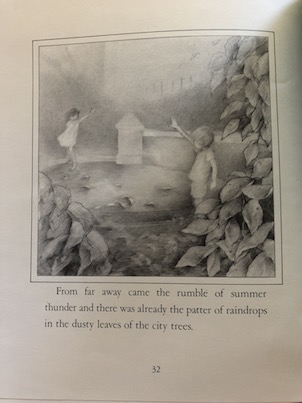
John Henry shows Pamela the little white marble he found.  Pamela thinks it’s as beautiful as he does, and John Henry realizes that no adult could understand how beautiful a small, simple thing like that could be, only another child.  That’s what binds John Henry and Pamela together.  As children, they can still appreciate the simple pleasures of life and the beauty and magic of small, ordinary things that adults take for granted, like a small white marble someone forgot in a park or how nice an evening can feel as rain moves in after a hot day.

WhiteMarbleGoodNight

When it’s time to go home, John Henry gives Pamela the white marble, a memento of this special night.

The pictures in this edition of the book are different from the ones that I remembered from the first time that I read it as a child.  This edition of the book, available through Internet Archive, shows the pictures that I remember.  The pictures in the later edition of the book are black and white, but the ones in the original edition are done in three colors: black, white, and blue.  Of the two, I really prefer the original drawings.  They capture the magic of a lovely night shared with a friend.

The Case of the Cat’s Meow

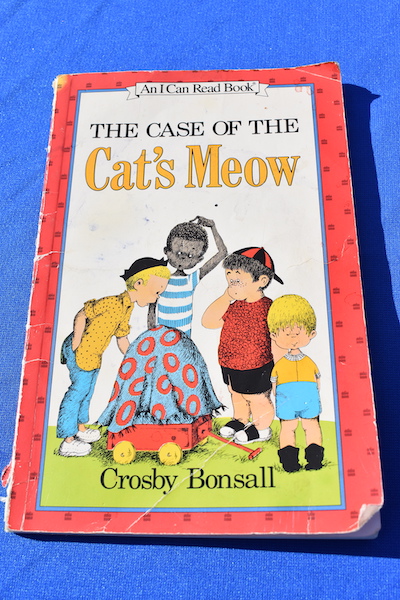
The Case of the Cat’s Meow by Crosby Bonsall, 1965.

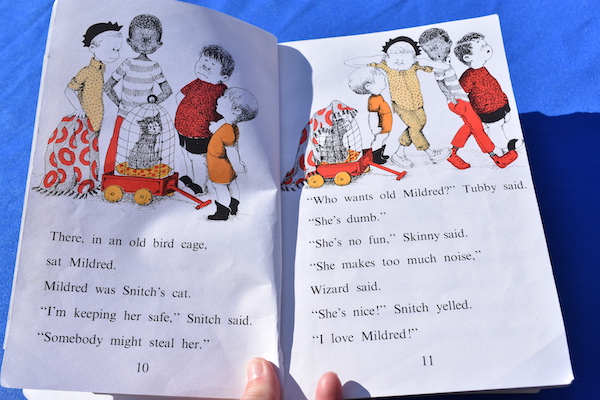
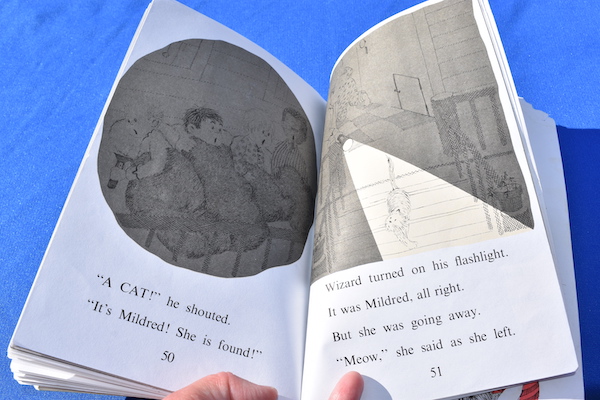
Four neighborhood friends, who call themselves by the nicknames Wizard, Skinny, Tubby, and Snitch, have their own private detective club.  Their club meets in a backyard clubhouse.  One day, Snitch gives them a case when he becomes worried that someone might try to steal his cat, Mildred.  The other boys think that’s unlikely because Mildred is noisy, and the other boys don’t think that she’s that great, but Snitch loves her and is worried.  The boys decide to keep her in their clubhouse with a special booby trap rigged up in case anyone tries to abduct her.

However, the next day, Mildred disappears.  Snitch is convinced that someone stole her, although the others don’t believe it.  The boys start asking around the neighborhood to find out if anyone has seen her.  When that doesn’t work, they try putting food out for Mildred, but they end up with every cat in the neighborhood except Mildred.

Eventually, they realize that Mildred has been coming back at night to visit her food bowl.  When they keep a watch for her, they discover where Mildred has been hiding and the reason why. 

Seeing Mildred’s adorable new kittens makes the other boys discover a new love of cats and take back all the disparaging things they said about Mildred earlier.

The book is currently available online through Internet Archive.

Tell Me Some More

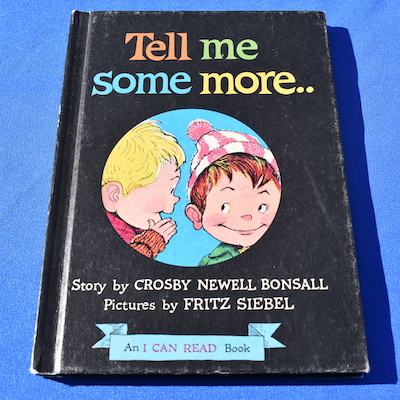
Tell Me Some More by Crosby Newell Bonsall, 1961.

I liked this picture book when I was a kid.  It’s one of those books that plays on the power of children’s imaginations.

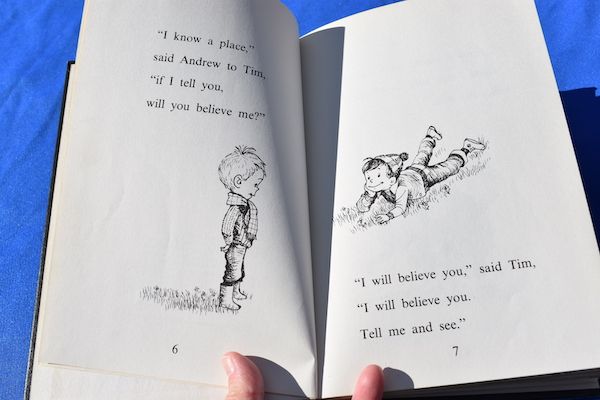
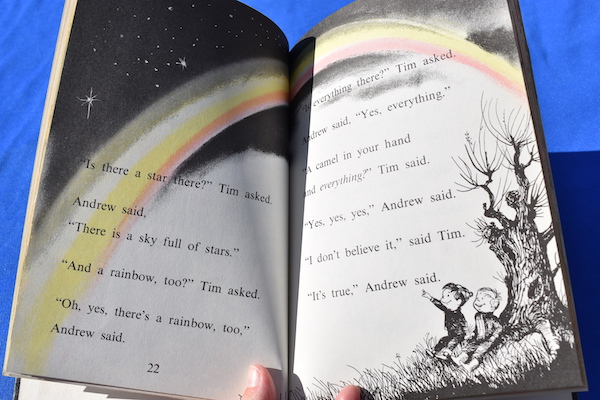
Two friends, Andrew and Tim, are talking, and Andrew starts to tell Tim about a mysterious “place” he knows about.  Andrew doesn’t say right away what the place is, but he makes some amazing claims about it.

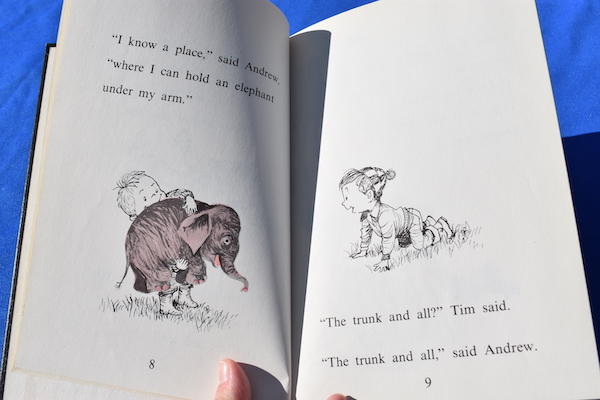
Andrew says that at this place, a person can hold an elephant under his arm and a camel in his hand.  With each new claim, Tim says, “Tell me some more.”

Many of Andrew’s claims involve animals, but he also says that in his place, he can be taller than a tree, that he can pick up a river without getting wet, and that there are all sorts of wonderful things there, like mountains, kings, trucks, and lakes.  Basically, this place has everything.

When Tim says that he doesn’t believe it, Andrew says that he’ll take him there and show him.  The “place” is the public library.  All of the amazing things that Andrew described are in the books.  You can pick up and carry around elephants, camels, and rivers easily when they’re in book form.

As the boys walk home, they talk about the giraffe, elephant, rocket, and steam shovel that they’re bringing home in book form as if they’re really full size.  When they get home, Tim starts talking to his sister, Tansy, like Andrew did to him earlier, introducing her to the library.

The book is currently available online through Internet Archive.

Four Dolls

FourDolls

Four Dolls by Rumer Godden, 1983.

This is a collection of four stories about different, special dolls.  Each of the stories is from the perspective of the dolls themselves, talking about their owners and their adventures.  A common thread through all four stories is the bond between the dolls and their owners and how they make a difference in each other’s lives.

Even though the collection of stories is from 1983, each of the individual stories in the book was written separately, in different years.  You can find each of these stories as their own individual books as well as part of other collections.  I give the original years of each story next to their titles.

The pictures in the book are wonderful, some of them in black and white and some in full color.

The book is currently available online through Internet Archive.

The four dolls and stories are:

Impunity Jane (1955)

FourDollsJane

The word “impunity” basically means freedom from harm, and it’s an apt nickname for the doll Jane.  She’s a very sturdy little doll, the kind that can stand up to the rough play of children and last for a long time.  From the time when she is first bought, she stays with her original owner’s family, passed down through the generations and enjoyed by various girls in the family.  However, they mostly keep her in the family doll house and play with her in different ways.  One girl likes to sew clothes for her and another, who wants to be a teacher, gives her lessons.

There is just one problem: Jane is frequently bored.  More than anything, she wants to be a pocket doll, carried around in her owner’s pocket, seeing the world and experiencing everything.  She doesn’t get much excitement in the doll house where the girls keep her, and her latest owner doesn’t seem interested in playing with her at all.  But, unexpectedly, a boy in the family comes to her rescue, the younger cousin of her current owner.  Although most boys aren’t interested in playing with dolls, Gideon likes to use Jane as his “model”, taking her outside, carrying her around in his pocket, and giving her rides in his toys, giving Jane the adventurous life she’s always dreamed of!

At first, Gideon borrows the doll without his cousin’s permission, and Jane dreads the day that he will give her back, even though she hates to see Gideon feel guilty.  Fortunately, when Gideon does take her back, it turns out that his older cousin is getting rid of a lot of her old toys because she’ll soon be heading off to boarding school. She tells Gideon that he can have anything he wants, so he keeps Jane, who continues being Gideon’s model and good luck charm.

The Fairy Doll (1956)

FourDollsFairy

Elizabeth is the youngest of her siblings and feels like she can’t do anything right.  She’s always making mistakes and can’t even ride a bicycle.  Everyone is used to telling her what to do, and she receives a lot of criticism from teachers and parents and teasing from other children, giving her poor self-confidence.  She is clumsy and break things, she forgets things, and she is frequently punished for every little thing she does.  The more they all scold her, the more mistakes she makes, and they can’t seem to figure out why.

(It’s painfully obvious while reading it – Elizabeth’s family makes her live in a constant state of nervousness, and she’s afraid of really trying many things because they keep telling her that she can’t do anything.  Her siblings seem more outright abusive rather than simply teasing, and her parents seem clueless, not punishing the older siblings for their terrible, bullying behavior.  I think that the family is meant to seem merely impatient with Elizabeth because they forgot how much younger she is than the other children and perhaps thoughtless to the effect that they’re having on her, but it seriously looks like they’re actually gaslighting the poor kid, purposely and systematically undermining her self-confidence for their own sick amusement, even the girl’s father.  Seriously, I hated all of them (except Elizabeth, whose only real problem is being a little kid) before I was very far into the story.)

However, the Fairy Doll that has been passed down in their family seems to have a kind of magic effect on Elizabeth.  No one knows quite where the doll came from because it’s been around for so long, although they use her as a Christmas decoration every year, at the top of the tree.  Only Elizabeth’s mother and great-grandmother seem concerned about Elizabeth at all, and it is at the great-grandmother’s insistence that Elizabeth be given the Fairy Doll to play with all year, after Elizabeth accidentally breaks a crystal bowl. (Which she only did because her bratty sister Josie shoved her from behind while she was holding it. Why did the parents never notice and properly punish the little brat Josie like they should?  I’m telling you, they’re clueless and useless, and possibly gaslighting her.  It really looks like that.  The father even makes a big deal about what use it is to give Elizabeth Christmas presents like the other children when she doesn’t ride the bike he gave her. Look, she’s just a little kid, and it takes some kids longer to learn to balance than others.  What a weird, oddly vindictive father.)

The Fairy Doll seems to suggest things to Elizabeth.  When Elizabeth doesn’t quite know how to do something, the Fairy Doll gives her hints.  When Elizabeth is in danger of forgetting something, the Fairy Doll reminds her.  In other words, the Fairy Doll does what a family is supposed to do and what her family could do if they weren’t so busy bullying her. The Fairy Doll offers Elizabeth help, support, and guidance.  Elizabeth is only seven years old at the oldest in the story, and Elizabeth’s family is too busy yelling at her for doing little things wrong or not knowing things to properly teach her anything.  They say that they tried to teach her to ride a bike, but I wonder how much “teaching” actually happened and how much it was really just yelling and mocking her for not already being able to do it.  I think they also get kind of a kick out of seeing Elizabeth look bad because they think it makes themselves look better. 

(The father in the story seriously disturbed me.  What kind of father is that hateful just because a very young child has some trouble riding a bike? Also, what’s the hurry in her riding it right away? Bikes don’t come with an expiration date, so it’s still going to be there when she grows a little more and learns to balance better.  Taking a little while to learn to ride a bike is hardly a sin, but Elizabeth’s father makes it clear that he does not care about Elizabeth’s feelings at all.  She has to buy his affection by . . . learning to ride a bike?  Because only bike riders are truly worthy of love?  Elizabeth’s family is really useless and weirdly vindictive.  I still hate them.  They are that horrible, just hearing about them.)

Little by little, Elizabeth’s small successes add up, and Elizabeth slowly crawls out of her shell, becoming more confident while her nasty, bratty, horrible siblings (yeah, I’m still angry, and I wonder if the father’s favorite little darling is the little psycho Josie) marvel at how she changes.

Little by little, Elizabeth comes to realize that she can do more than she thinks she can.

The Story of Holly and Ivy (1959)

FourDollsHollyIvy

Holly the doll doesn’t like being in the toy shop.  Abracadabra the owl frightens her, and she wishes that someone would buy her and give her to some girl as a Christmas present.

Meanwhile, Ivy is a troubled orphan who dreams of a new home with a grandmother who could take care of her.  When other children from the orphanage are taken to spend Christmas with families and Ivy is left behind, she tries to take matters into her own hands and find a family for herself.  Is there someone who could make wishes come true for both Holly and Ivy?

I worried about Ivy during this story, even though I knew that she and Holly would eventually end up together and okay.  She is lucky that she didn’t freeze to death.  Abracadabra the owl is also kind of a disturbing character, but they also get rid of him by the end of the story.  Apparently, the assistant in the toy stop doesn’t like him, either.

Candy Floss (1960)

FourDollsCandyFloss

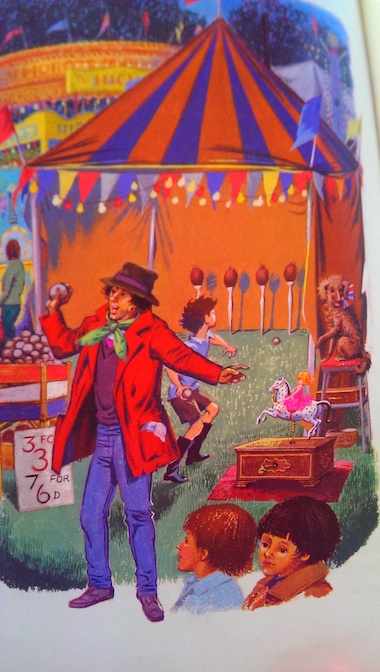
Candy Floss the doll belongs to Jack, who runs a carnival game, a “coconut shy,” where people try to throw balls at coconuts to knock them down and win a prize.  She enjoys living with Jack and his dog.  Jack has a special music box with a little horse on top, and Candy Floss sits on the horse while the music box plays and Jack’s dog begs nearby.  In this way, Candy Floss and the dog earn a little extra money.  When Jack is done working, he takes his dog, Cocoa, and Candy Floss the doll with him to see the rest of the carnival, and both of them enjoy it.

One day, a spoiled girl named Clementina attends their carnival.  Although Clementina is from a wealthy family, and her parents give her all sorts of things, she finds that she is frequently bored and unhappy.  When Clementina sees Candy Floss, she wants her, too, and is angry when Jack says that she can’t have her.  It’s the first time in her life that anyone has said “no” to Clementina about anything.  Clementina steals Candy Floss just to prove the point that when she wants something, she gets it.

However, Candy Floss wants to return to Jack.  She refuses to accept Clementina as her new “owner,” resists Clementina’s efforts to play with her (much to Clementina’s surprise), and finds a way to teach Clementina a lesson about greed.

In the end, Clementina not only returns Candy Floss but helps Jack to run his carnival game for awhile.  Part of Clementina’s unhappiness is caused by the fact that, even though she has many toys to play with, she doesn’t have much to do that is really meaningful to her.  She is surprised when she discovers how good it can feel to really earn something, like the coins that Jack gives her for helping him.

One of the cute things about this story is that it includes the music and words for the tune in the music box.

The book, which contains all four of these stories, is currently available online through Internet Archive.

Escape to Witch Mountain

EscapeWitchMountain

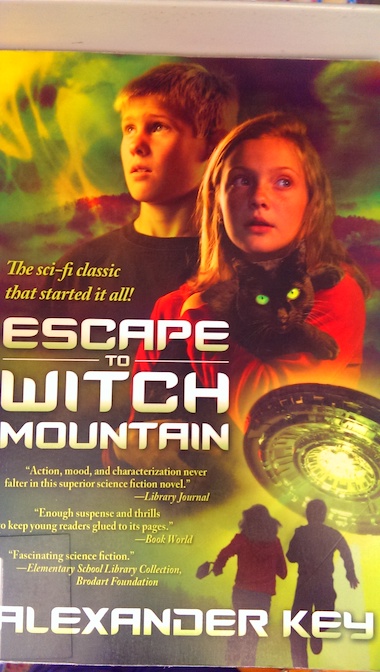
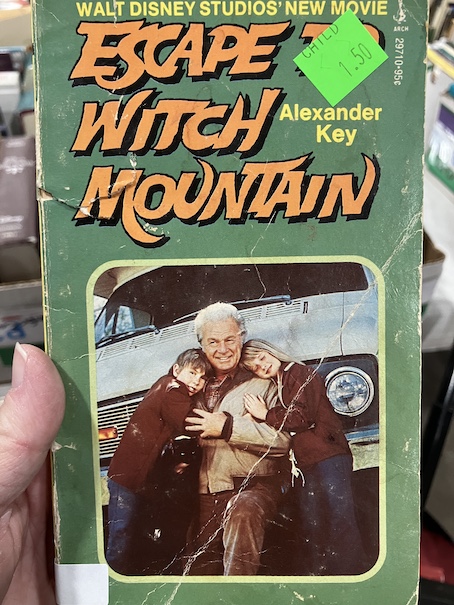
Escape to Witch Mountain by Alexander Key, 1968.

This is the book that the Disney movie of the same name was based on.  In fact, there have been three movie renditions of this book, although the 1975 Disney version is the one I know the best, and it’s the only film version to call the children by their original book names, Tia and Tony (other versions use the names Danny and Anna or Seth and Sara).  There are some major differences between the book and each of the the movies.  For one thing, most people in the book think that Tia is mute because she speaks at a frequency that ordinary humans can’t hear.  Only her brother, Tony, can hear what she’s saying.  She uses the little case with the double star emblem that she’s had ever since she can remember to carry paper and pencils so that she can write messages in order to make herself understood by other people.  In the 1975 movie, Tia can speak to Tony telepathically, but both children can speak aloud normally and be understood by everyone.

When the book begins, Tia and Tony know that they’ve always been different from other children.  They look different: they have olive skin, pale hair, and very dark blue eyes, which is a somewhat unusual combination. They can do things that others can’t: Tony can make things move with his mind, Tia can open locks without using a key or any other device, and only Tony can understand the strange way that Tia talks that others can’t even hear. They can’t remember any other home than the one they had with Granny Malone, the woman who adopted them, but now that she’s dead, they find themselves wondering who they really are and where they came from.  Tia has shadowy memories of a time before they came to Granny Malone, when they were on a boat and something bad happened to them, but she can’t quite remember what.

With no known relatives to go to, the children are taken to an orphanage, Hackett House, after Granny Malone’s death.  It’s a tough, inner-city environment, where no one has any patience with Tia and Tony’s strangeness.  However, when the children from the orphanage are sent to Heron Lake Camp in the mountains during the summer, a nun recognizes the double star symbol on Tia’s case as one that she had seen before on a letterhead, giving the children their first clue to finding their origins.

Then, a figure from one of Tia’s memories, Mr. Deranian, comes to the orphanage to claim them, saying that he’s their uncle. The children can tell that he’s no relative of theirs. They run away to see a kind priest, Father O’Day, an associate of the nun they met earlier. Father O’Day is the only one who believes the children when they talk about what they remember of their past and isn’t frightened by their strange mental powers. When the children show him a map that they found in a hidden compartment in Tia’s case, he offers to help them find the place marked on it and, hopefully, someone who knows who the children are and where they belong.

The book is currently available online through Internet Archive.  There is a sequel to this book which was also made into a movie, Return from Witch Mountain.
My Reaction and Spoilers

As the children and Father O’Day try to elude Deranian and the others who are chasing them, more of Tia’s memory returns. The children are from another planet. Years ago, their planet was destroyed when it crashed into one of their twin suns. Their people, who call themselves the Castaways, knowing that their planet would not be habitable for much longer, had already begun looking for a new home. Earth was the nearest habitable planet, so some scouts arrived early and began to create a home for them in the mountains of North America, which was the closest environment to their former home.

Unfortunately, when the rest of the children’s people came to Earth, the group that Tia and Tony were with crashed in Eastern Europe. The book was written during the Cold War, so the place where they crashed was controlled by Communists. When the Communists realized the powers these people possessed, they planned to make use of them themselves. One of Tia and Tony’s people escaped with the children and managed to get them aboard a ship heading for America. Before he died of a gunshot wound, he placed some money and a map in Tia’s case so that the children would know where to find the rest of their people. However, the children were traumatized by the experience, and Tia blocked the memory out of her mind. The ship’s captain, upon reaching the United States, gave the children to Deranian, a friend of his. Deranian, not knowing who the children were or what powers they possessed, gave them to Granny Malone to raise. Later, he found out about the children’s abilities from his contacts in Eastern Europe and tried to get the children back.

In the end, Father O’Day manages to reunite the children with the rest of their people, who take them to the community they have built on Witch Mountain, a place where locals are too superstitious to go, named for the odd things they’d seen there when the Castaways first arrived. Father O’Day plans to go there and join the community along with the children someday.

In spite of the Communists being enemies during the Cold War, Tia and Tony say that one of the reasons why their people had trouble establishing themselves in America at first was that they were unaccustomed to the idea of having to buy land to live on.  On their world, no one owned land; land was just there for people to live on and care for.  Their people’s early scouting expedition included selling pieces of their ships in order to raise enough money to buy some land in order to build their community.  Father O’Day is impressed with the Castaways’ commitment to the common good of all people and unselfish sharing.  So, although the oppressive Communist regimes of the Cold War are enemies in the book, some of the ideals of sharing and supporting the common welfare of everyone are still attractive ideals in the book.  The implication in the book is that Tia and Tony’s people are socially as well as technologically advanced and have created the best of all possible systems, a blending of ideals to create the ideal balance.

I can understand why the movies did not include Tia speaking at a frequency no one else can hear and appearing mute.  That would be difficult to show in a movie that relies on characters being able to communicate with each other, and it makes sense to replace it with an ability to communicate telepathically by choice instead.  None of the movies include the Cold War references that were present in the book, and the character of O’Day or the person who helps the children to reach Witch Mountain changes from movie to movie, but the plot of the 1975 Disney movie is still the closest to the original book.

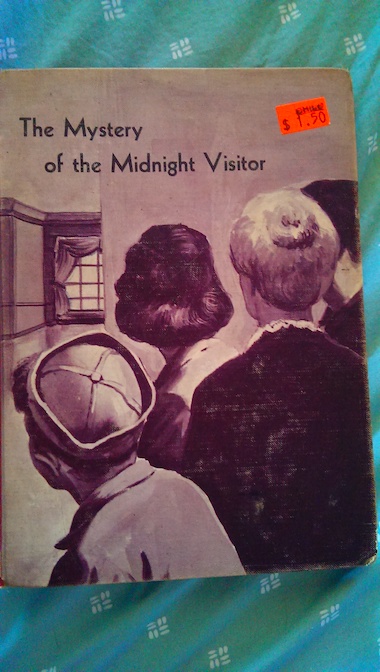
The Mystery of the Midnight Visitor

MorganMidnightVisitor

The Mystery of the Midnight Visitor by John and Nancy Rambeau, 1962.

One day, Gabby is going fishing on the beach at Morgan’s Landing. Miss Wellington, a family friend, owns the property along with the old mansion known locally as Morgan Castle. She has given permission to Gabby to fish there, but Gabby is surprised to meet a stranger on the beach as well. This stranger is an old man who says that his name is Admiral Lavendar. When Gabby tells him that he’s on private property, the old man moves on. Then, Gabby spots smoke coming from Morgan Castle!

When Gabby goes to investigate, he finds that someone has shut Miss Wellington in a closet and that there is a fire in the bedroom that had once belonged to Mrs. Morgan, the former lady of the house. He gets Miss Wellington out of the closet, and they call the fire department. The firemen put out the fire and tell Miss Wellington that it was apparently caused by a dropped candle.


Morgan Castle was once owned by the wealthy Morgan family that gave Morgan Bay its name. However, the house has become shabby over the years. Miss Wellington inherited the house after Mrs. Morgan died because there were no other Morgans left. However, she doesn’t actually live in Morgan Castle because she has a house of her own. People have been saying that perhaps the house should be torn down because of its poor condition. Miss Wellington doesn’t have much money and says that she would find it difficult to manage the upkeep of the house.

Gabby and his brother Bill and sister Vinny don’t want to see the old beautiful old mansion destroyed, and there is still the mystery of who dropped the candle and why to consider. A small silver box that Gabby found on the beach turns out to be a jewelry box that once belonged to Mrs. Morgan. Mrs. Morgan wasn’t particularly interested in jewelry, but she did own one particularly fine emerald necklace that was never found after her death. Perhaps the person who dropped the candle was looking for it!

To give Morgan Castle a new purpose and prevent it from being torn down, the kids convince Miss Wellington to let them turn it into a Historical, Boat, and Tennis Club, dedicate to celebrating local history and providing entertainment for local people.

At first, the mysterious Admiral Lavendar looks like a likely suspect for the person sneaking around Morgan Castle, but he turns out to be very helpful to the children and their plans. There is another stranger in town who has the knowledge to seek out Mrs. Morgan’s lost necklace.

MorganMidnightVisitorThief

This book is part of a series that were once used as classroom readers.

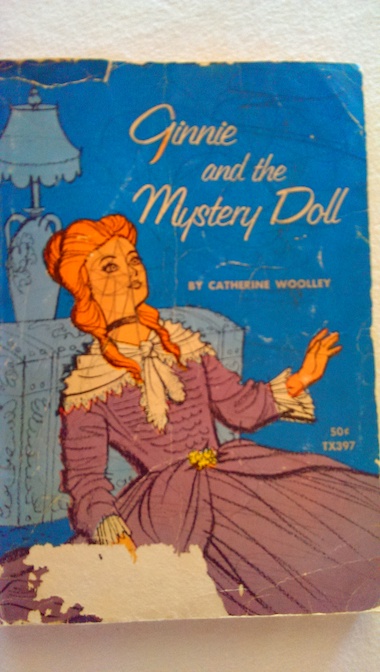
Ginnie and the Mystery Doll

GinnieMysteryDoll

Ginnie and the Mystery Doll by Catherine Woolley, 1960.

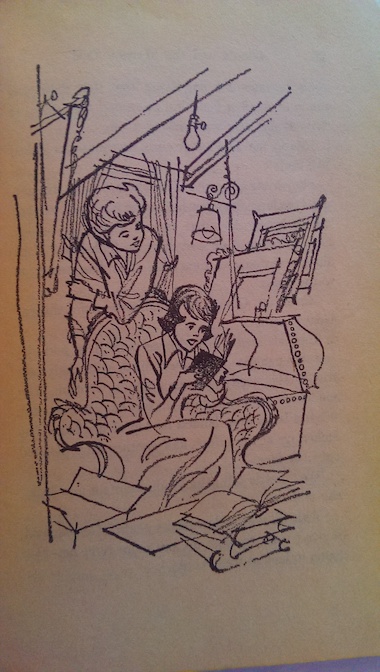
Ginnie and Geneva’s families have rented a house on Cape Cod for the summer, so they’ll be sharing their vacation at the beach. Their next door neighbor at Cape Cod is Miss Wade, a nice older lady. Miss Wade’s house is very old-fashioned, and when the girls make friends with her, she shows it to them, allowing them to see some of the neat old things in her attic on a rainy day. The girls have fun trying on the old clothes in the attic, and then they find an old diary belonging to Miss Wade’s mother when she was a girl. In the diary, the girl talks about the special doll that her uncle gave her, which has a “precious jewel.”

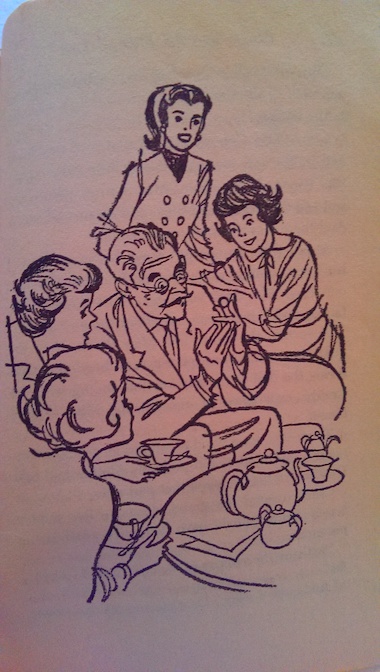
GinnieMysteryDollDiaryAtticThe girls ask Miss Wade about the doll, and she says that she knows the one they mean, but she no longer has it. Her mother’s uncle was the captain of a ship and used to bring her presents from around the world. The doll, called Lady Vanderbilt, was very fancy, and Miss Wade describers her costume to the girls. However, she says that the doll disappeared after she rented her house out to a family one summer while she was traveling. She never found out what happened to the doll, but she assumed that the children of the family probably found her and either took her or broke her. Miss Wade said that she didn’t think that the doll was worth making a fuss about, so she never asked the family about it. The girls note that Miss Wade doesn’t seem to know anything about a precious jewel in the doll, but they decide not to say anything about it since Miss Wade doesn’t have the doll anymore.

The girls decide to concentrate on enjoying their summer vacation, picking beach plums and digging clams with Miss Wade on the beach. Then, when they go to see a local auction, they spot a doll that looks exactly like the Lady Vanderbilt that Miss Wade described! The girls try to bid on the doll at the auction, but someone else buys her instead, and that lady leaves the auction before the girls can talk to her.

GinnieMysteryDollJewelThe girls tell Miss Wade and their mothers about the doll, but when they try to ask the people in charge of the auction where the doll came from and who bought her, they learn that the woman who was in charge of organizing the toys has already left on vacation. The only clue that the girls have is that the woman who bought the doll left the auction in a red Jaguar.

The girls make it their mission to track down the doll and its buyer, asking questions all over town about who might own a red Jaguar. Then, at an art exhibit at the Historical Society, they make a surprising discovery: a painting of the very doll that they’re looking for!

But, just when they figure out who has the doll and where she is, she disappears again when the red Jaguar is stolen with Lady Vanderbilt inside! Was it just an accident that the doll was stolen along with the car, or does someone else know that Lady Vanderbilt might be hiding a valuable secret?

The book is currently available online through Internet Archive.
Mystery Back of the Mountain

MysteryBackMountainMystery Back of the Mountain by Mary C. Jane, 1960.

Anne and Stevie Ward are thrilled when they discover that their father has inherited a house in the country from a distant relative who has recently died. Neither of the children had met their father’s “Uncle” James (really a distant cousin of their great-grandfather), and even their father hadn’t seen him for years. Probably, the only reason Uncle James left him the old farm where he used to live was because he had no children of his own and the two of them shared the same name.

The children think that a country house would be a great place to spend the summer, and even their mother thinks that perhaps they should keep the house as a vacation home, but their father has some reservations about it. For starters, the old farm house, located outside of a small town in Maine, is kind of shabby and has no running water or electricity. It’s so isolated that people named the area Back of the Mountain. Then, there’s Uncle James’s reputation. Uncle James was the black sheep of the family, having apparently made his money in some unethical business dealings and then became involved in some kind of inappropriate romance that ended tragically. The children’s father isn’t completely sure of the details because he only heard whispered rumors about Uncle James when he was young, but he knows that the people of his town weren’t very fond of him, and he suspects that they might feel the same way about his relatives. He thinks that it might be better just to sell the house and forget about it. Nevertheless, he agrees with his wife that the family should go there and take a look at the house and decide what they’re going to do with it.
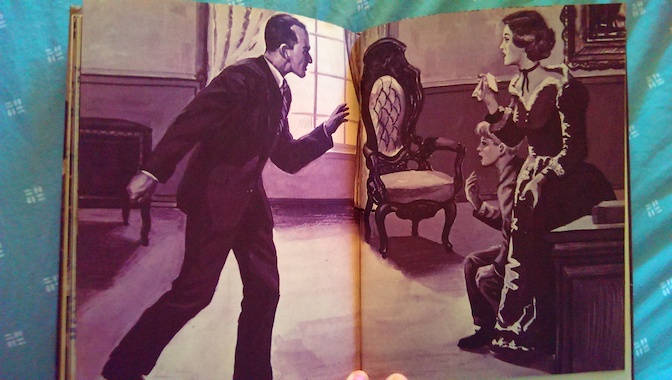
MysteryBackMountainMissingPictureWhen they get to Maine, they meet Uncle James’s lawyer, Mr. Palmer, to collect the key to the house.  Mr. Palmer tells them that the house has a few items in it that could be considered valuable antiques, including a portrait of the woman that Uncle James had wanted to marry, Drusilla Randall.  The children’s father asks Mr. Palmer more about Drusilla Randall, and he says that all he knows is that she had an argument with Uncle James and then disappeared.  He thinks that she just left town, although he says that there are rumors that Uncle James may have murdered her.  Mr. Palmer thinks that the rumors are ridiculous and doesn’t take them seriously, but Stevie and Anne are disturbed at the idea that their relative may have been a murderer, or that people thought he was.  Mr. Palmer also mentions that Drusilla’s sister, Marion, has decided to return to her family’s old house for the summer as well, so she’ll be living close to their farm.
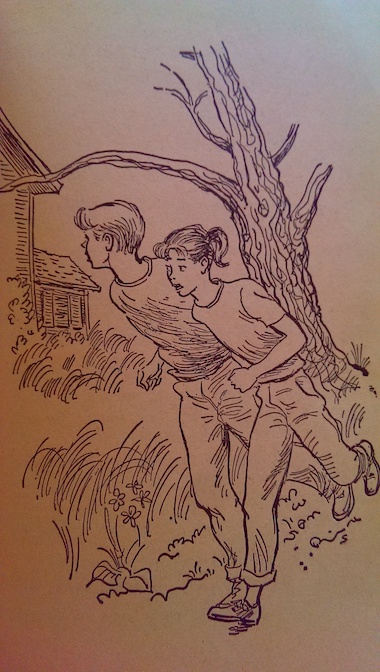
MysteryBackMountainRunningThe house is certainly an isolated place, and their closest neighbors, the Hodges have an old grudge against Uncle James.  The unethical business deal that Uncle James did years ago involved buying some of the Hodges’s family’s best land.  Bert Hodges, who was young at the time, says that the deal ruined his father’s life, and it’s making his miserable, too, because he really needs that land to make his farm profitable.  Anne hears this from Bert’s young niece, Oleva, an orphan who has come to live with her aunt and uncle.  Although Uncle Bert is strict with her and somewhat bitter about the past and the family’s circumstances, Oleva likes her aunt and uncle and wishes they would adopt her, giving her the stable home she’s longed for since her parents died and she began being traded around among her relatives.  However, Bert doesn’t have much faith in other people, and even though he likes his young niece, is afraid to commit to adopting her.

MysteryBackMountainBridgeAnne feels badly that Uncle James’s land deal seems to have ruined people’s lives.  Oleva also tells her something disturbing about Drusilla, the girl that Uncle James loved.  They were supposed to be married when Drusilla turned twenty, but she disappeared before that happened, and most people think that she drowned in the natural pool on Uncle James’s property.  It’s deeper than it appears at first, and some things belonging to her were found nearby, so everyone thinks that she probably drowned and that her body is still somewhere at the bottom of the pool.  Whether her death was an accident, suicide, or murder is still unknown.

Mysterious things are happening around Uncle James’s property.  The portrait of Drusilla that Mr. Palmer said would be in the house is missing.  The family hears eerie howls in the night.  Oleva is sneaking around, doing something that she says her uncle would disapprove of, but which she insists that she can’t stop.  Then, Anne finds a poem engraved on a stone in an old graveyard, apparently written by Uncle James in Drusilla’s memory that points to the secret of their quarrel and her death.  The things that Uncle James did in his life still cast their shadow, and the only person who can tell them the full story of what really happened all those years ago and set things right . . . is Drusilla.

Uncle James’s problem, as the children eventually learn, was the nature of his ambitions.  He wanted to be a big man more than a good one.  It wasn’t that he was completely awful.  Drusilla herself (once the children learn where she really is and who she is) tells them that he could be charming, and she knows he never really meant to do anything wrong.  The problem was that he wanted to be important and admired by others to the point where “getting ahead” of others was all that really mattered to him.  There was a point when he could have used what he had to help his neighbors when they were in trouble, but instead, he used their troubling situation to his own advantage to take what they had for himself.  When he discovered something valuable on the land he’d acquired from Hodges family, something that would have saved them from their problems if they had known about it before the sale of the land, he could have turned it over to them to help make things right, but he refused to do it, which was the basis of his quarrel with Drusilla.  As far as Uncle James was concerned, he was entitled to what he found because he had bought the land legally, but Drusilla argued against keeping it on moral grounds, out of compassion for the Hodges.  In the end, Uncle James was admired by no one because of his selfishness, and Drusilla realized that wasn’t a quality that she wanted in the man she was going to marry.  Uncle James’s attempts to make people admire him for being wealthy and important ended up costing him friendships, relationships with relatives, and ultimately, the woman he wanted to marry.  Like others, Uncle James believed that Drusilla was dead, that she had drowned herself over their quarrel.

Uncle James’s drive to make people like him causes Anne to reconsider something that was bothering her as well.  She isn’t as good at making friends as her brother because her brother is more outgoing and good at sports.  The other kids always want Stevie to play for their team.  Anne often wishes that she could be more athletic, “to come in first,” so that other kids will like her better and want her to play with them more, instead of picking her last for every game.  However, she comes to realize that being “first” in things isn’t what really wins friends in the end.  Caring about others and being there for them when they need you wins real friends.  As Anne explores the old graveyard, she thinks about how just being alive and enjoying life is a great feeling by itself, whether you’re “first” or not, and sometimes, good things come to those who take their time instead of just rushing to be “first.”