Schoolhouse Mystery

The Boxcar Children

It’s June, and the Aldens are trying to decide what to do for the summer. Benny says that his friend Max remarked that the Aldens always seem to find something exciting everywhere they go, but Max doesn’t think anybody could find anything exciting about the little village where his father likes to go fishing. Max says that it’s a tiny and isolated village on an island with little to do, and he doubts even the Aldens would find anything interesting or exciting there. The only people who usually go there are summer visitors going fishing, like Max’s dad. Mr. Alden has been thinking over other plans for the summer, but he says that, if the children want to take a short visit to his village, called Port Elizabeth, to test out Max’s theory of how boring the place is and see if they can find something exciting about the place, it’s fine with him. The Aldens think that purposely visiting a dull town and seeing what they can find there sounds interesting by itself, so they decide to go.

When they arrive, they find that the place is as small as Max described. It doesn’t take them long to explore the town. There is a small store, but it’s well-stocked with all the food they need. There’s a big old house that seems to be abandoned, and there’s a quaint little schoolhouse with a bell and an odd-shaped chimney.

The people of the town seem suspicious of them at first. They don’t get many outsiders coming to their town, and they can tell immediately that the Aldens are rich because of their car and their clothes. However, because the Aldens are friendly and polite visitors, people gradually begin warming up to them.

The Aldens learn that most people in town work for the local sardine factory. There aren’t many other job prospects in the area, and they don’t have access to higher education or even outside sources of information, like television, so the local kids don’t aspire to much more. Local kids work, too.
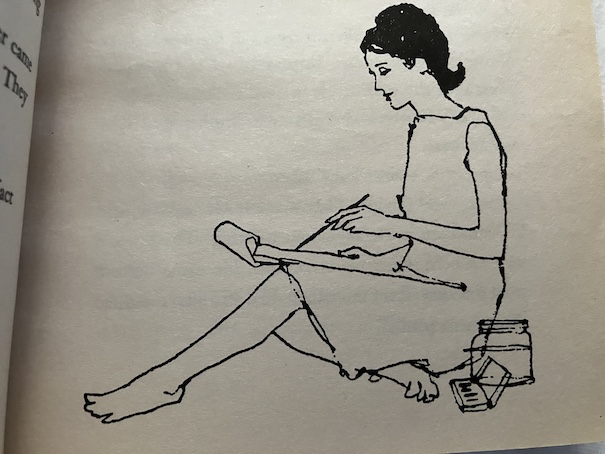
One day, a pair of twins approach Violent while she’s painting a picture and start talking to her about painting. They’ve never really owned any proper art supplies themselves, only some crayons, but they’ve been interested in learning to paint since a professional artist came to town to paint the seaside. They also tell Violet and her siblings that the town has had trouble keeping teachers. Most people don’t want to stay in the town very long because it’s so small, and there’s so little to do. Because they change teachers so often, the kids never really advance much in their classes. Every teacher basically keeps starting over in their lessons. The last one told them to study this summer to make progress and prevent themselves from forgetting what they’ve learned, but the local kids don’t really know how to study or what to study, and they’ve never had a teacher who taught any of the really fun subjects, like art.

The local kids ask the Aldens if they could help them study this summer, and the Aldens get the idea to set up their own summer school in the local schoolhouse. They speak to the lady who owns the schoolhouse, Miss Gray, and she gives her permission. The Aldens recognize her as a famous author, but now, she lives like she’s a recluse in her big, old house. She also asks the Aldens whether or not they know a blond man who smiles a lot, but the Aldens don’t know who she’s talking about.

The people in town don’t have much money, and they save what they can in cash rather than using a bank. However, something odd has happened recently because a man has bought a couple of coins from some of the locals for more than the face value of the coins. The locals don’t know why he was willing to do this, but they’re always grateful for anything extra they can get. The locals have started calling this blond man “the money man” because he not only buys coins but also various other odd, old things that most of the locals think of as junk. They don’t know why he wants these things, but they’re just glad he’s willing to pay something fro them. Mr. Alden is very interested in this man and wants to know more about him.
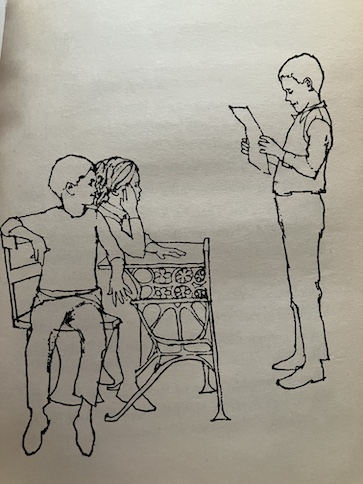
The Alden kids buy some art supplies and school supplies so they can get started with lessons for their summer school. Even though they provide some supplies and have some textbooks in the schoolhouse, they find that there are things they need because previous teachers in town haven’t left some of the things they need, like easy reading books. They improvise as best they can, with Benny helping the kids in class write simple stories about themselves and their lives to use for reading lessons. The local children talk more about the “money man” and how he trades them new toys for old ones they’ve had. The children think that’s great, but the Aldens are suspicious about the “money man’s” apparent generosity.

It isn’t long before Mr. Alden and the children have an encounter with the blond “money man.” The man, called Freddie, notices that Mr. Alden has a rare penny on his watch chain and offers to buy it. He explains that he deals in coins and antiques. Mr. Alden can tell that Freddie is knowledgeable but slick when it comes to buying collectible items. Mr. Alden refuses to sell the man his coin or his watch, and after he leaves, the children tell their grandfather what they know about his dealings with the local people.

It has become apparent that Freddie is cheating the locals, buying antiques and collectibles from them while either paying them much less than what they’re really worth or trading them for newer but cheaper items. Because this town is relatively isolated and the people don’t have much money, they’ve spent generations keeping and reusing antique items without knowing how valuable they’ve become. The local children are thrilled when he lives them newer and more colorful toys in exchange for their old ones, because they don’t know how much their antique toys are worth. Technically, Freddie hasn’t done anything illegal because the people he’s been buying from and trading with have agreed to the deals so far and been satisfied with what they’ve gotten, but that’s only because they don’t know that they could have gotten much better deals from someone else. Freddie’s dealings aren’t really fair or ethical, and Mr. Alden and the local author have become concerned that he may take even bigger advantages of the local people than he already has.

When some valuable collectors’ books disappear from the little village’s neglected library, the author, Miss Gray is convinced that Freddie is responsible. How can they catch him and prove to everyone what he’s been doing?

As with many of the earlier Boxcar Children books, there is an element of mystery but more emphasis on the adventure and the kids’ summer experiences than on the mystery. We have an obviously suspicious right at the beginning, and we have a sense of what he’s doing that’s a problem pretty quickly. This is one of those mysteries where the protagonists have an obvious villain and a good understanding of what’s going on, but the mystery is about getting the evidence and proving it. Part of the issue at first is that duping people into trading things with him or selling them to him for less than what they’re really worth is more unethical than illegal because, as long as the participants are satisfied with the trade and willingly agree to it, it’s difficult to prove that they were deceived. It’s when the villain crosses the lines and actually steals something nobody agreed to give him or sell him that they can really start to nail him for what he’s been doing.

Part of the solution felt a little contrived because it turns out that the villain has been hiding his ill-gotten gains in a location that is right under the children’s noses, and there is something special about the place that allows them to watch the villain without being observed. It’s an interesting set-up, but I usually prefer a more traditional style mystery where there’s more for the amateur detectives to figure out.

The Mystery of Castle Croome

Molly Stewart, an American college student attending Oxford, is an orphan who is barely scraping by when she suddenly receives word that she has inherited an ancient castle in Scotland from her great-uncle, who has recently died. Molly’s friends, a pair of twins called Pat and Penny Roderick (short for Patricia and Penelope), go with her to have a look at the place, but right from the beginning, it seems like nobody wants her there.

Although the lawyer, Mr. Harding, is aware that Molly has been attending Oxford, he also knows that she is planning to return to the United States when she finishes her degree. He also knows that her great-uncle, Sir Malcolm, disapproved when her father married an American and moved to the United States himself, so he was surprised when Sir Malcolm’s will left his estate to his nephew or his nephew’s heirs. Mr. Harding had expected that Sir Malcolm would leave the estate to Jamie Campbell instead because Jamie has been the caretaker for years. The estate doesn’t come with much of an income, and the farms attached to it don’t have tenants, so they’re not bringing in rent money. It would take a lot of work to restore the estate. Since Mr. Harding would rather deal with Jamie Campbell anyway, he thinks that Molly would find it a better deal to just sell the castle to Jamie and use the money to finish her degree and go back to the United States. Molly asks why Jamie Campbell would want to buy the castle if it’s not worth much and needs so much work to restore. Mr. Harding says he might buy it out of sentiment, but Molly wants to have a look at the castle before agreeing to sell it. After seeing it, she might decide that it isn’t the kind of place where she could live, but she won’t know for sure until she sees it herself. Mr. Harding agrees and says that he will tell Jamie Campbell that she’s coming.

When Molly arrives with Pat and Penny, they see that the castle is isolated and rather eerie. Inside, it is run down, and living conditions are primitive. Jamie Campbell, an elderly man, isn’t happy that they’re there. There is no other staff, and while Jamie was happy to serve the old laird and nurse him through his final years, he has no intention of serving this young American grand-niece. Although there is an electrical generator at the castle, Jamie says that it hasn’t worked in years, and he and the old laird used oil lamps and candles. If Molly and her friends think he’s going to go to special efforts for their comfort, they can think again. Molly refuses to be intimidated by his disrespect, and she tells him that, because this castle has been his home for years, he is welcome to continue staying there, although Jamie Campbell thinks that she’s only extending that invitation to get a free caretaker.

Molly is studying engineering at college, and her friends think that she could probably fix the generator, but Molly tells them that she would like to wait to look at it. She hasn’t had much practical experience yet, so she wants to take time to study the situation before she does anything. She also tells her friends not to mention to Jamie Campbell that she has any engineering knowledge. She doesn’t trust Jamie, and she thinks it might be better for him to think that they’re more helpless than they actually are.

Molly sees definite signs that Jamie Campbell hasn’t been honest with them about the real condition of the castle and about even the contents of the castle at the time that her uncle died, and she can tell that he’s deliberately trying to make life harder for them to drive them away from the castle. After Jamie Campbell tells them that there is no running water at the castle, the girls notice that soap next to a sink is still wet, indicating that Jamie has very recently washed his hands there. The girls think that he probably shut off the water right before they got there, and they also think there is probably nothing wrong with the generator, that Jamie probably just turned it off. He tries to keep them from even looking at it, and he’s reluctant to hand over the keys to the castle to Molly. Many pictures are missing from the walls of the castle, and Jamie says Molly’s uncle sold them for money, but another painting disappears during their stay, showing the girls that Jamie is the one looting artwork from the castle. Molly realizes that nobody seems to know exactly what was in the castle at the time her uncle died, making it difficult to prove that Jamie is stealing things. When Molly tries to search her uncle’s desk, she finds that it’s been completely cleared of even routine papers, and Jamie admits in a cagey way that he may have tidied up a little.

Things improve for Molly and her friends when they set out to buy some food and make contact with other people outside the castle. Jamie refuses to even feed them, saying that he barely has enough for himself. He says that he might have been able to provide something for Molly if she was alone, but he can’t be expected to feed her friends, too. Fortunately, the girls have some provisions with them that get them through their first night at the castle. When they set out in the morning to buy more food, they can’t take their care because there’s a large nail in one of the tires. They can’t prove that Jamie sabotaged the car, but they all suspect he did. They decide to set out on foot to find somewhere with a telephone or somewhere they can buy some food. They meet up with a scout troop camping nearby, and they save the girls from stumbling into a bog. They share a meal with the girls, and the girls tell them what’s been happening at the castle.

The scout leaders don’t like the sound of Jamie and the things happening at the castle, and they tell the girls that they will send a mobile shop to the castle to sell them food. There’s a van that travels among the farms in the area, selling groceries, sort of like a food truck, and it carries a surprising variety of goods. The scouts also tell the girls how they forage for wild foods, and they offer their services for changing the car’s tire and other things they might need.

That night, Molly has a frightening encounter with a ghostly white figure, although she believes that it’s just Jamie, trying to frighten her away from the castle. The next day, Molly and her friends confront Jamie about the missing painting, and he tells Molly that her great-uncle sold that painting years ago. He tries to convince her that the only reason why she thought she saw it is that she has “second sight.” He says that it was a favorite painting of her great-uncle’s and that she only saw it because she’s a member of his family and has psychically sensed the memory of the picture. Molly knows that can’t be true because her friends also saw the picture. Molly also asks Jamie about a strange roaring noise that she heard at night that sounded like machinery of some kind, and Jamie tells her that it’s the “Roar of the Stewarts.” He says it’s a bad omen, and that Stewarts hear it before something bad happens. Although none of the girls admits to having seen a “ghost” the night before, Jamie also tells them about the “Specter of the Castle”, and he insists that all of these bad omens are signs that Molly and her friends should leave the castle because it’s dangerous for them.

Molly and her friends know that Jamie badly wants to frighten them away from the castle, and part of that might be that he’s been looting objects from it since Molly’s great-uncle died, but what is the real cause of the machine noises in the night? Then, suddenly, Jamie welcomes a pair of unexpected guests into the castle as paying guests. Mr. and Mrs. Smith claim that they’re traveling tourists who think it would be exciting to stay in a real castle. Molly tries to discourage them from staying by charging them more than anyone might expect from staying in a run-down castle with primitive living conditions, but the Smiths insist that they would enjoy an authentic experience. Molly and her friends are immediately suspicious, especially when they realize that the Smiths don’t seem to have a car, and there’s no obvious way they could have even reached this out-of-the-way castle. Who are they really? Are they confederates of Jamie’s? What has Jamie really been doing at the castle, and what is he so afraid that Molly and her friends will discover if they stay?

The book is available to borrow and read for free online through Internet Archive (multiple copies).

I found this book recently at a used book sale, but I recognized the title because I tried to find this book when I was a kid. I wanted it because it was on a list of suggested books in the back of another mystery book I read and liked as a kid. Actually, I think I enjoyed it more as an adult than I would have has as a kid. As a kid, I would have liked the notion of a girl inheriting a spooky old castle that might be haunted, but in this story, it’s pretty obvious right away that Jamie is behind all the mysterious things happening.

This story is not like other mysteries where you have to wonder who among the suspects could be responsible for the mysterious happenings because Jamie is the only suspect from the beginning. The real mystery, for both the characters and the readers is why he’s doing it. It’s a “whydunnit” more than a “whodunnit.” Although it would have been fun and atmospheric if Molly and her friends believed that the castle was haunted and were scared, I have to admit that I loved how unimpressed the girls were when Jamie awkwardly makes up his spooky stories and excuses about “second sight”, the “Roar of the Stewarts”, and the “Specter of the Castle.” They know that he’s just making it all up. They just don’t kick him out of the castle immediately because he’s an old man who’s been there for years, and they also want to know that he’s up to.

It turns out that part of what he’s up to is obvious and part actually resembles the mystery book that had this listed as a recommended book. Readers can figure out the more obvious part themselves, but there’s a revelation later that Jamie is also involved in another crime that he can’t explain away as any misunderstanding. There’s a suspenseful part of the story where the girls are trapped in the castle with Jamie and his confederates and need to figure out how to escape or summon help. I thought that the ending part wrapped up a little quickly, but overall, I liked the story. I think I enjoyed the book more now than I would have if I’d found it when I was a kid.

After the Sun Sets

This was my favorite book of fairy tales when I was a kid! I gave away my copy years ago and regretted it, but I was thrilled to find another copy later at an antique/vintage mall.

The collection includes some popular fairy tales that you can find in other fairy tale collections, like Cinderella, Brier Rose (the Sleeping Beauty story), and Hansel and Gretel. It also has some stories that are less commonly known these days, like Aiken-Drum, the Brownie and Prince Hal and the Giant. When I was young, my favorite stories in the book, the ones I read over and over, were Snow-White and Rose-Red, The Princess on the Glass Hill, and East of the Sun and West of the Moon.

One of the things that makes this collection unique is that it includes a section of poems at the back of the book. I love the one called Cinderella’s Song, and it was one of the reasons why I missed this collection so badly. I don’t think I’ve seen that poem in any other book.

The illustrations in the book are beautiful! I loved them as a child, and I still find them enchanting as an adult. Some are in black-and-white, but some are in full color.

I didn’t realize it when I was a kid, but this book is actually the third book in a series, The Wonder-Story Books, and it was a unit in The Row, Peterson Basic Reading Program. I have the 1962 edition, but the book is actually older than that. Its copyright was renewed multiple times.

The book is available to borrow and read for free online through Internet Archive. There is also an earlier edition of this book available through Internet Archive, and it doesn’t have the section of poetry included, so the poetry might only appear in the 1962 edition.

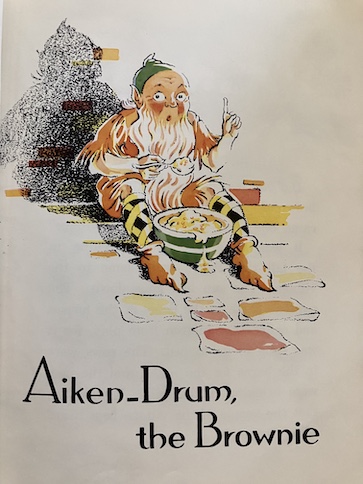
Aiken-Drum, the Brownie

Aiken Drum is a Brownie, a magical little man who likes to do chores for other people for little reward. Reward a Brownie too much, and he will leave.

Pat and the Fairies

Pat joins the fairies in a dance, and they loan him a pair of shoes when his wear out. When he later comes to return the shoes, he gets a wonderful reward. A greedy shoemaker tries to join the fairies in their dance and borrow a pair of shoes to get the same reward, but the fairies punish him when he tries to cheat them.

Change About

A husband grumbles about how little his wife accomplishes in the course of a day while she minds the house and their child and he works out in the fields. The husband and wife decide to switch places for a day to prove which of them works harder, and the husband has a surprise about what really happens at home while he’s away.

Cinderella

A girl who is abused by her stepmother and stepsisters receives magical gifts from her fairy godmother so she is able to attend the prince’s ball.

Snow-White and Rose-Red

A widow and her two daughters let a gentle talking bear spend the winter with them so he won’t freeze, but this bear is under a spell.

Snip, The Tailor

A tailor sets out to make his fortune. He uses his wits to defeat a pair of giants and win a castle and half the kingdom from the king.

Brier Rose

This is the Sleeping Beauty story. A young princess is cursed by a bad fairy. When she hurts her hand on a spindle, she and everyone in her castle falls asleep for a hundred years.

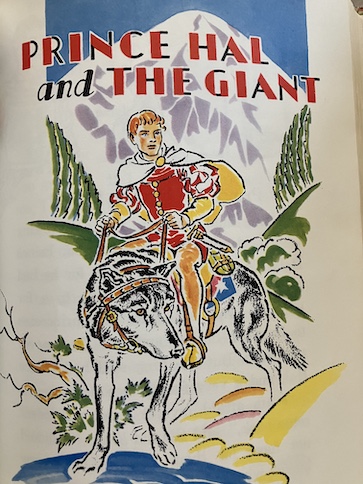
Prince Hal and the Giant

Prince Hal is the youngest of a king’s seven sons. The other six have left home to find brides and have never returned home. No one knows what happened to them. Prince Hal sets out to find what happened to his brothers. He finds out that they and their brides have been turned into stone statues in the house of a giant. Prince Hal must find a way to save them and the princess who has become the giant’s latest captive.
Hansel and Gretel

A pair of children are abandoned in the woods, and they find a strange house made of gingerbread. They are almost eaten by the witch who lives in the house.

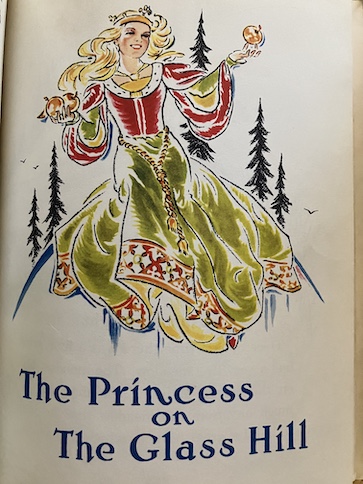
The Princess on the Glass Hill

Every year on Midsummer Night, the hay disappears from a farmer’s field. Each of his sons tries to find out why, but each of them is frightened by the strange things that happen, until the youngest son faces the phenomenon and discovers a strange horse with a coat of mail that fits him perfectly. The same thing happens twice more so that the youngest son acquires three fine horses and three sets of mail. He keeps them secret at first, but later, he uses them to perform an amazing feat and ride to the top of a glass hill to win the hand of a princess.

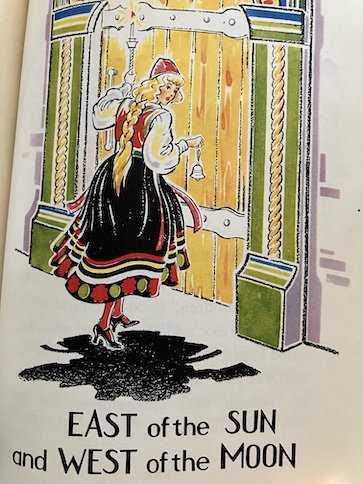
East of the Sun and West of the Moon

A white bear comes to a family with many children and says that he will make them rich if the eldest daughter, Freda, will come with him. At first, she doesn’t want to go, but when she does, he takes her to a magical castle. Unfortunately, she disobeys the bear’s instructions while she’s there. He is under a witch’s spell, and Freda must find a way to undo the damage she’s caused and break his spell, following him to the witch’s castle by riding the winds, east of the sun and west of the moon.

I Keep Three Wishes Ready by Annette Wynne – It’s good to know what you want to wish for, just in case you get the chance.

At the Zoo by A. A. Milne – There are many fascinating things to see in a zoo!

Some One by Walter de la Mare – Someone knocked at the door. Who?

Little Nut Tree by Mother Goose – A traditional rhyme about a magical tree. One of my favorites!

The Duel by Eugene Field – The gingham dog and the calico cat have a fight.

Queen Mab by Thomas Hood – About the fairy queen and how she gives pleasant dreams to children.

Cinderella’s Song by Elizabeth Madox Roberts – Cinderella confides her secret to her cat.

Trees by Harry Behn – Trees are wonderful things!

The Story of the Baby Squirrel by Dorothy Aldis – A child finds a baby squirrel and raises it. When it grows up, it runs away, but they think he’s probably still living with the other squirrels nearby. They sometimes see a squirrel who seems to be saying hello to them.

The Hens by Elizabeth Madox Roberts – It sounds like the hens are talking, but what are they saying?

Roads by Rachel Field – Roads might lead anywhere and to all sorts of wonderful things!

Washington by Nancy Byrd Turner – About George Washington. This one seems like an odd inclusion to me, adding a poem about a historical figure to a collection that has more fairy tale themes.

The Diamond in the Window

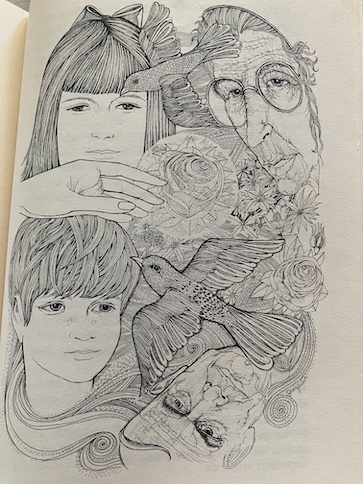
Eleanor and Edward Hall are orphans who live with their Aunt Lily and Uncle Frederick in their family’s big but somewhat shabby old house in Concord, Massachusetts. The family has lived there for generations, and they are intellectuals with a particular interest in the literary history of Concord. Uncle Freddy is obsessed with Ralph Waldo Emerson and Henry Thoreau, although he doesn’t share Eleanor’s love of Louisa May Alcott. When a couple of the town leaders threaten to take the family’s house because of unpaid back taxes and to destroy it because they think it’s an eyesore, the children come to learn that their house holds more secrets and history than anyone knows.

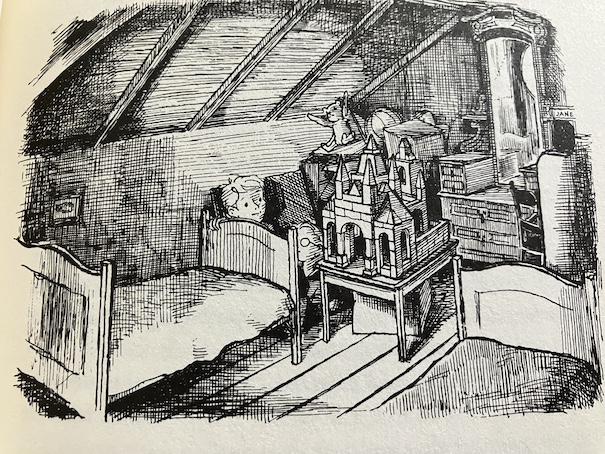
As Eleanor and Edward look at the house from the outside, they suddenly realize that there’s an window at the top of the house that’s shaped like a key and made of colored glass. They’ve never seen that window from the inside of the house, so there must be a secret room! The children search the attic and find a trap door that they never realized was there before. When they look into the hidden room, they find a pair of children’s beds and toys.

The children ask Aunt Lily about the room, and she sadly admits that she hadn’t wanted to tell them about it. Then, she begins to explain more about the family’s history and the aunt and uncle the children never knew. Aunt Lily is their father’s sister, and Uncle Freddy is their brother, but there were once two more children in the family, called Ned and Nora. Eleanor and Edward were named after them, but Ned and Nora mysteriously disappeared years ago. Aunt Lily still believes and hopes that, somehow, they will return someday, so she has always kept their room ready for them.

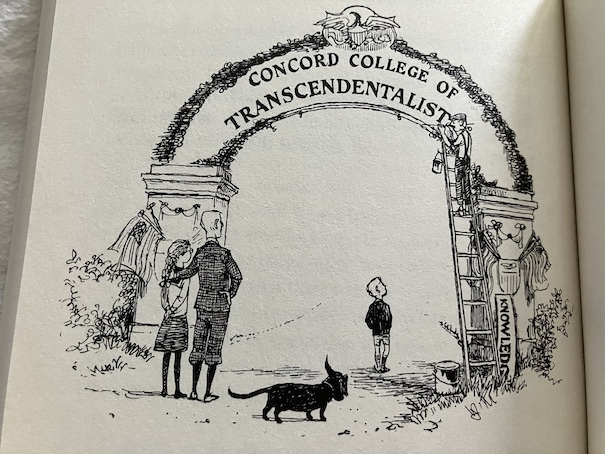
When she shows the children pictures of Ned and Nora in the family’s album, they also see a picture of a young man in a turban and ask about him. Aunt Lily says that the man is Prince Krishna, son of the Maharajah of Mandracore. Their Uncle Freddy has written books about Emerson and Thoreau and was once considered an expert on the Transcendentalists. People who were interested in Transcendentalism, like Prince Krishna, used to come and study with him. Aunt Lily wasn’t really interested in Transcendentalism, but she explains, “I think he said that the Transcendentalists believed that men’s minds were very wonderful, and that they could know all kinds of important things without being taught about them through their eyes and ears –because they were part of something called an Over-Soul.” Eddy approves of this concept because it sounds like it’s about learning without school, and he approves of anything that involves no school.

Everyone was fond of Prince Krishna while he lived and studied with the family, and Aunt Lily said that he used to make up fun games for Ned and Nora, like treasure hunts with real jewels as prizes because the prince was very rich. The children get the sense that Aunt Lily was in love with Prince Krishna, but he also vanished shortly after Ned and Nora did. When they discovered that Ned and Nora were missing from their beds one morning, Prince Krishna dashed around, looking for them, but suddenly, he was also gone, and no one knew where or how.

Eleanor and Eddy return to Ned and Nora’s room upstairs to have another look at it, and they find a mysterious poem called “Transcendentalist Treasure.” From the handwriting, which matches a note that Prince Krishna wrote to Ned and Nora with a present he gave them, Eleanor and Eddy realize that Prince Krishna also wrote the poem. Since the poem seems to be some kind of treasure hunt, the children think that it was probably part of the treasure hunts that Prince Krishna used to make for Ned and Nora. They try to figure out what the clues in the poem mean and what it might lead to, hoping that it might be the jewels that Aunt Lily told them about and which haven’t been seen in the house since Ned, Nora, and Prince Krishna vanished. If they could find those jewels, they could pay the back taxes and save their house!

However, they don’t really begin to grasp the full importance of the poem until they ask Aunt Lily if they can spend the night in Ned and Nora’s room. During the night, they have a bizarre dream, in which they’re climbing an elm tree with Ned and Nora and find a harp, which is something that was mentioned in the poem. A dangerous wind blows them out of the tree, and they wake up. They could have believed that it was only a dream except that they realize that they both dreamed the same thing, Eleanor has bruises and a scratch on her leg that she got from falling out of the dream tree, and Eddy has located the harp in Ned and Nora’s bedroom.

They show the harp to Aunt Lily, and she says that Prince Krishna had given it to Ned and Nora years ago, hanging it in a tree so that they would hear the wind blowing across it. The poem and the dreams that Eleanor and Eddy have seem to be hinting at the treasure hunts that Prince Krishna had with Ned and Nora. Eleanor and Eddy begin to think that solving the riddles in the poem may not only lead them to the jewels but to the truth about what happened to Ned, Nora, and Prince Krishna.

The book is available to borrow and read for free online through Internet Archive.

The book introduces the concept of Transcendentalism. I remember my English and history teachers discussing the Transcendentalists when I was in high school, but for some reason, they didn’t appeal to me back then, even though I went through a kind of phase where I was interested in metaphysical topics. I think my teachers put a lot of emphasize on their interest in nature, and I wasn’t an outdoorsy person. The background information in this story revived old memories of my high school classes and actually clarified a couple of points for me. The kids visit real places in Concord, Massachusetts, including the house where Louisa May Alcott once lived, and the book is full of discussions of literary figures and their lives and quotations from their works.

The children’s surrealist dreams connect to real objects in their lives and in the history of the family and their house. The dreams follow the poem that Prince Krishna left behind, and in each of their dreams, they see Ned and Nora up ahead of them, so the Eleanor and Edward realize that they’re following their path. The poem and the dream reference pieces of Transcendental literature and thought, and the children’s uncle explains the references throughout the story.

Many of the dreams also show the children’s personal and mental growth. In one dream, the children examine different images of their future selves, seeing how different choices they make can lead their lives in different directions, and they make up their minds which version of themselves they want to aim to be. In another dream, the children are trapped in a nautilus shell, and they discover that they have to think their way out of it. The thoughts they have help them work their way through each chamber of the nautilus, but they have to use thoughts with increasing depth and complexity to make progress. At first, remembering nursery rhymes is enough to help them move forward, but as they go further, they have to concentrate on more complex poems and higher-level moral and philosophical thoughts.

Although the dreams the children have are very surreal, and readers have no idea where they might be leading, the children do find Prince Krishna and their missing aunt and uncle. When the three of them return, Prince Krishna does explain where they were the entire time they were missing. He doesn’t offer a detailed explanation because they were trapped in a sort of magical/metaphysical prison, but he does explain who trapped them and why. There is a villain in the story, but it takes a while to grasp who and what the villain is because readers don’t really see it/him in his true form and don’t understand who he is and what his motives are until Prince Krishna explains. Eleanor and Eddy end up understanding more than Aunt Lily and Uncle Freddy do in the end, but finding Ned and Nora, Prince Krishna, and Prince Krishna’s treasure changes everyone’s lives for the better. Throughout the book, Uncle Freddy is mentally unbalanced, eccentric at the best of times and outright crazy at others. Local people want to see him committed to an asylum, but his mind was unbalanced by Ned and Nora’s disappearance. Once they’re back, he regains his senses.

The author wanted to write realistic children as her protagonists to appeal to real children. Eleanor and Eddy have their own insecurities and dreams which play into their characters all through the book and appear in the visions of the futures and choices they have to make in their dreams.

Emma in Winter

This is the second book in the Aviary Hall Trilogy. Each of the books in the series could be read independently of each other, but this book in particular makes more sense if you have read both the first book, which is The Summer Birds, and the third book, Charlotte Sometimes before reading this one. People in this book directly reference events in The Summer Birds, something with Charlotte Sometimes does not. Although Charlotte Sometimes was written and published after this book, it actually takes place during the autumn before this story and it does inadvertently contain a spoiler for Charlotte Sometimes because Charlotte appears at the beginning of the book. It’s just my own preference that it’s better to read this book after Charlotte Sometimes because it makes Charlotte Sometimes more suspenseful. Like Charlotte Sometimes, this book also involves time travel, and the characters do some research on the subject of time and how it works.

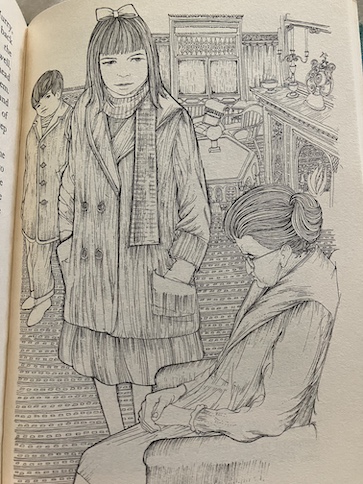
At the beginning of the story, Emma Makepeace is upset because her older sister, Charlotte, will be leaving early for the new term at her boarding school after Christmas. At this point, Charlotte has already had her first term at boarding school (which is where and when Charlotte Sometimes takes place, although there are no references to the events of that story here), and she has been invited to visit one of her new friends from boarding school before they return to the school together. All through Charlotte’s first term at boarding school, Emma has been lonely without her and has been finding life at their home, Aviary Hall, increasingly difficult. 

The girls are orphans (although the books never explain what happened to their parents) who live with their grandfather and his housekeeper. Between the two of them, Charlotte is the more serious and responsible and Emma is the more mischievous and thoughtless. Up to this point in their lives, Charlotte has acted the part of the caring older sister, trying to teach Emma to behave herself and covering for her when she doesn’t. Charlotte has realized that their grandfather has little patience for misbehaving children and that Emma pushes the limits, so she has frequently intervened and smoothed things over when Emma tries his patience. 

Emma has often thought of Charlotte as a kind of spoilsport for trying to act grown-up and mature, but during Charlotte’s absence at boarding school during the previous term, Emma has suddenly come to see how much Charlotte has been helping her and saving her from the consequences of her own actions and the realities of their home life. Without Charlotte there to be the motherly big sister, providing some warmth and affection and acting as a buffer between Emma and the adults, the grandfather has become more impatient with Emma’s immaturity. Both he and the housekeeper have been more direct with Emma about her behavior and bad habits, and there’s no one there to shield Emma from it. Emma is lonely for Charlotte’s company and feels picked on by the adults, so when Charlotte cuts her time with Emma short after her first visit home to go visit one of her school friends, Emma is angry and resentful. Charlotte is tempted to back out of her friend’s invitation for Emma’s sake, but she feels like she can’t, and their grandfather tells her that she must go ahead with the visit.

Emma is in a state of emotional turmoil through most of the story, adjusting to Charlotte’s absence, the new expectations of the adults in her life for her to mature and improve her behavior, and her own resentment about these things. While all this is happening, something else strange happens. Emma begins having strange dreams about flying. They remind her of the children’s flying adventures from two years previously, as described in The Summer Birds. It has been so long since she last flew that she struggles to remember how in her dreams, and when she wakes up, her muscles feel sore from the effort. However, at first, she can’t remember what happened in her dreams.

At school, when the new term begins, Emma is made head girl because she is the eldest girl in the class. A boy called Bobby Fumpkins is made head boy because he is the eldest boy. Emma is embarrassed and uncomfortable about being the head of the class in partnership with Bobby. She hates Bobby because he is fat, awkward, and spoiled. Before his mother gave birth to Bobby’s younger sister, who is still a baby, she babied Bobby more than she really should have at this age. Their family also has their own tv set, something most of the other children’s families don’t have at this time, and which Bobby bragged about when they got it. For these reasons, most of the other children in the class don’t like Bobby, either, and they’ve teased him mercilessly for years. They think he’s a sissy and a baby because of his mother’s attention and because he’s milder-mannered than they are and never stands up to them. Because of his awkwardness, they like to call him Jemima Puddle-Duck after a character from a children’s book by Beatrix Potter. Bobby tells himself that his classmates mean all this teasing good-naturedly, but they don’t really. Emma is particularly adamant within herself that she genuinely hates Bobby.

However, like it or not, Emma’s life has become intertwined with Bobby’s. Their teacher expects the two of them to work together at school during the day, and at night, she gradually begins to realize that he is sharing in her same dream of flying. Other children at school tease Emma about being friends with Bobby, particularly one girl who really wants to cause trouble for Emma because, as the next eldest, she would be next in line for the head girl position herself. Emma denies being Bobby’s friend, partly because he still gets on her nerves and partly because she’s still lonely without Charlotte and is worried by being shunned by the other children at school. However, she gradually begins to feel guilty about the way she and others have been treating Bobby, and she begins to feel the impulse to try to be nicer to him. 

As her relationship with Bobby improves, Emma begins remembering more of their shared dream, and the two of them talk about the dream together. Bobby was one of the children at school who shared in their flying adventures two years before, and the two of them discuss their past adventures with each other and how they compare to the dream they’re now having. There are a few things that they begin to notice that are different from their past flying adventures. One is that they both have the feeling that someone is watching them. It seems to be a stern or hostile presence, a pair of eyes that belong to some unknown person, but they don’t know who it is. They also begin to notice that it looks like plants are growing backward as they fly over the countryside. That is, grown plants seem to be returning to small plants and seeds. They gradually notice that the land seems to be going back in time. Eventually, they start seeing dinosaurs in their dreams, and it looks like they might be going back to the beginning of the world. What will happen to Emma and Bobby in their dream when they eventually reach the beginning of everything?

The book is available to borrow and read for free online through Internet Archive.

I’ve already explained my reasoning about the reading order of the books. The Summer Birds is the first book in the trilogy, and you really have to read it before you read this book because the characters directly reference events from that story. Actually, I thought that was a really interesting choice, to have Emma and Bobby talking openly with each other about the summer when they learned to fly. They just accept that event as a common event in their lives that they shared and that everyone who shared it with them openly acknowledges. Sometimes, in children’s fantasy stories, the characters later downplay magical events, feeling like they were dreams they had or games of pretend they played because they seem too strange to have really happened, but no, in this book, the characters all know what happened to them and just accept it as a part of their lives. I thought it was interesting that this book acts as a bridge between the theme of flying and the themed of time travel in Charlotte Sometimes, although I still think that Charlotte Sometimes keeps more of its suspense if you don’t know that Charlotte safely returns to her own time before you read it. 

I still think that Charlotte Sometimes is the best book in the trilogy. It is the best known, and unlike this book, it can be read independently of the others in the trilogy. It doesn’t reference either of the other two books at all. There are no references to Charlotte having participated in any previous magical adventures in that story. That may be partly because she is among strangers at her new boarding school who wouldn’t know anything about her flying adventures, but even her private thoughts don’t give any hint to that. What I think that The Summer Birds and Emma in Winter add to Charlotte Sometimes are some further insights into Charlotte and Emma’s personalities and the relationship between them. I still think that Charlotte Sometimes is the best book in the trilogy. It is the best known, and unlike this book, it can be read independently of the others in the trilogy. It doesn’t reference either of the other two books at all. There are no references to Charlotte having participated in any previous magical adventures in that story. That may be partly because she is among strangers at her new boarding school who wouldn’t know anything about her flying adventures, but even her private thoughts don’t give any hint to that earlier adventure. What I think that The Summer Birds and Emma in Winter add to Charlotte Sometimes are some further insights into Charlotte and Emma’s personalities and the relationship between them. Emma in Winter also adds some thoughts about the nature of time and time travel, which add some further insights into Charlotte’s time travel experiences.

Emma and Bobby do some research about time in her grandfather’s study, a room where Emma is usually forbidden to go. One of the theories they find is that time moves in a coiled pattern, like a spring, and that the coils of the spring can be pushed together so different points on the coils can touch each other. This theory really relates better to Charlotte Sometimes than to Emma in Winter, but what is more relevant to this story is the idea that human thought can be the force that pushes the coils together and makes them touch. This is also a part of Charlotte Sometimes, and I explain in my review of that story about how Charlotte and Clare having many similarities and being in a similar state of mind as well as sharing the same physical space at different times allowed them to switch places with each other. However, the emphasis in Emma in Winter is Emma and Bobby realizing that their own thoughts and feelings influence their dreams and, therefore, their time travel.

This story is rather metaphysical and a little difficult to follow during the dream phases. I noticed that some other reviewers seemed confused about the point of the time traveling. I found it a little confusing, too, but it seems like this is a coming-of-age story, like the other books in the trilogy. The Summer Birds focused on Charlotte and how her more mature outlook helped the other children make an important decision that would alter their lives forever. Charlotte Sometimes raises the question about what defines a person’s identity and how a person’s identity can be tied to someone else’s even when they’re separate people. Emma in Winter focuses on emotional understanding.

Both Emma and Bobby are going through major changes in their lives, particularly ones that require them to become more mature than they once were. Bobby has been somewhat spoiled and coddled by his mother, but he’s no longer the center of attention at home, now that he has a little sister. At first, Bobby finds it hard to cope with his mother no longer giving him the attention she used to give him, but it does give him the opportunity to become more independent and mature. Emma despises Bobby for being babyish because he was spoiled and overprotected by his mother when he was younger, but the truth is that Emma is also babyish. She’s not accustomed to being accountable for her own behavior and bad habits because Charlotte usually takes responsibility for her and shields her from some of the reactions of the adults and other people. 

When Charlotte goes away to boarding school, Emma is left on her own for the first time to deal with the consequences of her actions and other people’s reactions to them. It’s a bit of a shock for her at first, and she realizes that she hasn’t fully appreciated what Charlotte was doing for her for the whole time. She also comes to the disquieting realization that, even thought she feels like the adults are picking on her over her behavior, she doesn’t like the way she behaves, either. She comes to feel guilty about the way she treats Bobby, and when she draws some nasty pictures of her teacher, she is startled to realize how much she has hurt her teacher’s feelings and how badly she feels about doing that. For the first time in her life, Emma has to face her own behavior and see how her behavior truly affects other people. She is shocked and troubled when she realizes that she doesn’t like what she sees and it’s her own fault. Only Emma can decide how nice or how mean she is and who she really wants to be.

The children’s time traveling adventures that they have while dreaming lead them to explore their relationship with each other. Emma realizes that she has to be nice to Bobby and learn to get along with him for them to be able to function with each other in the dream. Their final dream together is confusing and rather surreal, but it also involves the two of them confronting aspects of themselves, their lives with other people, and their own behavior. 

When they move all the way back in time as far as they can go, they’re confronted by a vision of their teacher, not as she actually is, but as Emma drew her in a mean drawing. Emma has to remind herself and tell the figure that it’s only a drawing she made; it’s not reality. They also see visions of other people in their lives and even of themselves at their worst and most frightening, but they have to hold on to the reality of themselves, as they are now, the people they’re becoming, not who they used to be or how other people see them. I took it to mean that neither of them can go backward in their lives anymore, to their old habits and who they were or how they were as younger children, but they have to accept the changes taking place in their lives and in themselves to return to the real world, their own time, and the lives they have ahead of them. They discover that the key to traveling through time is thinking, so they have to think themselves out of their time travel dreams, focusing on their real selves and the real lives, accepting and even loving themselves as they are. Change has been coming for both of them, but they have to make the decision to face it and embrace it and to let go of their past selves to move on in time and in their lives.

Mr. Willowby’s Christmas Tree

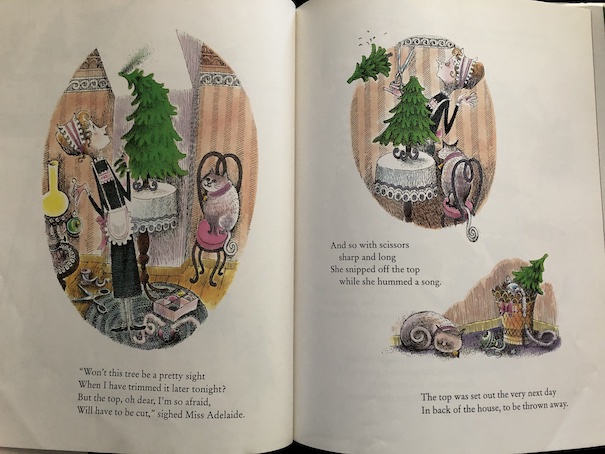
Mr. Willowby’s Christmas Tree by Robert Barry, 1963, 2000.

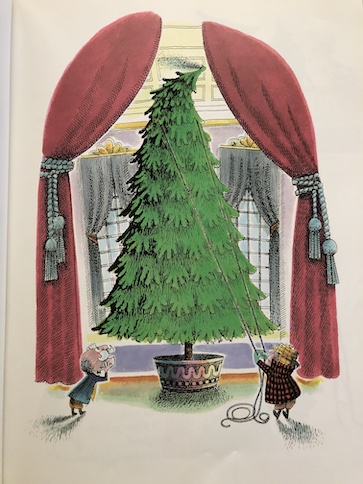
Mr. Willowby lives in a large house, and he orders a large Christmas tree by special delivery. It’s large and wonderful, but it’s just slightly too tall for the room where Mr. Willowby wants to put it.

Mr. Willowby’s butler solves the problem by chopping the top off the tree, and because he doesn’t want the top to go to waste, he gives it to Mr. Willowby’s maid.

The top of the tree is about the right size to make a small Christmas tree for the maid’s room, but it turns out that it’s just slightly too tall again. The maid also clips the top off her tree.

From there on, the tree top moves on to other people and animals. The gardener spots the top that the maid throws out and decides it would make a nice, small Christmas tree. Like everyone else, though, he finds that the tree needs a little clipping for it to go where he and his wife want it to go.

As the top of the tree gets smaller, it starts drawing the interest of animals. Even animals enjoy having a Christmas tree as grand as Mr. Willowby’s!

The story is cute and told in rhyme! The book is available to borrow and read for free online through Internet Archive (multiple copies).

My Reaction

I remember this book from when I was a kid! I remember liking how several people and animals get Christmas trees out of just the top of one large Christmas tree. It’s a fun story about how one person’s trash is someone else’s treasure and nothing needs to go to waste. Mr. Willowby’s Christmas tree ends up helping everyone. In the end, everyone is happy because they all get a nice Christmas tree.

The illustrations in this book are full-color, but some older version of the book are in limited color – black, white, and green.

The Mystery of the Green Ghost

The Three Investigators

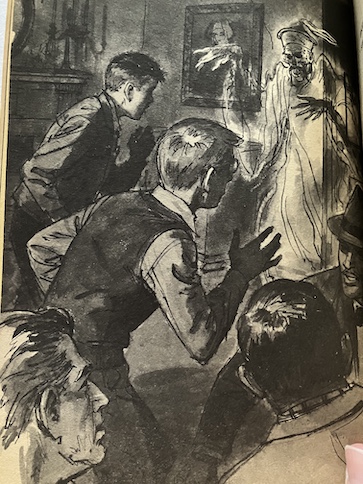
Bob and Pete are looking at an old, abandoned house that’s in the process of being torn down when they hear an unearthly scream from the house! There are stories that the old house is haunted, and the boys run away, only to be stopped by a group of local men, who ask them what’s going on. When the boys explain, the men talk about calling the police or going inside the house to investigate. The men decide to just go in and have a look around themselves, in case someone’s hurt and needs help right away. They tell the boys that they can leave because they will handle the situation, but the boys decide that they can’t leave without having a look themselves.

As they take a look around inside, they see the remains of the ornate wall paper and impressive features of the once-rich house, and the men talk about Mathias Green, who used to live in the house. At first, the searchers can’t find anything, but then, they spot a greenish figure on the stairs. Thinking that there’s some prankster in the house, the searchers go upstairs to confront the person, but they can’t find whoever it was. The boys suggest that they have a look at the dust on the floor and try to follow the person’s footprints, but the only footprints the searchers can find are their own. Could they have seen a ghost?

The searchers do notify the police about what they’ve seen in the house, but the police don’t take it too seriously … at first. However, they soon begin receiving other reports from various people around the city who claim to have seen a greenish, ghostly figure. Even then, the police might not have take the reports too seriously, except that a couple of officers on patrol witness a greenish, ghostly figure in the cemetery … at the burial site of Mathias Green, who died falling down the stairs in his house, 50 years before.

While Bob and Pete were at the house, Bob had his tape recorder with him, and he plays the recording of the scream they heard for their friend and fellow investigator, Jupiter. Jupiter is willing to believe it could be the scream of Mathias Green’s ghost, and the boys review the information they know about Mathias Green. Mathias Green was once the skipper of the ship, and he sailed to China. For reasons that nobody fully understands, he had to leave China suddenly, and the rumors were that Mathias’s wife was a Chinese princess and that Chinese nobles had a grudge against Mathias. Mathias brought his wife back to the United States with him, and they built their house in Rocky Beach after Mathias had a fight with his sister-in-law, and they moved away from San Francisco. They had some Chinese servants, but when Mathias was later found dead, apparently from an accidental fall down the stairs, the servants and his wife disappeared. People assumed that they left for fear that they would be blamed for Mathias’s death, and Mathias’s sister-in-law inherited the house. Recently, Mathias’s niece decided to sell the house to a developer, who is planning to tear it down and build more modern houses.

Local newspapers have picked up the stories about the green ghost and its apparent connection to the old Green mansion, and some of them have implied that the ghost is looking for a new place to haunt now that its house is being torn down. The Three Investigators have access to more information than most people because Bob’s father is one of the reporters covering the ghost incidents. The police chief tells them, off the record, that he witnessed the ghost himself, in the cemetery, and it looked like it disappeared by sinking down into Mathias’s grave. Then, the police chief learns that the workmen tearing down the house have discovered a hidden room. Bob’s father and the boys are allowed to come with him to see what the room contains.

The discovery is a shock. The hidden room contains an ornate coffin, holding the skeleton of Mathias’s Chinese bride, dressed in elaborate robes and with an unusual necklace of gray pearls, called ghost pearls. The story is that the reason why Mathias and his bride had to suddenly flee China was that Mathias reportedly stole the pearl necklace to give to his bride. When she died in Rocky Beach, he couldn’t bear to be parted from her, so he “buried” her secretly in his house, along with the necklace.

The discovery of Mathias’s wife’s hidden burial chamber doesn’t lay the ghost to rest, though. Bob and Pete get a phone call from Mathias’s niece, Lydia, asking them to visit her at the vineyard where she lives, to talk about what they witnessed at the house. She says that the ghost has actually appeared at her vineyard! Jupiter is not invited to the vineyard because he didn’t witness the appearance of the ghost with the others, but he couldn’t go anyway because he’s temporarily in charge of his uncle’s salvage yard while his uncle is out of town. He tells Bob and Pete to go ahead and meet with Lydia and let him know what they learn.

At the vineyard, Bob and Pete meet Lydia’s distant cousin, Harold, and Lydia’s great-nephew, Charles, who is actually the great-grandson of Mathias Green and the real heir to Mathias’s estate. Charles, who is called Chang, grew up in China, and they explain that he is descended from Mathias’s first wife, who died of an illness in China. After the death of his first wife, Mathias put his young son into an American missionary school in China and left him there as a boarding student. When he married his second wife and had to flee China, he left his son behind. His descendants remained in China since then, until it became unsafe for Americans or people of American descent in China. Then, Charles, who is an orphan and part Chinese (hence his nickname of Chang), was sent to live with Lydia in the United States. Until that point, he knew very little about his ancestors and his relatives in America. Technically, Mathias’s estate should have come to Chang’s side of the family when Mathias died, but they were living in China at that time and were not in touch with the rest of the family. Lydia says that Chang should even technically own the vineyard that she and Harold have built with the family’s money, but Chang doesn’t want to take it from them, so Lydia says that she is leaving it to Chang in her will. Chang is satisfied with this arrangement, but the family has debts, and if they don’t resolve them, they might lose the vineyard entirely.

Lydia believes that the green ghost is Mathias’s ghost, and he is haunting them because he’s angry with her for selling his old house to be torn down. The ghost has been scaring away workers at the vineyard, and if they can’t get the harvest processed, they won’t be able to keep the vineyard. However, Chang doesn’t believe that his great-grandfather would want to hurt his own family. Chang might be willing to believe that the ghost is an evil spirit, masquerading as his great-grandfather. That’s not the only possibility, though. There could be a human being with a motive for wanting to ruin the vineyard. Then again, there is the question of who really owns the ghost pearl necklace. If Mathias’s family owns the necklace, they could sell it to cover their debts, but it might really belong to the family of Mathias’s Chinese wife. Her family is more difficult to trace, but one person has stepped forward, claiming to be her heir. Then, someone attacks Harold and steals the necklace from him. Was the necklace always the ghost’s target, from the beginning? Meanwhile, back in Rocky Beach, Jupiter has a revelation. There was a dog present when Bob and Pete were searching the Green mansion with the men, and the dog … didn’t do anything. That might be the most important clue of all!

The book is available to borrow and read for free online through Internet Archive (multiple copies, including some in other languages).

I enjoyed the mystery and the reference to Sherlock Holmes about the dog that did nothing in the nighttime. In this story, Jupiter takes the dog’s non-reaction as a sign that there was no supernatural presence in the house because animals are supposed to react to the presence of ghosts. There is definitely a human behind all the spooky happenings, and I was partly right about who it was. However, the author threw in a complication by inserting another mysterious villain who kind of usurped the original plotter’s plot for his own purposes and partly distracts the characters from the original villain for part of the story.

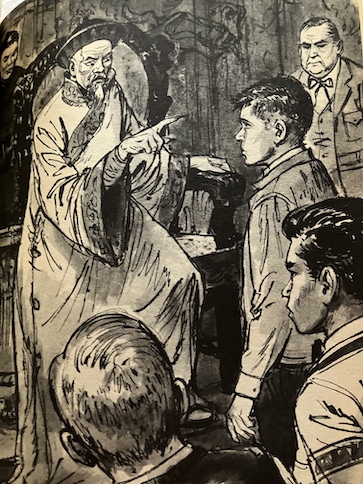
This added villain is a mysterious old man from China who claims that he’s 107 years old and that he wants the pearls because drinking dissolved ghost pearls is the key to immortality. This mysterious old man is wealthy, and he has bought up the family’s debts, meaning that he will get control of the vineyard, if they can’t pay their debts. However, he’s not really interested in the vineyard for its own sake. He just wants those pearls. Although he does some criminal things in the story, nothing much seems to happen to him at the end, and he works out a deal with Lydia, so she can keep the vineyard. It’s left open whether or not he truly ended up with the pearls or whether the pearls actually have properties for preserving someone’s life, but it seems that he truly believes it, and he has no other motivations for his part in the story.

This almost Fu Manchu style character, who uses hypnosis to control people, adds an element of exoticism to the story that I thought wasn’t really necessary. I liked the ghost mystery well enough with its original villain and without him, and I felt like the introduction of the extra villain sent the plot a little off the rails, but he does allow the story to end on a somewhat creepy and ambiguous note. We don’t entirely know who he is, and we never really find out what happens to him. We don’t know if he’s really as old as he says he is or if he continues much further in his quest to live forever. He just disappears after getting what he can of the pearls, presumably to go hunting for more elsewhere.

As far as I’ve been able to determine, the ghost pearls aren’t real, and the legend about them prolonging people’s lives isn’t real. However, there are legends and superstitions from around the world about pearls being associated with wisdom and longevity and having healing powers. Pearls can be dissolved in an acidic liquid and drunk by a human, as in the famous story about Cleopatra drinking a pearl in vinegar, which was supposed to be an aphrodisiac.

Getting back to the mystery, though, I did like the Scooby-Doo-like mystery, and I was satisfied by the original plot, and the villain’s methods and motives. I was looking at that character with suspicion for a number of reasons. Perhaps, if the part about the pearl necklace, the ancient man who drinks pearls, and Mathias’s bizarre room with his dead wife weren’t in the story, the solution would be too obvious, but overall, I enjoyed it. I also appreciated how Jupiter worked out some of the details of the first haunting by visiting the house and studying the scene while his friends were at the vineyard. He comes to some conclusions about how that first haunting occurred that Bob and Pete didn’t think about, and his solution also provides a reasonable answer to the question of why that group of men happened to show up outside the house on the evening the haunting happened, to witness it.

Return to Gone-Away

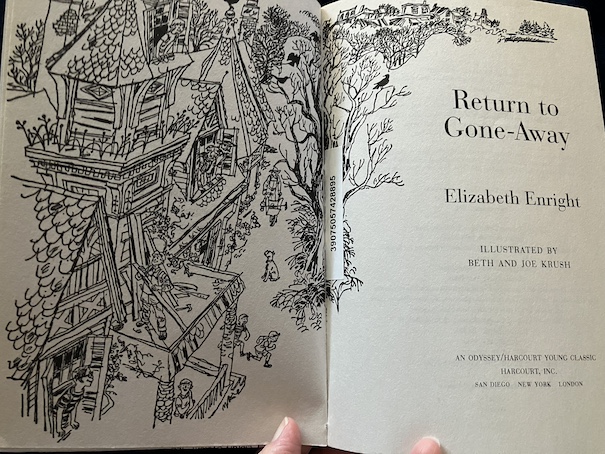
Return to Gone-Away by Elizabeth Enright, 1961.

This story picks up the spring after the previous book, Gone-Away Lake, with Portia Blake’s parents purchasing one of the old houses in the abandoned resort community now known as Gone-Away Lake. They’ve bought the large house that’s in the best condition, the one formerly known as the Villa Caprice. The wealthy woman who had once owned it had died many years before in the San Francisco Earthquake of 1906, leaving no heirs. Few other people would be interested in owning it since the lake has become a swamp, so the Blake family got a really good deal on it. The Blake family think the place is wonderful, filled with some amazing old things, and they’re looking forward to fixing it up and restoring the old garden. They plan to use the house as a summer home, and they will still live in their apartment in New York, where the kids go to school, for the rest of the year.

Portia’s aunt and uncle live nearby with her cousin Julian, and the two remaining residents of the old resort community, affectionately known as Aunt Minnehaha and Uncle Pin, still live there. Portia and Julian are part of a club they call the Philosopher’s Club, after Uncle Pin’s old group of friends, which includes Portia’s younger brother Foster and a couple of other kids who live in the area. They have a meeting space in another of the old, abandoned houses.

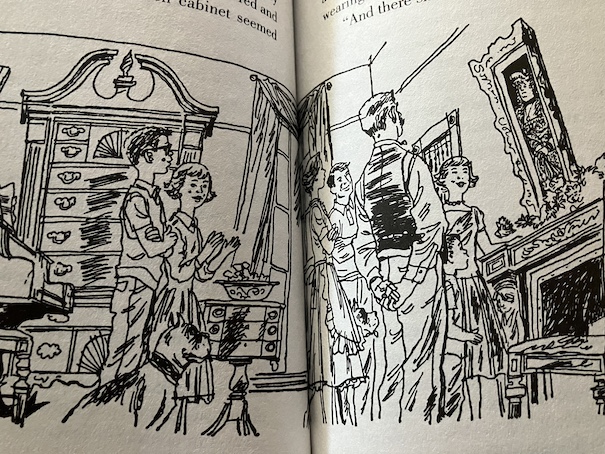
When the Blakes see the Villa Caprice again, the parents feel less optimistic about their purchase of the house because it looks shabbier than they remembered, and there is so much to fix. The adults know that it will take a lot of money and hard work to restore the house. However, the children are still enthusiastic because they know the old house is full of some fascinating things. One of the first things they run into is a dummy set up by the former owner to frighten and discourage trespassers. They nickname him Baron Bloodshed. When the adults realize that the old chandelier in the house is a Waterford chandelier, they begin to see that there may be some worthwhile treasures in the house after all.

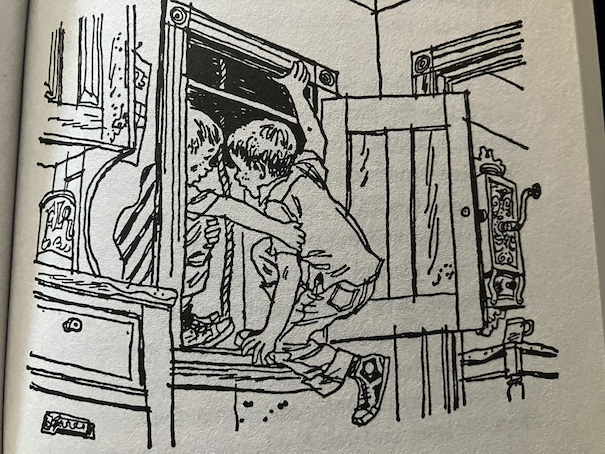
The Blake family takes the children’s spring vacation to start cleaning the house and sorting through the things inside. They find some other valuable, collectible items, like a set of Lowestoft china and antique Chippendale furniture. The adults realize that, if they sell some of these valuable antiques, they can use the money to pay for the renovation of the house. The children have little interest in such things, but they are amazed by some of the old-fashioned features of the house, like the old dumb waiter. Foster climbs inside the old dumb waiter, gets stuck, and has to be rescued. His parents tell him off because it was a dangerous thing to do and the old rope holding it might have been rotten.

The children look forward to spending the whole summer exploring the house and seeing what other treasures it has to offer. Aunt Minnehaha tells them more about the wealthy woman who used to own the house, Mrs. Brace-Gideon, who was a very determined woman who was accustomed to telling everyone what to do and getting her way because of her money. She was self-centered and callous in some ways, but she was also a brave and just woman in others. When Aunt Minnehaha tells them a story about how Mrs. Brace-Gideon dealt with a burglar who was trying to rob her wall safe, Julian begins asking more questions about the safe because they haven’t seen any sign of it. Aunt Minnehaha says that Mrs. Brace-Gideon wasn’t a very trusting woman, so she probably either told everyone the wrong room it was in on purpose to keep its location a secret or maybe had it moved after that incident or removed the safe entirely when she decided that she wanted to move to California. Even if the safe still exists, concealed somewhere in the house, it’s not likely that it would contain anything really valuable because Mrs. Brace-Gideon might have taken her valuables to California with her. All the same, the kids think that it would be exciting to try to hunt for the safe, in case it’s still hidden somewhere.

The kids begin another fun summer, improving their club’s meeting place with discards from their new house, enjoying outdoor fun with their friends, hearing stories about the past escapades of the people of Gone-Away, and spending the night camping out in a spooky old house during a thunder storm. They enjoy finding new treasures among the abandoned belongings of Gone-Away, and before the summer is over, they find the greatest treasure of all!

The book is available to borrow and read for free online through Internet Archive (multiple copies).

My Reaction

This is a fun sequel to the original book! I loved hearing about the things the family discovered in their old house and how the adults let the kids have some neat old things for their club. The small details in the book are magical, like the addition of the dummy they call Baron Bloodshed and the way he keeps scaring them because they keep forgetting that he’s there until they stumble on him again.

It’s the sort of idyllic summer in a unique location that kids dream of having! I liked the treasure hunt for the lost safe, and there are many small adventures and escapades along the way. The stories that the older couple tell the children about wonderful past summers both offer the kids inspiration for their summer and are like little mini-stories within the bigger one.

Even though this old, abandoned community and the house the family is fixing up are charming, there is also some acknowledgement in this book that there are dangers in exploring and playing in the abandoned houses. The incident with the dumb waiter could have been dangerous, and there is also a collapsed stairway in the story. While these houses full of valuable antiques and hidden treasures are wonderful, the inclusion of some of the dangers of abandoned places, no matter how exciting they are to explore, add an element of reality to the story.

The Summer Birds

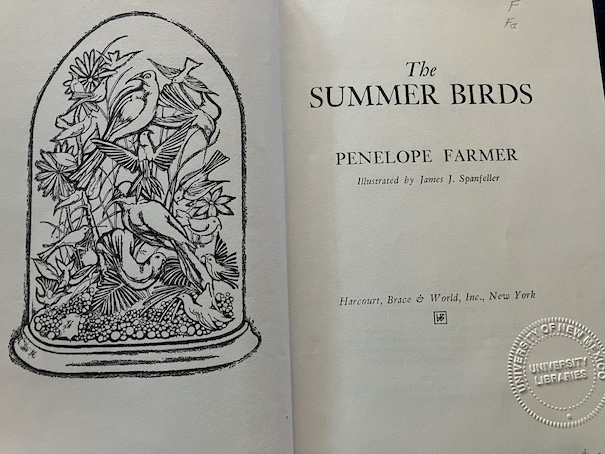
The Summer Birds by Penelope Farmer, 1962.

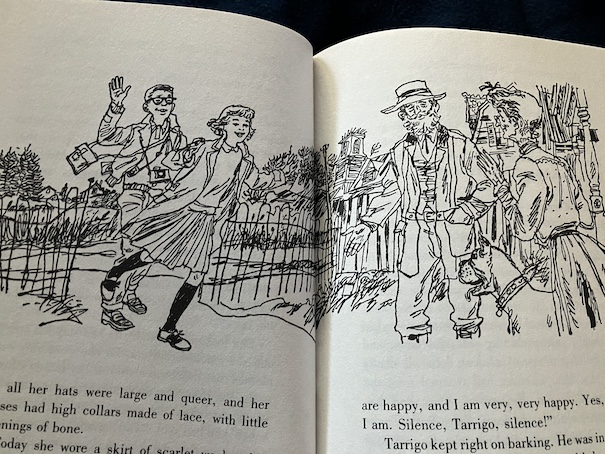
Aviary Hall is an old, Victorian-era house in a small village in England. It doesn’t really have an aviary, although there are hummingbirds on display in a glass case in the drawing room. Like other houses of its type, it has greenhouses and a walled kitchen garden. Twelve-year-old Charlotte Makepeace and her younger sister, ten-year-old Emma, live there with their grandfather. Every morning, they walk to school, and they admire the birds in the area, wishing that they could fly like that themselves. One morning, they meet a strange boy on their way to school. Charlotte is cautious about meeting strangers, but Emma talks to the boy. Charlotte says that they should hurry, or they’ll be late for school. The boy says that he doesn’t go to school, so Emma invites him to come with them to their school. Charlotte isn’t sure what their teacher would think of the strange boy showing up, but they have to go or they will be late.

However, when they arrive at school, Charlotte gradually begins to realize that nobody seems to notice the new boy except for her and Emma. Other people just look past him, and nobody asks who he is. It’s like they can’t even see him. As the lessons at school continue, Charlotte’s attention wanders, and she finds the heat of the room uncomfortable. Then, the boy invites Charlotte to come away with him, promising that he will teach her more than she will learn in class.

At first, she thinks that people will notice if she leaves, but they don’t. She and the boy run away from the school, and Charlotte feels wonderfully free, like a bird. The boy asks Charlotte if she would like to fly like a bird. Charlotte doesn’t see how that’s possible, but they says that it is and shows her that he can fly. The boy teaches her some exercises to make sure she’s strong enough. Charlotte can’t fly at first, just falling to the ground when she tries, but when the boy urges her to continue trying, she gradually realizes that she is staying in the air longer and longer. They have a wonderful time on this adventure.

The boy is very mysterious about who he is although he asks many questions about Charlotte and her home and family. Charlotte asks the boy if the other kids from school can also learn to fly. The boy says that they have to learn one-by-one, but he will teach them individually, and it has to be a secret.

Then, suddenly, Charlotte finds herself back at school. No one has noticed that she was gone, not even Emma. At first, Charlotte wonders if it was all just a dream, but she discovers that she still has the ability to fly and has to be careful not to let other people see her feet leave the ground when she kicks her feet. Emma can tell that Charlotte has a secret, and she’s irritated when Charlotte refuses to tell her what it is. However, Charlotte knows that Emma will learn soon enough.

Emma learns to fly the next day, and gradually, other children at school also start to be able to see the boy and get their own flying lessons. Charlotte’s best friend, Maggot (a nickname, not her real name), seems particularly accepting of the strange boy and his strange powers of invisibility and flying. She seems to understand things about him, maybe even more than Charlotte does, saying that her uncle has told her about such things.

Their teacher discovers what they’re doing when she catches one of the children flying, and she questions them about it. The children don’t want to admit anything to her because they call swore an oath to keep it a secret, but the mysterious boy says that their teacher is all right and reveals himself to her. He explains that he taught the children to fly, and their teacher is surprisingly accepting of that. She asks if she can also learn, but the boy explains that he can only teach children. The teacher regretfully says that she suspected that might be the case, and the children begin to consider that their ability to fly might also fade with age. The teacher invites the boy to join their class for the rest of the term and seems to quietly support their flying adventures.

When school lets out for the summer, the children continue their flying adventures, still a secret from their parents. The boy, who has still not told anyone his name, is very strange, and not just because he can fly. Charlotte sees him eating insects, which he says he loves, and he doesn’t seem to understand things about school and ordinary houses. During an argument among the boys in the group, who don’t want to be bossed by the mysterious boy without reason, one of the boys, Totty, challenges the mysterious boy about who he really is, where he really comes from, and how he came by his flying magic. The other children are afraid to challenge the mysterious boy because they know that he is strange, they worry that there may be something evil about his magic (although they doubt it), and they fear losing the ability to fly.

The children decide to settle the conflict with a special challenge. If the mysterious boy wins the challenge, he wants to stay with them for the rest of the summer, being their leader and not explaining anything about himself. If Totty wins, the mysterious boy says he will explain who he really is and then leave, although he will let the children keep their ability to fly until the summer is over. The mysterious boy wins the challenge, but at the end of the summer, he makes them all an offer that could change their lives forever.

The book is the first book of the Aviary Hall Trilogy, although it isn’t as well-known as Charlotte Sometimes, which is the third book. It is available to borrow and read for free online through Internet Archive (multiple copies).

My Reaction and Spoilers

Although Charlotte and Emma are sisters, this is the only book in this short series in which they both appear together. Each of the other books focuses on each of the girls separately. Charlotte Sometimes, the best-known book in the series, is set when Charlotte goes away to boarding school, and the second book in the series, Emma in Winter, takes place while Charlotte is away at school, focusing on Emma, who is left at home. All three books focus on growing up and issues of personal identity, although they do it in somewhat metaphysical terms and with fantasy elements.

Charlotte Sometimes focuses on personal identity as Charlotte finds herself traveling back and forth through time, trading places with another girl who attended her school in the past. At times, Charlotte feels like she’s losing her identity as Charlotte and becoming more like the other girl. One of the things I liked about The Summer Birds was getting a glimpse of Charlotte just being in her own identity all the way through the book. The beginning of the book makes it clear that the other children at school think that Charlotte is a prig (someone who is rigidly well-behaved to the point of being obnoxious), but it also clarifies that it’s because she feels compelled to look after Emma and set a good example for her.

The two girls live with their grandfather Elijah, who is obsessed with astrology, and an elderly, lazy housekeeper. The book never really explains what happened to their parents, but it seems that Charlotte and Emma are orphans. It is established in Charlotte Sometimes that their mother is dead, and this book mentions that their father was a sailor. Their grandfather likes girls to be well-behaved, and Emma is anything but, so Charlotte keeps trying to teach Emma how to act to keep their grandfather happy and trying to smooth things over with their grandfather when Emma misbehaves. In Emma in Winter, Emma has to face up to the realities of her personal behavior and other people’s reactions to her behavior without Charlotte running interference or taking responsibility on her behalf. That’s her coming-of-age moment, and it leads her to become more mature, personally responsible, and better-behaved herself and to appreciate what Charlotte was trying to do for her.

Although each of the books in this short series can be read independently of each other, I think reading all of them adds some depth and understanding to the characters. Charlotte was always a very responsible and cautious person in Charlotte Sometimes, showing that there is continuity to her character, but knowing the history of why is that way makes her more understandable. Although the other children sometimes consider Charlotte a drag for pointing out things that they shouldn’t be doing, it’s Charlotte’s serious nature that causes the other children to question the offer that the mysterious boy makes them at the end of the summer.

We also get to meet Charlotte’s best friend in her home town in this book, a girl called Maggot, who never appears and is never even mentioned in Charlotte Sometimes. The reason why she doesn’t appear in later book is that she is the only one who decides to accept the mysterious boy’s offer at the end of the book, leaving with him to be forever young as a bird. Charlotte is tempted by the offer, but she realizes that accepting it would mean giving up everything else and everyone else in their lives. The children would be happy for a while in their freedom as birds, but they would eventually miss their parents, and their parents would grieve for them because they would never be able to return. Although the other children don’t always listen to her, she is able to persuade them that this is really a serious matter that is about their very lives, forever, not just a brief summer lark. In the end, Maggot is the only one who can accept the offer because she is the only one who has no one left in the village to miss. She is an orphan and lives with an uncle who pays little attention to her. It is implied that he would hardly notice if she left, whereas Charlotte and Emma’s grandfather really would miss them, even if he sometimes doesn’t like their behavior. Maggot was also always the most birdlike, and she probably knew that the boy was really a bird before the others did because her uncle is a gamekeeper.

There are still some questions left unanswered at the end of book, but that is typical of this series. Readers might have guessed that the boy was really a bird all along, but we still don’t really understand his magic or see what happens in the village after Maggot leaves with him. We don’t know for sure that Maggot’s uncle doesn’t miss her or try to look for her, what the other villagers decide happened to Maggot, or if the teacher ever tells anyone what she knows about the children flying or if she understands what happened to Maggot herself.

Overall, it’s a pretty slow-paced book. Most of the story feels like pretty low stakes until the part at the very end, where the boy offers to let the other children come with him to be young birds forever. Then, it becomes a serious question of whether they are willing to continue with their normal lives, growing up and losing their flying magic, or if they’re willing to give up everything and everyone they know and love forever to keep it. Even though most of the story is peaceful, I had the feeling from the beginning that there might be a sinister turn somewhere because the boy’s behavior didn’t always seem straight-forward and friendly, and he was definitely keeping secrets. I had the feeling that the mysterious bird boy wanted something from them or was going to try to get them to do something they shouldn’t eventually. It’s an interesting premise, although I still think that Charlotte Sometimes is the best in the series. Events in this book are also mentioned in Emma in Winter, when characters in the story discuss them with each other, showing that all of the local children still remember their flying adventures together and that the events in this book didn’t just happen in their imagination.

Mr. Pine’s Purple House

Mr. Pine lives in a little white house. All of the houses on Vine Street are white, and they look completely identical. Mr. Pine thinks that he’d like to do something that will make his house different from all the other little white houses.

His first idea is to plant a pine tree in his front yard. Since his name is Pine, everyone seeing it will think of him, and his house will be different from everyone else’s. The problem is that all of his neighbors like his pine tree and decide to plant their own trees. Soon, all of the houses look alike again with pine trees in the yards.

To make his house look different, Mr. Pine tries to plant a bush next to his tree, but everybody likes that idea, too. Soon, everybody has both a bush and a pine tree in their yard, and the houses look identical again.

Mr. Pine tries to think of something that he can do with his house that his neighbors won’t imitate. He gets the idea of painting his house, but he can’t pick any obvious color that all of his neighbors will want, too. He decides to paint his house purple. Is this finally the idea that will make Mr. Pine’s house different from the rest?

This book is actually the second book in a series of picture books about Mr. Pine.

I often think of this book and The Big Orange Splot together because they’re both about people in a neighborhood of identical houses who make changes to distinguish themselves and their houses and end up changing the way their neighbors view their own homes. The difference between the books is that, in The Big Orange Splot, the neighbors were completely opposed to changes that made anyone’s house different until they began to see the opportunities for living out their own dreams through their homes. In this book, the neighbors immediately seize on everything that Mr. Pine does that’s different and start copying him. They think all of his changes are great and frustrate his efforts to be different by doing everything he does until they decide to all paint their houses different colors. Of course, Mr. Pine’s changes are all less outlandish than the ones from The Big Orange Splot, so they would be easier to accept.

I liked it that Mr. Pine’s neighbors all have colors for names: Mrs. Gray, Mr. Gold, Mrs. Green, Mrs. Brown, and Mrs. White, and all the colors they eventually pick for their houses are different from the colors in their names. Even though this book mentions a lot of colors, the only colors shown in the pictures are black, white, and purple. In the end, when the houses are all different, the differences in color are shown with lines providing shading rather than with actual colors. It still works to show that the houses are now different from each other.