Clifford's Christmas

Clifford

Clifford’s Christmas by Norman Bridwell, 1984.

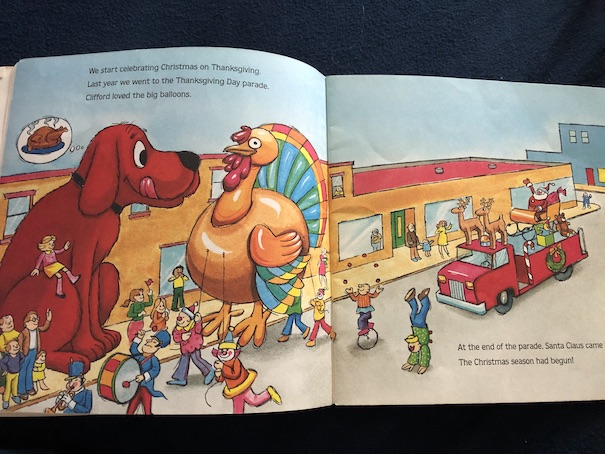
Christmas is coming, and Emily Elizabeth and Clifford are ready to celebrate! Emily Elizabeth talks about how the Christmas season begins with Thanksgiving. (That’s not how everyone regards it, but it is a common way to mark the season in the United States. The day after Thanksgiving, Black Friday, is considered the start of the Christmas shopping season, with people looking for bargains on Christmas presents.)

When it starts to snow, Emily Elizabeth, Clifford, and their friends have fun playing in the snow. They get a Christmas tree, prepare their stockings, and participate in other holiday activities leading up to Christmas. Clifford even gets a kiss under mistletoe!

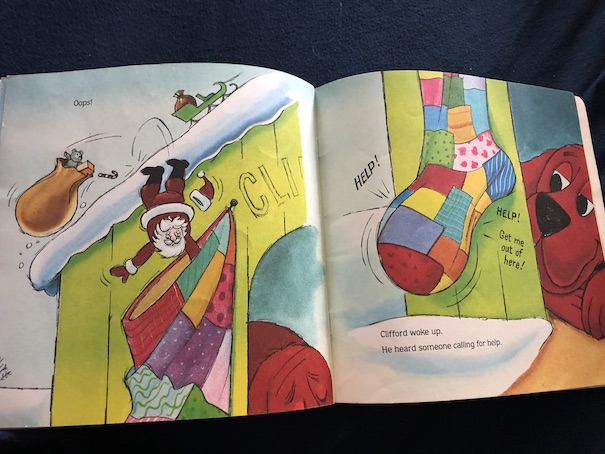
When Santa comes, he lands on the roof of Clifford’s dog house and accidentally falls into Clifford’s stocking, dropping his sack of toys. Clifford has to rescue him.

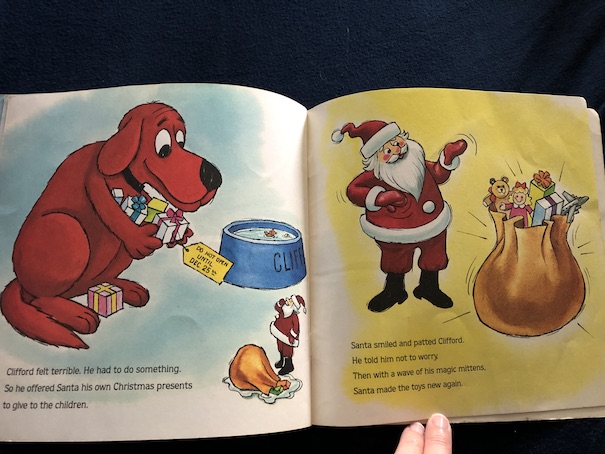
The toys fall into Clifford’s water bowl, but Santa fixes them with his magic. No harm done, and it’s a Merry Christmas after all!

This is just a cute Christmas story with a popular children’s books character. I loved the Clifford books when I was a kid, but I have to admit that they don’t look as good to be now as an adult. The entire plot of Clifford books revolves around Clifford’s enormous size, which is the very idea of the series. However, the plot of this is light, the problem is both caused and immediately solved by Clifford’s large size, and I think I’m just not interested in the usual trope of Famous Character Saves Christmas In Some Way anymore. I think that some Christmas stories with popular characters are still good, but for them to work, they usually have to have deeper, more clever, more interesting plots. This book isn’t bad, but I just didn’t think it was particularly great.

The book is available to borrow for free online through Internet Archive.

The Fun of Cooking

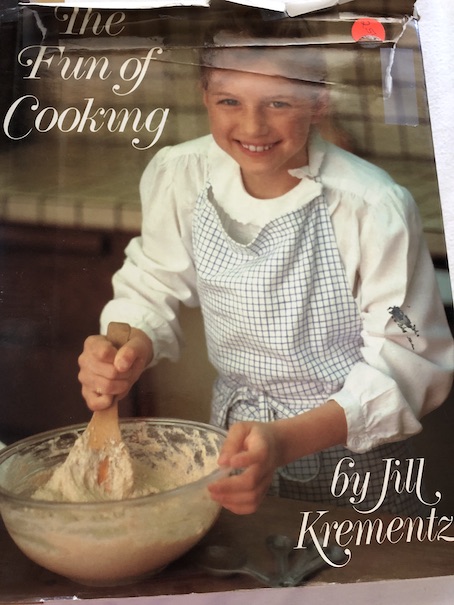
The Fun of Cooking by Jill Krementz, 1985.

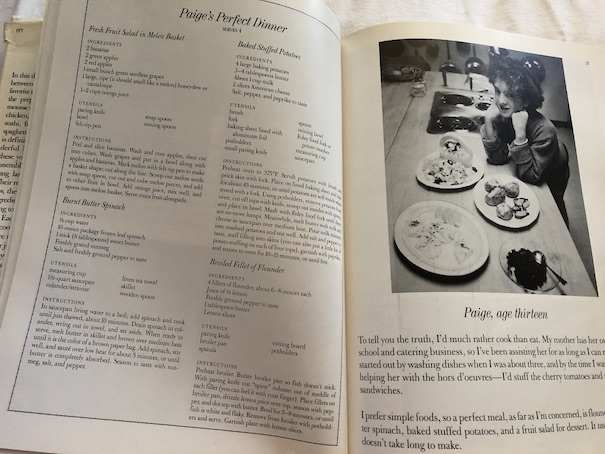
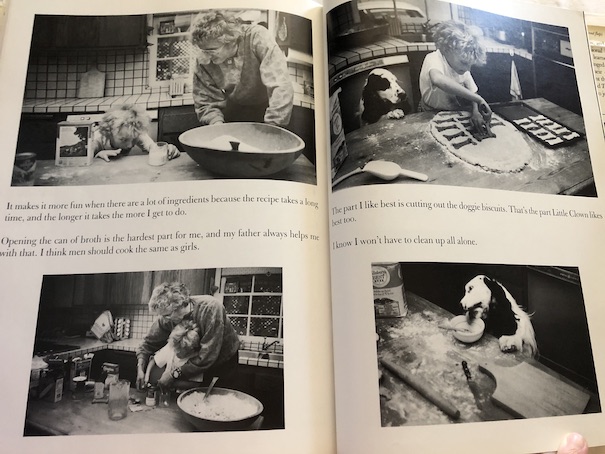
This cookbook was designed not only for children but includes real children making their favorite recipes, sometimes by themselves and sometimes with the help of their parents. The author, Jill Krementz, was also a photographer, and she photographed the children as they cooked. (Another interesting fact is that Jill Krementz was also married to Kurt Vonnegut, until his death. It’s not directly related to this book at all, just a fun fact.)

The recipes in the book aren’t arranged in any particular order, going back and forth between main dishes and desserts of various kinds. Some of the children included recipes for entire meals that included both main dishes and a dessert.

The children themselves are a range of ages from six to sixteen. The older children tend to make more complex dishes or meals, and the younger ones tend to make simpler ones, although even the younger children can make complex dishes with the help of their parents or grandparents. One girl, Michele, has a father who is a professional chef, and she says that it’s her ambition to be a chef, too. She and her father are shown making spaghetti together in the kitchen of his restaurant.

The children all seem to live in or around New York City, where the author lived, and they are from a variety of backgrounds. There are two girls who mention that they are Jewish, including the girl who makes matzo ball soup with her grandmother. There are also two black girls, and one boy with Greek ancestry. Not all of the children have obvious backgrounds like this, but I thought it was interesting where it was noticeable. I think that having a variety of children with different ages and backgrounds was a good idea because it could help many young readers to identify with different types of children.

I also liked the fact that there were both boys and girls cooking their favorite recipes. Not only did Michele cook a recipe with her father, but there are other fathers in the book, helping with the cooking, too. One of the boys makes dog biscuits for his dog with his father, and he comments, “I think men should cook the same as girls.” It’s nice to see cooking characterized as something that anyone can enjoy doing, both men and women, as well as children of different ages.

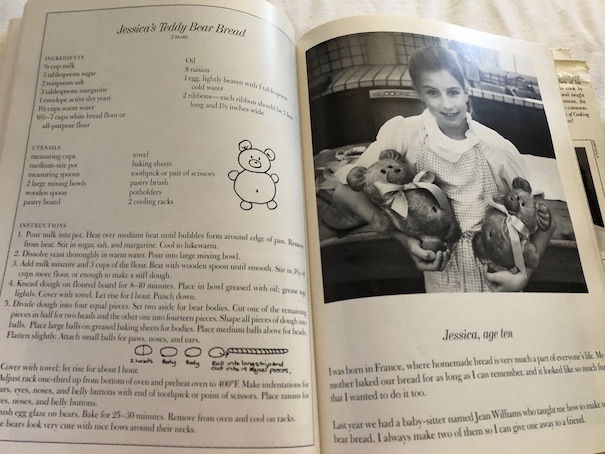
One of the cutest recipes is one for making loaves of bread shaped like teddy bears.

One of my favorite recipes was the one for pumpkin pie. I’ve made pumpkin pie from a whole pumpkin like this before, and it’s a lot of work, but it’s fun! The girl making the pie also roasts the pumpkin seeds.

The book is available to borrow and read for free online through Internet Archive.

Kids Cooking

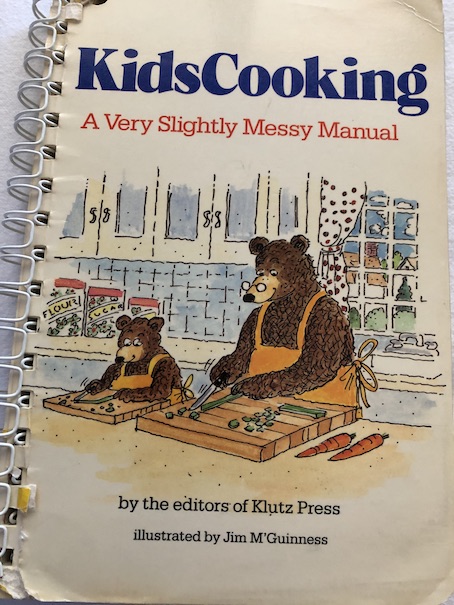
Kids Cooking: A Very Slightly Messy Manual by the editors of Klutz Press, 1987.

This book is part of the classic children’s hobby and activity series from Klutz Press. Originally, this book came with a set of plastic measuring spoons, which was attached to the book at the hole in the upper left corner.

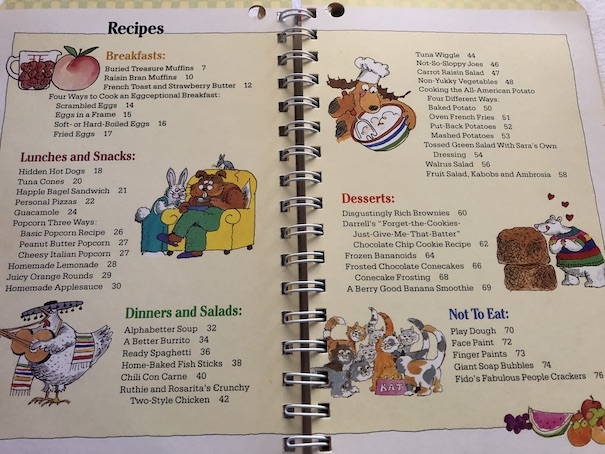
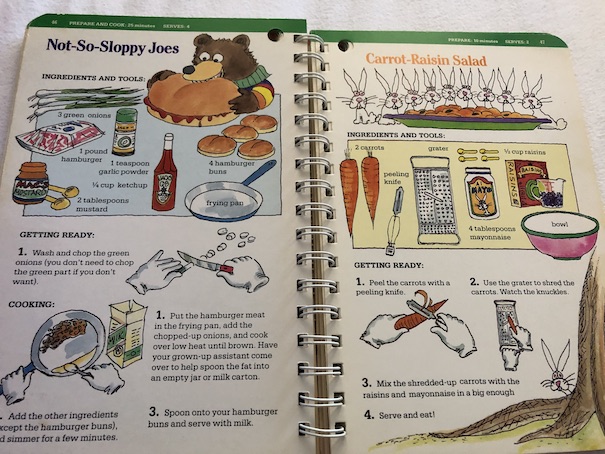
The recipes in the cookbook are listed in categories by the type of meal: breakfasts, lunches and snacks, dinners and salads, and desserts. There is also a section of recipes for non-edible things, like play dough and finger paint.

The food recipes are fairly simple, but not the overly-simple, boring recipes that I’ve seen in some children’s books, like how to make a peanut butter sandwich.

Kids can make these recipes, but they’re not for little kids who are still at the level of learning to make their own basic sandwiches. They do involve things like using stoves and ovens and chopping ingredients with a sharp knife. It’s common in the book to include “grown-up assistant with knife” under the list of ingredients and tools needed for recipes.

Some of the recipes in the book include multiple ways to cook something, variations on popular foods or different ways of seasoning a dish. For example, the breakfast section explains different ways to cook eggs, including scrambled eggs, fried eggs, soft or hard boiled eggs, and eggs in a frame.

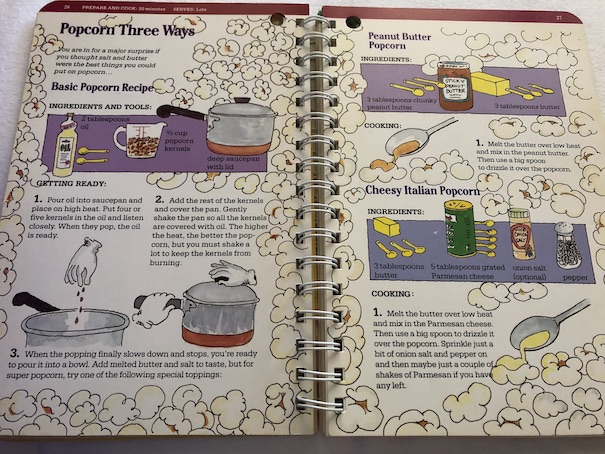
There are different ways of cooking potatoes in the dinner section, and I also like the popcorn variations in the snack section, which include different ways to flavor popcorn with cheese or peanut butter.

The dessert section includes brownies (“Disgustingly Rich”), chocolate chip cookies, and some more unusual desserts, like frozen bananoids, which are pieces of banana covered in chocolate and frozen.

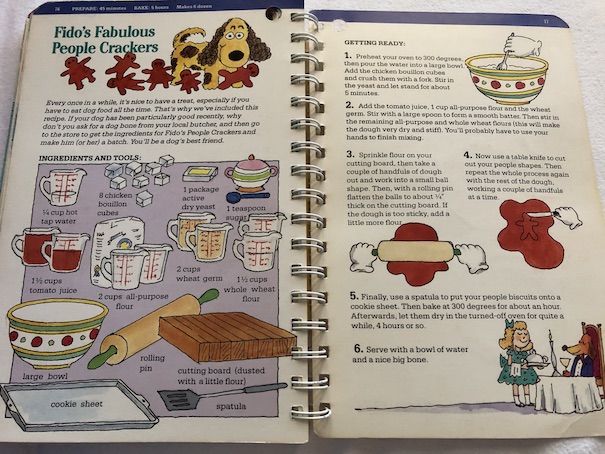
The section of non-edible recipes also includes a recipe for dog biscuits, Fido’s Fabulous People Crackers. They’re edible for dogs, just not something people would enjoy.

The book is available to borrow and read for free online through Internet Archive.

The Secret of the Indian

The Secret of the Indian by Lynne Reid Banks, 1989.

This is the third book in the Indian in the Cupboard series.

This book immediately picks up where the last book in the series left off, with Omri injured after witnessing the battle in Little Bear’s time and he and Patrick and their small army having just fended off the gang of local hoodlums who had tried to break into Omri’s house and rob it. Omri’s parents return home from the party they had attended and are appalled to see Omri hurt, although the story of the burglary covers up the real reason for Omri’s injuries, which the boys don’t think they can tell Omri’s parents. Omri still can’t adequately explain how part of his head got burned, but he makes up a story about him and Patrick trying to light a bonfire and accidentally getting burned. His parents are occupied, alternately angry with the babysitter who was supposed to come and didn’t and with themselves for leaving before they were sure that she had arrived. The police come to question the boys and inform the parents that the reason why the babysitter didn’t come was that she was mugged that night. Omri knows who the thieves are, but hesitates to turn them in.

First, Omri needs to deal with Little Bear and his band of warriors. Some of them were killed in the battle, and others are injured. Patrick and Omri bring the Matron who treated Little Bear before to life to help them, but although she does her best, she says that her skills aren’t adequate to help them all and that they need a real surgeon. The Matron is sharp and tells the boys that it’s useless to insist that this is all just a dream because she knows that, strange as this situation is, it’s all real and that the death and pain she’s witnessed around her are real. The boys explain to her about the key and cupboard that bring plastic figures to life, and she asks them if they can get a doctor. It’s Sunday, so the boys can’t just go buy one, but the Matron came from a set owned by Patrick’s cousin, Tamsin, and there were other medical professional figures in it. When Patrick’s other cousin, Tamsin’s twin, Emma, comes to Omri’s house to see Patrick, Omri is forced to let her in on the secret and recruit her to help him.

Meanwhile, Patrick has gone back in time with Boone the cowboy. In Boone’s time, Patrick is tiny, the size of the figures in his own time. Unfortunately, Patrick made a terrible mistake by going back to Boone’s time with Boone as a plastic figure. That meant that Boone became a real person in the chest, trapped under Patrick’s body and almost smothered to death and needs to be treated by the Matron in order to survive.

In Boone’s time, tiny Patrick ends up in the company of Ruby Lou, a woman who likes Boone. Patrick knows that Boone is unconscious in the desert and helps Ruby Lou to find him. The doctor in their time doesn’t know what’s wrong with Boone and can’t figure out why he’s unconscious, suggesting only that they let him rest for the present and recover. Ruby Lou presses Patrick for answers, and he explains everything to her about how they travel through time using the magic key and how Boone has just left his full-size body behind to go into the future in the form of a little figurine. It’s an incredible story, but Ruby Lou believes him and expresses concern about getting Boone back safely. But soon, they’re all in trouble when there’s cyclone threatening.

Also meanwhile, Mr. Johnson, the headmaster of Omri’s school, has learned about Omri’s story that won the contest. Back in the first book of this series, Mr. Johnson actually saw Little Bear. At the time, he thought that he was hallucinating, but Omri’s supposedly fictional story has now convinced him that he really saw what he saw. He demands that Omri tell him the truth about his “Red Indian.” (Omri corrects him, saying that it isn’t right to say “Red Indian” and that they prefer to be called “American Indian” or “native American”, but Mr. Johnson angrily insists that he’s always said “Red Indian” and will continue to do so, establishing him as an unsympathetic villain in the story.) Mr. Johnson is relieved to know that he wasn’t hallucinating before, but since Omri is reluctant to explain anything, he decides to call Omri’s mother. When she answers, she demands that Omri tell her where Patrick is because his mother is frantically looking for him.

Of course, Omri knows that Patrick is still in the trunk in his room, in a coma-like state because he’s still in the past and there are living miniature people in his room who will also be discovered if people start searching. Can Omri fix everything in time to rescue Patrick and his little friends and prevent their secret from being exposed?

The book is available to borrow and read for free online through Internet Archive (multiple copies).

My Reaction

Although the story takes place immediately after the previous one left off, the rules of the magic in this world have changed a little. Before, when a person from Omri and Patrick’s time went back to the past, they kind of became part of the scenery. This time, when Patrick visits the Old West, he is there as a tiny person, although no figurines of the boys exist in the past. What this book does emphasize is that the magic key does change real people from modern times into little people into people in another time and real people from other times into tiny people in modern times. At this point in the series, it’s all still mysterious why the key is magic and why the little cupboard in particular only seems to affect plastic items and people. Some of those explanations come in the next book.

I did like the parts where other people, including Patrick’s cousin Emma and Mr. Johnson in the present and Ruby Lou in the past, catch on what’s happening with Omri and Patrick and their plastic figures. In so many children’s books, the magic absolutely depends on secrecy. In this series, Patrick and Omri both know that they don’t want most people to know their secret because they don’t want people either interfering or thinking that they’re crazy. With Patrick disappearing mysteriously and other things happening because of their interactions with the little people from the past, it makes sense that people would start noticing that the boys have become involved in something really strange, even thought some of them don’t know what it is. However, the magic still works for them even when other people find out and the people who could pose a threat to their activities either never find out the truth or are distracted or apparently discredited.

At the end of this book, Omri becomes more serious about the risks of the cupboard and decides that he wants the key put away, to be give to his future children in the event of his death. However, there are other books in this series to come, so they do use the key again.

The Return of the Indian

The Return of the Indian by Lynne Reid Banks, 1986.

This is the second book in the Indian in the Cupboard series.

Omri’s family has moved to a new house, but Omri doesn’t like it. The new house is bigger than the old one, but the neighborhood around it is a bit run-down and shabby. Most of the kids in the area go to the state school (public school in the US), but Omri attends a private school, and his school uniform makes him stand out from the other kids. The other kids in the neighborhood view him as an outsider and like to push him around, especially the group of bigger boys who like to hang out near the arcade. Omri is a little afraid of the local bullies, but he doesn’t like to show it. Instead, he remembers how brave his small American Indian friend, the one who came to life from his plastic figurine, was with him, even though Omri was many times bigger than he was. Still, Little Bear was a real warrior, who knew how to fight. Ormi wishes that he could fight like an American Indian or maybe a cowboy, like Boone. If he could do that, he wouldn’t have any reason to fear the local bullies.

Patrick, Omri’s best friend, is also living in a new house in the country and is now going to a different school because his parents have divorced. (The story indicates that Patrick’s father was abusive, hitting his wife and children.) When the two of them meet again, Patrick denies remembering their plastic figures that came to life. That bothers Omri, although he thinks that Patrick really does remember but doesn’t want to admit it because talking about things like that would make him seem weird when he’s trying to fit in with his new home.

Then, Omri wins a writing contest for a story that he wrote about his plastic Indian. He’s thrilled, although he also feels a little guilty because the contest was supposed to be for fiction, and his magical adventures with Little Bear were real. Although, his story is his own work, even if he didn’t exactly make up Little Bear.

Ever since his adventures with Little Bear the previous year, Omri has asked his mother to keep the key to the cupboard “safe” for him. Really, he has wanted to remove the temptation to bring Little Bear to life again. After their previous adventures, they had all decided that it would be better for Little Bear and Boone to remain in their own lives in the past. Yet, having won this contest, Omri has the sudden desire to see Little Bear again and tell him all about it. His mother usually wears the key as a pendant around her neck, and one day, when she takes it off, Omri decides that he’s going to use it.

However, when he brings Little Bear and his wife, Bright Stars, back to life from plastic, he finds that time has moved forward for Little Bear, just has it has for him. Little Bear is badly injured, having been shot by a soldier. Bright Stars begs Omri for help. Since Omri once brought a WWI medic to life to help with a wound before, he tries it again. Unfortunately, this time, all Omri gets is an empty pile of the medic’s clothes. Shocked, Omri realizes that this is a sign that the medic was killed in action. Time moved forward for him since their last encounter, and the medic, Tommy, who was a real person in the past, was killed during the war.

Still desperate to help Little Bear, Omri rushes to see Patrick at his aunt’s house and explains the situation. At first Patrick tries to pretend that the figures coming to life was just their imaginations, but when Omri impresses on him that Little Bear is in trouble and needs help, Patrick takes him seriously and comes up with a solution. One of his cousins got a set of plastic figures for her birthday, and they all have different professions. Among them, there is a nurse and two doctors. If they borrow one of those figures, they will have medical help. The cousin finds them messing with her toys and fights with them, so they have to rush off in a hurry, taking the nurse figure instead of one of the doctors, but she’s better than nothing.

After the nurse, known only as Matron, gets over the shock of finding herself very small, Omri explains Little Bear’s condition to her. She’s reluctant to try to operate on him herself because she’s not a surgeon, but since there is no one else to help, she does so anyway. Omri gives her Tommy’s medical bag so she’ll have the implements she needs. She manages to help Little Bear, and Little Bear recovers.

Although Patrick says that his mother got rid of most of his plastic figures when he stopped playing with them, he still has the cowboy, Boone, because he was special. Patrick uses the cupboard to bring him back to life, and they explain to him about Little Bear. When Little Bear is well enough to talk, he explains that his village was attacked by French soldiers, and many of his people are dead. Boone spots Omri’s collection of plastic figures, with soldiers from different periods and suggests sending them back with Little Bear to fight the French. Patrick is all for it, but Omri points out that there are problems with that. All of those figures aren’t just toy soldiers; they represent real people from history. They all come from different periods of history, and they all have their own goals and personalities. They would all be shocked at finding themselves in an unexpected place and a completely different time period than their own, and there’s no telling how these armed people might react. What would a Medieval knight, who might be on his way to the Crusades, understand about American Indians from the 18th century, and why would he be willing to fight on their behalf? Which side would a member of the French Legion pick? They wouldn’t be able to even speak to all of Omri soldiers because they come from different countries and speak different languages, and even if they choose modern British soldiers using modern weaponry, what would that mean for history? They don’t belong in the 18th century, and because they’re real people, they would be killing other real people and might get killed themselves.

Patrick thinks that Omri thinks too much, but Ormi knows that Patrick is too impulsive. Patrick does impulsively bring some modern soldiers to life, and they almost shoot everyone because they’re in the middle of a battle. Patrick quickly turns them back to toys and apologizes. Then Omri has another idea: they can’t explain to people from other time periods that Little Bear needs their help to fight in the French and Indian Wars, but they could appeal to other American Indians. Finding allies for Little Bear is fine, as long as they’re the kind of allies who could reasonably appear in Little Bear’s time and understand and be willing to aid him.

There are complications in this plan when Little Bear says that he wants modern weapons his people can use and a modern soldier to teach them how to use them. Omri has misgivings about this but gives in to Little Bear’s request. While Little Bear goes back to his time with his new allies and weapons, the boys worry about what’s happening in the battle and Bright Stars, who is still in their care, gives birth to Little Bear’s son. Boone suggests to Omri that, if he’s concerned about how the battle is going, there might be a way to go back in time and see it.

Ormi has an old wooden chest in his room, and Boone suggests that he could see if the key fits the box and use it to send himself back to Little Bear’s time. Not only does Omri help Little Bear and the others, but this odd army also helps Omri when the local bullies try to rob his house in the middle of the night.

The book is available to borrow and read for free online through Internet Archive (multiple copies).

My Reaction:

I read the first book in this series when I was in elementary school as part of a class assignment. There are parts of this series I like, but parts I don’t.

I like the way Omri thinks about the little people from his cupboard. He remembers that all of the plastic figures are only plastic when they’re toys, but as soon as they come to life, they are real people, pulled out of their own lives and into his, and they have a responsibility to them. He feels terrible when he realizes that his old friend, the WWI medic called Tommy, died during the war because he wasn’t just a toy, he was a real person who helped them when they needed him, and Omri realizes that he probably died not long after they returned him to his own time. Patrick is less thoughtful, but he does wonder if their interaction with him played a part in his death, and Omri thinks it probably didn’t because his full-sized body must have remained in the past and would have died anyway. When they last talked to him, Tommy said that he’d heard the sounds of an attack, and that could have been the attack that killed him. When Omri sends Little Bear back with his new allies and weapons, Omri feels guilty because he realizes that he’s basically playing God, sending real people to kill other real people in past, but he goes through with it because he feels committed to it at that point, having assembled and armed this fighting force and promised it to Little Bear.

I didn’t like some of the stereotypical stuff about cowboys and American Indians. This is one of those books where they try to write characters speaking with an accent, and that always feels awkward to read, and I’m not sure that everything Omri says about American Indians is true. At first, Omri says that American Indians gave birth alone, so he’s not too worried about Bright Stars. When I read that, I wasn’t sure if any American Indian tribes had that as a custom, so I looked it up. Apparently, there is some basis for that happening, although sometimes women would also help each other, and since most of the white people who said that Native Americans gave birth alone were men and wouldn’t have been involved in assisting the birth anyway, they may not have been fully aware of who else would have been involved. When Bright Stars starts giving birth, Omri remembers hearing that, when women give birth for the first time, it can take a long time for the baby to arrive, and he wonders if that’s true of American Indians as well as white women. That question made me cringe a little. As an adult white woman, I would assume it probably is because there many aspects of the human condition that are just universal, but again, Omri’s a boy who doesn’t have any relevant life experience experience, and even I can’t swear what Native American births are like, so I suppose I can’t fault him for wondering.

This is the book that establishes that the key used with the cupboard is magic by itself. It seems to fit in any lock and can send people back in time. When they’re sent back from the present day, Omri observes that the person sent to the past is cold and motionless in the chest, which scares him. Also, the boys observe that when they go to the past, they seem to be part of the scenery, part of the paintings on the side of Little Bear’s teepee, unable to speech or move by themselves, just watching what happens. It’s odd, but in stories where there’s magic, there are still rules, and as the boys experiment more with the key, part of the rules start becoming more clear to the readers.

The Indian in the Cupboard

The Indian in the Cupboard by Lynne Reid Banks, 1980.

Omri thinks that he’s starting to get tired of collecting and playing with plastic figures when his friend Patrick gives him a plastic American Indian figure that he doesn’t want anymore for his birthday. At first, Omri doesn’t think much of the Indian figure because it’s just a used plastic figure that doesn’t match any other figure sets he has, so he’s not sure how he can use it in his games. Then, his brother Gillon gives Omri a wooden cupboard that he rescued from an alley. Omri likes the cupboard, and his mother lets him have an old key that happens to fit the cupboard so he can lock it. His mother says that the key used to belong to her grandmother’s jewelry box, which fell apart years ago. As Omri tries to decide what he wants to keep in the cupboard, his mother suggests putting his American Indian figure in it because she found it in the pocket of his other pants. Omri puts the toy in the cupboard and locks it. Later, he hears sounds coming from the cupboard, and when he opens it, he discovers that his toy Indian figure has come to life!

Omri is startled to see that the Indian has come to life, and the tiny Indian is afraid of him. The Indian pricks him with his tiny knife and threatens to hurt him if he comes closer. The Indian insists that he’s not small, it’s Omri who is big. When Omri’s mother comes into the room, Omri quickly shuts and locks the cupboard so his mother won’t see that his toy has come to life. Later, when he opens the cupboard again, the Indian is just a plastic toy again. Omri is sure that he didn’t imagine the figure coming to life, but he’s not sure why that happened or why it’s just a toy again now.

Then, that night, after Omri locks the Indian in the cupboard again, he comes to life once more. This time, when Omri opens the cupboard and talks to the Indian, he asks the Indian what happened. The Indian replies that nothing happened, he just went to sleep. Then, he asks Omri for food and a blanket. Omri asks the Indian more about himself and learns that the Indian is named Little Bear and is the son of an Iroquois chief. He offers Little Bear a plastic teepee from his collection of toys to sleep in, but Little Bear recognizes that it’s not a real teepee and besides, Iroquois sleep in longhouses, not teepees. Omri can’t provide a longhouse, so he makes a better-looking teepee out of sticks and a piece of felt, so it’s at least not plastic. Little Bear accepts it.

Omri begins to realize that either his new cupboard or the key that he’s been using with it or both are magical and can bring toy figures to life. He begins doing experiments to see how it works and what else he can make real. The plastic teepee becomes a real one after being locked in the cupboard, but a metal toy car doesn’t change at all, making Omri realize that, for some reason, the cupboard only works with plastic toys.

Omri tells Little Bear that he’s in England now, not America, and Omri discovers that Little Bear approves of the English because the Iroquois fought with the English against the French and the Algonquins. Omri asks Little Bear if he also fought, and Little Bear brags about what a fighter he is and how many scalps he’s taken, but adds that they were French and not English. It sounds kind of stereotypical, but the author is referring to real battles that took place during the 17th century and 18th century around the Great Lakes area, during the French and Iroquois Wars and the French and Indian War, giving Little Bear a rough time period and location. This is meaningful not only for historical reasons, but also because it indicates that Little Bear isn’t just a toy with no personality or history. As far as Little Bear is concerned, he’s a real person with a past and memories and a life beyond being Omri’s toy. In fact, he doesn’t really know anything about being a toy sometimes in Omri’s time period. Omri also realizes that Little Bear’s history makes him a real person, somehow pulled more than 200 years into the future in miniature form, instead of just a toy brought to life.

Still, Omri delights in having adventures with Little Bear, introducing him to things Little Bear otherwise wouldn’t have. When Little Bear says that he’s never hidden a horse before because the Iroquois don’t have them in his time, Omri brings one of his plastic horses to life so Little Bear can ride. When Little Bear gets hurt, Omri brings a WWI medic from his set of toy soldiers to life so he can treat the wound. The medic, Tommy Atkins, is alarmed when he sees Omri and confused when he’s asked to treat an American Indian, but he does so anyway, deciding that it’s all just a dream. Omri lets him think so and then puts him back in the cupboard to send him home.

Omri does some research about Iroquois to learn more about Little Bear and his history. Patrick wonders about Omri’s obsession with the little toy figure he gave him, but Omri is reluctant to tell him. Then, when Omri buys another Indian figure, an old Indian chief, and brings it to life, the poor old man goes into shock at the site of Omri and dies. Omri feels terrible about causing the old man’s death, coming to recognize that the old man was also a real person, sometime and somewhere, and he wouldn’t have died if Omri hadn’t put him in the cupboard and brought him into his time as a miniature person. Then, Patrick gives Omri a plastic cowboy figure. Omri doesn’t want it because he doesn’t want the cowboy to come to life and hurt or kill Little Bear. Patrick is impatient, saying that’s how the game of cowboys and Indians goes and that’s what people do with figurines of cowboys and Indians, have them fight. That’s when Omri realizes that he needs to explain to Patrick that it’s more than just a game and there are real people involved.

Patrick is stunned when Omri shows him Little Bear, and when Omri tells him about the dead chief, he comes to realize that this game is serious. In spite of that, Patrick asks Omri to let him bring just one figure to life. At first, Omri tries to prevent Patrick from bringing another figure to life because the situation is already complicated enough, but Patrick does so anyway when Omri leaves him alone in his room … and the figure that Patrick picks is the cowboy.

Having an American Indian and a cowboy both in Omri’s room, even in miniature form is just as much trouble as Omri feared it would be. The two of them pose a very real threat to each other, and Omri tries to do his best to help them get along with each other. To make things more complicated, Little Bear says that he wants a wife, and the boys take him to the store to pick out a female American Indian from the plastic figures. The school principal sees the figures, but fortunately, decides that he’s just unwell and hallucinating. Meanwhile, Omri has to impress on Patrick that their little people are actually people and not toys simply to be played with. Of course, there’s only one way to ensure that their new little friends will be able to safely continue their lives: send them home!

Personally, I would have ended the game and sent Little Bear home as soon as I realized that he could die, like the chief in the story, but the boys keep their miniature living people for much longer. In fact, this is the first book in a series, and the boys have further adventures with Little Bear, Boone the cowboy, and other figures/people.

This book was commonly used in schools when I was a kid, and it might still be. When I was a kid, my teacher didn’t go into detail about Little Bear’s time period or explain about the context of his life and the conflicts with the French and Algonquin that he described. Now, as an adult, I have more context for understanding what he’s talking about. I also appreciate the author of the book pointing out that different types of Native Americans lived in different types of homes in the past, something that Omri didn’t understand at first, and I liked that Omri started doing his own research to better understand the Iroquois. The book never gives an exact date to Boone the cowboy or Little Bear’s time periods, but by context, Boone has to be more than 100 years younger than Little Bear, from sometime in the late 19th century. I appreciate having some historical details added to a fantasy story about toys coming to life, but the book isn’t very specific, focusing more on the complications involved in keeping miniature people from the past alive and secret in Omri’s bedroom.

There is also a movie version of this book. The book is available to borrow and read for free online through Internet Archive.

Mystery of the Melted Diamonds

Mystery of the Melted Diamonds by Carol Farley, 1986.

This is the last book in the Kipper and Larry mystery series.

This time, Larry has come to visit Kipper and his family on their farm in Kansas while his father attends a police convention in Florida and will be spending Christmas with them. At first, Kipper thinks that Larry probably regrets this visit because Kansas isn’t very exciting, and it’s snowing while Larry’s father is in sunny Florida.

The situation gets worse when Kipper gets into a fight with his friend Scooter when Larry and Kipper were supposed to be spending the night at Scooter’s house. Scooter apparently cheated at a game, and Kipper got so mad that he said that he and Larry would just go home. The problem is that the boys have to walk a couple of miles to reach the farm where Kipper’s family lives, and the snow has turned into a blizzard.

The boys start to get scared that they might freeze to death when Larry spots a light from a house nearby and heads toward it. Kipper thinks that it’s a dangerous mistake because the house with the light is the old Morgansterne house, and it’s been empty for years. However, when the boys reach the house, there are oil lanterns burning in the windows and a fire in a wood-burning stove. Out of desperation, the boys let themselves into the house to warm up, but then they start to wonder who lit the fire and the lanterns. They search the house to see if there’s anyone there, but they don’t find anyone. The only thing they find upstairs is an old box of Christmas ornaments.

The boys spend the rest of the night in the house without seeing anyone and continue to the farm in the morning. When they explain to Kipper’s mother what happened and where they spent the night, she’s concerned, both because the boys were out in the snowstorm and because nobody should be in the old Morgansterne house. Old Miss Morgansterne, who owns the house, has been living in a retirement home, and no one else is supposed to be there. Kipper’s mother decides to call the sheriff and have him look into it.

The sheriff comes and questions the boys about what they saw in the house, and they ask him about a robbery at a jewelry store in town that the family heard about on the radio while waiting for him to arrive. Larry wonders if there’s a connection between the robbery and the supposedly empty house that seemed to be occupied by someone before they arrived. The sheriff doesn’t see why there would be a connection between the two events, but Kipper’s younger brothers think that maybe the robbers were in the house the whole time, hiding in some kind of secret passageway, like in books and movies. The sheriff thinks that the boys have overactive imaginations.

However, there is more to the theory that the house and the robbery are connected than the sheriff thinks. Soon, the sheriff is alerted that the car that is believed to belong to the robbers has crashed into a pond near a dangerous curve in the road and the two men inside the car are dead. When they search the car, they find some of the jewelry from the robbery, the less expensive costume jewelry, so it seems that they were correct that these men were the robbers, but strangely, the most expensive jewels from the robbery, diamonds, are still missing. The sheriff says that it’s almost like they melted away, like the diamond-like snow that Larry commented on earlier.

It makes sense to the boys that the robbers were in the Morgansterne house before they were. They remember seeing a car like the robbers’ car along that road before the snow storm got bad, and it would explain why the house was empty all that night. The robbers accidentally saved the boys’ lives by lighting the stove in the house for them, but they never returned to their hideout in the empty house because they had their car accident. But, somewhere along the way, the diamonds they stole seem to have vanished. Can the boys figure out how?

The book is available to borrow and read for free online through Internet Archive.

My Reaction

Overall, I liked the story. I had more than one theory about where the diamonds were, and one of them turned out to be correct, but there was enough doubt in my mind to keep the story interesting until the end.

The Berenstain Bears Trick or Treat

The Berenstain Bears

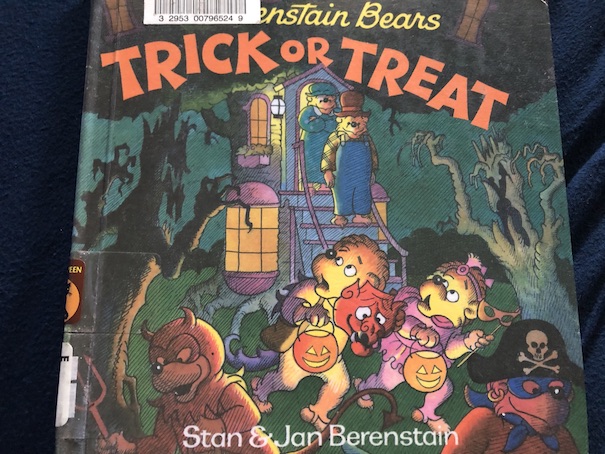
The Berenstain Bears Trick or Treat by Stan and Jan Berenstain, 1989.

“Even little bears
expect a good fright
when they go out for treats
on Halloween night.”

Brother and Sister Bear are looking forward to trick-or-treating on Halloween night with their friends. Sister is going as a ballerina, and Brother is dressed as a monster. When Brother jumps out at Mama in his monster costume, she pretends to be frightened, and when he takes off his mask, Mama comments that “appearances can be deceiving.” Sister asks what that means, and Mama explains that “things aren’t always what they look like.”

This is the first year that Brother and Sister will be allowed to go out trick-or-treating without their parents. They plan to trick-or-treat with friends, and they talk about the houses that they plan to visit. The one house in the neighborhood that they don’t want to visit belongs to Miz McGrizz. Miz McGrizz’s house looks spooky, and the kids think that she might be a witch. Mama tells them that’s nonsense and that Miz McGrizz is a nice person.

As the young bears set out to trick-or-treat with their friends, some of the bigger, tougher cubs in the neighborhood try to talk them into joining them in some pranks. First, they want to decorate Miz McGrizz’s house with toilet paper.

However, before the cubs can do anything, Miz McGrizz comes out of her house, and seeing the cubs, tells them that she’s ready for them. Although the kids are frightened at first, it turns out that Mama really was correct about Miz McGrizz. Miz McGrizz is just a nice old lady who has a special treat for the cubs who are brave enough to visit her house.

In real life, trick-or-treaters shouldn’t go into the houses of people they visit unless they know them very well, but in this case, it’s not so bad because the cubs’ mother approves of Miz McGrizz and would be fine with the children visiting her.

The book is available to borrow and read for free online through Internet Archive (multiple copies).

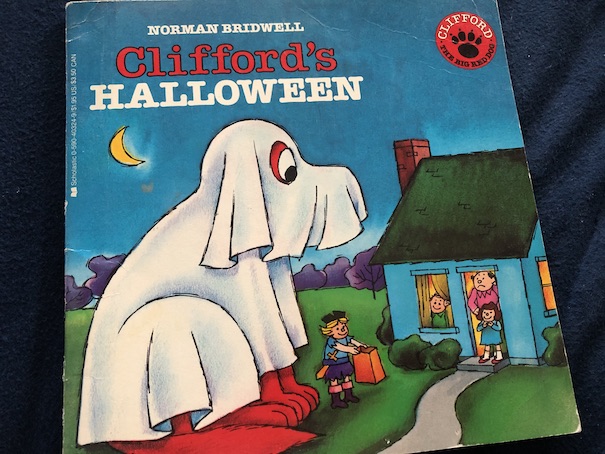
Clifford's Halloween

Clifford

Clifford’s Halloween by Norman Bridwell, 1986.

Halloween is Emily Elizabeth’s favorite holiday! Emily Elizabeth talks about the various holidays that she and Clifford enjoy, but Halloween is the one they enjoy the most.

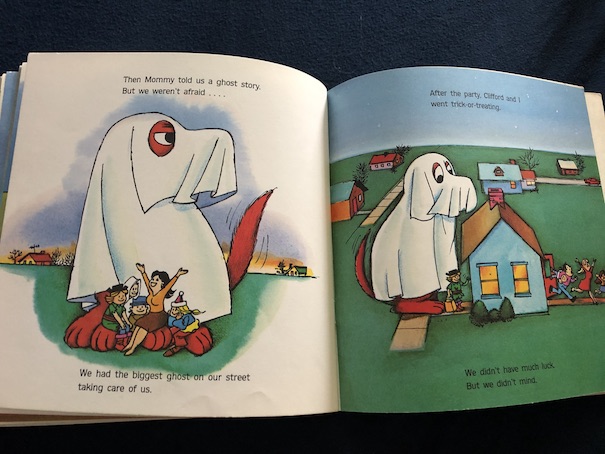
Last Halloween, she considered various costumes for Clifford, but Clifford decided that he wanted to be a ghost, covered with a giant sheet. (I love how they say that nobody could guess who the giant ghost is, like there could be someone else in the neighborhood that big.)

When you’ve got a giant dog, bobbing for apples doesn’t go the way you expect.

However, when you’ve got a giant dog, nothing else is very scary, either.

The book ends with Emily Elizabeth considering different costumes for Clifford for this Halloween, inviting the reader to think of other possible costumes.

I like the idea of letting kids consider which Halloween costumes they like the best from the ones that Emily Elizabeth considers. Kids like making choices, and trying to think of costumes that would work on a gigantic dog presents a creative challenge. When Emily considers dressing Clifford as a knight, they don’t consider where she’s going to get a suit of armor that size, but the books in this series don’t worry much about the logistics of caring for a dog the size of Clifford.

When I first read this book back in the 1980s (I was four years old when the book was new, although I can’t remember exactly how old I was when I first read it), I didn’t think too much about the Indian (Native American) costume with a pipe, although I wouldn’t think of suggesting that as a costume for anyone now. It’s partly because there’s something of a stigma against Native American costumes now. It’s not enough of a stigma to get people to stop wearing them and major costume retailers from selling them, but enough that some people raise eyebrows at them because of some of the connotations attached to them. If you read some of the reviews of Native American costumes on Amazon, like I did, it seems that more of them were purchased for school plays and projects or Thanksgiving plays than for Halloween. However, the part about this costume that particularly jumped out at me was the ceremonial pipe. Kids sometimes dressed as American Indians for Halloween when I was young, although the practice is discouraged now, but with all of the anti-smoking campaigns aimed at children when I was young, most of our parents wouldn’t have even considered giving us a peace pipe as part of a costume, even ignoring the social and cultural implications of that. I think that idea shows the age of the book’s creator. I grew up in the American Southwest, but I didn’t grow up on old western shows where peace pipes were a common feature. I didn’t see those shows until I was older, and by then, they looked pretty cheesy. I think that the book’s author was from the generation that was raised on those westerns and had nostalgic associations with them.

The book is available to borrow for free online through Internet Archive.

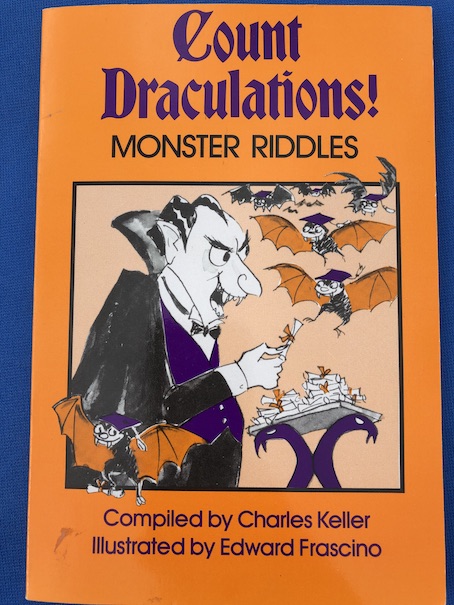
Count Draculations!: Monster Riddles

Count Draculations!: Monster Riddles compiled by Charles Keller, 1986.

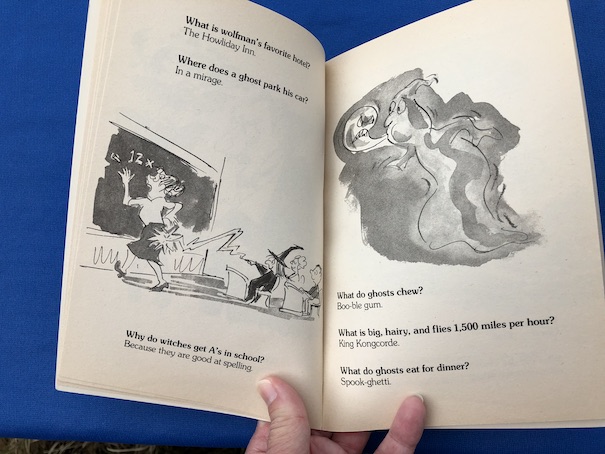
This is one of those themed joke books for kids that has monster and Halloween-themed jokes.  The jokes are the basic kid-friendly question-and-response type with lots of puns.  There are also some cute black-and-white illustrations.
Some of my favorite jokes:

Why do witches get A’s in school?

Because they are good at spelling.

How do you get into a locked cemetery?

With a skeleton key.

Why did Frankenstein’s monster go to the psychiatrist?

He thought he had a screw loose.

Why did the invisible man go crazy?

Out of sight, out of mind.