The Bear That Was Chicken

The Land of Pleasant Dreams
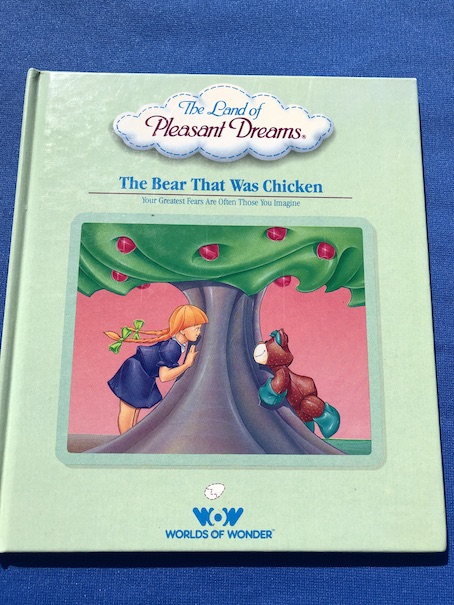
The Bear That Was Chicken by Ane Weber, Ron Krueger, Tony Salerno, 1986.

In her dream, Mary meets Threads the Bear.  When she meets him, he’s trying to sleep under a tree.  He’s sad and tells Mary that he thinks he’s a chicken and that all of his friends say so.  (It’s not a nice thing for friends to say, and I wish the story had said so.  There’s a song about it on the tape that accompanies the book with the words given in the book, but it bothers me because calling people “chicken” is something that I associate with people who are trying to goad people into doing things that they really shouldn’t do. I don’t think that it’s good to teach children to react to being called “chicken” or any other insulting names.)
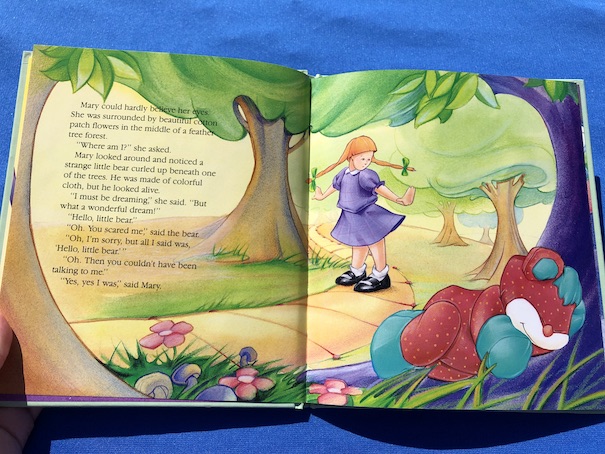
Mary thinks that Threads’ imagination is getting the better of him and that’s why he’s so afraid of so many things.  However, Threads tells Mary something that isn’t imaginary: there are some strange eggs in his cave that appeared there suddenly and mysteriously.  That’s why he’s sleeping in the forest, because he doesn’t know where the eggs came from or what they are.  Mary bravely offers to go with him to have a look at the eggs.

When they go to look at the eggs, Mary thinks that they look pretty harmless.  They’re kind of cute and colored like Easter eggs.  Threads is still worried about them and what they might hatch into.  Mary says again that Threads is imagining the worst and volunteers to sit with Threads while he takes his nap and keep an eye on the eggs to see what happens.
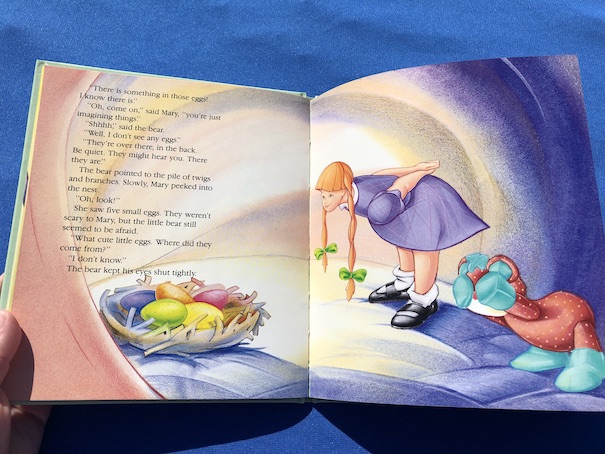
The eggs do hatch, and it turns out that they contain tiny teddy bears, very much like Threads.  When Threads sees the little bears, he loves them and thinks that they’re adorable.  The little bears seem worried when Threads wants to take them outside to play, but Threads encourages them, telling them that there’s nothing to be afraid of.
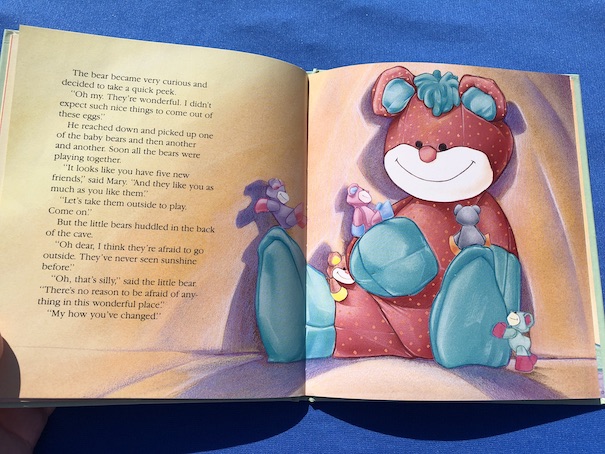
Moral: Your Greatest Fears Are Often Those You Imagine.

The main message of the story is that it’s better to face your fears than imagine the worst. However, I found some of this story a little confusing as a kid, and some of the implications are a little alarming when you begin to analyze it.  Where did those little bear eggs come from?  Did Threads lay them himself in his sleep? Are those little bears his children?  Did Threads lay eggs because he was a “chicken”?  But, Threads is a boy bear!  Then again, this is supposed to be a dream, so I guess it doesn’t really have to make sense.

I still don’t like that the story uses “chicken” as an insult and in a way that implies that people who are called “chicken” should try to prove that they’re not. This just seems like a recipe for disaster, encouraging children to accept dares.

The book is available to borrow and read for free online through Internet Archive. This book is currently available online through Internet Archive. It was made into an episode for the tv show version of this series with puppets.

A Fence Too High

The Land of Pleasant Dreams

A Fence Too High by Jeanine Bartelt, Jeff Parker, and Tony Salerno, 1986.

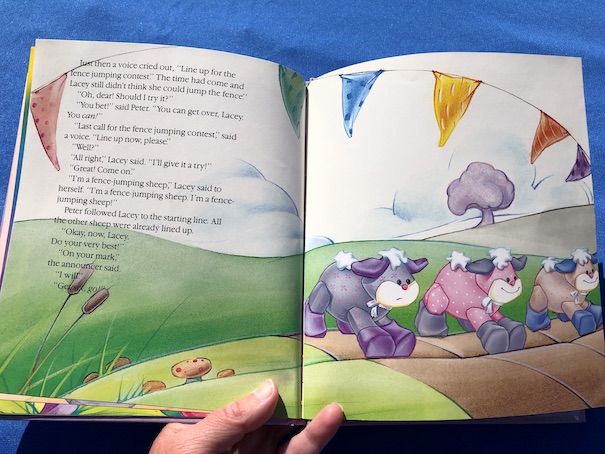
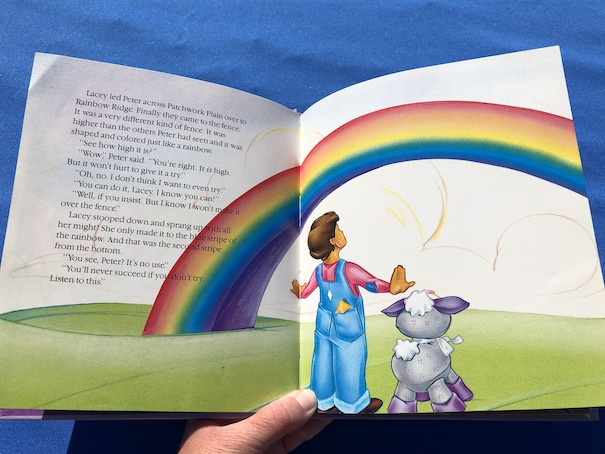
Peter falls asleep while counting sheet jumping over the fence and meets Lacey the Lamb in his dream. Lacey the Lamb is sad and worried because, even though she’s growing up to be a fence-jumping sheep, there is one fence that she just can’t get over. Peter offers to take a look at the fence with her and see if he can help. When he does, it turns out to be a giant rainbow.

It’s important that Lacey make it over this fence because she is taking part in a fence-jumping contest in less than an hour. Lacey doesn’t think that she can learn to jump this fence in so little time. However, Peter encourages Lacey to try again.

After a few more tries in which she hits the blue stripe on the rainbow and then the yellow stripe and then the orange stripe, Lacey is ready to give up. She thinks that it’s hopeless. Peter points out that it isn’t hopeless because each time that Lacey has tried, she has improved, gradually hitting higher and higher marks on the rainbow. He doesn’t think that Lacey should give up so easily.

Even though she’s still feeling very unsure of herself, she decides to participate in the contest. This time, Lacey does make it over the fence, and she feels much better about herself because of her success. She thanks Peter for giving her the encouragement to try one more time.

Moral: If At First You Don’t Succeed, Try, Try Again.

It’s a nice story about the importance of making an effort, trying again, and not giving up just because there are obstacles and challenges. Life has many challenges, and just because something is difficult doesn’t mean that it’s impossible or not worth doing. People don’t need to be perfect; it’s enough to be willing to improve.

This book was made into an episode for the tv show version of the series with puppets.
Is It Soup Yet?

The Land of Pleasant Dreams

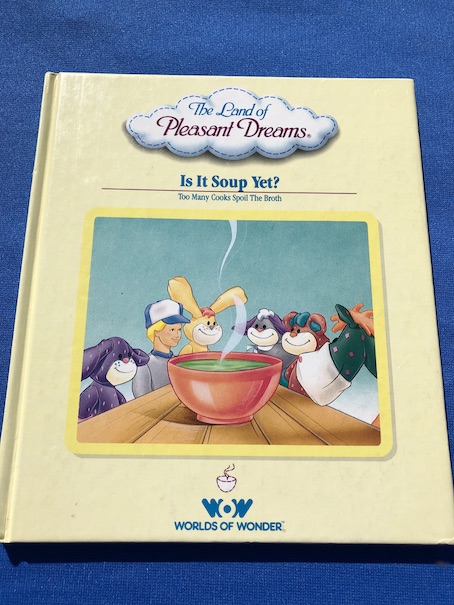
Is It Soup Yet? By Ane Weber, Ron Krueger, and Tony Salerno, 1986.

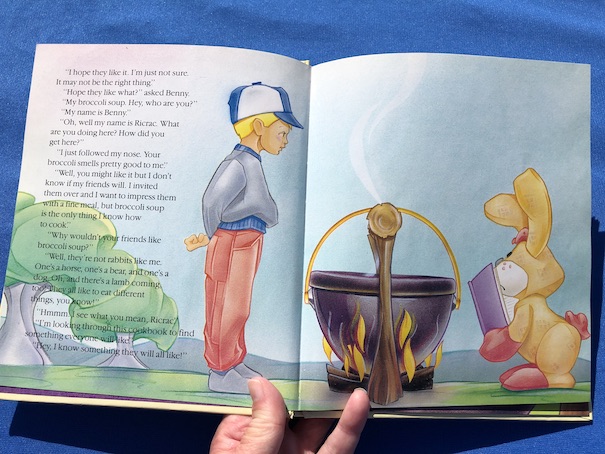
When Benny enters the Land of Pleasant Dreams, he meets Ricrac Rabbit.  Ricrac is trying to cook something for his friends, but he’s worried because the only thing he knows how to make is broccoli soup, and he doesn’t know if his friends will like it because they all have different tastes.

Because Benny’s father is a chef, he suggests that Ricrac try his recipe for black bean broth because everyone loves that when his father makes it.  Ricrac decides to give it a try, adding the black beans to his broccoli soup. 

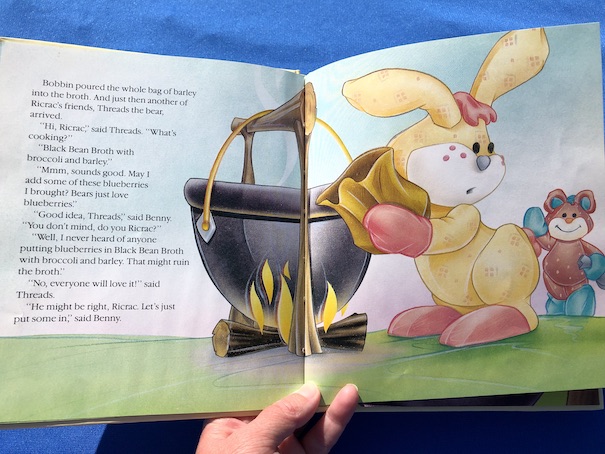
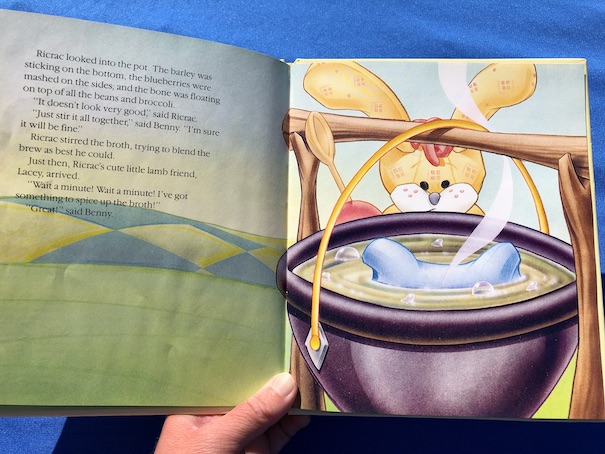
However, as each of Ricrac’s friends arrive, they also decide to bring their favorite ingredients with them.  Bobbin the Horse brings barley, and Threads the Bear brings blueberries.  Then, Snips the Dog brings a bone, and Lacey the Lamb brings buttercups.  In an effort to please everyone, Ricrac adds each ingredient to the soup.

When they finally try it, the soup is horrible.  At first, everyone argues about which ingredient ruined the soup, but Benny realizes that their real mistake wasn’t trying the soup according to Ricrac’s original recipe.  When they try the broccoli soup as it was supposed to be made, without the extra ingredients, it’s really good.

Moral: Too Many Cooks Spoil the Broth.

The point of the story is that trying to please everyone often means pleasing no one.  When planning a project, if you try to stretch it in too many different directions, it’s difficult to accomplish anything because you’re not focusing on anything in particular. In the end, you have to pick one way and stick with it, focusing on what you can do best.

The book is available to borrow and read for free online through Internet Archive. This book was made into an episode for the tv series with puppets. Sometimes, you can find it or clips of it on YouTube.

Can’t You Sleep, Little Bear?

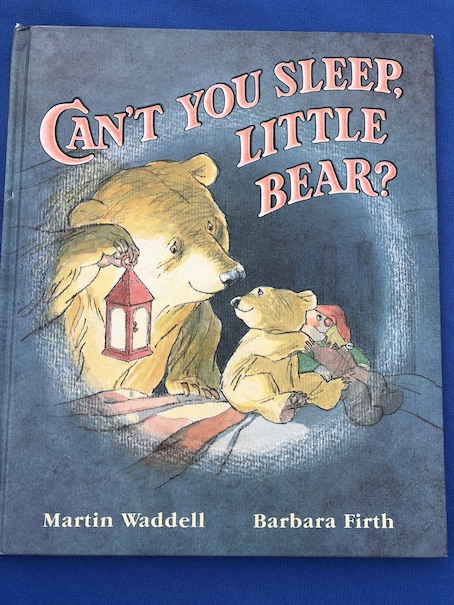
Can’t You Sleep, Little Bear? By Martin Waddell and Barbara Firth, 1988.

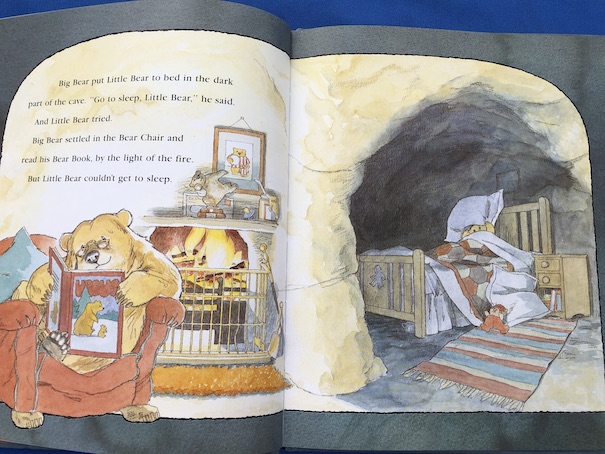
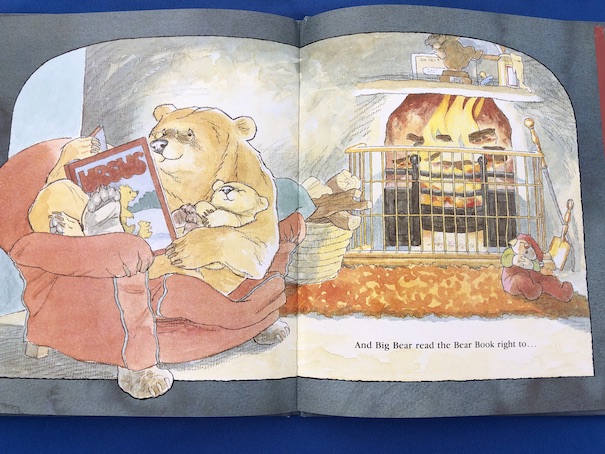
Big Bear and Little Bear live in their Bear Cave.  (Big Bear is apparently the father of Little Bear, but they don’t call him that.)  After Big Bear puts Little Bear to bed at night, Little Bear has trouble sleeping.  Little Bear says that he can’t sleep because he’s afraid of the dark.

Big Bear gives Little Bear a lantern, but that doesn’t work.  Little Bear says that the lantern isn’t big enough.  Big Bear tries to bring two larger lanterns, but neither of those helps, either.

Little Bear says that the dark beyond the cave bothers him.  To prove to Little Bear that the darkness outside isn’t scary, Big Bear takes him outside.

Outside, he shows Little Bear the moon and the stars, so he’ll know that it’s not completely dark.  Little Bear falls asleep in Big Bear’s arms.

This is one of those cute bedtime stories that can help to reassure young children at bedtime. Sometimes, it is a big, scary, dark world out there, but it’s not always as dark as it seems when you take a second look, especially if you’re with someone you can really trust. Because the bears appear to be father and son, it also makes a nice father/son story.

The book is currently available online through Internet Archive. There is also an animated version of this story. I haven’t seen it for sale (if anyone knows where to get it, let me know), but it sometimes appears on YouTube (link repaired July 18, 2024).

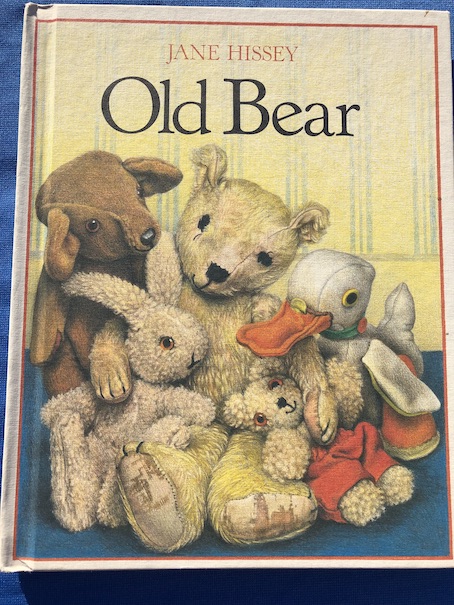
Old Bear

Old Bear by Jane Hissey, 1986.

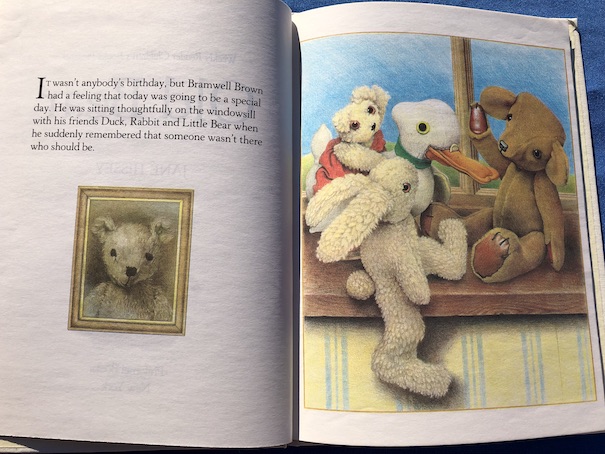
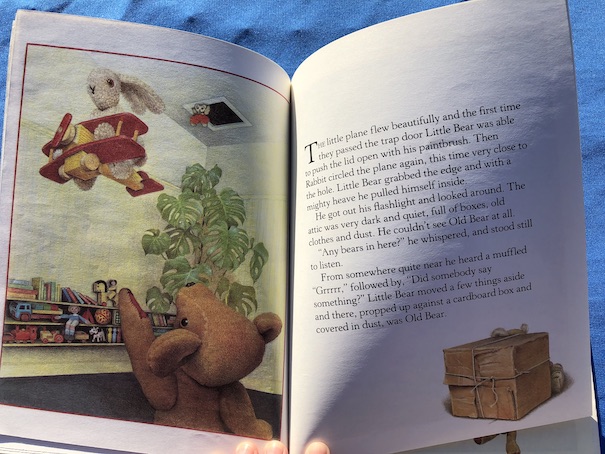
A group of stuffed animals remember that an old friend of theirs, Old Bear, was put up in the attic because he was an old toy and the children of the house were too rough with him.  The other stuffed animals miss him and worry that the humans in the house have forgotten about him, so they try to think of a way to get him out of the attic.

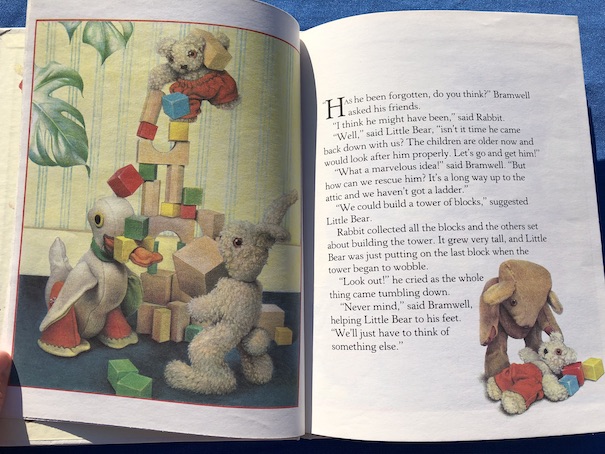
The problem is that the entrance to the attic is in the ceiling, high above their heads.  The stuffed animals try various tricks to get up to the attic, from building a tall tower of blocks to jumping on the bed.

Eventually, they are successful when they use a toy airplane.  After Little Bear finds Old Bear in the attic, they use parachutes made of handkerchiefs to parachute back into the playroom to rejoin the other stuffed animals.

Old Bear says that he spent most of his time in the attic sleeping, but he is glad to be back with his friends.

I remember my mother reading this book to me when I was a young child in the 1980s! One of the things that I like about this book is the detailed pictures. The textures on the stuffed animals are excellent, giving readers the feeling that they could reach into the book and touch the fluffy Little Bear, Bramwell’s paws (which look like they’re made of vinyl), and the Duck, who looks like he’s made of felt.  The stuffed animals’ schemes to reach the attic are also fun and clever, using other children’s toys.

The book is part of a series originally published in the UK. The series was later made into a British television series during the 1990s. This particular story is one of the episodes, and you can see this episode on the author’s YouTube channel.

The book is available to borrow and read for free online through Internet Archive. (To borrow a book through Internet Archive, you have to sign up for an account, but it’s free, and then you read the book in your browser window.)

Happy Birthday, Moon

Happy Birthday, Moon by Frank Asch, 1982.

Bear really loves the moon and decides that he would like to give the moon a birthday present.  The problem is that he doesn’t know when the moon’s birthday is.  He tries asking it, but it doesn’t answer.

Deciding that he needs to get closer to the moon to talk to it, Bear goes to the mountains to ask the moon when its birthday is.  In the mountain, Bear hears his own echo and thinks that it is the moon answering him.  When Bear tells the moon that his birthday is tomorrow, the “moon” replies that its birthday is tomorrow.  Bear is pleased, especially when the moon echoes his wish for a hat for its birthday.

Bear buys the moon a hat and puts it on top of the moon by putting it in a tree.  The following morning, the hat is on Bear’s doorstep, and Bear accepts it as the moon’s present to him.

When the wind blows poor Bear’s hat away, Bear goes to the mountains again to apologize to the moon for losing the hat.  It’s okay, though, because Bear and the moon still love each other.

Bear never realizes that what he’s hearing is his own echo.  It’s sweet although somewhat silly.  If you wonder what happened to the hat in the end, it’s shown on the back cover of the book, holding a bird’s nest.

The book is currently available online through Internet Archive. (When you borrow a book from Internet Archive, you have to set up an account, but it’s free.)

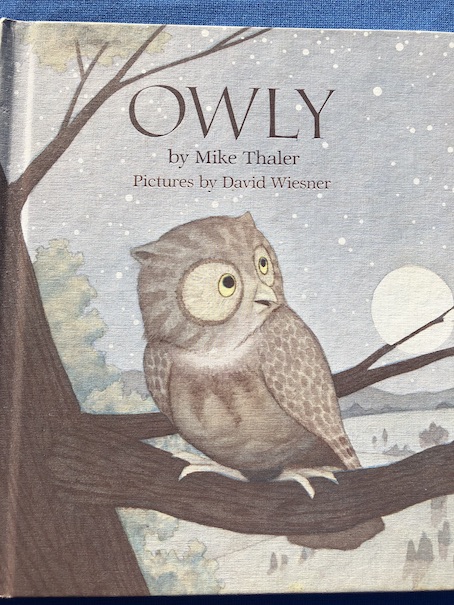
Owly

Owly by Mike Thaler, 1982.

Owly is a curious young owl.  He is always asking his mother questions, like how many stars there are in the sky or how high the sky is.

Owl’s mother tells him to go and see these things for himself, but there are too many stars in the sky to count, and he can’t fly high enough to reach the sky.

The story continues with Owly’s questions and attempts to find the answers, but all of his questions are unanswerable because they involve amounts too big to count or measure.

In the end, Owly and his mother talk about how much they love each other, and they compare it to the number of stars in the sky and the other things that couldn’t be counted or measured.

This is one of those children’s books where the story leads up to how much the parent loves the child (and vice versa). I’ve seen other books where the author sets up a cute way to talk about how much parents love their children, and sometimes, the set up is pretty obvious in this type of story. However, the message is still sweet, and this gentle story might make nice, calming bedtime reading. The pictures are as gentle and calm as the story itself.

The book is currently available on Internet Archive.

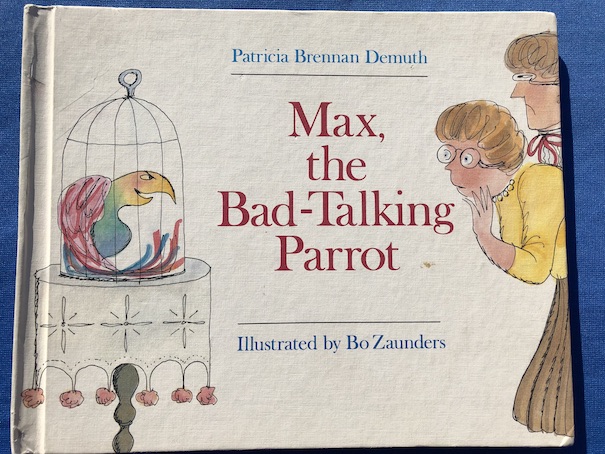
Max, the Bad-Talking Parrot

Max, the Bad-Talking Parrot by Patricia Brennan Demuth, illustrated by Bo Zaunders, 1986.

Don’t worry, Max’s “bad” talk isn’t really that bad.

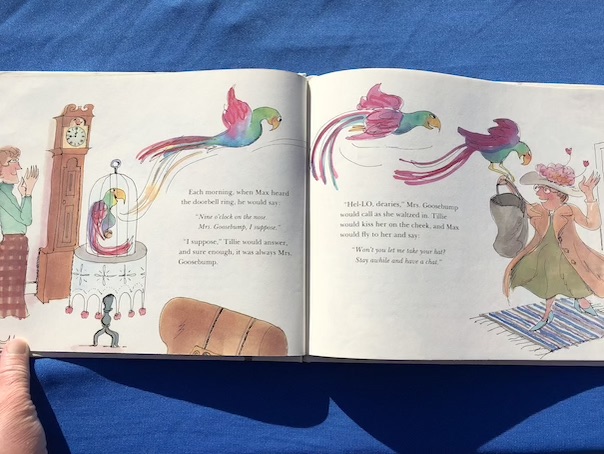
Max is a parrot who belongs to a woman named Tillie.  They live in a house that has been made into two apartments.  The woman who lives in the apartment above them is Mrs. Goosebump.  Mrs. Goosebump is Tillie’s friend, and Max likes her, too.
Because Mrs. Goosebump works the night shift in a toll booth, she always comes to see Tillie and Max in the morning, when her shift is over.  Max always greets her with one of his rhymes.  Everything Max says is a rhyme.

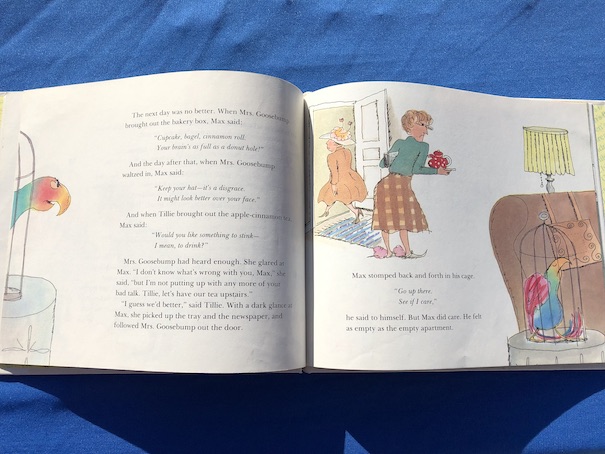
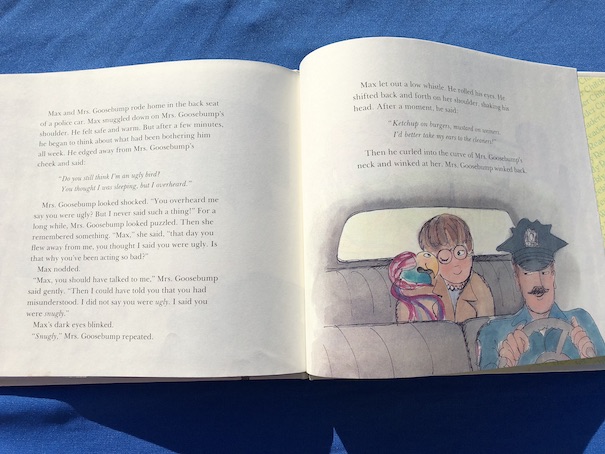
However, one day, as Max is dozing on Mrs. Goosebump’s shoulder during one of her visits, he thinks that he hears her calling him an ugly bird.  Max gets upset and returns to his cage, not ever saying goodbye to Mrs. Goosebump when she leaves.  He feels badly about the insult, and when Mrs. Goosebump visits later, he only gives her insulting rhymes, like, “Cupcake, bagel, cinnamon roll, Your brain’s as full as a donut hole!”

Mrs. Goosebump and Tillie have no idea why he’s so angry. The only thing that they can think to do is ignore him.

Later that night, a burglar breaks into Tillie’s apartment and starts stealing some of her things, including Max!  Max is scared, but by coincidence, the burglar stops to pay at Mrs. Goosebump’s tollbooth.  When Max recites some of his rhymes for her, she recognizes one of his usual rhymes and calls the police.

After Max is rescued, he finally tells Mrs. Goosebump why he was so angry, and Mrs. Goosebump explains that she actually said that he was “snugly”, not ugly.  With the misunderstanding cleared up, the two of them become friends again.  Max is also considered a hero for alerting Mrs. Goosebump about the robber.

When I was a kid, I thought that Max’s rhymes were funny, and the scene with the robber at the tollbooth is funny because Max tricks Mrs. Goosebump into believing that the burglar is insulting her before he says the rhyme that Mrs. Goosebump recognizes.  The book is also a good lesson about the importance of talking to people about what you’re feeling in order to clear up misunderstandings.

I Like Things

I Like Things by Margaret Hillert, illustrated by Lois Axeman, 1982.

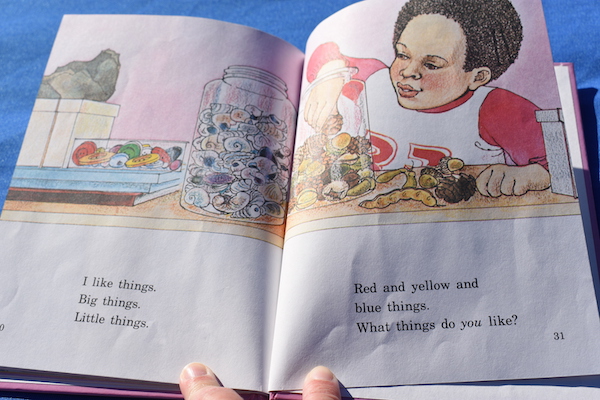
This is a cute little picture book about the fun of collecting things.  A young girl talks about the things that she collects and why she likes them.

She enjoys collecting all kinds of things with different shapes, sizes, and colors.  Sometimes, she likes to sort the things in her collections, like buttons, by color or size.

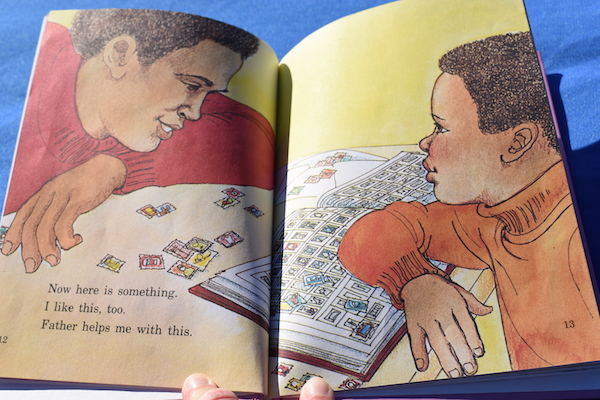
Sometimes, her father helps her with her stamp collection.  She also likes to find seashells and rocks at the beach.  Sometimes, she and her friend trade sports cards from their collections.

At the end of the story, the girl asks readers what kinds of things they like, so adults can use the story to get kids to talk about what they like to collect.

I thought it was interesting how the girl put one of the bigger rocks in her collection into a jar that was partly full of water so that the water would act as a magnifier, making the rock look bigger.

One thing I noticed is that the girl never refers to the objects in her collections by name.  Mostly, she just talks about what she does with them using very simple words.  I think that’s to make the book easier for younger children.  There is a word list in the back of the book of all of the words used in the story, and there are only 64 different words.

Mufaro’s Beautiful Daughters

Mufaro

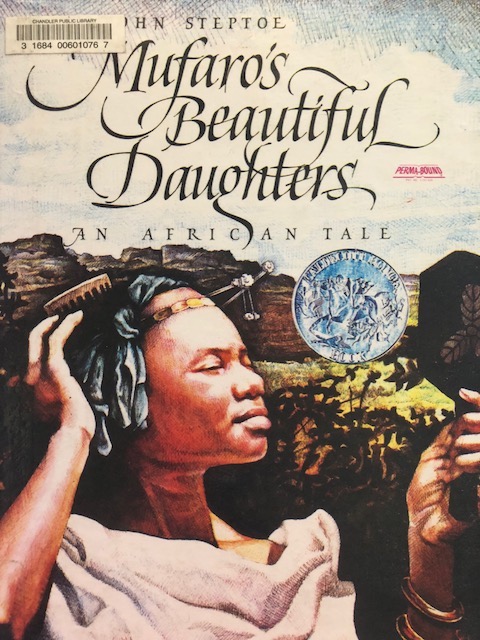
Mufaro’s Beautiful Daughters by John Steptoe, 1987.

This story, based on an African folktale, is somewhat similar to other folktales and fairy tales from other parts of the world such as Cinderella, Mother Holle, and Vasilisa the Beautiful, where a girl with a kind, hard-working nature triumphs over a mean sibling because someone in authority recognizes her good nature and rewards it.

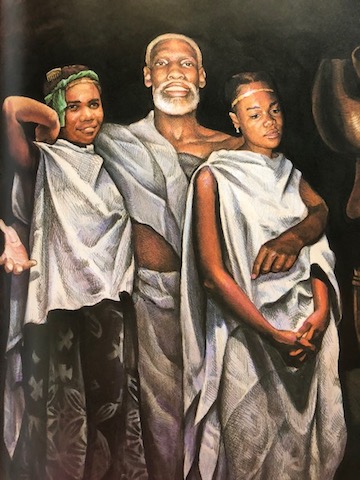
In a small village in Africa, a man named Mufaro has two daughters, Manyara and Nyasha.  Both girls are beautiful, strong, and clever, but they have very different natures.  Nyasha is kind, gentle, and patient.  Manyara is bad-tempered, jealous, and self-centered.  She frequently taunts Nyasha about how, one day, she will be the queen and her sister will be her servant.  When Nyasha asks her why she is so mean, Manyara says that she hates the way people praise Nyasha for her kindness.  She thinks that Nyasha is their father’s favorite child, and she wants to prove that Nyasha’s “silly kindness is only weakness.”

MufaroSisters

Since there is nothing that Nyasha can do to change her sister’s mind or attitude, she just continues doing her usual chores and being kind to people and animals.  In particular, she makes friends with a small garden snake, knowing that his presence in her garden will keep away pests.

Manyara is sneaky and always behaves herself when their father is present, so Mufaro doesn’t know about the troubles between his daughters.  When a messenger arrives, saying that the Great King is seeking a wife and that beautiful, worthy girls are summoned to his city so that he can choose from among them, Mufaro is proud and eager to present both of his beautiful daughters.  Manyara tries to persuade her father to send only her, but Mufaro is firm that both girls must present themselves for the king’s decision.

Manyara decides that the only way to get the better of her sister is to be the first to arrive and present herself to the king, so she slips out in the middle of the night and begins the journey alone.  However, both the journey and the king are not what Manyara thinks they are.  Along the way, Manyara encounters various strange characters who ask for help or offer advice, but thinking that a queen doesn’t need to pay attention to others or do anything she doesn’t want to, Manyara ignores them all.

Nyasha, on the other hand, gets ready to leave at the appointed time in the morning.  Everyone worries about Manyara but decides that the best thing to do is to follow her to the city, since she seems to have gone on ahead.  As Nyasha travels with the rest of their friends and family, she listens to the people Manyara ignored and shows them kindness.

MufaroCity

When they finally reach the city, Nyasha encounters a terrified Manyara, who hysterically insists that when she went to meet the king, she found a horrible monster instead.  However, like everything else, it’s just another part of the test, and Nyasha is the one who passes because she, like her sister, has actually met the king before, but unlike her sister, she actually paid attention to him.

MufaroSnakeKing

The pictures in the book are beautiful and colorful.  A note in the front of the book says that the buildings in the illustrations were based on an ancient city in Zimbabwe that is now ruins.  The note in the book also explains that the names of the characters in the story come from the Shona language.  The meanings of the names are clues to the characters’ natures.  Manyara means “ashamed”, and Nyasha means “mercy.”

The book is a Caldecott Honor Book.  It is currently available online through Internet Archive.

MufaroWedding