Immigrant Kids

ImmigrantKids

Immigrant Kids by Russell Freedman, 1980.

ImmigrantKidsEllisIsland

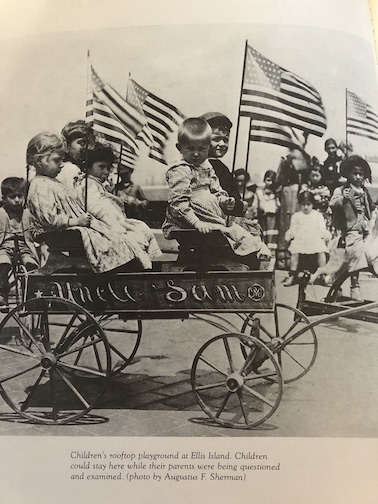
One of the best parts about this book is the pictures.  The preface of the book specifically talks about photography at the turn of the 20th century, how cameras were still fairly new technology but growing in popularity.  Cameras that were small enough to be held in a person’s hands were an 1880s innovation, and the book mentions that small cameras like that were known as “detective cameras” because they were small enough that they could be used to take pictures without the subjects noticing.  Over time, it became easier for amateurs to learn to use cameras, and it became more common for people to take pictures of their ordinary, everyday lives.  Pictures like these open up a window on the past.  The pictures in this book are of children whose families had only recently arrived in America from countries around the world.  The photographer for many of these pictures was Jacob A. Riis, a journalist in New York City who wanted to document the living conditions of poor immigrants.  He published a book called How the Other Half Lives in 1890, in which you can see more of his work.  Other pictures in this book are by Lewis Hine, who is known for his photographs of child laborers.  They are not the only photographers whose work appears in this book, but they are the most famous.

The book is divided into sections, covering different aspects of the lives of immigrant children.  In the chapter called Coming Over, the author describes what the journey to America was like.  One of the primary motivations for people to come to America around the turn of the century was money and employment opportunities.  If a family had little money and little or no chance of getting better jobs in their home country, they would decide to try their luck somewhere else.  Because most of the immigrant families were poor, it was common for families to immigrate gradually.  Often, the father of the family would come first, find a job, start establishing a life and home for his family, and eventually send for his wife and children when he’d saved enough money.  The actual journey was by ship, often in “steerage,” the cheapest form of passage available, in cramped rooms in the ship’s hold.

ImmigrantKidsFamilyQuestions

Although the journey could be harrowing, one of the most nerve-wracking parts was the immigrant processing that took place at immigrant ports like Ellis Island.  There were routine questions that immigrants were expected to answer and exams for them to take, and if the questioners weren’t satisfied, the immigrants could be sent back to the country they came from.  Doctors would examine the immigrants to evaluate their health and look for signs of possible mental defects.  They were particularly concerned about signs of infectious diseases.  Sometimes, it was difficult for immigrants to answer all the questions because of language barriers and the immigrants’ own nerves at being interrogated.  If an immigrant seemed too agitated, the examiners would typically let them rest for a while before trying again.

ImmigrantKidsTenement

The other chapters in the book are At Home, At School, At Work, and At Play, which give more details about the lives of immigrant children as their families settled in America.  They often settled in large cities because those were where the most employment opportunities were to be found.  Because they didn’t speak much English and needed help learning how things worked in America, such as how to find jobs and places to live and how laws worked, they tended to settle in neighborhoods with others from similar backgrounds who could help them.  That is why, even to this day, there are certain areas of large cities, such as New York, Boston, or Chicago, which are known for people of a particular nationality (like the Irish neighborhood, the Jewish neighborhood, Chinatowns, etc.).  New arrivals often joined friends or relatives who had already been living in the US for a while, seeking help in getting themselves established.  These ethnic neighborhoods were located in poor parts of town because the people there didn’t have much money.  People lived in small, crowded apartments called tenements, sharing water and toilet facilities with other families because the apartments were not provided with individual facilities.  However, once these groups of immigrant families became established, they remained established for a long time, and they gave these neighborhoods their own distinctive style.

ImmigrantKidsSchool

School was often difficult for new arrivals because the children had to learn English before they could study other subjects.  There were some special English language learning classes for them at larger schools with enough demand for them.  At smaller schools which didn’t have these classes, they often had help from other children who had arrived in America earlier and could act as translators.  They were also frequently put into classes for children who were younger than they were, studying easy subjects, until they had learned enough English to move up to classes with children their own age.

Typically, immigrant children aimed to stay in school until they were fourteen years old because that was the age when they could officially get full-time work.  However, because their families were poor, the children might have to leave school early to find jobs and help their families make ends meet.  The book describes how rules were frequently bent or broken because the laws were not well-enforced, and children often worked at younger ages, even under harsh conditions.  For immigrant children, the most important education was that which taught practical, vocational skills that would help them find jobs quickly.  Some agencies, like the Children’s Aid Society (known for the Orphan Trains), would help them with vocational training.

ImmigrantKidsBaseball

However, immigrant children still like to play.  Boys and girls usually played separately.  Boys frequently played games like baseball in the street, or stickball, which was a variant that could be played in smaller spaces.  In stickball, the “bat” was a stick or the handle of an old broom, and the ball was rubber and allowed to bounce before it was hit.  Girls would play other games, like “potsy,” which was a version of hopscotch.

Because of the lessons they were taught in schools and because the immigrant children mixed with children outside of their immigrant groups in school, the children absorbed the local culture and became Americanized faster than their parents.  Many of them experienced the feelings of being torn between their parents’ traditions and wanting to fit in with society around them.

In each of the chapters in the book, there are anecdotes from people who had arrived in the US as children around the turn of the century, telling stories about different aspects of their lives.

The book is currently available online through Internet Archive.

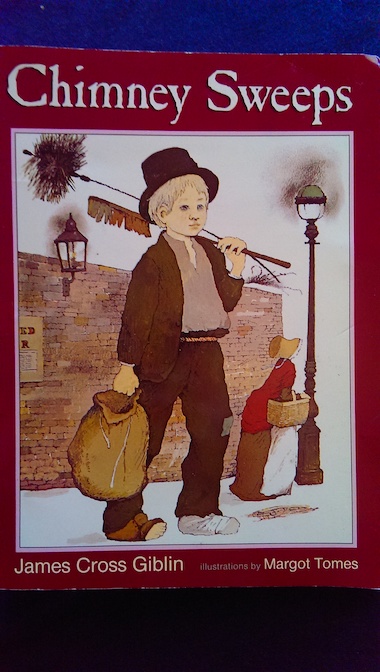
Chimney Sweeps

ChimneySweeps

Chimney Sweeps by James Cross Giblin, 1982.

This book explains about the history and traditions of chimney sweeps. I love books that cover odd topics from history like this!

It starts by explaining the origins of chimneys in the Middle Ages. Before they were invented, people would have to have simple holes in the roofs of their houses to let out smoke from heating and cooking fires, or they would have had to rely on windows or doors to perform the function of venting smoke. Chimneys vent smoke more efficiently, but the more they are used, the more soot collects inside them, and they need to be cleaned out from time to time. If they aren’t cleaned, the build-up inside could either block air from getting to the fire in the fireplace, causing the fire to go out sooner, or it could pose a fire risk because the build-up inside the chimney is still flammable. Sometimes, home owners could clean their own chimneys, if they weren’t very tall, but the taller the chimney is, the more professionals are needed to clean it.

ChimneySweepsAdult

Modern chimney cleaners have vacuums that they can use to clean soot out of a chimney, but originally, people were basically relying on brushes. The book explains the evolution of the profession and variations in the profession between England, Germany, and the United States. Germany is significant to the profession because it was one of the first places where chimney sweep became a recognized profession and there were laws even in the 1400s that all chimneys had to be cleaned twice year. (Remember that chimneys that haven’t been cleaned can be a real fire risk, posing a danger not only to you but your neighbors, especially during a time when most buildings are made of wood and other highly flammable materials.) When chimney sweep became a recognized profession during the Middle Ages, members of the profession formed a guild (as was traditional for different professions in general during the Middle Ages) and established rules and standards for the profession. One of the responsibilities of a guild was to decide on the training and qualifications that the profession requires, and in the case of chimney sweeps, the only way to learn was by serving an apprenticeship. The apprentice would live with a master sweep for three years, learning the trade, and at the end of his training, he would have to prove that he could clean a difficult chimney all by himself with thoroughness and reasonable speed.

There are many traditions and superstitions that came to surround the profession of chimney sweep. One of them that you can still sometimes see even in modern times is the image of the chimney sweep in a top hat. The exact reasons for adopting a top hat and tailcoat as part of their uniform are uncertain, but it began back in the 1500s in Europe. The sweeps often got their top hats and tailcoats as secondhand clothing from undertakers (yes, really). Part of the reason for wearing them might have been as an effort to look professional, but the color black was also suitable for a person who was going to end up covered in soot. According to superstition, the top hat would help to protect the chimney sweep from falling when he was on the roof of a house. Chimney sweeps were often thought to be lucky because their jobs were dangerous, yet they survived.

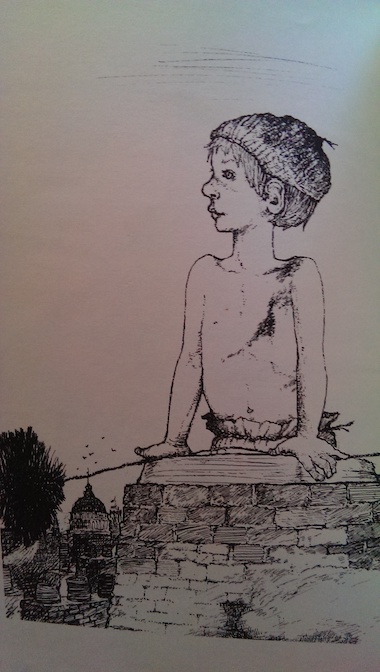
ChimneySweepsChild

However, chimney sweeps’ lives and work were often hard. In 18th century England, their jobs became more difficult because chimneys were purposely being built in narrow, crooked zigzags. The idea behind the crooked chimneys was that they would keep more heat in, but that made them much harder to clean. Because brushes couldn’t make it around the bends of these chimneys and adults couldn’t get into the narrow flues, sweeps became reliant on young boys to climb up into them and clean them by hand. Although the law required boy apprentices to be no younger than eight years old, many sweeps used boys as young as four or five. Sometimes these boys were official apprentices with the permission of their parents (typically from poor families with many children) or even the sweep’s own children (sometimes, they used their daughters because girls were often smaller than boys). If they couldn’t get children any other way, sometimes sweeps would get children from orphanages or might even resort to kidnapping.  The author of this book includes a short story about what a day in the life of a child chimney sweep was like.

The plight of child chimney sweeps came to light during the early 19th century, when people were starting to become concerned about child labor of all kinds. At first, there was strong opposition to banning child chimney sweeps and using new cleaning devices because the adult chimney sweeps saw it as a threat to their livelihoods and home owners were worried that new methods would be more expensive for them (of the two, I think I’m more offended at the home owners’ attitudes because of the implication that they were more upset about a possible slight increase in expense than the risk to the lives of the children they knowingly endangered).  Many of the child chimney sweeps suffered severe and permanent health problems because they were forced to do this kind of work at an early age, while they were still growing, and because they inhaled and were covered with soot for such long periods.

In the back of the book, there is a poem by William Blake called “The Chimney Sweeper,” which was published in Songs of Innocence in 1789. Knowing the risks to young children, like the little boys in the poem, makes the poem seem pretty disturbing, which may actually be the author’s intention.  Eventually, after long years of struggles in which children were still exploited in chimney sweeping spite of regulations against it, in 1875, Parliament tightened regulations against child labor even further, forcing chimney sweeps to apply for licenses in order to practice their trade, listing each of their apprentices and their ages.

Chimney sweeping in American history was a little different from the way things were done in Europe. The American colonists sometimes tried some strange tactics for cleaning their chimneys. One of the oddest methods was to tie a rope to a goose’s feet and lower it down the chimney. The goose would become frightened and flap its wings, thus knocking the soot loose. When the job was done, the home owner would pull the goose out of the chimney and wash it off. Another tactic was to actually burn the excess soot out of the chimney, although there was a risk of simply setting the house on fire. Later, American cities had official chimney sweeps who were licensed and regulated. On Southern plantations, slaves were used as chimney sweeps, and some of them continued to work as chimney sweeps after they gained their freedom.

Later, when homes began to be heated by other sources than fireplaces, chimney sweeps were in less demand, although there was increased demand in the 1970s, during the energy crisis, because people started using their fireplaces more instead of relying on other heating methods that involved scarce or expensive fuel. Chimney sweeps can also perform other duties beyond simply cleaning chimneys, depending on where they live. For example, in Germany, sweeps perform inspections of factories and homes to make sure that they are using fuels efficiently, looking for sources of needless pollution, which can lead to fines for the owners of the buildings if the problems are not corrected. Some people might also become chimney sweeps as a seasonal part-time job, while they also have another career.

The book is available to borrow and read for free online through Internet Archive.

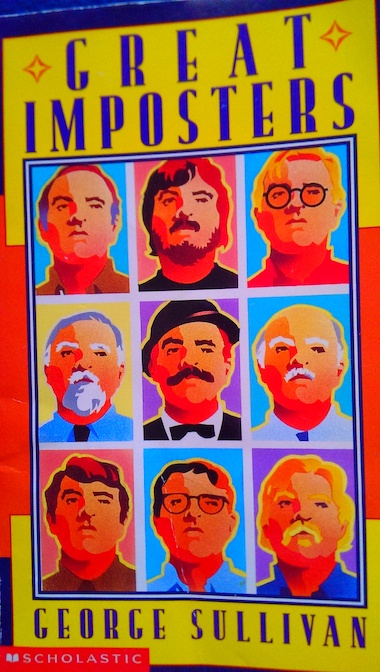
Great Imposters

GreatImposters

Great Imposters by George Sullivan, 1982.

This is one of those unusual history books that I like about odd, little-covered topics.  The author begins by explaining what an imposter is: “a person who practices deception under an assumed name or character.”  Each of the people in the following collected stories is pretending to be someone they’re not, for a variety of different reasons.  The author points out the differences in the imposters’ motives, which range from pure greed to a desire for fame and attention to thrill-seeking behavior.  Each of these stories really happened, and the people involved were real people, even if their claimed identities weren’t.  The stories skip around in time and location, so they can be read in any order.

Willie the ActorWillie Sutton started out as a petty thief while growing up in a tough Brooklyn neighborhood and later graduated to pulling a series of daring robberies while wearing various disguises during the 1930s through the early 1950s.

Bad HabitFerdinand “Fred” Waldo Demara, Jr. was the son of a fairly wealthy man who later lost the family’s money. Sis family’s loss of their previously well-off position was hard for Fred, and it led to a lifetime of him trying his hand at various professions (winging it without proper qualifications) and adopting (or stealing) new identities.  The movie The Great Imposter was based on his life and exploits.

Princess of PretenseSarah Wilson was a maid in the household of Queen Charlotte in England during the 18th century.  When she stole some clothes and jewelry belonging to the queen, she was exiled to the American colonies as an indentured servant.  However, she used her knowledge of royal and the objects she stole to run away and pose as an exiled younger sister of the queen.

Lord Gordon-Gordon – Philip Guy spent his youth stealing and selling stolen goods for extra money until he ended up stealing a trunk that happened to contain gentlemen’s clothes that happened to fit him.  When he noticed how much better everyone treated him when he was dressed as a wealthy gentleman, he created a new identity for himself as an English lord, undertaking greater thefts and frauds to maintain it.

The Counterfeit CountVictor Lustig acquired a skill for languages when he was young and later used them when he masqueraded as an impoverished nobleman, covering up his gambling habits and confidence swindles in Europe and America, including his daring scheme in 1920s Paris to sell people materials from the Eiffel Tower, which was supposedly going to be dismantled.  He also once successfully swindled Al Capone.

The Claimant – During the mid-1800s, Arthur Orton pretended to be Roger Tichborne, the long-lost (and probably deceased) heir to an English baron.

The Baron of ArizonaJames Addison Reavis, a former Confederate soldier from the American Civil War, learned that he had a talent for forgery and tried to use it to forge land grants, giving himself a large section of land in the Arizona Territory and the title the “Baron of Arizona.”

The Actress – Constance Cassandra “Cassie” Chadwick was a girl from a poor family in the 1800s who posed as a spiritualist, swindling people while claiming to save them from terrible fates, and later, pretended to be a lover of Andrew Carnegie.  (This book doesn’t mention it, but other sources say that Cassie’s real name was Elizabeth Bigley, and they say that she claimed to be Carnegie’s daughter, not his lover.)

Electronic TrickeryReginald Jones was a scientist in Britain during the 1940s.  He was also a practical joker who enjoyed taking on new identities in order to play pranks on friends and colleagues over the phone.  Later, during WWII, he found ways to put his practical joking to practical use.

The SkywaymanFrank Abagnale took on a variety of new identities while writing bad checks during the 1960s and 1970s.  The story of his life was later turned into a book called Catch Me If You Can and a movie of the same name.

Dangerous Game – This chapter is about WWII intelligence agents, who also had to assume new identities to do their jobs without being caught.

The Man of a Hundred LiesStanley Clifford Weyman was an imposter from the 1920s through the mid-20th century who held a variety of prestigious positions . . . all self-appointed.

The book is currently available online through Internet Archive.

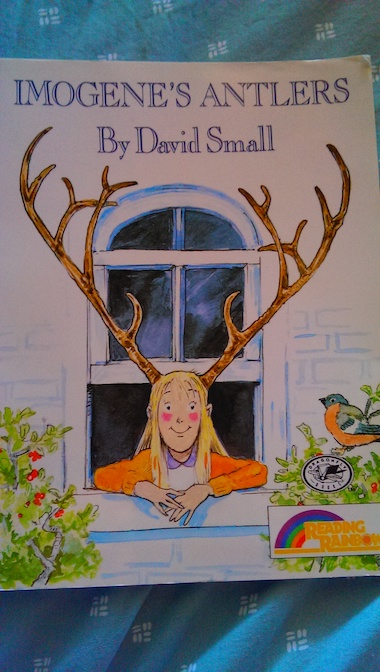
Imogene’s Antlers

ImogenesAntlers

Imogene’s Antlers by David Small, 1985.

One day, a young girl named Imogene wakes up to find that she has sprouted antlers during the night. It comes as a shock to the rest of her family, and she finds that it’s very difficult to do things with large antlers sticking out of her head.

No one seems to know why Imogene has sprouted antlers or what to do about them. Imogene’s mother faints just about every time she looks at her daughter, and her attempt to help Imogene hide them with a specially-designed hat is pure disaster. Imogene’s brother, Norman, thinks that Imogene might be a rare kind of elk now.

However, Imogene still has a lovely day as the family maid uses her as a rack to dry towels and the cook decks out her antlers with donuts to feed the birds.  She even puts candles on her antlers as an elaborate candelabra while she practices her piano lesson.

ImogenesAntlersDonuts

Still, it’s a most bizarre day, and her family is relieved when the antlers are gone the following morning.  But, Imogene’s adventures may only be just beginning.

The book never offers an explanation for why Imogene grew antlers or why she now has a peacock tail, but it doesn’t really matter. This is just one of those books that’s fun to read because it’s silly. While Imogene’s mother panics over her daughter’s condition and tries to hide it under a ridiculously big hat at one point, readers don’t have to worry about the long-term implications of Imogene’s antlers (or any other animal transformations) because she just enjoys them for what they are. The peacock feathers may not have as many practical uses as the antlers did, but one can imagine that Imogene will make the most of them while she has them.  I loved this book when I was a kid!

This book was featured on Reading Rainbow.  It is currently available online through Internet Archive.

Paul Bunyan and Babe the Blue Ox

PaulBunyan

Paul Bunyan and Babe the Blue Ox by Jan Gleiter and Kathleen Thompson, 1985.

This story is based on an American folktale that was used to promote the logging industry. The book doesn’t explain the background to the story, but in a very literal sense, it is a “tall tale.”  The book is part of a series about legendary figures from history and myth.

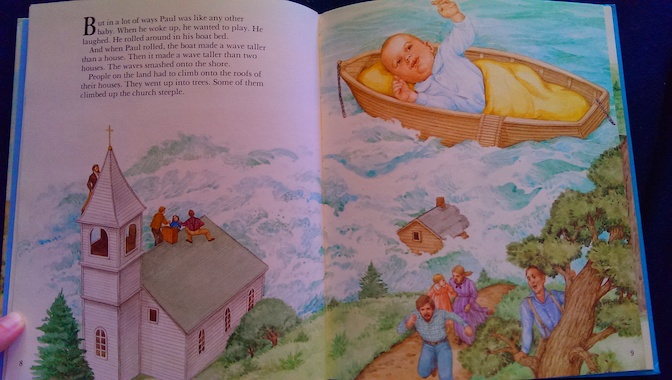
Paul Bunyan is a giant of a man, and he was a giant since he was a baby, even though his parents were both of normal human size (no explanation given). Because he was never small enough to fit in his parents’ house, they made a large boat for him to sleep in as a cradle, rocking him to sleep on a river. Needless to say, having a giant baby complicates everything and can pose a real risk to everyone. His parents had to teach him early about what he could and couldn’t do so that he would avoid hurting people.

PaulBunyanBaby

However, Paul discovered early that he was skilled with an ax, and because of his great size and strength, he realizes that he is good at cutting down trees. Because this was the frontier days in America, good loggers were in demand because trees were plentiful and wood was needed to build houses and railroads. (Paul Bunyan would not be such a hero for cutting down whole forests today.)

However, a giant of a man can also be lonely when there’s no one around his own size. Paul finds a companion in a giant blue ox. (Yep, that’s part of the traditional story.) He found the ox partly buried in a blizzard. After he dug it out, he named it Babe, and the two of them became lifelong friends.

PaulBunyanBabe

Part of the story is that the Mississippi River and all the lakes in Minnesota were caused by Babe accidentally spilling water that he was carrying on his back. Paul also supposedly dug the Grand Canyon by accident by dragging his ax behind him when he walked to California.

PaulBunyanBabeSpill

Paul also meets a man named Hals Halvorsen who is almost his size. After trees get cut down, Paul and Hals pound the stumps into the ground with their fists to finish clearing the land. Then, they try planting some corn to see how good the land is for farming, but the corn stalk grows up so high that Hals nearly starves to death while climbing it to try to find the top of it.

PaulBunyanHals

The part of the story I liked the best as a kid was when they made gigantic pancakes for Paul Bunyan and Babe, greasing their giant griddle by basically skating across its surface with grease strapped to their feet.

PaulBunyanPancakes

I can’t say that this was one of my favorite folktales as a kid, and my feelings as an adult about deforestation don’t make me feel good about it now. Still, it is an interesting piece of Americana and a little nostalgic.  As a side note, Paul Bunyan was used as a mascot for a pancake restaurant in an episode of Disney’s Phineas and Ferb (which has also been done in real life).  In that episode, Norm, a giant robot, accidentally gets the head of the Babe statue outside the restaurant stuck on his head, causing Phineas and Ferb to think that they are being chased by a Minotaur.  Now that I think about it, this joke’s use of Paul Bunyan and Babe the Blue Ox makes me smile more than the original version of the story.

The book is currently available online through Internet Archive.

Pocahontas

Pocahontas

Pocahontas by Jan Gleiter and Kathleen Thompson, 1985.

The story about the life of the young Native American woman known as Pocahontas (“Pocahontas” was really a nickname, which the book mentions, although it doesn’t say that her original name was Matoaka) has been told many times in many forms, but this particular book is somewhat sentimental for me because it was the first one I ever read about her when I was a kid. It’s part of a series about famous and legendary figures in history and myth. Pocahontas was a real, historical person, but aspects of her life have taken on the characteristics of legend (as well as providing material for a Disney movie, although the Disney movie takes liberties with the real life of Matoaka/Pocahontas and the movie was not based on this particular rendition of her story).

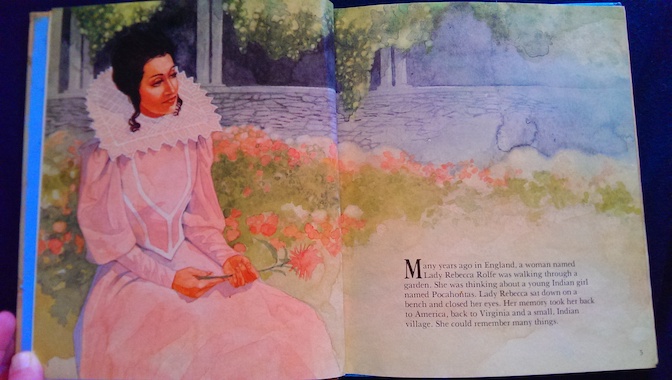
When this particular book begins, Pocahontas is a grown, married woman going by the name of Lady Rebecca Rolfe. While living in England, she reflects back on her life and youth, remembering when she first met Europeans.

PocahontasEngland

When she was ten years old, she heard her father, Powhatan (who was the chief of their tribe) and other men talking about the white men. Although Pocahontas hears that the white people had betrayed her people’s trust and even killed some of them, she is curious to get a look at them.

PocahontasSettlerChildren

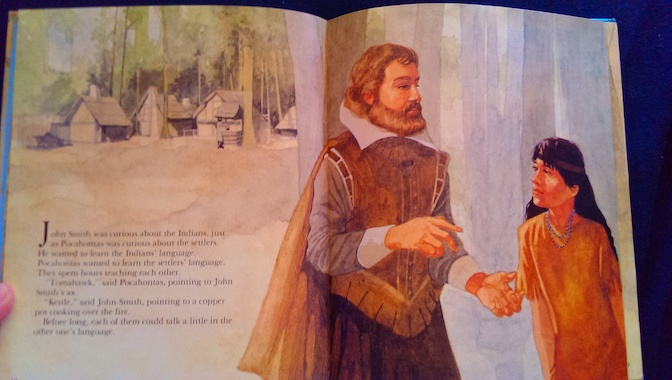
She ends up meeting with a group of boys from Jamestown and playing with them. She begins making friends with people in Jamestown and visiting them from time to time. A man named John Smith becomes curious about the girl and her people and gets Pocahontas to teach him some of her language.  (The book is more accurate than the Disney version here, showing that there is a significant age difference between Pocahontas and John Smith, with Pocahontas being a child at their first meeting.)

PocahontasJohnSmith

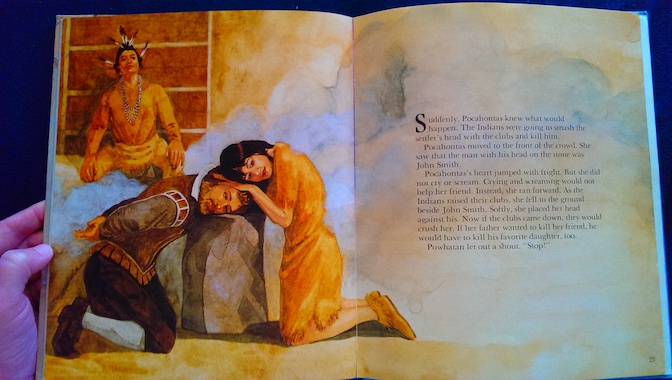
Then, one day, there is a feast in Pocahontas’s village, and some of the men of the tribe bring a white man who was caught trespassing in their territory. Pocahontas recognizes the white man as John Smith and, upon realizing that he is about to be executed, intervenes to save his life. (This is one of the most famous parts of the story of Pocahontas’s life, although the exact circumstances surrounding the real-life incident are a little confusing and may have actually been part of a more complex ritual that John Smith didn’t fully understand at the time, not an actual attempt at execution, if the event actually happened at all. This book offers a simplified version of the incident, supposing that John Smith’s life was in real danger, as he described it in his account of what happened.)

PocahontasExecutionAttempt

In the end, the settlers at Jamestown kidnap Pocahontas in the hope that Powhatan would end hostilities with them, using her as a bargaining chip.  (The book says that her father wasn’t too worried because he knew that the settlers were her friends and would treat her well, but I find this part of the book pretty worrying myself, reading it as an adult.  I’m pretty sure that is not how a parent would react to a missing child in real life.  I guess that the book is trying to keep the tone light for children, but it just sounds weird.) Pocahontas remains among the settlers, living according to their lifestyle and taking the name Rebecca. Eventually, she meets a man named John Rolfe and marries him. The two of them have a son together. With her new family, she travels to England and tries to help the people there to understand her people.  (The book says this in a very optimistic way, calling her visit a “success”, although in real life, this visit was largely a propaganda move on the part of the Virginia Company of London. On the other hand, she was, evidently, very well-received in England, if something of a social curiosity.)

PocahontasWedding

The story in the book ends here, with her still in England, thinking back on her life and her reasons for being there. Part of me wishes that it had explained a little more about Pocahontas’s earlier life and some other facts behind her story. Sadly, part of the reason why they might have been reluctant to tell the rest of the story to children was that the real Pocahontas didn’t live very long after the point where the story ends.  As she was preparing to return to Virginia from England, she became very ill and died.  Her exact age at the time of her death is unknown, but she was probably about 21 years old.  Her son, Thomas Rolfe, was very young at the time she died, but they do still have living descendants today.

Overall, I’d say that this is one of those stories that becomes more interesting when you’re older and realize the full depth of it.  This picture book is a very simplified version of the story, meant for kids, but when I was young, it did inspire me to learn more about Pocahontas.  There any many missing details of Matoaka/Pocahontas/Rebecca Rolfe’s life because of the limited records of it, but what is known is fascinating.  It’s sad because she died so young, but that the story of her life lived on in so many imaginations after her death is profound.  Different people, both when she was alive and after her death, tried to use her for their own purposes, but her legend still continues, out-living them all.  I’ve never seen the Disney Pocahontas movies, and I don’t really want to.  I already know how the story ends.

The book is currently available online through Internet Archive.

The Haunting of Cabin 13

Cabin13The Haunting of Cabin 13 by Kristi D. Holl, 1987.

Thirteen-year-old Laurie is looking forward to her family’s vacation. They’ve rented a cabin for a week, Cabin 13, by the lake at Backbone State Park (It’s a real state park in Iowa. Link repaired 10-19-22.), and her friend Jenny is staying there with them. Laurie’s mother isn’t looking forward to the trip. She hates dirt and bugs and doesn’t like the cabin when they arrive. As everyone starts unpacking, Laurie looks around the cabin and finds a note that warns them to leave because the cabin is haunted. Supposedly, it was written by the ghost herself. The note is signed “Eleanor.” Laurie’s mother thinks that they should leave right away, but Laurie and the rest of the family persuade her that it’s just a joke. At first, Laurie’s sure that’s all it is.

Then, the park ranger tells the family that the other families who have tried to stay in that cabin this summer also found similar notes. It might be just a prank, but it might not. He also tells them that a girl named Eleanor, the same age as Laurie and Jenny, drowned there the summer before, and strange things have been seen there since, like lights around the lake. Laurie’s brother, Ricky, thinks it sounds cool that they’re staying in a haunted cabin by a haunted lake. Like others, Laurie thinks that the notes are the product of a prankster, but what would be the point behind it?

The girls meet a pair of brothers who are staying nearby, Kevin and Matt. When they tell them about the note, Matt is eager to investigate. Jenny enjoys flirting with boys, and she’s mostly interested in flirting with good-looking, athletic Kevin. Matt is in a wheelchair, so Jenny doesn’t pay much attention to him. She just makes an awkward comment about cripples being able to contribute to society that makes everyone feel uncomfortable. Although Laurie knows that Jenny’s comment was inappropriately personal and callous, Laurie also underrates Matt’s ability to help with their note mystery at first, and she’s shy about talking to him because she’s often shy around boys. However, needing someone to confide her thoughts in when Jenny isn’t interested, Laurie talks to Matt about her theories about the mysterious notes. Matt turns out to be easy to talk to, helping Laurie get over her nervousness about talking to boys.

At first, Laurie tells Matt that she thinks that the prankster is trying to drive people away from Cabin 13 because something important is hidden there. However, as she starts asking questions about Eleanor, she learns that the notes haven’t just been directed at Cabin 13. Staff at the park have also received notes from “Eleanor.” Laurie also sees a figure in black sneaking around the park, who she is sure is not a ghost.

It isn’t long before Laurie receives more notes from “Eleanor,” hinting that she might be in danger, and she and Jenny see the mysterious lights that people have been talking about. Then, when the children are out in a canoe together, it develops a leak and sinks. Matt panics because his legs are paralyzed, and he can’t swim, but Laurie saves him with the help of some people in another boat.

Was that accident just an accident, or could it have something to do with Eleanor’s “accident” last year? There are plenty of suspects who might have reasons for playing ghost and stirring up trouble at the lake. Matt’s father blames the park ranger for the accident that paralyzed Matt. At a previous visit to the lake, Matt was crossing a road with his father and brother and was struck by a speeding car. Matt father says it wouldn’t have happened if the roads had been policed properly. Laurie realizes that he might have a motive for revenge. Then again, some people have been coming to the lake, drawn by the ghost stories and hoping to see the mysterious lights. Could the ghost be a publicity stunt to drum up business?

The book is available to borrow and read for free online through Internet Archive.

My Reaction and Spoilers

When Laurie discovers that Eleanor’s half sister has come to the lake to investigate Eleanor’s death herself, she thinks that she has the mystery solved, but she’s only half right. It’s true that Eleanor’s sister has been responsible for some of the things happening at the lake, but not all of them.  She explains to the kids that Eleanor loved mystery stories and was always playing detective games, but she thinks that perhaps the game got too real for Eleanor the summer that she died.  There is something sinister going on at the lake, something that Eleanor also realized before her death, and there is more to Eleanor’s death than most people know.

At the end of the book, Matt gets a chance to be a hero and stop the bad guy from escaping, using his wheelchair to his advantage because a person on wheels can sometimes move faster than a person on foot.  Even before that, Laurie had gained an appreciation for Matt and his sensible thinking, realizing that a person who is impaired in one way can still have great abilities in other areas of life.  She also comes to think of Matt as being brave for coming back to the site of the accident that made him a paraplegic.  Matt says that he had to come in order to prove to himself that there was nothing inherently bad about the  place and to stop the nightmares he was having about his accident.  Matt and Eleanor’s sister both make Laurie realize that everyone has something difficult or frightening that they have to deal with in their lives; it’s just that some people’s problems are more obvious than others.  Everyone can see what Matt’s dealing with at first glance because he’s in a wheelchair, but no one knew about the pain and fear that Eleanor’s sister was carrying around with her until she admitted it.

I consider this story a pseudo-ghost story because the obvious parts of the haunting were caused by living people, for reasons of their own.  However, Laurie seems to feel that Eleanor’s spirit was there with them, waiting to see the mystery of her death solved.  It’s left open to interpretation, but if Eleanor was there, it was only seen in the odd feelings that Laurie had from time to time, not in any more obvious or physical way.

Something that confused me a little in the book is that, at one point, Jenny tells someone that Laurie already has a reputation for being an amateur detective, having discovered that Jenny herself had been kidnapped when the authorities thought that she had run away from home. Jenny gives full details of the time when she was kidnapped, including who kidnapped her and why and how Laurie figured out where she was. When I read that section of the story, I thought at first that the author was talking about a previous book that she had written with these two characters, but I had trouble figuring out which it was, if any.

Interesting fact: some of the children in the story are named after the author’s own children.

Color War

Camp Sunnyside Friends

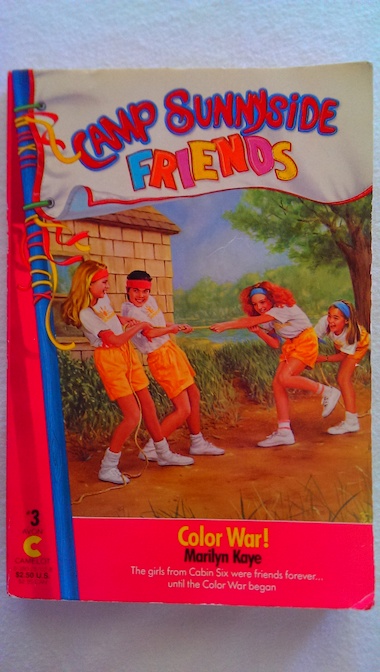
ColorWar#3 Color War! by Marilyn Kaye, 1989.

Usually, the girls of Cabin 6 at Camp Sunnyside have fun during the camp’s annual competition.  Every year, the girls at camp are divided up into two teams, red and blue, and they compete against each other in a series of contests.  Ms. Winkle, the camp director, cautions the girls at the beginning of the Color War not to let themselves be carried away by the competition, to remember that they’re all still friends and members of the same camp, and to keep the contests friendly.  Usually, that isn’t a problem for the girls of Cabin 6.  They each have their favorite activities, and every year, they’re always on the same team, working together against other cabins.  However, this year is different.

When the girls of Cabin Six are split up and put on different teams, the competition between them threatens to ruin their friendship.  Some of the girls of Cabin 6 are more competitive than others, especially Katie, who likes to be a leader and hates to lose at anything.  Trina, on the other hand, values loyalty and friendship more than competition.  She looks on the other girls in her cabin as being almost family because they’ve spent so much time together and considers Katie to be her best friend at camp.  There is an unexpected clash between the two girls when Katie turns out to be the captain of the blue team, and Trina ends up on the red team.

Both Trina and Katie are disappointed about the team assignments.  Trina had helped to campaign for Katie during the elections that were held for the team captains, before the teams were even assigned, and Katie had told her that she wanted her to be her assistant.  But, teams are assigned randomly after the entire camp elects two captains to lead them, and none of the girls had any say in it when Trina and Erin were both placed on the red team, under the leadership of Maura, a snobby older girl who is even more competitive than Katie and not above stooping to some mean tricks to get ahead.  Switching teams is against the rules, so there’s nothing to be done about it.

Trina feels badly that she can’t be on Katie’s team and still thinks of her as her friend.  But, she notices that, from the moment when the teams are assigned (the girls each have a dot of a different color paint on their foreheads when they wake up one morning, indicating what their team will be), Katie starts behaving awkwardly around Trina, treating her almost as a suspicious stranger, or worse, an enemy.  When Katie tries to play on Trina’s sympathies, getting her to let her have an edge at certain contests or even bow out so Katie’s team can win, Trina is willing to go along with it at first because she likes Katie and wants to see her win, if it’s important to her.  But, gradually, Katie’s pushy competitiveness begins to wear on Trina, especially when she sees her taking advantage of her and other friends without regard for their feelings.  When someone tries to deliberately sabotage an activity that Trina is taking part in, it seems like Katie is willing to stoop to some dirty tricks and even cheating against her “best friend” in order to win, and it doubly hurts.

With Katie expecting Trina to give her advantages and inside information on demand and then shutting her out immediately afterward and acting suspicious of her, even accusing her of doing some of the things Katie herself is doing, Trina is fed up!  Katie’s seeming sabotage is the last straw, and Trina decides from that point on, she’s going to treat the Color War as the serious competition Katie acts like it is.  The girls’ unfriendly attitudes toward what are supposed to be fun games turns the Color War into a real war with friend against friend.  When people as well as friendships seem to be getting hurt, the girls have to decide what’s really important to them and what the cost of winning is going to be.

The book is currently available online through Internet Archive.

My Reaction and Spoilers

Although I liked this book when I was a kid, it frustrates and even angers me now.  I have a long-standing contempt for one-upmanship in all of its forms, and I lose respect for anyone I see using one-upmanship tactics.  (I didn’t write this, but I agree with it, especially the part that says, “You really do not need to be the winner every single time.” Seriously.)  As a character, Katie is my least favorite of the girls because of her overly-competitive attitude and lack of consideration for others.  It’s all the more aggravating because, as much as Katie likes to be the leader and the other characters follow her, she isn’t actually good at leading.  She’s mainly good at being bossy and manipulative.  As soon as Katie gets put into a leadership role in a competitive atmosphere, her usual standards of behavior go straight out the window, and she uses even close friends as mere tools to her glorious victory.  Note that she isn’t focusing on leading her troops to victory.  The victory is all about her and the trophy she wnats, regardless of what it does to people around her, and that’s why she’s not good at leading.  In this story, she’s mainly just selfish.  Some people can enjoy some harmless competition without losing their scruples, but sadly, Katie is not one of them.  Now that I’m an adult with more experience with this personality type, I have less patience for it than I ever did.

It’s true that Katie isn’t as bad as Maura, who we learn later actually did some of the worst things that Katie and Trina suspect each other of doing.  Neither Katie nor Trina actually sabotaged each other’s activities.  Maura did that both to give her team an edge and also to stir up Trina’s anger against Katie.  Maura saw that Trina wasn’t a competitive person and was willing to let Katie win just for the sake of friendship, and she realized that the only way to get Trina to even try to win would be to make her fighting mad.

Maura’s lying and acts of sabotage were worse than what Katie did because it was direct cheating, but Katie’s tactics were also a kind of cheating.  Katie persuades Trina to let her have the better horse for the riding contest, even though Trina was supposed to ride that horse, and she tries to convince her to fake an injury so that she can bow out of a gymnastics contest, which she knows Trina loves, just because she knows that Trina is likely to win that activity.

Supposedly, Katie’s a nice person most of the time, but you wouldn’t know it to see her in this contest.  Almost from the word go, Katie turns into a rabid little win-monster, ready to shove even her closest friends under a bus to win . . . at summer camp games.  At one point, she tries to make Sarah compete in a pie-eating contest because she knows Sarah is normally a big eater, but Sarah gets upset because she’s been dieting, and it was just starting to pay off, and she doesn’t want to ruin what she’s done just for the sake of some dumb contest.  When Trina sees how upset Sarah is, she tells her to be honest with Katie about how she feels, and Katie flies off the handle irrationally, as if she had never heard of Sarah’s diet before (she had, a lot, because Sarah had been talking a lot about how hard it was to fight temptation) and accuses Trina of trying to make her lose.  Katie can’t stand the idea of not winning, in case you couldn’t tell, and she doesn’t care about what her friends stand to lose in the pursuit of her personal victory or what the lasting consequences might be after the contest ends.

You might be wondering why winning is so important to Katie.  What’s really at stake for her in this summer camp contest?  I was wondering this a lot, all through the book.  It turns out that winning is important because the alternative, not winning, will make Katie feel like a loser, and people might think she was lame.  And . . . nothing.  That’s it.  Whoopty doo.  Katie fears getting jeered as the loser at the end of the contest, which is silly because no one does jeer the loser at the end, and most of the younger girls they talk to while campaigning for Katie to be one of the team captains in the beginning were kind of unenthusiastic about the games, not because they feared losing, but because they figured that the older girls wouldn’t let them try any of the more fun stuff, saving all the best parts for themselves.  In other words, very few people beyond Katie and Maura were at all concerned about who won or lost, they just wanted to take part.  Mostly, it seems that what Katie is really afraid of is coming up against an opponent, or even other teammates, who are just like her.  Katie is the manipulator who uses her friends; her friends are not trying to manipulate her or make her lose.  Katie is the rude one who jeers at losers.  Ultimately, she’s afraid of what she does to other people coming back on her.

Part of the reason Katie was hoping that Trina would be her assistant on her team was because Katie remembered that the year before some of the girls had ganged up on their team’s captain over a part of the competition that had gone badly.  Trina remembers that Katie had been the main instigator of the rebellion.  Katie’s scared of getting a taste of what she dished out to someone else before.  She fears getting jeered because that’s what she does to others when they lose.  She fears teammates getting down on her for not winning because she does that herself, to them.  And as the reader, we’re supposed to like her and hope she wins against awful Maura?  I have pity for her former team captain, getting stuck with this bratty little girl who ruins fun and makes people miserable because she can’t win at everything.  It must have been like babysitting, unpaid, while she’s supposed to be on vacation.  Have I mentioned how much I hate one-upmanship?

It’s funny, but by the end of the book, I had more contempt for Katie than I did for Maura.  It’s not that I liked Maura at all.  Maura’s tactics were definitely worse.  If I were in charge of the kids, she would be punished worse for what she did.  My anger at Katie is because of her sense of entitlement and because she’s still considered one of the “good guys” at the end, and I don’t think she deserves either.  She saw nothing wrong with manipulating her friends and forcing them to do what she wanted for her own personal glory, even when some of what she asked them to do would have been actually harmful to some of them, like interfering with Sarah’s diet. She plays on their feelings of friendship but with no feelings of friendship returned.  If she feels real friendship for them, it all evaporates the moment the possibility of being a “winner” is on the horizon.  Even if it’s just a dinky summer camp contest.  Worst of all, Katie routinely does things to others that she fears and resents having done to her. She does them more frequently to others than anyone does them to her, and often, she’s the first to do them, so she can’t even say that it was retaliation.  Part of Maura’s justification for her bad behavior is that Katie would do the same things she’s doing.  While Katie might not stoop quite as low as Maura does, the sad part is, Maura’s not that far off in her assessment of Katie.  Even though Trina doesn’t like Maura and sees her behavior as worse than Katie’s, she admits that Maura is pretty good at reading people and understanding their motivations.

In the end, Katie does acknowledge to Trina that the situation was really all of her fault and that she intentionally tried to make Trina feel bad about being on the opposite team because she genuine feared that Trina would win against her.  I don’t have any sympathy for Katie at all, and her apology falls flat for me.  Trina genuinely cared about about Katie.  She let her win when she didn’t have to and was actually happy when she did well.  All the time, Katie just cared about Katie and winning and that was about it.  Even after her apology to Trina, Katie says that she still wants to win.  Dang it, girl, don’t you have any other priorities in your life or any other dimensions to your character?  I would have found Katie more interesting as a character if she liked winning but had exceptions where the price of winning was just too high.  I wish she had limits.

The one part of the book that makes me feel better is when Trina is taking part in the gymnastics competition, and she realizes that if she made a mistake on a very difficult part, she could hand victory to Katie and no one would know that it was intentional.  At that moment, Trina realizes that she can’t do that because it wouldn’t be honest.  She says to herself, “You don’t have to prove your friendship this way . . .  If Katie expects you to, then she’s not a true friend.  And if you intentionally give this away, you’re not being a friend either – you’re trying to buy a friend. And that’s not what it’s all about.”  Bravo, Trina, for growing a backbone and some self-respect!  Katie also shows that she’s happy when Trina does well, and that’s something, a kind of progress for her, learning to care about someone else and be happy when they succeed at something that isn’t also a personal win for her . . . but dang it, that silly, shallow, win-monster still annoys me.  I didn’t really want Maura to win, but I have to admit that I wasn’t entirely happy that Katie’s team won, either.  I didn’t feel like either one of them really deserved it.

Since I disliked both Maura and Katie, I suppose it’s a given that I was going to be disappointed no matter which of them won.  But, I keep thinking of ways that the story could have ended which would have been better.  What if . . . no one won?  Suppose it was a tie?  Trina would have been happy since she doesn’t like to see people lose and doesn’t really care who wins.  In a tie, no one wins, but no one loses, either.  Also, it might bring it home to both of the team captains that the real goal of the contest, which they both somewhat failed, was to make the contest fun for their teammates.  Instead, people on both teams repeatedly remark that the contest is so much nastier this year with both Maura and Katie in charge and everyone feels awkward about it.  Nobody really enjoyed this contest except maybe Katie, because she won the trophy she was hungering for.  Then, when Katie has her pretty trophy at the end, she doesn’t even acknowledge her teammates’ hard work or how they helped her to win.  Many people would be thanking their teammates and talking about this trophy belongs to everyone because everyone won it together, but not Katie.  She was just happy that she had her trophy.  It’s her trophy, hers.  Whee.

I understand that we’re supposed to learn from both Katie and Maura what not to do in competitions, but watching them do what they do is painful and frustrating, a slow train wreck on Katie’s way to victory, and I hated seeing her friends just letting her obsessive meanness slide in the beginning.  In the end, the only person I felt was a real winner was Trina.  She never cared that much about winning the contest because her self-esteem doesn’t depend on it.  Trina is a valuable person and a true friend whether she wins a contest or not.  She knows what’s really important to her, and nothing important changes if she wins a game or not.  I think the world needs more people like Trina, who aren’t in it for the winning but are willing to work cooperatively with others to make good things happen for everyone.  By contrast, Katie needs to win because she is . . . just a winner.  At summer camp.  She’s got a trophy now.  Winner, winner, chicken dinner.

In spite of the fact that a large part of this review is me venting about the frustration, I actually did like this series when I was a kid.  This is the only book in it that I’ve been able to get my hands on recently, and it happens to be the one I find most frustrating.

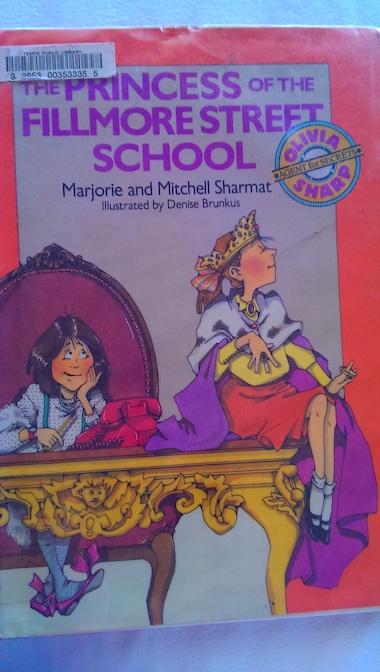
The Princess of the Fillmore Street School

Olivia Sharp, Agent for Secrets

OSPrincess

The Princess of the Fillmore Street School by Marjorie Weinman Sharmat and Mitchell Sharmat, 1989.

Desiree, who has always been a bit prissy, tells Olivia that she has decided that she wants to be princess of their school. She plans to prove that she is a perfect princess by trying to make all the other kids perfect. She is getting on everyone’s nerves, telling them to stand up straight or that their hair needs to be fixed.

When the others ask Olivia to help, she suggests to Desiree that she concentrate on making improvements to the school itself, but even that causes problems. Eventually, things get to the point where the school’s principal asks for Olivia’s help. Can anything stop the princess of Fillmore Street School before she drives everyone crazy?

Olivia’s solution is partly pointing out to Desiree the effect that she’s having on other people and partly explaining that a school which is already governed by a principal doesn’t also need a princess.  Then, she finds a way to help Desiree to feel like a princess even though she can’t be one.

The Pizza Monster

Olivia Sharp, Agent for Secrets

OSPizzaMonster

The Pizza Monster by Marjorie Weinman Sharmat and Mitchell Sharmat, 1989.

Olivia lives in a penthouse in San Francisco with her chauffer, Willie, and her housekeeper, Mrs. Fridgeflake. Her wealthy parents live there, too, but they are often traveling and are rarely home. When her best friend, Taffy, moves away, Olivia is lonely. She buys herself a pet owl named Hoot, but that still doesn’t completely help.  She needs something to help keep herself busy. Olivia realizes that she is good at keeping secrets and at helping people with their problems, so she decides to busy herself running a service to help people with their secret problems. She has a bunch of flyers made and hangs them up around town saying that she is an agent for secrets and will help people.

A boy named Duncan, who Olivia knows from school, asks her to help him with his friend, Desiree. He says that they were together at the pizza parlor when she suddenly got angry and walked out.  He doesn’t know what made her angry, but he asks Olivia to help him find out and fix their relationship.

Olivia’s attempts to help are a matter of trial and error. At first, Olivia thinks that Desiree was merely offended that Duncan gave her the smallest slice of pizza. She suggests that Duncan buy her another whole pizza, but that doesn’t work. Even Olivia’s idea to buy her a lot of different kinds of pizza doesn’t work. Eventually, Olivia talks to Desiree herself and learns that there is another reason why she is angry with Duncan.

It turns out that the problem doesn’t have anything to do with pizza but with Duncan himself.  He’s always full of doom and gloom and criticism for everything.  What Duncan needs is an attitude adjustment.  He doesn’t realize that his pessimism and negativity makes it difficult for others to be around him.  Olivia encourages him to be more positive and to develop his sense of humor.  Once his attitude improves, so does his relationship with Desiree.