The Case of the Wandering Weathervanes by E.W. Hildick, 1988.
Brains Bellingham brings a new case to the other members of the McGurk Organization: a weathervane that he was using for his latest science experiment has been stolen! Although Brains says that the weathervane was extremely valuable because it was a critical part of his experiment, the others don’t think much of it. However, Brains’ weathervane turns out to be just one of many weathervanes that have disappeared all over town.
At first, everyone is sure that it’s just a prank, probably by some local kids, and it gets reported as an odd tidbit on the local news. However, the more weather vanes that disappear and the more time that goes by without them being returned, the more disgruntled the local citizens become. People (like Brains) start claiming that their weathervanes were worth more than they probably were, although there were a couple of legitimate collectors’ items among the stolen weathervanes. The police fail to see the humor behind the incident and start talking about serious consequences for the one responsible for the weathervanes’ disappearances. Unfortunately, as often happens in these cases, people begin looking at Wanda’s brother, Ed, as the culprit.
Ed has a long-standing reputation as a prankster, and so is the first person most people suspect when strange things start happening. Wanda is sure that he isn’t guilty this time, though. Her brother wouldn’t be above taking something for a short period of time just as a joke, but he wouldn’t just steal things from people and keep them. When some of the weathervanes start reappearing, at the wrong houses, it looks like it might have been a prank after all, but Ed still maintains that that he’s innocent.
The members of the McGurk Organization believe that the real culprit might be a friend of Ed’s who admires some of his pranks and might be trying to imitate him with a wild scheme of his own. However, if Ed’s friend is really guilty, where are the missing weathervanes and why haven’t they been returned? A professional private investigator has been pressing the kids for what they know about the thefts, and Ed suddenly disappears! There may be much more to the mysterious disappearing weathervanes than meets the eye. What started as an odd prank may have uncovered something more serious!
The book is currently available online through Internet Archive.
The Case of the Muttering Mummy by E.W. Hildick, 1986.
Joey Rockaway needs to buy a special present for his mother’s birthday. Having broken his mother’s china cat ornament recently, he has decided that he will buy one of the replicas of a golden cat statue from Egypt at the Egyptian exhibit at the local museum. The other members of the McGurk Organization come to the museum with him, and McGurk uses this as an opportunity to give them a kind of memory test about objects in the exhibit.
Actually, everything in the exhibit is a replica, not just the items sold in the museum gift shop. Justin Matravers, a wealthy man who has recently died, collected Egyptian artifacts, but part of his will specified that the collection should never be put on public display. However, his widow, who wanted to show off the collection, had replicas made of everything in the collection so that she could have those put on display.
McGurk sneers about how everything in the exhibit is fake, although he is actually surprisingly superstitious. The museum always did have a real mummy case on display. They always said that the mummy case was empty, but some of the more superstitious kids, like McGurk, believe that there is a mummy inside the case and that there is a curse on it. McGurk has nicknamed the mummy Melvin. The other kids aren’t afraid of Melvin or Egyptian curses, and while they are looking around the Egyptian exhibit, Mari plays a joke by using her ventriloquist skills to make the mummy case “talk.” This trick sets off a bizarre mystery for the McGurk Organization.
A scholar and author, Harrison Keech, is sketching the replicas at the exhibit and witnesses Mari’s trick and Joey picking out the replica cat for his mother. After he asks Joey if he can take a look at the cat, Keech suddenly becomes very upset, saying that the cat statue is cursed! He says that Mari’s joke has angered the spirit of the mummy and awakened the spirit of Bastet. The mummy was a follower of Bastet, the Egyptian cat goddess, and it will now be drawn to the statue if they remove it from the museum. Mari tells Joey that she can tell from Keech’s voice that he’s making up the whole story and that he shouldn’t let that stop him from buying the cat.
However, strange things start happening after Joey buys the cat. It seems like someone is following him home, a dark, shadowy figure. Joey thinks it might even be the mummy, come back to life! The others are skeptical, and McGurk arranges a kind of test where Joey brings the statue with him to a meeting of the organization. Sure enough, a strange figure lurks outside their meeting, and they hear strange whispers in a foreign language!
The spookiness doesn’t last for long. It turns out that Mari, as well as being a ventriloquist, has some skill with different languages and recognizes what the “mummy” says as being Greek, not Egyptian, and the phrases as being typical things that someone might say in a restaurant. When the kids find a scrap of bandage outside, they are quick to notice that it’s a modern, elasticized bandage, like the kind you can get at any pharmacy.
So, the question becomes who is playing at being a mummy and why? Is it Keech, wanting to make the kids think that the mummy story he told them is real, and if so, what would he have to gain from it? The only other two people who know about the story are Joanne, who works at the museum, and Donny, her fiancé, who is jealous of the attention she’s been paying to Keech when he comes to the exhibit.
I have some complaints about this book that hadn’t occurred to me when I read it as a kid. At one point, Donny, who is described as being a social worker, comes to visit the kids because he wants to hire the organization to check up on Keech and his relationship with Joanne. Donny is very jealous, and when he explains how Joanne seems to be falling for all of Keech’s crazy mummy stories, he suddenly turns to Wanda and Mari and says, “You women, you’ll believe anything when a smarmy two-bit jackass like that starts shooting his mouth off!” That’s just really inappropriate for an adult to say to kids, and the whole situation is weird on several levels. First of all, Donny is an adult, and if he’s having issues with his love life, especially with the woman he thinks he wants to spend the rest of his life with, the last thing he should do is hire kids (even really smart ones) to handle the issues for him. Second, Wanda and Mari are young girls, not “women,” and what little girls believe is no business of Donny’s. Trying to imply that Wanda and Mari might someday fall for a “jackass” is not only insulting but implies that Donny is thinking about Wanda and Mari in terms that no grown man should be thinking about girls their ages. I find it disturbing that Donny is apparently a social worker, a person in a position of trust who is supposed to help people in difficult situations to manage their lives, and he’s acting like this. Also, toward the end of the book when the bad guy (I won’t say who it is here, although I thought that the answer was pretty obvious even early in the story) is making his escape, he shoves Joanne aside and calls her a “slut.” That’s pretty strong language for a kid’s book of this level. None of this occurred to me when I was a kid, so maybe other kids reading this wouldn’t notice, but I thought that I’d mention it because these things bother me now.
At one point, Brains gives a demonstration of using water displacement to determine the volume of irregularly-shaped objects, explaining how Archimedes discovered the principal (although I’m not sure that Archimedes’ Principal was quite as he explains it), as the kids investigate what makes Joey’s cat statue so special. You might be able to guess what it is. It seemed pretty obvious to me. The one thing that seemed the most puzzling was how it was done. Mari also offers an interesting explanation of the different kinds of lies that people tell and their motives for doing so.
The book is currently available online through Internet Archive.
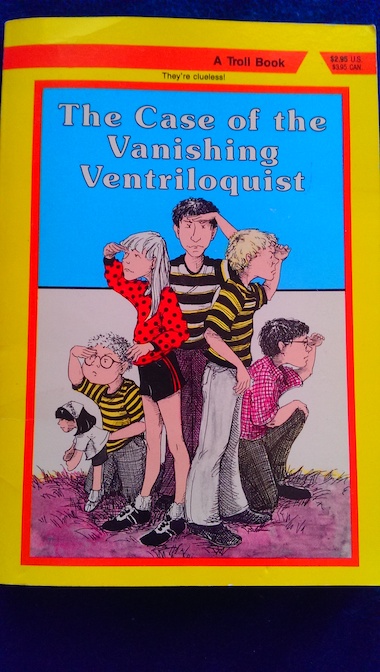
The Case of the Vanishing Ventriloquist by E.W. Hildick, 1985.
Mari Yoshimura, Wanda’s pen pal from Osaka, Japan has just arrived in the United States, and she’s eager to meet Wanda’s friends. Mari’s father is the head of Yoshimura Electronics, and he is visiting different cities in the United States on business. While her father travels, Mari gets to enjoy an extended visit with Wanda. Wanda has told her all about the McGurk Organization, and Mari is eager to join up with them during her stay in America. Unfortunately, when she first arrives, McGurk isn’t in a very receptive mood.
McGurk tells Mari that she can’t join the organization, which hurts Mari and offends Wanda, because he has organized a series of challenges in order to decide which of the current members to give a promotion. McGurk thinks that Mari’s presence would upset the challenges, and he can’t promote her because she hasn’t actually done anything with the organization yet. However, Wanda negotiates with McGurk. Since Mari is her guest, and she can’t neglect her guest, she arranges for Mari to just follow along on the challenges, working through them herself just for fun. McGurk allows it on the condition that Mari not help Wanda because that would give Wanda an unfair advantage. Wanda and Mari agree to the arrangement, and Mari writes all of her notes for the challenges in Japanese, just to make sure that Wanda doesn’t accidentally see any of her answers.
Mari turns out to be really good at the challenges that McGurk sets. When he tells the members of the organization to spend a day observing people and notice how many times people do things that would be a temptation to criminals (like leaving packages in a car, tempting someone to break in and get them), Mari ends up with more observations than anyone else. Mari also proves to be good at noticing suspicious behavior when she sees a man that no one else notices, who seems to be hanging around a bus stop for no reason, not showing any interest in getting on any of the buses.
Then, Brains accidentally discovers a real mystery that the McGurk Organization can investigate where Mari plays a special role. While Brains is working on one of his latest inventions, a new kind of portable phone for kids (this is before cell phones became popular), he accidentally gets his signals crossed and ends up overhearing part of someone else’s conversation. It sounds like the two men Brains overhears are going to target someone at the Senior Citizens’ Annual Picnic. However, because Brains didn’t hear the whole conversation, they can’t be sure what these men are going to do. They report the incident to Patrolman Cassidy at the police station, but he doesn’t think too much of it. He says that he’ll look in on the picnic but that what Brains overheard might not really have to do with a crime. He heard too little of the conversation to be sure what the men were actually talking about.
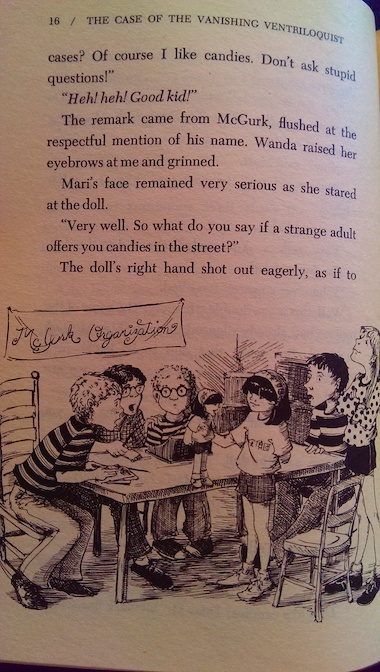
Fortunately, because Wanda’s mother is part of the committee organizing the picnic, the kids have a good opportunity to investigate the matter themselves. Wanda will be helping her mother to serve food, and Mari is going to be part of the entertainment, putting on her ventriloquist act. Mari says that the other members of the organization can be part of her act, so they can be on hand to keep an eye on things. McGurk is pleased about this and finally offers Mari a position as a trainee of the McGurk Organization.
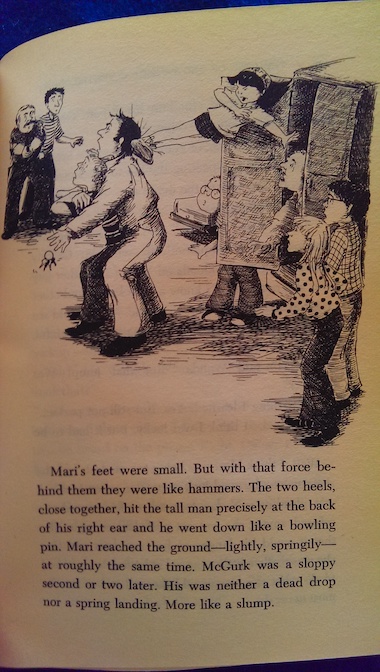
However, it turns out that everyone has completely misjudged the situation. A very serious crime is being planned, and the McGurk Organization doesn’t realize it until Mari is kidnapped from the picnic! Mari was the target all along, and the suspicious man at the bus stop was actually there to watch her. Can the others get her back before it’s too late?
From this book on, Mari becomes a regular character in the series and a full member of the McGurk Organization. Mari’s father decides that he wants to open one of his electronics factories in the United States, so Mari and her family will be living there for awhile to oversee it, giving Mari the chance to stay with the McGurk Organization for an extended period of time. McGurk starts dreaming that when Mari eventually goes back to Japan, she will open a branch of the McGurk Organization there, but that would be years in the future, if it happens. McGurk dreams big.
One of the funniest parts of this book is when the kids are supposed to be looking around for examples of suspicious behavior. Before the challenge begins, McGurk admits that what is “suspicious” is difficult to quantify and that most of what they’ll notice will have perfectly reasonable, non-criminal explanations behind it. Joey Rockaway notes that, for most of that particular challenge, the members of the McGurk Organization themselves are the ones who are acting most suspiciously, running around and spying on random people. At one point, Joey almost gets thrown out of a supermarket because the manager noticed the creepy way he kept spying on a woman who kept picking up packages of cookies and then putting them back. It turns out that the manager of the store knows that the woman is on a diet and has had trouble wrestling with temptation. She routinely gets tempted to buy cookies, picks some up, and then puts them back on the shelf when she realizes that she shouldn’t have them. Her behavior may look odd to people who don’t understand what she’s going through or what she’s doing, but perfectly understandable to those who do, like so many things.
The book is currently available online through Internet Archive.
The members of the McGurk Organization have been planning a kind of open house in order to show the other kids from the neighborhood the kind of mystery-solving work they do. However, someone seems to be doing their best to ruin it.
It starts with the mice that the members of the Organization find in their headquarters, which have already gnawed some of the exhibits for the open house. It quickly becomes obvious that the mice didn’t find their way in by accident when someone posts a sign warning people away from the open house because of the mice. There’s no way anyone could have found out that there were mice, especially not that quickly, unless they had planted them there deliberately. The mysterious sign is signed “Agent 93,” but who is that?
While Brains works on a way to get rid of the mice, the others begin thinking about who could have it in for the McGurk Organization. They consider past cases they’ve solved and villains that they’ve unmasked as well as some of the kids they know generally from school who don’t like them or were offended when they weren’t allowed to join the Organization.
By the time of the open house, they still don’t know who the saboteur is, and when it’s time to unveil the real police handcuffs that Patrolman Cassidy gave them as an award (the highlight of the open house for the McGurk Organization), they are suddenly and inexplicably replaced by a pair of fake mice and another note from “Agent 93.”
Whatever it takes, McGurk is determined to find the guilty person and get those handcuffs back!
The book is currently available online through Internet Archive.
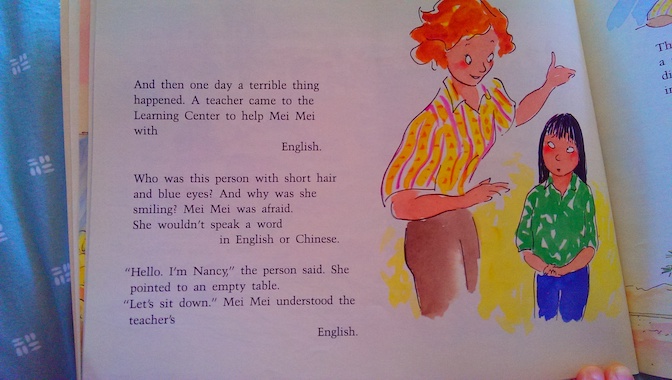
When Mei Mei’s family moves from Hong Kong to New York, she finds herself forced to go to a school where no one else speaks Chinese. She is expected to learn English and to read, write, and speak in English, and she hates it! To her, English is a very strange language, and the writing system is nothing like Chinese. For a time, Mei Mei refuses to speak in English, even when she understands what is being said around her, because she hates it so much.
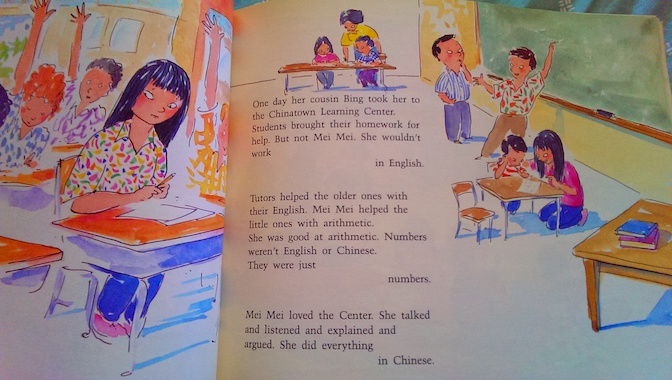
The only part of New York that Mei Mei really likes is Chinatown and the Chinatown Learning Center. Mei Mei likes it because she is surrounded by people speaking Chinese. There, she can relax and be herself because people there understand her.
However, Mei Mei’s refusal to speak English isn’t helping her at school or anywhere else. It’s keeping her from speaking to anyone outside of Chinatown, and it can’t continue. When an English teacher, Nancy, comes to the Learning Center to help Mei Mei with her English, she resists learning at first. She feels like she’ll lose her Chinese and part of her identity if she uses English.
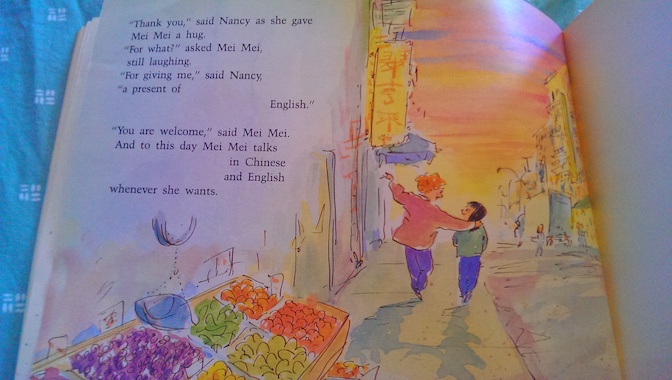
At first, Mei Mei’s worries about speaking English intensify with Nancy’s lessons. It disturbs her how English has words that would be difficult or impossible to translate into Chinese and English words seem to be coming more easily to her, even when she doesn’t really want to speak the language. Nancy explains to Mei Mei that English is necessary for her because she will need it to talk to many people in America, and there are many people who also want to talk to Mei Mei and be her friend, including Nancy. It’s only when Nancy overwhelms her by constantly talking in English and Mei Mei becomes desperate to talk about herself and be understood in English that Mei Mei realizes that speaking a new language doesn’t mean losing her identity. It’s just another way of expressing herself, and she can go back and forth between the two any time she wants.
Mei Mei’s feelings of strangeness in her new home and the difficulties of learning a new language are relatable. The hardest part of the experience for Mei Mei is feeling like she might be giving up a part of her past, her culture, and herself by switching from Chinese to English. But, refusing to speak English puts Mei Mei in the position of being someone who can only listen, never talk, limiting her ability to be understood and to make friends. In the end, she comes to realize that speaking a new language is not a matter of giving up anything, just adding to what she knows and making herself understood in a new way. It’s the beginning of expanding her horizons and building relationships with new people.
My favorite part as a kid was the part where Mei Mei and her friends went to the beach and cooked shellfish that they found. It was interesting to me because I never lived near a beach when I was young. The lifeguard at the beach tells Mei Mei and her friends that they can’t eat the shellfish, and they realize that he thinks that because he doesn’t know how to cook them. I never did either and still don’t, but I liked hearing about it.
The book is currently available online through Internet Archive.
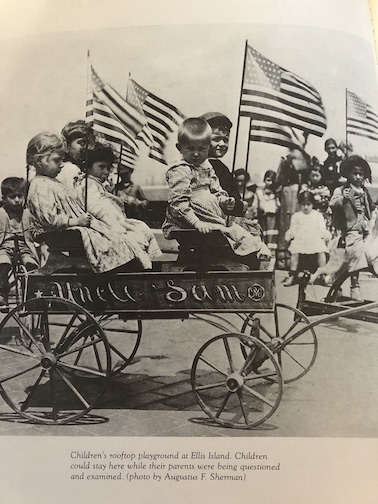
One of the best parts about this book is the pictures. The preface of the book specifically talks about photography at the turn of the 20th century, how cameras were still fairly new technology but growing in popularity. Cameras that were small enough to be held in a person’s hands were an 1880s innovation, and the book mentions that small cameras like that were known as “detective cameras” because they were small enough that they could be used to take pictures without the subjects noticing. Over time, it became easier for amateurs to learn to use cameras, and it became more common for people to take pictures of their ordinary, everyday lives. Pictures like these open up a window on the past. The pictures in this book are of children whose families had only recently arrived in America from countries around the world. The photographer for many of these pictures was Jacob A. Riis, a journalist in New York City who wanted to document the living conditions of poor immigrants. He published a book called How the Other Half Lives in 1890, in which you can see more of his work. Other pictures in this book are by Lewis Hine, who is known for his photographs of child laborers. They are not the only photographers whose work appears in this book, but they are the most famous.
The book is divided into sections, covering different aspects of the lives of immigrant children. In the chapter called Coming Over, the author describes what the journey to America was like. One of the primary motivations for people to come to America around the turn of the century was money and employment opportunities. If a family had little money and little or no chance of getting better jobs in their home country, they would decide to try their luck somewhere else. Because most of the immigrant families were poor, it was common for families to immigrate gradually. Often, the father of the family would come first, find a job, start establishing a life and home for his family, and eventually send for his wife and children when he’d saved enough money. The actual journey was by ship, often in “steerage,” the cheapest form of passage available, in cramped rooms in the ship’s hold.
Although the journey could be harrowing, one of the most nerve-wracking parts was the immigrant processing that took place at immigrant ports like Ellis Island. There were routine questions that immigrants were expected to answer and exams for them to take, and if the questioners weren’t satisfied, the immigrants could be sent back to the country they came from. Doctors would examine the immigrants to evaluate their health and look for signs of possible mental defects. They were particularly concerned about signs of infectious diseases. Sometimes, it was difficult for immigrants to answer all the questions because of language barriers and the immigrants’ own nerves at being interrogated. If an immigrant seemed too agitated, the examiners would typically let them rest for a while before trying again.
The other chapters in the book are At Home, At School, At Work, and At Play, which give more details about the lives of immigrant children as their families settled in America. They often settled in large cities because those were where the most employment opportunities were to be found. Because they didn’t speak much English and needed help learning how things worked in America, such as how to find jobs and places to live and how laws worked, they tended to settle in neighborhoods with others from similar backgrounds who could help them. That is why, even to this day, there are certain areas of large cities, such as New York, Boston, or Chicago, which are known for people of a particular nationality (like the Irish neighborhood, the Jewish neighborhood, Chinatowns, etc.). New arrivals often joined friends or relatives who had already been living in the US for a while, seeking help in getting themselves established. These ethnic neighborhoods were located in poor parts of town because the people there didn’t have much money. People lived in small, crowded apartments called tenements, sharing water and toilet facilities with other families because the apartments were not provided with individual facilities. However, once these groups of immigrant families became established, they remained established for a long time, and they gave these neighborhoods their own distinctive style.
School was often difficult for new arrivals because the children had to learn English before they could study other subjects. There were some special English language learning classes for them at larger schools with enough demand for them. At smaller schools which didn’t have these classes, they often had help from other children who had arrived in America earlier and could act as translators. They were also frequently put into classes for children who were younger than they were, studying easy subjects, until they had learned enough English to move up to classes with children their own age.
Typically, immigrant children aimed to stay in school until they were fourteen years old because that was the age when they could officially get full-time work. However, because their families were poor, the children might have to leave school early to find jobs and help their families make ends meet. The book describes how rules were frequently bent or broken because the laws were not well-enforced, and children often worked at younger ages, even under harsh conditions. For immigrant children, the most important education was that which taught practical, vocational skills that would help them find jobs quickly. Some agencies, like the Children’s Aid Society (known for the Orphan Trains), would help them with vocational training.
However, immigrant children still like to play. Boys and girls usually played separately. Boys frequently played games like baseball in the street, or stickball, which was a variant that could be played in smaller spaces. In stickball, the “bat” was a stick or the handle of an old broom, and the ball was rubber and allowed to bounce before it was hit. Girls would play other games, like “potsy,” which was a version of hopscotch.
Because of the lessons they were taught in schools and because the immigrant children mixed with children outside of their immigrant groups in school, the children absorbed the local culture and became Americanized faster than their parents. Many of them experienced the feelings of being torn between their parents’ traditions and wanting to fit in with society around them.
In each of the chapters in the book, there are anecdotes from people who had arrived in the US as children around the turn of the century, telling stories about different aspects of their lives.
The book is currently available online through Internet Archive.
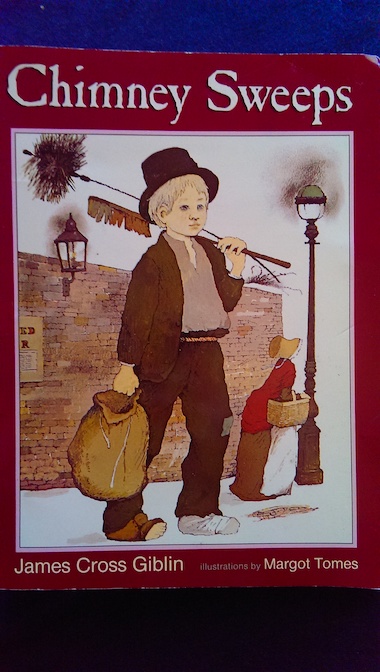
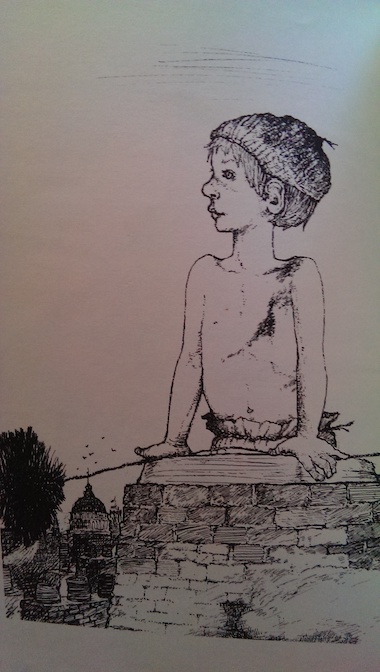
This book explains about the history and traditions of chimney sweeps. I love books that cover odd topics from history like this!
It starts by explaining the origins of chimneys in the Middle Ages. Before they were invented, people would have to have simple holes in the roofs of their houses to let out smoke from heating and cooking fires, or they would have had to rely on windows or doors to perform the function of venting smoke. Chimneys vent smoke more efficiently, but the more they are used, the more soot collects inside them, and they need to be cleaned out from time to time. If they aren’t cleaned, the build-up inside could either block air from getting to the fire in the fireplace, causing the fire to go out sooner, or it could pose a fire risk because the build-up inside the chimney is still flammable. Sometimes, home owners could clean their own chimneys, if they weren’t very tall, but the taller the chimney is, the more professionals are needed to clean it.
Modern chimney cleaners have vacuums that they can use to clean soot out of a chimney, but originally, people were basically relying on brushes. The book explains the evolution of the profession and variations in the profession between England, Germany, and the United States. Germany is significant to the profession because it was one of the first places where chimney sweep became a recognized profession and there were laws even in the 1400s that all chimneys had to be cleaned twice year. (Remember that chimneys that haven’t been cleaned can be a real fire risk, posing a danger not only to you but your neighbors, especially during a time when most buildings are made of wood and other highly flammable materials.) When chimney sweep became a recognized profession during the Middle Ages, members of the profession formed a guild (as was traditional for different professions in general during the Middle Ages) and established rules and standards for the profession. One of the responsibilities of a guild was to decide on the training and qualifications that the profession requires, and in the case of chimney sweeps, the only way to learn was by serving an apprenticeship. The apprentice would live with a master sweep for three years, learning the trade, and at the end of his training, he would have to prove that he could clean a difficult chimney all by himself with thoroughness and reasonable speed.
There are many traditions and superstitions that came to surround the profession of chimney sweep. One of them that you can still sometimes see even in modern times is the image of the chimney sweep in a top hat. The exact reasons for adopting a top hat and tailcoat as part of their uniform are uncertain, but it began back in the 1500s in Europe. The sweeps often got their top hats and tailcoats as secondhand clothing from undertakers (yes, really). Part of the reason for wearing them might have been as an effort to look professional, but the color black was also suitable for a person who was going to end up covered in soot. According to superstition, the top hat would help to protect the chimney sweep from falling when he was on the roof of a house. Chimney sweeps were often thought to be lucky because their jobs were dangerous, yet they survived.
However, chimney sweeps’ lives and work were often hard. In 18th century England, their jobs became more difficult because chimneys were purposely being built in narrow, crooked zigzags. The idea behind the crooked chimneys was that they would keep more heat in, but that made them much harder to clean. Because brushes couldn’t make it around the bends of these chimneys and adults couldn’t get into the narrow flues, sweeps became reliant on young boys to climb up into them and clean them by hand. Although the law required boy apprentices to be no younger than eight years old, many sweeps used boys as young as four or five. Sometimes these boys were official apprentices with the permission of their parents (typically from poor families with many children) or even the sweep’s own children (sometimes, they used their daughters because girls were often smaller than boys). If they couldn’t get children any other way, sometimes sweeps would get children from orphanages or might even resort to kidnapping. The author of this book includes a short story about what a day in the life of a child chimney sweep was like.
The plight of child chimney sweeps came to light during the early 19th century, when people were starting to become concerned about child labor of all kinds. At first, there was strong opposition to banning child chimney sweeps and using new cleaning devices because the adult chimney sweeps saw it as a threat to their livelihoods and home owners were worried that new methods would be more expensive for them (of the two, I think I’m more offended at the home owners’ attitudes because of the implication that they were more upset about a possible slight increase in expense than the risk to the lives of the children they knowingly endangered). Many of the child chimney sweeps suffered severe and permanent health problems because they were forced to do this kind of work at an early age, while they were still growing, and because they inhaled and were covered with soot for such long periods.
In the back of the book, there is a poem by William Blake called “The Chimney Sweeper,” which was published in Songs of Innocence in 1789. Knowing the risks to young children, like the little boys in the poem, makes the poem seem pretty disturbing, which may actually be the author’s intention. Eventually, after long years of struggles in which children were still exploited in chimney sweeping spite of regulations against it, in 1875, Parliament tightened regulations against child labor even further, forcing chimney sweeps to apply for licenses in order to practice their trade, listing each of their apprentices and their ages.
Chimney sweeping in American history was a little different from the way things were done in Europe. The American colonists sometimes tried some strange tactics for cleaning their chimneys. One of the oddest methods was to tie a rope to a goose’s feet and lower it down the chimney. The goose would become frightened and flap its wings, thus knocking the soot loose. When the job was done, the home owner would pull the goose out of the chimney and wash it off. Another tactic was to actually burn the excess soot out of the chimney, although there was a risk of simply setting the house on fire. Later, American cities had official chimney sweeps who were licensed and regulated. On Southern plantations, slaves were used as chimney sweeps, and some of them continued to work as chimney sweeps after they gained their freedom.
Later, when homes began to be heated by other sources than fireplaces, chimney sweeps were in less demand, although there was increased demand in the 1970s, during the energy crisis, because people started using their fireplaces more instead of relying on other heating methods that involved scarce or expensive fuel. Chimney sweeps can also perform other duties beyond simply cleaning chimneys, depending on where they live. For example, in Germany, sweeps perform inspections of factories and homes to make sure that they are using fuels efficiently, looking for sources of needless pollution, which can lead to fines for the owners of the buildings if the problems are not corrected. Some people might also become chimney sweeps as a seasonal part-time job, while they also have another career.
The book is available to borrow and read for free online through Internet Archive.
This is one of those unusual history books that I like about odd, little-covered topics. The author begins by explaining what an imposter is: “a person who practices deception under an assumed name or character.” Each of the people in the following collected stories is pretending to be someone they’re not, for a variety of different reasons. The author points out the differences in the imposters’ motives, which range from pure greed to a desire for fame and attention to thrill-seeking behavior. Each of these stories really happened, and the people involved were real people, even if their claimed identities weren’t. The stories skip around in time and location, so they can be read in any order.
Willie the Actor – Willie Sutton started out as a petty thief while growing up in a tough Brooklyn neighborhood and later graduated to pulling a series of daring robberies while wearing various disguises during the 1930s through the early 1950s.
Bad Habit – Ferdinand “Fred” Waldo Demara, Jr. was the son of a fairly wealthy man who later lost the family’s money. Sis family’s loss of their previously well-off position was hard for Fred, and it led to a lifetime of him trying his hand at various professions (winging it without proper qualifications) and adopting (or stealing) new identities. The movie The Great Imposter was based on his life and exploits.
Princess of Pretense – Sarah Wilson was a maid in the household of Queen Charlotte in England during the 18th century. When she stole some clothes and jewelry belonging to the queen, she was exiled to the American colonies as an indentured servant. However, she used her knowledge of royal and the objects she stole to run away and pose as an exiled younger sister of the queen.
Lord Gordon-Gordon – Philip Guy spent his youth stealing and selling stolen goods for extra money until he ended up stealing a trunk that happened to contain gentlemen’s clothes that happened to fit him. When he noticed how much better everyone treated him when he was dressed as a wealthy gentleman, he created a new identity for himself as an English lord, undertaking greater thefts and frauds to maintain it.
The Counterfeit Count – Victor Lustig acquired a skill for languages when he was young and later used them when he masqueraded as an impoverished nobleman, covering up his gambling habits and confidence swindles in Europe and America, including his daring scheme in 1920s Paris to sell people materials from the Eiffel Tower, which was supposedly going to be dismantled. He also once successfully swindled Al Capone.
The Claimant – During the mid-1800s, Arthur Orton pretended to be Roger Tichborne, the long-lost (and probably deceased) heir to an English baron.
The Baron of Arizona – James Addison Reavis, a former Confederate soldier from the American Civil War, learned that he had a talent for forgery and tried to use it to forge land grants, giving himself a large section of land in the Arizona Territory and the title the “Baron of Arizona.”
The Actress – Constance Cassandra “Cassie” Chadwick was a girl from a poor family in the 1800s who posed as a spiritualist, swindling people while claiming to save them from terrible fates, and later, pretended to be a lover of Andrew Carnegie. (This book doesn’t mention it, but other sources say that Cassie’s real name was Elizabeth Bigley, and they say that she claimed to be Carnegie’s daughter, not his lover.)
Electronic Trickery – Reginald Jones was a scientist in Britain during the 1940s. He was also a practical joker who enjoyed taking on new identities in order to play pranks on friends and colleagues over the phone. Later, during WWII, he found ways to put his practical joking to practical use.
The Skywayman – Frank Abagnale took on a variety of new identities while writing bad checks during the 1960s and 1970s. The story of his life was later turned into a book called Catch Me If You Can and a movie of the same name.
Dangerous Game – This chapter is about WWII intelligence agents, who also had to assume new identities to do their jobs without being caught.
The Man of a Hundred Lies – Stanley Clifford Weyman was an imposter from the 1920s through the mid-20th century who held a variety of prestigious positions . . . all self-appointed.
The book is currently available online through Internet Archive.
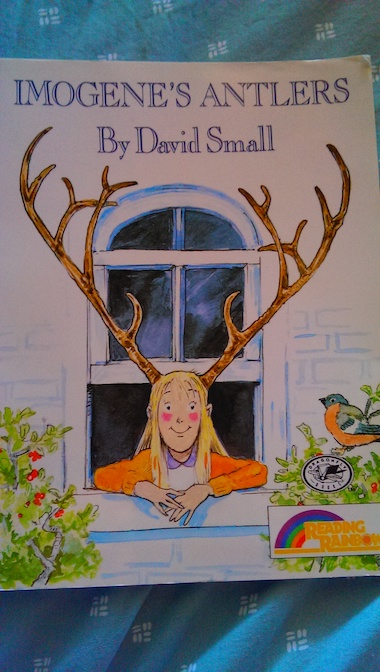
One day, a young girl named Imogene wakes up to find that she has sprouted antlers during the night. It comes as a shock to the rest of her family, and she finds that it’s very difficult to do things with large antlers sticking out of her head.
No one seems to know why Imogene has sprouted antlers or what to do about them. Imogene’s mother faints just about every time she looks at her daughter, and her attempt to help Imogene hide them with a specially-designed hat is pure disaster. Imogene’s brother, Norman, thinks that Imogene might be a rare kind of elk now.
However, Imogene still has a lovely day as the family maid uses her as a rack to dry towels and the cook decks out her antlers with donuts to feed the birds. She even puts candles on her antlers as an elaborate candelabra while she practices her piano lesson.
Still, it’s a most bizarre day, and her family is relieved when the antlers are gone the following morning. But, Imogene’s adventures may only be just beginning.
The book never offers an explanation for why Imogene grew antlers or why she now has a peacock tail, but it doesn’t really matter. This is just one of those books that’s fun to read because it’s silly. While Imogene’s mother panics over her daughter’s condition and tries to hide it under a ridiculously big hat at one point, readers don’t have to worry about the long-term implications of Imogene’s antlers (or any other animal transformations) because she just enjoys them for what they are. The peacock feathers may not have as many practical uses as the antlers did, but one can imagine that Imogene will make the most of them while she has them. I loved this book when I was a kid!
Paul Bunyan and Babe the Blue Ox by Jan Gleiter and Kathleen Thompson, 1985.
This story is based on an American folktale that was used to promote the logging industry. The book doesn’t explain the background to the story, but in a very literal sense, it is a “tall tale.” The book is part of a series about legendary figures from history and myth.
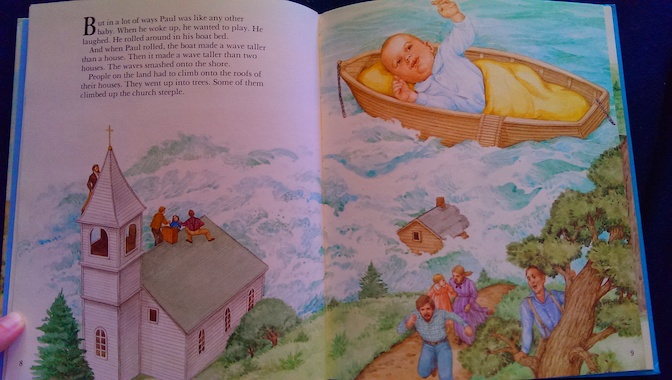
Paul Bunyan is a giant of a man, and he was a giant since he was a baby, even though his parents were both of normal human size (no explanation given). Because he was never small enough to fit in his parents’ house, they made a large boat for him to sleep in as a cradle, rocking him to sleep on a river. Needless to say, having a giant baby complicates everything and can pose a real risk to everyone. His parents had to teach him early about what he could and couldn’t do so that he would avoid hurting people.
However, Paul discovered early that he was skilled with an ax, and because of his great size and strength, he realizes that he is good at cutting down trees. Because this was the frontier days in America, good loggers were in demand because trees were plentiful and wood was needed to build houses and railroads. (Paul Bunyan would not be such a hero for cutting down whole forests today.)
However, a giant of a man can also be lonely when there’s no one around his own size. Paul finds a companion in a giant blue ox. (Yep, that’s part of the traditional story.) He found the ox partly buried in a blizzard. After he dug it out, he named it Babe, and the two of them became lifelong friends.
Part of the story is that the Mississippi River and all the lakes in Minnesota were caused by Babe accidentally spilling water that he was carrying on his back. Paul also supposedly dug the Grand Canyon by accident by dragging his ax behind him when he walked to California.
Paul also meets a man named Hals Halvorsen who is almost his size. After trees get cut down, Paul and Hals pound the stumps into the ground with their fists to finish clearing the land. Then, they try planting some corn to see how good the land is for farming, but the corn stalk grows up so high that Hals nearly starves to death while climbing it to try to find the top of it.
The part of the story I liked the best as a kid was when they made gigantic pancakes for Paul Bunyan and Babe, greasing their giant griddle by basically skating across its surface with grease strapped to their feet.
I can’t say that this was one of my favorite folktales as a kid, and my feelings as an adult about deforestation don’t make me feel good about it now. Still, it is an interesting piece of Americana and a little nostalgic. As a side note, Paul Bunyan was used as a mascot for a pancake restaurant in an episode of Disney’s Phineas and Ferb (which has also been done in real life). In that episode, Norm, a giant robot, accidentally gets the head of the Babe statue outside the restaurant stuck on his head, causing Phineas and Ferb to think that they are being chased by a Minotaur. Now that I think about it, this joke’s use of Paul Bunyan and Babe the Blue Ox makes me smile more than the original version of the story.
The book is currently available online through Internet Archive.















 Jestress's Forgotten Books and Stories