Clever Tom and the Leprechaun

CleverTom

Clever Tom and the Leprechaun by Linda Shute, 1988.

This picture book is based on an Irish folktale, The Field of Boliauns.

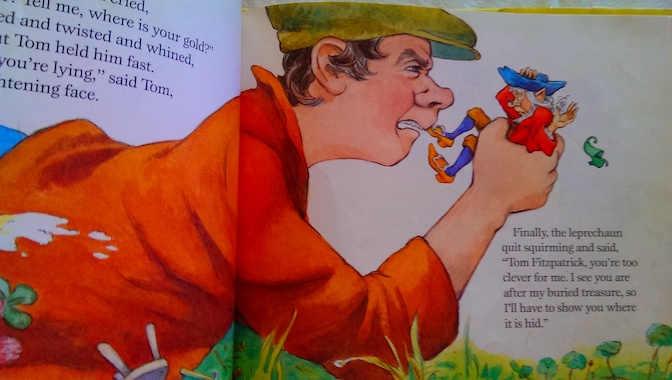
Tom Fitzpatrick thinks that his fortune is made when he is lucky enough to catch sight of a leprechaun one day.  If a person can manage to catch hold of a leprechaun and frighten him, the leprechaun will hand over his gold.  Tom thinks of himself as a clever man, so he doesn’t see how he could fail.

CleverTomCapture

Tom does capture the leprechaun, and the leprechaun does promise to show him where his treasure is buried.  The leprechaun directs Tom to a field of boliauns (a kind of weed, also known as ragwort or ragweed) and points out the plant which marks the place where he buried his treasure.

CleverTomField

Tom needs to get a shovel to dig for the treasure, but he worries about whether he’ll correctly remember the spot when he gets back.  He takes off one of his red garters and ties it on the plant so he’ll be able to find it again, making the leprechaun promise not to touch it while he’s gone.

CleverTomGarter

The leprechaun promises not to touch the garter, but Clever Tom isn’t quite as clever as the leprechaun.  When Tom gets back to the field with his shovel, he’s in for an unpleasant surprise.

CleverTomTrick

Clever Tom might not have his fortune made after all, but he has a great story to tell to the younger generation.

CleverTomTaleTelling

In the back of the book, there is a section with more information about the folk tale, Irish legends and leprechauns, and Irish culture and history.  One of the things I found interesting was the explanation that the leprechaun in the picture book is wearing a red coat because that’s how they are described in Irish folklore.  It’s usually the Trooping fairies who are described as wearing green, like we often see leprechauns depicted in St. Patrick’s Day decorations.  The stories of buried gold left by leprechauns may also may also be based on treasure hoards left by Viking raiders during the Early Middle Ages.  The leprechaun in this story also has ale made from heather, which is something that only Danish Vikings were said to know how to make.
Gila Monsters Meet You at the Airport

GilaMonsters

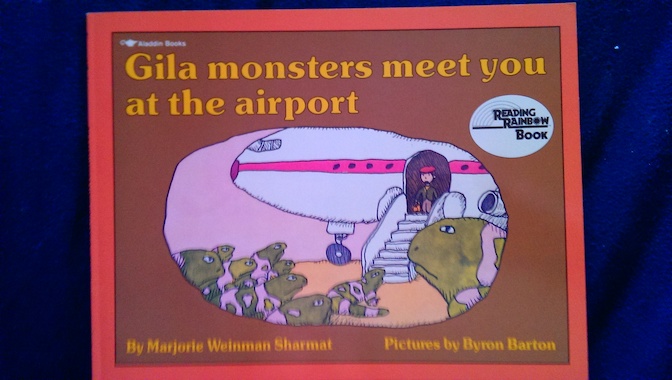
Gila Monsters Meet You at the Airport by Marjorie Weinman Sharmat, pictures by Byron Barton, 1980.

This is a humorous picture book about a boy moving from one side of the United States to the other and his misconceptions of what he’s going to find when he goes west.

At the beginning of the story, the boy lives in an apartment in  New York City.  As far as he’s concerned, he could live there forever, but his parents decide that they’re going to move “Out West.” (The book never really says what state they’re moving to, but it seems to be somewhere in the Southwestern United States, like Texas, New Mexico, or Arizona.)

GilaMonstersMoving

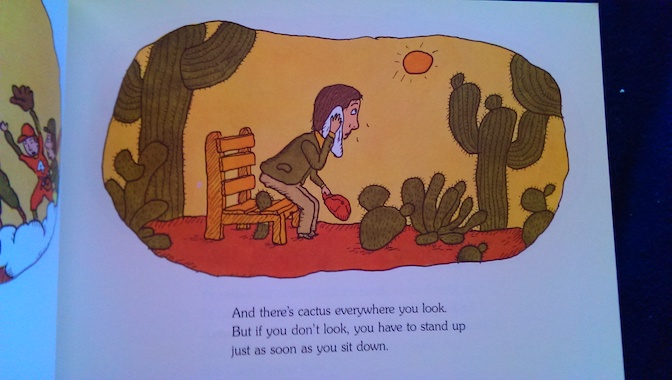
The boy thinks he’s going to hate his new home.  He thinks of all the things that he’s heard about the West, like there’s cactus everywhere so you hardly know where to sit down, everyone dresses like a cowboy and rides horses everywhere, all he’ll ever get to eat is chili and beans, and he’s bound to die of heat exhaustion in the desert.  His best friend in New York, Seymour, told him that Gila monsters would meet him at the airport.

GilaMonstersCactus

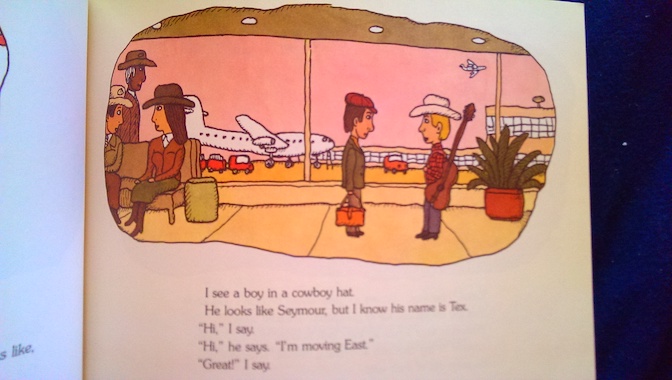
Of course, there aren’t any Gila monsters at the airport when the boy gets there.  Instead, he meets another boy whose family is moving East.  The two boys talk to each other for awhile, and the Western boy starts telling him that he’s not looking forward to heading East because he’s heard that it’s always cold there, the cities are overcrowded and full of gangsters, the buildings are so tall that airplanes fly through the apartments, and there are alligators in the sewers.  He expects to find alligators waiting for him at the airport.

GilaMonstersAirportBoy

Of course, things aren’t as bad as either boy is expecting.  The boy from New York realizes that Seymour and his other friends back East don’t know much about the West, and he starts realizing that things in his new home are actually pretty good, some of them not all that different from home.

GilaMonstersArrival

This book was featured on Reading Rainbow.

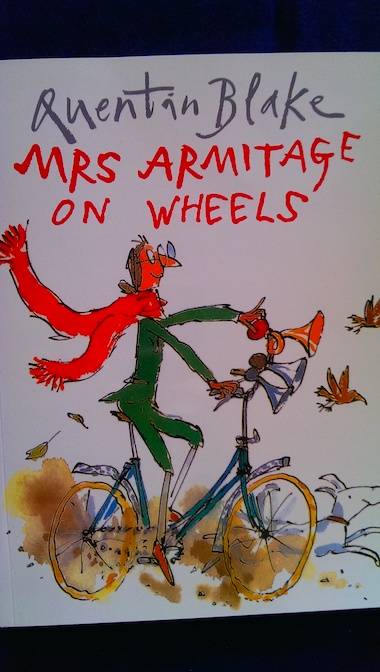
Mrs. Armitage on Wheels

ArmitageWheels

Mrs. Armitage on Wheels by Quentin Blake, 1987.

Mrs. Armitage loves to ride her bicycle with her dog, Breakspear, running alongside.  However, she sometimes runs into difficulties that require some minor repairs to her bike, and she can’t resist the urge to tinker further.

The more she thinks about it, the more ideas for improvements she has.  Each idea starts with the words, “What this bike needs . . .”

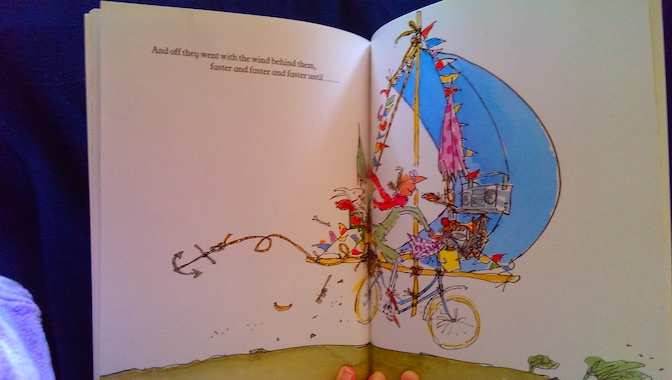
But, Mrs. Armitage goes well beyond what the bike really needs.  Beyond adding a seat for her dog and room for her lunch, she gradually turns her bicycle into a crazy, unwieldy contraption.

ArmitageWheelsSail

Was adding the sail and anchor where she went too far, or did she reach that point long before?  Even after she trades what’s left of her bike for some skates, one has the feeling that her tinkering is far from over.

The book is available to borrow and read for free online through Internet Archive.

ArmitageWheelsSkates

Huggins and Kisses

HugginsKisses

Huggins and Kisses by Susan Creighton, illustrated by Ron C Lipking, 1985.

Mary has been wanting a dog for some time. She admires her neighbor’s dog, Sugar, who is so well behaved.

When her parents finally give her the puppy she’s been wanting, Mary is thrilled, and names the puppy Kisses. However, taking care of a dog and training it turns out to be a lot more work than Mary expected! Kisses doesn’t know how to walk on a leash, and he sometimes chews things he shouldn’t.

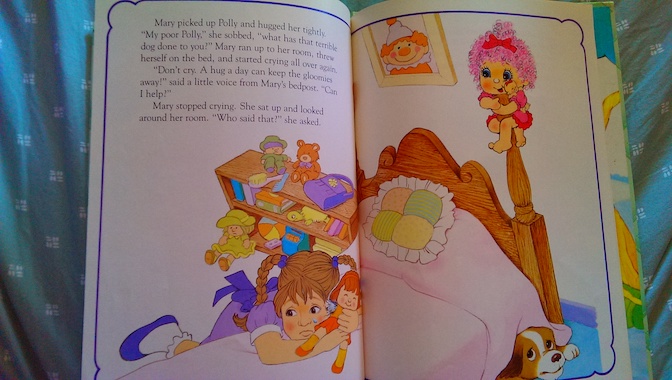
One day, Mary gets angry with Kisses for ripping the arm off of her favorite doll and yells at him. While Kisses is hiding under Mary’s bed, and Mary is crying, one of the Hugga Bunch, Huggins, appears to comfort them. Mary is surprised to see Huggins, and she explains to Mary that she is from Huggaland, which can be reached through her bedroom mirror. She invites Mary to see it for herself, and Kisses follows them.

HugginsKissesDoll

In Huggaland, Huggins repairs Mary’s doll, which makes her feel better. Then Kisses knocks over the birdbath at Huggins’s house, and Mary gets angry again. Huggins points out to Mary that Kisses hasn’t actually broken anything and that he was probably looking for water because he was thirsty. Huggins gives Kisses more water and a hug.

Mary asks Huggins how she can hug Kisses when he’s been bad, and Huggins explains the importance of gentle discipline. Dogs may be naughty sometimes, but what they really need is love and training. Mary just hasn’t been patient with Kisses and given him the time he needs to learn how to behave.

Mary remembers how much that she really loves Kisses and resolves to give him the time and attention he needs to learn to be a good dog.

It’s a cute picture book, and a nice story about learning to care for pets, giving them the training they need and the time to learn.

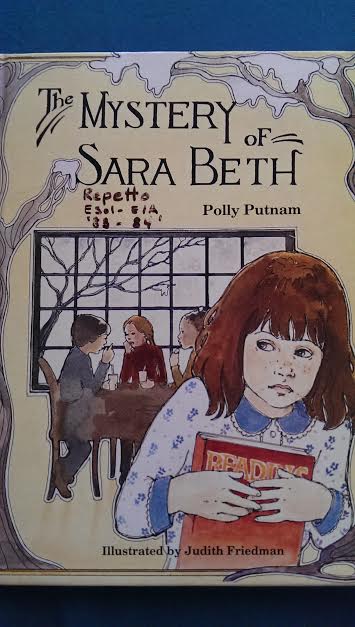
The Mystery of Sara Beth

SaraBeth

The Mystery of Sara Beth by Polly Putnam, illustrated by Judith Friedman, 1981.

This was one of my favorite books when I was young. It’s a nice mystery story for children in early elementary school.

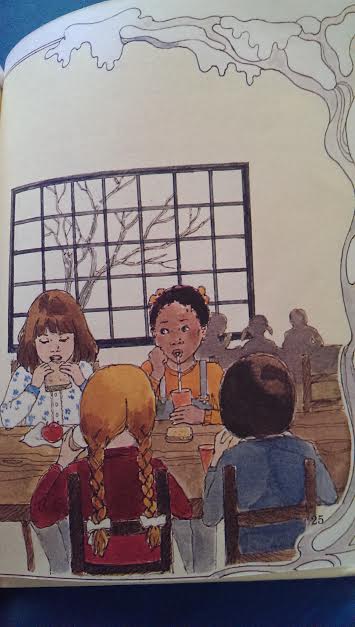
When a new girl named Sara Beth joins their class, Becky and her friends go out of their way to make her feel welcome. However, Sara Beth barely acknowledges their attempts to make friends with her.

SaraBethPic2

Becky becomes concerned about Sara Beth and her lack of interest in making friends at school. Becky also notices some other odd things about Sara Beth’s behavior, which tends to change unexpectedly.  Sometimes, Sara Beth likes the class’s pet guinea pig, and sometimes she seems afraid of it.  One day, Becky catches Sara Beth taking a reading book home that was supposed to stay in the classroom.  Later, she sees Sara Beth hiding a cupcake from a class party to take home. Could these things help explain what Sara Beth is trying to hide?

The book is currently available online through Internet Archive.

My Reaction and Spoilers:

The solution to Sara Beth’s problem is quite simple, but it may seem bigger to younger children. The story presents a good example of the use of observation and logical thinking when approaching a problem. As Becky tries to determine why Sara Beth acts the way she does, Becky watches her closely and makes a list of her observations before coming to her final conclusion.  Becky is not only compassionate toward Sara Beth in trying to help her solve her problem and make friends at her new school, but she is also a very logical thinker.  I really enjoyed her as a character!

The artwork in the book is nice, and I thought it was clever how the borders of all of the images kind of give a hint to Sara Beth’s problem.  Even when the characters are indoors, the pictures are surrounded by snow-covered trees because it’s important to the story that it takes place in winter.  The snow is the root of Sara Beth’s problem.  The girls live in a cold climate and “Sara Beth” comes from a poor family.

(Spoiler: Becky correctly realizes that “Sara Beth” is actually a set of twins, Sara and Beth, which is why they behave differently each time they switch places.  Their family moved to the area from a warmer climate because the twins’ father is looking for work, but they only had enough money for one warm coat for the girls, so one of them has to stay home while the other goes to school.  They take turns going to school, and the one who goes to school brings the other one books, school assignment, and class treats so she can follow the lessons and not miss out.  When Becky confronts one of the twins, Beth, she admits that they were afraid of making friends at school because they knew that someone would find out the truth.  Becky persuades Beth to talk to their teacher, and the teacher arranges for the twins to receive an extra coat that was unclaimed from the school’s lost and found so that they can both come to school.)

In the back of the book, there’s a list of vocabulary words that appear in the story. It does not provide definitions for these words, though. I think that the most unusual words in the book were guinea pig and tetanus shot.

One more thing I thought that I would mention is that Becky, the main character, is African American. This is not mentioned at all in the text of the book and is not important to the story, but it is shown in the pictures.  I didn’t think about it much when I first read the book as a kid, but looking back on it, I found it interesting because it reminded me of the character of Adam in the Third Grade Ghosthunters series.  It fascinates me that there is something about these characters that people wouldn’t know without looking at the pictures, and I also like it that the characters themselves are not defined by race.  It’s just an interesting detail, not central to their characters.

The Mysteries of Harris Burdick

HarrisBurdick

The Mysteries of Harris Burdick by Chris Van Allsburg, 1984.

Harris Burdick isn’t exactly a mystery story, not even really a story exactly, but it is mysterious.  Most of the book is pictures, and that’s kind of the point.  The premise of the book is that a mysterious stranger known only as Harris Burdick approached a publisher about some stories that he had written and illustrated.  As examples of his work, he gave the publisher a collection of illustrations he had done for each of his stories with accompanying captions.  The publisher loved the illustrations, but Harris Burdick didn’t keep his appointment to bring in the complete stories the next day.  When the publisher tried to contact him about the stories, he was never able to find Harris Burdick and never heard from him again.  However, the publisher continued to be intrigued by the pictures and wondered what the stories were like, so his children and their friends wrote their own stories about them.  The pictures are therefore presented as a collection, and readers are invited to imagine the stories that they are part of.

HarrisBurdickAnotherPlace

I remember one of my teachers using this book as part of a writing exercise, having us each choose a picture and write the accompanying story as we imagined it.  Over the years, I’ve changed my mind about which picture is my favorite.

HarrisBurdickLibrary

I thought for awhile that “The House on Maple Street” could have inspired the author himself in writing Zathura, the sequel to his other book, Jumanji, although there is apparently no direct link between the two.

HarrisBurdickHouse

The book is currently available online through Internet Archive.  There is also a collection of stories called The Chronicles of Harris Burdick in which well-known authors present their own versions of each of the stories.

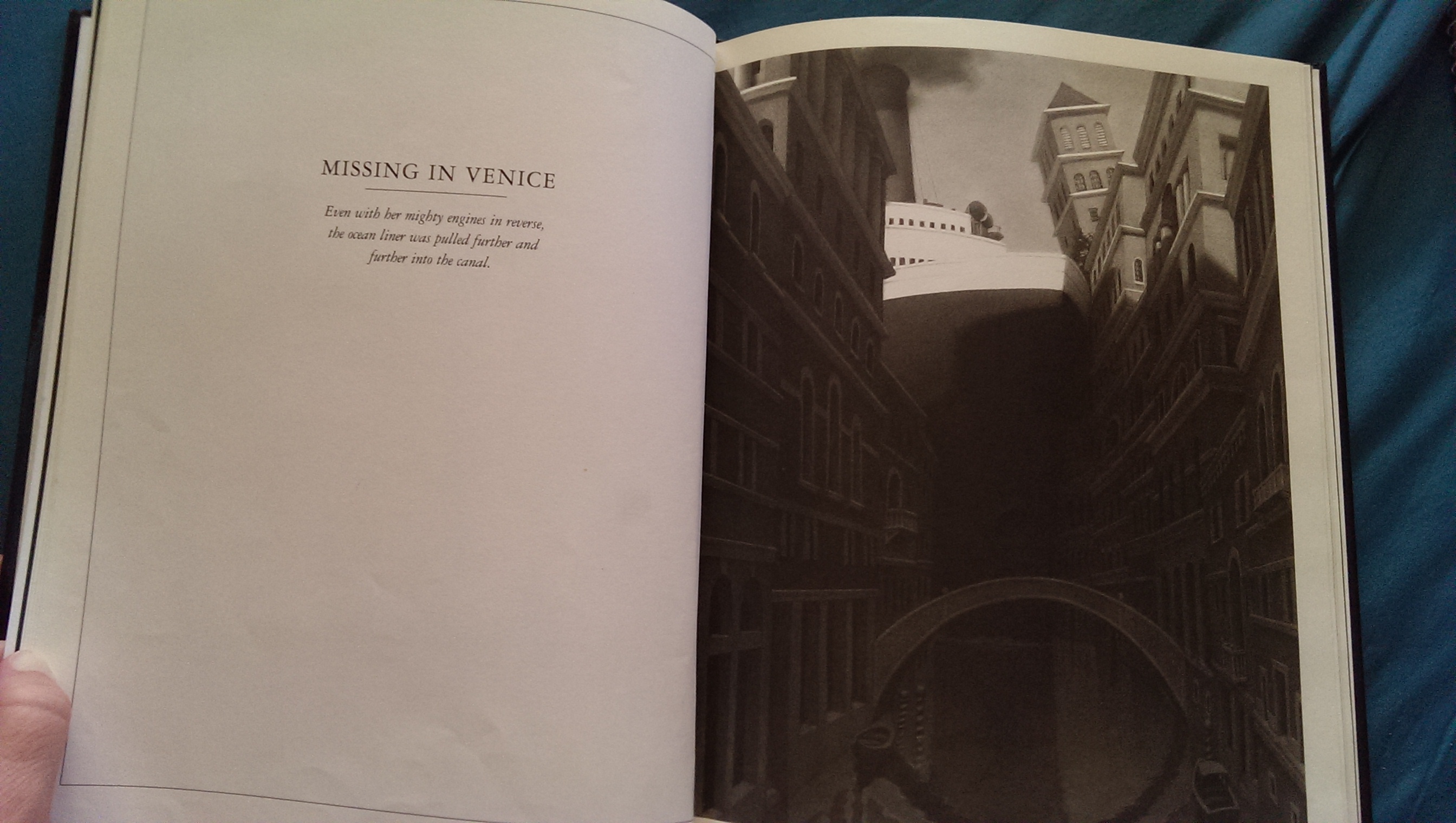
HarrisBurdickVenice

Jumanji

Jumanji

Jumanji by Chris Van Allsburg, 1981.

Judy and Peter, a brother and sister, are left home alone while their parents go to an opera. In spite of their parents’ warning not to make a mess because they’ll be bringing guests by later, the kids scatter all of their toys around while playing. Then, the kids go to the park to play for awhile, and they find a board game labeled Jumanji with a note that the game is free to anyone who wants to play it. Judy and Peter decide to give the game a try and take it home.

JumanjiPark

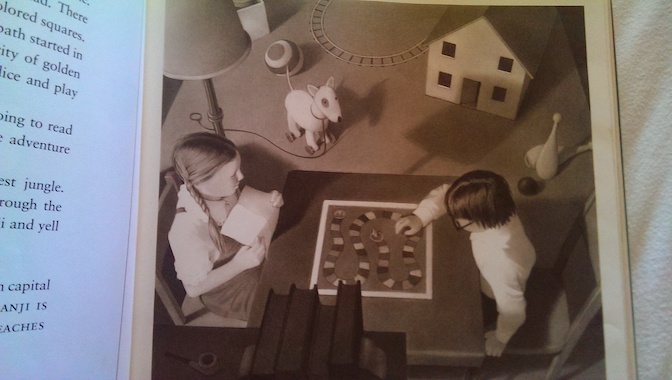
Jumanji turns out to be a kind of race game. Players are supposed to make their way down a path through a jungle, facing all kinds of dangers, until someone reaches the golden city of Jumanji. The instructions warn them that once a game has begun, it will not be over until one of the players reaches Jumanji.

JumanjiGameStart

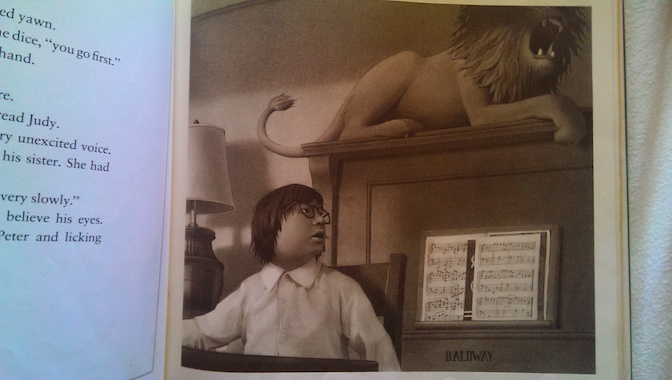
At first, Peter thinks that the game is boring and easy, but it soon becomes apparent that things that happen in the board game are starting to happen in real life when a live lion suddenly appears after an encounter with one on the game board.  Peter is scared and wants to stop playing, but Judy reminds him that they can’t stop because the game won’t end until one of them reaches the end of the path on the game board. Until the game ends, they’re stuck with the lion and anything else that happens to appear because of the game. They have no choice but to keep playing, facing each danger as wild animals rampage through their house.

JumanjiLion

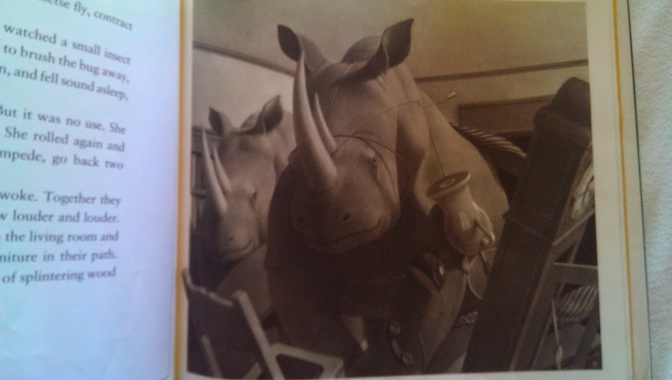
Chris Van Allsburg books always have amazing illustrations, and the pictures in this book are especially good!  At the end of the book, the children see two other children find the game, which leads to the sequel, Zathura.

JumanjiRhino

There is a movie version of this book, but the movie differs greatly from the original story. In the movie, the two kids were friends, not brother and sister, and the boy ends up trapped in the game for a period of years until, finally, a new set of kids starts playing and helps the original players to finish their game.  When their game ends, the original children are returned to their own time, and no one but them knows that they were ever gone.  Things turn out better for the future children as well because the older players make things better for everyone in their own time.  There were no players stuck in the game in the original book, and everything takes place during a single day.

The book is currently available online through Internet Archive.

JumanjiParents

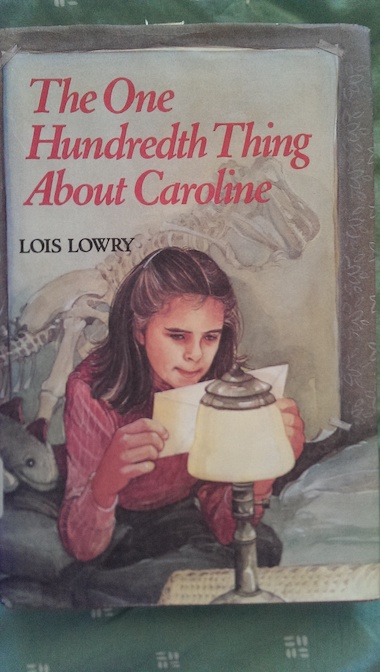
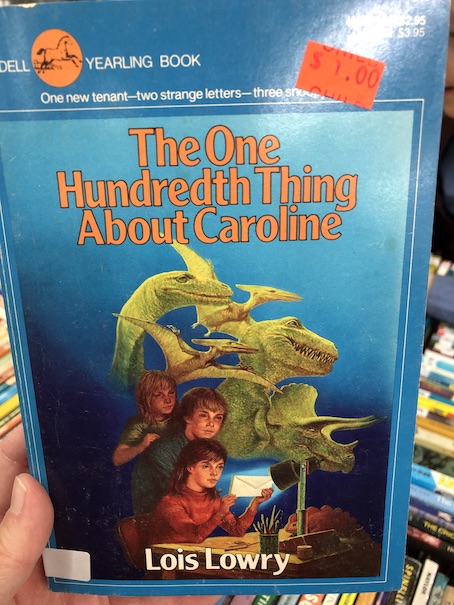
The One Hundredth Thing About Caroline

The One Hundredth Thing About Caroline

The One Hundredth Thing About Caroline by Lois Lowry, 1983.

Eleven-year-old Caroline Tate knows that she wants to be a paleontologist when she grows up, but she is also fascinated with her friend Stacy’s dream of becoming a great investigative reporter. For fun, the two girls begin investigating the people who live in their respective apartment buildings.

Caroline’s investigation focuses on the mysterious Frederick Fiske, who lives on the fifth floor of her building. In a wastebasket, she finds a letter written to him by a man she’s never heard of telling him to “eliminate the kids.” Also in the wastebasket, there is an overdue notice for Fiske from the library, and the book is about poisons. From this evidence, Caroline comes to believe that the strange Mr. Fiske is planning to murder some children.

The situation becomes worse when Mr. Fiske begins dating her divorced mother, and Caroline fears that the children Mr. Fiske is planning to murder are her and her brother, J.P.. Can Caroline, J.P., and Stacy prove that Mr. Fiske is a cold-blooded murderer before his relationship with the Caroline’s mother can go any further and before he succeeds in poisoning them?

The book is available to borrow and read for free online through Internet Archive.

My Reaction and Spoilers:

It’s a bit of a spoiler, but this is one of those stories where the mystery is largely based on a series of misunderstandings. The book is a comedy mystery.  Mr. Fiske isn’t really a murderer, although he has done some things which make the children suspicious.  It’s a humorous story, and the kids’ antics as they try to further their investigation and collect “evidence” against Mr. Fiske are hilarious.  Along the way, the kids end up helping Mr. Fiske with a problem he’s been having, and the kids realize that they’ve made a mistake about him and his intentions.  Whether Mr. Fiske learns of their suspicions about him or not is left to the imagination, although something at the very end of the story may bring everything out into the open.

The title of the book comes from a joke between Caroline and her mother.  Caroline’s mother is always talking about the things she loves about Caroline, giving them different numbers.

Who Stole Kathy Young?

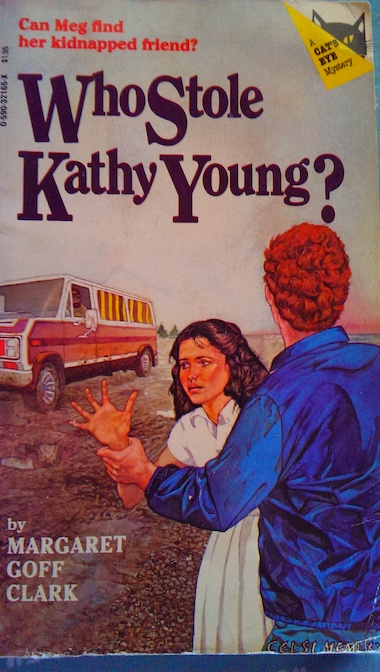
KathyYoungWho Stole Kathy Young? by Margaret Goff Clark, 1980.

Kathy Young has had her share of problems.  Her mother died a year and a half ago, and now, her father has a housekeeper with a sour personality.  A couple of months after her mother’s death, Kathy was seriously ill, and her illness caused her to lose most of her hearing.  She now depends on a hearing aid and her improving lip-reading and sign language abilities.

This summer, Kathy’s best friend, Meg, is staying with her while her parents are on a trip to Switzerland.  Meg was of great help to Kathy when she was trying to adjust to her hearing loss, practicing sign language with her during her special lessons.  Kathy’s dream is to become an artist, but Meg now wants to be a teacher for the deaf, like the teacher who taught Kathy.  Kathy is still very unsure of her abilities to cope with her deafness.  She had the opportunity to attend a special art workshop over the summer but passed it up because she was worried about whether she would be able to communicate with and understand her teacher and the other students, and she knew Meg couldn’t attend to help her.

Kathy has been enjoying Meg’s summer visit, but the girls have noticed something odd.  It seems like a couple of strangers, a man and a woman, have been hanging around everywhere they go.  Meg is worried about it, but Kathy doesn’t want to worry her father.  She thinks that they’re probably tourists, like the housekeeper said.  They nickname the strangers Heron and Toad because of their appearances.

One day, Kathy is kidnapped!  Some men in a van stop to ask her directions and when she tries to explain where they have to go, they pull her inside and drug her!  Meg witnesses the kidnapping, but is standing too far away to help Kathy.

When Kathy wakes up from being drugged, she finds herself on a boat.  Her abductors have cut her hair and changed her shirt to disguise her from anyone who might spot her.  They’ve also taken her hearing aid, hoping to render her helpless and keep her from finding out their plans because she can’t hear them.  However, Kathy isn’t as helpless as they think.  She can still read lips, and she can still think.

Kathy learns to rely on herself and her own wits as she tries to gather as much information as she can about her kidnappers and to figure out how she can save herself.  Through this experience, she develops more self-confidence, realizing that she can do more and handle more than she had thought was possible.

While Kathy is struggling in captivity and her father is dealing with the police and the ransom demand, her friend Meg is trying desperately to find her.  The story alternates viewpoints between the two girls as Meg aids the investigation into Kathy’s disappearance and puts together clues that Kathy leaves for her as her abductors move her from place to place.  The mastermind behind the kidnapping plot is closer to home than they think.

The book is available to borrow and read for free online through Internet Archive.

The Haunting at Cliff House

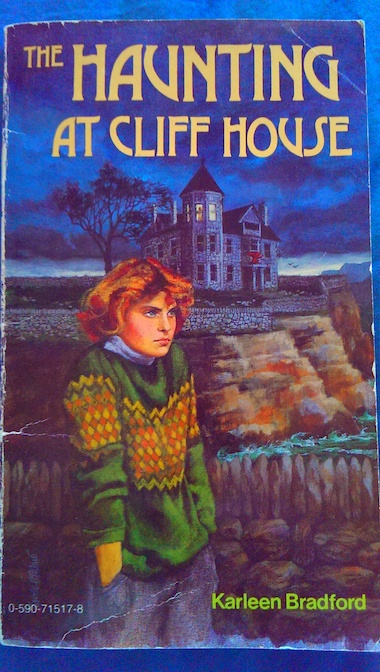
HauntingCliffHouseThe Haunting at Cliff House by Karleen Bradford, 1985.

This is a relatively short chapter book, but suspenseful, thoughtful, and well-written.

When her father inherits an old house in Wales from a distant relative, Alison, a young teenager, finds out that he plans for the two of them to spend the summer there.  Alison’s father is a university professor and is writing a book, and he thinks that the house in Wales sounds like a great place for him to get some writing done while he and Alison have a look at his new inheritance.  Alison isn’t enthusiastic about the trip, but she and her father are very close, especially because she lost her mother at a very young age.  Besides, the only place she could stay in Canada would be with her grandmother, and her grandmother didn’t seem enthusiastic about having her.

From the moment they arrive at the old house, called Pen-y-Craig or Cliff House by the locals, Alison has a bad feeling about it.  It stands on a lonely cliff by a small town.  The carved dragon over the door gives her the creeps, and there is something disturbing about a particular room in the house.  Sometimes, she can almost hear a voice calling out to her, and she has visions of another girl, about her age.  At first, she tries to tell herself that it’s all her imagination, but it soon becomes obvious that it’s not.

Some of the local people know that the house has an unhappy history, and Alison eventually learns that the great-aunt that her father inherited it from even refused to live there during her last years because it disturbed her too much.  A little more examination of the room that had disturbed her helps Alison discover the reason why.  After having a vision of a young girl hiding something behind a brick in the fireplace of one of the bedrooms, Alison searches the spot and finds a diary dating from 1810, written by a girl named Bronwen, who was the same age as Alison.  Like Alison, Bronwen was brought to the house by her widowed father and was unhappy about it, but those aren’t the only parallels between Bronwen’s life and Alison’s.

Alison becomes uncomfortable with her father’s new friendship with a Welsh neighbor, Meiriona.  Alison likes Meiriona’s younger brother, Gareth, but when it looks like her father’s friendship with Meiriona is turning into romance, Alison becomes jealous and fears changes in her close relationship with her father, a situation that mirrors Bronwen’s life when her father falls in love with her governess, Catrin.  Although Meiriona tries to be nice to Alison, Alison can’t bring herself to like her, and she argues with her father about it.

The only person who seems to understand her feelings at all is Gareth, and Alison confides her worries in him, both about Meiriona and about Bronwen, whose spirit keeps calling out to Alison to help her, although Alison doesn’t know how.  She struggles to read through the diary, whose pages are not all legible anymore because they’re damaged with age, to learn what happened to Bronwen and what Bronwen wants her to do now.  Gareth tries to reassure Alison that her father’s relationship with Meiriona will not be as bad as Alison thinks.  He thinks that the relationship would be good for both Alison’s father and Meiriona because they are both lonely, and he doesn’t think that Alison should worry about losing her father because he’s not worried about losing his sister, even if she goes to Canada to study and spend more time with Alison’s father.  At first, Alison isn’t comforted by these reassurances.  However, Gareth agrees that the matter of the ghost is serious, and he can feel her presence as well. Gareth warns Alison to be cautious about the ghost but to try to help if she can and to call out to him if she’s ever in danger.  Alison would really rather just go home to Canada, run away from her father and Meiriona, and forget the whole thing about Bronwen, but history seems to be repeating itself, and Bronwen’s voice calls out to her insistently for help that only Alison can give.

It’s a bit of a spoiler, telling you this, but although Alison at first thinks that the diary ends with Bronwen killing herself in despair, thinking that her father only loved Catrin and not her and that there was nothing left for her to live for, the truth is that Bronwen’s suicide attempt didn’t succeed and that she made another mistake that she wants Alison to help her to change.  Bronwen attempted to kill herself by going to a cave by the sea during a terrible storm, planning to allow herself to drown, but when the water started rising, she became too frightened and decided to leave by a secret entrance to the cave.  Not knowing that Bronwen was safe, Catrin attempted to save her and drowned in the cave herself.  As Bronwen was climbing to safety, she heard Catrin calling for her but was too frightened of the storm and angry at Catrin to go back for her.  Although Bronwen lived on after the incident, she could never get rid of her guilt at Catrin’s death, realizing that, even in the middle of her resentment toward Catrin, Catrin loved her more than she knew, even to the point of giving up her own life while attempting to save hers.

Now, the anniversary of Catrin’s death is approaching, and so is a storm very much like the one that killed her.  At the top of the cliff by the cave, Alison finds her time merging with Bronwen’s, and she will only have one chance to help Bronwen make the right decision the second time around.  Helping Bronwen to prevent the worst mistake of her life and to make a better choice also helps Alison to reconsider her own choices and future.  Just as Bronwen misjudged Catrin, Alison may have also misjudged Meiriona. Instead of losing her father or being forced to accept a poor substitute for her mother, Alison may be gaining a kind of sister who will love her more than she realizes.