The Root Cellar

RootCellarThe Root Cellar by Janet Lunn, 1981.

Rose Larkin is an orphan, living with her grandmother, a stern businesswoman.  Her grandmother travels frequently on business, so from the time Rose came to her when she was three years old, she just took Rose with her wherever she traveled, tutoring her in school subjects in the evening after work.  Rose’s early life is largely one of travel to strange places and isolation.  When her grandmother is working, Rose is pretty much left to her own devices, often either reading alone in their hotel rooms or exploring strange cities by herself.  Not going to school, she has no friends her own age and doesn’t really know how to behave around other children or live as part of a normal family.

When her grandmother dies suddenly of a heart attack in Paris when Rose is twelve years old, her remaining relatives have to decide what to do with her.  She temporarily stays with aunts who are into fashion and high living before goes to live with another aunt and uncle and their boys on an old farm.  Aunt Nan (Rose’s father’s sister) and her husband are better suited to caring for Rose and can give her a more settled family life, but Rose’s other relatives don’t seem to think much of Aunt Nan, who is an author of children’s books.  Rose has heard that Aunt Nan has no sense and that the family has just moved to a shabby little farm house in Canada.  Rose is prepared not to be happy there, on a dumpy little farm, miles from anywhere, with a bunch of strange people.

Her new life gets off to a bad start when there is no one to meet her at the house when she arrives.  As she waits for her aunt and uncle to return, a strange old woman appears who seems to know her.  She calls herself Mrs. Morrisay and acts like she belongs to the house.  But, when Rose’s relatives arrive home, Mrs. Morrisay suddenly disappears, and none of them seem to know anything about her.  Later, Rose sees a girl making a bed upstairs, but her relatives just laugh when Rose asks them about the maid, which is who Rose thought the girl was.  There is no maid in this house, and Rose is the only girl.  To Rose’s annoyance, her relatives think she imagined the whole thing.

Actually, life in her aunt and uncle’s house in the country isn’t as bad as her other aunt has lead her to believe, but becoming part of their household isn’t easy because Rose is used to a very different kind of life.  The house is definitely old and in bad need of repair, and her relatives are noisy and disorganized, at least more so than Rose is accustomed to.  Rose isn’t used to the chaotic life of a family with a lot of children, and Aunt Nan has another on the way.  Also, tourists who are fans of Aunt Nan’s books sometimes stop by the house, and Rose doesn’t like dealing with their scrutiny and questions.  Sam, one of the older boys in the family, seems to resent Rose’s presence in the house, and Rose overhears him saying a lot of bad things about her to her aunt, calling her snobby and criticizing her appearance.  Rose takes his attitude as further evidence that she doesn’t really belong in their house and that she’ll never fit in.  If they think badly of her, why should she think any better of them?

Rose also becomes increasingly aware that there is something not quite normal about her relatives’ house, especially the old root cellar, and the people she saw on her first day in the house are part of it.  Sam thought that he might have seen a ghost in the house one day, an old woman, and Rose recognizes his description as that of the Mrs. Morrisay she saw on her first day there.  She sees Mrs. Morrisay in her bedroom later, suddenly walking through a wall.  Rose thinks Mrs. Morrisay is a ghost, but Mrs. Morrisay tells her that she’s not dead, just “shifting” through time and that she wants Rose to stay in the house and help restore it to its former glory.  Rose doesn’t know why or how she can possibly help Mrs. Morrisay.

Rose learns that her aunt’s house was once an old farm house that belonged to the Morrisay family, and there is still an old root cellar on the property, a relic from the time when people had to store certain kinds of food underground to keep them cool and prevent them from spoiling.  One day, Rose goes down into the root cellar and meets a mysterious girl dressed in old-fashioned clothes, the same girl she saw earlier, making beds.  Although Rose and the other girl don’t realize it immediately, Rose has gone back in time.  The girl was someone who lived on the farm in the past, during the 1800s.

Rose and the girl in the past, Susan Anderson, become friends, and Rose is grateful for another girl to talk to.  Susan is an orphan herself, living with the Morrisay family as a servant girl.  She and Will Morrisay, old Mrs. Morrisay’s son, are friends, and both of them are sympathetic to Rose when she tells them about her new life with her relatives and the problems she has. Rose finds herself wishing that she could stay in the past with them forever.  However, once they realize that Rose is traveling through time when she goes in the root cellar, they also discover that it isn’t reliable about exactly when Rose will reappear in the past.  Although at first there are only days between Rose’s visits from her perspective, months or years pass in her friends’ lives between her visits.  They eventually manage to solve this problem through a friendship pact where they exchange favorite objects.  It’s at a good time, too, because soon Rose’s friends need her help as much as Rose needs them.

After a terrible fight with her relatives in which her aunt slips and falls and Rose worries that her aunt and the baby might die, Rose runs away to the root cellar and goes to see her friends, discovering that in their time, Will has gone away to fight in the American Civil War alongside his favorite cousin and has not returned.  It’s been awhile since Susan has heard from him, and she fears the worst.  Rose suggests that they go to look for Will at his last known location, but it’s a difficult, perilous journey. At first, they’re not sure whether they’ll find Will alive or not.

When they finally find Will, he is a changed man from the war, and Rose and Susan have to help him to remember who he really is and where he really belongs.  In helping Will to remember where he comes from, his life before the war, and how much Susan needs him, Rose comes to realize some important things about herself and where she really belongs.

The book is available to borrow and read for free online through Internet Archive.

My Reaction and Spoilers

As difficult as the choice is, Rose realizes that she must return to her own time, face the consequences of her earlier actions, and do what she can to become a real member of her new family.  After she returns home and the root cellar is destroyed in a storm, it seems as though she might never see her friends from the past again, but friendship can transcend many boundaries, including time.

I didn’t realize this the first time I read the book, but it’s actually part of a loose trilogy.  I say loose because none of the main characters from each story appear in the others (except, perhaps, for one who is in both the second and third books), which also take place in different time periods.  What binds the stories together is the location where the stories take place and also some distant family relations, particularly focusing on the Anderson and Morrisay families.

It is something of a spoiler, but it seems that the time travel in this story may not be so much a matter of the house being special or magical, but because Susan is special.  It is revealed in one of the other books, Shadow in Hawthorn Bay, that her grandmother was psychic.  Will and Susan briefly refer to Susan’s grandmother and her stories about ghosts when talking to Rose.  Susan seems to have little control, especially later in life, over her ability to shift through time, but it may be her special attachment to the Morrisay house and her need for Rose’s friendship and help that makes Rose’s time travel possible.  It’s never explicitly stated that Susan inherited her abilities from her grandmother, but I think that it is implied during the course of the books.

Merry Christmas From Eddie

MerryChristmasEddie

Merry Christmas From Eddie by Carolyn Haywood, 1986.

This is a collection of short stories, most of which involve one of Haywood’s favorite characters, Eddie.  Eddie is often full of big ideas and is eager to get involved in new projects.  Although this book was written in the 1980s, aspects of it seem more like Christmas in the 1950s in a fairly small town.  A few of the stories at the end focus around a special children’s program that the kids take part in.

The book is currently available online through Internet Archive.

Stories in the Book:

Merry Christmas from Eddie Fire EngineEddie’s Christmas Card

Eddie loves the decorations down at the used car lot, especially the fire engine with Santa Claus at the wheel.  Eddie thinks it would be great if his father could take a picture of him sitting next to Santa Claus so he can use copies of it as Christmas cards, but a surprise snow storm changes his plans.

How Santa Claus Delivered Presents

Every year, there’s a large public Christmas party at the town hall, and children from the local children’s shelter are invited and given presents.  This year, Eddie’s father is in charge of the celebration. Mr. Ward is loaning the fire engine from his car lot for transporting the presents, but they need some extra help transporting the extra-large Christmas tree.

Christmas Is Coming

Eddie and Boodles go Christmas shopping.  Boodles wants to get a pet bird for his mother, and Eddie has decided to buy a small present for a little boy on his street who has a broken arm.  Then, Eddie ends up winning a prize for being the ten thousandth child to enter the department store.  It solves the problem of what to buy for the little boy, but getting it home isn’t going to be easy.

Merry Christmas from Eddie TreeHow the Christmas Tree Fell Over

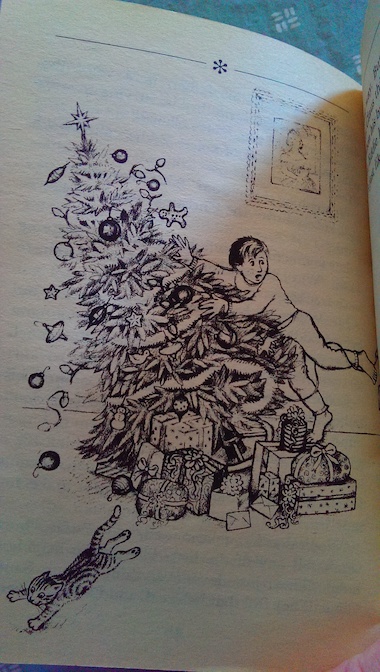
Eddie is old enough to figure out that his father is the one who puts the presents under the Christmas tree on Christmas Eve, eats the cookies they leave out, and leaves a thank you note from Santa.  This year, he gets a funny idea: he’ll leave extra presents under the tree for everyone and a second thank you note for the cookies and make everyone wonder where they came from.  But, his brilliant idea doesn’t quite go as planned.

Christmas Bells for Eddie

Eddie regrets that he never joined the school orchestra now that he’s learned that they will be performing for a Christmas program on television.  His mother suggests that Eddie could sing, but he says that the singing parts have gone to Anna Patricia’s cousin, L.C..  Then, Eddie’s father gives him an early Christmas present that will allow him to join the orchestra after all.

Merry Christmas from Eddie Christmas ProgramThe Christmas Concert

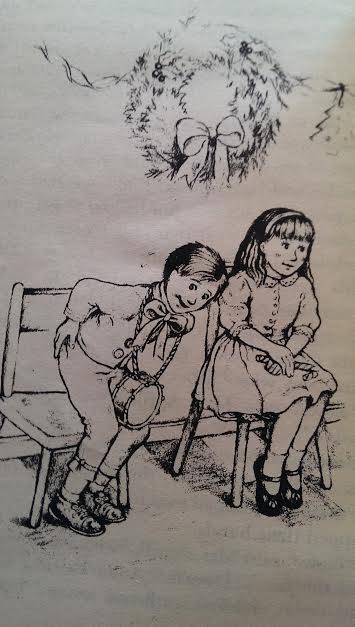
L.C. is spoiled and refuses to sing unless they give him chocolate-covered marshmallows.

New Toys from Old

Eddie’s third grade class is collecting and repairing old toys to be given as presents to the children at the children’s hospital.  Boodles has some fun making Anna Patricia think that Eddie painted the wrong colors on a doll’s face, and people question whether it was such a good idea to turn a nice white horse into a zebra.

The Christmas Program

Eddie has to be Little Boy Blue in the program that his class is putting on at the children’s hospital, but he has doubts about whether his old costume fits him well enough to get through the program.

The Mystery of the Christmas Cookies

Eddie’s mother plans to make some cookies for Eddie to give to his teacher, Mrs. Aprili, for Christmas, but a series of mistakes prevents him from giving those cookies to Mrs. Aprili.  Eddie finally gives up and orders some cookies from the bakery for her.  However, unbeknownst to Eddie, someone else tries to correct for his mistake and ends up creating a mystery for both Eddie and his teacher when a second batch of cookies unexpectedly arrives that is very different from both the cookies he ordered from the bakery and the ones his mother baked.

The Biggest, Most Beautiful Christmas Tree

BiggestChristmasTree

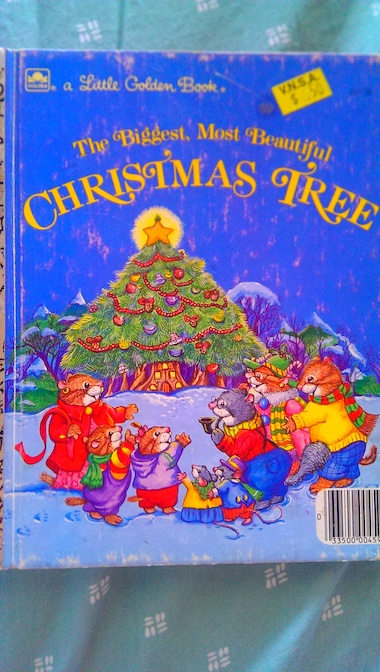
The Biggest, Most Beautiful Christmas Tree by Amye Rosenberg, 1985.

This is a Little Golden Book.

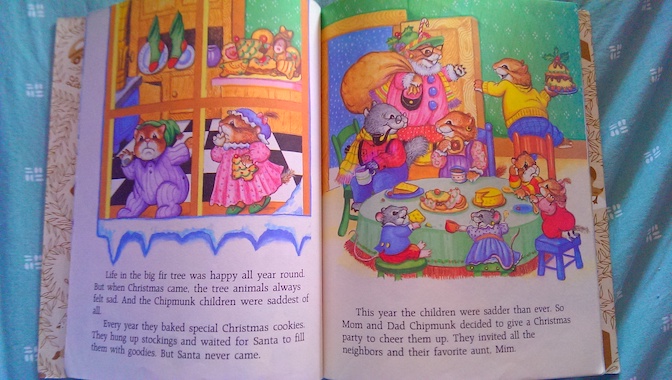
Every year at Christmas, the Chipmunk children, Nina and Nutley, are disappointed because Santa doesn’t visit their home in a large fir tree in the forest.  They always hang up their stockings and put out cookies, but for some reason, Santa never comes.

BiggestChristmasTreeDisappointment

However, this year, their Aunt Mim has figured out the reason why Santa passes them by and what to do about it.  Aunt Mim has realized that Santa can’t find their tree because it looks like every other tree in the forest.  What they have to do is to decorate their tree so that Santa can find it among all the others.

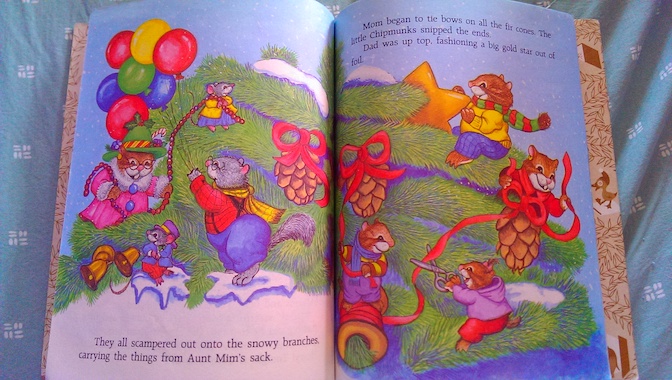
Aunt Mim brings lots of things they can use as decoration, and all of the other animals who live in the tree help with the decorating.  They tie bows on the pine cones, hang strings of berries, and paint balloons to look like large Christmas tree ornaments.

BiggestChristmasTreeDecoration1
BiggestChristmasTreeDecoration2

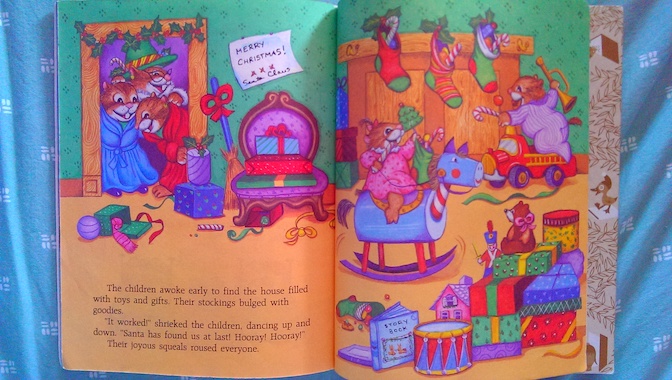
Sure enough, once Santa knows how to find the Chipmunk children, they get the kind of Christmas they’ve been waiting for!

BiggestChristmasTreePresents

This is just a cute picture book that I liked when I was young.  It is available to borrow and read for free online through Internet Archive.

Amelia Bedelia’s Family Album

ABFamilyAlbum

Amelia Bedelia’s Family Album by Peggy Parish, 1988.

Mr. and Mrs. Rogers realize that they’ve never met the rest of Amelia Bedelia’s family, so they tell her that they’d like to give a party for her and family. Amelia Bedelia is happy about the party and shows Mr. and Mrs. Rogers some pictures of her relatives.

It turns out that her tendency to be extremely literal is a family trait. Her father is a telephone operator who operates on telephones and her mother is a “loafer” who makes loaves of bread. One of her uncles is a “big-game hunter” and has a checkers set that takes up an entire room, and another “takes pictures” in the sense that he is basically an art thief.

With each relative introduced, readers can pause for a moment to consider what each of Amelia’s relatives do, in a very literal sense, based on Amelia’s description, before turning the page to confirm it.  (I kind of identify with the “bookkeeper” because my room looks kind of like that, for similar reasons.)

In this picture book, Amelia Bedelia isn’t doing any chores or getting confused about instructions, like in other books, but all the occupation-related puns have the same feel as Amelia’s routine misunderstandings about the multiple meanings of words from the rest of the series.

The book is currently available online through Internet Archive.

ABAlbumReunion.jpg

Merry Christmas, Amelia Bedelia

Merry Christmas Amelia Bedelia

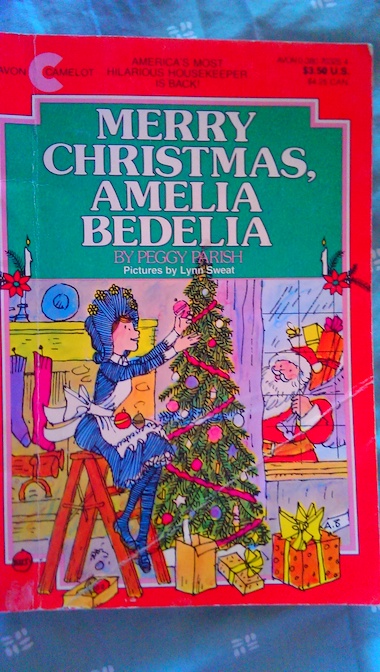
Merry Christmas, Amelia Bedelia by Peggy Parish, 1986.

Christmas is coming, and once again, Mrs. Rogers has left a list of things for Amelia Bedelia to do while she goes to pick up her Aunt Myra, who is visiting for the holiday.

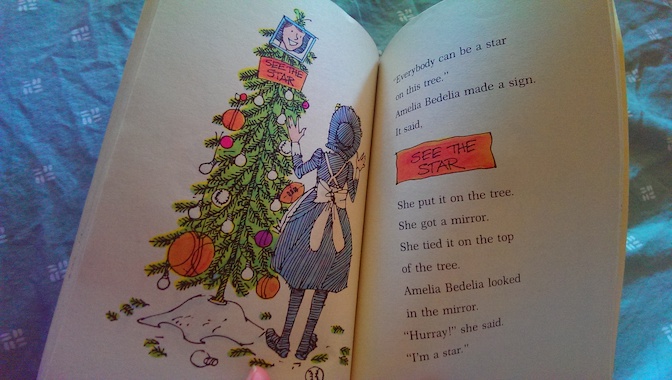
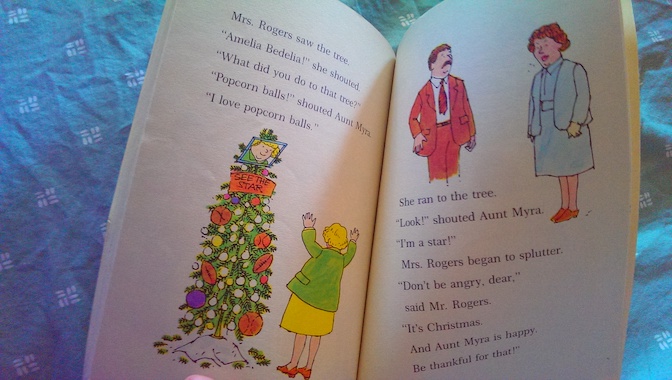
Leaving Amelia Bedelia unsupervised with a list of instructions can be dangerous at any time of the year, but this time, Amelia Bedelia is in the holiday spirit, determined to do her literal best to stuff stockings (with the same kind of stuffing you might use with a turkey), trim the tree (to the size that she thinks Mrs. Rogers would want it), deck it out with lights and balls (light bulbs and sports balls of all kinds), and find an appropriate star to put on top (and, you know, who wouldn’t want to be a star?).

Merry Christmas Amelia Bedelia Balls on Tree
Merry Christmas Amelia Bedelia Tree Star

So what will Aunt Myra think of Amelia’s special brand of literal kookiness? Fortunately, she loves the idea of being a star, too. Amelia Bedelia may be aggravating in the way she interprets the instructions given to her, but she’s also endearingly humorous . . . and she bakes a really good spice cake, too.

The book is available to borrow and read for free online through Internet Archive.

Merry Christmas Amelia Bedelia Aunt Myra

The Legend of the Bluebonnet

LegendBluebonnet

The Legend of the Bluebonnet by Tomie dePaola, 1983.

This is a story about the Comanche People in what is now Texas, based on an old folktale.

There has been a severe drought and famine in the land for a long time, and many people have died.  The survivors pray to the spirits for help in ending the drought, and they receive a sign that it will not end until someone among the Comanches makes a sacrifice of the thing that is most dear to them.

LegendBluebonnetShaman

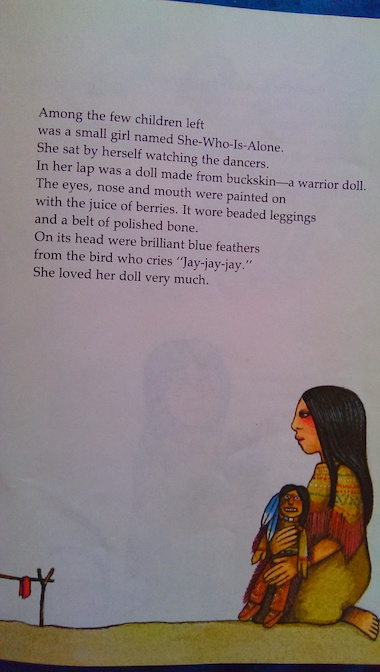
The people debate about who is supposed to make the sacrifice and what object the spirits could want, but one young girl thinks that the spirits are talking about her and her doll.  The girl is called She-Who-Is-Alone because she is the last of her family.  Her parents and grandparents are dead, victims of the famine.  The only thing she has left to remind her of them is her doll, a warrior with blue feathers in its hair, that her parents made for her before they died.

Desperate to end the drought and famine and to save her people, the girl makes the difficult decision to sacrifice her doll by burning it.  Her sacrifice is rewarded not only by the end of the drought but by the sudden appearance of a field of flowers as blue as the feathers in her doll’s hair.  The girl receives a new name from her people, acknowledging her sacrifice on their behalf.

LegendBluebonnetFlowers

A section in the back of the book explains a little about the Bluebonnet flower, which is the state flower of Texas, and the origins of the story in the book, which is based on a folktale.  This is also a little information about the Comanche People.

The book is currently available online through Internet Archive (multiple copies).

Meg Mackintosh and The Mystery at the Medieval Castle

Meg Mackintosh Mysteries

MMCastle

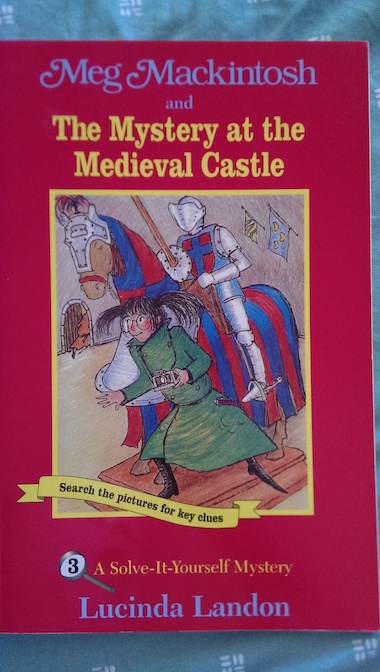
Meg Mackintosh and The Mystery at the Medieval Castle by Lucinda Landon, 1989.

Meg is visiting Dundare Castle with her teacher and some other students.  Dundare Castle is a special museum where people can learn about life in Medieval times, although it used to be a private home.  The owner’s family came from Scotland, and they built their home to look like their ancestors’ castle there.  Eleanor, the owner, now calls herself the Duchess of Dundare, and with her staff, dresses up to recreate the lives of people from the 1300s.

MMCastleTour

One of the Duchess’s prized possessions is a silver chalice studded with jewels that has been in her family for generations.  She keeps it on display in the castle’s “abbey,” guarded by the actor playing the part of a knight, Knight Henry.  But, when Meg and her classmates get to the abbey, the chalice is gone, and Knight Henry is lying on the floor, unconscious!

MMCastleTheft

Not long before they found Knight Henry, the kids had seen a robed figure run across the courtyard.  Monk William falls under suspicion, although the Duchess doesn’t really believe that he is guilty because he’s been with her family for a long time.  There are other possible suspects, and Meg believes that both the thief and the chalice are still in the castle.

The book is currently available online through Internet Archive.

MMCastleSearch

My Reaction

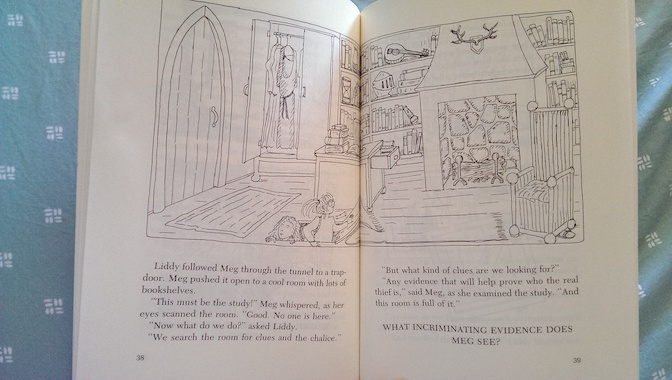
I love this series because the books are interactive, giving readers the opportunity to figure out the clues and solve the mystery along with Meg. As Meg interviews the other actors in the castle and explores every room, readers are invited to study the pictures and consider the evidence to see if they can solve the mystery before Meg can.  At various points in the story, there are questions for the reader to consider, giving them the chance to pause and see if they’ve noticed what Meg has seen. I recommend that adults who are introducing children to the mystery genre read a couple of these stories along with them and discuss the clues as they go, helping children to learn how to notice details, solve puzzles, and think critically. It’s a good learning opportunity as well as a fun mystery!

Meg Mackintosh and The Case of the Missing Babe Ruth Baseball

Meg Mackintosh Mysteries

MMBaseball

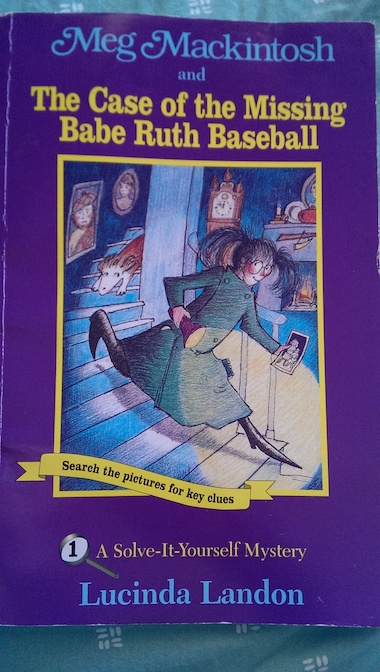
Meg Mackintosh and The Case of the Missing Babe Ruth Baseball by Lucinda Landon, 1986.

MMBaseballAlbumThis is the first book in the Meg Mackintosh series, and it was the first mystery story that I ever read, when I was about seven years old.  It started a life-long love of mysteries!

Meg’s grandfather shows Meg and her friend Liddy some old family photographs and tells them about the time when his cousin Alice took his prize possession: a baseball autographed by Babe Ruth.  Alice was a bossy girl who always liked to tease him, and so she created a kind of treasure hunt, challenging him to solve it in order to get the baseball back.  Unfortunately, he could never figure out the clues and still doesn’t know what happened to the baseball.

Meg’s brother, Peter, has a Detective Club, but he refuses to allow Meg to join, saying that she needs to prove that she can solve a mystery.  Seeing this as her chance, Meg decides that she’s going to solve this old puzzle and find the Babe Ruth baseball!  However, she also has competition from Peter, who thinks that he’s the better detective and tries to send Meg off in the wrong direction.

The book is currently available online through Internet Archive.

My Reaction

All of the books in the Meg Mackintosh series allow readers to try to solve the mysteries along with Meg, stopping periodically to ask them if they’ve noticed a clue that Meg has noticed or if they know what the significance of a clue is.  There are pictures to help, and readers are invited to stop and study the details before moving on. I think this is a good way to introduce children to puzzle-solving and help them develop critical thinking skills and an ability to notice details. I would recommend adults reading these books, or at least the first one or two along with children, so they can discuss the stories and clues with them, helping them spot clues as they begin to get used to the format of the books.

This is an excellent series for introducing children to the mystery genre for the first time! When I was young and just learning what mysteries were, I was fascinated to discover that I already had all of the knowledge I needed to solve this mystery along with Meg because all of the clues to Alice’s treasure hunt had to do with nursery rhymes. If you can recognize the rhymes in the book, you’re well on your way to solving the mystery!

The Dollhouse Murders

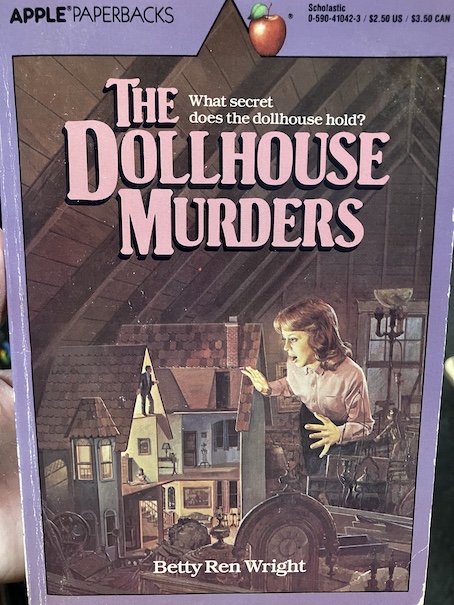
The Dollhouse Murders by Betty Ren Wright, 1983.

Amy is upset because she constantly has to look after her sister Louann, who has developmental problems. Louann is only a year younger than Amy, but her condition makes her think and act like a small child all the time. Amy loves Louann, but having her around all the time makes it difficult for her do things on her own and to make friends.  It’s frustrating because the girls’ mother doesn’t seem to understand the pressure Amy feels.

One day, she has an argument with her mother about it and runs away to her aunt’s house. Aunt Clare normally lives in Chicago, but she has returned to her home town to sort out the things in her grandparents’ old house. Sympathizing with Amy, Aunt Clare offers Amy the chance to stay with her for a couple of weeks, without Louann.

Aunt Clare and her brother, Amy’s father, used to live with their grandparents when they were young, and Aunt Clare says that she has unhappy memories of that time.  While helping her aunt go through some of the old things in the house, Amy discovers that there is a dollhouse in the attic made to look exactly like the grandparents’ house and dolls which look like the grandparents, Clare, and her brother. Amy thinks the dollhouse is wonderful, but Aunt Clare seems to find it disturbing.

When Aunt Clare refuses to talk about her deceased grandparents, Amy looks at some old newspapers at the library to learn more about them. To her shock, she learns that they were murdered in the house and that the killer was never found. Soon, strange things begin happening with the dollhouse. The dolls move around on their own, mysterious lights appear, and crying noises can be heard. The dolls seem to be acting out the events of the night of the murder. After all this time, the dolls seem to be trying to tell them something, if they have the courage to listen.

The book is currently available online through Internet Archive (multiple copies). There was a movie version of this book made in 1992 (Sometimes called Secrets in the Attic), but it’s difficult to find copies of it now.  Sometimes, the movie or clips of it appear on YouTube.  Apart from that, it’s very difficult to see it.

My Reaction and Spoilers

dollhousemurders

I remember liking this book when I was a kid, although I was often a timid kid who was easily scared by scary stories. I think it was the mystery angle, solving the old murder, that intrigued me the most, although I also enjoyed the characters in the story. I felt impatient with both Amy and her mother at times, but I liked the way the family eventually worked through their problems and came to understand each other better.

Aside from revealing the murderer’s true identity, the dolls settle other troubling matters in Amy’s family.  For years, Aunt Clare has blamed herself for the way she behaved around the time her grandparents were killed.  She was afraid that something she did might have even led to their deaths.  But, none of it was really her fault, and her grandparents want her to know that she needn’t blame herself anymore. In some ways, I felt a little cheated by the answer to the murder mystery because the murderer is a person we never see and who has been dead for years, so there was no way readers could have known it was him, and he is never brought to justice. However, learning the identity of the murderer is important because it gives Aunt Clare some closure. When Aunt Clare realizes the truth, she feels like a great weight has been lifted from her.  She begins coming to terms with her past and appears to be headed for a better future. 

Amy also comes to terms with her sister’s condition and values her even more highly when Louann’s lack of fear of the dollhouse gives Amy the courage to see the dolls’ final message. Louann might have been less scared by the dolls than Amy was because Amy understands more of the situation behind the haunting, but the dolls aren’t actually malicious, and there’s no need for the girls to be afraid. Louann is a tender-hearted girl who loves the dolls and dollhouse immediately, and Amy finds that Louann’s willingness to see what the dolls have to show them gives her comfort and courage. Because Aunt Clare understand the feeling of guilt, she helps Amy to see that some of the ways that her mother behaves regarding Louann, babying her a little too much and trying to make Amy more responsible for her, also come from a feeling of guilt. There was nothing Amy’s mother could have done that would have changed Louann’s condition, but Amy’s mother feels guilty anyway. Her guilt is a problem because she’s been holding Louann back from experiences that would help her develop more and give Amy a little more freedom from having to look after Louann so much.  In the end, Amy’s family does make changes to help Louann become a little more independent and to allow Amy a little more independence of her own.

Halloween Treats

HalloweenTreats

Halloween Treats by Carolyn Haywood, 1981.

This is a collection of short stories with the usual Haywood characters as they celebrate Halloween.  These stories have a tone that’s more like Halloween of the 1950s than the 1980s, when they were written.  In this neighborhood, everyone seems to know each other, and parents are unafraid to let even young children go out on Halloween without an adult along.  It isn’t even a problem when older children invite young trick-or-treaters into their Halloween party on a whim to participate in bobbing for apples.

The book is currently available online through Internet Archive.

Stories in the Book:

HalloweenTreatsPic1The Witch and the Balloon

Katie and Mark, a set of twins, believe that the old woman who lives next door is a witch.  She has a black cat and just seems odd, banging on the wall whenever she thinks the twins are being too noisy.  But, one Halloween, when they hear banging on the wall in the middle of the night, they realize that she needs help.

Anna Patricia’s Costume

Anna Patricia loves Halloween, and she especially loves planning new costumes.  By the time Halloween actually comes, she’s changed her mind about her costume many times over.  However, there is still one change more because a surprise invitation to a Halloween party while trick-or-treating causes her to change costumes once more.

The Two Halloween Bears

Penny (a boy) and Patsy (a girl) are best friends, and they have identical teddy bears.  On Halloween, the two of them think it would be fun to wear identical bear costumes to look like their teddy bears, but they’re so much alike, even their mother have trouble telling them apart.

HalloweenTreatsPic2Monkey Business

After Eddie buys an old grind organ at a second hand shop, he realizes that he has the basis for a great Halloween costume: he’ll be an organ grinder with a dancing monkey.  He manages to persuade the girl next door to dress up as his monkey, but the long tail on her costume causes them problems.

Trick or Treat

Eddie likes old Mr. Timkin, a retired sailor, but when Mr. Timkin forgets that it’s Halloween and has no treats for the kids, they feel obligated to play a prank on him. Eddie only hopes that Mr. Timkin won’t be too mad.

Billy’s Halloween Party

When Billy holds a Halloween party only for kids in his grade at school, the younger children in the neighborhood feel left out.  Eddie recruits Betsy’s younger sister and her friend to help him play a prank on the older kids that makes the party more memorable for everyone.

HalloweenTreatsPic3Jonathan and the Jack-o’-Lantern

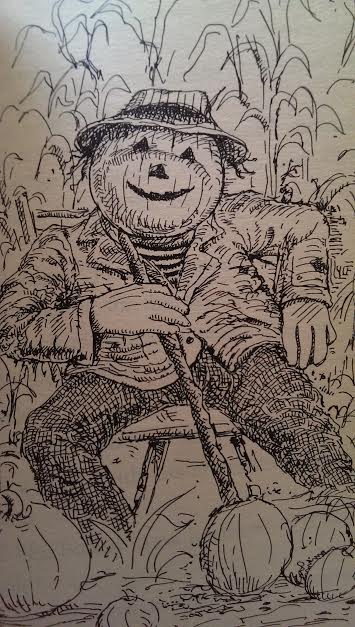
Jonathan’s family has moved from the city to the country, and he’s excited that he can see all the pumpkins growing before Halloween.  Then, some dummies with jack-o’-lantern heads give him the idea for the best costume to wear for the Halloween parade.

Who Scared Who?

Donald and Ronald, another young set of twins, are fascinated by the scary Halloween masks in the stores.  Even though the masks scare them, they think it would be funny if they could buy some really ugly masks to scare the neighborhood policemen.  However, the policemen also think it would be fun to give some of the neighborhood kids a fright.

Pennies for UNICEF

There is a contest for children collecting pennies for UNICEF.  The child who collects the most will win a trip to New York to visit the UN.  As an avid coin collector, Eddie is eager to win the contest, and he makes a special discovery among the coins that he collected on Halloween night.