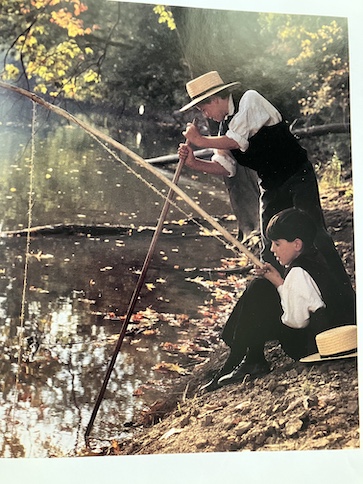
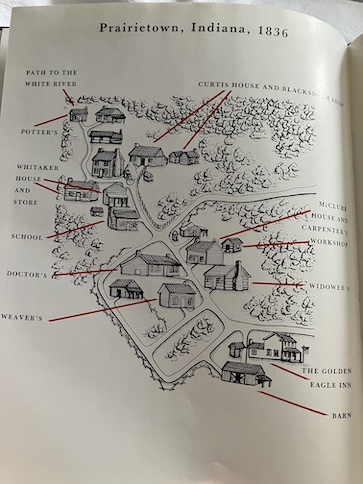
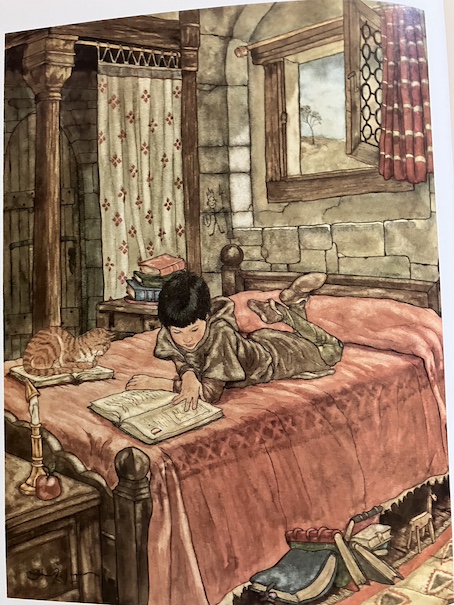
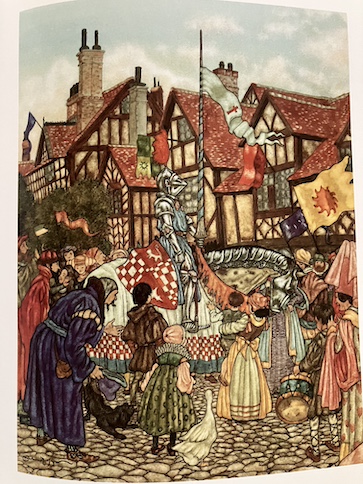
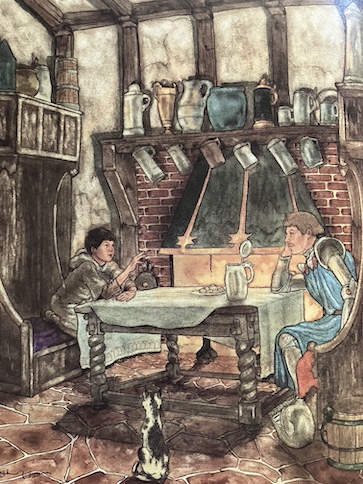
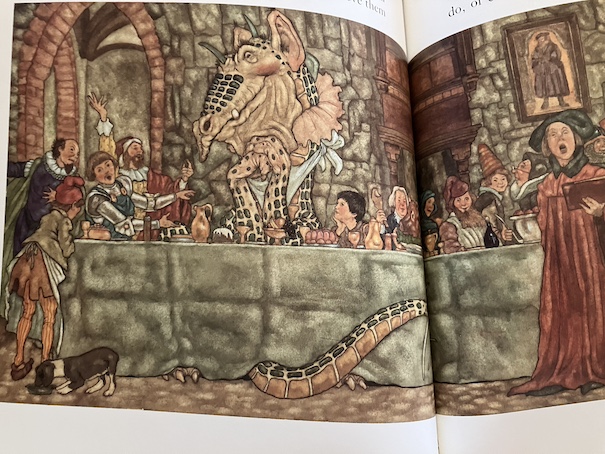
The Mysterious Horseman: An Adventure in Prairietown, 1836, by Kate Waters, 1994.
This book is part of a loose series of books by Kate Waters, showing child reenactors at living history museums, having adventures in the roles of the characters they play. While most of the books are set in Colonial times at Plymouth and Colonial Williamsburg, the setting for this story is the Connor Prairie living history museum in Indiana, which shows life in a small town in the 19th century.
The story centers around a boy named Andrew McClure. He is the only one of his siblings left still living with their parents. His older sister is now married, and his baby brother died of an illness during the last year. His family is still grieving for his little brother. Andrew’s best friend is a boy named Thomas Curtis, who lives nearby, and Andrew works part time at a local inn to earn some money.
One day, while Andrew is doing some sweeping at the inn, he overhears some men talking in the taproom. He doesn’t hear their entire conversation, but he hears them talking about a mysterious rider without a head who chased a schoolmaster. Andrew is startled, and he wonders if that has something to do with the new schoolmaster who is supposed to arrive in town.
When Andrew is done with his work, he goes to the schoolhouse, and he finds his friend Thomas and Thomas’s sister, helping the new schoolmaster to clean the schoolhouse and prepare it for lessons to start. Andrew wants to talk to Thomas about what he overheard at the inn, but the schoolmaster only wants to talk to the boys about lessons.
Later, Andrew does have a chance to talk to Thomas, and both of the boys are spooked by the idea of a headless rider. They even think that they hear the rider on the road! The frightened boys go see Thomas’s father, the blacksmith, and tell him about the rider. Fortunately, the blacksmith knows what the men were talking about, and he can settle the boys’ fears.
The book is available to borrow and read for free online through Internet Archive.
My Reaction
I didn’t know about this book until I was looking up Kate Waters’s books for my younger cousins. I was surprised because Kate Waters’s living history museum books are mostly set on the East Coast or focus on the Colonial era. This 19th century book set in Indiana somewhat departs from the theme and has a different feel from the other Kate Waters books, but I enjoyed it. I’ve been to Connor Prairie because I have relatives in the area, and I enjoyed my visit. It’s been years since I’ve been there, so I didn’t immediately recognize the setting. When I read the explanation in the back of the book, I was fascinated to realize that I had visited that location before.
Andrew has a fascination for life on the frontier because he often watches people pass through his town on their way further west, and he daydreams about going west himself. His family is also still coming to terms with the death of his little brother, so the subject of death is still on Andrew’s mind. The deaths of children due to illness were sadly common in the 19th century and on the frontier, and the mourning in Andrew’s family adds to the melancholy and spooky atmosphere of the story.
Most adults and older children will probably recognize what the men at the inn where actually talking about when they were discussing the headless rider who chased the schoolmaster. When the boys talk to Thomas’s father, he immediately recognizes the story as the plot of The Legend of Sleepy Hollow by Washington Irving, originally published in 1820, about 16 years before the story in this book is suppose to take place. The men at the inn were just discussing the plot of the story, not something that they saw on the road themselves.
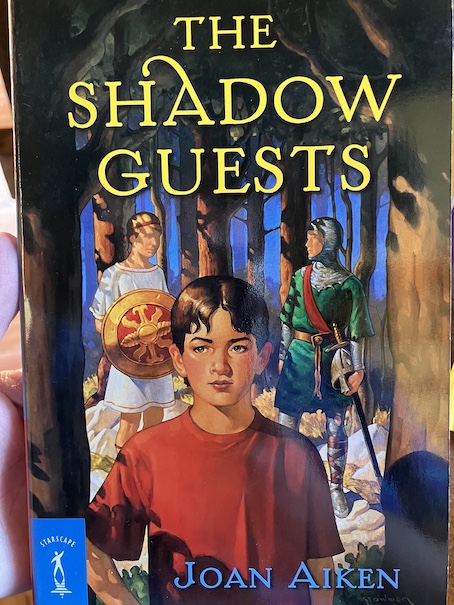
When Cosmo’s mother and brother mysteriously disappear, Cosmo’s father sends him to live with eccentric cousin Eunice in England, who is a mathematician educated at Cambridge and who now lives in Oxford. Cosmo’s father plans he will join Cosmo in England later, after he’s finished wrapping up the family’s business in Australia.
After Eunice picks up Cosmo at the airport, she tells him that she’s arranged for him to attend a small boarding school. Cosmo has never been to any kind of school before because his family lived too far outside of town. He and his brother always had their lessons together at home. Cosmo isn’t sure he’s going to like living with all these strangers at school, but Eunice says that she arranged for him to be a boarder rather than a day pupil so he would make friends faster. Eunice lives at the old Curtoys mill house, and Cosmo joins her there on weekends.
However, most of the other students at school don’t seem particularly friendly, and one of the teachers seems oddly confrontational about Cosmo’s father. He knows that Cosmo’s father, Richard Curtoys, was once a well-known cancer researcher in London, and he doesn’t know why he gave it all up and moved his family to the middle of nowhere in the Australian Bush. Cosmo doesn’t know what to say because he was very young when his family moved to Australia, and he doesn’t really know why they moved.
On his next weekend with Cousin Eunice, he asks her about it and whether or not the family’s sudden move to England had anything to do with what happened to his mother and brother. Eunice admits that it did. Cosmo’s father hadn’t wanted to explain and had left it up to Eunice to decide how much to tell Cosmo, but Eunice believes that it’s better for people to know everything than not know anything. Eunice reveals to Cosmo that their family has been under a curse for generations.
The Curse
The curse apparently started with the Roman invasion of Britain. Their family seems to have Roman roots, and one of their ancestors was apparently a Roman soldier. When the Romans took over Britain, they wanted to convert the inhabitants to the Roman religion, which was still pagan at that time. According to the legend passed down in their family, their ancestor was one of a group of soldiers who were ordered to destroy a pagan British temple. The son of one of the priestesses at the temple tried to resist them, and Cosmo’s ancestor killed him. The boy’s mother then killed herself out of grief. The boy’s grandmother, who was also a priestess, placed a curse on Cosmo’s family: in every generation, the eldest son of the family would die in battle, and his mother would die of grief.
Since then, Eunice says, the curse seems to have come true. She can list generations of their family where the eldest son has died in battle, including Cosmo’s father’s generation. Cosmo’s father was the youngest son of his family, and his elder brother, Frank, died young in battle. After Frank’s death, when Richard was only 10 years old, his mother died of grief, just like in the curse. Richard claimed that the curse was all nonsense when he was an adult, and he refused to tell his wife about it when they got married. However, Eunice had been friends with his wife before she met Richard, and she didn’t think it was fair to keep the secret from her, now that they had two sons of their own. Eunice admits that she told Cosmo’s mother everything, and that the story seriously upset her. It was Cosmo’s mother who insisted on moving to Australia, hoping to get as far away from the curse and any potential war as possible.
When Eunice explains this, some of the things about Cosmo’s family begin to make sense to him. Eunice admits that it seems like the elder brothers of the family resent the younger ones, who are safe from the curse, and Cosmo realizes that he sensed that his brother seemed to be hard on him or resent him, indicating that he probably had some sense that he had an ordeal or possible early death to face that Cosmo would be spared. Yet, younger brothers in the family are not entirely spared from the curse. It’s true that they live to carry on the family line, but each of them is also destined to lose their first son, and shortly afterward, to lose their wife to grief at their son’s death. Cosmo considers that maybe, when he’s grown up, he’ll just adopt a child to get around the problem.
He somewhat compares the family curse to a form of cancer. Some families are more genetically prone to particular types of cancers than others, and the way that members of those families survive is if, somehow, a genetic mutation is introduced to the family line, something that makes those individuals different from the ones before. It’s an indication that, maybe, this curse might not afflict their family forever. If someone, like Cosmo, can figure out how to be different from earlier generations of his family, and not pass on the cursed element to the next generation, there might be an end to the curse. Figuring out how to do that is going to be difficult, though.
Eunice says that his mother tried to evade the curse by running away, but apparently, it didn’t work. Nobody knows exactly what happened to Cosmo’s mother and brother, only that their car was found abandoned, and that they appeared to go off into the Australian desert on foot. Searchers have found no sign of them since, and because it’s such a harsh environment, people don’t think it’s likely that they’re still alive. Nobody knows why they went off into the desert, except maybe either the curse drew them there or they were trying to escape from it. Eunice’s housekeeper, who also knows about the curse, talks about it with Cosmo, and Cosmo asks her whether she thinks it’s possible to break the curse. Like Cosmo, she thinks it might be a case of gradual changes, members of the family doing things differently from earlier generations. Unlike Eunice, she thinks that maybe what Cosmo’s mother and brother did was one such change, and it’s difficult to tell what effect it has had yet.
Cosmo remembers a strange old man who visited them once in Australia. He thinks the man was probably a sorcerer or something because he told them things about their futures. He’s not sure what the man said to his mother, except that it seemed to upset her, and she was never the same afterward. Eunice suspects that the man may have told her that it’s impossible to run away from heredity and destiny. The man told his brother something about there being many different types of battles, which might indicate that staying away from wars would not be sufficient to save him from his destiny. The old man didn’t clarify that statement, but it’s true that people also fight internal and emotional battles every day, no matter where they are. Was this the battle Cosmo’s brother lost or could lose, and has it actually claimed his life already?
Cosmo had always thought his brother and mother were braver than he was, but now, he comes to question that. They had tried to run from their apparent destinies, and maybe the running caused them to go missing, and maybe even to die. When Cosmo’s father writes to him about the family curse, he explains that he has come to believe that the curse is a self-fulling prophecy, that it only comes true because people expect it to. Perhaps Cosmo’s mother and brother would have been fine if they hadn’t tried so hard to outrun their curse, putting themselves into a dangerous situation.
Of course, Cosmo realizes that it’s easier for Cosmo and his father to put aside their fear than it was for Cosmo’s mother and brother. Being the direct subject of an existential curse is certainly much more terrifying than just being part of a family that has a curse that may kill people around you. These thoughts cause Cosmo to consider the nature of fear and how people can be afraid of many different things and how the nature of a person’s fears make a difference in how they are affected by them. What one person can face with courage may be the undoing of another.
The Ghosts
Meanwhile, the other kids at school have become deliberately hostile to Cosmo. They accuse him of being stuck up and lying to them about Australia, and they start saying that Cosmo has probably never even been to Australia. Cosmo knows that all of the things that they say about him are untrue and unfair, but there isn’t much he can say to refute it. It seems to be a form of hazing at the school. He thinks about how petty and childish the other kids are and how they have no concept about the serious issues that are hanging over Cosmo. In a way, though, Cosmo discovers that he’s actually more comfortable brooding over the curse than he is thinking about the obnoxious kids at school. There is a kind of comfort in knowing your life fits a pattern, even if it’s a disturbing and unpleasant one. He also thinks about what the old man told him, that one day, he would have three friends. Because of the way kids at school act, Cosmo can’t image having any friends there at all, but that prediction comes true as well.
Cosmo gradually discovers that the mill house where his aunt lives is haunted. Eunice tells him about a phantom coach and horses that are supposed to appear at night, and Cosmo begins seeing a boy who calls himself Con. Con first appears to him as a little boy, about 4 years old, but each time Cosmo sees him, he gets a little older. He also eats Cosmo’s candy bars from his room. Eventually, Con speaks to Cosmo as a young man. He admits that he took the candy because eating someone else’s food forms a relationship between the two of them. Con explains to Cosmo that his father was a free Roman soldier, but his mother is a slave woman, so Con himself is a slave. The only way he can win his freedom is to play in the gladiatorial games, and he needs Cosmo’s help to practice. At night, Cosmo practices Roman style fighting with Con, but it is gradually revealed that Con does not expect to survive his upcoming fight. When Con speaks to Cosmo more about his family, it is revealed that Con is a member of Cosmo’s family from the distant past. He is the eldest son in his generation, and he knows about the family curse. Because of the curse, he expects to die fighting. Cosmo tries to explain to Con that he doesn’t need to believe in the curse.
Whether that helps Con or not isn’t apparent because Cosmo has to spend the next weekend at school and doesn’t see Con again. The next ghost he sees is a boy called Sim. Sim has been living at a monastery in the Middle Ages, getting an education, but his father has pledged him to his uncle to go fight in the Crusades. Sim is worried because he doesn’t know anything about fighting and thinks that he’ll be killed. He asks Cosmo if he can help him learn to fight. Again, Cosmo doesn’t know much about fighting, but he tries his best to help Sim. He doesn’t really see why Sim has to be obligated to go to war if he’s no good at it and doesn’t want to go, but he does notice that Sim’s eyesight is poor, and what he really needs are glasses.
Then, some of the hauntings at the mill house turn frightening. Cosmo is almost killed in multiple, inexplicable accidents. It seems like a poltergeist is out to get him. One of the boys who’s been giving Cosmo a hard time at school is also visiting the mill house and witnesses some of these accidents one weekend because his father works with Eunice. Not only do the boys learn to get along better after getting to know each other, but Cosmo starts realizes that the boy, Moley, actually has some problems of his own. He has an unhappy home life because of his stepmother. Moley also has a weak heart that keeps him from participating in certain school activities. Knowing this makes Cosmo feel more sympathetic toward him. Moley also comes to realize that something mysterious and threatening is happening to Cosmo, and he witnesses a ghost that Cosmo doesn’t see: a stern old woman in black. Moley has the sense that this old woman is responsible for the accidents happening to Cosmo, although he doesn’t seem to recognize that she is a ghost at first. It seems like Cosmo has now become the target of his family’s curse, which shouldn’t happen because he isn’t the eldest son. Has Cosmo become the target of the curse or some other supernatural force that now sees him as a threat?
My Reaction and Spoilers
I enjoyed the story, although I feel a little conflicted about the ending. The story is somewhat open-ended. We know that Cosmo survives his ordeals. Part of me wonders if the curse may have actually saved his life, after a fashion. If his bother was fated to die and Cosmo was fated to survive, then the forces trying to kill Cosmo were destined to fail. But, that’s just conjecture. These questions are never really answered. In the end, Cosmo doesn’t know if anything he’s done has changed the nature of the curse or if it actually can be changed. He still doesn’t know what might be in store for his future wife and children or if he will actually have a future wife and children. The only way to know is to live his life as best he can and deal with whatever comes along the way.
There are two things that I can see that he gains from his ordeals: closure about his mother and brother and a glimpse at what various other relatives have done in the past to change their fate (or if they did anything). I think there are some indications, based on Cosmo’s encounters with family ghosts, that what his father believes about the curse is probably true, but the story leaves that up to the imaginations of the readers. If you like speculative books, you might enjoy this one.
Metaphysics
Although Eunice is a mathematician, she’s also interested in metaphysics. She and Cosmo have discussions about the nature of time and reality and the possibility of other dimensions or other realities, which have a bearing on whether or not we interpret the ghosts that Cosmo sees as ghosts or not. In some ways they seem like ghosts, but in others, they might be people who have not yet died but who have crossed over in time.
This isn’t confirmed, though, and during Cosmo’s ghost experiences, someone from the past is attempting to kill him. (Spoilers) At first, I thought that the old woman attempting to kill Cosmo was the old priestess who originally put the curse on his family and who was trying to stop Cosmo from helping the ghosts who came to him to survive and thwart the curse. That isn’t the case, though. What Cosmo discovers is that various ancestors have tried different ways of thwarting the curse themselves. So far, none of them have been successful (and I’ll have more to say about that), but Cosmo discovers that one ancestress and her son actually became evil sorcerers themselves. The old lady is a sorceress, and she believes a prophecy that her son will die in a fight with Cosmo, so both she and her son are traveling through time and actively trying to kill Cosmo to save the son from the family curse.
During his struggles with this unholy duo, Cosmo is very close to being killed, and he has a near-death experience. He sees a beautiful, peaceful place, with Con and Sim and his mother and brother. He wants to join them all there, but they tell him that it’s not his time, and they will wait for him there until it is. This seems to represent a vision of Heaven and to confirm the supernatural nature of the story and that Cosmo’s mother and brother are also both dead.
Destiny and Curses (Lots of Spoilers)
I already said that, in the end, we don’t know if anything that Cosmo has seen, done, or experienced has broken the curse or changed his future or his family’s future. What we do see through Cosmo’s experiences are two things: that different generations of the family have tried to thwart the curse in different ways and that (although the story doesn’t explicitly spell this out) there may have been reasons other than the curse itself for what happened to the sons who died, including what Cosmo’s father said about belief in the curse itself causing it to come true.
Con tried to practice his fighting skills in an effort to win his battle, but unlike Cosmo, he never seemed to seriously consider that maybe he didn’t need to fight that battle at all. We’re not sure exactly how many generations removed he was from the original curse (maybe one or two, possibly more?), but it seems that enough time has gone by to convince him that the curse is real and that he should believe in it. Did his belief that he was going to his destiny and going to die in the upcoming fight cause him to actually seek out that fight and also to lose it?
When Sim comes to Cosmo, Cosmo tries to talk to him about just choosing not to fight, but Sim explains that isn’t an option for him. His father arranged it with his uncle, and Sim has no power to refuse to go. The choice not to fight isn’t open to Sim, but Cosmo also realizes that, beyond simply not being a skilled fighter, Sim is also at a disadvantage because he has bad eyesight. So, was Sim’s death almost arranged by his family because they had already concluded that it was his fate to die in battle, never teaching him to actually fight and overlooking his eyesight? If they had left Sim in the monastery, where he was studying, maybe nothing bad would have happened to him.
After Cosmo recovers from his near death at the hands of the sorceress and her son, who was an 18th century member of the Hellfire Club, he learns their fate from Eunice. Both the evil mother and her son died at the same time in the river where they nearly drowned Cosmo, indicating that they accidentally got themselves killed in their attempt to kill him. The prophecy that said the son would die while fighting Cosmo was actually a self-fulfilling prophecy. If they simply hadn’t believed it and had ignored Cosmo, he would have never met them at all, living in a completely different time and having no way to magically travel through time on his own. It’s only because they sought him out and actually started the fight that both of them died, which lends credence to what Cosmo’s father says about believing in the curse causes it to happen.
Before the end of the story, Cosmo’s father tells him that searchers have finally found his mother’s and brother’s bodies in the desert, confirming his vision of them in Heaven. We still don’t know exactly why they went off into the desert to die. Were they trying to flee the curse in a panic, so they weren’t thinking about how this decision could lead to their deaths? If they had simply chosen not to believe in the curse and had continued living in London instead of trying to wildly flee, losing the battle with their own emotions, perhaps they would have both lived normal lives and not died early … maybe.
There’s no real way to prove exactly what happened to Cosmo’s mother and brother. We never hear what happened to them from their point of view, and what decisions they made because of it. Both Cosmo’s father and Eunice says that they shouldn’t blame them for how they attempted to deal with something beyond themselves because they did the best they knew how at the time, even if no one else understands. This leads me to consider that maybe the real curse of the family is: bad decisions. Whenever the curse seems to arise again, each generation has to decide how they will handle it: run or fight, believe or not believe, etc. Each time, they’ve made the wrong choice for their circumstances.
In a way, Eunice bears some responsibility for what happened to Cosmo’s mother and brother, although no one blames her for her role in the situation. Cosmo’s father, having concluded that belief in the curse causes it to come true, had decided not to tell his wife or kids about the curse, so they would never have to grapple with whether they believed it or not. But, apparently, he never explained that logic to Eunice because she spoiled it by telling Cosmo’s mother and shocking her into taking a course of action that led to her and her elder son dying. Would the situation have been different if she had said nothing or if she had said something but said it at a different time from the one she actually chose? Eunice says that she thought Cosmo’s father should have explained the situation before he got married. Maybe that would have changed things or maybe it wouldn’t, but if she felt that strongly that this was the right thing to do, she could have brought up the subject earlier. Maybe she should have talked to both of Cosmo’s parents before their marriage to either get everything out in the open or at least understand why she should keep the secret. Either Eunice didn’t do that or she weakened in her resolve to keep the secret, and she inadvertently set the curse cycle in motion again.
The supernatural nature of this story and its ghosts suggests that the curse is probably real on some level and not just a series of bad luck incidents and unfortunate mistakes that the family makes. The hopeful outlook, the one that Eunice’s housekeeper believes, is that, little by little, with each passing generation, the family changes. Each generation is a little different from the last. Cosmo’s brother was apparently the first not to die in a conventional battle or a physical fight. He died trying to avoid fighting. With him, it seems to have been some kind of internal battle. This may be true of later generations, or maybe this is the first step in shattering the pattern of the curse. Possibly, all that Cosmo has seen will grant him the ability to make better choices, teach this children how to break old patterns, or do something drastically different that nobody else has done before. It’s hard to say, but realizing that it’s hard to say what might happen or what could have happened is a major part of the story.
Thinking about the curse and all of the ways the family could break it and all of the ways they’ve failed to break it so far shows the unpredictable nature of the choices people make in life. Each generation apparently did something they thought was for the best, whether they were embracing fate, fighting fate, or running from fate. The story leaves open the possibility that fate (or the curse) will always find them in some form, no matter what they do. If they don’t actively go to war, they may face their battles in another way, like internal or emotional battles. Who’s to say whether a different sort of internal battle might have taken Cosmo’s brother in London, even if the family said nothing about the curse to him or his mother? As a teenager, he might have had a battle with drugs or depression and lost. He might have gotten a disease and lost that battle. Life has a lot of maybes, and none of us can foresee every possible struggle or disaster.
Another maybe is that maybe the important point isn’t whether or not the curse exists or whether or not they can save all the potential victims but what each of them chooses to do with the life they have while they have it. Cosmo and his father will keep on living. His father will return to his important cancer research, and Cosmo will have decisions to make about his own life. He may or may not decide to have kids, he may or may not tell his future wife or fiance about the curse, and he may or may not try to adopt a child rather than have a biological one. In fact, unless the curse guarantees that sons will be born in the family, we don’t know for sure whether Cosmo might have all daughters. Really, anything is possible. What his future children’s struggles might be or what the real risks to them could be are a distant unknown right now in Cosmo’s life. In the end, he will have to trust them to a certain extent to make the right choices or at least the best choices that they know how when their battles come to them, in whatever form they take. We all have battles of our own to face and risks we take, no matter who we are, and nothing in life is guaranteed for any of us.
There is one last thing that did surprise me. In all of the ways it seems people in Cosmo’s family tried to end or thwart the curse, did nobody think of maybe some form of apology or atonement? The curse stems from an ancient offense someone in their family committed. Perhaps, if they found a way to say they were sorry, it would do something to end the vengeance against them, but it seems like nobody even suggests it. Heck, the evil sorceress lady and her son acquired the ability to use magic and travel through time, but because they were evil and stupid, they went after Cosmo, who was probably their greatest ally, instead of looking further back in time for the real source of their problems. Couldn’t they have gone and faced the priestess lady and either stopped her from creating her curse or stopped their ancestor from killing her grandson? There are a lot of maybes to this whole situation, but I’m honestly surprised that they didn’t think of that one.
School Troubles
Some of the school experiences in the story may have been based on the author’s own education. Joan Aiken was home schooled until she was 12 years old, and then, she was sent to the Wychwood School in Oxford, a boarding and day school. It’s possible that she also encountered difficulties adjusting to being at school with other children and the hazing and bullying that can occur in that type of environment. In the story, Eunice sees value in learning how to get along with other people, although Cosmo questions the value of learning to get along with people as awful as the kids at his school.
He gradually begins to learn more about the relationships of kids at school by observing them as an outsider. Some of the awful ways of treating him are considered some kind of hazing or initiation, and he’s expected to undergo it with some degree of grace before they will grant him acceptance. It’s all pretty idiotic and immature. Cosmo realizes it, although he knows he can’t show much reaction, or it will make things much worse. It’s the sort of thing I hated when I was a student myself. I admit that I was shy and socially awkward, and I didn’t get along well with many other kids because I just couldn’t stand this sort of thing.
Over 30 years later, I haven’t really changed my mind about that. I get that being around other people can open your eyes to human nature and how to deal with your fellow flawed human beings, but I see the same problem in this story as I do in real life: allowing this system of hazing encourages the personal entitlement of particular students, and it also is detrimental to the mental health of people who struggle to deal with them. I think schools do better at this now than they did when I was a kid, when it seemed like almost 100% of the personal development, learning, and personal responsibility was put on the shoulders of everyone else who has to deal with this type of person. I think I have much, much less patience for this kind of thing now than I used to due to overexposure early in life, which does call into question whether what I learned from that experience was really beneficial or not. On the whole, I actually do think that I benefited from exposure to other people, in spite of all the stresses and mental health issues along the way. Part of the issue is, when you’re part of a group of people, you have to put up with the worst parts of that group to spend time with the better parts of the group. If you avoid society too much, you don’t meet the better parts. Learning social skills and human understanding also requires time and practice, which is what Cosmo learns in the story.
People who bully and cause problems can be considered in the learning phase of developing social skills themselves. It’s just that there do have to be rules about how much of their bad behavior can be allowed while they learn. They can’t be allowed to sabotage other people’s social development for the sake of their own because that only leads to their personal entitlement at someone else’s expense. If they are spared consequences for their actions, they never learn anything, either, never improving or showing signs of development, just putting more needless stress on other people and never seeming to understand or care why. I’ve seen far too many examples of this in real life.
I actually enjoyed the way the school in the book handled some of these conflicts. The headmaster is a psychologist, and although some of the things he does seem a little unfair, he actually discusses his reasons for doing this with Cosmo. He understands how his students think and feel, and he knows how to give consequences for actions that not only enforce the school’s rules and better treatment for bullied children but also which affect their relationships with each other more positively.
At first, Cosmo is angry when he’s punished along with some of the other kids who have been bullying him for a prank he tried to discourage them from committing. However, the headmaster apologizes to him for that, saying that he knows those other kids have been giving him a hard time, treating him like he thinks he’s better than they are. One of the other teachers says that Cosmo has been targeted because he’s one of the bright students, and some of the members of his family have a more prestigious reputation than Cosmo realizes. By giving Cosmo the same punishment as the other boys, while the other boys are made to acknowledge that it’s unjust and that Cosmo doesn’t deserve it as much as they do, the headmaster is showing the other boys that they don’t have reason to think that Cosmo is being treated better than they are, ending some of their resentment against him. He also knows that the boys can now accept Cosmo as being one of them, united in resentment against the headmaster for being harsh and unfair. The headmaster is willing to take their resentment against him because, as an adult faculty member, he doesn’t need to be one of “them”, as in one of the students or their “friend” or “pal.” He’s apart from them anyway in terms of age and status, and part of his role is guiding their actions and relationships with each other. In a way, Cosmo admires the logic and the tactic, even though it means enduring the punishment, and it does improve the way the the other boys treat him.
This classic children’s book from the mid-19th century is famous as the story that popularized the concept of British children’s boarding school stories, although many people in the 21st century haven’t read it themselves.
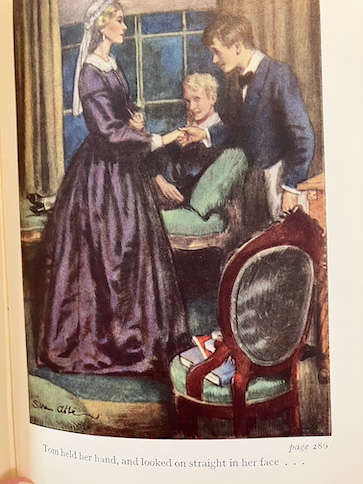
Young Tom Brown was brought up in a very close family, although they are often given to quarrels and drama among each other. He is the eldest of his parents’ children and spends his early young life in the vale where he was born, raised by his family and his nursemaid, Charity. Tom’s mother has a talent for training young servants. She is kind and patient with servants in training, treating them almost like older children of the family. Charity is rather clumsy and not too bright, and she has her hands full with young Tom. He is a strong and rebellious little boy. Charity’s relatives have a farm nearby, and she takes him there to pick up supplies for the Brown household. The people on the farm are kind to Tom, and they also help raise him. Because Tom resists training and supervision from women, the Brown family eventually hires an older servant, Benjy, to take care of Tom from about age four. Benjy takes little Tom fishing and tells him stories about the history of the Brown family. Generally, Tom’s early childhood is pleasant and easy.
As Benjy gets older, he is troubled more by arthritis and finds it harder to keep up with young Tom. Tom gets a governess at home, and when Tom begins lessons at the local school, he begins to calm down at home because he spends his energy at school and playing with the local boys in the village. Being friends with other boys his own age is good for Tom because they share the same interests and levels of energy. They play games and wrestle with each other for fun. Then, when Tom is nine years old, his family sends him away to boarding school. There are some sad goodbyes from the local boys in the village, and the other boys give him some little toys as going-away presents. This is the first time that Tom has ever been away from home, and this is where the story of Tom’s education really starts.
First Boarding School Experience
Tom spends about a year at a private school before going on to a public school. The author pauses here to explain the differences between British private schools and public schools. Unlike in the United States, “public” schools are still schools that require school fees, but private and public schools differ in who is accepted as a student and how the students are treated in their time outside of class. In the author’s time and young Tom’s time, students at private schools are more closely supervised in their off hours, with the idea that molding the students into good citizens (which is considered a higher goal in their education than the subjects taught in the classroom) cannot be adequately accomplished in classroom time only and that most of it takes place outside of the classroom. At public schools, the author says, the boys have more freedom and less supervision outside of class.
The boys at the private boarding school Tom attends are supposed to be supervised by school ushers, who monitor their behavior, resolve quarrels, and set a good example for them. Unfortunately, the ushers at Tom’s school aren’t very well educated or good at their job, and they have little interest in doing their job properly. As a consequence, the older students bully the younger ones, students are encouraged to tattle on each other, and physical punishments are used to keep the students in line. In spite of this and some homesickness, Tom actually has a pretty good time at school with his new friends at school. They have some adventures (some of which involves cruelty to animals they find, and the author makes it clear that he doesn’t endorse this and thinks that the bee stings they get are earned) and delight in scaring each other with ghost stories at night. However, this school isn’t really the best treatment or education Tom can get, so it’s just as well that he is sent to a public school after this.
Tom’s change in school comes when there’s an outbreak of disease in the area, and the schoolmaster of the private school is one of the people to become ill. All of the boys are sent home to their families. Since Tom has already told his father that he would rather attend a public school and since school at the private school is canceled for the rest of the term, Tom’s father decides to send him to Rugby. When Tom goes to Rugby, his father talks to him about his school experiences. Tom’s father says that he is going to Rugby at a younger age than he had planned to send him, and if schools are still like they were when he was young, he’s going to see people doing many cruel things and will hear bad talk from other people. He urges Tom, whatever happens at school, to be brave, kind, and truthful and, no matter what other people say, to not say anything he wouldn’t be willing to have his mother or sister hear him say. If he does these things, he won’t have to feel ashamed to see his family when he comes home from school, and they won’t be ashamed of him. This talk and the thoughts of his mother make Tom a little emotional, although he tries not to show it too much.
Tom’s father privately reflects on the reasons why Tom is going away to school. Partly, Tom is going to school because Tom really wants to go and have that experience. The fact is that Tom’s father doesn’t really care too much about Tom learning subjects like Latin, and his mother doesn’t care too much about academics, either. Tom’s parents aren’t too concerned about what kind of scholar Tom is. What Tom’s father really wants for Tom is what he has already told him to be. He wants his son to be brave and truthful, and he wants Tom to be a good and helpful English gentleman and a Christian. Basically, he’s more concerned with his son’s character and life choices than with his son’s grades. He thinks about whether or not he should warn Tom about various temptations he might experience at school, but he decides not to because Tom is still just a boy, and he thinks he wouldn’t understand.
Going to Rugby
Tom takes a stage coach by himself to school, nervous about what the school will be like but excited about the the experiences he is about to have. When Tom arrives at Rugby, a more experienced student, Harry East, helps Tom get settled and acts as a mentor to Tom about school life. East’s aunt is an acquaintance of Tom’s family, and she knew Tom would be coming to Rugby, so she asked East to hemp Tom. He explains the school grounds and uniform pieces to Tom, describes student activities and sports to him, and answers his questions.
Tom loves sports and is eager to play Rugby football, but East tells him that he won’t be able to play until he learns the game. Football is different at Rugby, and it’s a much rougher game than other schools play. East says players often get hurt and break bones. There is a match that day, and Tom finds it exciting to watch, especially since their house wins! After the match, East says that he doesn’t have any allowance money right now, so Tom buys some food they can have for tea, and they share some of it with some of the other boys from their school house. Tom starts making friends with the other boys, and they all talk about the match together.
After tea, East says that it’s time to join their house for singing. Tom is surprised, but East says that group singing among the students is a regular school activity. There are also speeches from other students at the school singing. Today’s speech is about their house’s victory at the football match. One of the students speaking, Brook, praises the players and congratulates them for their victory on behalf of the house, with all the other boys cheering. He says that their house won the match because their house has the best house spirit and team spirit, and they know they can depend on each other. However, he also issues a warning to the students about bullying in the house. Some of the older students have been picking on the younger ones. He doesn’t want to encourage tattling among the students, and he says that learning to deal with bullies is a valuable skill that makes a boy tougher, but at the same time, bullies are cowards, they encourage cowardly behavior among others, and they break up house spirit and bonds of teamwork among the students. He cautions everyone that too much bullying and allowing bullying to continue will destroy the house spirit that helped them win today, so if they want to continue winning and enjoying house victories, they’d better cut it out. Some of the younger students look at the older students have been doing the bullying, especially a boy called Flashman.
Brook also cautions the other students against drinking in the local pubs and talks to them about their new headmaster. Some of the students haven’t been happy with him because he’s changing some of the school customs. Students have been grumbling and would like to see the new headmaster gone, but Brook points out that Brook isn’t going anywhere and that the “customs” he’s been changing have been destructive pranks and other habits that were also causing problems. The new headmaster hasn’t touched some of the customs that really matter to the students, like their sports, and in fact, the headmaster was also watching the match today. There are mixed feelings among the boys at this part of the speech because they like the idea that the headmaster, who they call “the doctor”, was watching the match, but at the same time, the boys don’t really know him or trust him yet.
The author notes that the new headmaster found the school in a state of disorder and mismanagement when he took his position, and the changes he’s been making are about restoring order to the school. The boys, not knowing the difference between a more orderly and well-managed school and the one they got to know when they first arrived, don’t appreciate the doctor’s wisdom of kindness yet. Tom first encounters the doctor when he leads the students in prayers.
Before bed, Tom and the other younger boys meet with some bullying from Flashman and Flashman’s cronies. Some of the other boys are terrified, but Tom and East allow themselves to endure the bullying, being “tossed” by the older boys so the other boys will be spared. The other boys are grateful to them for this, so they start to hold Tom in high regard.
Getting Into Trouble
This eventful first day is a good introduction for Tom about what life at Rugby School will be like for him. Sports, bullying, pranks, fighting, camaraderie among the other students, singing, speeches, and the new headmaster are going to be major themes for him in his education. Like other younger students, Tom has to act as a servant and do chores for older students, part of a tradition called “fagging” (more about that below in my reaction). Tom does well in his classes at school because he has already had a good grounding in his subjects, and he is generally positive about his life at school, in spite of the bullying. He loves participating in the school sports and physical games, like Hare and Hounds.
However, things do get harder for Tom at school. Because he is doing so well at his grade level, he is quickly promoted to the next. When he gets there, with some of his new friends, like East, Tom becomes less studious and more unruly, like the others. Also, the older boys who were trying to set a good example for the others and protect the younger students from the bullies graduate from the school, leaving bullies and less conscientious students as the senior students. The bullying gets worse, and as Brooks had predicted, it breaks the spirit of teamwork in Tom’s house. The students in the house start dividing into factions of bullies and bullied, the younger students against the older.
The younger students get increasingly resentful of the ill treatment and bullying of the older students and start getting rebellious against the system of “fagging” at the school, with Tom and the others declaring that they simply won’t serve the older students anymore. When students like Flashman the bully call for them, they just pretend they don’t hear and refuse to answer them. Flashman and the others try to physically break into Tom and East’s room when they refuse to come, but Tom and East barricade themselves inside. Their success against the older students encourages other students to rebel. Tom considers going to the headmaster about it, but the others discourage the idea. None of the students want to go to the schoolmasters unless absolutely necessary because the students think that the right thing to do is to work out their own problems with each other.
Diggs, one of the older students who is nicer tells the others that, when he and Flashman were younger students, the students in their grade also rebelled against the older students to teach them not to bully them, but Flashman didn’t rebel with the others. Instead, he ingratiated himself to the older students, continuing to serve them and bribing them with treats he got from home. He has evaded discipline and consequences for his behavior by making himself into a useful toady for the students with more authority. Now, Flashman and his cronies increasingly bully the younger students and use physical hurt to subdue them. The younger students retaliate against them with pranks. Tom and East become Flashman’s particular enemies because they live close together in their house and because Tom and East started the rebellion and have been open and accurate in their criticism of his cowardice, refusing to be subdued by the beatings he gives them.
Matters with Flashman come to a head over a lottery, when Flashman pressures other students to turn over their tickets to him. Tom refuses to part with his, and Flashman and his cronies beat him and burn him, hurting him so badly that Diggs intervenes, worrying that they might kill Tom. Diggs shows Flashman to be a coward when he confronts him over the incident and hits Flashman, but Flashman doesn’t fight back because he’s afraid of getting hurt himself. This doesn’t end Flashman’s aggression against the younger boys, and when he starts getting worse again with Tom and East, Diggs urges the two boys to gang up on Flashman. For them to fight him singly wouldn’t be a fair fight because Flashman is several years older than they are and bigger, but Diggs considers it fair for both of them to stand up to Flashman at once. To Flashman’s shock, the two boys do gang up on him. He’s much bigger than they are but not as good at fighting and pretty cowardly about fights where he doesn’t have some obvious, overwhelming advantage. Tom and East win the fight, giving Flashman a cut on his head that bleeds. At first, Tom and East are worried about whether they’ve hurt Flashman badly, but Diggs has a look at the wound and tells Flashman off for being dramatic about how hurt he is. Flashman has only skinned his head a little, and he’s done much worse to the younger boys. Flashman never physically fights the boys again. He eventually leaves the school, being sent away by the headmaster after he becomes disgracefully drunk at a nearby pub one evening. The headmaster was already displeased with Flashman, and this was the last straw. The younger boys are glad to see the bully gone, although some of the older students bear some resentment against the younger ones for their rebellion and their triumph over someone from their level.
Tom and East are emboldened by their victory and for moving up at school, and they become regular rule breakers. They never consider the justice or reasons behind school rules, taking them more as challenges. They get into trouble for trespassing on someone else’s land to go fishing, and the land owner’s gamekeeper brings Tom before the headmaster. Later, Tom and East climb onto the roof of the school and carve their names on the minute hand of the school clock. They are caught because they accidentally change the time on the clock, and when someone investigates why the clock is wrong, finds their names.
Later, they sneak into town against the headmaster’s orders and get caught. They are both taken before the headmaster for this, and they receive floggings for their stunts. The headmaster also gives them a lecture about the dangerous nature of some of their stunts, pointing out that they could have fallen and broken bones from the clock stunt. He points out that they never think about the reasons why rules exist, thinking of them only as whims of the schoolmasters, which isn’t the case. The rules exist for good reasons, and they apply to everyone at the school, including Tom and East. The headmaster says he doesn’t want to keep giving them floggings for their stunts, and if they can’t gain some maturity and reform their behavior, he’ll send them both away from the school. Tom and East are shocked because they never thought that they might have gone far enough to risk their positions at the school. They love their lives at the school and don’t want to be sent home in disgrace. The headmaster tells them to think about their futures at the school seriously when they go home for a term break.
The Headmaster’s Solution
Privately, the headmaster has a word about the boys with one of the other schoolmasters. The headmaster is concerned that, if they continue their irresponsibility and recklessness, they will fail their studies, get into some really serious trouble, and possibly turn into thoughtless bullies of the younger children as they get older. The other schoolmaster acknowledges that they are not the best students and they are a problem, but he thinks that they’re not really bad boys and could still be turned into decent young men. He says to the headmaster that what these boys need is something to give them a sense of responsibility and suggests making each of them responsible for a younger boy at school. Protecting a new boy from the older bullies could settle them and make them more serious and responsible and prevent.
When Tom returns to school for the next term, he expects that he and East will be allowed to share a room and study, which is something that they’ve hoped for. They’ve been making plans for all the ways they can have fun and goof off in their own space. Instead, the school matron introduces Tom to a new boy who will be sharing his room and who will be Tom’s responsibility. George Arthur is a pale, timid, skinny boy, and Tom can see that he’s just the sort of boy who would be picked on by the others. Tom is annoyed at having his plans with East spoiled, but the matron stirs his sense of sympathy by telling him that George Arthur’s father is dead and that he has no brothers. Tom can see that young Arthur will probably be made miserable at school by bullies unless someone stands up for him and teaches him how to handle life at school, so he agrees to take responsibility for him.
The schoolmaster is correct that looking after little George Arthur changes the way that Tom looks at himself, his fellow students, and his education. The change starts when Arthur says his prayers openly at night, getting him a teasing from the other boys, who take any sign of weakness or sentiment as an opportunity for teasing. Tom defends Arthur from them. He also feels a twinge of shame because he remembers, for the first time in a long time, that he had once promised his own mother that he would always say his prayers at night, and he has become neglectful about this, specifically because he wanted to avoid the teasing or bad opinion of the other students. It shames Tom a little to think it, but he realizes that, although Arthur may be physically weaker than he is, he has displayed more moral courage than Tom has simply by saying his prayers, regardless of what the other students think.
Looking after Arthur gives Tom a sense of responsibility, as the schoolmaster hoped, and Tom appreciates feeling like he has a purpose. He enjoys seeing timid Arthur beginning to develop as a student and start to make a new friend on his own. However, Arthur also has things to teach Tom. Tom’s friendship with Arthur helps his own personal development and causes him to consider sides of himself he hasn’t thought about much. As Arthur opens up more to Tom, he explains that he is serious about religion because his late father was a clergyman. When he was alive, his father used to read the Bible with him. Inspired by Arthur’s example, Tom becomes more serious and starts exploring his religious side, although he takes some teasing and criticism from the other students over this budding sentimentality and defense of little Arthur. Tom and East start participating in Bible readings and study with Arthur, considering some of the deeper questions of life and religion that they’ve never considered before. They begin to think even more deeply about life and death when a disease spreads through the school. Arthur becomes ill and another boy dies. Tom is relieved when Arthur recovers, but his near death and the other boy’s death cause Tom to really consider life and death seriously for the first time.
As Tom develops a deeper understanding of life and religion, he finds himself a little at odds with East, who still doesn’t take life seriously. Fortunately, the two of them respect each other enough as friends to talk about their views seriously with each other. Tom doesn’t consider himself as knowledgeable about the subject or as good as explaining it to others as Arthur, but through their conversation, East realizes that he does actually care about the subject and goes to talk to the headmaster about his feelings and about confirmation. The headmaster’s kind understanding and reassurance is an inspiration to the boys, and they come to respect him, although Tom doesn’t fully understand the headmaster and what he’s done for the boys until he is a young man.
At the end of the story, Tom is with some college friends when he hears that the old headmaster has died, and he feel compelled to visit Rugby School again to pay his respects and reflect on his old headmaster.
Although it was not the first book set at an English boarding school, this 19th century book is famous for being the book that popularized the trend of British boarding school stories, which has continued for over 150 years since! There are also references to this specific story in other books, and I have to admit that it gave me a giggle to recognize the scene that Terry Pratchett parodied in his novel Pyramids. The story is semi-autobiographical, based on the experiences the author, Thomas Hughes, had when he attended Rugby School as a boy during the 1830s. There is now a statue of Thomas Hughes outside the Rugby School Library.
The headmaster in the story is only called “the doctor” for most of the story, until the very end, when Tom learns of his death and his last name is given as “Arnold.” Tom’s headmaster is based on Thomas Arnold, who was the real, historical headmaster of Rugby when the author of the book was a student there himself. The real Thomas Arnold did die suddenly of a heart attack at age 46 in 1842, and this book is an homage to his memory as well as the recollections and thoughts of the author on the subject of education. The real life Thomas Arnold did reform the habits and organization of Rugby School, like the headmaster in the story, focusing on the religious and character development of students and creating a system of prefects called “praepostors” as student monitors, something that is referred to in the story. Other British boarding schools copied and built on his ideas and practices. (Added fun fact: Thomas Arnold was the great-grandfather of the author Aldous Huxley, known for Brave New World.)
The book requires some patience for modern because the author spends some time setting the scene and explaining the background of Tom’s family and early childhood before really getting into the story. Part of the reason for that is that the author, Thomas Hughes, based the story on his own childhood and youth, and he spends some time comparing the childhood and conditions of life in young Tom’s time with life at the time he wrote the story.
Hughes admits that he doesn’t like the direction the social situation has been heading in his time, and he feels that his time period is at a changing point. He sees many of the old ways of life falling aside, and he partly blames the new upper classes, who take advantage of the working class, using them to enrich themselves (“buying cheap and selling dear”). He’s describing an increasingly industrialized and urbanized society with a significant wealth gap between the wealthiest members of society and the working class, which was characteristic of Victorian society. Hughes notes that some members of the upper classes profess to be trying to reform the lower classes, but the author says they don’t really understand the working classes at all. There is part of the story, early in the book, after he describes young Tom’s experiences at a local fair, where he delivers a lecture to the younger members of these rising upper classes on the subject. Hughes was a social reformer in the Victorian era, so he has many thoughts about how to improve society and a pretty accurate understanding of social conditions during his lifetime, and he works them into the story of Tom’s education.
A Victorian Boarding School
It’s interesting to see Thomas Hughes’s descriptions of Rugby School and boarding school life and education in the 1830s. I’ve never been to a boarding school before, and neither have most of the other readers who enjoy boarding school stories. It’s getting to see a type of school that most of us will never attend that makes stories of this kind fascinating. Seeing them as they looked in the past is especially fascinating. I’ve read other books and seen documentaries about boarding schools in Britain, and it was interesting to note the aspects of school life that are the same or different from what someone might encounter in a modern school. From what I’ve learned about British boarding schools, extracurricular activities, like sports and singing, are still major features of British boarding schools that have stood the test of time. However, modern schools have cracked down on bullying and abuse from older, higher level students.
A couple of words that appears in the story, “fags” and “fagging” sound like derogatory terms from modern times, but it has nothing to do with homosexuality in this context. “Fagging” was a tradition at British public schools of this time and earlier, where senior students used younger students as servants, giving them menial chores to do. The “fags” described in the story are younger students, who are described as performing various tasks, like fetching things for the older students, cleaning, carrying messages, or arranging furniture for singing. The problem with the tradition of fagging was that it often led to bullying and abuse of younger boys at the hands of the older students, and this is something that’s addressed in the story. The bullying and abuse associated with this tradition is what led to the end of the tradition in modern times.
There are also other student habits which would seem odd by modern standards, including some which would definitely not be allowed for boys of this age. The students at the school are about 11 to 19 at the oldest, but they routinely drink beer, even the younger boys, although I think it’s probably a weak version. The ways the students are treated with regard to money and how they spend their money are also odd by modern standards. Their allowances may be withheld from them as a punishment. There are times in the story when students in need of money auction off some of their own belongings, a subject that appears in A Sweet Girl Graduate, although the boys don’t get in trouble for this as the girls in A Sweet Girl Graduate did. The older boys also impound the allowances of the younger boys for a lottery at one point, using the funds to purchase sweepstakes tickets on a horse race. The younger boys are not consulted about their participation in the gambling, and the only problem that arises from it is when Flashman tries to bully them out of their tickets to get ones he thinks are likely to win.
Education and Manhood
As the author reflects on his time at school, his experiences with friends and classmates, and the inspiration of his old headmaster, he also offers advice to other boys and his thoughts on what it means to be a man and to take charge of ones own development. I don’t think modern parents and teachers would agree on all of his advice, but he makes it clear what experiences from his school days have led him to believe what he does about how boys and men should conduct themselves.
At one point, he says that he has no problem with the idea of boys fighting with each other because he sees fighting and struggling as just part of the role of men in life. He says his only concern is whether or not they’ve chosen the right side to fight on. Flashman serves of an example of how bad people can actually be quite popular, at least among their cultivated cronies, and are often supported by the social system or know how to use the system to their advantage. The author warns other boys not to see another person’s popularity or social position as a sign that they are good people or that they are in the right in a situation because the opposite is very often true. What is good and right is independent of popularity, power, and money and is determined by other factors. He admits, through the character of Tom, that he has developed a soft spot for underdogs and says, even if you think the underdog is wrong in his beliefs, he shouldn’t be scorned but respected for his willingness to fight for what he believes, even knowing that he doesn’t have popular support.
At the end of the story, when the headmaster dies, the character Tom despairs because, although he has moved on from Rugby School, and he realizes that many of the boys who are there now don’t know who he is and wouldn’t recognize him as one of them, the headmaster was a guiding light in his life and spiritual development. He still feels ties to his old school and headmaster because his time there and the headmaster’s influence set him on the course for his life and development. The author reflects that Tom the character was still someone self-centered at this age, and in the first shock of hearing about the headmaster’s sudden death, he thinks of the loss of the headmaster as a personal loss that no one else would understand. However, when he returns to Rugby and thinks about it further, he realizes that he is not the only one whose life was touched by the man, remembering that he left behind a wife and children and that the headmaster cared about all of his students and influenced them all in different ways. Tom the character sheds some of his self-centeredness and realizes that it’s time to move on in his life. The author also says that there is a flaw in looking to mortal men, even the kindest and greatest among them, as the ultimate source of guidance because no mortal man lives forever. Tom the character will tend to his own spiritual development from this point forward and look to God Himself for guidance. In this way, it seems that young Tom the character has developed into the kind of young man his father wanted him to be in the beginning, making his education successful.
Before Tom learns of the headmaster’s death, he discusses his future ambitions with an old schoolmaster, saying that he wants to make a difference in the world as well as earn a good living. The schoolmaster cautions him to be certain of his priorities and know which of those two goals is more important. There are many people who spend their lives making money but do nothing of lasting importance for the world and other people, and there are many people who do good in the world without making much money. If Tom focuses too much on making money, he may sacrifice the goal of doing good in the world, so he needs to remember what he really wants to accomplish in his life and what he wants to prioritize.
Thomas Hughes went to Oxford after his time at Rugby School, like his character, and he became a lawyer, social reformer, and member of Parliament as well as a writer. Among his books are books about religion and the nature of manliness. The themes of Tom Brown’s School Days really were the themes of his life, and he genuinely means the advice that he offers to young men in the story.
It’s summer, and the four Melendy children have some big plans! They’ve already started building a dam to make the swimming area on the property of their new house bigger. Their father, who travels frequently, giving lectures, tells them that he’s going to be away for most of the summer. He has to work hard to provide for his big family, and he has also taken a government job that will help the war effort. Mr. Melendy isn’t going to be a soldier because he’s a little old for that and the father of four children. He says that he can’t tell the children about his job, but it will keep him away in Washington for long periods of time. While he’s away, the children will be in the care of the housekeeper, Cuffy, and the handyman, Willy. They will also largely be left to entertain themselves, which is something they definitely know how to do.
Aside from swimming and enjoying themselves this summer, the kids decide that they should also do something useful, to help the war effort. Because of the war, patriotism is running high, and the children feel like they should take on some serious responsibilities. They’ve held events to help the war effort and bought bonds before. This summer, Rush and Randy decide that they’re going to go door to door, collecting scrap metal. Their collecting efforts help them to further get to know their neighbors, and they make friends with the Addison children and a nice, older man named Mr. Titus, who likes to spend his time fishing and baking things and invites the kids to join him sometimes.
However, there is a nasty man called Orin who yells at the children and scares them away when they come to ask him for scrap metal. Soon after this unpleasant incident, Rush and Randy meet Mark, the nice boy who lives with Orin. Mark is an orphan, and he lives with Orin because he’s a distant cousin. Orin’s wife was a nice lady, and Mark liked her, but she died a couple of years before. Orin is mean to everybody, and he mainly sees Mark as a source of unpaid labor on his farm. The Addison children, who know Mark from school, confirm that all of this is true. Orin doesn’t even let Mark go to school very often because he wants to keep him working most of the time. Their teacher and the school superintendent both tried to go see Orin and insist that Mark go to school regularly, but Orin is a violent and frightening man. He chased them both away and sent his mean dogs after them. Nobody really knows what to do about Orin, and most people are afraid to try. He also locks Mark in his room to keep him from running away, although Mark has found a way out and sneaks out sometimes.
The Melendy children feel sorry for Mark, although they try not to be too pitying so they won’t make Mark feel too self-conscious. Rush and Randy start meeting with him secretly to go swimming and fishing and hunt for arrowheads left by the Iroquois who used to live in the area. Rush and Mark also play at being soldiers on a secret mission and go stargazing. Mark knows about the constellations, and the boys watch the Perseid meteor shower in August.
Then, Mark reveals to Rush that Orin and his few friends are making illegal alcohol in a still. They do it because it costs less than buying alcohol. Orin’s friends include a couple of brothers who live in the woods and hardly ever come to town and a man who’s been suspected of bank robbery and murder although nobody was ever able to prove it. The boys spy on Orin and his friends at their still one night, and they hear Orin talking about selling his farm and maybe getting one of the new defense jobs. His friends ask him what he’ll do with Mark if he moves out, and Orin says that he’ll probably just turn him over to the county. One of his friends say that giving Mark to the county might not be so easy because they’ll ask questions, but Orin says he’s thinking of changing his name. The suspected criminal says that he might take Mark because he has trouble keeping workers around his place. Mark tells Rush that he’d rather run away that go live with that criminal, and Rush says that Mark can come stay with his family. The men almost catch the boys listening because the boys are wearing citronella to keep the mosquitos away, but the boys manage to get away before the men catch them.
Rush tells Mark that he’ll talk to his father to see if Mark can stay with the Melendy family or if he knows what else Mark can do. Then, a series of events happen that change everything. First, Cuffy has to go away for awhile to take care of an injured relative, leaving the children even more to their own devices, with Willy and the older children in charge. Then, the in the middle of the night, Rush wakes up to realize that something is on fire. It turns out that Orin’s farm is burning! Rush wakes Randy, and the two of them hurry down to Orin’s farm to see if Mark is safe. They find Mark hurrying to get the animals out of the barn, and neighbors and firefighters are already working on the blaze, but it’s a loosing battle. They manage to save the animals, but both the house and barn are destroyed. Willy, who was also there to help fight the fire, take the Melendy children and Mark back to the Melendy house. Later, Willy informs them that they have discovered that Orin was still in the house and was killed in the fire. (A short flashback informer readers, although the characters in the story don’t know it, that Orin accidentally started the fire when he returned home from his still, drunk, and passed out in the kitchen with a lamp too close to a wall calendar.)
Mark was never fond of Orin because Orin treated him badly, but without Orin, Mark’s custody is in doubt. Mark doesn’t have any other relatives. He’s still only 13 and not old enough to live alone. Rush decides to call his father to ask if Mark can live with them. Mr. Melendy tells Rush to keep Mark at their house for now, and when he returns home from Washington, he’ll straighten things out.
The Melendy children make Mark welcome at their fascinating house, the Four-Story Mistake, and Mark begins to enjoy all the new experiences they give him. He gets to try their books, enjoying classics like Tom Sawyer, Robin Hood, Eight Cousins, and various fairy tales. Mark also likes listening to Rush playing music on his piano. Above all, Mark gets the new experience of living with a family that really cares for him. Mark becomes part of the Melendy family’s idyllic summer, but the children worry about whether or not their father will allow them to stay with them permanently.
This book is different from the earlier two books in the series because, while the other adventures were all just treated as fun adventures without anything truly tragic happening when things go wrong, this book actually contains some serious issues. Mark is an orphan living with a violent and abusive guardian who frightens all of the local adults who have tried to intervene on Mark’s behalf. Mark’s guardian is also involved with some seriously shady people and illegal activities. The sudden death of Mark’s guardian frees him from the abuse but also leaves his future in doubt. This is the darkest book in the Melendy series. The book doesn’t shy away from Mark’s feelings and the sadness of Orin’s death, even though he was an awful person. Fortunately, because the tone of this series is optimistic, things work out for the best.
Of course, Mr. Melendy agrees that Mark can stay with the family, but in a realistic touch, adopting him isn’t as simple for the family as taking in a stray dog. Some of the local farmers offer Mark a place working on their farms, including the disreputable man and possible criminal who was one of Orin’s friends. Social service agencies want to know about the home and family Mr. Melendy has to offer Mark before they decide whether or not to allow Mark to remain with them, and a social worker comes to interview him. The social worker sees a taste of the family’s boisterous children and eccentric hobbies (at one point, Mona enters the room, practicing the part of Ophelia from Hamlet), but she is charmed by them and sees that Mark loves being with them, and she decides that the Melendy family will be good for him. There is extra legal work for Mr. Melendy to officially adopt Mark after Mark is allowed to stay with them as a ward or foster child, and the local bank is also interested in Mark’s custody because Orin had a mortgage on his farm, and there are financial issues to be arranged.
In the end, the bank claims Orin’s property because of the mortgage, but Mark inherits the animals because he’s Orin’s only relative. Mark keeps a few animals that can live on the Melendy property, and the Melendys help him sell the others in an auction held on their property. They turn the livestock auction into a fair to raise money for the war effort. Some of them make baked goods to sell, Mona dresses up as a fortune teller, and they hold a talent show with other children from school.
The element of raising money for the war effort continues a theme from earlier books in the series and emphasizes the point that this book was set contemporary to the time when it was written, during WWII. I find books that were written during major events and that take those events into account interesting because it shows how people felt about those events and what they wanted children to understand about them. The kids sometimes make references to the war in casual conversation in a way that seems realistic for a child’s observations, such as when they describe someone as having “teeth like a Japanese general”, although I know that what they’re probably referencing is anti-Japanese propaganda cartoons at the time rather than actual pictures of them. That isn’t mentioned in the story, but I’ve seen those cartoons before, so I can envision what kind of teeth the kids in the story are probably picturing.
The Lighter Side
In spite of the dark parts of the story, the book still has qualities of idyllic life in a big house in the country and the outdoor fun the children have. Some of the images in the story would fit well with cottagecore themes today, such as Mona weaving a strawberry plant in her hair. Oliver collecting caterpillars and watching moths. On Oliver’s 8th birthday, the whole family, including Mark, goes on a picnic to a cave that Mark knows.
There is also a theme around cooking and baking in the story. Mona develops an interest in cooking and baking, and Mr. Titus teaches her recipes and helps her and Randy when they experiment with canning vegetables from the garden. Mona had told her brothers to leave her and Randy alone in the kitchen when they were canning because it was women’s work, and Rush thinks it’s funny that it’s Mr. Titus who rescues them when the job gets too much for them and it becomes obvious that the girls don’t know what they’re doing. Mr. Titus tells the kids at one point that, when he was younger, he was a little embarrassed about his interest in cooking because it didn’t seem like men’s work, but now, he doesn’t care anymore, and he just appreciates doing what he really loves to do.
Another fun note is that the Melendy children like to play a game they call the Comparison Game. One child leaves the room, and the others think of a person they all know or know about. When the other child returns to the room, the others say whether they thought of a male or female person, and the other child starts asking them what that person is like. The child who left the room earlier asks the others what color the person is like, what animal the person is like, what type of weather the person is like, etc., until the child can guess which person they’re talking about by the comparisons made about the person.
William Brown is an imaginative young boy who gets into trouble in various ways. People often don’t understand why William does the things he does because they don’t know what books he’s been reading or movies he’s been watching that inspire him to his various escapades.
William isn’t an example of how anybody should behave. He frequently lies to get his way, and he and his friends have formed a kind of club that they call the Outlaws, and they play at being outlaws. William is a scamp and a troublemaker, who sometimes means well and sometimes doesn’t because, after all, he thinks of himself as an outlaw. His family well know what William is like and the scrapes he’s likely to get into unsupervised, yet he is often left unsupervised and even given some responsibilities, which inevitably go horribly wrong.
This is the first book in a series, and each chapter in the book is a short story. Most of the books in the series are also collections of short stories. The stories are funny, but there are some things modern readers should be aware of, especially before sharing them with modern children.
This vintage British children’s series is well-known, although it has faced criticism for the ways the children in the stories treat animals. There are multiple incidents in this book – from the things the kids do with their pets when they have a circus to the lizard William accidentally kills in his pocket to the pet rat that gets killed when William tries to teach it to be friends with his dog.
There are also instances of inappropriate racial language, especially related to Native Americans because William finds them fascinating, at least in the way that books and movies portray them. At one point in this book, William pretends to be an American Indian, and the girl his brother likes plays along with him. William darkens his face with cork for the game, and the language they use with each other is stereotypical of old stories and movies with American Indians, like “paleface”, “red Indian”, and “squaw.” Various people use the phrase “Honest Injun” in the story.
William has a little extra money, so he buys some candy and goes to the picture shows. (These are silent pictures because of the time period, and William notes how exaggerated the actors’ facial expressions and gestures are.) William is inspired by the movies he’s seen, and he spends the rest of the day acting out what he’s seen, producing some embarrassing results because real life aren’t like movies.
2. William the Intruder
William’s older brother, Robert, has a crush on a girl. Robert gets their mother to invite her to tea, but he worries that William will mess things up because William often does. Their mother says that William will need to have tea with the family, but William is under strict instructions to spend the rest of the time playing outside and staying out of the way. However, the girl turns out to be a good sport who likes children, and she joins William in a game of pretend, where they pretend to be American Indians. Robert is disappointed that the girl seems to like William better than she likes him.
3. William Below Stairs
William gets into trouble at home, and feeling hurt and misunderstood by the just criticisms of his latest escapades with a balloon and inspired by a book that he’s been reading, he decides that the thing to do is to set out into the world to seek his fortune as a poor but deserving young man. He figures that everyone will be sorry when he gets rich with gold nuggets (like in the story) and won’t share them. Deciding that he will start out as a beggar and approaching a wealthy house to beg, William is mistaken for a boy who is supposed to be a new servant and gets his first taste of domestic labor. It turns out that being a poor but deserving young man requires more work than William is willing or able to do.
4. The Fall of the Idol
William gets a crush on his teacher and tries everything he can think of to impress her, including (gasp) actually studying for a change. Unfortunately, his teacher definitely doesn’t feel the same way about him.
5. The Show
William and his friends, a group called the Outlaws, decide to hold a circus. Aunt Emily, a hypochondriac relative who’s been making an unwelcome long stay with the family becomes an unwitting side show as the “fat wild woman” when William charges viewers to see her sleep and snore loudly. When the aunt wakes up and catches William and his guests, it ends her visit, but William’s father is actually relieved.
6. A Question of Grammar
William is bored on a rainy day, his family members all have something to do, and he doesn’t know what to do with himself. His mother’s suggestions are all boring ideas, his siblings have friends over, and his father just wants to be left alone. William asks his mother if he can have a friend over, but she says it’s too late to ask anybody. His family is all relieved when the rain is finally over, and they can send William outside to play.
However, William is still thinking about the idea of having friends over and having a party. His father emphatically refuses to consider the idea of William having a party, but later, a lesson at school about double negatives convinces William that his father’s refusal can actually be taken as approval. He knows the rest of his family will be going to visit an aunt soon, so he invites the children from his class at school to a party while his family is gone. The cook refuses to believe that William really has approval to have all of those children over, so she locks them outside, but William turns the party activity into a storming of the castle and a wild game of hide-and-seek!
7. William Joins the Band of Hope
When William’s mother makes him get cleaned up and try reading a book for a change, he accidentally convinces a visitor that he’s a serious and shy little darling. The visitor is a socially prominent woman who is involved with good works, and she persuades William’s mother to have him participate in one of her projects because children of their “class” are a good influence on others. William’s mother has doubts about how well that description fits William, but she is anxious to please this socially prominent guest, so she agrees to let William participate. William tries to get out of it by faking sick and pretending that he has a sprained ankle, but his family is unconvinced by his charades. However, it turns out that William’s other friends, part of a group they like to call the “Outlaws”, have also been recruited for the project. They make the meeting more interesting for the other children by teaching them a variation of William’s favorite game – one that his mother has forbidden him to play because it’s too rough.
8. The Outlaws
William’s mother volunteers him to take a neighbor’s baby for a walk as a favor, in spite of William’s brother pointing out that William might not be the most responsible person to look after a baby for any length of time. Unfortunately, William’s brother refuses to take care of the baby himself, so William is left with the chore that people should know he isn’t likely to carry out responsibly. William resents his mother giving him this task on his half day off school, and he dreads what his friends will say if they see him pushing a baby carriage. Then, William gets an idea. He takes the baby along to a meeting of the Outlaws as a kidnap victim to be held for ransom. The other Outlaws are thrilled with the idea, but the baby turns out to be too much for all of them.
9. William and White Satin
William is enlisted to be a page boy at a relative’s wedding, very much against his will. The bride thinks the idea of him being a page boy is sweet and romantic, but William knows all of his friends will make fun of him, seeing him dressed in the white satin outfit he has to wear. What saves the day for William is that the young girl recruited to be the bridesmaid thinks the whole thing is as sickeningly sweet as he does. When the two of them get too dirty in their outfits to take part in the ceremony, they are mercifully left at home to play their own games, and they think that’s much more fun and romantic than any wedding!
10. William’s New Year’s Day
Mr. Moss, who runs the store where William buys candy, says that he’s been asking the same woman to marry him every New Year’s Day for 10 years. William thinks that’s too many years to ask anybody over and over again, and he can’t understand who would turn down somebody who owns a sweet shop. On New Year’s Day, Mr. Moss has to run to catch his train to meet the lady, so he leaves William in charge until his nephew shows up to manage the shop. Mr. Moss thinks that William will only be in charge for a few minutes, but his nephew is sick and doesn’t come. William, left in charge, takes far more candy than Mr. Moss said he could have and attempts to overcharge another customer to cover the difference while he is overwhelmingly generous to a pretty girl he likes. Then, he generously hosts his friends and makes a mess. When Mr. Moss returns around lunch time, he would be more angry except that the lady finally agrees to marry him, and in the end, William has to cope with a serious stomach ache.
11. The Best Laid Plans
A young man has a crush on William’s sister, so he recruits/bribes William to be his confederate in a scheme to impress Ethel, getting him to fake sick on a trip with his sister so the young man can step in and “rescue” them by carrying William home. However, William turns out to be more of a handful (literally) than the young man expects, and the pet white rats that were William’s bribe cause chaos in the Brown household. (One of the rats meets a sad end from William’s dog when he tries to teach the two to be friends.)
12. ‘Jumble’
Although William’s dog, Jumble, appears in earlier stories in the book, this story is about how William acquired Jumble. Jumble the dog follows William home one day. He has a collar with his name on it but since he’s loose by himself, William thinks he’s a stray. His family tells him to take the dog to a police station to see if he has an owner, but William just can’t bring himself to leave Jumble there, so he brings him back home and tells his family that the dog followed him again. Eventually, Jumble’s owners do find him again with William. William insists that he didn’t steal Jumble, and he reluctantly asks if the family who owns him if they want him back. The girl in the family, who is William’s age, decides to give Jumble to William because she’s decided that she wants a Pomeranian instead, and the father of the family, who is an artist, sketches William with Jumble because he thinks that William has such an interesting expression.
Homer Price is a collection of short, humorous stories about a boy who lives in a Midwestern town called Centerburg. His parents own a tourist camp with cabins and a filling station, and Homer helps out there with odd jobs. In his spare time, he has a hobby, building radios.
Many people remember this book specifically for the episode of the doughnut machine that goes out of control. Stories in the collection have been made into tv episodes or short films three times, and two of those are based on the doughnut machine story. (Sometimes, they appear on YouTube.) There is also a sequel to this book called Centerburg Tales: More Adventures of Homer Price.
It didn’t occur to me until I started reviewing the book for this site, but it was first written and published during WWII. The war doesn’t play any part in any of the stories in the book, but it occurred to me as a fun collection of stories that its first audience of 1940s children might have enjoyed as a break from the chaos of the world around them. Various aspects of 1940s society and culture appear in the stories in humorous ways, like the comic book superhero who resembles Superman (a character introduced in comic books in 1938), lunchrooms (small diner-style restaurants), and the concepts of advertising, mass production, and suburbs with prefabricated houses.
There is one incident that readers should be aware of that concerns descriptions of Native Americans. When the town holds its 150th anniversary celebration, Homer and his friends have roles in skits about the history of the town, playing Native Americans, and part of their costume involves dyeing their skin, which would be considered tasteless and racist in the 21st century. Their skit also includes a “scalping scene” (not really described, except saying that it “had to be modified somewhat”), which would also definitely not pass modern standards in any public performance. Because this is a collection of intentionally humorous stories, I’m not sure whether the author included this stereotypical depiction of kids playing Native Americans in a tasteless way to poke fun at such depictions or not, but I though it was worth mentioning for the benefit of people sharing these stories with children, so you know that part is there.
I didn’t notice anything particularly concerning about the depiction of black people in the book. Black people are included in the stories as members of the community without too much attention to the fact that they’re black. They’re simply part of the town, and nobody makes a big deal about them being there or refers to them by any derogatory names. One black boy finds a wealthy lady’s bracelet inside a doughnut in the doughnut machine story, and the local African Baptist Church choir performs at the town celebration.
Stories in the Book:
The Case of the Sensational Scent
One evening, Homer gets his usual bedtime snack of milk and cookies and leaves some milk out for his pet cat. However, a skunk wanders in and finds the milk. Homer decides to try keeping the skunk as a pet, naming it Aroma. Aroma helps to thwart a gang of robbers.
Case of the Cosmic Comet
Homer and a couple of friends are reading comics and marveling over a superhero called Super Duper (who is sort of like Superman). Later, Homer’s friend Freddy says that there’s going to be a Super Duper movie playing in town and that Super Duper himself will be there. Homer isn’t quite as enthralled with Super Duper as Freddy is because he knows it’s just fiction, and he thinks the stories are kind of formulaic, but he agrees to come to the movie. When the Super Duper’s car crashes as he leaves, they see that the Super Duper is actually an ordinary human who doesn’t really have super strength and can get hurt. Fortunately, he isn’t hurt badly, and the boys take their disillusionment well, profiting from the help they give him.
The Doughnuts
Homer’s aunt and uncle own a lunchroom, and his uncle is a gadgeteer with a weakness for buying labor-saving devices. One of these devices is an automatic doughnut-making machine. One day, Homer’s uncle is trying to fix the doughnut-making machine, and he asks Homer if he can finish fixing it and make some doughnuts for him while he runs an errand (really, he’s going to play pinochle at the nearby barber shop) because Homer is good with mechanical devices. When Homer gets some help from a patron, mixing up masses of doughnut dough from her family’s old recipe and runs the machine, Homer has trouble turning off the machine. It just keeps making more and more doughnuts! What are they going to do with all these doughnuts, and will they ever get the machine to stop?
Mystery Yarn
Miss Terwilliger is locally known as a great knitter. She’s taught most of the local women how to knit, and everybody also loves her fried chicken. She has two admirers who would like to marry her, the local sheriff and Homer’s Uncle Telly, but she just can’t make up her mind which she would like to marry. When the Sheriff and Homer’s Uncle Telly compete to see which of them has the largest collection of string, the Sheriff arranges for the two of them to unroll their giant balls of string at the local fair to prove which of them has more string. They also decide that whichever of them win the contest will also win Miss Terwilliger … until they discover that Miss Terwilliger also collects string and is determined to enter the contest … and she just might be beat them both. All’s fair in love and string collecting, and to the winner go the spoils!
Nothing New Under The Sun
A strange man comes to town. He seems a little odd and kind of shy. The sheriff is a little concerned about who he might be. The stranger himself just makes an odd comment about having been away from people for a long time. The stranger might be a shy eccentric, but the sheriff is concerned that he might be some kind of fugitive. The sheriff talks to various people around town, and they all offer their advice about how to judge a person’s character and what they think about the stranger. Various people say that he reminds them of someone from a story, and the town librarian identifies the character they’re thinking of as Rip Van Winkle. Could this stranger really be an old man who fell asleep for 30 years in the mountains, like in the story? If so, what’s with the bizarre vehicle the stranger has? When Homer finally persuades the man to show him his car and tell him who he is, the story turns out to be stranger than fiction: he’s a man determined to literally “build a better mousetrap” and turns out to be a kind of modern-day Pied Piper.
Wheels of Progress
Centerburg is celebrating its 150th anniversary with a public celebration and the creation of a new suburb with mass-produced, prefab tract houses (the kind made fun of in the song Little Boxes by Malvina Reynolds, which “all look just the same”). The identical nature of the houses turns into a nightmare when the street signs aren’t ready in time for the grand opening celebration, confusing the townspeople.
Fun fact: The original name of the town is revealed to have been “Edible Fungus” after the edible fungus that kept the original settlers who founded the town alive. The choir in the story sings a song about it.
Danny Dunn and the Homework Machine by Jay Williams and Raymond Abrashkin, 1958.
At the beginning of the book, Danny develops a device that allows him to do his homework and his friend Joe’s homework at the same time by using a system of pulleys and a board that holds two pens at once. (This seems like an unnecessarily complicated device, since he and his friend could accomplish the same thing just by sitting next to each other and talking over their answers as they both write them down at the same time, although Danny says that he plans to build a second pen board so Joe can work on their English homework at the same time as Danny does their math homework.) Danny thinks that it would save even more time if he could find a way to build a robot that will just do the homework for them, but Joe warns him to be careful because things often go wrong with his inventions.
Joe leaves to get more materials for their homework device, and suddenly, Danny is surprised by a tapping at the window, and he sees a girl’s face looking in at him. It’s surprising because Danny is on the second floor of his house. At first, he thinks that this girl who seems to be hovering in the air must be from outer space or something, but it turns out that she’s just an ordinary girl on a ladder.
The girl tells Danny that her name is Irene Miller and that her family just moved in next door. Her father, Dr. Miller, is an astronomer who will be working at Midston University. The reason why Irene is up on a ladder is that she’s built a weather balloon, and now, it’s stuck on the roof of Danny’s house. Unfortunately, she’s just discovered that her ladder isn’t quite long enough to reach the roof. Danny, who loves science, is intrigued by Irene’s weather balloon, and he helps Irene retrieve it by climbing out an attic window and onto the roof.
Danny shows Irene his device for doing homework, but Irene says it doesn’t seem quite honest because it’s basically like copying from someone else. Danny defends his idea, saying it’s not really cheating if the second person actually does know how to do the homework and would give the right answers anyway. He just sees it as a time-saving device. He also says that Professor Bullfinch, an inventor and physicist at the university, says that homework isn’t relevant to the learning kids do in the classroom. Danny’s father is dead, and his mother is Professor Bullfinch’s housekeeper, so Danny and his mother live with him.
Danny is surprised at how much Irene knows about science because he didn’t think girls would be into science. Irene says that there have always been female scientists, like Marie Curie, and she also wants to study physics. Although Danny has learned a lot from Professor Bullfinch, he’s a little intimidated that there are things that Irene knows that he doesn’t.
When Joe returns, he isn’t enthusiastic that Danny has made friends with a girl. When Joe is derisive about women and girls, Danny even defends Irene and how much she knows. Irene confesses to Danny that getting her weather balloon stuck on the roof wasn’t an accident. Her mother had already talked to Danny’s mother, so she knew Danny was interested in science. She purposely got the balloon stuck on the roof to get his attention and give them a reason for meeting. Joe uses that as part of his assertion that women are trouble.
Irene joins Danny and Joe’s class at school, and she starts making some other friends there. There is one boy in class, Eddie, who seems to have a crush on Irene. She’s a little flattered that he thinks she’s pretty, but she begins to feel uncomfortable with his attention because he keeps staring at her. Danny explains to Irene that people call Eddie “Snitcher” because he’s always telling on somebody for things they do, seemingly out of spite.
When Danny invites Irene to come to his house for cookies after school, Professor Bullfinch surprises them by telling them that he’s going on a business trip, and while he’s gone, he’s going to let Danny take care of his new computer. The computer is called Miniac, which is short for “miniature automatic computer.” It’s much smaller than most computers of its time. During the 1950s, computers could take up an entire room. The Miniac is about the side of a large sideboard.
Joe asks Professor Bullfinch how the Minaic works, and he explains that they can ask it questions through a microphone. The computer prints out answers with an electric typewriter. Irene asks if they can ask it a question to see how it works, and she asks the Miniac a question from their homework. Joe is amazed at how quickly the computer answers the question, and Professor Bullfinch explain a little more about how computer work, with a memory unit that stores information. He says that facts are stored on magnetic tape. (This was true at the time this book was written, although 21st century computers are constructed differently, in ways that allow them to be made much smaller than 1950s computers. What he says next about the nature of computer intelligence is still true, although I’m going to have some things to say about AI in my reaction section.)
Irene marvels at how the computer seems almost like something from science fiction (for her time) and how amazing it is to have a device that can give you the answers to everything. Professor Bullfinch explains to her that’s not quite true, and that there’s something more amazing: the human mind.
It is only a kind of supertool. Everything in this machine is inside the human head, in the much smaller space of the human brain. Just think of it — all the hundreds of thousands of switches, core memory planes, miles of wire, tubes — all that’s in that big case and in this console — are all huge and awkward compared to the delicate, tiny cells of the human brain which is capable of doing as much as, or more than, the best of these machines. It’s the human brain which can produce a mechanical brain like this one. … The computer can reason … It can do sums and give information and draw logical conclusions, but it can’t create anything. It could give you all the words that rhyme with moon, for instance, but it couldn’t put them together into a poem. … It’s a wonderful, complex tool, but it has no mind. It doesn’t know it exists.”
Danny’s assignment while the professor is away is to feed data to the computer. The professor has laid out the information and code tables that Danny will need, although the professor says that Danny can add some extra information if he comes across something new and interesting in Scientific American or one of the other science magazines he reads. Irene asks if she can help with this task because she finds it interesting, and the professor gives her permission. Before he leaves, he warns Danny not to get too carry away with his enthusiasm. He knows that Danny likes to experiment, and sometimes, he gets carried away when he has an idea, without stopping to think first. The computer is a tool, not a toy, and the professor wants him to treat it as such.
However, a few days after Professor Bullfinch leaves, Irene has a question about their homework that Danny and Joe can’t answer because they also don’t really understand the subject. Then, Danny gets the idea of asking the computer about it. Inspired by how easily the computer answers the question, Danny suggests to the others that they use the professor’s computer as a “homework machine.” After all, it can answer questions and supply them with information, and Danny thinks he could even program it to write short compositions. Irene is a bit dubious about it, but Danny amends his idea to say that the computer would “help” them with their homework.
The book is available to borrow and read for free online through Internet Archive (multiple copies).
My Reaction and Some Spoilers
Advancements in Computer Technology
One of the interesting things about reading a vintage book like this that focuses on the technology of its time is seeing how things have changed and how people’s perceptions of technology have changed. The kids in this book are amazed by the professor’s computer, which is cutting edge for their time, although 21st century children grow up accustomed to computers in their homes that they are allowed to use. Modern children do use computers as toys, playing computer games, and they are also tools for doing homework.
However, even though things have greatly changed in the decades since this book was written, some of the issues surrounding the ethical use of technology are still concerns in the modern world. This story brings up the issue of how much a reliance on technology to do homework borders on cheating and keeps students from gaining the skills they’re supposed to use. This has become a major issue in modern education in the 2020s, with the rise of AI technology. In the story, Professor Bullfinch says that a computer cannot write poetry, which might get a smirk from modern readers because AI has achieved compositional writing skills. What I’d like to point out, though, is that there are still limits on that. As of this writing, the ideal way to use AI in writing is as a starting point for writing and research but not as a replacement for human writers or the human mind to edit and control the content of the writing. AI also uses human writing as the basis for its compositions, not writing everything from scratch:
“… an AI writing tool will gather information based on what other people have said in response to a similar prompt. The bot will search the internet for information about what you’ve asked it to write, then compile that information into a response. While this used to come back as clunky and robotic, the algorithms and programming for AI writers have become much more advanced and can write human-like responses. … AI writers are, so far, limited in their abilities to create emotional and engaging content. Humans, by nature, are storytellers. We have been since the beginning. Robots, however, are not. They are limited by what they’re programmed to do, and AI bots are programmed to gather information and make an educated guess about what you want to hear.”
Computers, even those in the 21st century, which are both smaller and more efficient than the ones from the 1950s, still rely on input from human sources to do anything. AI work is not original, it only builds on what humans have given it to use. In spite of the word “intelligence” in the name “artificial intelligence”, it still “has no mind“, as Professor Bullfinch put it. It’s literally artificially intelligent. It knows nothing independently of human beings, and one of the current problems with AI is that, although it can write convincingly and sound almost human, it not only does so only because it’s basing its writing on human writing that has been supplied to it but also, it has no idea whether or not anything it says is true or not. As the Microsoft article points out, it’s only using predictive technology to guess at what you want to hear and just tell you what you want to hear. It still takes a human being to reason out how much sense AI writing actually makes or whether or not it’s accurate.
One of the current problems with AI in the 2020s is AI hallucinations. Sometimes, AI seems to make things up that aren’t true at all because the way it processes information sometimes produces errors, and by itself, AI has no way of knowing when this has occurred. It has no understanding of the subject its writing about. It’s only attempting to predict and supply what it thinks the human who supplied the prompt wants it to supply.
“AI hallucination is a phenomenon wherein a large language model (LLM)—often a generative AIchatbot or computer vision tool—perceives patterns or objects that are nonexistent or imperceptible to human observers, creating outputs that are nonsensical or altogether inaccurate.
Generally, if a user makes a request of a generative AI tool, they desire an output that appropriately addresses the prompt (that is, a correct answer to a question). However, sometimes AI algorithms produce outputs that are not based on training data, are incorrectly decoded by the transformer or do not follow any identifiable pattern. In other words, it “hallucinates” the response.”
There are currently problems with students relying too much on AI to do both their thinking and writing for them, and even professionals who rely too much on AI tools to get through their work faster sometimes fail to notice when the AI writing says things that don’t make sense or are just blatantly untrue. The AI doesn’t know what’s true or not, it’s just telling you what it thinks you want to hear, based on information given to it, put together, and rearranged in its logic programming. Because it doesn’t actually understand the information fed into it, it has no idea when it gets the story wrong. Computers are faster at processing data than a human, but actual understanding of information is still entirely a human quality. A computer cannot understand anything on behalf of a human mind because it “has no mind” of its own to do the understanding.
There have been cases where professional lawyers who have relied on AI writing instead of doing their writing themselves have been sanctioned when AI hallucinations included information that was not only inaccurate but actually fictitious, citing court cases that never actually existed. The lawyers who received disciplinary action about this did not proofread the writing produced by AI, just trusting it to do all of their writing and thinking for them. Yet, the errors jumped out immediately when actual humans read the writing.
The more complex the writing is, the more the limitations of AI become apparent. AI can sound convincing in a short article (especially if you’re not doing any fact checking to see whether it’s talking about something real or not), but it isn’t always consistent or coherent in longer writing. The drama department of one of the local colleges where I lived put on a performance of a play written entirely by AI as a kind of thought experiment, and the results were hilarious. It was a mystery play, and the script was confusingly written. The AI had trouble keeping track of which characters were currently on stage and which were not, so actors who were not actually present in particular scenes had dialogue. At one point, when the detective was questioning everybody, he even talked to the person who was murdered, and the corpse responded. The play didn’t make sense because the AI doing the writing didn’t really understand the story it was telling. It just told a story in the pattern that was requested of it. It was, technically, a complete play, and if you gave it a cursory glance, it would have looked like a fully written play. It’s just that it had absent people and dead people talking. Perhaps at some point in the future, AI can do its own proofreading and learn to catch these types of problems, but for it to do so with the accuracy of an actual human, it would have to have a human level of understanding about the world and the subject matter it writes about. That is, it would have to have real intelligence, not just artificial intelligence.
This video from Wired on YouTube features AI and machine learning professor Graham Morehead from Gonzaga University, answering common questions about the nature of AI. In the video, he explains some of the differences between how AI “thinks” and how a human brain thinks, which help explain why AI can do some things that a human being would find pretty stupid. AI often thinks in terms of two-dimensional images as opposed to the three-dimensional world we live in as humans, and it doesn’t always understand the consequences of actions because, to AI, everything comes down to simple numbers and data as opposed to a physical world where actions have context and consequences.
Overall, I think this story did a good job of evaluating the differences between the human brain and the electronic brain at a point in history where the technology was relatively new and evolving. It also did a surprisingly good job of anticipating some of the developments and problems associated with the use of artificial intelligence, although the form it takes in this story isn’t quite what we’ve seen in the 21st century, and the kids in this story encounter an issue that modern students attempting to use AI to do their homework aren’t likely to encounter.
At the end of this story (spoilers), Danny and his friends come to realize, to their surprise, that they’ve actually been doing more homework than their classmates in order to make their wonderful homework machine function. They had to teach the machine the subjects they’re studying in order to have it do the assignments because the machine doesn’t innately understand the subject matter. The kids have to supply the knowledge base for the machine learning to function, and that ultimately takes more work and study for them than simply understanding the subjects in their own minds and just doing the assignments themselves. Danny’s mother and his teacher allow the kids to continue using the machine once Danny’s mother explains to the teacher how the process works so the kids can experience how a seeming shortcut can actually take more effort.
This is a little different from the 21st century AI tools, where someone else has already done the basic programming work, and students don’t have to actually understand the subjects themselves to use the AI tools. Of course, if the student doesn’t understand the subject matter of the assignment, there’s less chance that they’ll even notice when the AI produces an AI hallucination and says something that isn’t true or doesn’t make sense. There is an incident in the book where the computer messes up and outputs something that makes no sense, and the kids have to figure out why it did that.
The kids also consider the issue of whether or not using the machine to do their homework is cheating or not. Irene has serious reservations about it at first, and their teacher and some classmates think it gives them an unfair advantage when they find out. Danny, on the other hand, defends it, thinking of the computer as just a time-saving tool, like a typewriter, although the computer is doing more for them than a typewriter does. Danny is only focused on the idea of saving time so he can do things other than homework because he’s confident in his own ability to understand the academic subjects and thinks that practicing his skills or proving his knowledge through homework is a waste of his time.
The only reason why the teacher agrees to let them continue using the computer is that Danny’s mother figures out before he does how much extra work he and his friends are doing to teach the computer how to do their homework. This becomes obvious after the teacher gives them a special assignment, beyond what was covered in class, so Danny and his friends have to work extra hard and spend far more time to understand the material themselves and then teach the computer to understand it well enough to do the work. The first assignments weren’t so hard for Danny and his friends to teach the computer how to complete because the kids are at the top of their class, and they do know the material. However, the more difficult the assignments get, and the less familiar they are with the subject matter, the harder it gets to program the computer to handle the assignments. This exposes the flaws in their system and highlights the need for them to understand the material themselves rather than depend on the computer to do their work for them or even necessarily do it more efficiently. The great use of computers is to do tasks more efficiently, but that depends on the task and whether or not the computer has accurate instructions and an efficient knowledge base to draw on to do it. Building the programming and the knowledge base takes the work of a human mind that knows what it’s doing and is willing to put in the effort to do it correctly and to troubleshoot errors.
School in the 1950s
In this book, we get a glimpse of school in the 1950s. Something that stood out to me was when the teacher mentions that the class sizes have grown considerably in recent years, meaning that she has less time to work with individual students than she used to. This was a real problem in the 1950s, due to the effects of the Baby Boom. This generation of children was much larger than previous generations, so there were shortages of teachers and class space, and teachers and students did complain that students got less individual attention. (This documentary on YouTube shows some of the overcrowding.)
The focus on science and technology in the Danny Dunn stories is also important to the 1950s because that was the beginning of the era of the Cold War technology race, exemplified by the Space Race. The capitalistic United States and its allies competed against the USSR and its allies for world supremacy following WWII, and one of the ways they did that was by trying to develop superior technology and technological skills. This need to compete in the areas of science and technology led to changes in the US public education system, emphasizing the skills that we would call “STEM” skills today (science, technology, engineering, and mathematics). Echoes of those changes still influence the way we think about education in the 21st century.
This technological and scientific focus also influenced children’s entertainment, as adults tried to encourage children to take an interest in science and technology. The Danny Dunn series is one example of this, showing children who are interested in science and new inventions and portraying them as fun and exciting. Another example was the educational tv show Watch Mr. Wizard, which was being broadcast at the time the Danny Dunn books were written and published. Watch Mr. Wizard featured the title character performing experiments in his laboratory and demonstrating scientific concepts to child visitors. It was very popular, and in the 1950s, there were science clubs for children based around this show. This show also helped inspired new generations of shows with a similar premise, such as Bill Nye, the Science Guy, which was popular when I was a kid.
Last Stop on Market Street by Matt de la Pena, pictures by Christian Robinson, 2015.
After church, CJ and his grandmother have to wait for the bus while other people just get in their cars and leave. CJ is annoyed because it’s raining. He asks his Nana why they have to wait in the rain and why they don’t have a car. His Nana says that they don’t need a car because they have the bus.
The bus is interesting because many interesting people take the bus. The bus driver does little tricks, like pulling a coin from behind CJ’s ear, and there are interesting passengers, like the lady with a jar of butterflies and a man with a guitar.
While CJ’s friends, whose families have cars, go straight home after church, CJ and his Nana have somewhere else to go. CJ wishes that he could just go home, too, but Nana points out that the boys who just go straight home miss meeting so many interesting people. CJ does enjoy listening to the man with the guitar playing music on the bus.
CJ and his grandmother get off at the last stop on Market Street, which is in a bad neighborhood. CJ comments about how dirty it is, but his grandmother points out that people who surrounded by dirt know how to see what’s beautiful.
The reason why CJ and his grandmother are here is that they help out at a soup kitchen. CJ recognizes the faces of people he’s seen there before, and he realizes that he’s glad that he came.
This book is the winner of multiple awards. It’s a Newbery Medal winner, a Caldecott Honor book, and a Coretta Scott King Award honor book for its messages about appreciating and helping other people in a diverse community.
My Reaction
This is one of those picture books that I think can speak to adults as well as kids, maybe even more so because adults might understand some of the broader context of the story. CJ and his grandmother probably don’t have as much money as some of CJ’s friends and their families, which is why they don’t have a car. When CJ comments about why do they have to wait for the bus in the rain, his grandmother could have given him a straightforward answer about how they can’t afford a car, but that would have been depressing. Instead, she points out the positives of the bus and the people they meet. All through the book, she points out the positives about situations that both CJ and the readers can see are not entirely positive. It’s noticing these positives that help make the situation better.
CJ and his grandmother don’t have much money themselves, but Nana is teaching CJ how to help other people and build relationships with them. The people they meet are often poor people or people who are unfortunate in some way, but they still enjoy meeting these interesting people with colorful lives. There are times when CJ wishes that he could be somewhere else or doing something else, but yet, he also enjoys parts of where he is and realizes that what he’s doing is better than other things he could be doing. CJ and his grandmother experience the enrichment of life experiences and relationships with other people.
The Shoemaker’s Boy by Joan Aiken, illustrated by Victor G. Ambrus, 1991, 1994.
Jem’s father is a shoemaker, and Jem is learning his trade. However, things take a bad turn when his mother suddenly becomes ill. It’s a strange kind of illness. She sleeps all the time, can’t eat, and is hardly breathing. The doctors can’t seem to help her, so Jem’s father decides to go on a pilgrimmage to St. James in Spain and pray for his wife to get better.
While he’s gone, Jem has to mind the family business and look after his mother. Jem’s father has a reputation as a incredible shoemaker, with people coming to see him even from other kingdoms, and Jem is worried that he won’t be able to maintain the business on his own because he’s still learning the trade. However, since nothing else seems to help his mother, it seems like his father’s holy pilgrimage is their last hope.
While his father is away, Jem tries his best, but he finds it difficult to keep up with the orders that come in for shoes. He falls behind on his work, and money is running short. Then, one day, he has a strange encounter with three little men, who are only the size of young children. They are all dressed in green, and they ask Jem for the three silver keys. Jem doesn’t know what they’re talking about, but the men say that they were sent to ask him for them because someone was supposed to leave the keys with him. Jem says that nobody has left any keys with him, and suddenly, the little men vanish! At first, Jem thinks that maybe he imagined the whole thing, but this is just the beginning of a series of strange happenings.
Late that night, there is a knock on the door, and when Jem answers it, he is confronted by a knight wearing black. The knight says that he wants Jem to make him a pair of boots because he’s heard that the boots from this shop are the best. Jem doesn’t want the knight to be disappointed, so he explains to him about his father being away and that he is not as good as his father at making boots. The knight appreciates his honesty and says that he will try Jem’s work anyway. He promises Jem an excellent fee for his services if the boots are ready by morning, and to Jem’s surprise, he also asks Jem if someone has left three silver keys for him. Jem tells him that nobody has left any keys with him, and the knight says that someone may leave them by the time the boots are ready, and he asks Jem to take good care of them.
Jem works on the boots through the night, and he’s making good progress when, in the middle of the night, a second knight arrives. The second knight is dressed in white. This knight doesn’t want any boots or shoes. Instead, he asks Jem to take care of a little packet for him while he runs an errand. He says that he has heard that Jem is very trustworthy, and he says that if he doesn’t return by morning, Jem can keep the packet. Jem agrees that he will take care of the packet and make sure no one else touches it.
The rest of the night is very strange. While Jem works hard on finishing the last boot, he hears strange sounds outside, and he thinks that he can hear the little men and the black knight calling out for the mysterious keys. What does it all mean? Are the keys in the packet left by the white knight, and if so, what are they for?
The book is available to borrow and read for free online through Internet Archive (multiple copies).
My Reaction
This is a short, easy beginning chapter book, and it’s a nice story with a Medieval setting, written in the style of an old fairy tale. The story leaves a few questions unanswered at the end. We never really find out who the two knights are or who the little men are, although there are implications that they are supernatural. I think that they also have religious significance, tying them to Jem’s father’s pilgrimage. The contents of the white knight’s packet are not obvious, but it is the solution to Jem’s main problem. When Jem’s father returns home, he also has some information about Jem’s mysterious visitors, although he doesn’t have all the answers, either. Readers know enough at the end to appreciate that Jem made the right decision when he handled the packet and that his experiences were partly a test of his character.
The book mentions Jem’s father putting a scallop shell on his cap when he’s about to begin his pilgrimage. The scallop shell is a symbol of St. James, one of the original Twelve Apostles. The place where Jem’s father was going on his pilgrimage, the shrine of St. James at Santiago de Compostela in Spain is a real place that has been a popular site of religious pilgrimages for centuries. After Jesus was crucified, His disciples traveled to other places to spread the word about Jesus and gain new converts to the new religion of Christianity. St. James went to what is now Spain, and after teaching there, he eventually returned to Jerusalem. It isn’t entirely clear what happened to his body after he died, but one of the stories is that his followers brought his body back to Spain and buried it at the site now known as Santiago de Compostela. St. James is now the patron saint of Spain, and pilgrims who visit Santiago de Compostela often collect a scallop shell as a souvenir of their journey. Actually, that is the one complaint that I have about this book. In the story, Jem’s father puts on a scallop shell as he begins his journey, but in real life, Medieval pilgrims usually used the shell as a sign of completion of their journey.
The Reluctant Dragon by Kenneth Grahame, illustrated by Michael Hague, 1983.
This picture book, with its illustrations, is from the 1980s, but the story by Kenneth Grahame is much older, from 1898. It was always a short story, originally published in a collection called Dream Days. In the original version, there’s an opening part that isn’t included in this picture book, where a girl name Charlotte finds large footprints from a reptile, and a man tells her the story of the dragon.
There is a shepherd whose son loves to read, borrowing books from a friendly member of the gentry who lives nearby. Not all parents from their class value book learning, but the boy’s parents appreciate it and support their son for spending time reading. One day, the shepherd comes home and tells his wife and son that he’s had a terrifying experience. While he was out with his flock, he heard a strange snoring nose, and when he went to investigate, he found a frightening-looking creature with scales, with its head sticking out from the cave.
The shepherd’s son isn’t as alarmed as the shepherd. He merely identifies the creature his father saw as a dragon. He knows about dragons because he’s read about them, and he’s thought for some time that the cave was probably a dragon’s cave. Rather than being surprised or alarmed about the dragon, his father’s discovery merely confirms what the boy already suspected, that a dragon might have lived in the cave once and that it would be a suitable dragon’s home. Furthermore, the boy says that dragons are quite sensitive creatures, so he might look in on this one at some point.
When the boy goes to visit the dragon, the dragon tells him he won’t put up with any rough stuff, like hitting or throwing stones. The boy says he wasn’t going to do any of that, and the two of them start to talk. The dragon hasn’t been staying in the cave for very long, and he’s not sure if he’s going to stay or not. It’s a nice place, but he’s not sure if he’s ready to settle down or not. He admits that he’s lazy, compared to other dragons. Other dragons do things like rampaging, chasing knights, and eating damsels, but this dragon would just prefer a quiet life with regular meals and time to snooze and make up poetry. The boy and the dragon talk about poetry and how it seems like nobody else around them appreciates it the way they do or understands why they like it.
However, the boy can see that there would be problems with the dragon settling in this area. Dragons and humans just don’t mix, even though this dragon isn’t interested in rampaging or doing the other things that would be likely to make enemies of the local population. Once word has gotten around that there’s dragon here, there are bound to be people who will try to hunt it with spears and swords because they’ll only see the dragon as a monster. The dragon has trouble grasping the idea that he could even potentially pose a risk to the human population or that anybody might see him as a danger.
Eventually, word does get around that there’s a dragon living in the cave. The people in the village are both thrilled at this exciting thing happening to their village and plotting to rid their land from this supposed scourge, although the dragon has spent the entire time with his poetry and hasn’t been scourging anything. The village attracts the attention of St. George, the famous dragon slayer, and he comes to deal with the apparent problem.
The boy goes to the dragon and warns him that St. George is in town and that he’s got to prepare to face him and fight. Everyone in town is expecting him to, and they’re all excited about it because it’s the most exciting thing that’s ever happened there. However, the dragon says that he doesn’t like violence, and he doesn’t want anything to do with St. George. The boy worries that, if the dragon won’t take the threat seriously and fight, St. George will simply kill him, but he can’t seem to impress on the dragon just how much danger he’s in.
The boy tries to go to St. George and explain the truth about the dragon, but St. George doesn’t take him seriously at first. Everyone else in the village has been telling him tales of horror about the terrible things the dragon has been supposedly doing. The boy explains that the people in the village aren’t telling the truth because the truth is that they only want a fight. This is a quiet, boring little village, the villagers want excitement, and fights are a primary source of excitement for them. They don’t care at all that the dragon doesn’t like fighting and doesn’t want to be involved; they just want to stir things up with their stories and give St. George a reason to go over the dragon so they can watch the entertainment. When the boy explains that, right now, the villagers are taking bets on the upcoming fight, and so far, they’re favoring the dragon to win, St. George begins to think that maybe he’s been too quick to believe the villagers. He agrees to go with the boy to meet the dragon and talk things over.
Both St. George and the boy think the best thing might be to have a fight and get it over with because that’s how things typically go with dragons, and it’s what everyone is expecting. St. George even says that he wouldn’t have to hurt the dragon much in the course of the fight, as long as it looks good to the spectators. The dragon isn’t thrilled with the plan because he still doesn’t like violence, and he doesn’t want to be hurt or even kind of hurt. The boy realizes that the dragon won’t be getting out of the experience, either. St. George would get the glory for the fight, but what’s in it for dragon? Fortunately, the dragon knows what he wants – to be the guest of honor at the victory banquet!
The book is available to borrow and read for free online through Internet Archive. The original story of The Reluctant Dragon was made into a cartoon film (with some slight changes to the story) by Walt Disney in 1941, and it was used as a vehicle for a film tour of the new Walt Disney Studios in Burbank, California.
My Reaction and Spoilers
This story is fun because it’s sort of a parody on folktales, especially St. George and the Dragon, subverting everyone’s expectations. The dragon in this story isn’t particularly fearsome and just likes poetry and a peaceful life, and the villagers, who are supposedly being terrorized, are actually the bloodthirsty ones. St. George is rather disappointed when he realizes that the villagers have been duping him with their stories, but he also realizes that they have to find a way to give the people what they want while sparing the dragon and making it so the dragon won’t be victimized later. Although the boy feels like they have to have a fight of some kind to appease the villagers, he also doesn’t want his dragon friend hurt, and he realizes that they have to consider what the dragon really wants.
The three of them work out a way to give the villagers a good show during their “fight” without the dragon getting really hurt. Then, St. George declares that the dragon has been defeated, and there is no need to cut off his head as the villagers have asked because the dragon has seen the error of its ways and repented, so there is no further need for vengeance. St. George’s victory speech also makes it clear to the villagers that he won’t put up with any more stories about the dragon’s terror because he knows that they can’t be true, that they should drop their prejudices because it’s pretty clear that they don’t know everything even if they act like they do, and that it’s wrong to make up stories about things that haven’t actually happened just for the excitement of doing so. I particularly like that last part of his speech/lecture: “And he warned them against the sin of romancing [in the sense of dramatizing and romanticizing things], and making up stories and fancying other people would believe them just because they were plausible and highly coloured.”
I feel like this is a lesson that more people could stand to remember this modern era of conspiracy theories, social media, and Internet rumors. Yeah, I’m particularly thinking of the stories about immigrants eating animals in Ohio. I’m never going to let that one go because everyone who fell for that and helped spread it was acting like the villagers in this story. They were irresponsible and attention-seeking, causing trouble and danger for people who did nothing to deserve it just for their own excitement and hysteria. It doesn’t help if people based some of their belief on old stories about other groups of immigrants eating pets. That actually makes it much worse because I know those stories were debunked decades ago, so they have even less of an excuse to fall for that now.
If you’re thinking at this point that the matter of rumors of pet-eating immigrants is unrelated to the story, I would argue that it fits in very well because, in both the story and in the real-life rumors, social acceptance is a major issue. The dragon wants to be socially accepted so he and stay in the cave that he now considers his home. He wants to be left in peace to compose his poetry but at the same time have the ability to have company and join in local festivities so he won’t feel too lonely. The problem is that the village people have their own expectations and plans to use the dragon as their personal source of excitement, uncaring about whether that costs the dragon his life or if it costs the knight his life while attempting to kill the dragon. They honestly don’t care who gets hurt or even killed as long as they get to see it, knowing that the stories they invent to tell St. George are necessary to make it all happen. Immigrants also want social acceptance and to be allowed to live their lives peacefully and go about their business in their new homes. People sometimes tell wild stories about them, things they made up themselves, knowing that they’re untrue and uncaring about the consequences for other people, for their own purposes.
The very first time I heard of the Springfield pet-eating hoax, I immediately thought of Janie’s Private Eyes, which I reviewed here years ago and contained references to similar accusations about immigrants. I read Janie’s Private Eyes when I was a kid, and since it dealt with the dangers of rumors and prejudice, specifically rumors about immigrants eating pets, I grew up figuring that these were things that adults should just understand and that only had to be explained to kids, who hadn’t heard about them yet. I don’t suppose everyone has read Janie’s Private Eyes, but I always thought, surely, by adulthood, they would have read something or had somebody clue them in at some point.
There was just no chance of me ever being impressed about humors of Haitian immigrants supposedly eating pets as an adult after hearing about long-debunked rumors about Chinese immigrants supposedly eating pets and Vietnamese immigrants supposedly eating pets and Mexican immigrants supposedly eating pets (I live in a border state, so other parts of the US may or may not have gotten around to that one). After all, how many sets of immigrants can you hear this about before it just becomes eye-rolling routine, like those dumb chain emails that used to be popular in the early 2000s or those supposedly shocking but highly improbable kidnapping stories you’re supposed to warn every young woman in your life about but which are almost direct rip-offs of badly-misspelled fan fiction from Wattpad that was written by teens around that same time period? In all those cases, they’re the some wild stories, just retold with a few minor details and the names of the characters changed.
Stories do matter. The ones we hear when we’re young live in our heads and influence the way we look at things when we’re older and how we respond to some of the questionable things that other people are bound to tell us later in life. In a way, I think it really helps to hear some of this bunk when you’re young, under circumstances where you can tell it’s bunk or with someone cluing you in, so you can get some of these ideas out of your head earlier in life and be better able to tell what’s old-fashioned, sensationalist bunk from someone playing up for attention when you’re an adult. I think that The Reluctant Dragon, although it can be taken in a lighter fashion as parody or satire by people who know the type of stories that are being parodied, also offers the opportunity to talk about the power of stories, how they change people’s views and motivate people to action, and the serious consequences of rumors.
Maybe some of the people spreading the Internet rumors really were ignorant and gullible, easily alarmed and manipulated by a wild story, and maybe some of them just wanted in on the excitement to get attention for themselves and never cared whether it was true or not as long as they could latch on to the attention the story was getting and make themselves part of it. I’m pretty sure that the people starting them and passed them on wanted excitement and attention. There is a certain thrill to passing on rumors, feeling special because you “know” something other people don’t know yet and maybe even wanting praise as well as attention for passing the story along. Maybe some of those people also wanted to get some kind of petty revenge on the immigrant population by saying something bad about them, they expected that people would believe them if they made the stories seem dramatic and plausible (like St. George said in the story), and like the villagers in the story, they did not think or care about what would happen to the people who were the subjects of their libel.
It’s the same sort of thing with most social media rumors, which often contain little truth and can do a lot of harm by people believing them and continuing to spread them, which is why I’m against them all in principle. I urge everybody, when you hear any sensational story through Facebook or any form of social media, to pause and do a little fact-checking before you send that story to anyone else. If you can’t verify it or if you find evidence against it, make no other comment on it other than a link to the evidence against the story (if possible) and a message saying that you don’t want to see any more rumors or conspiracy theories. (At least, I sincerely hope you don’t. I’m telling you, they’re only trouble, and real people get hurt because of fake news.)
In real life, I doubt most people, being told off, even in a nice way, for making up stories and getting caught in lies, would behave with as much grace as the villagers in the story. In real life, people get defensive when they know they’ve been caught and “fight back”, but the villagers just accept it as part of the excitement they wanted and focus on getting to the party they know they’re going to have. During his speech, along with his other admonishments, St. George lets the villagers know, subtly, that he’s discovered that they’ve also been staging animal fights and that this practice is going to have to end, and the villagers all know that he’ll personally be checking on that. At the end of St. George’s speech, there is “much repentant cheering”, and they all go to enjoy the banquet. If people are feeling a little awkward about their behavior or the situation, they’re still determined to enjoy themselves and this remarkable event as much as possible. Everyone relaxes at the banquet because the major event is over, everybody has had a taste of excitement and the spectacle they were craving, and St. George’s speech is over, so there’s nothing left for anybody to plan or worry about. Everybody has a good time at the party, and the dragon is pleased that he’s been accepted into society, so he will be allowed to stay in this peaceful place and even have some company, which was what he really wanted.