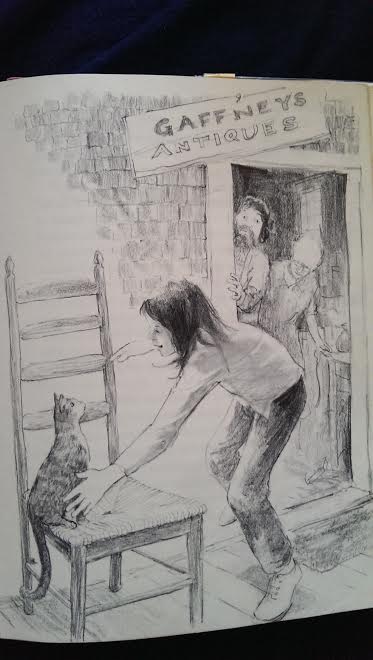
A Pattern of Roses

Tim Ingram has been feeling depressed since his parents decided to move from London to an old house in the country that they’re fixing up. It’s hard for him being separated from his friends and living in this overly-quiet place, where it seems like nothing ever happens, but the truth is that he was depressed even before his family moved. A large part of Tim’s problem is not knowing what he wants out of life. He works hard in school to get good grades, and his school has a reputation for getting its students into good universities, but it all seems so futile because Tim doesn’t know what he really wants to study or what he’ll do when he gets out of school. His father quit school early and went to work, working his way up the ladder in an advertising firm and becoming monetarily successful. However, Tim doesn’t feel like he has either the wit or self-confidence for starting off from practically nothing and working his way up in a direction he’s not even sure he wants to go. His father’s plans and suggestions for the future don’t excite him or make him happy. They actually make him feel more stressed and depressed when he thinks about them. His father is in a position to just give him a job with his company, so Tim does have a guaranteed job if he can’t think of anything else, but advertising doesn’t appeal to Tim. He’s not sure what does appeal to him. He fears and dreads the future, specifically his own future. He doesn’t know what to do with himself, and in this new place, it seems like there isn’t a lot he can do.

Tim has also been arguing with his parents, discovering that he has different interests and priorities in life than they do. While they’re enthusiastic about expanding onto this country house with a new and stylish modern wing, Tim prefers the older part of the house and its simpler style. He thinks the modern additions his parents made look ugly and out-of-place, ruining the natural beauty of the countryside. His parents feel like he’s unappreciative of their standards and the sort of lifestyle they’ve worked hard to build, and his mother even goes so far as to call him “perverse and awkward.” He kind of feels that way, too. Tim often feels like he’s a nobody, not very outstanding at anything. His ambitious parents are disappointed in him because they’ve invested so much in his education to show him off as another one of their achievements in life, and he doesn’t think he’s much to show off. He’s even a little disappointed with himself because, not only does he not seem to live up to his parents’ expectations, he doesn’t even have it in him to stand out as a rebel or a troublemaker, like some of his friends. He’s not an aggressive person, and it’s just not his nature to fight or get into trouble, and that makes him feel like even more of a nobody. If he neither excels at meeting people’s expectations or at deliberately flouting them, what is he? Who is he? Where does he fit in? With all of this, Tim hasn’t been feeling well, and he fakes being sicker than he is so he doesn’t have to get out of bed and deal with any of it. Since he’s been unwell, he’s also excused from school until after Christmas, leaving him with nothing to do in this countryside house but lie in bed and think about all the things that are worrying him.

Then, one day, the builder who’s been working on their house finds an old tin box hidden in the chimney of the room that Tim has chosen for his bedroom. The box catches Tim’s attention. It looks like a very old biscuit (meaning cookie, this book is British) tin decorated with a faded pattern of flowers. The builder opens the box and is disappointed to see that it just contains papers, not anything that looks really valuable. However, Tim is curious and insists that he wants to see the papers.

The papers are drawings, quite old and done in black crayon. Most of them are landscapes and buildings, but there is also a girl, who is labeled “Netty.” Netty’s name is written in a heart, so the artist must have loved her. The date on one of the drawings is February 17, 1910 (the story seems to be contemporary with the time when it was written in the early 1970s because Tim thinks that was 60 years ago), and to Tim’s surprise, the author signed with his initials: T.R.I. Tim’s full name is Timothy Reed Ingram. Tim is intrigued that the artist who lived so long ago had the same initials and apparently lived in his room.

The builder, called Jim, asks Tim if he likes to draw or knows anything about art. Tim gets good grades in art, but he’s not very self-confident about his abilities. Still, he knows enough to tell that the artist wasn’t particularly great at his art. There are places where he got the proportions of his drawings wrong, but Tim is impressed that they convey a lot of feeling. Even though the drawing of Netty isn’t perfect, Tim feels like he can tell what kind of girl she was. She looks like she’s in her early teens and has a kind of proud, somewhat naughty or daring look. Tim asks the builder if he knows anything about the artist or the people who lived in the house back in the 1910s. The builder says that was before his time, but he thinks that he remembers hearing that the family name was Inskip, and he says that he could ask his father if he knows more. Tim wonders why the drawings were hidden in the chimney and begins to imagine what the first T.R.I was like, picturing a boy close to his own age.

Tim is surprised at how real the boy he imagines seems because he’s often found it difficult to imagine old people as once having been young. He’s seen old men and known that they were part of the generation that fought in WWI but is unable to picture them as once having been soldiers. In fact, he knows that his own father flew a Spitfire during WWII, but even though he knows it happened, he has trouble picturing that of the middle-aged advertising manager his father has become. Yet, somehow, T.R.I. seems incredibly real to him, someone he can connect with, even more so than his own father. Details of this past boy’s life flash through Tim’s head without him knowing quite where they came from. However, Netty seems even more real to Tim because of her picture.

When Tim’s mother makes him get out of bed and go visit the local vicar to get a copy of the parish magazine, Tim has a strange vision of the boy artist he imagines as being named Tom Inskip passing him in the lane. It’s so real that Tim feels like Tom is actually there. As he pauses to look around the churchyard, he spots some beautiful purple roses by a gravestone. Taking a closer look, he sees that the grave has the initials T.R.I., a birth date of March 1894, and a death date of February 18, 1910. Tim is shocked to realize that the artist was not only a little less than 16 years old when he died, just a little younger than Tim is now, but that he also died the day after he drew that last picture. It seems like the boy’s death was sudden and unexpected, more like an accident than a long illness.

Tim doesn’t meet the vicar, but the vicar’s daughter, Rebecca, spots him in the churchyard and asks him if he’s all right. Tim just says that he’s there to get a parish magazine. Rebecca isn’t too cheerful or friendly, and she just gives him one and sends him on his way. Tim later learns that Rebecca is the youngest of the vicar’s children and the only one still in school. Her older siblings are all grown up and have jobs working for good causes and charity organizations.

Tim talks to Jim the builder about the grave he saw, and Jim is interested. He suggests that, since T.R.I. is buried in the churchyard, there will be church records about who he was and how he died. Tim has another vision of the boy, and the boy says, “Find out. But be careful it doesn’t happen to you.”

Tim returns to the vicarage and talks to Rebecca about T.R.I. Rebecca says that she doesn’t believe in ghosts and that she thinks the visions he’s had are just his imagination. However, Tim’s guess that the artist’s first name was Tom turns out to be correct. His full name was Thomas Robert Inskip. The records don’t say how he died, but Rebecca suggests that Tim ask an old local man called “Holy Moses.” The old man says that he remembers Tom Inskip but he doesn’t know what happened to him because he left the village to work somewhere else and didn’t come back until after Tom was dead. When Moses shows them an old photograph of all the children at the local school, Tim recognizes Tom instantly as the boy from his visions and strangely even knows the name of Tom’s friend, Arnold, standing next to him in the photograph, without being told.

From this point forward in the story, scenes with Tom alternate with scenes with Tim. Tom’s scenes start with the day the photograph was taken, when Tom was eleven years old. It was also the day that Tom first met the new vicar of the parish, Reverend Bellinger, a fire-and-brimstone kind of preacher, very different from the gentle man who was the last vicar. Like Tim, Tom was bright, imaginative, and artistic, but he was not much of a worrier. Tom fails to impress the new vicar because he is not very good with religious knowledge and often doesn’t pay attention. Tom loves to draw, but after he gets out of school and starts working, he finds that he doesn’t have time anymore. The vicar’s daughter, however, is kind and encourages him to draw because it’s a talent from God and must be used. People often underestimate her and don’t appreciate her because she has a disability, so she understands what it’s like not to have the opportunity to use and develop her talents to the fullest. It’s only sad that a tragic accident cuts Tom’s life short before they can see what he might have developed into, although when Tim and Rebecca manage to contact the people who knew and remember Tom best, one of them points out that, if Tom hadn’t died when he did, he might have been sent off to fight and die with the other young men during WWI, and with his gentle soul, he might have suffered more from the war than he did from the accident that took his life, when died young in an act of self-sacrifice.

Tim’s scenes involve his parents and school discussing his future, asking for little input from him, not caring about how he feels or what he wants. Tim actually does love art, and his art teacher thinks he should go further with it, but his teacher realistically acknowledges that, with Tim’s good grades in his other classes, his family and the school will want to push him into more lucrative and higher-status fields. But, does Tim really care about money and status as much as his parents? Is that really what he wants?

Gradually, Tim begins to consider the idea of the legacies people leave behind. Few living people remember that there was once a boy named Tom Inskip who died young, and after those people are gone, no one will remember. It occurs to Tim that few people would likely remember either him or his father as advertising workers. If all you care about is just getting money to afford the good things in life, any job could do, and there are many well-paying jobs that make little lasting or meaningful impact on the world. On the other hand, if what you want is to leave a lasting and meaningful legacy, you have to think a little deeper and maybe sacrifice some material gain. Money comes, and money goes, and one coin or bill looks like another, but what lasts as long and has as much individual character as a collection of imperfect but evocative drawings hidden away in an old tin box?
The question of what Tim wants to do with his life becomes the question of what Tim wants to leave as his life’s legacy. The quietness of the country, rather than being the torture it initially seemed, gives Tim a chance to think and really consider what he wants. Through his search for Tom’s past and consideration of Tom’s legacy, Tim finds a new vision of his own future that makes him more hopeful instead of more frightened and that may lead him to find what one of Tom’s friends called Tom’s “perfect spiritual grace.”

The book is available to borrow and read for free online through Internet Archive (multiple copies). Some US versions of the book are titled So Once Was I.

That alternate title is fitting for the theme of the story. Tom was once a living boy with choices to make in his future, much like Tim is now. That phrase also appears in the story as part of an epitaph from another tombstone, which I’ve also seen elsewhere. That same epitaph has been used in different forms in real life. It refers to the inevitability of human mortality – all those living will someday die, like every other generation before. As one of my old teachers used to say, “Nobody gets out of life alive.” But, I would also like to point out that the sentiment also refers to growing up. Every adult used to be young (although Tim has trouble picturing it), and every child will someday be an adult (if they live to grow up – Tom was unfortunate). Every person in a profession of any kind was once a student and a beginner, struggling to learn and find or make their place in the world, and every student will one day find or make some place for themselves and try to make a mark on the world. Change is inevitable. Time passes, people grow and change, and everyone moves on in one way or another. Tim won’t always be a student with his parents controlling his education. He will eventually grow up, graduate, and become an adult. That part is inevitable. What else he becomes is up to him and whatever opportunities he seeks and finds for himself. His future legacy is still in the making.

There is also a made-for-television movie version that is available to rent cheaply online through Vimeo. The movie version is notable for being Helena Bonham Carter’s first movie role. She played young Netty.

I found this story very sad, particularly Tom’s death, trying in vain to rescue beloved hunting dogs but drowning along with them in an icy lake when they all fell in. The death of the dogs was as traumatic as Tom’s, and it is described in awful detail. I also hated a part earlier in the story, where one of the dogs kills a pet cat. I love animals, and that was hard to take. It’s all a tragedy, but Tim’s story has a more hopeful ending. Besides leaving behind a box full of drawings, Tom’s effect on Tim’s life becomes a part of his legacy. Even though they lived in different periods of time, Tom and his life story helps Tim, who has been going through a personal crisis, to realize what’s really important and what he wants out of life.

Through much of the book, both Tim and Rebecca are in a similar situation when it comes to their future lives and their family’s expectations for them. As Tim gets to know Rebecca, he discovers that she has hidden depths and is inwardly quite sensitive. She often uses a blunt and abrasive manner to keep people at a distance and hide how sensitive she really is. Like Tim, she is also unimpressed by the money and business-oriented priorities of the modern world and Tim’s parents, preferring things with an old-fashioned, natural beauty – things that, sadly, are often cleared away by modern people in the name of money, business, and being modern. Yet, Rebecca also doesn’t feel like she fits with the lives that her family lives. She doesn’t have the patience to deal with the people her family tries to help, many of whom are nasty and ungrateful instead of kind and appreciative of the help they get, and she feels like her parents don’t have time for her because they spend all of their time helping everyone else. Rebecca is considering a career in social work, but it’s mostly because it’s what her parents want and expect of her. As they compare their family lives, Tim and Rebecca both realize that neither of them quite fits their families’ lifestyles and expectations. They both feel pressured. Their families are also extremes: extreme business and high-achievement vs. extreme charity. Tim and Rebecca are looking for a happy medium that neither one of them knows how to achieve. They feel overwhelmed by a world full of choices, their parents’ expectations, and their own uncertainty about what path to choose.

It occurs to them that a boy like Tom in the 1910s would have limited choices in life and expectations from his family and community. Tom died young, but if he hadn’t, he probably would have been expected to do what other young men in his community did, which was mostly farming or joining the army. In some ways, Rebecca thinks life was probably much easier for those who had no choices than it is for modern people with many more choices and little to no guidance about how to use them. Tim and Rebecca aren’t really bound to their parents expectations because there is less social stigma with being different in their time, but being young, inexperienced, and uncertain of their options in life, they aren’t sure what to do with their relative freedom. They feel trapped, but not in quite the same way as each other and in a different way from people in the past.

Perhaps all people have limits and obstacles no matter when or where they live, and nobody is ever fully in control of their destiny because they are subject to limits in knowledge, ability, and available options. Maybe not everybody is even really suited to where they end up in life. They learn that the man who was the vicar in Tom’s time was more of a bully than a loving and charitable man. Tim’s art teacher comments that he used to work in a job similar to Tim’s father before he found his calling teaching art. Having followed two different professions in his life and seen the people who thrive in each, he thinks that Tim’s personality fits better in the art world than the business world, but he can also see that Tim is going to have to learn to fight and stand up for himself to get where he really needs to be.

But, happiness in life depends on more than fighting or earning money. May, the vicar’s daughter, who is still alive and has lived a happier life than anyone expected after the death of her father, says that one of Tom’s greatest gifts was “perfect spiritual grace.” She explains that Tom never asked a lot out of life and was satisfied with what he had. His life was tragically short, but he enjoyed it to the fullest as long as he lived. Tim thinks that Tom might have gotten less satisfied with his limited prospects in life if he had lived longer, but it’s difficult to say. However, May’s description makes Tim realize that he wants that same sense of “perfect spiritual grace”, making the most of the opportunities open to him and being satisfied that he pursued those opportunities to the best of his ability.

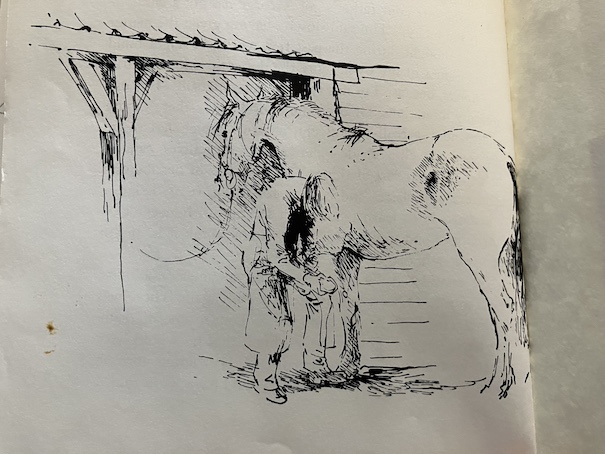
Life has a way of taking many people in directions that they never expected. People often don’t know what they want to do with their lives when they’re young, some of us still question our career choices when we’re older, and many of us end up doing things we didn’t expect or entering fields we didn’t originally study. Tim’s new home and new acquaintances and the inspiration that he receives from Tom’s life story cause him to consider different directions that his life might take. Tim finds a job in the country as the local blacksmith’s assistant. Blacksmithing appeals to Tim’s creative side, and there is enough demand for specially-crafted decorative metal objects that Tim is confident that he can build his own business around it. He’s confident enough about it that he finds the ability to stand up to his parents and insist on the future he really wants. He probably won’t make as much money at it as his father does in his advertising firm, but he’ll be independent and creating real things that will leave the lasting legacy that he now craves. He hopes that, along the way, he’ll also find the “perfect spiritual grace” that Tom had.

Tim also comes to realize that the company that his father built was his father’s act of creation, and that’s why he takes so much pride in it, wanting Tim to continue it as his legacy. However, Tim also realizes that what his father did with his life was his decision, done for his own reasons and his own sense of fulfillment, and he doesn’t need to stifle his own creative urges to validate his father. Tim is adamant that he wants to create something of his own, to know the satisfaction of that kind of creation for himself. His parents are angry with him, seeing his decision as throwing away all that they’ve given him and all they say that they’ve sacrificed for. Still, Tim points out that the lifestyle that his parents chose was their choice, not his. He didn’t ask them to do any of it, they did it because it was what they wanted to do, and he wants the right to make his own choices. It affects their relationship, but Tim already had the feeling that their relationship was strained because of his parents’ expectations for his future, which were making him unhappy. When they argue about it, it becomes apparent that his parents have been emotionally manipulative, and having a say in his own future isn’t an unreasonable thing for Tim to ask for, even though his parents claim that it is. His parents really have been selfish and even neurotic, planning to use Tim as something to show off, ultimately depending on him to make themselves feel successful and fulfilled and validating their life choices. They make it clear to him that their support for him hinges on him doing exactly what they want him to do. Their love is conditional and transactional. In an odd way, it feels like a relief to Tim to have it all out in the open and to take control of his destiny in spite of their opposition. Whether or not his parents will eventually accept Tim’s decision and independence or whether they will remain estranged is unknown.

I don’t think I’d read this book again because of the sad and stressful parts, but it does offer a lot to think about. I’d also like to point out that this story is not for young kids because of the subject matter, and there are also instances of smoking and underage drinking.

Two Are Better Than One

Two Are Better Than One by Carol Ryrie Brink, 1968.

This is a gentle coming-of-age story about two thirteen-year-old girls in Idaho during the early 1900s, but it’s told in a interesting format, as the reminiscences of one of the girls as an old woman and focusing on a story that the girls were writing together as teenagers. It’s like a story about a story within a story.

One Christmas, elderly Chrystal Banks receives a special present from her old friend, Cordelia Crump. The package contains two miniature dolls (she calls them “pocket dolls”) that Chrystal gave to Cordelia 60 years before. At first, Chrystal doesn’t remember giving her friend Cordy” these dolls but admits that her memory is starting to fail her. As she studies the little china dolls and their exquisite details, she begins to remember them and when she gave them to her friend. The dolls’ names are Lester and Lynette, and Chyrstal remembers how Cordy used to say that the little dolls were magical because any day she carried them seemed to become special and exciting. Even when Chrystal and Cordy grew older, supposedly too old for dolls, they still continued to love and believe in the magic of their special pocket dolls.

Before young Chrystal Reese (as she was known before her marriage) gave the dolls to Cordy, they were a Christmas present to Chrystal from her Uncle Dick. That was the Christmas when the girls were in seventh grade and were early thirteen years old. Uncle Dick had acquired a number of interesting presents for Chrystal on his trip to Europe. He doted on his niece because she had no parents or siblings, living only with her grandmother and Aunt Eugenia and their dog, Rowdy. All of the presents are wonderful, but the little dolls are something special. As she unwraps them, they are hidden within a small box inside another box inside of another box (not unlike the story itself). Chrystal loves the elegant, detailed, jointed dolls immediately and names them Lester and Lynette because they just seem like the right names for the dolls.

Immediately, she goes to see if the little dolls will work well in the dollhouse that she’s made out of orange crates. She has spent considerable time and most of her allowance money putting paint and wallpaper into the little house and making furniture for it. She made all of the dollhouse furniture to fit two small dolls that she already has, Elsie and Eileen. However, Elsie and Eileen are four inches tall, and Lester and Lynette are only about two-and-a-half inches tall, so they won’t work in the house. At first, Chrystal is unsure what to do with the tiny dolls. She loves them, but she’s going to have to figure out where to put them and how to play with them if they won’t fit into the doll house. Then, she gets the idea to give the little dolls to her best friend, Cordy. It’s a sacrifice to part with such a lovely present so soon after getting it, but she wasn’t satisfied that the little bottle of perfume she was going to give Cordy was really a good present. Besides, the girls are so close that they already share everything with each other, and as they like to say “Two are better than one.” Giving the dolls to Cordy won’t be like giving them so much as sharing them with someone who can help to make them even more fun.

Cordelia Lark (her maiden name) grew up in a well-off family with mostly boys. Her father was president of the local bank and president of the school board and a civic leader in other ways, and Cordy had four brothers and no sisters. Cordy and Chrystal are kind of like the sisters neither of them ever had. They like to call each other “Tween”, which is their special pronunciation of “Twin.” They justify being twins because their birthdays are only two weeks apart, so they’re almost exactly the same age.

On the way to Cordy’s house to give her the special Christmas present, Chrystal passes by the courthouse. When she and Cordy pass the courthouse, they can see the barred windows of the jail, and they make up stories to spook each other about how one of the prisoners might escape. On this particular day, Chrystal sees one of the prisoners gripping the bars of his window and looking out. He’s the first prisoner Chrystal has ever actually seen. She’s a little afraid of him, and when he starts talking to her, she doesn’t know what to say at first. The man first asks her what she’s staring at, and then he wishes her a Merry Christmas, even though he’s not having one. Not knowing what else to do, Chrystal murmurs “Merry Christmas” back and hurries on.

When Chrystal gets to Cordy’s house, the two girls exchange presents. It turns out that each of them almost got the other some perfume, but each of them changed their mind at the last minute and decided on something better. Cordy’s present to Chrys (as she sometimes calls her) is a book, which makes Chrystal happy because she loves books and didn’t get any for Christmas this year. But, it’s not just any book. This is Chrystal’s first grown-up novel instead of a children’s book. (They mention the Oz books, the Little Peppers, and the Little Colonel series as books they’ve read.) It makes Chrys feel grown-up. It’s a romantic story about a Southern girl during the Civil War who falls in love with a Northern soldier and eventually marries him. Chrys says that Cordy shouldn’t have told her the ending before she’s read it, but she’s still thrilled at having her first grown-up book.

Chrys worries that, since Cordy gave her a grown-up present, she’ll think that the little dolls are babyish, but Cordy loves Lester and Lynette immediately. She says nobody gave her a doll this year, and she felt disappointed because she loves dolls, and it just didn’t seem like Christmas without one. Chrys explains that these are pocket dolls, and they’re meant to be carried around in pockets, so they can go everywhere with the owner. Cordy says that they’re so tiny and perfect that they must be magic, and she decides to keep the names that Chrys gave them, Lester and Lynette. Cordy thinks that the little dolls are perfect to take along on adventures.

When Chrys tells Cordy about the prisoner, the two of them are nervous, although they don’t really think he can escape. Chrys asks Cordy to walk her home, but after they pass the courthouse, Cordy realizes that she’d have to walk past the courthouse alone on her way home. So, Chrys and Cordy turn around and walk the other way again, but then, they realize that they still have the same problem. No matter which way they go, they have to pass the courthouse, and no matter who walks who home, one of them will have to go alone at least partway. After they go back and forth a couple of times, they pause in front of the courthouse, and Cordy has an idea. She gives Chrys the Lester doll, keeping the Lynette doll for herself. That way, each of them will have someone to keep them company, and it will be like they aren’t alone. It gives each of them enough courage to go the rest of the way home, and it’s the beginning of their adventures with the dolls.

Chrys is inspired by her first grown-up book, and she thinks that maybe she’d like to write novels when she grows up. When the girls are in school, they like to write notes and funny poems with each other when they’re supposed to be studying, and Chrys suggests to Cordy that they start writing a novel together. Cordy agrees, and they decide to take turns writing chapters. They decide that the story will be about Lester and Lynette, and Chrystal writes the first chapter. Chrystal calls the story “The Romantical Perils of Lester and Lynette.”

However, the girls get in trouble for goofing off and not paying attention in class. Their strict teacher, Miss Hickenlooper, decides that the two girls can’t sit together anymore, and she confiscates Lester and Lynette and locks them in her desk. The girls are devastated. If the teacher wanted them to move desks, that was disappointing but justified, but she had no right to just take the dolls. The girls think that they’ll have to wait until the end of term to get them back, but they continue writing the story about the dolls. Chrystal had been going to write the first chapter about an elopement, but because the dolls are now imprisoned in the teacher’s desk, she decides to write it as a prison escape instead.

In the new version of the first chapter of the story, Lester and Lynette are brother and sister, and they are imprisoned in a castle overlooking the Rhine river in Germany (part of the the girls’ geography lesson in school) by their evil guardian, Baron von Hickenlooper. Lynette is rescued/kidnapped by a Viking pirate named Oskar, who carries her away from her brother, who still remains in the castle.

From this point on, the events in Chrys and Cordy’s lives alternate with new chapters of their tandem story about Lester and Lynette. Pieces of the girls’ lives work their way into the story. When the girls are ready to trade turns writing the story, they give each other what they’ve written so far and say “Muggins!” (The word comes from playing games like Dominoes and Cribbage where, if one player spots that another has missed a score or failed to count something properly, they can call “Muggins!” and add the overlooked points to their own score. I think what they’re implying is that this story is a game where one person picks up whatever the other one has left unfinished.) The girls also continue adding verses to an unflattering poem that they started writing about their teacher.

By accident, the girls loose track of the mean poem about their teacher, and Miss Hickenlooper finds it. At first, the girls are terrified that Miss Hickenlooper is going to be furious with them and do something horrible in punishment, but to their surprise, she starts crying. Miss Hickenlooper end up having a heart-to-heart talk about the girls’ experiences in Miss Hickenlooper’s class, what Miss Hickenlooper hoped for when she started teaching, and why she took Lester and Lynette from them. Miss Hickenlooper had wanted to be a teacher for a long time and was looking forward to it, but she had been away from it for a long time because she had to take care of her mother during a lengthy illness. Since she started teaching again, she can tell that her students haven’t been happy with her, but after reading the poem, she realizes that it’s worse than she thought. Even strict teachers can be respected by their students as long as they’ve taught their principles well and the students are learning valuable lessons. Miss Hickenlooper feels like she’s failed as a teacher because she hasn’t managed to connect with her students at all, and she’s making them miserable. The girls come to the surprising realization that their teacher really does care about her students and what they think of her.

The talk between the girls and Miss Hickenlooper was a little uncomfortable because the girls realize that they’ve done an injustice to Miss Hickenlooper by writing the mean poem about her, but I actually liked this part of the story because it’s the kind of honest communication that I often find missing in stories. Rather than anyone blustering or dodging or trying to save face, the girls and their teacher honestly discuss what happened and how they feel, and everyone involved learns something from the experience. The girls appreciate having this “human” communication with their teacher, and it earns their respect, more than any angry tirade or show of strength on their teacher’s part ever would have. It’s this very kind of open honesty and humanity with real feeling behind it that’s been missing from the class so far, and it’s what has prevented Miss Hickenlooper from really connecting with her students.

The girls apologize to Miss Hickenlooper about the poem, and Miss Hickenlooper admits the justice of some of their complaints. Miss Hickenlooper admits that maybe she went a little far in making Cordy turn out her pockets and taking her dolls from her for an extended period of time. Getting into someone’s pockets and taking personal possessions is a kind of invasion of privacy, and Miss Hickenlooper says that she only did it because the girls weren’t paying attention in class, which is true. In return, Chrys and Cordy acknowledge that they only wrote the poem to blow off steam because they were angry, but they also went too far, and they really should have considered their teacher’s feelings. The girls promise not to write any more poems like that, and Miss Hickenlooper gives Lester and Lynette back to them. Miss Hickenlooper says Cordy can keep the dolls in her pocket if she wants as long as the girls pay attention in class from now on. To further apologize, the girls make cards for their teacher and give her the two bottles of perfume that they almost gave each other for Christmas (“Two are better than one.”), and they start going out of their way to be nicer to her.

The girls’ talks with Miss Hickenlooper through the rest of the school year give her feedback that helps her to improve as a teacher. Later, when the girls are watching a lightning artist (someone who paints pictures very fast, not the more modern definition of someone who works in animation) at work and happen to see Miss Hickenlooper in the store as well, they point out that one of the artist’s pictures reminds them of the Rhine that they studied in class. Miss Hickenlooper doesn’t think much of the quality of the painting, but she admits that it does look like the Rhine and that another painting the artist did reminds her of Switzerland when she was there. The girls are amazed that Miss Hickenlooper has been to Europe because, other than Chrys’s Uncle Dick, they don’t know anyone who has. They ask her why she never talked about it in their geography lessons because that would have made them much more exciting, hearing about other countries from the perspective of someone who was actually there. Miss Hickenlooper is surprised. She says that she was only focused on teaching the lessons that she was assigned to teach and just never thought about including anything personal because she didn’t think her students would be interested in her personal stories. Again, it’s that personal element that Miss Hickenlooper needs if she wants to connect with her students on a personal level.

As the story continues, the girls also start to consider their attitudes about boys and men and future husbands. So far, most of their knowledge of boys has come from the boys at school and Sunday school and Cordy’s brothers, all pretty immature and rowdy. But, the girls are growing up, and so are some of the boys. New young men also come into the girls’ lives.

A friend of Chrystal’s grandmother asks her if she would be willing to rent a room to her 19-year-old son, who is looking for a place to stay as he takes his first teaching job at the local college. (That sounds young for a college teacher. In modern times, a nineteen-year-old would be a college student himself. Remember, this is the early 1900s, and education in the United States was very different then. Back then, teachers didn’t need to have the advanced degrees that they do now, and Mr. Banks later explains that he skipped grades when he was younger to get through school faster.) Chrystal’s grandmother agrees, although Chrystal isn’t anxious to have a teacher living in her house after her problems with her own teacher at school. Chrys also isn’t sure what to expect from a man living in the house because there’s never been a man in this house before. Cordy’s brothers are pretty rowdy. However, their new lodger, Mr. Banks, turns out to be quiet, polite, and very nice. (His last name is an indication that he’s going to be Chrystal’s future husband. There’s six years’ difference in their ages, but as times goes on, and Chrystal gets older, that’s not going to seem like as much of a gap.) He is the first person to ever address Chrystal as “Miss Reese”, which makes her feel grown-up.

Cordy’s family also has a boarder, Mr. Crump, who is attending the local college (obviously, Cordy’s future husband, based on her future last name). Mr. Crump is working his way through college by selling pots and pans, and Cordy goes with him to help carry things, bringing along Chrys because “Two are better than one.” The girls end up giving him some advice on his sales patter that helps him make more sales.

Meanwhile, the girls’ Sunday school class, which calls itself the Dorcas Club, decides to host a masquerade party with the boys’ class (who have dubbed themselves the Armored Knights) as their guests. Chrys and Cordy think of the boys as immature and uncouth and roll their eyes at the older girls who are boy-crazy. Then, because the party is on Presidents’ Day, all of the girls in the group want to go dressed as Martha Washington, and there’s a big argument about it. Originally, Chrys and Cordy wanted to be Martha Washington, too, but since that’s what all the others want, they decide that they want to do something completely original. Inspired again by the dolls, they decide to go dressed as dolls. However, because they don’t want to be like the prissy girls trying to be pretty and impress the boys, they decide not to go as elegant dolls but as old rag dolls in patched clothing.

The girls do win prizes for both the funniest and most original costumes at the party because they’re the only girls who don’t show up as some version of Martha Washington. However, the triumph turns against them because the girls who are in charge of the main entertainment for the evening have decided to turn it into the girls’ very first dance party with the boys, something that Cordy and Chrys weren’t expecting. Rag doll costumes are good for fun and games, but not so much for serious dancing and the possibility of budding romance. While all of the boys are wearing various fanciful costumes themselves, like pirates and clowns and cannibals, it turns out that they’re only interested in the girls who dressed in pretty clothes as Martha Washington, and none of them want to dance with the rag dolls. Chrys and Cordy were proud of themselves for being more original than the other girls, but it seems that the boys prefer “pretty” to “original.” At the end of the evening, none of the boys even want to walk Chrys and Cordy home. Chrys and Cordy feel embarrassed because their efforts to be “original” seem to have strayed a little into the outlandish at a time when the other girls and boys are starting to seriously get interested in each other.

Fortunately, their families guessed that something of the sort might happen and asked the young men boarding with them to go to the house hosting the party and walk the girls home if they had no one else to walk with them. Mr. Crump confirms to the girls that boys would prefer to walk with girls who made an effort to look pretty instead of girls who look like rag dolls. Mr. Crump says that there will be other parties, and next time maybe they’ll go as something more elegant, like Martha Washington, but the girls aren’t too thrilled about doing this type of party again. Mr. Banks takes a different view and says that he actually thought that the rag doll costumes were rather clever and that it was really better for the girls to be different instead of trying to be like every other girl in order to not stand out. “Sometimes it may hurt, but I think it’s better to be original.” Mr. Banks the college teacher is more mature than Mr. Crump the college student, and I think he has the right idea. Looks and clothing styles change, and people have different priorities when they get older, but original thinking and an interesting personality are hard to replace and never go out style. When Chrystal says that she doesn’t even know how to dance, Mr. Banks offers to teach her, so she can be more confident at future parties.

Having the boarders walk them home actually turns out to be an unexpected victory for Chrys and Cordy because, while the other girls were making fun of them for not having any of the boys dance with them or walk them home, Chrys and Cordy ended up being escorted by young men. Getting boys is all well and good for young girls, but being escorted by young men makes Chrys and Cordy look like young women, putting them on a higher level than mere girls. Chrys and Cordy don’t see it that way at first because Mr. Crump and Mr. Banks are just their families’ boarders and friends and treat them like younger sisters (at this point in their lives, anyway), but the other girls notice that the young men are more mature than the Sunday school boys, and it causes them to look at Chrys and Cordy with a little more respect for having their attention. In some respects, Chrys and Cordy might seem less mature than the girls who are excited about wearing makeup and getting boys because they’re into outlandish costumes and dolls and “romantical” stories, but in other respects, they may actually be a little more mature than the other girls for being confident in their individuality and the new awareness they’re acquiring of other people’s feelings. In the end, girls want to marry men, not little boys, anyway.

Through the spring, the girls have other adventures and continue writing their story with their dolls. Along the way, there are other signs that the girls are growing up. They notice that this is the first year when they’re more interested in getting new Easter bonnets than they are in their Easter eggs. Cordy’s family is heavily involved in the social life of the local college because two of their boys are students there, and Cordy even gets to go to some of the campus parties. She helps to serve punch there and sometimes gets to dance. She eventually arranges for Chrys to come with her to help with serving and have her first dance, too. Miss Hickenlooper also discusses the girls’ future with them, suggesting that they take exams to see if they can skip the eighth grade and go straight into high school because she thinks they’re smart enough to pass. The girls are uncertain if they want to go on to high school so quickly. They know they’re growing up, but they haven’t thought about high school yet (and this is a time period when not everyone even attended high school). There is also the horrible thought that one of them might pass the test while the other didn’t, and they might end up going to different schools and being in different grades. Miss Hickenlooper says that they don’t necessarily have to go on to high school yet, if they feel that they’re not ready, even if they’re offered the opportunity, but she urges them to take the tests anyway to see if they have the option. It makes the girls start questioning their future lives, what they really want, and where their education will take them.

At one point, Cordy’s brothers find their unfinished novel in Cordy’s room, steal it, and use it to make fun of the girls. The story isn’t really very well written because Chrys and Cordy are only thirteen years old. As readers will have noticed, there are spelling mistakes all through the story, and the girls also get mixed up about geography because they’re just focused on making the story exciting instead of really thinking about the setting. After their characters’ adventures on the Rhine, the girls send them floating in a boat to a tropical island with coconuts and palm trees because they don’t think about just how far away the tropics actually are. (Being shipwrecked on an island is also a common trope of vintage and antique children’s books, so they’ve probably read this type of story themselves. Just scroll through my lists of children’s books from the 1900s and earlier, and you’ll see what I mean.) Although Mr. Crump was laughing at the girls, too, he rescues the story from Cordy’s brothers and gives it back to them when he sees that the joke is going too far. However, the girls are somewhat dispirited, thinking that their story might be deeply flawed. At first, they don’t know if they really want to continue writing it, but in their desperation, they turn to the one person they know will be honest with them about what they’ve written and can not only tell them whether or not the story can be fixed but how to do it – their teacher, Miss Hickenlooper.

The book is available to borrow and read for free online through Internet Archive (multiple copies).

Themes, Spoilers, and My Reaction

The story is one of those gentle, calm stories with a few funny episodes and some genuinely touching moments. Fans of slice-of-life historical books like the Betsy-Tacy series will like this book. It is a coming-of-age story for Chrys and Cordy, as they begin to develop new attitudes and come to a deeper understanding of themselves and other people and start thinking about the future. However, the girls’ adventures also teach other people around them some lessons.

One of the themes of the book involves how people let their personalities show. Although the girls were originally thought silly for their outlandish rag doll costumes at the party, they were more bold and creative than the girls who just wanted to look like everyone else. Even though their creativity wasn’t fully appreciated at first, it ends up working in their favor in the long run.

One of the biggest developments in the story is the relationship between the girls and their teacher, and the keys to that relationship are learning how to see other people as people, how to be open about showing their personal sides, and how to appreciate people with different personalities. The girls begin as thoughtless students, and their teacher is a strict disciplinarian with little patience for their goofing off, which is why the girls see her as their antagonist. However, the girls’ eventually realize that, through their mean and complaining poem, they’ve hurt their teacher’s feelings as much as she’s hurt theirs, maybe more. It leads them to see her in a new light, as a person and just just their jailer (the role of her alter ego in the girls’ story). The honest talks between the girls and their teacher not only helps the girls to become more thoughtful and considerate of others’ feelings but also show their teacher that the key to improving her teaching and developing a better relationship with her students is to be a little more personal with her students. She gradually learns that letting her students see her as a person with interesting life experiences earns their respect more than just acting like an unfeeling drill sergeant enforcing discipline. Inspired by the girls’ interest in her travels when she was younger, Miss Hickenlooper starts bringing postcards and souvenirs from her travels to class to show during geography lessons. The students are fascinated by her souvenirs and stories and start thinking of her as an a kind of intrepid explorer or sophisticated world traveler instead of a dull woman who focuses on dry memorization and gets mad at them for daydreaming in class. As she tries new ways of approaching her lessons and adding in personal experiences, Miss Hickenlooper takes on a whole new role in the children’s lives and sparks all of their imaginations. All of the students, not just Chrys and Cordy, start behaving better because they become genuinely interested in what Miss Hickenlooper has to say and show them. They don’t want to make her angry because she’ll stop telling the interesting stories if they don’t get their work done. Just because she’s gotten more interesting and personal doesn’t mean she’s gotten soft. Don’t be afraid to be interesting and different!

The girls never actually show Miss Hickenlooper their story because they’re a little embarrassed by what they’ve gotten wrong, but they ask her questions about some of the things that they put in their story to find out what’s right. They do end up finishing the story and giving Lester and Lynette a grand wedding, but they also acknowledge that they are getting too old and busy with other things to continue playing with dolls, even Lester and Lynette. They plan to put Lester and Lynette away for now as souvenirs of their childhoods. Later, they do tell Miss Hickenlooper about their novel, and while she hasn’t read it, she has the feeling that she knows what it’s like from knowing the girls and their writing. (The girls wrote about scenes from their novel when asked to describe places they know for their high school entrance exams.) She tells them that she appreciates their imaginations but that they should remember to focus on the real world around them and gaining real experiences to write about in the future.

There are also themes that focus on what growing up and maturity mean. Because the story focuses on one school semester in the girls’ lives, there are many questions that the book leaves unresolved about what happened in the girls’ later lives, but it seems that their lives turned out well, and they look back on their experiences with Lester and Lynette as a turning point when they really started growing up. Toward the end of the story, the girls begin appreciating some of the possibilities of life and the wider world that they never considered before. Through it all, there is also the girls’ constant friendship. At the very end, elderly Chrys writes a letter to elderly Cordy, thanking her for sending the dolls and reminding her of this special time in their lives.

The author of this book, Carol Ryrie Brink, was also a child around the time that Chrys and Cordy were children. There is a picture of her as a child above her biography on the dust jacket of the book. She is also the author of Caddie Woodlawn, which is better known than this book.

I love books that contain details about life in the past, and there are a lot of fun details included in this story. I’ve mentioned some above, but that’s just scratching the surface. At one point, Chrystal says that the only paper she has that’s good for painting pictures is the pieced of paper that separate pieces of Shredded Wheat in the box. The lined paper from the notebooks she uses for school isn’t as good. When she’s out of those pieces of paper, she has to eat more Shredded Wheat to get more. I don’t remember seeing any similar kind of paper in shredded wheat boxes in my lifetime, so this must be something that existed before modern packaging.

At the college dances, the girls have dance cards for the young men to write their names and initials in to secure spots for dances. There are also occasional mentions of food, and Chrys mentions having floating island pudding for dessert, which I’d never heard of before. It’s a kind of meringue that floats on a base of vanilla custard.

The Ravenmaster’s Secret

The Ravenmaster’s Secret by Elvira Woodruff, 2003.

Forrest Harper is the son of the Ravenmaster of the Tower of London in 1735.  The story begins by explaining the tradition of keeping ravens at the Tower of London because of the superstition that the Tower would be conquered by its enemies if the ravens ever abandoned it.  This superstition led to the creation of the job of Ravenmaster, who looks after a flock of ravens that live at the Tower with wings clipped so that they can’t fly away.

Forrest Harper lives at the Tower with his parents and sisters, training to become a Ravenmaster, like his father.  He likes the ravens, and they like him.  He is pretty good at caring for ravens, but there is something that bothers him: he thinks that he isn’t brave enough and that others think that he is a coward, too.  He is smaller than the other boys and is often teased.  He has trouble cutting up the squirrels that the rat catcher’s boy (his only real friend, although his mother doesn’t approve of him) brings to him to feed to the ravens.  Even though it’s necessary, Forrest doesn’t like the sight of blood and feels kind of sorry for the squirrels.  Worse still, when Forrest’s family attends the public hangings (which were treated as a kind of festival day with music and entertainment in Forrest’s time), Forrest is unable to look at the criminals who are being hanged.  The one time he does try it, he throws up, and again, the other boys tease him mercilessly for it.  Forrest’s problem, as readers will see, isn’t so much that he’s a coward as he has more empathy than the other boys, both for animals and people, and that isn’t really as much of a problem as he believes.  His father tells him to ignore the bullies because they are foolish, and their foolishness will show in time.

Forrest sometimes dreams of going out into the wider world, beyond the Tower, where he could do something brave that would impress everyone.  The rat catcher’s boy, whose real name is Ned although most people just call him Rat, also dreams of running away because he is an orphan, treated harshly by his master and always in danger of being turned over to the chimney sweep to be used as a climbing boy.  He doesn’t think that Forrest has a real problem because his life at the Tower is pretty good, living comfortably at the Tower with his parents, whatever the local bullies say.  Still, the two boys often imagine what it would be like to go to sea together and have adventures.  When there is an announcement that a new prisoner will be arriving at the Tower, a Scottish Jacobite rebel, Forrest thinks that helping to guard a dangerous rebel will make the Tower bullies respect him.

To Forrest’s surprise and embarrassment, this rebel actually turns out to be a girl.  She is the daughter of the rebel Owen Stewart, who is being held in a different tower at the Tower of London (the Tower of London is actually a fortress with multiple towers – she is imprisoned in Bloody Tower and her father is in Bell Tower).  She has been charged with treason, along with her father and uncle.  Forrest isn’t happy about being given the task of taking food to a girl prisoner. 

However, Madeline McKay Stewart, the girl prisoner, is pretty tough in her own right.  Although Maddy’s been separated from her father and uncle and all three of them are likely to be executed, she is being pretty brave about it.  She talks to Rat and Forrest.  She is interested in Forrest’s pet raven, Tuck, and tells him about how she used to feed baby owls back home.  She talks about her life and family in Scotland, and Forrest realizes that he’s starting to think of her as a friend instead of an enemy to be guarded.

While Forrest is used to hearing English people criticize the Scots for being “savage,” he is astonished and a bit offended when Maddy talks about English people being “evil.”  For the first time, it makes him think of the situation from the other side.  He knows that not all English people are evil and realizes, having seen that Maddy actually has refined manners, that Scottish people aren’t “savage.”  One day, at Maddy’s request, he takes a message to her father in exchange for her ring, which he plans to sell in order to buy Ned back from the chimney sweep after the rat catcher loses his term of indenture to the chimney sweep in a game of cards, sparing him from the horrible life and health problems that the young climbing boys suffer.  Then, Owen Stewart gives Forrest a message to take back to Maddy.  Without really meaning to, Forrest realizes that he has suddenly become a go-between for the rebels and could be considered a conspirator under English law.

As Forrest considers the fate that lies ahead for Maddy and the nature of war between England and the Scottish rebels, it occurs to him that the adults in his life have often done the opposite of the things that they have always taught him were important.  His father always emphasized fairness, yet the war and Maddy’s possible execution are unfair.  Maddy shares Forrest’s feeling that the world might be a better place if people didn’t become adults and abandon their values.

Then, Maddy’s father and uncle are shot while attempting to escape, and Maddy is left completely alone.  Forrest feels badly for Maddy.  Soon after, he is unexpectedly approached by a carpenter who seems to know that he has become friends with Maddy.  The carpenter, who is a stranger to Forrest, tells him that Maddy will soon be executed by beheading but that he has a way to save her life.  Forrest has to decide if he is willing to trust the stranger and save Maddy, knowing that doing so would make him a traitor himself.

One of the parts of this story that interested me was how Forrest noted the hypocrisy in the adults around him as he was trying to decide what he should do.  Qualities that adults often praise and try to instill in their children are often ignored in the way that the adults live and even in how they treat other children, like Ned and Maddy.  Abandoning values, even the ones that they really want their children to have, isn’t something that adults have to do as they grow older, but it is something that some adults do if they think they must in order to live as they want to live or accomplish something that they want to accomplish.  The adults who think that Maddy should be beheaded would probably say that they were doing it for the greater good in promoting their cause against the rebels.  However, treating Ned as a piece of disposable property is something that they mostly do because they can and because they know that there is nothing that Ned can do to stop them.  Ned actually tries to repay his indenture legally with money that Forrest gives him, but although the sweep accepts the money, he refuses to let him go, saying that no one will take Ned’s word over his and that he could always use the money to make sure that Ned is hung as a thief if he tries to make trouble.  It is this type of attitude and situation that make the children realize that they are on their own to solve their problems and that working within the law is not going to be an option for them because the law is not just and it is not on their side.  It’s a frustrating situation, and I often feel frustrated when I encounter this type of thing in books, but fortunately, things do turn out well in the end.

This is one of those coming-of-age stories where a boy must decide what he stands for and where he really belongs.  Through Maddy and the inscription on her ring, which means “Face Your Destiny,” Forrest comes to understand the destiny that is right for him as he helps both Maddy and Ned escape to a better life elsewhere. 

The book also includes some interesting historical information. There’s a map of the Tower of London in the front of the book, and in the back, a short history of the Tower with information about famous prisoners and escapes. There is also a glossary of English and Scottish words that modern children (especially American children) might not know, such as breeches, wench, loch, and tattie-bogle (scarecrow).


The book is currently available online through Internet Archive.  (To borrow a book through Internet Archive, you have to sign up for an account, but it’s free, and then you read the book in your browser window.)

Spoiler: In the last chapter of the book, it explains what happened to the characters after the story ends.  Forrest does become the Ravenmaster after his father, realizing that it is the right kind of life for him and that he no longer desires to have adventures outside the Tower.  He has a wife and daughter, and years later, he receives a message from Ned, who says that he has become a captain in the Royal Navy and that Maddy has gone to live in the colonies with other Stewarts (something that my own Jacobite ancestors did, which is how I got to where I am now).

River Quest

Dinotopia

#2 River Quest by John Vornholt, 1995.

Thirteen-year-old Magnolia and Paddlefoot, a Lambeosaurus, are apprenticed to the Habit Partners of Freshwater. Habitat Partners keep an eye on different aspects of the environment on Dinotopia and make sure that the environment is maintained and cared for. The Habitat Partners of Freshwater are specifically concerned with the bodies and sources of freshwater all over Dinotopia.

When Magnolia’s master, Edwick, is injured badly during the eruption of a geyser, he and his partner, a Saltasaurus named Calico, retire and leave the post to Magnolia and Paddlefoot. Magnolia thinks that she is still too young for the position, and she and Paddlefoot worry about whether they are ready to handle the job. However, they have no choice because a crisis has arisen, and Edwick is in no shape to handle it.

The Polongo River, which supplies the water for the waterfalls that power virtually everything in Waterfall City, is drying up. Magnolia and Paddlefoot must journey up the river to find out what is happening and restore the river to its proper course.  Along the way, they find friends who can help them, but completing their mission means coming perilously close to the Rainy Basin where the meat-eating dinosaurs live.

The book is currently available online through Internet Archive.

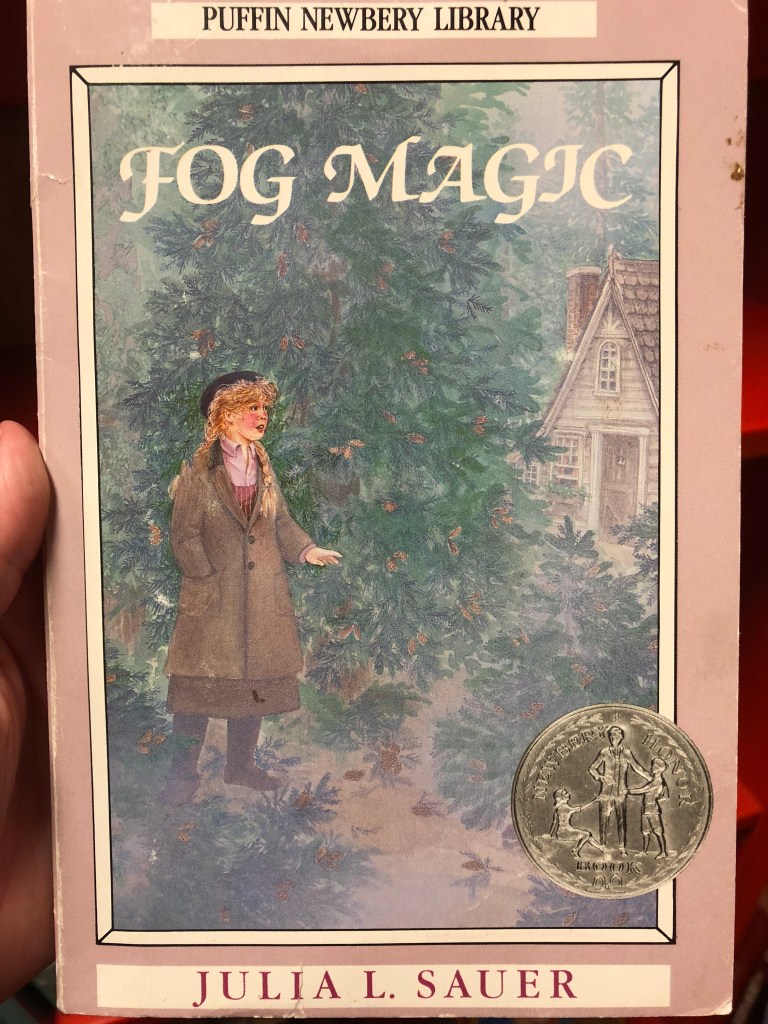
Fog Magic

Fog Magic by Julia L. Sauer, 1943.

Greta loves fog and always has, although other people can’t understand it.  When she is ten years old, she begins to get the sense that there is something in the fog that she should find.  One day, when she goes looking for a lost cow from her family’s farm, she sees a house in the fog that isn’t there when the fog is gone.  Apparently, there used to be a house on that site, but it’s gone now.  Except when there’s fog.

From then on, Greta loves to walk in the fog.  When she does, she meets people from the past.  One day, she meets a woman named Laura Morrill, who recognizes her as being from the Addington family and says that her name must be Greta.  According to Laura, there’s always a Greta in every generation of Addingtons and that there’s always a child in every generation who has a great love of fog.  Greta’s ability to use the fog to travel back in time and see her town as it once was is apparently inherited.

Greta makes friends with Retha Morill, Laura’s daughter.  However, when Mrs. Morrill gives her a piece of pie to take home, it disappears, making Greta realize that she can’t bring things from the past to the present.  Retha’s parents seem to realize it, too.  When Retha offers her a little silver egg cup to take home, Mrs. Morrill suggests that perhaps it would be better for Greta to leave it at their house and use it when she comes.  Greta also has the feeling that, when the fog starts to lift, she needs to go home, and Mrs. Morrill agrees.

On another day, Greta and Retha spot an older girl in the woods.  Retha seems to know who she is and calls out to her, but she runs from them.  They try to catch up to her, but she gets away, and Retha is upset.  It turns out that the girl is named Ann, and she was falsely accused of theft.  When it was discovered that she hadn’t stolen anything, the townspeople had tried to find her, but she’s been hiding from them ever since, too afraid to come back.  At first, people had thought that maybe she had gone to another town to find work, but now that they know that she’s been living alone in the woods, they’re worried about her.  The story also upsets Greta because she has heard a local ghost story about a girl who haunts the woods after being falsely accused, and Greta takes that to mean that Ann will die.  The Morrills assure her that they will look out for Ann.

Greta is tempted to talk to Retha about her mysterious time traveling in the fog, but Retha stops her from talking about it.  Retha says that even her mother doesn’t want to talk about where Greta goes while she’s not with them, only saying that both men who go to sea and the women who wait for them on shore “have to learn to be content and at peace shut in by their horizon.”  To Greta, that means that she should be content with wherever she is while she’s there and with the fog that allows her to see her friends in the past.

The more Greta visits the Morrills, the more she gets caught up in the lives and troubles of the people living in the past.  At one point, Greta and Retha talk about some of the sad things that have happened to people the Morrills know, and Retha asks Greta if there is sorrow where she lives.  Greta has to admit that there is.  People generally do have their troubles, no matter when they live.  Retha says that her mother says that living and dying are both natural things, so there is no use being sad about them, except when the death is an unnatural one, like in a war.  There is no war going on in Retha’s time, but Greta lives during the time this book was written, in the middle of World War II.  Greta is aware of the war and says that sometimes people have to fight whether they want to or not, but Retha doesn’t think so.  Greta realizes that she can’t make Retha understand the circumstances of the world in the future.

However, as Greta’s twelfth birthday approaches, she has the feeling that things are changing.  Her birthday will be the last time that she can visit her fog friends, but they give her a special present to remember them by.  Greta’s father seems to know what Greta has been doing in the fog, and he reveals to her, without actually saying it, that he once did the same thing himself.  He says that when people grow up, they leave the things of childhood behind, but each of them is able to keep a special birthday gift from the past as a reminder that some things do last.

The ending of the story implies that, although Greta’s adventures in the fog were real, not purely imaginary, she has to give them up to make room for the new things that will enter her life as she grows up.  Her life lies in her present and future, so she can’t keep going back to the past.  However, her experiences with her friends in the past are part of what has made her more mature, and they will stay with her forever.

The book is a Newbery Honor Book. It is available to borrow and read for free online through Internet Archive.

My Reaction

The idea of magic and magical adventures ending at a certain age, as the person begins to grow up, is a classic idea in children’s literature. Sometimes, in other books, it’s implied that the reason this happens is because the “magic” was all imaginary, and the child in the story grew out of that particular kind of imagining, but that isn’t the case in this story. The explanation in this book for why the magic has to end is simple but makes sense. The characters don’t really analyze the issue too deeply, simply taking it in stride. We never find out why this particular family seems to have this tradition of going back in time in the fog as children, and the characters seem to decide that there is no reason to find out why.

Unlike in some modern books, there doesn’t seem to be any particular mission for Greta (or her father or any other generations before her) to fulfill in her time traveling. Greta is mostly an observer of the events in the past, not really participating in them directly or changing them in any way. She doesn’t even seem to influence the thoughts or attitudes of people in the past much. When she talks about the concept of war with Retha, she doesn’t try to change Retha’s mind about it or tell her about World War II and other future events because she realizes that each of them really belongs to two different times and sets of circumstances, and each of them needs to live in their own time, dealing with their own situations. It is their differing situations which give them their attitudes. The Morrills seem to be aware that Greta comes from the future, but they treat the subject carefully, never directly stating where she is from, just hinting at it. From they way they act, it seems as though they’ve met other members of Greta’s family before, but again, the ties between their two families (if any) are never explained, and none of them seems to want to delve too deeply into the matter. For the most part, they just seem to take the whole situation as being a natural part of life in their families and in the area where they live, something just to be enjoyed and not questioned. In fact, some of their attitudes seem to imply that they fear questioning too deeply, as if that in itself might end the magic too soon.

Although the story leaves the reasons behind the time traveling very open and unresolved (probably, other children in Greta’s family will be doing this in the future, also not really knowing why), it is really a very calm story. Not having a special mission to complete in the past leaves Greta free to simply enjoy the company of the people in the past, observing their lives without the stress of needing to solve their problems for them, and readers can similarly enjoy the ride without worrying that anything really bad will happen. You do end up being interested in what happens to some of the characters, like the woman who is in danger of losing her family’s home, but events unfold in the way Greta knows they will. She’s sad when she knows that certain people are going to die (not the woman whose home was in danger, that works out well) and there is nothing she can do about it, but it all seems to be part of the natural circle of life, something that matures Greta when she realizes it.

One of the fun things that I liked about the book were some of the unusual first names of the characters, like Retha, Eldred (Retha’s father), and Ardis (Mrs. Stanton).

Are You There, God? It’s Me, Margaret

MeMargaretAre You There, God?  It’s Me, Margaret by Judy Blume, 1970.
This is one of the more controversial children’s books because parents raised concerns about the discussions of religion and puberty which are central to the story, and it has been banned or challenged in some libraries.  (Read to the end and see the spoilers before you decide if you agree with that.)

I wouldn’t recommend this book for young children because they wouldn’t understand the issues the story discusses, but it does speak to the concerns that pre-teen girls typically have about growing up, finding their place in the wider world, and fitting in with their friends as well as that haunting fear kids often have that they aren’t normal, compared to everyone else.  This isn’t a spoiler for the story (although there are plenty of those later on because I can’t really describe my thoughts about this book without them), but I just have to say that, in my experience, by the time people are done with college, maybe even by the time they’re done with high school, most of them come to realize that nobody out there is completely “normal.”  Some are just better at giving that impression.  Everyone out there has their quirks or issues, so if you think you’re a little odd in one way or another, or if you think your family is a little weird, you’re in pretty decent company.  Generally, it’s best not to worry too much about it and just get on with life.  In a way, I think that does fit in with the ending of the book.  But, I’ll talk a little more about my personal opinions about the controversial parts later.

When Margaret Simon is eleven years old, her parents decide to move from New York City to a suburb in New Jersey.  Margaret is accustomed to living in an apartment in a big city, and her new town and house seem a little odd to her.  She isn’t sure that she’s going to like her new home, and she knows that part of the reason why her mother wanted them to move was that she was worried that Margaret was becoming too close to her grandmother in New York and too easily influenced by her.

Margaret’s family is a little unusual in that her mother is Christian but her father is Jewish. (This is a little more unusual for when the book was first written than now because marriages of mixed religions are more common now than they were before, although they can still be complicated.)  The religious differences between her parents caused conflicts in their family even before Margaret was born.  Neither side of the family really approved of the match, so Margaret’s parents had to elope to get married.  Margaret’s mother’s parents disowned their daughter because of her marriage and haven’t seen or spoken to the couple in years or met their granddaughter.  However, Margaret’s father’s mother (his father is deceased) continues to spend time with the family, although she admits that it’s mostly for Margaret’s sake.  Margaret’s only close grandparent likes to spoil her and pays for her education at a private Jewish school, which is why her mother has become concerned that Margaret is influenced by her too much.  Margaret’s mother wants some separation so that she and Margaret can become closer as mother and daughter. The move and Margaret’s new friendships in New Jersey raise a number of troubling questions for Margaret about growing up, both physically and spiritually.

Because of the family religious conflicts, Margaret’s parents purposely raised her without a religion, telling her that she could choose for herself when she was old enough.  Until now, Margaret was not terribly concerned about it, but the move, the new friends she makes in New Jersey, and her increasing awareness of how religious differences have influenced her relationships with her family and other people cause her to question the choices she must make and what she really believes.  Throughout the book, she prays frequently in a casual, conversational fashion, telling God about the things that are happening in her life, the questions and problems she has, and what she really wants most.  Sometimes, she gets angry with God or disappointed when things don’t work out well, but the story makes it clear that her relationship with God is evolving, just as Margaret herself is changing as she grows up.  At one point, Margaret worries that, at age twelve, she is too old already to choose a religion and wishes that her parents had just given her one when she was little so she wouldn’t have this uncertainty.  However, growing up is a long process that Margaret is only beginning to appreciate.

The first new friend Margaret makes is a girl her age who lives next door, Nancy.  Nancy is eager to grow up and not at all shy about talking about things like boys, periods, bras, kissing, and even sex.  Sometimes, Nancy talks like she knows a lot about such things, although more mature people (and, eventually, Margaret) would realize that she doesn’t.  She introduces Margaret to two other girls, Gretchen and Janie, and the four of them form a kind of club that they call the Pre-Teen Sensations (PTS for short).  They give themselves secret names and hold meetings, talking about boys, people they know at school, and concerns that they have in their lives, especially related to growing up, periods, and sex (no one has any in the story, but the girls are fascinated by the idea).  One of the requirements of this club is that each of the girls has to wear a bra, and they feel each other’s backs at the beginning of each meeting to make sure.  Up until then, Margaret didn’t have a bra, so she has to buy her first one.  The girls worry about their breast size (none of them has much yet), and they try exercises to see if they can improve it (which is ridiculous, but it is the kind of thing that some pre-teen girls believe).  At the beginning, none of the girls has had their first period yet, and they’re looking forward to it with nervousness and anticipation, wondering what it’s going to be like.  They agree that whoever gets their period first has to tell the others about what it’s like.  Margaret nervously worries that she’ll be the last one to get hers or that she’ll turn out to be “weird” and never have one for some reason, although her mother assures her that it’s not likely and that it’s really just a matter of time.

Meanwhile, Margaret has some awkwardness at her new school, getting to know new people, sometimes making mistakes in the ways she relates to others, and figuring out which boys she likes the best. (She doesn’t get a boyfriend, just crushes.)  Her new teacher is also a little awkward because he’s young and this is his first teaching assignment, and he seems self-conscious that male teachers aren’t as common as female teachers.  Even adults can worry about being accepted by others.  He seems to be a good teacher, however, and he asks the students questions about themselves in an effort to get to know them better.  He learns early on that Margaret doesn’t have a religion and that it bothers her.  When he tells the students to choose a topic for a year-long research project into something that they care about, he allows Margaret to choose the topic of religion.

Margaret decides that her project for the year will be to learn about different religions and to finally choose one for herself.  Her focus is mainly on trying to decide between Judaism and Christianity because that’s what the two sides of her families are, that’s what most of the people her community are, and she says at one point that she doesn’t know anyone who is Muslim or Buddhist, so she can’t talk to them about their religions.   People in this community tend to belong either to the local YMCA or the Jewish community center, and Margaret thinks that if she figures out if she should be Christian or Jewish, she’ll be able to join one of those herself and fit in better.  Her friends help her in her project, some of them letting her come to church with them.  Each of the PTS girls is a different religion.  Janie is Jewish, and Nancy and Gretchen each attend a different Christian church.

Margaret’s friends aren’t particularly concerned about which choice Margaret will eventually make.  They find the story of her parents’ elopement romantic and are sympathetic to Margaret’s feelings.  However, Margaret notices that other people react differently to her project.  It seems like some of them view the idea of winning her to their side as some kind of personal victory for them, which hurts because she realizes that this is how her grandparents view her, even her beloved grandmother.  When her mother’s parents decide to visit them for the first time, there is an ugly scene where the family conflicts over religion come to a head, and Margaret feels so overwhelmed that she wants to give up on God and religion completely.  However, Margaret’s story isn’t over yet.  She’s really just started growing up, and whether she believes it or not at first, God hasn’t given up on her.  Getting what she wants most is really just a matter of time and patience.  Everyone grows up eventually.

So, what’s my overall opinion?  Generally favorable.  I read this book when I was about Margaret’s age and had the same concerns she did (or very similar, no two people are alike) and my friends and I were talking about the same kinds of things she and her friends were.  I think the key to this book is age-appropriateness.  Like I said, girls younger than about ten or eleven years old probably would not understand Margaret and her concerns because they just don’t share them.  It’s like Margaret and her friends themselves: they talk about the concerns that they all share, growing up and their new interests in boys and the idea of first periods.  If the reader isn’t a girl at that phase of her life, she just wouldn’t understand and connect with the story, and a few years later, those girls would likely move beyond all of that and on to other concerns (like whether or not they should go to college, what their major or career should be, etc. – life is full of things to figure out).  The things that seem so new and mysterious at age eleven, like real signs of growing up, later won’t matter so much because they’ve already lived it and found out that it’s not such a big deal.  Girls eager to get their first period or start shaving their legs at age twelve because they want to feel grown-up often start thinking of these things as hassles when they’re older and it’s all just become part of the routine of life.  They groan when a period starts on the day they want to go swimming or wear long pants on days when they’re too busy or just don’t want to bother shaving.  The novelty wears off, and you never look at it the same way again.  When older girls and women enjoy this book, it’s mainly as nostalgia for when they were Margaret’s age and still figuring things out.

The reason why this controversial story still remains popular even decades after its original publication is because it pretty accurately captures the thoughts and feelings of that pre-teen phase of life, when girls are just starting to grasp the complexities of life and the changes that lie ahead, alternately worrying about them and eager to get on with it and grow up.  It speaks to girls who are currently in that phase.  Reading it again as an adult, it reminds me of a time when I was in a similar place in life, although part of me now wishes that I could take young Margaret aside and tell her a few things that she eventually will come to realize:

  • That her friends are still finding their own way in life, just like she is, and even the ones who act like they know a whole lot really don’t (especially Nancy).
  • That growing up doesn’t end when you get your first period or even when you hit 18 or 21 because change is a life-long process and people mature at different rates, mentally as well as physically.
  • That many of the questions she’s struggling with are ones that everyone wonders about.  Some of them, like the religious issues and her own identity, are life-long struggles, even for people raised in more religiously-conventional households.  What human being can say that they thoroughly understand God and the mysterious ways in which He works?  It’s a worthwhile struggle, but not one that people resolve with complete certainty, certainly not by age twelve (Margaret’s age at the end of the book).  Margaret is far from being too old to consider these issues.  Philosophers and theologians have spent entire lifetimes on that subject.

But, even if I could say some of those things to young Margaret, they probably wouldn’t help completely because some things just have to be lived to be understood, which is the main reason why I would say banning the book is a mistake.  The issues Margaret deals with in the book are just common issues that come up in daily living, and the questions she asks about what she believes and what’s ahead for her are things that girls think about anyway and talk about with their friends, whether they read about them or not.  There’s no point in trying to get kids to stop thinking about these things because, at some point, they just have to because it’s a part of life, growing up, and the world around them.   Until they do consider some of these issues, it is difficult to move on to other, even more complex aspects of life, so I think it’s better to face them directly when the subjects come up instead of trying to dodge the subjects or put off thinking about them.

I think that Margaret’s elders were somewhat unhelpful in their approaches to Margaret’s religious life.  Her maternal grandparents are clearly selfish in their motives, caring only about winning the argument for their side, not really taking any interest in getting to know Margaret personally or caring about her feelings.  In fact, they only decide that they want to meet Margaret when they realize that she will be their only grandchild by blood, and even then, they make it clear that they expect the relationship to be on their terms alone.  Margaret’s paternal grandmother is better in her approach, nurturing Margaret from an early age in the hopes that she will grow up in the way she thinks best, but she endangers her relationship with her granddaughter when it seems like her previous nurturing and attention had the same selfish motive, wanting to win the argument in the same way that her other grandparents did.  Margaret wants them to like her for the person she is, not for what she might become or the ego boost they might get from her agreeing with their point of view.  Margaret’s parents are more interested in allowing her to develop her religious side on her own terms, loving her no matter what she chooses. However, Margaret might be correct in that they should have started discussing the issue honestly with her earlier in life, being a little too hands-off in order to avoid trying to win the argument or influence her too much one way or the other.

Even if the adults in Margaret’s life aren’t always the most helpful, children also learn the things that they don’t want to do from their elders.  Margaret at age twelve thinks that she’d like to raise any children she might have with a religion early in life so they won’t have to deal with the uncertainty and conflicts that she has, but she still has a lot of growing up to do, so anything can happen in her future.  Margaret’s future children (if any) will depend in equal measure on who Margaret’s eventual husband turns out to be and what he believes.  Life is a long journey, but Margaret seems headed for good things.

Many of Margaret’s growing-up issues will, like her first period, resolve themselves in time, and when she’s more experienced, part of her will look back and wonder why it all seemed so big and serious back then.  But, that’s just the phase of life she has to live through first.  Her religious issues will probably take a lot longer than physically growing up, but I think it’s important for readers to remember (as well as Margaret herself or anyone in a similar position) that Margaret is still young.  At the end of the story, Margaret still doesn’t know what religion she will choose (if any), but she’s still growing and changing, her life is changing, she’s becoming more aware of the larger world, and her mind may change many times with maturity and experience (like how many of us change majors about two or three times in college and then eventually end up in a completely different career).  Anything could happen in her life, and the range of possibilities in her life are part of the real magic of being young.  Because Margaret is a thoughtful person who seriously wants to understand the bigger issues in life, I think that she will probably be okay in the long run and that her personal relationship with God will continue to develop even if she finds it difficult to connect to an established religion.  That might not seem ideal to many people, but Margaret does the best she can with what she has in life, her circumstances and her understanding, and I think that’s a good sign.

Later editions of this book were revised to reflect new details of modern life, including how women and girls handle periods.  I’ve never actually seen the old belt-style of period pads that Margaret describes in the original version of the book, and later versions of the book describe the ones that are common today.  There is a movie version planned.

Tapenum’s Day

Tapenum's Day

Tapenum’s Day by Kate Waters, 1996.

This is about a day in the life of a Wampanoag boy living in the area around Plymouth, Massachusetts during the 1620s.  His life is reenacted by Issac Hendricks, who was a participant in the Wampanoag Indian Program at the Plimoth Plantation living history museum.

In the beginning, Tapenum introduces himself, explaining a little about his people and the strangers who have only recently come to their land, the English colonists, whom the Wampanoag call wautaconuoag (meaning “coat-men”).  Tapenum has just learned that he was not among those young men chosen to train as pniesog, a special kind of warrior among the Wampanoag who also possessed spiritual powers and acted as advisors and diplomats for their chief.  It has come as a great disappointment to him that he was not chosen for training.  To improve his chances of being chosen later, Tapenum has decided to train himself to improve his strength and hunting abilities.

Tapenum's Day Begins

Tapenum goes out hunting early in the morning, while his mother and sister are still asleep.  He starts before eating anything because he says that being hungry “makes the hunter more serious.”  Eventually, he catches a rabbit and a squirrel.  His mother is pleased with his catch, although his father has done even better by bringing home a wild turkey, which is even more difficult.

Tapenum's Day Hunting Trip

Later, Tapenum meets up with a friend, Nootimis.  The two of them go fishing in a canoe.  Nootimis knows that Tapenum is disappointed about not being chosen, but Tapenum says that at least he can still spend time with him before (hopefully) going away for training next year.

Tapenum's Friend

After fishing, Tapenum goes for a run as part of his training, and he sees smoke.  When he investigates, he finds an old wise man named Waban making a canoe.  Waban was a pniese himself when he was younger, and Tapenum offers him the fish he caught, hoping that Waban can tell him some things that will help him to be chosen for training.

Tapenum meets Waban

Tapenum ends up spending the rest of the day with the older man, learning and perfecting his skill at fletching arrows.  Waban also explains to him the importance of patience.  Tapenum is in too much of a hurry to grow up and begin serious training, but growing up takes time and so does developing the kind of strength and wisdom that he will need as warrior.

Tapenum learns some lessons

There is a section in the back of the book that explains more about the Wampanoag people, the the Wampanoag Indian Program, the Plimoth Plantation living history museum (now called Plimoth Patuxet), and the boy reenacting Tapenum’s life.

This is part of a series of books focusing on the lives of children in Colonial American history.  It is available to borrow and read for free online through Internet Archive.

The Keeping Room

KeepingRoomThe Keeping Room by Anna Myers, 1997.

Joey was named after his father, Colonel Joseph Kershaw, a wealthy businessman in Camden, South Carolina during the Revolutionary War.  Joey is like his father in many ways.  He idolizes him and does everything as his father wishes.  When his father marches off to fight on the side of the revolutionaries, he tells twelve-year-old Joey that he must be the man of the house while he is away and look after his mother and the younger children.  Joey takes pride in his new position as man of the house, but he is soon to undergo hardships that will turn him into an older and wiser person.

Joey’s father and his troops lose their battle and are captured by the British.  Soon, the whole town is taken by the British troops, and they commandeer the Kershaw house, the biggest house in town, as their headquarters, keeping Joey and his family as prisoners.  Joey can only watch in helpless anger as the British set up gallows in his family’s garden and hang rebels, his father’s surviving troops.

Joey’s mother was a Quaker before her marriage, and so is Joey’s tutor, Euvan.  They do not believe in the violence of war or harboring hate.  Although Joey seethes with anger at his father’s imprisonment, his family’s captivity in their own home, and the death and destruction he sees around him, they make efforts to remind him that British soldiers are human too, some good, some bad, and not all monsters.  However, how can Joey see the British as anything but monsters when he has seen their cruelty, when he and his family have suffered at their hands, and when he has watched them put many good men to death?

Before the British captured the house, Joey managed to hide away his father’s pistol.  It isn’t enough to fight an army, but Joey knows that he will use it to fight if he gets the chance.

Throughout the story, Joey undergoes a transformation, not just from a boy to a man, but from his father’s little copy into his own person.  From the beginning, Joey identifies himself mainly as his “father’s son.”  He loves his father and truly idolizes him.  He wants to be just like him, and his father is grooming him to take over his businesses one day, to do everything the way he does.  Joey loves how respectful everyone is toward his father, a wealthy and successful man, and how respectfully they treat him when he is with his father.  He hangs on his father’s words and adopts all of his beliefs.  But when his father is gone, things are different.  People who were respectful of him because of his father now regard him as just a boy, a little spoiled and not really knowing or understanding much.

Joey struggles to grow into his new role as man of the house, to really be a man as his father would have wanted.  But along the way, he comes to realize that there are many things that his father didn’t really understand himself and that he was wrong about many things.

Joey’s father didn’t believe in educating women beyond basic reading and writing.  His sister Mary has defied their father’s wishes before by borrowing Joey’s books, and although he didn’t want to tattle on his sister, Joey could never bring himself to support her studies openly because he didn’t want to go against what his father wanted.  However, during their captivity, Joey comes to appreciate his sister Mary’s courage and intelligence.  She gives him great support through their harrowing circumstances. He is proud of her and realizes that she is worthy of the studies she craves.

Similarly, Joey comes to question his father’s beliefs about slavery. Although his father railed against British tyranny, claiming that he would never be a slave to them, he kept slaves of his own.  When Joey had previously questioned him about that, his father told him not to worry about it because it was part of “the order of things.”  But, Joey’s own experiences in captivity make him think differently.  He also comes to appreciate the two slaves who stood by the family to help them through their captivity, learning more about their lives and history.  Because of his experiences, he decides that he will never be a slave owner himself.

Most of all, Joey finally sees the truth of what his mother, Euvan, and even Biddy and Cato (the two slaves who remained with them) tried to tell him about hate and killing when one of the British soldiers gets killed while saving Joey’s life.

As Joey reacts to the frightening circumstances around him, doing what he can to protect his mother and younger siblings, he realizes that he must rely on himself and his own judgement, not his absent father’s, to handle the situation.  In the end, he decides that, although his still loves his father and eagerly waits his return home, he does not really want to be like his father anymore.  He has truly become his own man and is ready to stand up for the man he has become, even though his father may no longer want him to run his businesses.

This book is currently available online through Internet Archive.

Susan’s Magic

SusansMagicSusan’s Magic by Nan Hayden Agle, 1973.

Susan Prescott believes in magic, although her mother tries to tell her that it’s all imagination.  Susan gets feelings about things and sometimes seems to have the ability to make things work the way she wants them to.  That’s part of the reason why she can believe that old Mrs. Gaffney is really a witch.  People say that Mrs. Gaffney used to be a fortune teller but had to stop when one of her predictions became frightening true and people got scared of her.  Now, Mrs. Gaffney runs an antique shop, living in a small apartment above it.  But, whether Mrs. Gaffney is really a witch or not, Susan’s life soon becomes entangled with hers through a series of unforeseen events.

Susan lives with her mother, who is a practical, down-to-earth woman, and her older brother Mike, who likes to play football.  Her parents are divorced, and her father lives in another state, only visiting occasionally, often at unpredictable times.  Susan’s father is known for not being very dependable, and he apparently left the family to be with another woman, although the story doesn’t provide many details.  Susan misses her father and is hurt by his absence, lack of dependability, and that he is more interested in being with someone else, somewhere else, instead of with her, her mother, and her brother.

The story begins when Susan sets out one day to buy a present for her mother’s birthday, and another girl she knows from school tells her to have a look at the flea market being held that day at a church.  Susan doesn’t have much money, and even most of the used items at the flea market are beyond her small savings.  Then, she foolishly spends what little money she has on cupcakes and lemonade.  Susan is angry with herself for her  foolishness, but her mistake leads her to greater adventures.

SusansMagicPic1One of the things at the sale which especially captures Susan’s attention is a small stuffed toy elephant.  The elephant is very worn, and Susan feels sorry for him, wanting to take him home and take care of him.  However, her money is gone, and she still has no present for her mother.  Then Mrs. Gaffney spots her looking sad and offers to lend her the 25 cents she would need to buy the elephant.  Although Susan has reservations about accepting such a loan, she does anyway, telling Mrs. Gaffney that she’ll pay her back.
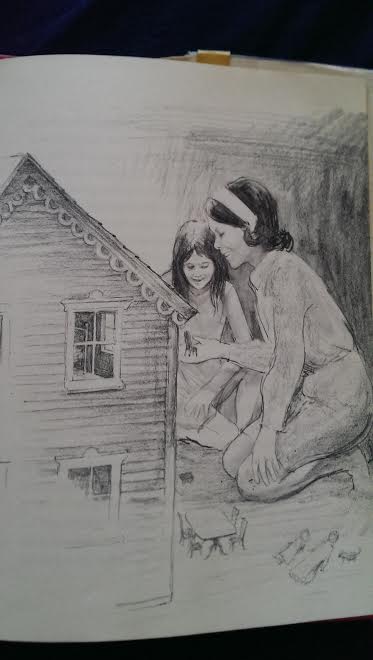
Susan brings the elephant, which she names Trunko, home, and when her mother thinks that Susan meant to give it to her for her birthday, she doesn’t correct her although she has become very attached to him herself.  Her mother, sensing Susan’s attachment to the toy, says that they can share it and that Susan can sleep with it.  Susan thinks this is a good arrangement until someone calls the house to say that the toy elephant was donated by mistake and that the original owner is sad and wants it back.

At first, Susan can’t bear the thought of giving up Trunko. But when she learns that the real owner is Hugo, a member of her brother’s football team, that he has had the toy ever since he was small, and that he really misses it, she realizes that she has to let him have it back.  To thank Susan for giving him back Trunko (originally named Stanley), Hugo gives Susan a stray cat that had been living under his porch.  Susan loves the cat immediately and names her Sereena.

However, Susan’s mother says that they can’t keep the cat because the hill nearby is a bird sanctuary.  Susan tries to persuade her mother otherwise, but she says that they’ll just have to find another home for Sereena.  Susan tries to get an older girl from school to look after the cat for awhile while she tries to persuade her mother to let her keep her, but the other girl refuses.  Then, unexpectedly, the cat runs into Mrs. Gaffney’s shop as Susan is walking past it.

In Mrs. Gaffney’s shop, Susan accidentally breaks a teapot, increasing her debt to Mrs. Gaffney.  However, Mrs. Gaffney turns out to be a cat lover and agrees to look after Sereena for Susan.  This is the beginning of a new relationship between Susan and Mrs. Gaffney as Susan offers to work for her in order to pay off her debt.  Mrs. Gaffney could use some help in her shop because sales haven’t been good, and she’s worried about losing it.

Sereena herself turns out to be good for Mrs. Gaffney’s shop, attracting customers’ attention to the items for sale.  Susan feels jealous about how much Sereena likes Mrs. Gaffney and her shop, as if Sereena has abandoned her like her father and Trunko have.  But, when a beautiful dollhouse in Mrs. Gaffney’s shop catches her eye and it turns out to be even more valuable than Mrs. Gaffney believed it was at first, Susan has to decide whether she is willing to give it up to help Mrs. Gaffney earn enough money to fix up her shop or if she will hold Mrs. Gaffney to her earlier promise to sell it to her for much less.

SusansMagicPic2In spite of the talk about magic and witches, this is not a fantasy story at all.  Susan’s concept of magic has more to do with a way of living, dealing with change, and solving life’s problems.  For the first part of the book, Susan’s “magic” focuses on getting what she wants for herself and getting things to work out the way she wants them to.  But, as the book goes on, Susan matures in the way she deals with the complications in her life.

Toward the end of the book, Susan thinks about reality and fantasy: “The magic part of living was how you fit yourself around real things, she guessed.  A magician was extra good at fitting. That’s why being one was important.”  What Susan really wants and the kind of person she wants to be change.  She comes to realize that, while she can’t get and keep everything she wants in life in the sense that it’s always with her all the time, caring about people and things is also a kind of ownership.  Giving up the toy elephant and sharing the cat with Mrs. Gaffney do not mean losing them completely because she still cares about them and the people connected with them.

Susan also realizes that, even if she doesn’t get exactly what she wants in the beginning, as long as things work out for the people she cares about, she can still be happy.  Although she has to make sacrifices at times for the people she cares about, she earns the love and respect of the people who mean the most to her.  Susan says, “Anyway, magicians don’t lose. They win. Dad, Trunko, and Sereena are mine still in a way.”  She will always be close to her mother and brother, even without her father’s presence, and Hugo, Mrs. Gaffney, and Sereena are all her friends.  Susan is a winner not because she gets what she wants for herself but because she knows how to make things work out in the best possible way for everyone she cares about, and that’s a kind of magic.

The book is currently available online through Internet Archive.

In some ways, this story reminds me a little of the Miyazki movie Whisper of the Heart, which also features a young girl who likes making up stories and who is led to an antique store by a friendly cat and meets an older person who helps her to learn about the person she wants to be and the kind of life she wants to live.  The two stories are not the same, though, and Whisper of the Heart was based on Japanese manga, not this book.  In some ways, however, both this book and Whisper of the Heart are the kind of stories that take on a new life when you read them as an adult because, at that point, you understand some of the feelings behind them better.

Crisis on Vulcan

Star Trek: Starfleet Academy

STAVulcan

#1 Crisis on Vulcan by Brad and Barbara Strickland, 1996.

This is the first book in a series about characters from the original Star Trek series when they were young.

Young Spock accompanies his father, Sarek, on a diplomatic mission while he negotiates a peace treaty among different factions of the Marathan system. The different factions have been fighting for years, but now they must resolve their differences because they wish to join the Federation. Spock and his father journey home on the Enterprise, which is captained by Robert April. April’s first officer, Christopher Pike, takes a liking to Spock and shows him around the ship. Spock is surprised at the mix of different races aboard the Enterprise, how well they work together, and how easily they accept him.

Then, a group of Marathans attacks the Enterprise with the intention of capturing Sarek. They claim that Sarek betrayed them, although they do not explain why they think so. Spock helps the crew of the Enterprise to escape from the Marathans, and out of appreciation, Captain April offers to sponsor him for Starfleet Academy. Spock has already been accepted to the Vulcan Science Academy, so he does not accept the offer. The Vulcan Science Academy is the one of the best places for a young scientist to study, but they have extremely strict standards.

STAVulcanPicAll Vulcans believe in logic and reason and the suppression of emotions. Spock is half human, and Sarek is concerned that his control over his emotions will not be sufficient to allow him to cope with life at the Vulcan Science Academy. Sarek could tell that Spock was pleased with the praise that the crew of the Enterprise gave him when he was able to help them, and he urges him to keep a tighter rein on his feelings. To help Spock adjust to life at the Vulcan Science Academy, Sarek arranges for him to stay there over the summer, before the next semester’s classes begin.

As Sarek suspected, Spock is heavily scrutinized by his teachers and the other students. They are suspicious of him because they know that his mother is human, and they suspect that his ideas are not as logical as theirs. Although Spock excels in his studies, none of the others will give him the respect that he deserves. Then, Spock’s father calls him home because there has been an attack on his mother. Someone is out to harm Sarek’s family, and it looks like it is the same Marathans that attacked the Enterprise, possibly including a young Marathan Spock befriended earlier. What to do they want, and why are they so angry over a treaty that they had already agreed to sign?

The book is currently available online through Internet Archive.