Steal Away

StealAwaySteal Away by Jennifer Armstrong, 1992.

Most of this story is framed as a flashback, actually two of them.  In the beginning, during the late 1800s, a girl named Mary is taken by her grandmother, Susannah, to visit an old friend of hers who is dying.  The friend, Bethlehem, is a black woman who is a teacher in Canada and has a student living with her, a young black girl named Free, who is about the same age as Mary.  At first, Mary doesn’t completely understand who Bethlehem is and why they are there to see her, and Free is somewhat aloof and suspicious of these white people, but together, Bethlehem and Susannah explain to both the girls about their unusual friendship and a shared history that changed both of their lives forever.  As they explain, Mary writes down their story.

Years ago, before the American Civil War, Susannah was a young teenage orphan.  She traveled from her home in Vermont to the home of her aunt and uncle in Virginia, her new guardians.  Homesick, missing not only her deceased parents but the friends she left behind, especially a boy who is her best friend (and who eventually becomes her husband, Mary’s grandfather), Susannah finds life in Virginia strange and unpleasant.  Her aunt and uncle own slaves, which is something that makes Susannah uneasy.  She was raised not to believe in slavery, but her aunt and uncle give her a slave of her own to take care of her, a girl about her age named Bethlehem.  Susannah is extremely uncomfortable with the situation, not really being the kind of person to get others to do things for her or order anyone around, and Bethlehem isn’t happy about being saddled with this sad, somewhat weak and clueless, white girl.

Bethlehem already has serious problems.  Susannah’s older, male cousin has taken a liking to Bethlehem and pursues her, trying to force his attentions on her.  Bethlehem resists but knows that one day she might not be able to stop him because she’s in his family’s power.  They own her and have authority over her.  Susannah is unaware of this situation at first, being a rather naive girl.  However, Susannah’s unhappiness at her new home increases, and more and more, she longs to return to her real home in Vermont, and her desire to escape also becomes Bethlehem’s ticket to freedom.

Both of the girls long for freedom, although each craves a different kind of freedom and has in mind a different kind of life they long to live elsewhere.  Together, they team up to run away in disguise as boys, although Bethlehem does not trust Susannah at first because she resents white people and the slavery that has been forced on her for her entire life. However, with their common interest in escape, they learn to rely on each other.  They come to trust and understand one another much better during the course of their journey.  It is an eye-opening and life-changing experience for both of them.  Then, when it comes time for them to say goodbye and go their separate ways, it is one of the hardest things that either of them have had to do.

It is a story about lives with separate directions but which crossed in unexpected ways to the benefit of both of them.  Because Susannah and Bethlehem have different destinies and different things that they want in life, they cannot live their lives together and do not see each other again for many years after their adventures, but because of their shared experiences, they still share a bond that lasts across time.

After Bethlehem’s death, Mary becomes concerned about the young student of Bethlehem’s, Free, who was living with her as a part of her family, but Free doesn’t want their help.  Susannah tells Mary that they have to let her live her life and establish her own independence in the way she wants, just as Susannah had to let Bethlehem go her own way years before as a strong, independent young woman who only wanted the freedom to choose her own course in life.

In the end, Mary, as an adult looking back on the one and only time she met her grandmother’s old friend, just before her death, realizes that she has also learned much from the experience, not just about her grandmother’s history, but about herself, other people, racial differences and attitudes, and some of the realities of the world, absorbing vicariously some of the lessons her grandmother learned years ago through her story and Bethlehem’s.

This isn’t really a happy story.  The ending kind of leaves readers with an unsettled feeling because there are many things left unanswered and unresolved.  The book does explain a little about what happens to the characters at the end, but for the most part, they all kind of go their separate ways.  Although they’ve had an effect on each other, nothing is clear-cut, and they share moments together more than lives.  I have to admit that I felt like some of the story dragged in places and others were downright depressing, making this a difficult book to get through.  However, it is interesting for showing a part of history, a life-changing event from different points of view, and some poignant thoughts about caring but letting go.

The book is available to borrow and read for free online through Internet Archive.

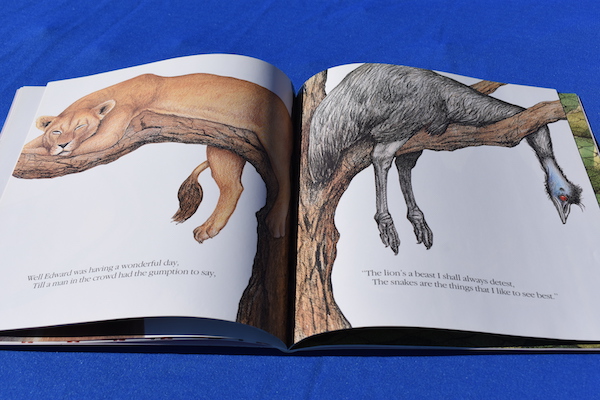
Edward the Emu

Edward the Emu by Sheena Knowles, illustrated by Rod Clement, 1988.

Edward the Emu lives in a zoo, but he finds it boring.  He is so bored that he decides to try living with and acting like the other animals. 

First, he envies the seals who live in the pen next to his and always seem to be swimming and having fun.  So, one night, he jumps out of his pen to join the seals.  The next day, he hangs out with the seals, lying in the sun and balancing a ball on his nose.  It’s much more fun than his boring old pen, but then he overhears a zoo visitor say that the lions are “the best thing to see at the zoo.”

Edward once again switches pens, deciding that he’ll try to be a lion.  He spends the next day growling and snarling while the lions roar.  It’s a lot of fun, but then another visitor comments that he likes snakes the best. 

Once again, Edward switches pens and tries being a snake.  This time, someone comments about great emus are.  Feeling better about himself, Edward decides to return to his own pen. 

However, to Edward’s surprise, there is another emu in his pen, his replacement because he disappeared!  It’s not a problem, though, because the new emu, Edwina, is glad to see him, and Edward is less likely to be bored now that he has a friend.

A friend sent me this cute picture book from Australia.  The story is told in rhyme, and the pictures of Edward trying to be different types of animals are fun.

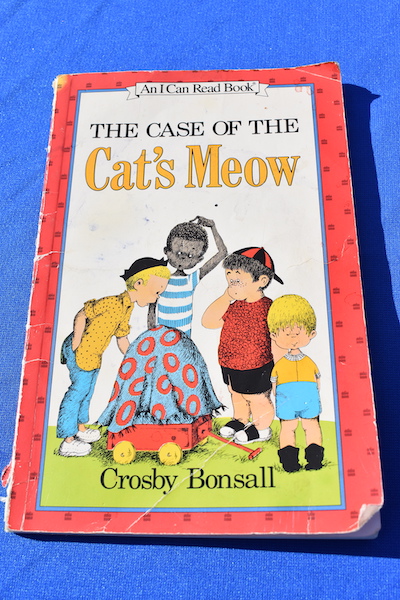
The Case of the Cat’s Meow

The Case of the Cat’s Meow by Crosby Bonsall, 1965.

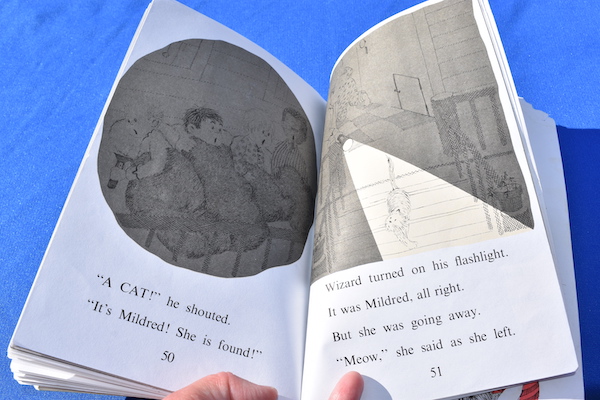
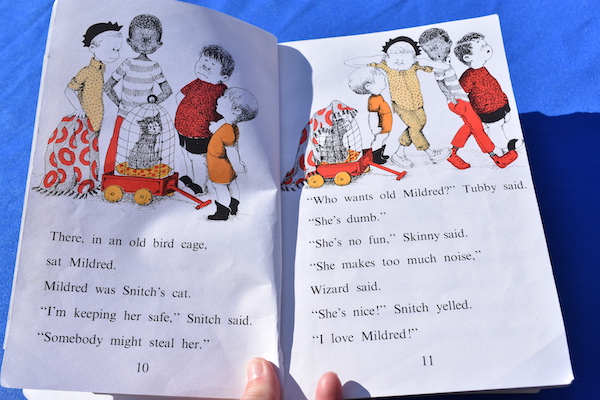
Four neighborhood friends, who call themselves by the nicknames Wizard, Skinny, Tubby, and Snitch, have their own private detective club.  Their club meets in a backyard clubhouse.  One day, Snitch gives them a case when he becomes worried that someone might try to steal his cat, Mildred.  The other boys think that’s unlikely because Mildred is noisy, and the other boys don’t think that she’s that great, but Snitch loves her and is worried.  The boys decide to keep her in their clubhouse with a special booby trap rigged up in case anyone tries to abduct her.

However, the next day, Mildred disappears.  Snitch is convinced that someone stole her, although the others don’t believe it.  The boys start asking around the neighborhood to find out if anyone has seen her.  When that doesn’t work, they try putting food out for Mildred, but they end up with every cat in the neighborhood except Mildred.

Eventually, they realize that Mildred has been coming back at night to visit her food bowl.  When they keep a watch for her, they discover where Mildred has been hiding and the reason why. 

Seeing Mildred’s adorable new kittens makes the other boys discover a new love of cats and take back all the disparaging things they said about Mildred earlier.

The book is currently available online through Internet Archive.

Tell Me Some More

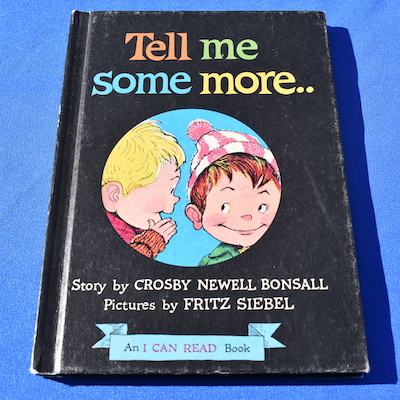
Tell Me Some More by Crosby Newell Bonsall, 1961.

I liked this picture book when I was a kid.  It’s one of those books that plays on the power of children’s imaginations.

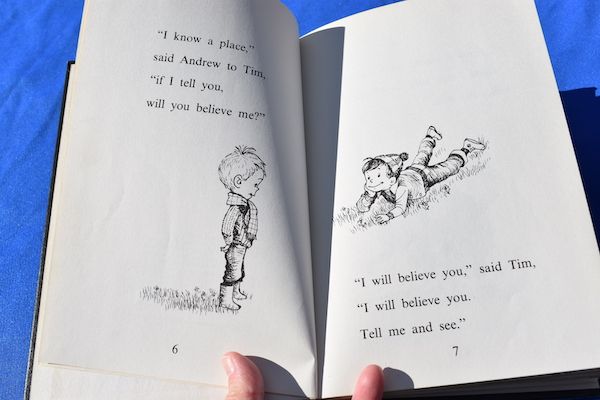
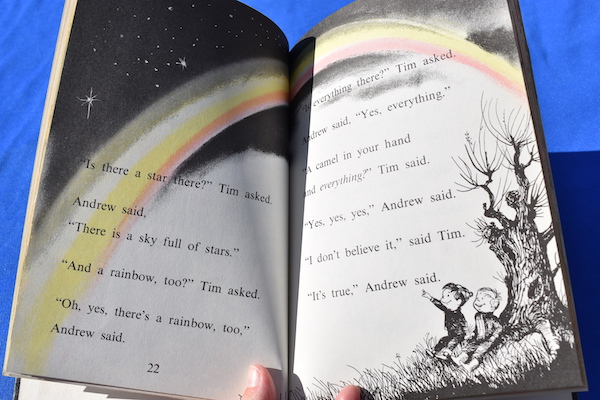
Two friends, Andrew and Tim, are talking, and Andrew starts to tell Tim about a mysterious “place” he knows about.  Andrew doesn’t say right away what the place is, but he makes some amazing claims about it.

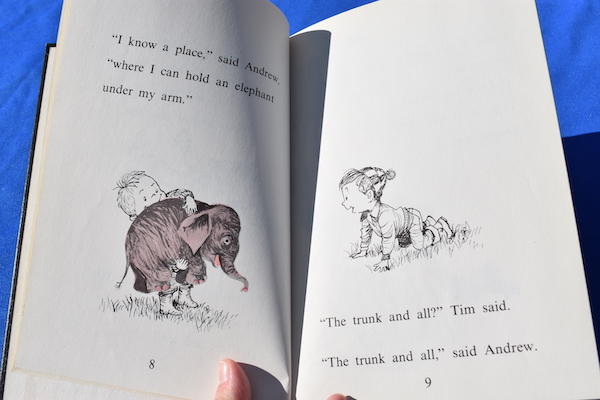
Andrew says that at this place, a person can hold an elephant under his arm and a camel in his hand.  With each new claim, Tim says, “Tell me some more.”

Many of Andrew’s claims involve animals, but he also says that in his place, he can be taller than a tree, that he can pick up a river without getting wet, and that there are all sorts of wonderful things there, like mountains, kings, trucks, and lakes.  Basically, this place has everything.

When Tim says that he doesn’t believe it, Andrew says that he’ll take him there and show him.  The “place” is the public library.  All of the amazing things that Andrew described are in the books.  You can pick up and carry around elephants, camels, and rivers easily when they’re in book form.

As the boys walk home, they talk about the giraffe, elephant, rocket, and steam shovel that they’re bringing home in book form as if they’re really full size.  When they get home, Tim starts talking to his sister, Tansy, like Andrew did to him earlier, introducing her to the library.

The book is currently available online through Internet Archive.

The Princess in the Pigpen

The Princess in the Pigpen by Jane Resh Thomas, 1989.

Elizabeth is the nine-year-old daughter of a nobleman in London in the year 1600, and she’s very sick.  However, while she’s lying in her bed with a terrible fever, she suddenly finds herself in a pigpen in 20th century Iowa with no idea how she got there. At first, she doesn’t even know where she is, and when she is found by the McCormick family, the family who owns the farm, they have no idea who she is or where she came from.  That she is very ill is obvious, so they take Elizabeth to the local doctor, who says that she has scarlet fever (what strep throat turns into when it’s neglected, it’s serious and life-threatening) and gives her penicillin, which helps her to recover.

However, there is still the question of how Elizabeth ended up on the McCormick farm in Iowa in the first place.  Elizabeth tells them that she is from London and insists that the year is 1600.  Ann, the McCormicks’ daughter, who is about the same age as Elizabeth, doesn’t believe that Elizabeth is really from the past.  The current year is 1988, and Ann thinks that Elizabeth is probably crazy, but obviously in need of some help.  The McCormicks tell the local sheriff about Elizabeth, and he begins looking through reports of missing persons to find one that fits her.

Still, it’s hard to explain Elizabeth’s strange clothing (Ann is sure that Elizabeth must be rich because her dress is obviously very fancy) or the antique toys that were found with her (a doll and a music box).  When Ann goes to school, Elizabeth stays at home with her mother, Kathy, and asks her about all the strange things that she’s been seeing around her, like cars and electric lights.  Kathy assumes that Elizabeth is merely confused and that her memory has been affected by her illness.

By coincidence, Kathy is a historian, teaching at a nearby university, and has studied English history.  She is aware of Elizabeth’s family, including her father, Michael the Duke of Umberland.  When Elizabeth asks her if she knows what happened to her mother, who was also ill when she last saw her, Kathy says that she was still alive in 1605, which means that she must have survived her illness.  Kathy quizzes Elizabeth in English history, and Elizabeth knows the correct answers because they are all current events to her.  Kathy thinks that someone must have taught Elizabeth history but notices that Elizabeth really seems to believe everything she says and knows a surprising amount of detail.

Further research into history and Elizabeth’s family tells Elizabeth the years when her parents and other people she cares about will die, which is distressing to her.  Ann begins to believe Elizabeth about her life when Elizabeth describes her home to her, and the description matches one in a book.  In the same book,there is also a portrait of Elizabeth’s family from 1605.  In the portrait, Elizabeth is a little older than she is now, and her mother has had another baby.  Elizabeth’s doll and music box are also in the painting.  The book also contains an account of the fire that later destroyed the manor house.  According to the book, Elizabeth managed to save the lives of her family by alerting them to the fire and also managed to salvage a couple of valuable books.

Now that Ann is convinced that Elizabeth is really from the past, they must find a way to help Elizabeth to return home so that she can save the lives of her family!

The book is available to borrow and read for free online through Internet Archive.

My Reaction

There were a couple of things that I liked about the time travel in this story. One is that it seems that it was fated to happen. Elizabeth is meant to survive her illness and to save the rest of her family. She was only able to do that because she had been to the future and learned about the dangers they would be facing. When she returns to her own time, she doesn’t change the past but makes sure that things turn out the way they were supposed to.

I also found it interesting that Elizabeth’s family has no living descendants in the late 20th century. Her family continued beyond Elizabeth’s time, but the family line apparently ended before the time period of the modern characters in the story, so we don’t have one of those moments that sometimes occurs in time travel stories where the modern characters meet a descendant of the past characters. That can be a fun moment in some stories, but I appreciate the variety.

At one point in the book, Ann makes a reference to the book A Wrinkle in Time, about other children who get “lost in space and time.”

Fog Magic

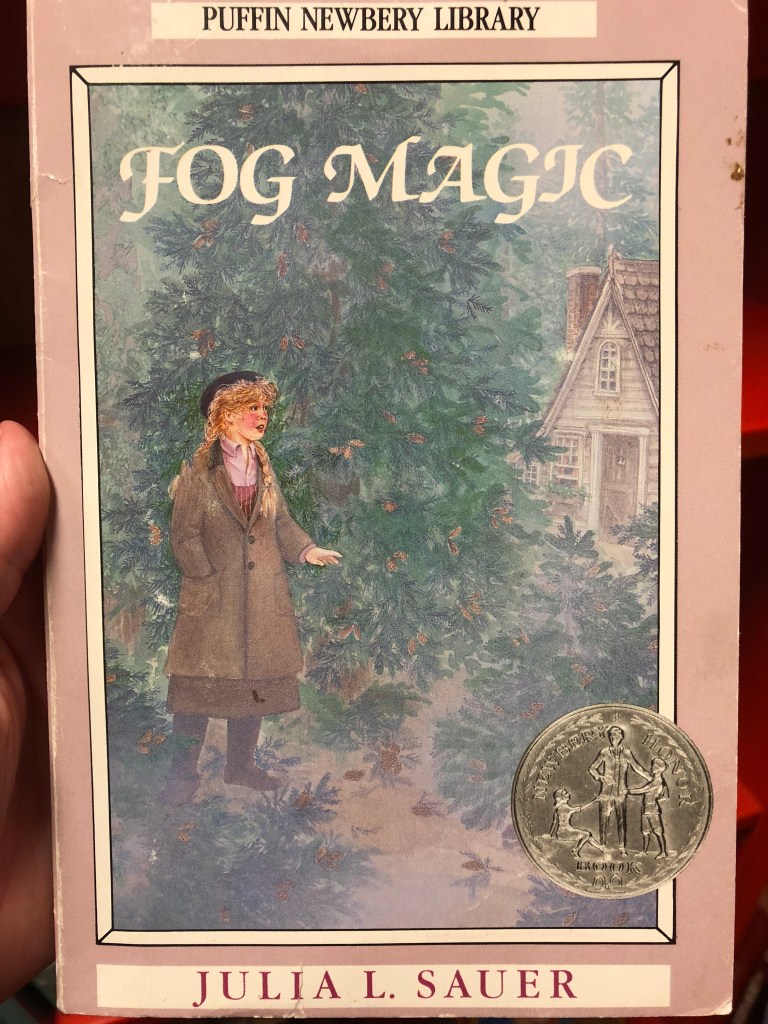
Fog Magic by Julia L. Sauer, 1943.

Greta loves fog and always has, although other people can’t understand it.  When she is ten years old, she begins to get the sense that there is something in the fog that she should find.  One day, when she goes looking for a lost cow from her family’s farm, she sees a house in the fog that isn’t there when the fog is gone.  Apparently, there used to be a house on that site, but it’s gone now.  Except when there’s fog.

From then on, Greta loves to walk in the fog.  When she does, she meets people from the past.  One day, she meets a woman named Laura Morrill, who recognizes her as being from the Addington family and says that her name must be Greta.  According to Laura, there’s always a Greta in every generation of Addingtons and that there’s always a child in every generation who has a great love of fog.  Greta’s ability to use the fog to travel back in time and see her town as it once was is apparently inherited.

Greta makes friends with Retha Morill, Laura’s daughter.  However, when Mrs. Morrill gives her a piece of pie to take home, it disappears, making Greta realize that she can’t bring things from the past to the present.  Retha’s parents seem to realize it, too.  When Retha offers her a little silver egg cup to take home, Mrs. Morrill suggests that perhaps it would be better for Greta to leave it at their house and use it when she comes.  Greta also has the feeling that, when the fog starts to lift, she needs to go home, and Mrs. Morrill agrees.

On another day, Greta and Retha spot an older girl in the woods.  Retha seems to know who she is and calls out to her, but she runs from them.  They try to catch up to her, but she gets away, and Retha is upset.  It turns out that the girl is named Ann, and she was falsely accused of theft.  When it was discovered that she hadn’t stolen anything, the townspeople had tried to find her, but she’s been hiding from them ever since, too afraid to come back.  At first, people had thought that maybe she had gone to another town to find work, but now that they know that she’s been living alone in the woods, they’re worried about her.  The story also upsets Greta because she has heard a local ghost story about a girl who haunts the woods after being falsely accused, and Greta takes that to mean that Ann will die.  The Morrills assure her that they will look out for Ann.

Greta is tempted to talk to Retha about her mysterious time traveling in the fog, but Retha stops her from talking about it.  Retha says that even her mother doesn’t want to talk about where Greta goes while she’s not with them, only saying that both men who go to sea and the women who wait for them on shore “have to learn to be content and at peace shut in by their horizon.”  To Greta, that means that she should be content with wherever she is while she’s there and with the fog that allows her to see her friends in the past.

The more Greta visits the Morrills, the more she gets caught up in the lives and troubles of the people living in the past.  At one point, Greta and Retha talk about some of the sad things that have happened to people the Morrills know, and Retha asks Greta if there is sorrow where she lives.  Greta has to admit that there is.  People generally do have their troubles, no matter when they live.  Retha says that her mother says that living and dying are both natural things, so there is no use being sad about them, except when the death is an unnatural one, like in a war.  There is no war going on in Retha’s time, but Greta lives during the time this book was written, in the middle of World War II.  Greta is aware of the war and says that sometimes people have to fight whether they want to or not, but Retha doesn’t think so.  Greta realizes that she can’t make Retha understand the circumstances of the world in the future.

However, as Greta’s twelfth birthday approaches, she has the feeling that things are changing.  Her birthday will be the last time that she can visit her fog friends, but they give her a special present to remember them by.  Greta’s father seems to know what Greta has been doing in the fog, and he reveals to her, without actually saying it, that he once did the same thing himself.  He says that when people grow up, they leave the things of childhood behind, but each of them is able to keep a special birthday gift from the past as a reminder that some things do last.

The ending of the story implies that, although Greta’s adventures in the fog were real, not purely imaginary, she has to give them up to make room for the new things that will enter her life as she grows up.  Her life lies in her present and future, so she can’t keep going back to the past.  However, her experiences with her friends in the past are part of what has made her more mature, and they will stay with her forever.

The book is a Newbery Honor Book. It is available to borrow and read for free online through Internet Archive.
My Reaction

The idea of magic and magical adventures ending at a certain age, as the person begins to grow up, is a classic idea in children’s literature. Sometimes, in other books, it’s implied that the reason this happens is because the “magic” was all imaginary, and the child in the story grew out of that particular kind of imagining, but that isn’t the case in this story. The explanation in this book for why the magic has to end is simple but makes sense. The characters don’t really analyze the issue too deeply, simply taking it in stride. We never find out why this particular family seems to have this tradition of going back in time in the fog as children, and the characters seem to decide that there is no reason to find out why.

Unlike in some modern books, there doesn’t seem to be any particular mission for Greta (or her father or any other generations before her) to fulfill in her time traveling. Greta is mostly an observer of the events in the past, not really participating in them directly or changing them in any way. She doesn’t even seem to influence the thoughts or attitudes of people in the past much. When she talks about the concept of war with Retha, she doesn’t try to change Retha’s mind about it or tell her about World War II and other future events because she realizes that each of them really belongs to two different times and sets of circumstances, and each of them needs to live in their own time, dealing with their own situations. It is their differing situations which give them their attitudes. The Morrills seem to be aware that Greta comes from the future, but they treat the subject carefully, never directly stating where she is from, just hinting at it. From they way they act, it seems as though they’ve met other members of Greta’s family before, but again, the ties between their two families (if any) are never explained, and none of them seems to want to delve too deeply into the matter. For the most part, they just seem to take the whole situation as being a natural part of life in their families and in the area where they live, something just to be enjoyed and not questioned. In fact, some of their attitudes seem to imply that they fear questioning too deeply, as if that in itself might end the magic too soon.

Although the story leaves the reasons behind the time traveling very open and unresolved (probably, other children in Greta’s family will be doing this in the future, also not really knowing why), it is really a very calm story. Not having a special mission to complete in the past leaves Greta free to simply enjoy the company of the people in the past, observing their lives without the stress of needing to solve their problems for them, and readers can similarly enjoy the ride without worrying that anything really bad will happen. You do end up being interested in what happens to some of the characters, like the woman who is in danger of losing her family’s home, but events unfold in the way Greta knows they will. She’s sad when she knows that certain people are going to die (not the woman whose home was in danger, that works out well) and there is nothing she can do about it, but it all seems to be part of the natural circle of life, something that matures Greta when she realizes it.

One of the fun things that I liked about the book were some of the unusual first names of the characters, like Retha, Eldred (Retha’s father), and Ardis (Mrs. Stanton).

Who’s Afraid of Haggerty House?

HaggertyHouse

Who’s Afraid of Haggerty House? By Linda Gondosch, 1987.

Kelly McCoy is eager to begin selling greeting cards for the Bismarck Greeting Card company because she wants to earn extra money for Christmas shopping.  Her best friends, Jennifer and Adelaide are selling cards, too, and Kelly is looking forward to teaming up with them.  However, she soon finds out that Jennifer and Adelaide have already finished their selling.  While Kelly was visiting her grandparents for a couple of days, the other girls hurried right out and started selling their cards.  They were worried about other kids beating them to the neighborhood houses.  By the time Kelly is ready to begin, the others are done and tired of going door-to-door, and many of the houses in the area have already bought all the Christmas cards they want.

Angry and hurt, Kelly has a fight with the other girls, and they mention that one house they didn’t visit was Haggerty House, which is supposed to be haunted.  Although the house spooks Kelly, she decides to go there and try to sell her cards.  When her brother, Ben, followers her and hits her with snowballs, further angering her, she dares him to come to Haggerty House, too.  Ben might be annoying company, but he’s still company.

Usually, the only time that kids in the neighborhood go to Haggerty House is on Halloween, and old Mr. and Mrs. Haggerty give good treats for the kids who are daring enough to visit, usually candied apples and nickels.  When Kelly and Ben approach the house to sell Christmas cards, Mrs. Haggerty invites them in for hot chocolate.  Mrs. Haggerty buys one of Kelly’s cards, and Kelly and Ben learn that Mrs. Haggerty is very lonely.  Her husband is ill and in the hospital.  She invites the garbage men in for hot chocolate, too, but is disappointed that they can’t stay very long because they have to finish their rounds.

Kelly and Ben can’t stay very long, either, much to Mrs. Haggerty’s disappointment.  However, Kelly later accepts an invitation from Mrs. Haggerty to visit again.  Mrs. Haggerty shows her some Christmas cards that people have given her previous years and tells her about her son, Tyler, who is a filmmaker in Los Angeles.  Tyler doesn’t visit very often because his work keeps him busy.  Mrs. Haggerty plays the piano, and she’s writing a song for Tyler for Christmas.  Mrs. Haggerty enjoys Kelly’s visit and wishes she could stay even longer.

Mrs. Haggerty becomes closer to Kelly’s family.  Ben helps Kelly to take Mrs. Haggerty’s picture and record the song she’s writing for Tyler so she can send it to him for Christmas.  Mrs. Haggerty also comes with the McCoys when they go shopping for a Christmas tree, and she comes to see Kelly as the Ghost of Christmas Past in her school’s A Christmas Carol play.

Then, while the kids are helping Mrs. Haggerty decorate at her house, an eccentric woman from the neighborhood, Malvina Krebs, comes to the house to ask if Mrs. Haggerty would like to participate in one of the seances that she holds regularly with friends.  Actually, they are hoping that she will let them hold a séance at her house because her house has such wonderful atmosphere and “vibrations.”  Mrs. Haggerty agrees because she’s never seen a séance before, and the séance group will be additional company.  Kelly asks if she could come because she’s curious to see what a séance looks like as well, and the ladies agree.

The séance is a very strange experience, although Kelly later discovers that some of what happened was a prank by her brother and his friend.  It occurs to Kelly that what she likes about visiting Mrs. Haggerty is that, unlike her friends right now, Mrs. Haggerty is always glad to see her and the interesting things that they do take her mind off of her fight with her friends.  However, she has come to miss talking to people who really understand her.  She can imagine what Jennifer would say about the séance and how she would find it interesting and how she would understand how Kelly felt about it.  Kelly’s earlier anger at her friends wasn’t really about how they made money with their cards and left no customers for her so much as they were having a good time without her and how they no longer seem interested in spending time with her.  She confides a little in Mrs. Haggerty how she feels about her friends, and she says that friends don’t always act like friends should.  Mrs. Haggerty herself doesn’t have as many friends as she used to because many of them have passed away.

Kelly does make up with Jennifer and Adelaide, inviting them to a Christmas party at Mrs. Haggerty’s.  There, she learns that some of their stand-offishness and secretiveness was because they’ve been planning a special Christmas present for Kelly.  The Christmas party is fun with a lot of old-fashioned games, but the best part is when Tyler finally comes home for Christmas!

The book is available to borrow and read for free online through Internet Archive.

My Reaction

Friendship is a large part of the theme of this story.  Kelly comes to understand Mrs. Haggerty’s loneliness partly through her quarrels with her friends.  At this point in their lives, each of them needs the other because they don’t really have anyone else.  Kelly’s time with Mrs. Haggerty gives her a new perspective on her relationship with her friends, and she also comes to understand some of the difficulties that Mrs. Haggerty faces because she is elderly.  Mrs. Haggerty’s song for her son is what makes him realize that he needs to spend more time with his aging parents, and Kelly and her friends decide that they will continue to visit with Mrs. Haggerty regularly.

The Spooky Halloween Party

SpookyHalloween

The Spooky Halloween Party by Annabelle Prager, illustrated by Tomie de Paola, 1981.

This book was an old Halloween favorite of mine when I was a kid.  It’s funny, slightly spooky, and has a bit of a twist ending!

Albert’s friend, Nicky, is inviting all of their friends plus his cousin Suzanne to a spooky Halloween party at his new apartment on Halloween night.  Albert hasn’t been to his new apartment yet, and Nicky says that it’s going to be really scary because he wants everyone to come in costume and to not tell anyone what they’re going to be so that everyone will be surprised when they take off their masks at the end of the evening.

SpookyHalloweenNickysParty

Albert doesn’t think Nicky’s party is going to be all that scary because he’s pretty confident that he’ll know who his friends are right away, even in costume.  Some of them have already given him hints.  Nicky was practicing going, “Whoo, whoo!” in order to scare people, so Albert knows that, whatever his costume is, it’s something that makes that sound.  Jan called up and asked Albert if he had an old mop that she could borrow, so he thinks that she’s probably going to be a witch and that she just got confused, thinking that witches carry mops instead of brooms.  Dan told Albert straight out that he’s going as a pirate because he doesn’t see the point in keeping his identity a secret.  So, Albert isn’t expecting any real surprises at Nicky’s party.

As for Albert’s costume, he’s tired of wearing the usual old clothes in the dress-up box, so he decides that this time, he’ll wear the box itself.  He cuts holes for his eyes and arms and decorates it so that he looks like a robot.  Almost completely covered by the box, he’s sure that everyone will have a harder time guessing his identity than he will theirs.

SpookyHalloweenElevator

When Albert arrives at Nicky’s new apartment house, he meets a girl dressed like a princess in the elevator.  She says that she’s going to the Halloween party on the fifth floor, and when Albert says that he is too, she suggests that they walk there together.  Albert guesses that she is Nicky’s cousin, Suzanne, who he hasn’t met before.

The apartment is pretty spooky, lit by jack o’lanterns, and there are already some guests there.  Albert is a little surprised that he doesn’t see a pirate, but there are a couple of witches and an owl, who could be Nicky.  Yet, when Albert tries to talk to the other guests, they seem to be acting strangely, and he realizes that he’s not quite sure who is really who.

SpookyHalloweenArrival

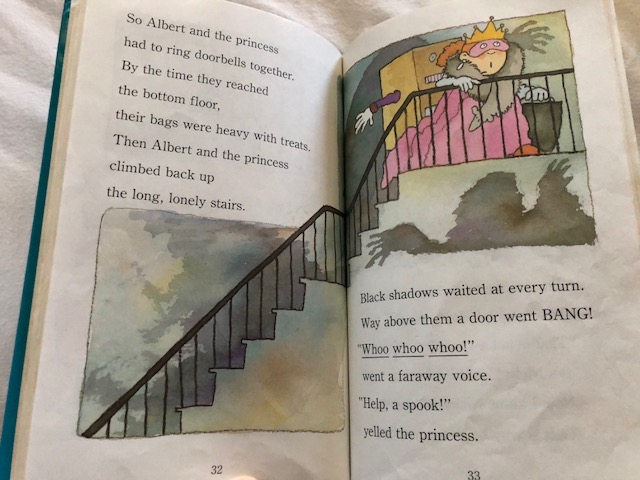
The princess is pretty spooked, and as the party goes around the apartment house, trick-or-treating, she kind of clings to Albert.  When some strange noises and a far-away “Whoo, whoo” sound startle her, Albert reassures her that it’s only Nicky in his owl costume.  Then, the princess tells him that she knows the owl, and it’s not Nicky.  That’s when Albert really starts getting scared, wondering why he doesn’t seem to know his own friends.

SpookyHalloweenTrickOrTreat

The book is available to borrow and read for free online through Internet Archive.

My Reaction and Spoilers

The reason why Albert doesn’t seem to know anyone becomes apparent when they unmask themselves after trick-or-treating.  Albert is really among strangers!  The princess isn’t Nicky’s cousin at all, and he followed her to the wrong Halloween party!  There were two Halloween parties on the fifth floor that night.  Nicky lives in apartment C, and Albert accidentally joined the party in apartment B.  Fortunately, Albert’s friends are also trick-or-treating around the apartment building and show up at that moment.

What started out as a potentially embarrassing mistake actually ends up making the evening more fun for everyone.  Albert’s mix-up brought an element of real suspense to both of the Halloween parties, with him wondering who everyone really was, the guests at the wrong party wondering who he was, and all of Albert’s friends wondering where he was.  Also, Albert gets some new friends out of this experience, and both parties end up combining into one big party at Nicky’s apartment.

SpookyHalloweenBigParty

Race isn’t important to the story and is never mentioned, but I’d just like to say that I appreciated the diversity of characters in the pictures.  Albert is black and so is Jan (you can see that when she isn’t wearing her clown costume), and the boy in the owl costume looks like he might be Asian.  I also really love that owl costume!  I don’t think I’ve ever actually seen anyone dress as an owl for Halloween, but it looks awesome!

The Dreadful Future of Blossom Culp

DreadfulFutureBlossomCulpThe Dreadful Future of Blossom Culp by Richard Peck, 1983.

This book is part of the Blossom Culp Series.

It’s 1914, and Blossom Culp is just starting high school. Although the principal of her old school tells her that this is a chance for her to make a fresh start, it looks like Blossom’s future is going to be very much a continuation of her immediate past.  In high school, she’s still a social outcast, looked down on by girls from better-off families, like Letty, the class president.  Also, despite her principal’s assertion that Blossom’s previous forays into the occult were imaginary, the product of the mental confusion that accompanies puberty, and that she is bound to grow out of them, Blossom knows that her psychic abilities are a natural gift and will not be ignored.

Blossom begins high school friendless because Alexander Armsworth has been ignoring her lately because of his important new position as class vice-president, his infatuation with Letty, and his friendship with a couple of local hooligans, Bub and Champ. Alexander is looking forward to his role in planning the school’s Halloween Festival, telling Blossom that he’s over their earlier, childish occult escapades and the Halloween pranks he used to pull.  Meanwhile, all of the other girls in school are infatuated with their handsome history teacher, Mr. Lacy, and so is the girls’ gym teacher, much to Blossom’s disgust.  Blossom thinks that Mr. Lacy is full of himself and denies that she has any such silly crush on Alexander.

Blossom makes an unexpected friend in a girl called Daisy-Rae, a girl from the country who has brought her younger brother into town to attend school and hoped to get an education herself but has been too afraid of the big town to actually attend classes.  Daisy-Rae hides in the school during the day and lives alone with her brother at night in the old chicken coop at the abandoned Leverette house.  It is through Daisy-Rae that she learns that Alexander and his friends aren’t so above childish pranks as they claim to be.  Blossom also discovers that Mr. Lacy has been romancing her old principal.  Mr. Lacy isn’t quite what he appears to be and has some unsavory secrets in his past.

Matters come to a head when Alexander (at Letty’s urging) tries to persuade Blossom to dress up and become the fortune teller for the haunted house that the freshmen class is doing for the Halloween Festival.  The haunted house is also a fundraiser, and Letty figures that they can get extra money from people if they’re willing to pay to have their fortunes told, and who would be better for the job than Blossom?  However, Blossom isn’t one to go out of her way to please others, especially Letty, and it turns out that they’re holding the haunted house in the Old Leverette place.  For some reason, that old house makes Blossom’s mother uneasy.  She seems to think that it’s haunted, but in an unusual way.  Blossom tells Alexander that she will not agree to be their fortune teller until he agrees to check out the house with her before Halloween and find out what’s wrong with it.  She figures that, since both of them are psychic, they can learn what’s so unusual.

As Blossom learns, her abilities don’t confine themselves to the past and people who have died but extend to the future and the people who haven’t yet been born.  Inside the Old Leverette house, Blossom suddenly finds herself entering the distant future, the 1980s.  In the 1980s, the Leverette house is once again lived in, and Blossom meets a boy named Jeremy who is a lonely social outcast, like herself.  Jeremy is a computer nerd, living with his divorced mother.  He takes Blossom on a tour of their town as it is in Blossom’s future, much larger than it used to be and with many familiar landmarks missing.  However, what Blossom sees in the future gives her the inspiration she needs to solve her problems in the past and hope that things will improve.  In return, she also proves to Jeremy that he is far from alone and has had a friend for longer than he ever imagined.

The time travel to the 1980s comes off as being a little corny (or so it seemed to me), but the writing quality of the book is excellent.  The author has an entertaining turn of phrase, and the book, like others in the series, is humorous and a lot of fun to read.

Besides being a kind of fantasy story, there are some interesting tidbits of history in the book, showing how people lived in the 1910s.  Blossom explains about the things she and her classmates did at school, like wearing beanies on their heads to show which year they were (freshmen, future graduating class of 1918).  At one point in the story, Blossom takes Daisy-Rae and her brother to their first movie, a silent film with an episode of The Perils of Pauline serial.  While Blossom worries about the future, readers can get a glimpse of the past!

As for what Blossom learns about her own future, she avoids finding out too much because she’d rather not know the details.  However, there are implications that she and Alexander may eventually marry and live in his family’s old house.

The book is currently available online through Internet Archive.
The Ghost Belonged to Me

GhostBelongedToMe

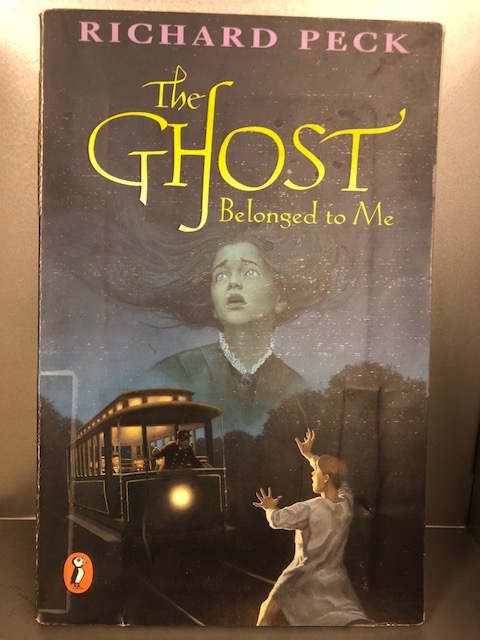
The Ghost Belonged to Me by Richard Peck, 1975.

The book takes place in the 1910s in a small town on the Mississippi River. Alexander Armsworth, a boy in his early teens, is approached by a girl from his class who tells him that the barn on his family’s property is haunted and that Alexander himself has the ability to see the “Unseen.” The girl, Blossom Culp, is a poor girl from a family of outcasts who has been known to tell tall tales, so Alexander isn’t sure he believes her at first. However, he can’t help but be curious, and when he sees a light coming from the barn at night, he decides to investigate.

Inside, he finds the ghost of a young girl who warns him of danger on the trolley tracks near his house and tells him that he must act fast to save everyone. Frightened, Alexander gets the trolley to stop and learns that by doing so, he has saved the lives of everyone on board from a disaster at the bridge further on. Naturally, everyone wants to know how Alexander knew to warn them. When Alexander explains, he is met with skepticism from his social-climbing mother and sister and unwelcome attention from news people and curiosity-seekers from town.

The ghost, who tells Alexander that her name is Inez Dumaine, is also in need of help before she can rest peacefully. Alexander will need the help of those who believe in him and the ghost to find Inez’s body and return it to her home in New Orleans.

In this first book in of the Blossom Culp series, Alexander is the main character, but the other books focus more on Blossom, who discovers that she also has the ability to see ghosts.  The book is available to borrow and read for free online through Internet Archive.
This is the movie that the Disney movie Child of Glass was based on, and the movie is available on dvd. Sometimes, you can also find it on YouTube, at least clips and reviews of it.

My Reaction

The story has sad and scary points, but those are balanced out by humorous situations. Alexander’s sister’s turmoil over the fiasco at her coming-out party is hilarious, and his mother’s change in attitude when she realizes that, instead of making them social outcasts, the ghost business actually attracts attention from one of the town’s leading citizens is a hoot. Blossom, of course, is wonderfully nosy, elbowing her way into Alexander’s life and selling tours of the haunted barn.

I was very young when I saw the Disney movie based on this book, Child of Glass (a live action movie that aired on television), and I was afraid of ghosts. However, years later, I took another look at the movie and decided to read the book that it was based on. When I did, I saw things I didn’t appreciate when I was young. The dialog and depiction of life in the early 20th century in the book are wonderful. It conjured up memories of Meet Me in St. Louis, especially the Halloween scene (which took place only about a decade earlier than this story). Unfortunately, this early 20th century setting wasn’t present in the movie version of this book because Child of Glass was placed contemporary with the time it was made, during the late 20th century.

The Disney movie was also different from the original book because it added the feature of the “child of glass” which didn’t exist in the original book. The “child of glass” was mentioned in a poem at Inez’s grave that explained how to lay her ghost to rest. At first, the Alexander and Blossom in the movie don’t know what it means, but it turns out to be Inez’s doll, which was lost when she was murdered by her wicked uncle. In the book, Inez died under different circumstances. However, the discovery of the doll in the movie uncovers the secret motive behind her murder, which is similar to the reason why Inez’s body was hidden in the book after she died in a riverboat accident.  In the book, Inez’s spirit finds rest after her body is found and taken to her family’s cemetery in New Orleans.  The Disney movie also turns this story specifically into a Halloween story, which wasn’t the case in the original book.