Cranberry Autumn

CranberryAutumnCranberry Autumn by Wende and Harry Devlin, 1993.

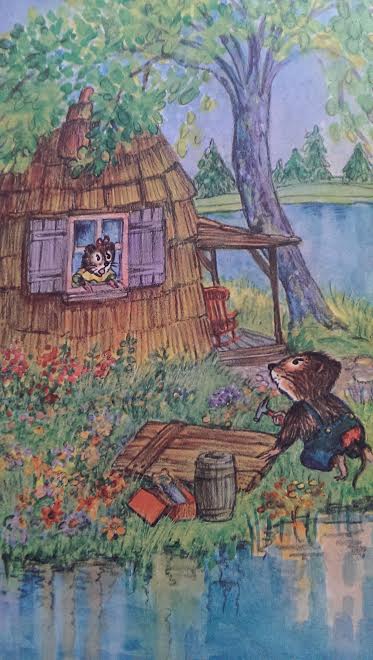
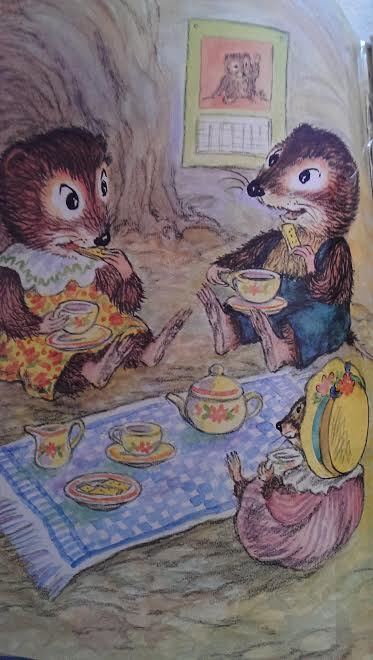
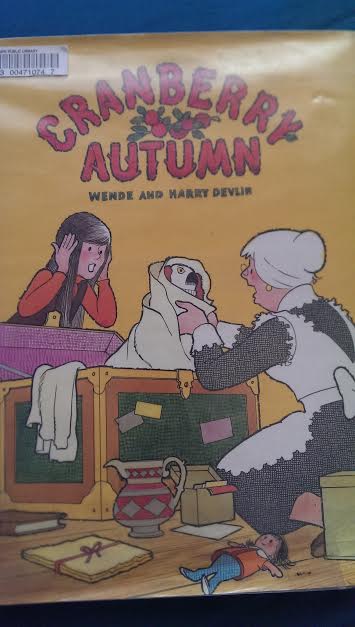
CranberryAutumnPic1School is about to start, and Maggie and her grandmother realize that they’re short of money.  Maggie needs new school clothes, and her grandmother needs a new coat.  They know that some of their neighbors could also use some more money, so Grandmother suggests that they hold a sale.  Some of them have some antiques and other interesting old items that they could sell.

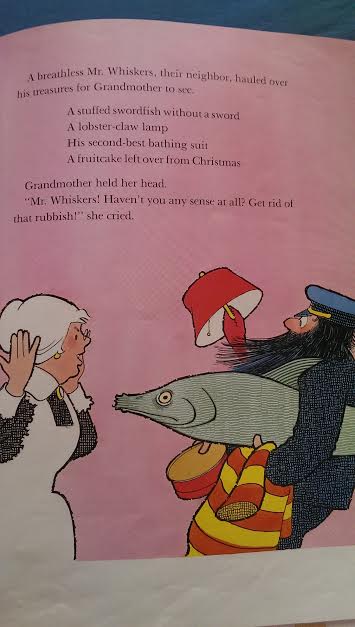
Mr. Whiskers tries to help, but he doesn’t have anything really interesting to sell.  At least, nothing Grandmother thinks that anyone would buy.  He’s disappointed because he really wants to help.

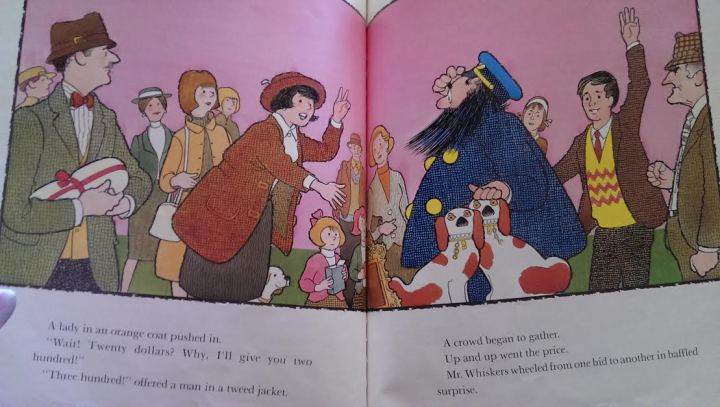
Mr. Grape, a greedy and dishonest neighbor of Mr. Whiskers, attends the sale and decides that he wants a pair of beautiful antique Staffordshire china dogs that Grandmother is hoping to sell for $200.  When he devises a scheme to cheat Grandmother and get the dogs for much less money, Mr. Whiskers gets his chance to help and to turn the tables on Mr. Grape.

As with other Cranberry books, this one includes a recipe that uses cranberries: Cranberry Squares.

CranberryAutumnPic2

CranberryAutumnRecipe

The Candy Corn Contest

The Kids of the Polk Street School

CandyCornContest#3 The Candy Corn Contest by Patricia Reilly Giff, 1984.

As Ms. Rooney’s class prepares for the upcoming Thanksgiving holiday, she gives them a contest: students can win the jar of candy corn on her desk if they can guess how many pieces of candy corn are in it (or get the closest to the right answer).  Richard “Beast” Best wants to win very badly because he loves candy corn and his mother never lets him eat many sweets at home.

The only problem is that students can only earn the ability to make guesses by reading books.  They get one guess for each page they read.  Richard has always been a slow reader, so he knows that this contest is going to be hard for him.  One day, while studying the jar of candy corn, trying to plan out his guess to make the best use of it he can, Richard gives in to temptation and eats three pieces.  Now, he doesn’t know what to do.  Ms. Rooney knows exactly how many pieces of candy there were in the jar, and if three are missing, she’ll find out.

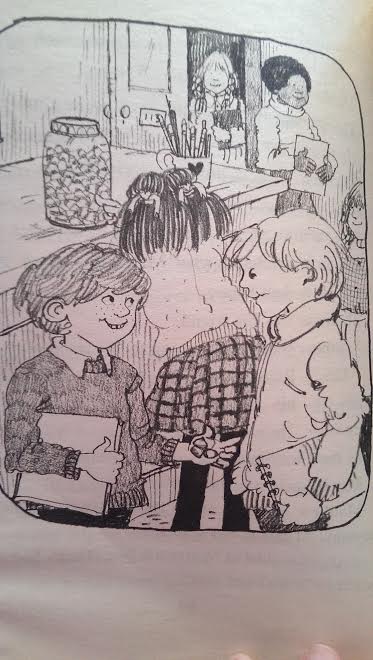
CandyCornContestPic2While Richard is worrying over his mistake, he’s also worrying about the sleep-over party his parents are letting him have over the Thanksgiving break.  At first, he was looking forward to it, but some of the other boys in class can’t come and some of those who said they could are concerned because Matthew is coming.  Matthew and Richard are friends, and people in class generally like Matthew, but everyone knows that Matthew still wets the bed.  Some of the other boys are worried that they’ll have to sleep next to Matthew at the sleep-over.  As much as Richard likes Matthew, it feels like his problem is going to ruin the party, and when Matthew is nice to him, it only makes Richard feel worse.

For awhile, Richard is short-tempered with Matthew and says some things that he later regrets.  His mean comments make Matthew decide not to go to his party, but Richard feels terrible because he realizes what Matthew’s friendship really means to him. Richard’s apologies later help to fix the situation.  It also helps that Richard admits to Matthew that he ate three pieces of the candy corn.  Richard’s confession that he did something wrong (more than one thing, actually) and that he wants to fix it helps Matthew to forgive him.  Matthew helps Richard to decide how to solve his candy corn problem honorably, and Matthew’s mother gives Matthew a suggestion that will help him to avoid problems at the sleep-over.

The book is currently available online through Internet Archive.

Fish Face

The Kids of the Polk Street School

FishFace#2 Fish Face by Patricia Reilly Giff, 1984.

When there’s a new girl in Ms. Rooney’s class, Emily Arrow is happy at first that she’ll be sitting next to her and thinks maybe they’ll be friends.  However, that feeling doesn’t last very long.  Dawn Bosco doesn’t seem interested in making friends.  She doesn’t respond to the compliments that Emily gives her.  Instead, she brags about herself, saying things that Emily learns later aren’t true.  Worst still, she steals Emily’s toy unicorn, Uni.

Uni is Emily’s best friend, and she’s convinced that he brings her good luck.  Without him, everything seems to go wrong.  Emily even has trouble sleeping because she always sleeps with Uni.  When she tries to get Dawn to give Uni back, she denies taking him, but Emily knows that Dawn is hiding him in her pencil box.  She saw him there, but she just can’t get to him.  Will Emily ever get Uni back?

The book is currently available online through Internet Archive.

My Reaction and  Spoilers

FishFacePic1The title of the story comes from the fish faces that Emily was making, imitating the classroom pet fish.  She shows Dawn her fish face when she’s trying to joke with her, but Dawn just thinks it’s weird.  Dawn worries that she’s not making friends, but at the same time, she also seems determined not to like things and people at her new school and stealing Emily’s unicorn and lying about it was a sure way to make her angry.

I didn’t like this book as well as others in the series.  The kids in the series don’t always explain their actions or completely understand them, which is somewhat true to life.  Young children don’t always understand their true feelings or motives because they don’t have the words or the experience to explain what they feel.  However, this book felt more unexplained than normal.

Dawn steals Emily’s toy unicorn just moments after they first meet, while sitting in the desk next to her in their classroom.  Emily doesn’t get help getting her unicorn back right away, and by the time she does, it’s too little help, and Dawn gets away with keeping the unicorn.  We’re supposed to believe that Dawn did it just because she felt awkward in a new place with no friends, but that’s shaky because even a second-grader would know that stealing something isn’t going to win friends.  The kids later find a letter Dawn was writing to a friend at her old school, saying that she’d done something bad but that Emily was mean and that she was upset about not having friends.  So, she understands that she did something wrong, but still thinks Emily is mean for trying to recover her stolen property?  Children can say and do some odd, sometimes contradictory, things, but Dawn’s feelings seem to be all over the place and her character difficult to pin down.

It’s difficult to tell what, if any, lesson to take away from this story.  That if someone steals your stuff, it’s because they’re lonely and you just don’t understand them?  Things partly get resolved because Emily is interrupted in searching for her unicorn and ends up taking Dawn’s reader out of her desk.  Returning the reader seems to be what causes Dawn to have a change of heart, maybe because missing it made her understand Emily’s feelings about the loss of her unicorn, but we never really find out.

Fortunately, Dawn does become a more distinct character in other books, and later, because she wants to be a detective, she gets her own series of mysteries.  One of the mysteries in her spin-off series references this story because something else disappears in class, and Dawn is suspected because people know that she stole something before.  In that book, Dawn has to figure out the mystery in order to clear herself of suspicion.

One thing I did like about this book was that, although losing Uni was very hard for Emily at first, she does come to realize that she can do without him, that he is not her sole source of good luck, and that she can sleep without him at night.  She is pleased when Dawn agrees to give him back, but she does recognize that learning that she can be okay on her own is a sign of growing up.

The Beast in Ms. Rooney’s Room

The Kids of the Polk Street School

BeastMsRooney#1 The Beast in Ms. Rooney’s Room by Patricia Reilly Giff, 1984.

It’s the start of a new school year, and Richard Best (nicknamed “Beast”) is embarrassed to find himself in Ms. Rooney’s room once again because he was held back a year for his poor reading skills.  Everyone he knows has moved on to the third grade, and he’s still in a second grade class with kids who were first grade babies last year.  He feels awkward, being the tallest, oldest person in class, and kids in his old class tease him and refuse to let him play baseball on the playground with them because he’s a pathetic “left-back.”

At first, Beast tries to pretend that it was all a horrible mistake that will be straightened out soon, but that just makes him feel bad for lying.  The kids who are now in the same class he is, who he still thinks of as “babies,” try to make friends with him, but he doesn’t accept them at first because of his embarrassment at being older and still not as good at reading as some of them are.

BeastMsRooneyPic1However, even though he’s embarrassed at having to attend special reading classes with Mrs. Paris while most of the rest of his class has normal reading, these special classes really help him, not just to improve his reading skills, but to connect with other kids in his new class who have the same reading difficulties he does and who understand how he feels.

Beast discovers that it’s no shame to not know something or to have trouble doing something because everyone has different skills and it can take some people longer to learn certain things than others.  Emily Arrow, the girl who now sits next to him in class is a whiz at math but has as much trouble reading as he does.  Beast learns some new skills from his new, younger classmates and realizes that they’re not really babies.  They also really appreciate him and help him see some of the good things about himself.

The book is currently available online through Internet Archive.

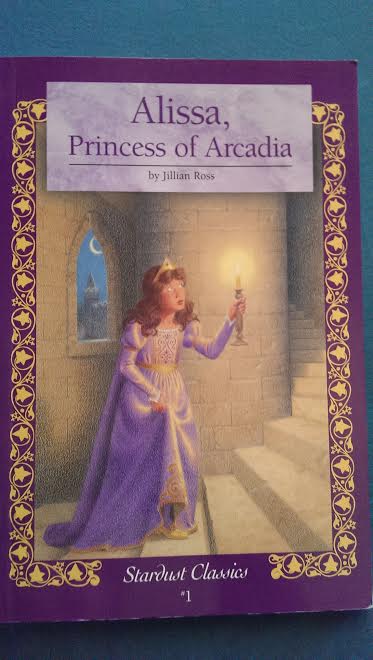
Alissa, Princess of Arcadia

AlissaAlissa, Princess of Arcadia by Jillian Ross, 1997.

Alissa, the only child of King Edmund of Arcadia, feels like her life has taken a turn for the worse since she turned ten years old.  Before, she lived a basically care-free life, but now, her family has become more serious about her education and training as the future Queen of Arcadia.  Her great-aunts are mainly in charge of her education now, and they find Alissa to be ill-mannered, impatient, and stubborn.  In some ways, she is.  Alissa is bored with her lessons in the standard school subjects and hates her “deportment” lessons, where she learns etiquette suited to the royal court.  More than anything, she wants adventure and excitement.

To Alissa’s surprise, she meets a strange old man one evening while walking in the garden who promises her the adventure that she’s looking for.  At first, Alissa doesn’t know what to think about this strange old man, Balin, who seems to know everything about her, even what she’s been thinking.  He sets Alissa a “quest”, to solve a riddle to determine where to find him.  After pondering it for awhile, Alissa realizes that the riddle says that Balin lives in the oldest tower of the castle, where no one ever goes anymore.

AlissaBalinIt turns out that Balin is a wizard.  He’s lived in the tower for centuries and hardly ever leaves, so most people have forgotten that he’s there.  He offers Alissa lessons in magic and the kind of quests that she’s been craving.  He once taught Alissa’s father similar lessons, although he thinks that King Edmund has also forgotten that he exists.  Alissa eager accepts the offer of magic lessons.

At first, the only other person who knows about Alissa’s lessons with Balin is Lia, a servant of one of Alissa’s great-aunts.  Lia had been about to run away from her position as servant because she didn’t think that she was very good at her job, but Alissa caught her the night when she was going to find Balin in his tower.  The two of them became friends, and Alissa makes Lia her lady-in-waiting. Alissa enjoys having someone her age to share her secrets and adventures.  Her great-aunts disapprove of her choice of lady-in-waiting, but Alissa’s father appreciates Lia because she sees the better side of Alissa, her bravery and kindness, and somewhat helps Alissa’s impatience because Lia is a more patient, cautious person.

AlissaKingWhen Alissa first begins her lessons with Balin, she thinks that studying magic is turning out to be as boring as her other lessons.  Balin makes her do little chores, like dusting things in his tower, and he has her read books and memorize words.  Alissa is impatient to get on with the exciting magic, but Balin impresses on her that she needs to start out slowly and to recognize that magic is not the solution to all things.

Meanwhile, Alissa’s father is preparing to hold a banquet to celebrate a new alliance with a neighboring kingdom.  Now that Alissa is old enough to participate in such banquets, she learns that she must not only attend the banquet but be the dinner partner of the invited king, who she has heard is a stern man who is a stickler for proper manners.  Alissa is terrified that she will make a mistake during the banquet, anger the king, and ruin everything.

Her fears grow worse when Balin tells her that he has seen impending disaster in his crystal ball and a threat to the alliance.  Alissa begs him to tell her more, but he says that something is preventing his magic from seeing more.  All he has to offer Alissa are a few vague hints which take the form of another riddle.

Balin believes that Alissa is the only one who can solve the riddle, stop the danger, and save the alliance, but Alissa doubts herself.  She’s still afraid that she isn’t up to the task and will ruin everything, and she wishes that Balin would give her some magic spell to prevent her from doing anything wrong.  However, the best weapons Alissa has are the ones she already possesses: her wits, her desire to work hard for what she wants to achieve, and the new patience that she is just starting to learn.

One of the things that I liked about the story was that the visiting king, for all of his sternness and demanding nature with others, is surprisingly understanding with Alissa.  Some adults still remember what it was like to be young and awkward and impatient to grow up.

This book does not have extra information or activities in the back, as other books in the Stardust Classics series do.  It is currently available online through Internet Archive.

The Mysterious Queen of Magic

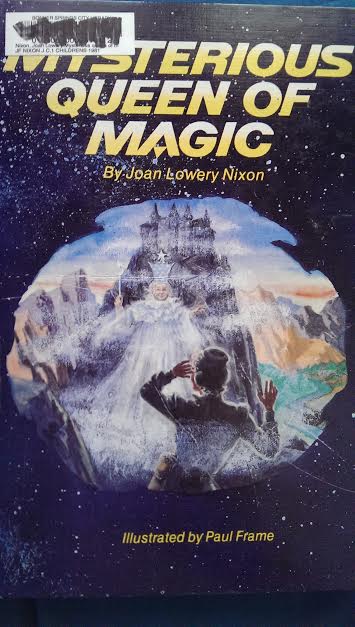
KleepQueenMagicThe Mysterious Queen of Magic by Joan Lowery Nixon, 1981.

This is part of the Kleep: Space Detective series.

Kleep and Till meet a strange young man who is looking for Kleep’s grandfather, Arko.  The young man, Mikkel, tells them a wild story, that an evil wizard is after him.  He is controlling Mikkel’s people on the planet Durth, putting them under a spell and forcing them to become his slaves. Mikkel believes that Arko may have the key to getting rid of him because an old wise man told him to ask Arko how to find Queen Stellara.  Queen Stellara was a legendary queen who could do magic, and Arko has some old write-rolls, scrolls of the kind people used to use before people began using computers alone for learning, that talk about her and her kingdom.  However, Arko doesn’t believe in wizards or magic spells or anything of the kind.

Kleep remembers Arko telling her the old stories from the write-rolls when she was little, and unlike her grandfather, she believes that wizards and magic may be real and wants to try to help Mikkel.  When Arko says that he doesn’t believe in magic and can’t help Mikkel, Kleep and her friend Till decide to use the scrolls to try to help Mikkel find Queen Stellara.  Taking Kleep’s robot, Zibbit, with them, they journey to the planet Loctar, where Queen Stellara was supposed to live.

Although this series is mostly sci-fi with a bit of mystery thrown in, this book is more fantasy.  When Kleep and her friends arrive on the planet Loctar, they discover that they must face a series of challenges to reach the legendary queen’s palace, like heros in a fairy tale.  Magic is real, and they must prove themselves worthy in order to meet the queen and ask her for the solution to the problem of the evil wizard.  But, their ordeal doesn’t quite end there because, while Queen Stellara provides them with the means to fight the wizard, they must face him themselves!

A little corny, but fun, although it’s not my favorite book in the series.  The others were more sci-fi, and this is more fantasy.  Also, for a “detective” series, there isn’t much mystery, more adventure.  It sort of reminds me of the original Star Trek episode Catspaw, except that the magical beings in this one are apparently really magical and not just aliens.  Like the other books in this series, I like the pictures, too.

KleepQueenMagicPic3

Mystery on Taboga Island

TabogaIslandMystery on Taboga Island by Patricia Maloney Markun, 1995.

Amy is excited to be spending the summer with her aunt on Taboga Island, off the coast of Panama, near the Panama Canal.  Aunt Rhoda is a curator for an art museum, and she is writing a series of art lectures.  In particular, she has an interest in Paul Gauguin, who painted in Panama in the late 1800s.  She has invited Amy to join her for the summer not only so that she can visit another country but because of their mutual interest in art.  Amy loves drawing and painting and wants to be an artist someday.

The one drawback of going is that Amy is worried that she will be lonely over the summer.  She doesn’t know whether there will be any kids her age close by or if she would be able to talk to them if there are because she doesn’t speak Spanish.  Fortunately, soon after they arrive on Taboga, Amy meets Zoe.  Zoe is from California but she comes to visit her relatives on Taboga every year.  She introduces Amy to her cousin, Juan, as well.  The three of them become friends, and Zoe and Juan even share their special, secret hiding place with Amy: a old lookout point on an old, abandoned pier left from World War II that can only be reached by walking on a narrow beam over the water.

TabogaIslandPicThey also introduce Amy to Madame Odelle, who people call The Bird Woman because of all the birds she keeps around her house.  She is a widow who lives alone and hardly ever sees people, but she invites the children in and when she learns that Amy is interested in art, she shows them a special painting that her family has had for generations.  Madame says that her grandfather bought the painting years ago from a traveling Frenchman who was in need of money.  Amy thinks that it looks like one of Paul Gauguin’s paintings, and she knows that some of his work is unaccounted for.  However, the initials on the painting are PGO.  What could the ‘O’ stand for?

Then, the painting is suddenly stolen, and there’s no shortage of suspects.  A strange woman named Phoebe Quincy has been lurking around Madame’s house and asking questions about her.  There’s also Donald S. Deffenbach, a birdwatcher who doesn’t seem to know much about birds, and Captain Billy, an Australian who owns a sailboat that he sails himself.  Dr. Denis Dobson, who is also a Gauguin expert, also happens to be staying at the resort on the island.  He is visiting places where Gauguin painted while writing a book about him.  Could he be the thief?

I like this book for the pieces of history about Panama and Paul Gauguin, which are important in solving the mystery and understanding the origin of Madame’s mysterious painting.  One of the things I remembered most about reading this book as a child, though, was when Amy and her aunt were eating at the little restaurant on the island and her aunt urged her to try a Panamanian dish so that she could get used to trying new foods when she travels.  Amy tries a tamale for breakfast and loves it, wishing that she had been brave enough to try it earlier since she and her aunt are now planning to do more of their own cooking.  I was familiar with tamales as a kid, but not for breakfast, although I like the idea.

The book is currently available online through Internet Archive.

Trapped in Time

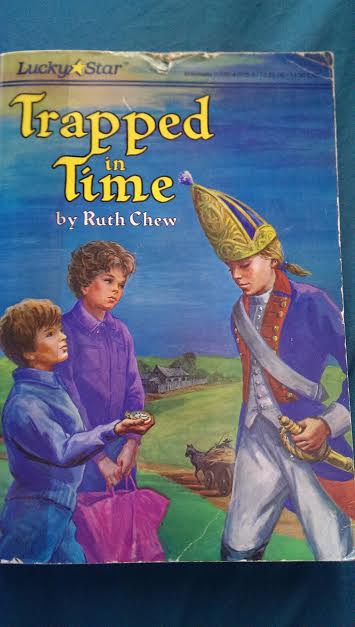
TrappedTimeTrapped in Time by Ruth Chew, 1986.

Audrey (called Andy) and her younger brother Nathan are having a picnic in Prospect Park in Brooklyn, New York, when Nathan falls and knocks over an old tree stump. They spot something shiny in the deep hole under the old stump, and Nathan climbs down to get it.  It turns out to be an old pocket watch, the kind that needs to be wound with a key.  Nathan has a small key in his pocket, made for a toy, and decides to try it on the watch.  He manages to wind it, but suddenly, the hands of the watch move backwards, the children feel strange, and everything around them seems different.  Although it takes the children a little while to realize it, they’ve traveled back in time about 200 years, back to the Revolutionary War.

They meet a boy named Franz and become friends with him.  Franz is a drummer boy for the Hessian soldiers, Germans hired by the British to help them fight against the rebelling colonists.  Franz’s superior orders his men to commandeer food and supplies from the people living in the area.  Franz is supposed to take a family’s cow, but the family desperately beg him not to because they have nothing left and will need the cow to support themselves.  Andy persuades Franz to leave the family and their cow alone.  However, disobeying the order means that Franz will be in trouble with his superior.  He decides that the only thing to do is to desert the army.

TrappedTimePicFranz had only joined the army in the first place because his parents were dead, and he didn’t know what else to do.  Now, he has to find a new place to live, somewhere where there won’t be other Hessians who would recognize him as a deserter.  Andy and Nathan also have problems because they’ve now realized what time they’re in, and they don’t know how to get home.  The watch no longer seems to work.

The children travel together, meeting others who help them and seeing the effects that all of the armies, British, Hessian, and American, have on the ordinary people as the war continues around them.

When they finally find a place where Franz can stay safely and someone he can call family, who can also use Franz’s help, Andy and Nathan realize who the watch really belongs to and how they can return to their own time.

The watch’s real owner is the person I thought it would be, and it took the kids unexpectedly long to realize it.  There is a hint of what happened to Franz when the kids finally return to their own time, but I kind of wished that they learned more about what Franz’s life turned out to be like.  From what the kids see, it seems that things went well for Franz and that he continued living in the house where they left him.

The book is currently available online through Internet Archive.

Mary Geddy’s Day

MaryGeddyMary Geddy’s Day: A Colonial Girl in Williamsburg by Kate Waters, 1999.

This book is part of a series of historical picture books about Colonial America.

Mary Geddy was a real girl living in Williamsburg in 1776. In this book, she is reenacted by Emily Smith, a young interpreter at the Colonial Williamsburg living history museum. The story follows her through a single day in her life as it would have been typically experienced by girls around the beginning of the American Revolution (lessons, chores, shopping, and visiting with her friend) up until the moment when the vote for independence at the Fifth Virginia Convention was announced.

Mary Geddy’s father was a silversmith, which put them in the middle class for the times.  They had a comfortable house with a shop next door where Mr. Geddy sold his silver work.  The Geddy family also had slaves to take care of household chores.

At the beginning of the story, Mary knows that the Fifth Virginia Convention is voting on the subject of independence from Great Britain.  Mary is concerned about the prospect of war, and she knows that if the vote is for independence, she will probably lose her best friend, Anne.  Anne’s family are loyalists, and her family plans to return to England if the colonies decide to break away.

All through the day, people are speculating and worrying about what is going to happen as they go through the typical routines of their day.  Mary explains the clothing that colonial girls would wear as she gets dressed in the morning.  Then, her mother sends her out to buy eggs at the market.  Although she can see Anne there and hear some of the talk about what’s happening, Mary is kept at home for most of the rest of the day, practicing her sewing, learning to bake a pie with her mother, helping in the garden, and having her music lessons. She is learning to play the spinet.  She envies her brothers, who are allowed to help their father in his shop and therefore able to hear more of the talk than she is.

I particularly liked how they showed the coins that Mary uses when she goes shopping.  Even though Mary’s family lives in an English colony, she’s using pieces of eight, which is Spanish money.  The book doesn’t explain what currency she’s using or why, but that’s why the coins are those little triangular shapes, like little pieces of pie. Let me explain.

First, the American colonies had a currency problem.  They actually had a shortage of English currency because England didn’t want wealth to leave the English economy and go out to the colonies.  One of the measures they took to prevent wealth from leaving England was to make it illegal to export higher-value pieces of currency to the colonies.  People in the colonies needed something to replace the pieces of currency that they didn’t have or had in too short supply, so they resorted to other methods of exchange such as barter, IOUs recorded in ledgers, and currency from other countries.  They had some standard units of exchange for converting different currencies into British money because that was the way people in British colonies thought about money.  One of the most popular coins in use was the old Spanish dollar or piece of eight, which was worth eight reales (unit of Spanish currency).  However, sometimes, people wanted to use a smaller piece of currency for small purchases and transactions (like buying eggs), so they physically cut one coin into eight pie-shaped pieces (hence, “pieces of eight”), each worth only one real.  They had to do the coin cutting very carefully because the value of this type of money was based on the amount of silver in the coins themselves, and if they cut a coin unevenly, it would impact the value of the sections.  Each section of a piece of eight was called a “bit“, and two bits would be worth one-quarter of the value of the original coin, which is why some people in the US refer to a US quarter as “two bits.”  That’s what Mary is holding in her hand in the picture.  For more information, see the YouTube video from Townsends about The History of Money in America.

When they discover that the Convention voted for independence, there is celebrating in the streets, and Mary goes with her parents and brothers to see everything.  Her little sister is afraid of the noise and stays at home with the slaves.  Everyone is excited, but Mary is worried because she knows that her friend will leave and nothing will be the same again.

Throughout the book, you can see that the slaves are always a part of the family’s activities.  They do chores together, and when the family is not doing housework, the slaves are still working in the background.  Having slaves didn’t mean that the family never had to do any chores themselves, but they had to do less of them, giving them more time for other things, like music lessons and visiting with friends.  When the celebrating starts, the boy slave, Christopher, who is about the age of the Geddy children, wants to go and see what is happening himself, but he has to stay and help look after the younger girl in the family.  Although the slaves live as part of the household and seem to be on friendly terms with the Geddys (Mary speaks of them fondly, wishing that Christopher could join in the celebration and is happy that Grace, the slave who mainly works in the kitchen as the cook, seems proud of her for learning to make a pie), they have no say in making decisions and are expected to follow the orders they are given, even when they don’t want to or larger events are taking place.

In the back, there is more historical information about the period and the Geddy family.  There are also instructions for making a lavender sachet like the kind Mary and her friend Anne make and a recipe for apple pie that was used in Colonial Williamsburg, like the one that Mary learns to make in the story.

The book is currently available online through Internet Archive.
Harvey’s Hideout

HarveysHideout

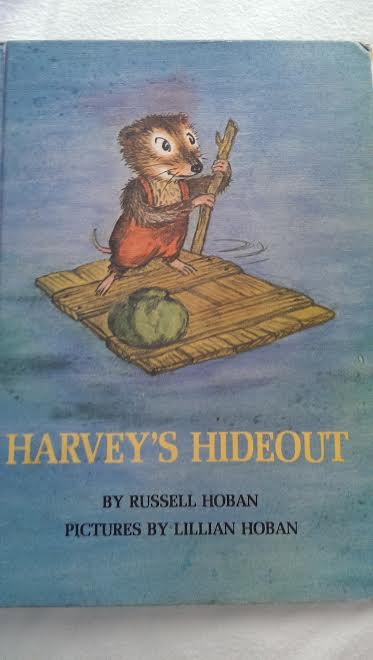
Harvey’s Hideout by Russell Hoban, illustrated by Lillian Hoban, 1969.

HarveysHideoutHouseSummer is difficult for the Muskrat kids this year.  Their friends are away for the summer, and Harvey and his older sister Mildred are getting on each other’s nerves.  But, there’s nothing that says they have to spend the whole summer with each other.

Harvey builds himself a raft and tells Mildred that he’s going off to meet with members of his secret club for a cookout where annoying big sisters aren’t welcome.  Mildred says that’s fine with her because she’s been invited to a party where there will be no annoying little brothers.  Harvey says that’s fine with him . . . except that it really isn’t.

The secret hideout where Harvey has been spending his time is empty except for him and the comic books he brought with him, and his cookout is for only one person.  He just made up the story about the secret club to make Mildred jealous and to have an excuse to spend time away from the house and her.  Harvey appreciates the freedom, but he’s also bored and lonely and envies Mildred, wondering who she knows who is still in town, inviting her to parties every day.

Then, when Harvey tries to make some improvements to his secret hideout, he discovers that he’s not the only one to dig a secret hideout for himself in the area.  Harvey’s unexpected discovery leads to a change in his relationship with his sister.

HarveyHideoutSecret


The book is available to borrow and read for free online through Internet Archive, and new copies are also available to buy through Plough.  If you try it and like it, consider buying a copy to own!

HarveysHideoutFriends

My Reaction

This is a nice story about sibling rivalry and cooperation.  One of the parts I like best is early on in the story when Harvey and Mildred’s father lectures them for fighting and insulting each other. I hated that part when I was a kid, but I kind of like it now because I realize what the father is actually trying to say.  He points out that there is some truth in their insults, but they’re wrong about each other at the same time.  Part of the reason they fight is because they each have their faults (Harvey can be selfish and Mildred can be bossy), but they each unfairly assume that the other is a lost cause and that they can never be friends.  It’s only when they come to realize that they’re equally lonely (Mildred has been having tea parties with just her doll) and Harvey makes the first move in offering to share what he has with Mildred that they realize that they can each be the friends they both need this summer.

When I was a kid, I wished I had a hideout like theirs!  I also love the colorful illustrations in the story.