Trapped in Time

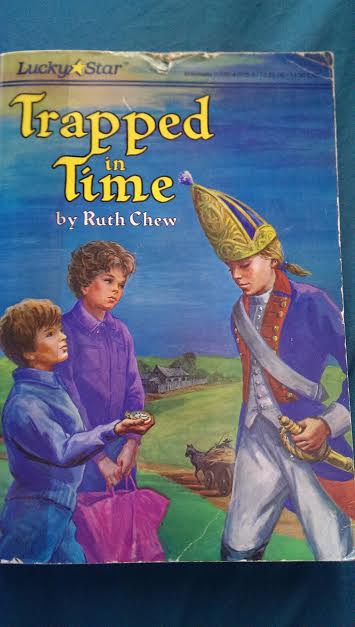
TrappedTimeTrapped in Time by Ruth Chew, 1986.

Audrey (called Andy) and her younger brother Nathan are having a picnic in Prospect Park in Brooklyn, New York, when Nathan falls and knocks over an old tree stump. They spot something shiny in the deep hole under the old stump, and Nathan climbs down to get it.  It turns out to be an old pocket watch, the kind that needs to be wound with a key.  Nathan has a small key in his pocket, made for a toy, and decides to try it on the watch.  He manages to wind it, but suddenly, the hands of the watch move backwards, the children feel strange, and everything around them seems different.  Although it takes the children a little while to realize it, they’ve traveled back in time about 200 years, back to the Revolutionary War.

They meet a boy named Franz and become friends with him.  Franz is a drummer boy for the Hessian soldiers, Germans hired by the British to help them fight against the rebelling colonists.  Franz’s superior orders his men to commandeer food and supplies from the people living in the area.  Franz is supposed to take a family’s cow, but the family desperately beg him not to because they have nothing left and will need the cow to support themselves.  Andy persuades Franz to leave the family and their cow alone.  However, disobeying the order means that Franz will be in trouble with his superior.  He decides that the only thing to do is to desert the army.

TrappedTimePicFranz had only joined the army in the first place because his parents were dead, and he didn’t know what else to do.  Now, he has to find a new place to live, somewhere where there won’t be other Hessians who would recognize him as a deserter.  Andy and Nathan also have problems because they’ve now realized what time they’re in, and they don’t know how to get home.  The watch no longer seems to work.

The children travel together, meeting others who help them and seeing the effects that all of the armies, British, Hessian, and American, have on the ordinary people as the war continues around them.

When they finally find a place where Franz can stay safely and someone he can call family, who can also use Franz’s help, Andy and Nathan realize who the watch really belongs to and how they can return to their own time.

The watch’s real owner is the person I thought it would be, and it took the kids unexpectedly long to realize it.  There is a hint of what happened to Franz when the kids finally return to their own time, but I kind of wished that they learned more about what Franz’s life turned out to be like.  From what the kids see, it seems that things went well for Franz and that he continued living in the house where they left him.

The book is currently available online through Internet Archive.

Mary Geddy’s Day

MaryGeddyMary Geddy’s Day: A Colonial Girl in Williamsburg by Kate Waters, 1999.

This book is part of a series of historical picture books about Colonial America.

Mary Geddy was a real girl living in Williamsburg in 1776. In this book, she is reenacted by Emily Smith, a young interpreter at the Colonial Williamsburg living history museum. The story follows her through a single day in her life as it would have been typically experienced by girls around the beginning of the American Revolution (lessons, chores, shopping, and visiting with her friend) up until the moment when the vote for independence at the Fifth Virginia Convention was announced.

Mary Geddy’s father was a silversmith, which put them in the middle class for the times.  They had a comfortable house with a shop next door where Mr. Geddy sold his silver work.  The Geddy family also had slaves to take care of household chores.

At the beginning of the story, Mary knows that the Fifth Virginia Convention is voting on the subject of independence from Great Britain.  Mary is concerned about the prospect of war, and she knows that if the vote is for independence, she will probably lose her best friend, Anne.  Anne’s family are loyalists, and her family plans to return to England if the colonies decide to break away.

All through the day, people are speculating and worrying about what is going to happen as they go through the typical routines of their day.  Mary explains the clothing that colonial girls would wear as she gets dressed in the morning.  Then, her mother sends her out to buy eggs at the market.  Although she can see Anne there and hear some of the talk about what’s happening, Mary is kept at home for most of the rest of the day, practicing her sewing, learning to bake a pie with her mother, helping in the garden, and having her music lessons. She is learning to play the spinet.  She envies her brothers, who are allowed to help their father in his shop and therefore able to hear more of the talk than she is.

I particularly liked how they showed the coins that Mary uses when she goes shopping.  Even though Mary’s family lives in an English colony, she’s using pieces of eight, which is Spanish money.  The book doesn’t explain what currency she’s using or why, but that’s why the coins are those little triangular shapes, like little pieces of pie. Let me explain.

First, the American colonies had a currency problem.  They actually had a shortage of English currency because England didn’t want wealth to leave the English economy and go out to the colonies.  One of the measures they took to prevent wealth from leaving England was to make it illegal to export higher-value pieces of currency to the colonies.  People in the colonies needed something to replace the pieces of currency that they didn’t have or had in too short supply, so they resorted to other methods of exchange such as barter, IOUs recorded in ledgers, and currency from other countries.  They had some standard units of exchange for converting different currencies into British money because that was the way people in British colonies thought about money.  One of the most popular coins in use was the old Spanish dollar or piece of eight, which was worth eight reales (unit of Spanish currency).  However, sometimes, people wanted to use a smaller piece of currency for small purchases and transactions (like buying eggs), so they physically cut one coin into eight pie-shaped pieces (hence, “pieces of eight”), each worth only one real.  They had to do the coin cutting very carefully because the value of this type of money was based on the amount of silver in the coins themselves, and if they cut a coin unevenly, it would impact the value of the sections.  Each section of a piece of eight was called a “bit“, and two bits would be worth one-quarter of the value of the original coin, which is why some people in the US refer to a US quarter as “two bits.”  That’s what Mary is holding in her hand in the picture.  For more information, see the YouTube video from Townsends about The History of Money in America.

When they discover that the Convention voted for independence, there is celebrating in the streets, and Mary goes with her parents and brothers to see everything.  Her little sister is afraid of the noise and stays at home with the slaves.  Everyone is excited, but Mary is worried because she knows that her friend will leave and nothing will be the same again.

Throughout the book, you can see that the slaves are always a part of the family’s activities.  They do chores together, and when the family is not doing housework, the slaves are still working in the background.  Having slaves didn’t mean that the family never had to do any chores themselves, but they had to do less of them, giving them more time for other things, like music lessons and visiting with friends.  When the celebrating starts, the boy slave, Christopher, who is about the age of the Geddy children, wants to go and see what is happening himself, but he has to stay and help look after the younger girl in the family.  Although the slaves live as part of the household and seem to be on friendly terms with the Geddys (Mary speaks of them fondly, wishing that Christopher could join in the celebration and is happy that Grace, the slave who mainly works in the kitchen as the cook, seems proud of her for learning to make a pie), they have no say in making decisions and are expected to follow the orders they are given, even when they don’t want to or larger events are taking place.

In the back, there is more historical information about the period and the Geddy family.  There are also instructions for making a lavender sachet like the kind Mary and her friend Anne make and a recipe for apple pie that was used in Colonial Williamsburg, like the one that Mary learns to make in the story.

The book is currently available online through Internet Archive.
Harvey’s Hideout

HarveysHideout

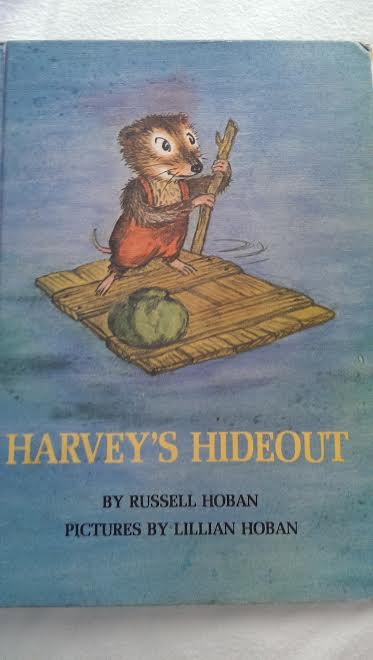
Harvey’s Hideout by Russell Hoban, illustrated by Lillian Hoban, 1969.

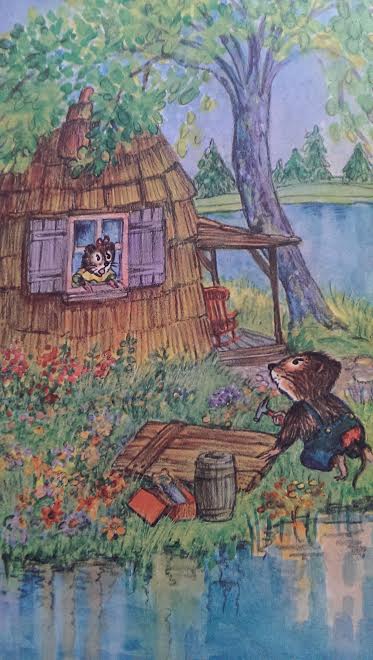
HarveysHideoutHouseSummer is difficult for the Muskrat kids this year.  Their friends are away for the summer, and Harvey and his older sister Mildred are getting on each other’s nerves.  But, there’s nothing that says they have to spend the whole summer with each other.

Harvey builds himself a raft and tells Mildred that he’s going off to meet with members of his secret club for a cookout where annoying big sisters aren’t welcome.  Mildred says that’s fine with her because she’s been invited to a party where there will be no annoying little brothers.  Harvey says that’s fine with him . . . except that it really isn’t.

The secret hideout where Harvey has been spending his time is empty except for him and the comic books he brought with him, and his cookout is for only one person.  He just made up the story about the secret club to make Mildred jealous and to have an excuse to spend time away from the house and her.  Harvey appreciates the freedom, but he’s also bored and lonely and envies Mildred, wondering who she knows who is still in town, inviting her to parties every day.

Then, when Harvey tries to make some improvements to his secret hideout, he discovers that he’s not the only one to dig a secret hideout for himself in the area.  Harvey’s unexpected discovery leads to a change in his relationship with his sister.

HarveyHideoutSecret


The book is available to borrow and read for free online through Internet Archive, and new copies are also available to buy through Plough.  If you try it and like it, consider buying a copy to own!

HarveysHideoutFriends

My Reaction

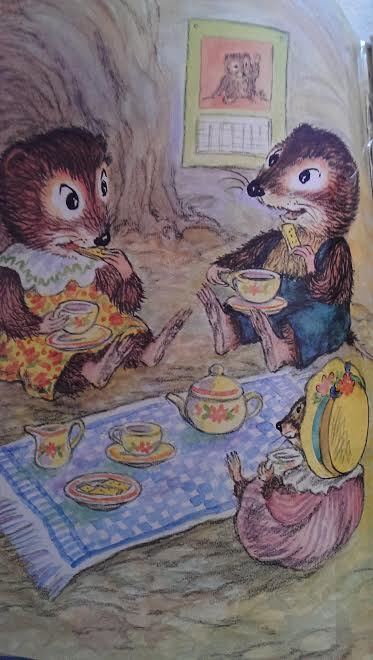
This is a nice story about sibling rivalry and cooperation.  One of the parts I like best is early on in the story when Harvey and Mildred’s father lectures them for fighting and insulting each other. I hated that part when I was a kid, but I kind of like it now because I realize what the father is actually trying to say.  He points out that there is some truth in their insults, but they’re wrong about each other at the same time.  Part of the reason they fight is because they each have their faults (Harvey can be selfish and Mildred can be bossy), but they each unfairly assume that the other is a lost cause and that they can never be friends.  It’s only when they come to realize that they’re equally lonely (Mildred has been having tea parties with just her doll) and Harvey makes the first move in offering to share what he has with Mildred that they realize that they can each be the friends they both need this summer.

When I was a kid, I wished I had a hideout like theirs!  I also love the colorful illustrations in the story.

The Case of the Cool-Itch Kid

Polka Dot Private Eye

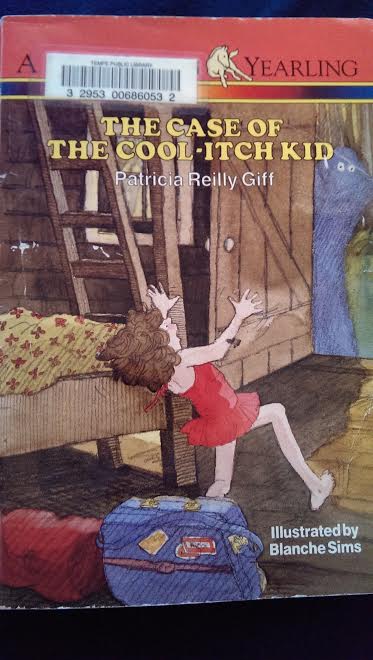
CoolItchKid#5 The Case of the Cool-Itch Kid by Patricia Reilly Giff, 1989.

Dawn heads off to summer camp!  At first, she’s not sure that she really wants to go, even though the idea of riding horses, swimming, and roasting marshmallows sounds appealing.  It turns out that there’s only one other girl from her school going, Jill Simon.  All of the other girls on the bus to camp are people she doesn’t know from another school called Coolidge (which Dawn pronounces “Cool-Itch”).

Before she leaves home, Dawn receives a package of small presents from her grandmother.  Among her grandmother’s gifts are some candy and cookies, a pin, and a small mirror surrounded by seashells that Dawn loves.  Later, after their bus stops at a rest stop, she realizes that some of these things are missing.  She particularly notices that the pin and the beautiful mirror are gone.

Who is the thief?  Could it be one of those kids from Coolidge (“Cool-Itch”)?

Dawn misses her family, especially her grandmother.  She hates the food at camp.  She’s upset about losing her grandmother’s presents.  Worst of all, she realizes that she left her Polka Dot Private Eye box at home!  How is she going to solve this mystery?

Part of the story is about the mistakes people make by jumping to conclusions.  Right from the beginning, Dawn assumes that her only friend at camp is Jill because the other kids are unfamiliar, and she thinks they’re unfriendly.  Also, she assumes that the presents disappeared because they were stolen, but actually, it’s due to a series of accidents and misunderstandings.

The book is currently available online through Internet Archive.

The Powder Puff Puzzle

The Polka Dot Private Eye

PowderPuff#4 The Powder Puff Puzzle by Patricia Reilly Giff, 1987.

Dawn is on her way to go swimming with her friend Emily Arrow when her cat, Powder Puff, is startled and jumps into a stranger’s car.  Before Dawn can do anything about it, the car drives away with her cat!

Fortunately, Dawn managed to notice a few things about the car and driver. The car is red and dented.  The driver is tall and skinny and has long, gray hair.  She was eating a jelly cookie and carrying a box and a long pole.  Her license plate had a name on it and that started with “PA,” but Dawn didn’t get to read the rest.

Emily’s father is a police officer, but he can’t trace the license plate with just the letters that Dawn was able to give him.  Instead, he has the kids make Lost Cat posters to put up in the neighborhood.  Still, that’s not enough for Dawn.  As The Polka Dot Private Eye, she should be able to figure out where her own lost cat is!

PowderPuffPicWith the help of her friends, especially Jason, Dawn uses what she knows to put together a picture of the person they’re looking for, and they try to retrace her steps through town.  Can they track down Powder Puff and get him back?
Part of the puzzle that Dawn and Jason overlook at first is the woman’s profession, which is one that the kids hadn’t really expected to find a woman doing, although Dawn spots the clues which point to what the woman was doing in the area and allow them to realize where she had to be going.  Whether more modern kids reading this book would feel the same way about the woman’s profession, I’m not sure.

The book is currently available online through Internet Archive.

The Secret at the Polk Street School

The Polka Dot Private Eye

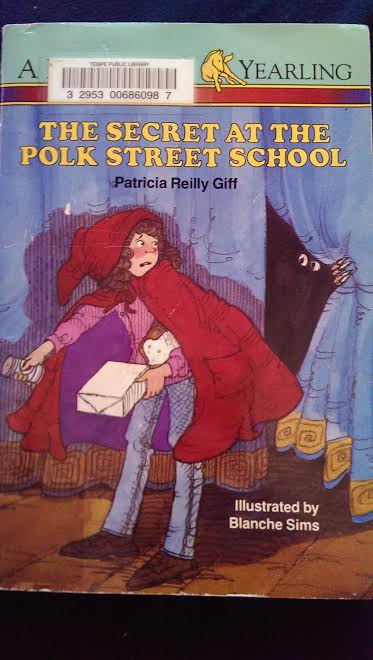
SecretPolkStreet#3 The Secret at the Polk Street School by Patricia Reilly Giff, 1987.

Dawn’s class is competing against other classes in a contest to see which class does the most for the school.  All of the classes are working on their own special projects, trying hard to keep them a secret until the judging.  Dawn, as the class’s resident detective, suggests that she could solve a mystery on behalf of the class, but unfortunately, there is no mystery for her to solve.  Yet.

Instead, Ms. Rooney’s class decides to put on a play for the rest of the school.  It’s Little Red Riding Hood, and Dawn is playing the starring role.  Jason gets to be the Wolf, borrowing an old wolf costume from his sister without her permission.

At the class’s rehearsal, Dawn gets mad when someone dressed in the wolf costume tries to scare her, and she thinks that it’s Jason, goofing off.  But, it turns out that Jason wasn’t even there, and the wolf costume is missing.  Suddenly, Dawn has a mystery!

Dawn starts receiving messages from “The Wolf” saying that someone is going to get her and Jason.  Then, someone takes a bite out of the loaf of bread that Dawn has been using as a prop (the food that she’s taking to “Grandma’s House” in the play).  Could “The Wolf” be someone in a rival class, hoping to sabotage their play so they can win the contest?

The book is currently available online through Internet Archive.

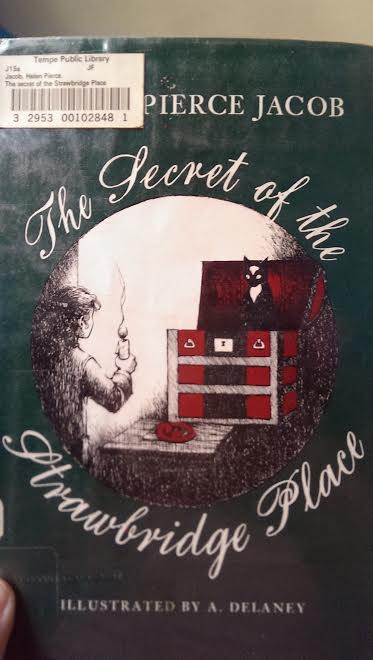
The Secret of the Strawbridge Place

SecretStrawbridgePlace

SecretStrawbridgePlacePic1The Secret of the Strawbridge Place by Helen Pierce Jacob, 1976.
This story takes place in Ashtabula, Ohio during the Great Depression. Kate is frightened of the hobos who pass through town looking for work, but at the beginning of summer, her brother Josh dares her to come with him to spy on the hobo camp. The two of them witness a fight between three hobos, and in their haste to get away, Kate falls and breaks her arm. At first, she is sure that her summer is ruined, but when she considers the place where she fell, she realizes that she has stumbled on an important clue to a secret surrounding the old house where they live.

Locals say that during the Civil War, the Strawbridge family, who lived in the house before Kate’s family, were part of the Underground Railroad, hiding runaway slaves. However, no one has ever been able to find the place where the slaves were hidden. When Kate fell, she discovered the opening to a cave near the river that she never knew was there before.

SecretStrawbridgePlacePic2Oscar, a boy visiting his grandfather nearby, becomes Kate’s friend. Since he was also injured in one of Josh’s escapades (having broken his leg when the kids were fooling around in the haymow), she invites him to join her in the search for the secret. They form a partnership called Cripples Incorporated and have fun inventing code words and writing secret messages about what they’ve discovered. Pursuing the secret comes with some risks, and before Kate can discover the whole truth about Strawbridge Place, she has a serious brush with danger.

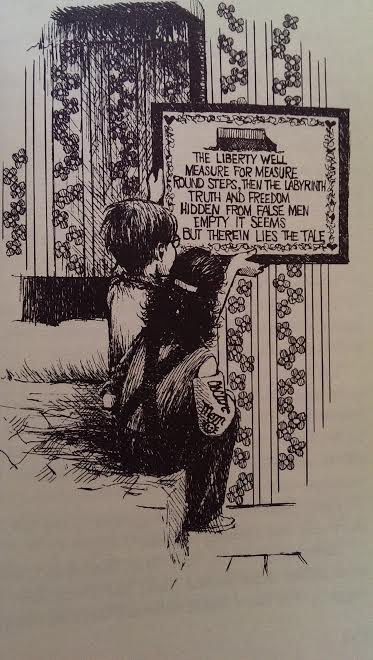
It’s an interesting mystery that invites readers to try to figure out the clues along with Kate and Oscar as they ponder the sampler with the strange motto left behind by the Strawbridge twins. Oscar also introduces Kate to Sherlock Holmes stories, one of which provides her with the inspiration to solve the mystery. Kate also develops better feelings for the hobos, who, like the runaway slaves, turn out to be mostly ordinary people just looking for a better life.

The book is available to borrow and read for free online through Internet Archive.  There is also a prequel book that focuses on the original adventures of the Strawbridge family when the house was operating as a stop on the Underground Railroad called The Diary of the Strawbridge Place.

The Mystery of the Haunted Trail

MysteryHauntedTrailThe Mystery of the Haunted Trail by Janet Lorimer, 1989.

Brian Kelly wasn’t too excited at first when his teacher assigned his class to write letters to students at a school in Hawaii.  He doesn’t really like to write, and the whole thing sounded boring, but it turned out to be pretty fun when his new pen pal, Alani, wrote back.  Brian discovered that he and Alani had a lot in common, and he even got to meet Alani when his family came to California on a trip.  Then, best of all, Alani’s family invited Brian to spend part of the summer with them in Hawaii!

Brian loves Hawaii from the moment he arrives.  Alani’s family lives in a rural area near Kalawa.  All of the families in the area raise their own vegetables and keep animals.  They depend on what they earn from selling food although some of them, like Alani’s mother, who is a nurse, have other jobs as well.  Alani’s father, like Alani’s grandfather, is primarily a farmer.  Alani’s grandfather lives with him on land that the family has owned for generations.

Alani and his family enjoy showing Brian around their island and talking about the history of the place.  Brian particularly likes the stories that Alani’s grandfather, who they call Kupuna, tells them, although some of them are frightening.  At the luau that the family and their friends have to welcome Brian to Hawaii, Brian overhears people talking about the Night Marchers.  They say that the Night Marchers have been seen recently and that bad things have been happening in the area, like crops dying and the nearby stream starting to dry up.  Some people seem to think that it’s a sign of bad luck and that maybe they should move away from the area.

According to Kupuna, the Night Marchers are a ghostly parade of the ancestors of the people who have lived there for generations.  Sometimes, it’s just ordinary people and sometimes it’s the souls of warriors.  Sometimes, Hawaiian gods may even walk among them.  But, when they march, any living person must either flee from them or, if that is impossible, they must lie down and hide their eyes.  At the head of the Marchers is a ghostly spearman who will strike down any living person who sees them, unless that person is related to one of the Marchers themselves.  They spare members of their own families.  People who are struck by the spear of the Marchers appear to have died of a heart attack.

The place where the Marchers supposedly walk is an old trail that leads to a sacred place where Alani’s ancestors are buried.  Brian is curious to see the place, but Alani warns him away, saying that they are not allowed to go there because it’s too dangerous.  However, Brian soon sees the Marchers himself one night in Alani’s family’s fields, and the next day, their crops are dead.  When Brian notices strange footprints in the fields as well, he realizes that some living people may be responsible for the awful things that have been happening in the area, but the only way he can prove it would be to explore the haunted trail himself and track the “ghosts” to their lair.

Janet Lorimer’s books are interesting because they are often a combination of mystery and ghost story.  There are logical explanations and living villains who are responsible for the things that are happening to Alani’s family and their neighbors, but there is also a definite supernatural element to the story as well.  Telling you where one ends and the other begins may be saying too much.  It may be more fun to let you find out yourself.

The book is currently available online through Internet Archive.

Summer Fun

SummerFunSummer Fun by Carolyn Haywood, 1986.

This is a cute book of short stories featuring favorite Haywood characters, including Betsy and Eddie.  The children spent their summer in different ways, having fun summer adventures.  None of the adventures is particularly scary.  Although a couple of the kids find themselves in semi-dangerous situations, everything is resolved pretty quickly, and the rest of the stories are more slice-of-life style stories about fun and funny things that the kids do or lessons they learn.

The stories are very easy to read and great for children beginning chapter books or for some light bedtime reading for younger kids.

The book is currently available online through Internet Archive.

The stories in this book are:

Bears and Blueberries

Peter is at summer camp, and when he goes on a hike and camp-out with his camp friends, they have encounters with wildlife.

SummerFunPic2The Watermelon Party

Betsy’s father tells her that he used to have watermelon parties with his friends when he was young, and that the person who had the most watermelon seeds at the end of the party would win a prize.  Betsy decides that she wants to have a party like that, but her friend Rodney learns why cheating takes all the fun out of a contest.

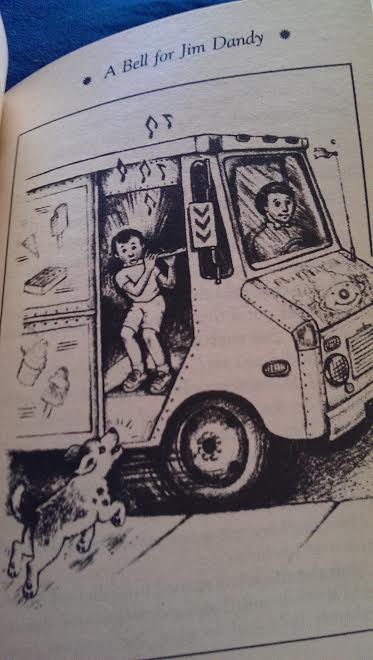
A Bell for Jim Dandy

Jim Dandy is a brand of ice cream that comes on a stick.  When the bell on the ice cream truck is broken, Billy gets a job trying to help the driver attract customers in exchange for free ice cream.  But, without a bell himself, how will he get people’s attention?

Betsy’s Property

While Betsy is visiting her aunt and uncle at their summer home by the beach, she discovers a special rock a little ways out from the shore that she likes to think of as all her own.  She likes to sit out on the rock and read with her aunt’s dog, but what will she do when a sudden storm leaves her stranded?

SummerFunPic1Betsy’s Hammock Club

Betsy loves the hammock that her father bought for her, but so does every other kid in the neighborhood!

Eddie and His Hermit Crab

Anna Patricia buys a couple of hermit crabs at the beach as pets.  When she gives one to Eddie, he decides that his crab will win the hermit crab race at the beach!

Eddie and His Money Sheet

Eddie sets out to make some money with sand sculptures and ends up convincing Anna Patricia to adopt a stray cat.

The Picnic

Eddie and Anna Patricia find out that her new cat actually belongs to someone else.  But, they become friends with the cat’s owners, who take them out for a sailing trip and picnic.  When the kids’ parents are late arriving with food for the picnic, Anna Patricia tries to let the kids into the house and discovers how different the Goldilocks story would have been if the bears had a security alarm.

An Afternoon on the Farm

Teddy and Babs visit a farm with their parents and make friends with the grandchildren of the owners, Mark and Sarah.  While the children are playing at being explorers one day, they find a dead animal they’ve never seen before.  When they bring it back to show their parents, they learn why you shouldn’t mess with a skunk, even a dead one. (No mention of disease, just smell, although I’d think that would be a more serious issue.)

End of Summer

It’s time for Mark and Sarah to go home after visiting their grandparents.  With all of the things they have to remember to take with them and all of the things they forget, will they actually make it to the train on time?

Castle Diary

CastleDiary

Castle Diary: The Journal of Tobias Burgess, Page by Richard Platt, 1999.

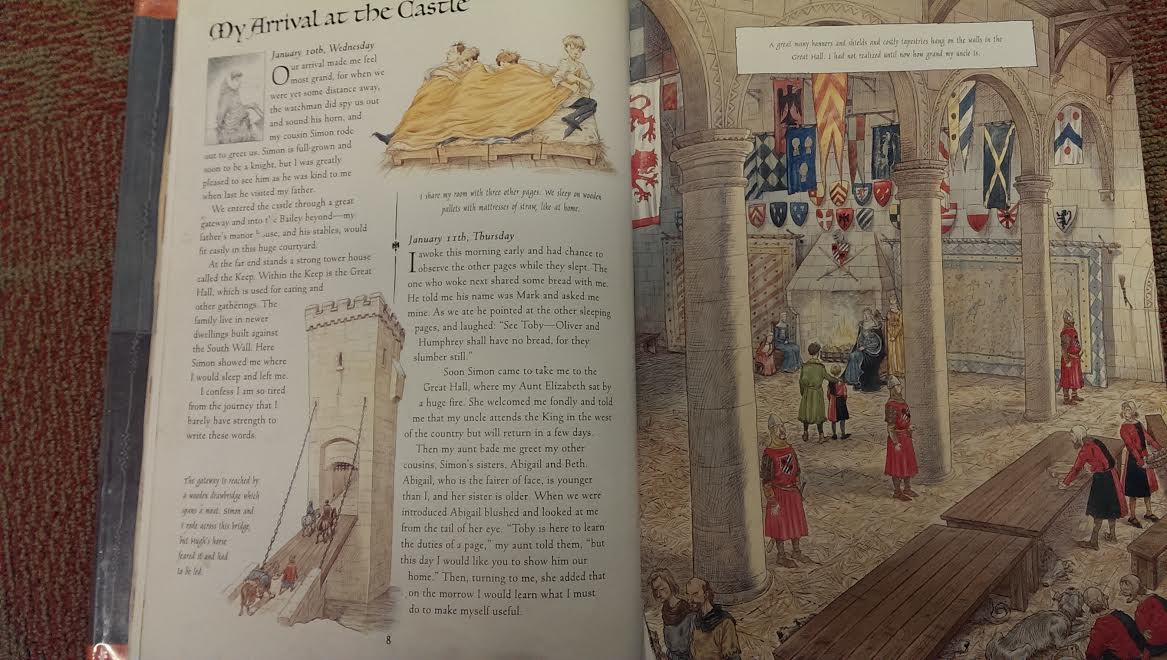
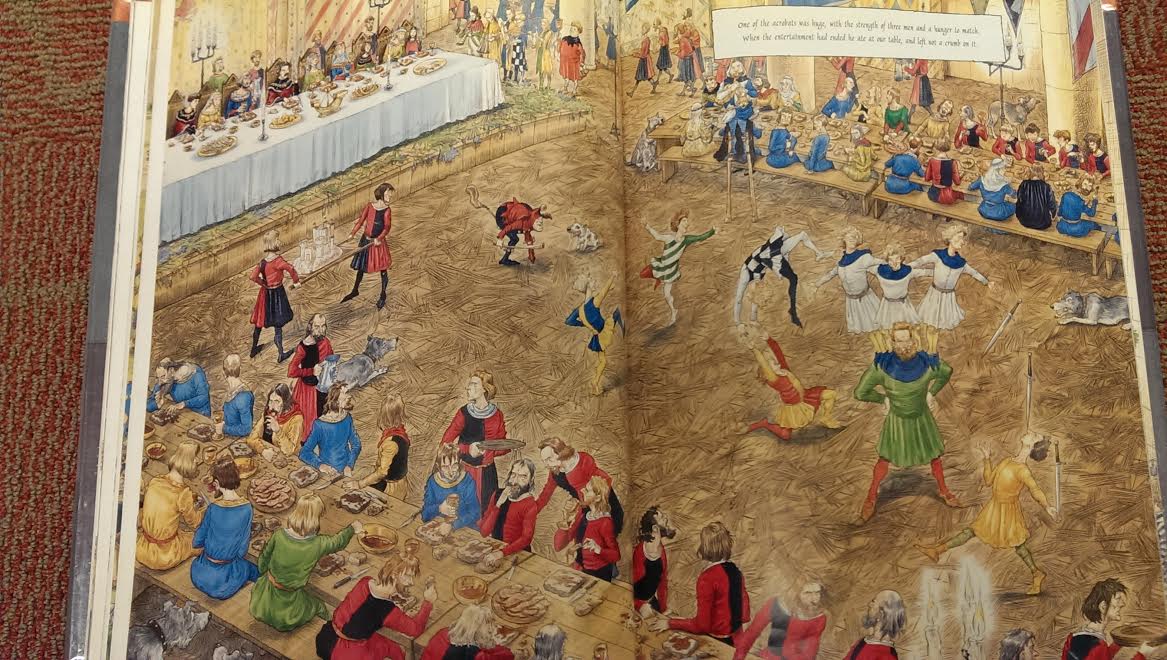
Tobias is an eleven-year-old boy living in England in 1285.  He is from a noble family, and his father is sending him to his uncle to become a page.  As a page, Tobias will learn manners and skills that he will need as he eventually becomes a squire and then a knight.  During the first year of his training that he spends with his uncle, he keeps a diary of everything that happens to him and everything he learns.  Toby is a fictional boy, but his life and family are meant to illustrate what life was like for a young boy from his social level during the Middle Ages.

CastleDiaryPic1

The castle were Toby’s uncle lives is much bigger than his parents’ manor house.  Toby has to learn the roles of all the servants who live there: who is in charge of what and who reports to who.  Not all servants are equal, and some command more respect than others.  Some of them are even from noble families like his, including his aunt’s companion, Isbel.  Toby himself is assigned to do chores for his aunt like running errands, delivering messages, serving food at meals, and holding up the hem of her cloak when she walks outside.

Toby shares a room with the other pages at the castle, all boys of noble families and destined to become knights, just like him.  They have lessons in reading, writing, mathematics, Latin, and scripture from the castle’s chaplain, and he is a harsh disciplinarian.  They practice their lessons on wax tables that can be smoothed out and used again.  The boys also learn manners and start learning archery and about all the weapons and armor that knights use.  When they have time to play, they try walking on stilts and play at being jousting knights by carrying each other on their backs and trying to knock each other off.

CastleDiaryPic2

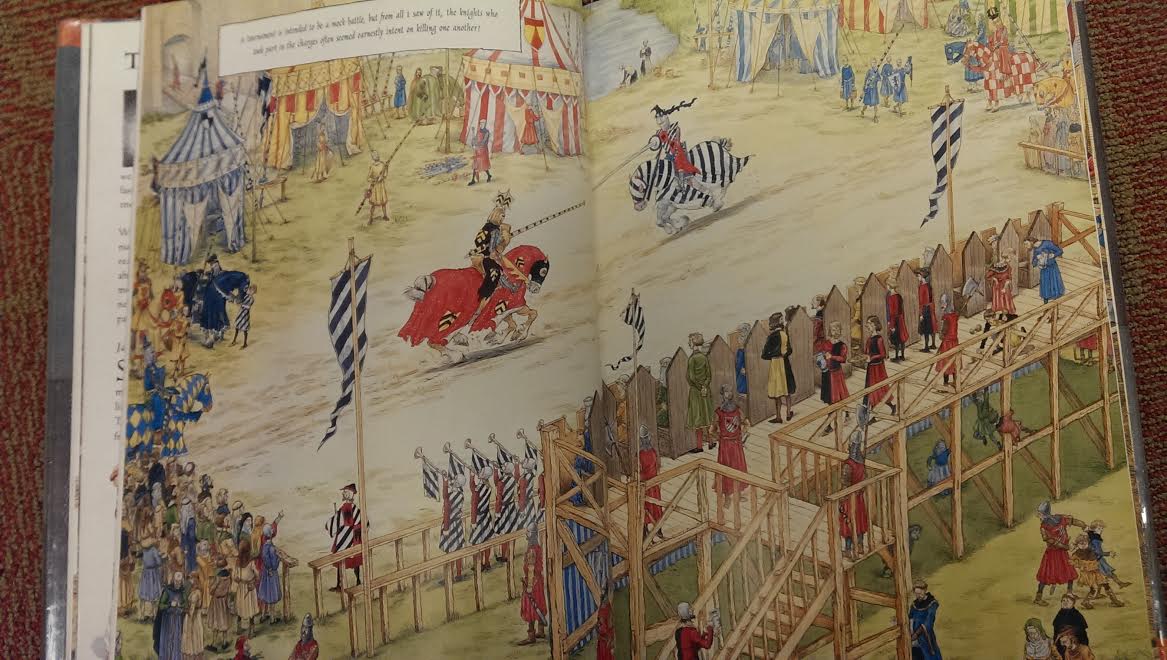
During the course of the year, Toby gets to witness a hunt, a joust, and a banquet with important guests.  At one point, he gets sick and receives treatment from a physician.  He also encounters a poacher on his uncle’s land.  This man is eventually caught (although Toby decides not to turn him in) and put on trial, but in the end, he is not punished because the jurors were sympathetic.  The book ends with a Christmas celebration, after which Toby goes home to visit his parents.

CastleDiaryPic3

In the back of the book, there is a section with more information about Medieval society, castles, sieges, weapons, armor, and the changes that eventually brought an end to feudal system that Toby knew.

The book is part of a series of historical picture books.  It is currently available online through Internet Archive.

CastleDiaryPic4