Halloween Treats

HalloweenTreats

Halloween Treats by Carolyn Haywood, 1981.

This is a collection of short stories with the usual Haywood characters as they celebrate Halloween.  These stories have a tone that’s more like Halloween of the 1950s than the 1980s, when they were written.  In this neighborhood, everyone seems to know each other, and parents are unafraid to let even young children go out on Halloween without an adult along.  It isn’t even a problem when older children invite young trick-or-treaters into their Halloween party on a whim to participate in bobbing for apples.

The book is currently available online through Internet Archive.

Stories in the Book:
HalloweenTreatsPic1The Witch and the Balloon

Katie and Mark, a set of twins, believe that the old woman who lives next door is a witch.  She has a black cat and just seems odd, banging on the wall whenever she thinks the twins are being too noisy.  But, one Halloween, when they hear banging on the wall in the middle of the night, they realize that she needs help.

Anna Patricia’s Costume

Anna Patricia loves Halloween, and she especially loves planning new costumes.  By the time Halloween actually comes, she’s changed her mind about her costume many times over.  However, there is still one change more because a surprise invitation to a Halloween party while trick-or-treating causes her to change costumes once more.

The Two Halloween Bears

Penny (a boy) and Patsy (a girl) are best friends, and they have identical teddy bears.  On Halloween, the two of them think it would be fun to wear identical bear costumes to look like their teddy bears, but they’re so much alike, even their mother have trouble telling them apart.

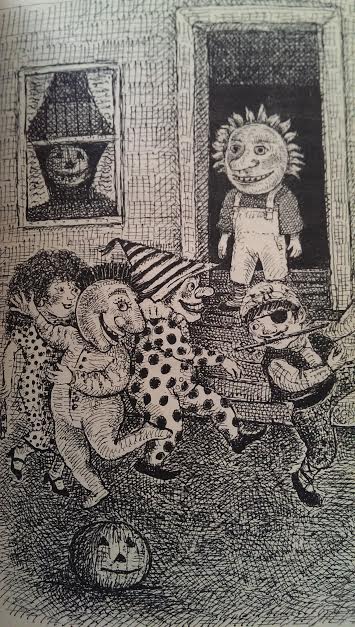
HalloweenTreatsPic2Monkey Business

After Eddie buys an old grind organ at a second hand shop, he realizes that he has the basis for a great Halloween costume: he’ll be an organ grinder with a dancing monkey.  He manages to persuade the girl next door to dress up as his monkey, but the long tail on her costume causes them problems.

Trick or Treat

Eddie likes old Mr. Timkin, a retired sailor, but when Mr. Timkin forgets that it’s Halloween and has no treats for the kids, they feel obligated to play a prank on him. Eddie only hopes that Mr. Timkin won’t be too mad.

Billy’s Halloween Party

When Billy holds a Halloween party only for kids in his grade at school, the younger children in the neighborhood feel left out.  Eddie recruits Betsy’s younger sister and her friend to help him play a prank on the older kids that makes the party more memorable for everyone.
HalloweenTreatsPic3Jonathan and the Jack-o’-Lantern

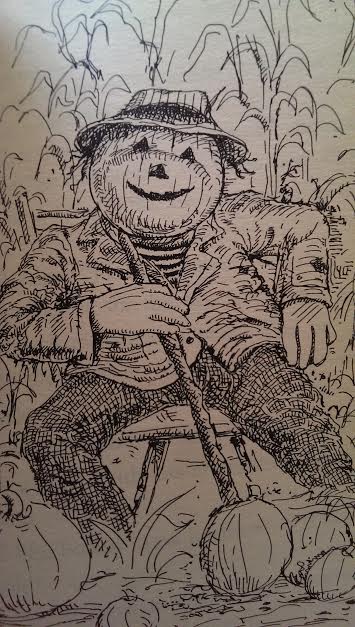
Jonathan’s family has moved from the city to the country, and he’s excited that he can see all the pumpkins growing before Halloween.  Then, some dummies with jack-o’-lantern heads give him the idea for the best costume to wear for the Halloween parade.

Who Scared Who?

Donald and Ronald, another young set of twins, are fascinated by the scary Halloween masks in the stores.  Even though the masks scare them, they think it would be funny if they could buy some really ugly masks to scare the neighborhood policemen.  However, the policemen also think it would be fun to give some of the neighborhood kids a fright.

Pennies for UNICEF

There is a contest for children collecting pennies for UNICEF.  The child who collects the most will win a trip to New York to visit the UN.  As an avid coin collector, Eddie is eager to win the contest, and he makes a special discovery among the coins that he collected on Halloween night.
The Haunted House

Peanut Butter and Jelly

PJHauntedHouse

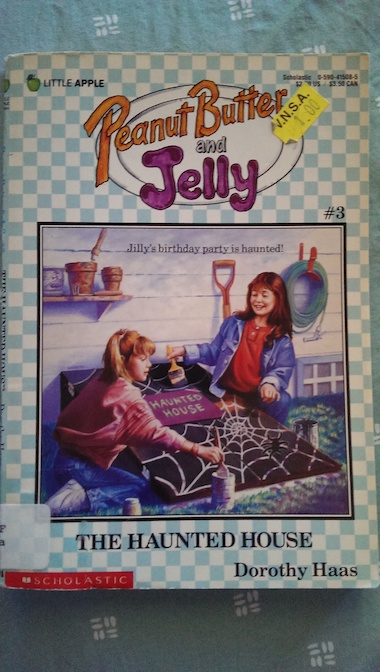
#3 The Haunted House by Dorothy Haas, 1988.

PJHauntedHouseCostumesJilly was sick on her birthday and couldn’t have a party, so she and Peanut decide to hold an haunted house party, just for fun and invite all the kids in their class. The girls’ nemesis, Jennifer, and her friends are in another class and won’t be invited to the party, but when they hear about it, they make it a point to tell Peanut and Jilly how childish it sounds.  However, no one else seems to think so, and the girls’ classmates are eager to come.

Peanut has fun making Halloween-themed food, and the girls decorate the fruit cellar in Jilly’s basement as their haunted house. They tell everyone to come in costume, and promise a prize to the person in the best costume.  Peanut also tells everyone to bring un-birthday presents to surprise Jilly and make up for missing her actual birthday.

Everyone is excited about the party, but when it starts, some strange things happen. First, it looks like more people show up than they expected.  Then, a mysterious, glowing ghost comes and tells them the tragic story of his death. What is going on?

This is just a fun book about a group of friends and a fun haunted house party they had together.  It doesn’t actually take place on Halloween (the girls get a fake skeleton on sale that was left over from Halloween), but it makes a nice Halloween-type story.  When I was a kid, I liked reading about the creative ways the girls set up the various surprises in the haunted house: making people crawl through a tunnel they’d made, having a skeleton pop out of a trunk by attaching elastic to it, and using a rubber glove filled with water and frozen as a ghostly hand reaching out to touch people, etc.  They also describe how Peanut made “frogs’ noses” out of shell pasta that was dyed green and covered with salad dressing as scary food for the party guests.

The book is currently available online through Internet Archive.

Felicity Learns a Lesson

American Girls

FelicityLesson

Felicity Learns a Lesson by Valerie Tripp, 1991.

FelicityLessonGirlsThis is the second book in the Felicity, An American Girl series.

So far, Felicity has mainly been taught at home, learning to read and write and take care of basic household tasks, like cooking and sewing, from her mother.  However, Felicity’s parents have decided that it’s time for her to begin furthering her education.  Felicity fantasizes about studying Greek, Latin, and geography, like boys do in college, but girls of her time do not receive that kind of education.  Some girls take on apprenticeships, learning professions such as seamstress, which Felicity thinks might be exciting, but her father is a wealthy merchant, which means that Felicity will be educated as a gentlewoman, not as a girl preparing herself for a trade.  A gentlewoman’s education involves lessons in penmanship, fine stitchery, dancing, manners, and hostess skills.  Felicity doesn’t find that prospect as exciting.

Felicity starts taking lessons from Miss Manderly, a respected gentlewoman, in manners and the practical arts that girls from well-off families of her era were expected to know. Two other girls, a pair of sisters who have recently arrived from England, are also taking lessons from Miss Manderly, and at first, Felicity worries that they will know more than she does.  However, they are also young and have lessons of their own to learn.  The younger of the sisters, Elizabeth, becomes Felicity’s best friend.  However, Annabelle, the older girl, is disapproving.  She misses her old life in England and doesn’t think that anything in the colonies is good.

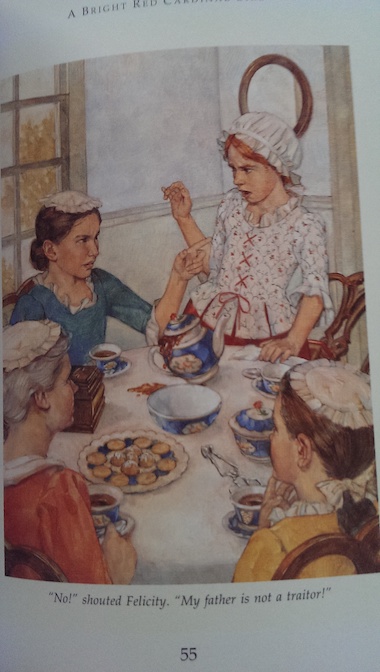
FelicityLessonAnnabelleThen, Felicity’s father declares that because of the tax on tea, he will no longer carry it in his shop. It leaves Felicity feeling conflicted about Miss Manderly’s lessons, which include the proper way to serve tea. She has started enjoying the lessons and doesn’t want to lose Elizabeth’s friendship, but she wants to support her father, too. Then, Annabelle criticizes Felicity for what her father said at one of the lessons, prompting Felicity to storm out angrily. She is doubly angry and hurt that Elizabeth didn’t try to defend her, making her doubt Elizabeth’s friendship.

At first, Felicity thinks that there is no way she can return to the lessons, but her mother convinces her that if there’s something that she really cares about (the lessons, Elizabeth’s friendship, supporting her father, etc.) she will find a way to work through the conflict rather than give up on it.  She also points out that some people aren’t as brave as others and find it more difficult to speak their minds and that Felicity should give Elizabeth another chance at friendship.  In the end, Felicity works out a compromise for her lessons using what Miss Manderly has already taught her, and Elizabeth finally finds the courage to tell Annabelle how she really feels about her behavior and the way she treats both herself and Felicity.

Each of the girls in the American Girls stories has her own personality, including strengths and weaknesses. Felicity is a spirited girl, but at first, she has a tendency to be too impatient and impulsive. Part of what she learns is the need take responsibility for her choices and to think things through before she acts.  Elizabeth, who is shy and easily intimidated by her older sister, learns that nothing will improve until she makes her true feelings known and that she has as much right as anyone else to be treated with respect.  Annabelle is a rather self-centered individual and is genuinely surprised when Elizabeth finally stands up to her.  In some ways, Annabelle is unfortunate because she does not find a friend at Miss Manderly’s like her sister does, but readers will recognize that Annabelle’s lack of friends is partly her own fault because she is deliberately antagonistic and does not try to earn Felicity’s friendship.

In the back of the book, there is a section that explains more about how children were educated in the American colonies around the time of the Revolutionary War.  Other good books on this topic are Going to School in 1776 and Colonial Crafts.

This book is currently available online through Internet Archive.

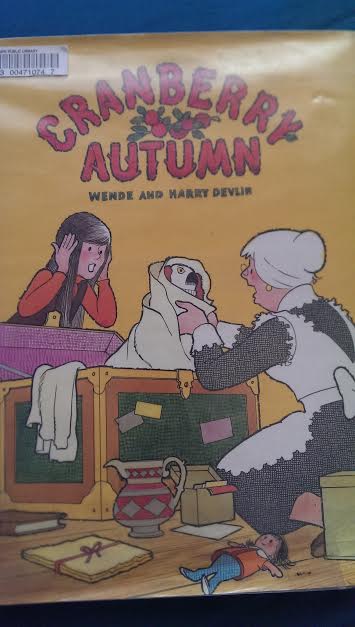
Cranberry Autumn

CranberryAutumnCranberry Autumn by Wende and Harry Devlin, 1993.
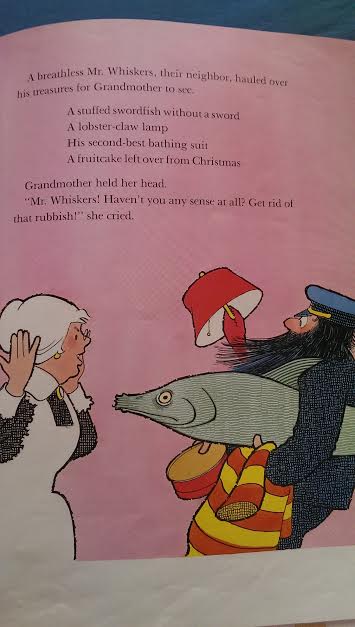
CranberryAutumnPic1School is about to start, and Maggie and her grandmother realize that they’re short of money.  Maggie needs new school clothes, and her grandmother needs a new coat.  They know that some of their neighbors could also use some more money, so Grandmother suggests that they hold a sale.  Some of them have some antiques and other interesting old items that they could sell.
Mr. Whiskers tries to help, but he doesn’t have anything really interesting to sell.  At least, nothing Grandmother thinks that anyone would buy.  He’s disappointed because he really wants to help.

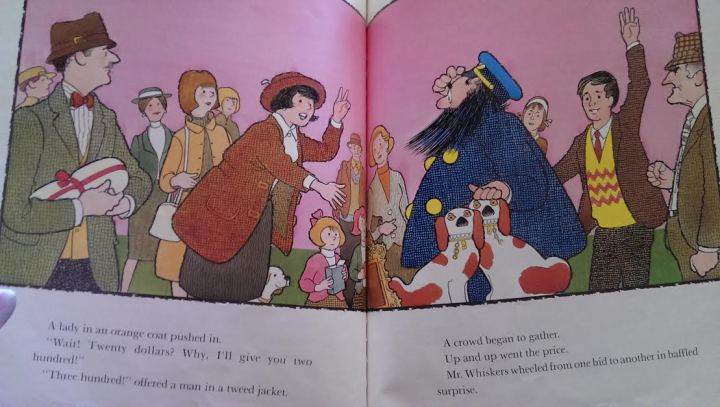
Mr. Grape, a greedy and dishonest neighbor of Mr. Whiskers, attends the sale and decides that he wants a pair of beautiful antique Staffordshire china dogs that Grandmother is hoping to sell for $200.  When he devises a scheme to cheat Grandmother and get the dogs for much less money, Mr. Whiskers gets his chance to help and to turn the tables on Mr. Grape.

As with other Cranberry books, this one includes a recipe that uses cranberries: Cranberry Squares.

CranberryAutumnPic2

CranberryAutumnRecipe

The Candy Corn Contest

The Kids of the Polk Street School

CandyCornContest#3 The Candy Corn Contest by Patricia Reilly Giff, 1984.
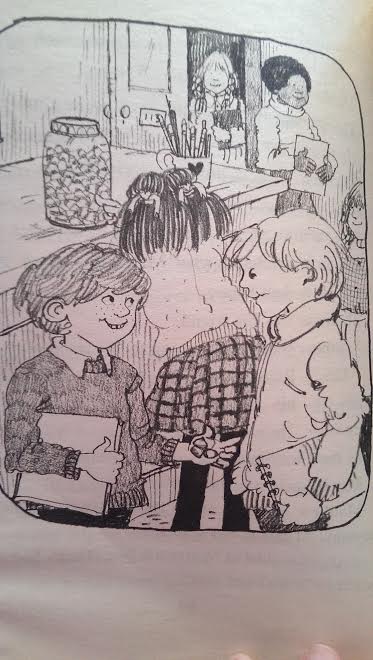
As Ms. Rooney’s class prepares for the upcoming Thanksgiving holiday, she gives them a contest: students can win the jar of candy corn on her desk if they can guess how many pieces of candy corn are in it (or get the closest to the right answer).  Richard “Beast” Best wants to win very badly because he loves candy corn and his mother never lets him eat many sweets at home.

The only problem is that students can only earn the ability to make guesses by reading books.  They get one guess for each page they read.  Richard has always been a slow reader, so he knows that this contest is going to be hard for him.  One day, while studying the jar of candy corn, trying to plan out his guess to make the best use of it he can, Richard gives in to temptation and eats three pieces.  Now, he doesn’t know what to do.  Ms. Rooney knows exactly how many pieces of candy there were in the jar, and if three are missing, she’ll find out.

CandyCornContestPic2While Richard is worrying over his mistake, he’s also worrying about the sleep-over party his parents are letting him have over the Thanksgiving break.  At first, he was looking forward to it, but some of the other boys in class can’t come and some of those who said they could are concerned because Matthew is coming.  Matthew and Richard are friends, and people in class generally like Matthew, but everyone knows that Matthew still wets the bed.  Some of the other boys are worried that they’ll have to sleep next to Matthew at the sleep-over.  As much as Richard likes Matthew, it feels like his problem is going to ruin the party, and when Matthew is nice to him, it only makes Richard feel worse.

For awhile, Richard is short-tempered with Matthew and says some things that he later regrets.  His mean comments make Matthew decide not to go to his party, but Richard feels terrible because he realizes what Matthew’s friendship really means to him. Richard’s apologies later help to fix the situation.  It also helps that Richard admits to Matthew that he ate three pieces of the candy corn.  Richard’s confession that he did something wrong (more than one thing, actually) and that he wants to fix it helps Matthew to forgive him.  Matthew helps Richard to decide how to solve his candy corn problem honorably, and Matthew’s mother gives Matthew a suggestion that will help him to avoid problems at the sleep-over.

The book is currently available online through Internet Archive.

Fish Face

The Kids of the Polk Street School

FishFace#2 Fish Face by Patricia Reilly Giff, 1984.

When there’s a new girl in Ms. Rooney’s class, Emily Arrow is happy at first that she’ll be sitting next to her and thinks maybe they’ll be friends.  However, that feeling doesn’t last very long.  Dawn Bosco doesn’t seem interested in making friends.  She doesn’t respond to the compliments that Emily gives her.  Instead, she brags about herself, saying things that Emily learns later aren’t true.  Worst still, she steals Emily’s toy unicorn, Uni.

Uni is Emily’s best friend, and she’s convinced that he brings her good luck.  Without him, everything seems to go wrong.  Emily even has trouble sleeping because she always sleeps with Uni.  When she tries to get Dawn to give Uni back, she denies taking him, but Emily knows that Dawn is hiding him in her pencil box.  She saw him there, but she just can’t get to him.  Will Emily ever get Uni back?

The book is currently available online through Internet Archive.

My Reaction and  Spoilers

FishFacePic1The title of the story comes from the fish faces that Emily was making, imitating the classroom pet fish.  She shows Dawn her fish face when she’s trying to joke with her, but Dawn just thinks it’s weird.  Dawn worries that she’s not making friends, but at the same time, she also seems determined not to like things and people at her new school and stealing Emily’s unicorn and lying about it was a sure way to make her angry.

I didn’t like this book as well as others in the series.  The kids in the series don’t always explain their actions or completely understand them, which is somewhat true to life.  Young children don’t always understand their true feelings or motives because they don’t have the words or the experience to explain what they feel.  However, this book felt more unexplained than normal.

Dawn steals Emily’s toy unicorn just moments after they first meet, while sitting in the desk next to her in their classroom.  Emily doesn’t get help getting her unicorn back right away, and by the time she does, it’s too little help, and Dawn gets away with keeping the unicorn.  We’re supposed to believe that Dawn did it just because she felt awkward in a new place with no friends, but that’s shaky because even a second-grader would know that stealing something isn’t going to win friends.  The kids later find a letter Dawn was writing to a friend at her old school, saying that she’d done something bad but that Emily was mean and that she was upset about not having friends.  So, she understands that she did something wrong, but still thinks Emily is mean for trying to recover her stolen property?  Children can say and do some odd, sometimes contradictory, things, but Dawn’s feelings seem to be all over the place and her character difficult to pin down.

It’s difficult to tell what, if any, lesson to take away from this story.  That if someone steals your stuff, it’s because they’re lonely and you just don’t understand them?  Things partly get resolved because Emily is interrupted in searching for her unicorn and ends up taking Dawn’s reader out of her desk.  Returning the reader seems to be what causes Dawn to have a change of heart, maybe because missing it made her understand Emily’s feelings about the loss of her unicorn, but we never really find out.

Fortunately, Dawn does become a more distinct character in other books, and later, because she wants to be a detective, she gets her own series of mysteries.  One of the mysteries in her spin-off series references this story because something else disappears in class, and Dawn is suspected because people know that she stole something before.  In that book, Dawn has to figure out the mystery in order to clear herself of suspicion.

One thing I did like about this book was that, although losing Uni was very hard for Emily at first, she does come to realize that she can do without him, that he is not her sole source of good luck, and that she can sleep without him at night.  She is pleased when Dawn agrees to give him back, but she does recognize that learning that she can be okay on her own is a sign of growing up.

The Beast in Ms. Rooney’s Room

The Kids of the Polk Street School

BeastMsRooney#1 The Beast in Ms. Rooney’s Room by Patricia Reilly Giff, 1984.
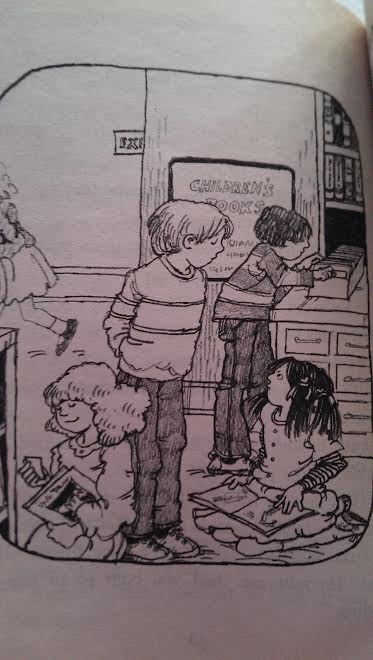
It’s the start of a new school year, and Richard Best (nicknamed “Beast”) is embarrassed to find himself in Ms. Rooney’s room once again because he was held back a year for his poor reading skills.  Everyone he knows has moved on to the third grade, and he’s still in a second grade class with kids who were first grade babies last year.  He feels awkward, being the tallest, oldest person in class, and kids in his old class tease him and refuse to let him play baseball on the playground with them because he’s a pathetic “left-back.”

At first, Beast tries to pretend that it was all a horrible mistake that will be straightened out soon, but that just makes him feel bad for lying.  The kids who are now in the same class he is, who he still thinks of as “babies,” try to make friends with him, but he doesn’t accept them at first because of his embarrassment at being older and still not as good at reading as some of them are.

BeastMsRooneyPic1However, even though he’s embarrassed at having to attend special reading classes with Mrs. Paris while most of the rest of his class has normal reading, these special classes really help him, not just to improve his reading skills, but to connect with other kids in his new class who have the same reading difficulties he does and who understand how he feels.
Beast discovers that it’s no shame to not know something or to have trouble doing something because everyone has different skills and it can take some people longer to learn certain things than others.  Emily Arrow, the girl who now sits next to him in class is a whiz at math but has as much trouble reading as he does.  Beast learns some new skills from his new, younger classmates and realizes that they’re not really babies.  They also really appreciate him and help him see some of the good things about himself.

The book is currently available online through Internet Archive.

Alissa, Princess of Arcadia

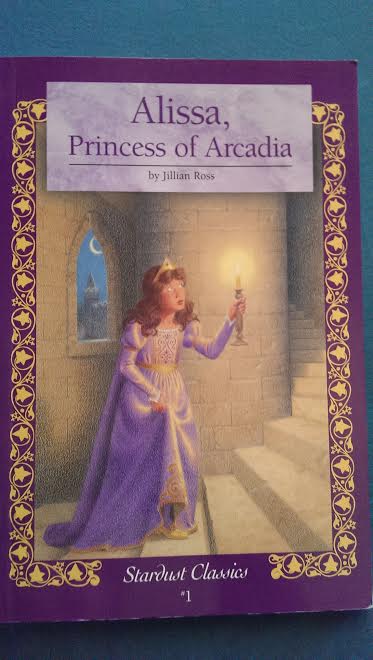
AlissaAlissa, Princess of Arcadia by Jillian Ross, 1997.

Alissa, the only child of King Edmund of Arcadia, feels like her life has taken a turn for the worse since she turned ten years old.  Before, she lived a basically care-free life, but now, her family has become more serious about her education and training as the future Queen of Arcadia.  Her great-aunts are mainly in charge of her education now, and they find Alissa to be ill-mannered, impatient, and stubborn.  In some ways, she is.  Alissa is bored with her lessons in the standard school subjects and hates her “deportment” lessons, where she learns etiquette suited to the royal court.  More than anything, she wants adventure and excitement.

To Alissa’s surprise, she meets a strange old man one evening while walking in the garden who promises her the adventure that she’s looking for.  At first, Alissa doesn’t know what to think about this strange old man, Balin, who seems to know everything about her, even what she’s been thinking.  He sets Alissa a “quest”, to solve a riddle to determine where to find him.  After pondering it for awhile, Alissa realizes that the riddle says that Balin lives in the oldest tower of the castle, where no one ever goes anymore.

AlissaBalinIt turns out that Balin is a wizard.  He’s lived in the tower for centuries and hardly ever leaves, so most people have forgotten that he’s there.  He offers Alissa lessons in magic and the kind of quests that she’s been craving.  He once taught Alissa’s father similar lessons, although he thinks that King Edmund has also forgotten that he exists.  Alissa eager accepts the offer of magic lessons.

At first, the only other person who knows about Alissa’s lessons with Balin is Lia, a servant of one of Alissa’s great-aunts.  Lia had been about to run away from her position as servant because she didn’t think that she was very good at her job, but Alissa caught her the night when she was going to find Balin in his tower.  The two of them became friends, and Alissa makes Lia her lady-in-waiting. Alissa enjoys having someone her age to share her secrets and adventures.  Her great-aunts disapprove of her choice of lady-in-waiting, but Alissa’s father appreciates Lia because she sees the better side of Alissa, her bravery and kindness, and somewhat helps Alissa’s impatience because Lia is a more patient, cautious person.

AlissaKingWhen Alissa first begins her lessons with Balin, she thinks that studying magic is turning out to be as boring as her other lessons.  Balin makes her do little chores, like dusting things in his tower, and he has her read books and memorize words.  Alissa is impatient to get on with the exciting magic, but Balin impresses on her that she needs to start out slowly and to recognize that magic is not the solution to all things.

Meanwhile, Alissa’s father is preparing to hold a banquet to celebrate a new alliance with a neighboring kingdom.  Now that Alissa is old enough to participate in such banquets, she learns that she must not only attend the banquet but be the dinner partner of the invited king, who she has heard is a stern man who is a stickler for proper manners.  Alissa is terrified that she will make a mistake during the banquet, anger the king, and ruin everything.

Her fears grow worse when Balin tells her that he has seen impending disaster in his crystal ball and a threat to the alliance.  Alissa begs him to tell her more, but he says that something is preventing his magic from seeing more.  All he has to offer Alissa are a few vague hints which take the form of another riddle.

Balin believes that Alissa is the only one who can solve the riddle, stop the danger, and save the alliance, but Alissa doubts herself.  She’s still afraid that she isn’t up to the task and will ruin everything, and she wishes that Balin would give her some magic spell to prevent her from doing anything wrong.  However, the best weapons Alissa has are the ones she already possesses: her wits, her desire to work hard for what she wants to achieve, and the new patience that she is just starting to learn.

One of the things that I liked about the story was that the visiting king, for all of his sternness and demanding nature with others, is surprisingly understanding with Alissa.  Some adults still remember what it was like to be young and awkward and impatient to grow up.

This book does not have extra information or activities in the back, as other books in the Stardust Classics series do.  It is currently available online through Internet Archive.

The Mysterious Queen of Magic

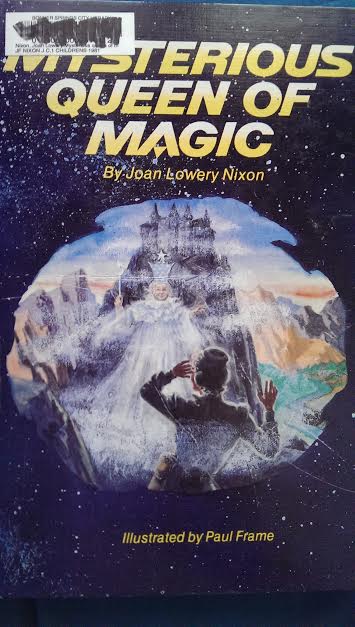
KleepQueenMagicThe Mysterious Queen of Magic by Joan Lowery Nixon, 1981.

This is part of the Kleep: Space Detective series.

Kleep and Till meet a strange young man who is looking for Kleep’s grandfather, Arko.  The young man, Mikkel, tells them a wild story, that an evil wizard is after him.  He is controlling Mikkel’s people on the planet Durth, putting them under a spell and forcing them to become his slaves. Mikkel believes that Arko may have the key to getting rid of him because an old wise man told him to ask Arko how to find Queen Stellara.  Queen Stellara was a legendary queen who could do magic, and Arko has some old write-rolls, scrolls of the kind people used to use before people began using computers alone for learning, that talk about her and her kingdom.  However, Arko doesn’t believe in wizards or magic spells or anything of the kind.

Kleep remembers Arko telling her the old stories from the write-rolls when she was little, and unlike her grandfather, she believes that wizards and magic may be real and wants to try to help Mikkel.  When Arko says that he doesn’t believe in magic and can’t help Mikkel, Kleep and her friend Till decide to use the scrolls to try to help Mikkel find Queen Stellara.  Taking Kleep’s robot, Zibbit, with them, they journey to the planet Loctar, where Queen Stellara was supposed to live.

Although this series is mostly sci-fi with a bit of mystery thrown in, this book is more fantasy.  When Kleep and her friends arrive on the planet Loctar, they discover that they must face a series of challenges to reach the legendary queen’s palace, like heros in a fairy tale.  Magic is real, and they must prove themselves worthy in order to meet the queen and ask her for the solution to the problem of the evil wizard.  But, their ordeal doesn’t quite end there because, while Queen Stellara provides them with the means to fight the wizard, they must face him themselves!

A little corny, but fun, although it’s not my favorite book in the series.  The others were more sci-fi, and this is more fantasy.  Also, for a “detective” series, there isn’t much mystery, more adventure.  It sort of reminds me of the original Star Trek episode Catspaw, except that the magical beings in this one are apparently really magical and not just aliens.  Like the other books in this series, I like the pictures, too.

KleepQueenMagicPic3

Mystery on Taboga Island

TabogaIslandMystery on Taboga Island by Patricia Maloney Markun, 1995.

Amy is excited to be spending the summer with her aunt on Taboga Island, off the coast of Panama, near the Panama Canal.  Aunt Rhoda is a curator for an art museum, and she is writing a series of art lectures.  In particular, she has an interest in Paul Gauguin, who painted in Panama in the late 1800s.  She has invited Amy to join her for the summer not only so that she can visit another country but because of their mutual interest in art.  Amy loves drawing and painting and wants to be an artist someday.

The one drawback of going is that Amy is worried that she will be lonely over the summer.  She doesn’t know whether there will be any kids her age close by or if she would be able to talk to them if there are because she doesn’t speak Spanish.  Fortunately, soon after they arrive on Taboga, Amy meets Zoe.  Zoe is from California but she comes to visit her relatives on Taboga every year.  She introduces Amy to her cousin, Juan, as well.  The three of them become friends, and Zoe and Juan even share their special, secret hiding place with Amy: a old lookout point on an old, abandoned pier left from World War II that can only be reached by walking on a narrow beam over the water.

TabogaIslandPicThey also introduce Amy to Madame Odelle, who people call The Bird Woman because of all the birds she keeps around her house.  She is a widow who lives alone and hardly ever sees people, but she invites the children in and when she learns that Amy is interested in art, she shows them a special painting that her family has had for generations.  Madame says that her grandfather bought the painting years ago from a traveling Frenchman who was in need of money.  Amy thinks that it looks like one of Paul Gauguin’s paintings, and she knows that some of his work is unaccounted for.  However, the initials on the painting are PGO.  What could the ‘O’ stand for?

Then, the painting is suddenly stolen, and there’s no shortage of suspects.  A strange woman named Phoebe Quincy has been lurking around Madame’s house and asking questions about her.  There’s also Donald S. Deffenbach, a birdwatcher who doesn’t seem to know much about birds, and Captain Billy, an Australian who owns a sailboat that he sails himself.  Dr. Denis Dobson, who is also a Gauguin expert, also happens to be staying at the resort on the island.  He is visiting places where Gauguin painted while writing a book about him.  Could he be the thief?

I like this book for the pieces of history about Panama and Paul Gauguin, which are important in solving the mystery and understanding the origin of Madame’s mysterious painting.  One of the things I remembered most about reading this book as a child, though, was when Amy and her aunt were eating at the little restaurant on the island and her aunt urged her to try a Panamanian dish so that she could get used to trying new foods when she travels.  Amy tries a tamale for breakfast and loves it, wishing that she had been brave enough to try it earlier since she and her aunt are now planning to do more of their own cooking.  I was familiar with tamales as a kid, but not for breakfast, although I like the idea.

The book is currently available online through Internet Archive.