The Mysterious Visitor

Trixie Belden

tbvisitor#4 The Mysterious Visitor by Julie Campbell, 1954.

Now that school has started again, Trixie and Honey see more of the other kids who live in Sleepyside, including a girl named Diana Lynch. Trixie has known Diana for a long time, but ever since her father made a lot of money, Diana has been distant.

Di is deeply unhappy because her parents, particularly her mother, have been trying to live up to their new status by having the household run by fussy servants who don’t care much for children. Diana always has to wear formal clothes, she doesn’t get to play with her younger siblings as much, and she finds it increasingly hard to just relax and have fun with friends.

When Honey and Trixie invite Diana to become a member of the Bob-Whites, she tells them about her long-lost uncle who has recently come to visit her family. Her mother is happy about finally meeting the brother she has not seen since she was a baby, but Uncle Monty has been making Di’s life miserable. Whenever she makes plans to have a Halloween party or do things with friends, he tries his best to interfere and ruin everything. Uncle Monty is rude and offends people. Trixie is convinced that Di’s Uncle Monty is not what he seems to be, but she’s not sure how to prove it.

I love the description of the Halloween party that the kids have at Diana’s house!

The book is currently available online through Internet Archive.

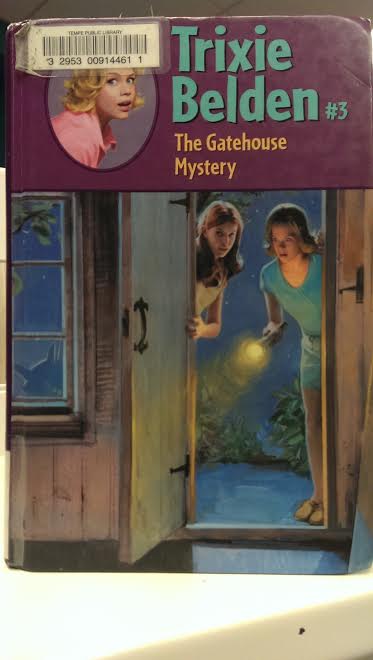
The Gatehouse Mystery

Trixie Belden

TBGatehouseMystery#3 The Gatehouse Mystery by Julie Campbell, 1951.

One day, Honey and Trixie decide to explore the old gatehouse on the property of Honey’s mansion. It hasn’t been used for years, and it is overgrown with vines. However, it looks as though someone has been there recently, and the girls find a diamond on the floor inside. There are signs of a scuffle, and the diamond looks like it was accidentally wedged into the floor. Have thieves been hiding out in that old cottage?

Honey thinks that they should turn the diamond over to the police, but Trixie wants a chance to investigate the crime first, just the two of them, and to prove to Jim and her brothers that she and Honey can be detectives as good as any man could. However, the boys become involved when someone attempts to enter Honey’s room at night to reclaim the diamond.

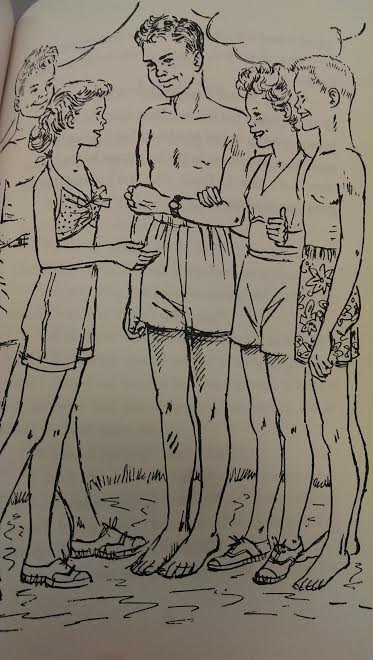
With their suspicions divided between the new gardener and the new chauffeur, the kids form a club they call the Bob-Whites of the Glen to investigate the matter and to trap the thieves.  This club continues for the rest of the series.

The book is currently available online through Internet Archive.

TBGatehouseMysteryPic

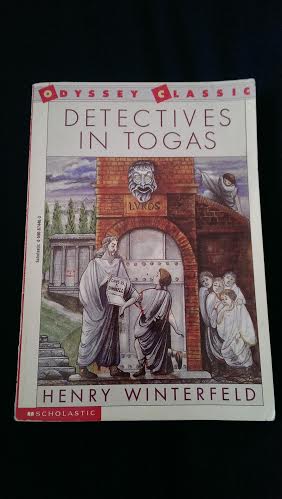
Detectives in Togas

detectivestogasDetectives in Togas by Henry Winterfeld, 1956.

Seven Roman boys, all the sons of wealthy families, attend the school run by the Greek mathematician and scholar, Xanthos. Although the boys are proud of their school, the lessons are sometimes boring, and everyone has given Xanthos the nickname Xantippus, in reference to the wife of Socrates, who was known for her nagging.

During a rather boring lesson on Greek vocabulary, a fight breaks out between two of the students that ends up creating a strange mystery for all of them. Caius was poking Rufus with his stylus, so Rufus wrote “Caius is a dumbbell” on the wax tablet where he was supposed to write his lesson. The boys get into a fight, and when Xantippus breaks it up, he sends Rufus home with the threat that he will expel him from the school.

detectivestogaspicThe next day, when the other boys arrive at school, they discover that their teacher has been attacked and robbed during the night. Worse still, when they go to Rufus’s house to visit him, they learn that someone has written “Caius is a dumbbell” on the side of the Temple of Minerva, which has been dedicated to the emperor. Defacing a temple is a crime, and soon Rufus is arrested and sent to prison (being young and part of an important family does not guarantee him special treatment). Rufus swears that he was not the one who defaced the temple, but who else could have done it?

Rufus disappeared that night, but if he didn’t go to the temple, where was he? Does the vandalism have anything to do with the attack on their teacher?  The key to the mystery seems to be a mysterious soothsayer with ties to some of the highest officials in Rome. Something sinister is happening in Rome, and the boys are the only ones who can discover what it is!

This story was inspired by a piece of graffiti found during excavations of Pompeii in 1936. (This video doesn’t actually show the Caius inscription but similar types of graffiti, including ones done by children. I keep looking for the Caius graffiti, but I can’t find pictures of it. This video of a lecture at the Western Australian Museum about ancient graffiti in Pompeii shows the more graphic adult kind of graffiti with swear words, if you’re interested.) In ancient Pompeii, someone wrote “CAIUS ASINUS EST” on the wall of a temple, which basically means “Cauis is a dumbbell” (or similar type of insult) in Latin.

Although the book was originally from 1956, it was also originally written in German. I have a later reprinting that was translated into English.  The book is available to borrow and read for free online through Internet Archive.  There is a sequel called Mystery of the Roman Ransom.

The Valentine Star

The Kids of the Polk Street School

valentinestar#6 The Valentine Star by Patricia Reilly Giff, 1985.

Emily Arrow and Sherri Dent have been fighting ever since Emily refused to play a game with Sherri at recess.  It wasn’t because Emily didn’t like Sherri.  She was just having too much fun running around with her toy unicorn, Uni.  But, Emily made the mistake of running up on top of that huge snow pile near the school fence, the one that the kids aren’t supposed to play on.  Then, Sherri told on her to Ms. Rooney.  After that, it becomes a game of tit-for-tat, each of the girls telling on the other for little things.  While Emily is acting as room monitor while Ms. Rooney is out of the room, Sherri gets out of her seat to get a book instead of doing her work, so Emily writes her name down and tells Ms. Rooney.  Sherri promises that she’ll get even.

Around the same time, Ms. Rooney’s room gets a new student teacher, Ms. Vincent.  Ms. Vincent is very pretty and nice, and Emily likes her immediately.  The kids are making rhyming Valentine’s Day cards for each other because Valentine’s Day is just a few days away, and Emily wants to give a special one to Ms. Vincent.

valentinestarpic1But then, Emily and “Beast” (Richard Best) make a serious mistake.  It was hot inside at lunch, and they couldn’t resist the urge to run outside in the snow for just a couple of minutes without their coats.  Then, they got locked out and had to get Beast’s sister to let them in a different door.  They thought no one saw them, but a neighbor did and contacted the school.  Now, Emily is afraid of what will happen if their teacher finds out that it was her and Beast.  Will the school be angry enough to hold them both back a grade or maybe worse?  Maybe Emily will be spending Valentine’s Day in the school office instead of at the party, watching Ms. Vincent enjoy her special valentine . . . especially if Sherri happens to know what they did.

Many of the The Kids of the Polk Street School books are about the little problems that kids get into but that seem big because they’re young and inexperienced.  Ms. Vincent’s kindness and understanding help Emily and Sherri to work out their differences, and a President’s Day lesson about the honesty of both Lincoln and Washington help Emily and Beast to realize that tattling on yourself makes you a better person than tattling on others.

The book is available to borrow and read for free online through Internet Archive (multiple copies).

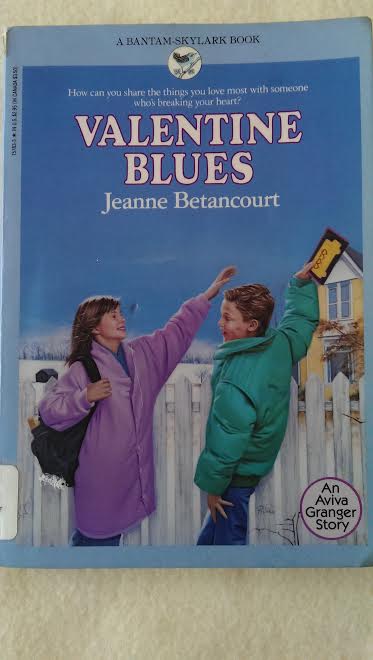
Valentine Blues

valentinebluesValentine Blues by Jeanne Betancourt, 1990.

This book is part of the Aviva Granger Stories series.  (It’s the only one I have in the series right now.)

In the last book, Aviva’s best friend, Josh, came to live with her, her mother, and her step-father.  Josh was living in an orphanage before that, and since he and Aviva were close, her mother and stepfather thought that it would be natural to invite him to be part of the family.  At the time, Aviva thought that it was a good idea, but being friends with someone doesn’t mean that it will be easy living with them, and Aviva’s family life is already complicated!

Aviva’s parents are divorced, and both her mother and father are already in new relationships.  Her mother has remarried, and Aviva not only has a stepfather but a half-sister (college age) and half-brother (baby) living in the same house.  Aviva’s father has a girlfriend, Miriam, and Aviva doesn’t get along well with her.  Miriam would like it if she and Aviva’s father had a child of their own.

When Josh comes to live with Aviva’s mother and her family, Aviva realizes that sharing a family and house with him makes things even more complicated.  He takes too long in the bathroom and makes her late to school.  He’s one more person for her mother to pay attention to, so Aviva gets less attention.  Even her dog seems to like Josh better now!

Then, shortly after Valentine’s Day, Aviva overhears Josh and his friend Ronnie Cioffi talking about girls and giving them ratings based on their looks.  Out of 10 points, Cioffi rates Aviva as a 2, and Josh agrees.  Josh has a crush on Louise, a girl they know from school, and she has a much better figure.

It isn’t that Aviva is in love with Josh, who she sees more as a friend/brother, but it hurts that he seems to be taking her place in the family and doesn’t even really appreciate her, joining in with his friend in making fun of her body.  With her time divided between two households, two parents who hardly seem to have time for her these days, and Josh moving in and taking over, Aviva worries that maybe she doesn’t really belong anywhere or to anybody.

It takes a night when Aviva sleeps out in the barn without telling anyone where she is to make the people closest to her realize how much she needs them.  A sleepover at Louise’s house (where the girls candidly discuss their own ratings for the boys they know) and Aviva’s anonymous question in sex ed class also help to put the rating system into perspective for all the kids.

The book has some Christian themes because the children go to a Catholic school, although this book mostly focuses on family life and girls’ and boys’ perceptions of each other.  The kids are eighth graders, and there is also some talk about sex ed.

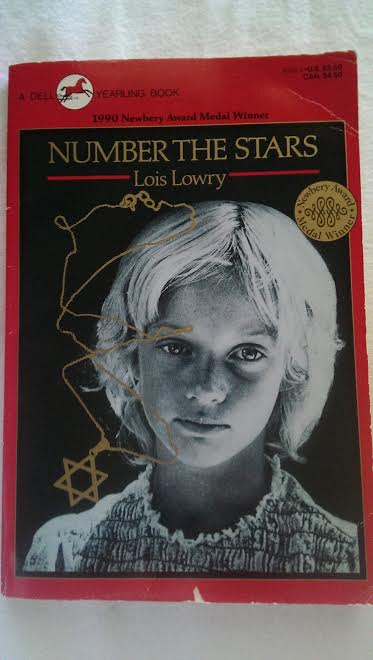
Number the Stars

numberstarsNumber the Stars by Lois Lowry, 1989.

Annemarie Johansen is ten years old and living in Copenhagen in 1943.  Denmark is now occupied by the Nazis, and she and her little sister Kirsti have become accustomed to the sight of German soldiers in the streets and the food rationing and curfews that have come with the war.  But, there are still worse changes to come in their lives. Jewish people like Annemarie’s best friend, Ellen Rosen, are in danger.  The Germans have been closing businesses owned by Jews, and worse still, some Jewish families simply . . . disappear.

Annemarie comes to understand the disturbing truth behind many of the things that have been happening around her, including the sudden death of her older, grown-up sister, Lise.  Although she had earlier been told that Lise had been killed in an accident, what happened to Lise was no accident.  Lise and her fiance, Peter, were both part of an underground Resistance movement, working against the Nazis.  Peter is still part of the Resistance, and he calls upon Annemarie’s family to help him save not only Ellen’s life but the lives of other Jews who are in danger.

When the Johansens learn that the Nazis are looking for Jews from the register at the Rosens’ synagogue, Annemarie’s family takes in Ellen and pretends that she is their third daughter, Lise, while Peter helps to hide her parents make preparations to get them out of the country.  They journey to the seaside, where Annemarie’s Uncle Henrik prepares to help take the Rosens and others to safety on his fishing boat.  At first, Annemarie is angry that the adults are telling her things that she knows aren’t true and keeping secrets from her about their plans, but they tell her that it is for her own good not to know too much because they don’t want her to be too frightened with the details.  She soon comes to see their point because, as they set their plan into motion, Annemarie must perform an act of bravery for it to be successful.

Besides being an historical novel, this is partly a coming-of-age story as Annemarie goes from being an innocent young girl to being more fully aware of the problems and dangers surrounding her, her family, and her friends.  The title of the book comes from a Biblical quotation about how God “numbers the stars” and Annemarie’s thoughts as she considers her situation and the danger everyone is in.  Ellen’s mother said that she doesn’t like the sea because it is too big and too cold, and on a starry night in the middle of their peril, it strikes Annemarie that night sky and the whole world is like that, too: too big and too cold.  Annemarie thinks that sky is full of more stars than anyone can count, and the world situation and its complexities seem too great for Annemarie to fully grasp.  The immensity and  dangerous nature of it all frighten her.

Annemarie’s older sister, the grown-up child in their family, understood the complexities and dangers of the world and risked her life to fight for their country’s freedom, ultimately losing her life in the process.  Annemarie’s younger sister is still largely unaware of the risks her family is taking to save their friends, still thinking in her innocence that the explosions from the destruction of the Danish naval fleet when the Nazis invaded were “fireworks” for her birthday.  At the beginning of the story, Annemarie is between her two sisters: more aware of what is going on than Kirsti is but not aware of what her older sister did or knew.  By the end of the story, Annemarie has moved to a more grown-up understanding but uses her innocent, little-girl appearance to fool the Nazis into thinking that she is just an ignorant child so they will be less suspicious of her.

Although this story is fiction, similar incidents happened in real life when people took great risks to help Jewish people escape from the Nazis. In the back of the book, there is an Afterword that explains more about the historical events behind the story.

This book was a 1990 Newbery Award winner.  It is currently available online through Internet Archive.

Soup

soupSoup by Robert Newton Peck, 1974.

This is the first book in a series about the author’s childhood best friend.  His friend’s real name was Luther Wesley Vison, but he always hated that name.  Because Luther refused to come home whenever his mother called his name for dinner, his mother took to just yelling, “Soup’s on!” when she wanted him to come home to eat.  After that, everyone else just started calling him “Soup”, which he liked a lot better than “Luther.”

Together, Soup and Robert had a reputation for getting into scrapes in their small town in Vermont.  The book is a series of short stories about the funny things they did as kids, like how they got revenge on the school nurse for asking embarrassing questions, how Soup got punished for breaking a window other than the one he’d actually broken, how Soup talked Rob into rolling down a hill in a barrel, and how Robert’s aunt let him tie her to a tree right before a lightning storm.

souppicSome of the stories are laugh-out-loud funny, and some of them have kind of a moral lesson to them, like the time when Rob realized that he didn’t have the heart to lie to his mother even if it would allow him to escape punishment for talking back to the school nurse, the time when Soup and Rob tried to cheat Mr. Diskin out of some money so they would have enough to go to the movies but ended up feeling guilty, and how the boys made themselves sick by attempting to smoke cornsilk.  Others are just stories of childhood events and friendship, like the story of how Rob and Soup played football and how Soup loaned Rob his new shoes when his were ruined.  Even though Soup often got Rob into trouble, he really was a good friend and went out of his way to make Rob feel better when he needed it the most.

Although it is a short chapter book that is easy to read, a couple of the stories might require some further explanations for young children reading them, like the one where the boys smoke cornsilk using homemade pipes and the one where Soup says that someone told him it was all right to cheat Mr. Diskin because he’s a Jew (a belief that they come to rethink when they feel guilty for cheating someone who was always fair with them and was kind to them even when he discovered the deception).  They deal with older practices and prejudices and can be the start of discussions about the lessons people learn by making mistakes. Other than that, these stories present a fascinating look at what it was like to grow up in the country during the 1920s.

The book is available to borrow and read for free online through Internet Archive.

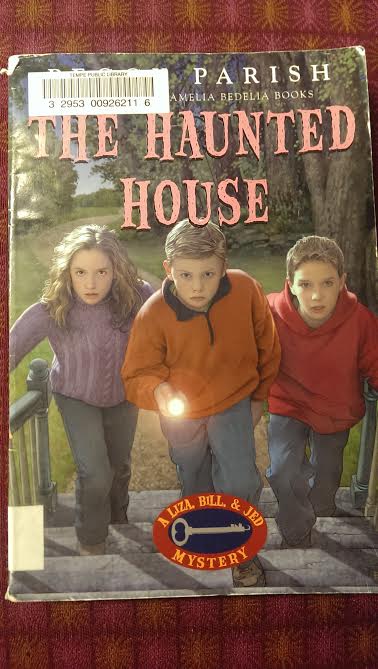
The Haunted House

hauntedhouseThe Haunted House by Peggy Parish, 1971.

The Roberts family is moving to a different house across town because they want a bigger place to live. Liza, Bill, and Jed are not very happy about moving, at least at first, because they will be farther away from their friends, especially Jimmy and Mary, who have been their best friends and next door neighbors. Liza is also worried because the house they will be living in is the old Blake house, which is rumored to be haunted. A couple of past caretakers have left because they claimed to hear ghostly noises.  The boys tease her about it, and their father insists that there is no such thing as ghosts.

The house is definitely much bigger than their old one, and there is a barn, a garden, and a large wooded area on the property. When they actually move in, the kids become fascinated with the old things in the attic, which the children are allowed to go through.  The kids also plan to start building a tree house.  The boys become excited about the house, but Liza is still nervous about the ghost stories.

Then, strange notes and coded messages appear for the children, starting with a note taped to Liza’s window in the middle of the night. Little presents are left for them in a hollow tree with promises of bigger surprises later. Who is sending these messages? Could it be the ghost?

Like other books in this series, there are coded messages and word games that the readers can solve alongside the children.  Some of them are easily recognizable, like word scrambles and Pig Latin, and others are a little harder.  The kids walk readers through their solutions, but readers can attempt the puzzles on their own first.

The book is available to borrow and read for free online through Internet Archive.

Mystery at Camp Triumph

camptriumphMystery at Camp Triumph by Mary Blount Christian, 1986.

A year ago, sixteen-year-old Angie was blinded in a car accident.  It was shocking and devastating for her, especially since she was planning to become an artist.  She loved painting, and she feels like all of her dreams have died since she became blind.  Many of her friends no longer speak to her (partly because she has become angry and bitter and they don’t know how to cope with it), and she refuses to return to her old school, partly because of her fears of not being able to cope and largely because she doesn’t want to be the subject of ridicule or pity because of her new disability.  Her mother has been tutoring her at home, and her parents argue frequently about what’s best for her.

On the advice of a psychologist who has been trying to help Angie during her difficult adjustment, Angie’s parents have decided to send her to a special camp for children with disabilities called Camp Triumph.  Angie makes it plain that doesn’t want to go.  She feels that going to the camp with other disabled kids will just a painful reminder that she’s no longer “normal”, and she can’t imagine that there will be anything fun that she can do at a camp now that she can no longer see.  She knows that she’ll never be able to paint again, so she thinks arts and crafts are out, and how can she possibly ride a horse or go on nature walks?  However, her parents are firm with her, telling her that this is for the best.  There are things Angie needs to learn that they can teach her at camp.

Angie’s first days at the camp are miserable.  The other campers try to make friends with her, although she tries their patience with her bitterness and complaining that she doesn’t want to be there.  Then, someone messes with the guide ropes put up to help the blind children find their way around, sending a frightened Angie plunging into the river on her way back to her cabin.  Although she isn’t hurt, she becomes convinced that the camp is dangerous.  Everyone else thinks it was just a mean-spirited prank by one of the other campers.

Then, while visiting the doctor in town, Angie overhears a conversation between people she whose voices she doesn’t recognize, learning that what happened to her wasn’t just a prank.  Someone is deliberately committing acts of vandalism and sabotage at the camp, trying to get it shut down.  But why?   Angie flees the scene when she realizes that the people who were talking have heard her.  Unfortunately, she drops her cane as she flees.  Her cane has her name and address on it, and Angie later finds it lying on her bed in her cabin at camp.  Whoever these mysterious people are, they know who she is and can find her at any time.  Can Angie convince the other campers of what she heard and find the culprits before something worse happens?

Angie is terrified as she tries to solve the mystery, feeling helpless against her unknown enemies, who can see her while she can’t see them.  But, with the help of her new friends at camp, she comes to realize that she isn’t as helpless as she thinks she is.  Her experiences give her a new perspective on her life.  It’s true that things will never go back to being as they were.  Her life won’t be an easy one, and there are certain things that she can no longer do.  But, she comes to realize that there are still many things she can do, and there are other types of art that are still open to her.  In the end, Angie has friends she can count on, a life that’s worth living, and a better future ahead of her than she thinks.

Along with the story, the book describes some of the techniques that Angie has to learn to cope with her blindness: picturing a “clock” to remember the positions of objects around her (ex. “Your suitcase is at two o’clock.”), following the guide ropes with notches in them to know which path she’s on, listening for clues about her surroundings (she and other blind people recognize the sound of clinking from the flagpole at the center of camp and use that to orient themselves when things get confusing), putting notches in the tags of her clothes so that she knows which pieces of clothing match, using her sense of touch to make clay sculptures, etc.

Besides addressing Angie’s feelings and how she copes with them, the story also touches on how disabilities affect the people who are close to the disabled person.  At first, Angie’s parents don’t know how to help her, struggling themselves with coming to terms with what’s happened.  Her mother feels guilty because she was driving the car when they had their accident, and she wasn’t as badly hurt.  Her guilt leads her to baby Angie more than is good for her.  Angie’s father is a stern businessman with high ambitions, failing at first to understand and accept Angie’s feelings and the way her life has changed, reacting with impatience while Angie struggles.  Angie’s parents also had marital problems before the accident, which only added to the tension between them.  In the end, coming to terms with what has happened to Angie not only helps Angie to improve but helps her parents to improve their relationship with each other.

The book is currently available online through Internet Archive.

Baby-Sitting Is a Dangerous Job

Baby-Sitting Is a Dangerous Job by Willo Davis Roberts, 1987.

Thirteen-year-old Darcy knows that babysitting the Foster kids isn’t going to be easy. Jeremy, Melissa, and Shana Foster are young children and rather spoiled. Their parents are wealthy, but they don’t spend much time with their children. When Darcy babysits them, the children go off in different directions and do things they know they aren’t supposed to do.

On top of that, Darcy is worried that someone will figure out that she and her friend Irene have been helping to hide their friend Diana, who ran away from home because her father was beating her. Diana is afraid to go to the police because her sister tried to tell them about their father’s abusive behavior, and no one believed her. She thinks that the police will just take her home and her father will beat her again.

One day, while Darcy is babysitting the Foster kids, some men break into the house and kidnap them all for ransom. Darcy feels guilty for not preventing the kidnapping, but she’s determined to make sure that she and the kids make it home safely to their parents.  When the kidnappers make a slip that allows Darcy to discover their true identity, she must come up with a daring plan to save herself and the children, who turn out to be surprisingly resourceful themselves.

The book is available to borrow and read for free online through Internet Archive.

My Reaction

I enjoyed this book! The Foster kids start out being nightmares to babysit because they’re badly behaved, but Darcy can tell that their bad behavior is because they’re neglected. They act out for attention and because their parents haven’t paid enough attention to them to teach them about boundaries and how to behave. On the outside, it might seem like the Foster kids are fortunate because their family has money, but when Darcy starts babysitting for them, she can see that their lives aren’t really as great as they seem. However, the kids do turn out to be clever and resourceful, and they really help Darcy when they’re all in danger.

There is an element of mystery to the story about who has kidnapped the children. Part of what makes their situation dangerous is that Darcy actually knows their kidnappers, and when they realize that she has recognized them, Darcy fears that they will try to eliminate her and possibly the young children, to avoid being identified to the police.