The Pet Day Mystery

This book is part of the Sherlock Street Detectives series.

It’s Pet Day at school, and twins Walter and Ann are bringing their dog, Watson, and their cat, Fuzz Face to school with them. Watson is really Walter’s dog, and Fuzz Face is Ann’s cat. The school bus is chaotic and noisy because the other children have their pets with them, too.

At school, each of the kids tells the rest of the class about their pet. When it’s time to go to lunch, the kids give their pets food and water and leave them in the classroom.

When they come back from lunch, a pair of hamsters are missing, and their owner, Tina, thinks that Fuzz Face might have eaten them. Ann points out that Fuzz Face couldn’t have eaten the hamsters because Fuzz Face was in his cage during lunch.

The kids figure that the hamsters are probably hiding somewhere in the room, and they ask Tina to tell them everything she knows about the hamsters so they can find them. They use what Tina tells them about the habits of hamsters to figure out where they are.

The book is available to borrow and read for free online through Internet Archive.

It’s a fun picture book mystery, but it’s also educational, like other books in the series. The information the kids give about their pets is true. Some of them say where their pets originally came from, like Pedro, who says that his pet parrot is a breed that comes from South America. Ann mentions that her cat takes vitamins and has to go to the vet sometimes, like people have to visit their own doctors. I liked how the characters use facts about the behavior of hamsters to figure out where the hamsters went.

I was a kid about the age of the characters at the time this book was published, although I don’t remember reading this book at the time. When I was in kindergarten, the year before the book was published, we had a special pet event in my class, but we didn’t do it like the class in this book. As I recall, different people brought in pets on different days so it was less chaotic and there was no chance of one pet eating another, which is a real risk. Also, all pets had to be in cages to keep them from running away or causing trouble, and they were never left unattended. My mother helped me bring our pet birds to class, and she took them home with her immediately afterward, so they weren’t left sitting around the classroom.

The book has a vocabulary list and glossary in the back.

The Mystery of the Missing Scarf

This book is part of the Sherlock Street Detectives series.

Ann doesn’t have much confidence in her twin brother Walter’s dog Watson. She doesn’t think that he’s capable of learning tricks, and when Walter shows her the new trick he’s taught Watson, she isn’t very impressed. The trick is for Watson to just grab a red rag out of Walter’s hand and run off with it.

Ann is more concerned with getting her scarf washed and hung out to dry before they go see their friends. David and Pedro like Watson’s trick. At least, it’s a pretty good trick for Watson because Watson doesn’t know many.

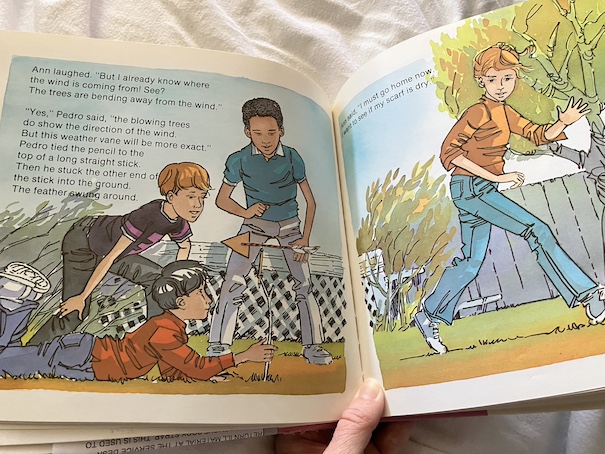
Pedro shows the other kids how he’s making a weather vane. It’s a windy day, so it’s a good time to try it out.

Then, Ann notices that the scarf she hung out to dry is gone! At first, she blames Watson for taking it as part of the trick Walter taught him. However, the dog is not at fault. Pedro uses his weather vane to show Ann how to find her scarf.

The book is available to borrow and read for free online through Internet Archive.

It’s a fun picture book mystery, but it’s also educational. I liked the part where Pedro explains how he made his weather vane. Kids can follow along with his explanation to make a weather vane of their own. The mystery of what happened to the scarf isn’t difficult, but the way the children found the scarf was clever. The book also has a vocabulary list and glossary in the back.

The North Pole Mystery

This book is part of the Sherlock Street Detectives series.

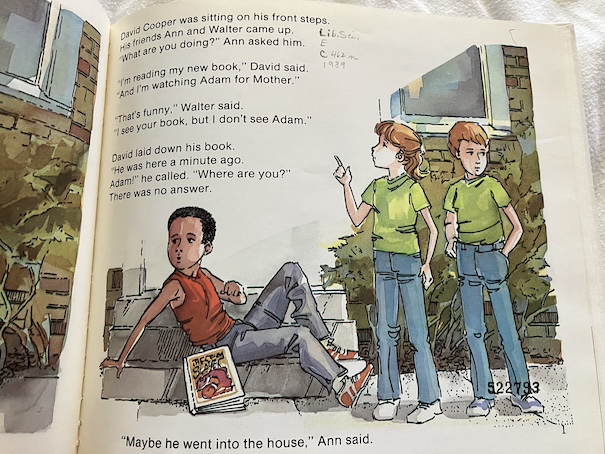
David is supposed to be watching his younger brother, Adam, while his mother is gone, but he gets absorbed in his new book. When David’s friends come to see him, they realize that Adam is missing!

The kids look for Adam everywhere, but they can’t find him. David is very worried.

Walter tries to use his dog, Watson, to track down Adam, but Watson hasn’t been trained to track people. When that doesn’t work, Walter tries writing down everything David can remember about Adam’s disappearance, but because David was reading instead of watching, he can’t remember much.

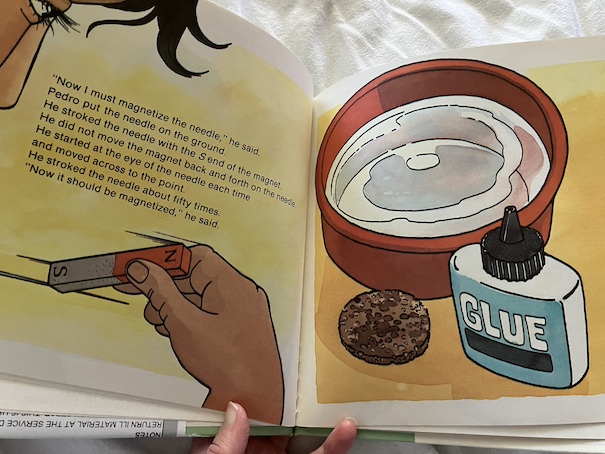
One thing that David remembers is that Adam wanted to go for a walk. David didn’t want to go, so he let Adam play with his compass instead. David explained to Adam that a compass always points toward the North Pole, and that fascinated Adam because the North Pole is where Santa Claus lives. The kids realize that Adam still has the compass, so he is probably using it to go north and find Santa!

What they need to do is go north themselves to find Adam, but they don’t have another compass. What can they do?

The book is available to borrow and read for free online through Internet Archive.

It’s a fun picture book mystery, but it’s also educational. The books in this series use scientific concepts to explain the mysteries or to help solve problems. This book explains how a compass works, and to find Adam, the kids have to create a compass of their own.

There is also a vocabulary list and glossary in the back of the book.

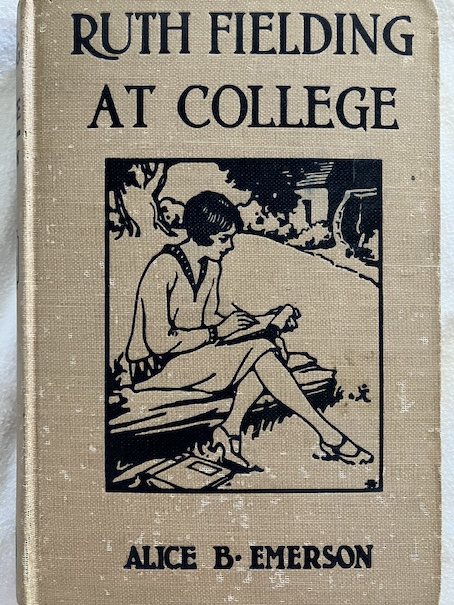
Ruth Fielding at College

Ruth Fielding

Ruth Fielding and her friends have graduated from their boarding schools, and now, they’re headed off to college! Ruth and her best friend, Helen, will be attending Ardmore, a college for young women only. Helen’s twin brother, Tom, will be going to Harvard. When they were at boarding school, they also attended girls’ only and boys’ only schools, but their schools were located near each other, and they were able to visit each other on weekends and attend joint social events held between the schools. Helen and Tom are close as twins, and Helen worries that she won’t be able to see her brother as often while they’re in college. Tom and Ruth are also fond of each other, and although they’re excited about college, they’re also a little sad at the idea of being apart.

While they’re having tea with Aunt Alvirah (the housekeeper), the hired hand working for Ruth’s Uncle Jabez, Ben, comes in and says that there is a boat adrift on the river that runs by the mill where they live. Everyone goes outside to have a look at the boat. At first, they think no one is in it, and Uncle Jabez says, if it’s abandoned, then he will go after it as salvage. Then, they see that someone is in it after all, just lying down in the bottom of the boat, but the boat is drifting toward the dangerous rapids below the mill! Whoever is in the boat seems incapacitated or unaware of their dangerous situation.

Uncle Jabez is less eager to go after the boat when he knows there’s somebody in it than he was when he thought he could get a free boat, but Ruth persuades him that they have to rescue whoever is in the boat. They manage to reach the boat, and they find an unconscious girl in it. They bring the girl back to the house with them, and Tom says that he will get a doctor. However, Aunt Alvirah doesn’t think that a doctor will be necessary because it looks like she has only fainted, and she thinks that the girl will be all right.

When the girl wakes up, she explains that her name is Maggie and that she was working at Mr. Bender’s camp for summer vacationers up the river. After the season ended, the vacationers left, and Mr. Bender paid her for her time at the camp, someone was supposed to give her a ride across the river with her luggage, but Maggie fell asleep while she was waiting in the boat. When she woke up, she was drifting down the river alone. She got scared, and she fainted. Ruth says, if her job is over, then she has no reason to return to Mr. Bender’s camp, and Maggie says that’s true and that she needs to find another job. Ruth says they can use their telephone to call Mr. Bender’s camp to explain the situation and reassure Mr. Bender that Maggie is all right.

Ruth likes Maggie, and she notices, from the way she talks, that she seems more refined than most poor working girls. Aunt Alvirah is getting older, and she often has trouble with her rheumatism. Ruth suggests to Uncle Jabez that they hire Maggie to help Aunt Alvirah at the mill this winter while Ruth is away at college. Uncle Jabez is still a miser and he grumps about Ruth spending his money. Ruth has money of her own now, and she is willing to pay Maggie’s wages, although she says that Uncle Jabez must make sure that Maggie has good food because she looks undernourished. Ruth and Uncle Jabez often butt heads over the issues of money and Ruth’s education because Uncle Jabez never had much education and is both proud of the money he has now and is tight-fisted with what he has. At this point, the story explains some of the history of the characters. Since Ruth retrieved a stolen necklace for the aunt of one of her school friends and received a reward for it (in Ruth Fielding and the Gypsies), Ruth has had enough money to be financially independent of her uncle and to fund her education. She is also correct about Aunt Alvirah’s age and health, and she is concerned for the older woman’s future.

Aunt Alvirah welcomes the idea of help at the mill, and Maggie accepts the position. Ruth notices that Maggie studies an Ardmore yearbook, and she is surprised that Maggie is interested in the school. She has the feeling that there is more to Maggie’s past than she knows.

When Ruth and Helen go to Ardmore, some of the girls have already heard about Ruth’s reputation as a writer of movie scenarios from the movie that Ruth wrote and her classmates helped make to raise funds to replace a dormitory that burned at their school. Some of them are prepared to despise Ruth as being stuck up about her writing, although some who saw the moving picture liked it.

A girl named Edith thinks that they’ll have to “take her down a peg or two” as soon as she arrives. One of the other girls, Dora, reminds the others about the rules against hazing at the school. The rules have been strictly enforced since a hazing incident went too far last year and traumatized a student, Margaret Rolff, who was trying to join the Kappa Alpha sorority. Since that incident, the college has forbidden sororities to initiate freshmen or sophomore students as members and cracked down on hazing rituals. Edith, a sophomore, thinks that’s a shame because the sororities are fun, while May sarcastically remarks about how fun “half-murdering innocents” is. The students aren’t really supposed to talk about what happened to Margaret, although the sophomores don’t see why not because everybody who was at the school when it happened knows about the incident.

Margaret’s nerves were apparently shattered by the incident, and a valuable silver vase, an ancient Egyptian artifact, disappeared from the college library the same night. It isn’t entirely clear what the Kappa Alpha sorority told Margaret to do, specifically, but it seems that Margaret’s initiation task involved both taking the vase from the library and going to nearby Bliss Island alone at night. She was found there the next day in a terrible state. Nobody is sure what happened to the vase, and Margaret was apparently unable to explain it. She left the school soon after, and nobody knows where she is now. The vase might have been stolen by somebody else that night, or it might have somehow been lost in the confusion of the initiation stunt that went wrong. Because the Kappa Alpha sorority was responsible for telling Margaret to commit a theft from the school (or, at least, borrow a rare and valuable object without permission), they are raising money to replace the vase. The students’ opinions about the incident waver back and forth between thinking that Margaret was a naturally nervous and delicate person to be so dramatically affected by the incident to thinking that maybe she faked her trauma as an excuse to get away with the theft herself.

When the other girls start discussing Ruth Fielding again and how grand she must think herself, being involved with the movie industry, a plump girl who is listening to them starts laughing, but she refuses to tell the other girls why. Then, a wealthy-looking girl with a lot of fancy luggage arrives at the school, brought by a chauffeur. Her luggage is stamped with European labels and has the initials “R. F.” on it, so the other girls assume that this must be the overly-grand Ruth Fielding. The plump girl struggles not to laugh as she watches their reactions because she knows Ruth and knows that this girl is someone else.

Meanwhile, Ruth and Helen have traveled to the school by train and are coming from the train station by bus. They arrive at their college dormitory, Dare Hall, just in time to see the other girls giving “R. F.” a hard time because of her fancy luggage. When Edith addresses “R. F.” as “Miss Fielding”, “R. F.” corrects her in front of the other girls, telling her that her real name is Rebecca Frayne. The plump girl, Jennie Stone, laughs at Edith’s presumptuous mistake and greets the real Ruth Fielding and Helen.

Jennie Stone was one of their fellow students at their boarding school, Briarwood Hall, in upstate New York. She was affectionately known as “Heavy” because she’s always been “plump” (or, as the book sometimes calls her, “fleshy”). Ruth and Helen are surprised to see Jennie at Ardmore because they thought that she was lacking some credits to go to college, but Jennie says that she made up those credits, and she wanted to go to college because she really had nothing to do after graduating from Briarwood but eat and sleep and put on more weight. There is some joking about Jennie’s weight, and Helen gives her a teasing pinch, but Jennie reminds her that she has feelings, too. People in Jennie’s family are naturally big, but she is determined that, as part of her college experience, she will lose weight. She wants to keep busy and reform her diet. The mathematics instructor at Ardmore has been advising her about her eating habits, urging her to eat more vegetables. The teacher seems to be hard on Jennie on the point of her weight, but the teacher openly tells her that’s only because she cares about Jennie. She knows that Jennie will want to make friends in college, and she won’t want to get a reputation as the heaviest girl in her class. It’s hard on Jennie, but she appreciates the teacher’s advice and the fact that she cares.

The mathematics teacher, Miss Cullam, also privately confides in the girls that she’s worried about the incident that happened on campus last year. She has some suspicions about the older classes of girls, although she can’t really prove anything against them. Few other people know this, but Miss Cullam admits that she had hidden some papers for last year’s mathematics exam inside the vase that disappeared from the library. It was an impulsive move and only meant to be temporary hiding place for them, but when she tried to get the papers out of the vase, she couldn’t because they were stuck. She went to get some tongs to retrieve them, but by the time she returned to the library, the vase was gone. At exam time, several students that she had not expected to pass her class did unexpectedly well on their final exam. She can’t prove that they got hold of the papers from the vase, and she hates to think that any of her students would cheat, but she still suspects they did. It bothers her that she doesn’t know for sure that they didn’t. Although the vase had value itself, the mathematics teacher’s story raises the possibility that someone knew that the exam papers were in the vase and that was the motive for the theft.

Ruth, Helen, and Jennie talk about the politics between the freshmen, sophomores, and upperclassmen in college. Edith seems undeterred by her earlier mistake and still gives Ruth a hard time about her writing and budding movie career. It doesn’t entirely surprise Ruth that people would give her a hard time because she is a noticeable figure among the freshmen, and having been to boarding school, she knows how things typically work among cliques and class levels at school. Although some of what Edith says embarrasses her and hurts her feelings, she knows that it’s best not to make too much fuss about the things people say, and just wait for it to blow over. It helps that Helen and Jennie stand by her and stand up to the other girls on her behalf. Ruth is somewhat reassured that hazing is forbidden at Ardmore, so she expects that little will happen other than occasional mean comments.

Although hazing is forbidden on campus, the college does allow the upperclassmen some privileges over the underclassmen. They do it with a purpose in mind, using it as a tool to get the freshmen to bond with each other and solidify their class leadership. Few freshmen pay attention to the elections for class president until the seniors put up notices to tell the freshmen that they must all wear baby blue tams (hats), that no other colors will be allowed, and that the freshmen only have three days to comply. The freshmen aren’t sure what the upperclassmen will do if they don’t comply, and some of them are resentful about the upperclassmen commanding them to buy new hats. Helen, like some of the others, initially thinks they should just ignore the command and not bother, showing the upperclassmen that they won’t be bossed around, but Ruth decides that she would rather buy and wear one of the tams because she doesn’t want to draw unnecessary attention to herself and maybe more resentment from the older girls on campus. When they go shopping in town, they see that every shop is selling baby blue tams, and one shop keeper (described as a “Hebrew” for no real apparent reason and having an accent that seems to indicate that he’s an immigrant) comments that blue is their class color, which gives the girls a clue that this is an organized campus tradition or stunt with the support of the local businesses. Because those tams are everywhere in town and other freshmen are buying them, even most of the reluctant freshmen end up with one of those hats. After that, the freshmen realize that they need to get serious about organizing their class leadership so the upperclassmen won’t be dictating everything to them.

There is one hold-out among the freshmen who doesn’t buy one of the tams, and that’s Rebecca Frayne. She just keeps wearing the same tam she was wearing when she arrived at school. When the three days are up, and Rebecca still doesn’t have a baby blue tam, the upperclassmen start boycotting her. If she comes to class in her usual tam, they all get up and walk out. They even walk out on meals when they see her. This seems like more of a punishment for the upperclassmen, who have to leave without finishing their meal, than it is a punishment for Rebecca, and someone does point that out.

(I see what the students say about these traditions being bonding experiences, but I really don’t have any respect for these catty and manipulative tactics because it looks dumb, and I think it just disrupts class for everyone to have so many students walking out. I think my college professors would have counted them as absent if they walked out of class over a dumb hat because student social activities need cannot impact the education they are supposedly here to receive and have no place in the classroom. Whatever they do needs to be done on their own time, not on the teacher’s or the class’s time. Actually, I did have a professor who used to award extra points to students who showed up on days when class attendance was low due to bad weather or people ditching class for sporting events. He would have us take notes or a short quiz and write a special phrase at the top of the paper as a sign that we were there that day when others weren’t, like “Rainy Day Faithful” or “Sports Day Faithful.” I kind of wanted to see the instructors in the story do something similar. On the other hand, if they self-punish themselves by sending themselves away from the dinner table, I’m inclined to think it’s deserved. I’d be inclined to let them do that until they get hungry enough to stop. It’s a rare example of a problem that will eventually solve itself.)

However, Rebecca’s apparent defiance of the social order even gets on the nerves of her fellow freshmen. The others have come to appreciate the bonding experience of buying the matching hats and solidifying their support of their own class leadership. It was a ridiculous and high-handed order from the upperclassmen, but ultimately, a fun and harmless one, a reason for a short shopping trip, and only a minor expense that supports local businesses. The other freshmen don’t understand why Rebecca isn’t joining in with them in class solidarity. Rebecca doesn’t mix much with the other students, and the others think that she doesn’t want to be friends, although Ruth can see that the boycotting she’s suffering is hurtful to her.

However, there may be another explanation for Rebecca’s behavior besides defiance or stand-offishness. Ruth begins to realize that Rebecca not only always wears the same hat but that she’s only ever seen Rebecca wear the same three outfits, over and over. They’re good quality clothes, but it’s odd that she never seems to wear anything else. Although they all saw Rebecca arrive at college with a lot of luggage, more than the other students had, she either doesn’t seem to have many clothes or never wears the other clothes she brought. From the way she arrived and the amount of luggage she had, everyone expected that Rebecca would be the wealthy fashionista of their class, but that hasn’t been the case. Is Rebecca not as wealthy as they thought, and could her choice to not buy a blue hat be because she can’t afford one? But, if her luggage wasn’t full of fashionable clothing, what was really in her large trunk? Ruth becomes concerned about her and tries to figure out what’s really going on with Rebecca.

Meanwhile, Ruth, Helen, and Jennie have been exploring the area around the college. One day, the three of them go to Bliss Island to have a look around. Jennie is hoping that hiking around the island will help her in her quest to lose weight. While they’re exploring, Ruth thinks that she sees someone else on the island. She doesn’t get a good look at this other person, but she thinks it looks a lot like Maggie. Helen thinks that she must be wrong because Maggie is supposed to be helping Aunt Alvirah back at the mill. Later, Ruth sees a light on the island at night and realizes that someone must be camping there.

When Helen and Ruth go to investigate who is camping on the island, Ruth expects to find Maggie. Instead, they find a strange girl who seems to bear a resemblance to Maggie. This other girl seems suspicious and doesn’t want to explain much about herself. What is she doing on the island, and does it have anything to do with what happened on Bliss Island during the hazing incident?

The book is in the public domain and is available to read for free online through Project Gutenberg.

In a way, this story is what I had hoped that Ruth’s first adventures at boarding school in Ruth Fielding at Briarwood Hall would be like. It doesn’t have any spooky stories, but there is an unresolved mystery involving the initiation rituals of a campus sorority, the theft of a valuable object, and a possible cheating scandal. There also also mysteries about the behavior of other students and girls Ruth knows. At first, I thought there might be a connection between all of these things, but the mysteries aren’t call connected.

Ruth is correct that Rebecca isn’t as rich as she looked at first. When Ruth speaks to Rebecca privately, Rebecca explains that her family was once wealthy, and they still live in the biggest house in their small town, but the family’s fortunes have diminished over the years. Her aunt, who takes care of her, thinks it’s important to keep up appearances, which is why she has a few nice clothes but not many. The family has to make real sacrifices to keep up the pretense that they have more money than they really have, and Rebecca arrived at college thinking that she would have to make an impression on the others at the beginning that she came from money so they wouldn’t think that she didn’t belong.

Ruth explains to her that college isn’t really like that. Not everyone at college has much money, and many other girls get part time jobs, like waitress, to pay for their education. Belonging at college comes from participating in activities with everyone else, and Rebecca is pushing other students and potential friends away by not joining in the traditions of the college. Personally, I thought the other students were being too militant about this silly hat thing. I get how people can bond over shared traditions and how school traditions and spirit events are meant to be bonding experiences, but I just think that they went overboard, making too much of a big deal about this one student, with only Ruth thinking to actually talk to her and find out what’s going on with her. It does beg the question of whether the students are really focusing on this as some kind of school initiation/bonding ritual for the fun of it or because the older students are on a power trip and trying to exert control and be exclusive. In a lot of ways, I share Olivia Sharp’s feelings about exclusive clubs and initiation rituals from The Green Toenails Gang. It’s one thing if a club has a particular purpose, but being pointlessly exclusive is something else. This is something that Ruth actually addresses with the upperclassmen later, which was a relief.

However, even though Ruth is sympathetic to Rebecca, Ruth points out to Rebecca that her resistance to participation with the other students is causing problems in her relationships with others. When she doesn’t do what everyone else is doing, she isn’t sharing in their experiences and doesn’t bond with them. That’s when Rebecca says she really can’t afford to buy one of the blue tams, and her aunt would never allow her to take a part time job because that would ruin the pretenses the family tries to maintain about their actual money troubles. Ruth thinks the Frayne family pretenses are as silly as I thought the students’ militant hat ritual was, but she can see that a more creative approach is necessary to solve Ruth’s problem. Rebecca knows how to crochet, so Ruth suggests that she crochet a tam for herself in the baby blue color of their class because that would be cheaper than buying a tam. This will allow Rebecca to participate in this campus ritual and tradition but on her own terms and within her budget.

Then, Ruth quietly has a word with some of the senior students and freshman students about Rebecca’s situation to keep them from harassing Rebecca further while she’s working on her new tam and so they won’t give her a hard time about anything related to money. She even stands up to the seniors and tells them that, if their enforcement of the tam rules was for the sake of campus tradition and creating a memorable bonding experience among the students, they should have compassion for Rebecca and her situation, but if it was only to bully and exert power over the younger students, she will tell the other freshmen that’s the case, the freshmen will completely rebel, and everyone will stop wearing the hats or doing anything else the seniors say to do. If the upperclassmen continue to insist on leaving the dining hall in the face of their disobedience, the freshmen will make sure that the upperclassmen don’t eat on campus for the rest of the year. The seniors understand the situation, appreciate Ruth standing up for her classmate, and like her spirit, so they finally lay off their boycott of Rebecca.

Ruth also helps Rebecca solve her money problems when she realizes that Rebecca has brought something with her to college that is worth real money. Rebecca’s trunks were from the attic of her house, and she brought them just to create the illusion that she had more money and belongings than she really does, but she hasn’t appreciated the value of what they contain. Rebecca has many lessons to learn about the real value of many things. The contents of the trunk seemed a little anti-climactic at first because I had initially thought the story was building up the idea that she might be carrying something more suspicious, maybe something illegal or a smuggled person, but I liked the theme that Rebecca and her family know more about the superficial look of things rather than their true value.

The mystery of Rebecca and her behavior is an interesting side plot that adds dimension to the main plot and mystery, which concerns campus politics and initiation rituals and what happens when they go too far. Most of the rest of the plot and mysterious happenings centers around what happened to Margaret and the vase. In some ways, the solution to that problem turns out to be disappointingly simple. Margaret was a very nervous person who, although academically bright, was too easily influenced by other people and unable to stand up for herself. When Margaret got nervous and messed up the initiation ritual, she didn’t know how to explain herself and fix things. The situation does get resolved, and Margaret is fine. (You might have even guessed where she is through most of the story.)

However, I thought the story did a good job of demonstrating how social initiation rituals and school stunts can get out of hand when closed societies don’t consider how the things they do or ask others to do affect other people. The sorority didn’t really know Margaret as a person before they set her a task that was more difficult for her to do than it might have been for someone else, and Margaret was too timid, nervous, and anxious to be accepted by others to explain how she really felt about it or refuse to do it. This is part of the reason why the school later forbids the sororities from initiating freshmen and sophomores, so the younger students have time to get to know the campus and its groups, develop some confidence, and understand what’s acceptable for a group to ask and what isn’t. Having the sororities only recruit upperclassmen also gives them time to get to know prospective members and set appropriate tasks for people who know their own limits and when the groups are asking too much. The task should also not have involved taking a valuable object that didn’t belong to the sorority and putting it in a position where it could be lost. That is the Kappa Alpha sorority’s fault for setting a task that really wasn’t appropriate under any circumstances.

I liked the multiple mysteries of the story, the ones that connected to each other and the ones that were more stand-alone. There’s also a brief subplot where some of Ruth’s friends fake a haunting to get a relative of a faculty member to move out of her room in their dormitory so they can use the space. Before she came, that room was being used as a public sitting-room for the students, and they resent her taking it. The students involved in the plot don’t tell Ruth what they’re doing or ask her to join them, but they explain it to her when they’ve accomplished their goal. I appreciated that the plot was subtle, just making subtle noises at night using a rocking chair.

Up to this point in the series, Ruth Fielding and her friends were teenagers at boarding school. Now, they’re becoming young women and young men in college. I liked how aspects of their college life resemble their experiences at boarding school, but the characters show that they are now more experienced. The things that happen with the social politics on campus build on the girls’ earlier boarding school experiences, but they are now more aware of the dynamics of these situations and how to deal with them. There are some times when it’s better to go along with the group for the sake of building friendships, but there are also sometimes when they have to stand up for themselves and others and tell the groups on campus that they’ve gone too far. There are times when it’s better to take some teasing and let it go, and there are times when teasing and enforcement of group conformity goes too far, and someone needs to be told to stop and go easier on someone. They still have things to learn, but it was nice to see their development and the use of things they have already learned. Students like Rebecca and Margaret suffer more at college at first because they are more new to the large school environment, and they don’t understand what others expect from them or when and how to stand up for themselves. They need some help from compassionate, experienced students to find their way.

Readers also see main characters are continuing to build their future lives and develop as people. Ruth has already started her writing career, and through the story, we are told that she is still working on a play she’s writing, and she and her friends also take part in the filming of another movie during a school break. Ruth is planning to go further in her writing and movie career, and she is serious about using her education to develop her career.

We don’t know as much about what Helen and Jennie are planning for their futures. Helen’s family is wealthy, so she technically doesn’t need a career, but she is a serious student. Jennie’s trait of being overweight, something which has helped to define her character through the series is interesting in this story both because Jennie stands up for herself and emphasizes that she has feelings and so more than just a fat person to be made fun of, and she’s also decided that she wants to change her image. While her teacher urges her to eat healthier, Jennie also starts joining in the sports on campus. At first, it’s difficult for her, but she gradually becomes stronger and more athletic, and she enjoys it. College is a time for people to experiment with their lives, habits, and self-image, and Jennie specifically wanted to go to college for that reason as part of her personal development.

I didn’t like the repeated references to Jennie as “plump” or “fleshy.” I did like seeing her try new activities to change her appearance and develop different sides of her personality, but the older Stratemeyer Syndicate books do have this odd focus on describing characters’ weight. Heroines are usually described as “slim” or “slender”, pleasant sidekicks are “plump”, and villains and unpleasant characters are actually fat. These designations appear repeatedly in various Stratemeyer Syndicate series, although I think they finally stopped doing it after people raised public awareness about fat shaming. In Jennie’s case, I minded it less than I’ve minded the weight references less than I’ve minded it in other books because she does remind people of her feelings and because her decision to try to improve her weight situation was her own decision rather than one she was bullied into making and is an extension of her trying new activities, experimenting with her self-image, and the college experience of personal development. Jennie was at a point in her life where she felt the need for a change, so she’s just going for it.

At this point, I want to remind readers that characters who develop and change are rare in Stratemeyer Syndicate books, at least the ones that most people remember from their childhoods, because in the series that are still in print, the characters’ ages are frozen.

I’ve pointed this out before, but one of the hallmarks of most of the classic Stratemeyer Syndicate books that most people remember reading when they were growing up is that the characters never age. In series like Nancy Drew and the Hardy Boys, they’re always in their late teens or early twenties, and their exact age often isn’t specified. Readers just know that they’re old enough to be traveling around and doing things without adult supervision, sort of like the characters in the Scooby-Doo cartoons. Also, like Scooby-Doo cartoons, the series get redone about every decade or so to update technology, slang, and world circumstances so that the books take place roughly around the time when they were written. (For example, you won’t find any Cold War references in books written after the 1990s, and existing books for series that were still in print were rewritten and reissued in the mid-20th century, around the time of the Civil Rights Movement, to remove unacceptable racial terms and stereotypes.)

However, it’s worth reminding readers that this wasn’t always true of Stratemeyer Syndicate books. The oldest series produced by the Stratemeyer Syndicate are often unknown or forgotten by modern readers because the characters did age. As the series ran their course, characters grew up, graduated from school, married, and became parents themselves. When Stratemeyer Syndicate characters got too old to be teen detectives or young adventurers, the Stratemeyer Syndicate would simply stop producing their series and start a new one, often with characters who were somewhat similar to characters in previous series but not exactly the same, so they could continue writing series with similar themes and a similar feel, but also a little different. Ruth Fielding is one of those forgotten characters because she did age, and her series ended around the time that the first Nancy Drew books were published. Nancy Drew was meant to be the next generation series to Ruth Fielding, a similar character who has investigates mysteries and has adventures with her friends, but by that point, the Stratemeyer Syndicate realized that, if they never let Nancy age, they would never have to end her series or replace her with anyone else. This is the reason why 21st century readers know who Nancy Drew is, but not many people know Ruth Fielding.

Also, because Ruth Fielding books weren’t being produced during the mid-20th century, when existing Stratemeyer Syndicate books were being revamped and modernized, the Ruth Fielding books were not modernized. The movie industry, which becomes increasingly prominent in the books, makes silent movies because the stories are set in the 1910s. There are some racial terms in books, while not being deliberately insulting, also don’t sound right because they’re not polite by modern standards. It did throw me a bit when the book referred to a shopkeeper as being “Hebrew.” I think I might have heard this before in relation to Jewish people (I can’t remember where right now, although I think it might have been an older book as well), but not often. Using the word “Hebrew” in this way is acceptable in some languages, but not in modern English, and it is considered a derogatory reference by modern standards. It took me out of the story temporarily when I got to that part because I had to stop and think it over. I came to the conclusion that the kind of person who would use “Hebrew” instead of “Jewish” to describe a Jewish person sounds like someone whose primary knowledge of Jewish people comes from reading the Old Testament rather than talking to them in life. Then, after I considered that, I had to stop and consider how Ruth Fielding could know that the shopkeeper was Jewish without even knowing his name or him saying anything about it. I suppose it might have been his general look, but that’s not always reliable. More importantly, it’s a case of the author telling us something as if it makes a difference to the character or the scene when it doesn’t. This goes absolutely nowhere. Ruth has never seen this shopkeeper before because she’s new in town, and we never see him again. This is why writers are discouraged from bringing up people’s racial or ethnic backgrounds unnecessarily because it sounds like they’re trying to make a point about something when there’s no point. This is also why I don’t mind rewrites of books that include outdated or unacceptable racial terms because I read them as a distraction that actually takes away from the story. I suppose, from a scholarly viewpoint, it’s kind of informative about the way people spoke in the past, but from the point of view of someone just trying to enjoy the story, it acts like a speed bump that shakes the reader out of it.

I don’t think the Nancy Drew or Hardy Boys books ever connect the characters with any world events with known dates because that would also mark the characters’ ages relative to events and make it obvious that they don’t age over time, but the Ruth Fielding books do connect to world events, and we’re almost to the point in the series when the characters become directly in World War I. I’ll have more to say about that when we reach that point in the series.

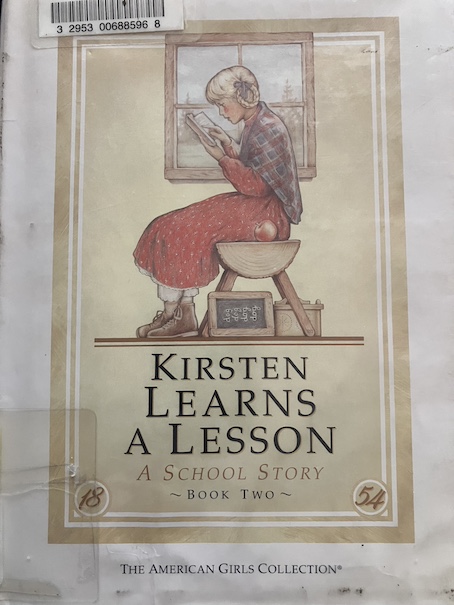
Kirsten Learns a Lesson

Kirsten, An American Girl

It’s November, 1854, and now that nine-year-old Kirsten’s family has settled in their new home in Minnesota and the harvest season is over, it’s time for the children to go to school. Kirsten and her brothers, Lars and Peter, will go to the small local school with their cousins, Lisbeth and Anna. Powderkeg School is a one-room schoolhouse in a little log cabin. Lisbeth and Anna’s stories about what Powderkeg School is like worry Kirsten. They talk about how strict their teacher, Mr. Coogan, is. Sometimes, the boys in class get rowdy and fight, and Mr. Coogan uses physical punishment on them. However, the girls tell Kirsten that she probably won’t have any problems with Mr. Coogan because he likes children who are well-behaved, and Kirsten is well-behaved. Still, Kirsten is nervous about what her new school will be like.

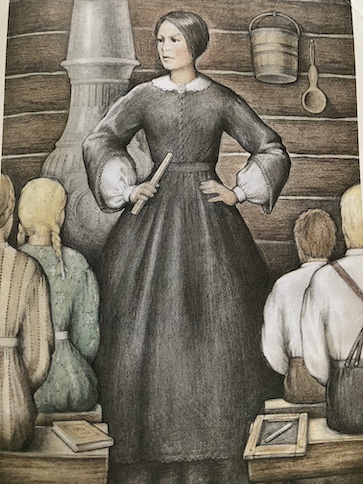
When they get to school, they learn that Mr. Coogan was injured in a fall from his horse, so they will have a replacement teacher, Miss Winston, who has only recently arrived from Maine. When one of the mean boys in class says he hops the horse also stepped on Mr. Coogan, Miss Winston tells him that nobody talks out of turn in her class and, although they live in the country, “we are not savages like the Indians.” (This is a 19th century attitude toward Native Americans, but this concept is challenged later in the story.)

Miss Winston has each of the children in class introduce themselves so she can get to know everyone. When it’s Kirsten’s turn to say her name, she forgets to address her teacher as ma’am, like the other students. Miss Winston insists that she say “ma’am”, and when she sees Kirsten struggling with the language, she asks Kirsten if she speaks English. Kirsten says that she speaks a little, and her cousins explain that her family just came from Sweden and that they speak Swedish at home. Miss Winston says that “practice makes perfect”, so Kirsten will practice her English in school. For now, she will have the easiest lessons and share seven-year-old Anna’s schoolbook.

When the mean boy, Amos, laughs at Kirsten, Miss Winston glares at him and strikes the school’s iron stove with her ruler, startling the students. Miss Winston says that her father was a ship’s captain, so she knows how to be in charge of her students, like he was in charge of his crew. Then, she deconstructs the sentence “Miss Winston hit the stove”, pointing out which words are the subject, verb, and direct object of the sentence. Then she warns the class to “Be careful that the direct object of hit isn’t the student.” The implication is that Miss Winston is just as willing to use physical punishment against her students as Mr. Coogan was.

When Amos introduces himself to Miss Winston, we learn that he is nineteen years old, the same age as the new teacher, but the new teacher says that, in spite of being the same age, she’s still the teacher, and he’s the student. In spite of being more a young man than a boy in age, Amos has only just finished the third reader, and Miss Winston says her role is to help him read and do math like a man would, embarrassing Amos. (He can’t use his age to put himself on an equal footing with the new teacher because they are not intellectual equals. She’s the same age, but she has graduated from her own school and become a teacher, and he’s still struggling along with low level math and reading.)

Anna helps Kirsten with her lessons, and Miss Winston praises her for helping to teach Kirsten, but she doesn’t praise Kirsten for doing a good job. At the end of the school day, Kirsten and her cousins talk about the new teacher. Anna thinks that Miss Winston seems nice, but Kirsten thinks that Miss Winston doesn’t like her and that she seems very strict. She asks if that was what Mr. Coogan was like, and Lisbeth says he was worse. The best part of the day for Kirsten was lunchtime, when the children were allowed some play time. When she ran around and played tag with the other children, it didn’t matter if she didn’t speak much English.

When the girls play school with their dolls, Anna imitates Miss Winston and her comment about “savages.” Kirsten asks the other girls what that word means. They say it means “wild.” Kirsten asks them if the Indians (Native Americans) are really like that, and they say that some people say they’re kind and will help people if they need food but others day that they’re “cruel and bloodthirsty.” They’ve seen an Indian man before. He came to their house when their mother was roasting meat, and he left when their mother gave him some. They thought he looked pretty “savage” because his face was painted, and he had eagle feathers in his hair. The girls say that Native Americans also wear knives and live in tents. As a farmer, their father is concerned about the Native Americans. He knows that, if the farmers take too much of their usual hunting grounds for farming, it will drive away the animals, and the Native Americans will be starving and angry. While he is happy that he has been able to secure some farmland for his family (I explained a little about the famine conditions and lack of farmland in Sweden around this time that caused people like the Larsons to leave their country when I covered Meet Kirsten), he is aware that the Native Americans also need land for their survival.

At school, Miss Winston announces that each student will memorize a poem and recite it for the class. When they recite their poems, she wants them to say them with feeling and show the emotions their poem is trying to convey. Kirsten worries about this assignment because she’s still learning English. It’s hard enough for her to learn to read anything in English and understand the meaning of the words. She doesn’t know how she can also learn to memorize an entire poem and say it in front of everyone. Miss Winston gives Kirsten a short poem to learn, but having even a short one doesn’t seem to help Kirsten.

Meanwhile, Kirsten has her first encounter with a Native American when she spots an Indian (Native American) girl watching her while she’s getting water from the stream. The girl runs away, but Kirsten finds a blue bead that she dropped. Kirsten takes it and leaves her a little pretend cake that she and her cousins made for their dolls. Later, she finds that the cake is missing and that there’s a green duck feather in its place. She and the Indian girl trade little objects in this way, gradually becoming friends.

Kirsten’s secret friendship with the Native American girl becomes a comfort to her when school is stressful. Frontier teachers often board with families who live near the school, and when Miss Winston comes to stay at Kirsten’s aunt and uncle’s house, Kirsten feels like school is following her home. What’s worse is that Kirsten’s family will be joining them for dinner, and they will practice English during the meal. Kirsten knows that the meals, instead of being comfortable family time, will now be like lessons, and they will struggle to say things they would want to say because her family still hardly knows English. Worse yet, Miss Winston is cross with Kirsten because she can’t seem to memorize even her short poem.

Sneaking away to visit the Native American girl, who is called Singing Bird, gives Kirsten an escape from her struggles with English. Somehow, Kirsten and Singing Bird manage to communicate well enough with each other, even though neither of them speaks each other’s language. Then, Singing Bird takes Kirsten to see her village. To her surprise, Kirsten realizes that she has been gradually teaching Singing Bird English words without realizing it. However, Singing Bird’s people are going to be moving on soon. Kirsten’s uncle is correct that farming is driving away the animals the Native Americans depend on for food, and they’re suffering for it. Singing Bird invites Kirsten to come with her tribe when they leave, and it’s tempting to think of living an exciting life, traveling with Singing Bird and not going to school. But, is that what Kirsten really wants?

The book ends with a section of historical information about frontier schools in the mid-1800s.

The book is available to borrow and read for free online through Internet Archive (multiple copies).

Along with the first book in the series, this is the book that I remember the best of the Kirsten books. I think I either didn’t read the others or didn’t finish them because there are some sad things in the Kirsten stories that I didn’t like. In the first book, Meet Kirsten, another child Kirsten befriends on the journey to Minnesota dies of cholera. It’s historically accurate that some children died of disease on the journey west, but it was still hard to take. I also talked about how the reason why families like Kirsten’s wanted to come to America was that Sweden was experiencing famine around this time. The first book didn’t say much about that, but in this book, Kirsten remembers experiencing hunger in Sweden when her father’s crops failed and how her little brother cried from hunger.

Kirsten understands the plight of the Native Americans when they have to move to a new area when their food supplies run low. However, when Singing Bird invites Kirsten to come with them, she realizes that would mean leaving the rest of her family, and she can’t do that. While it’s tempting to go with her friend and escape the problems in her life, Kirsten can’t do that without also giving up the good things in her life and trading the problems in her life for a different set of problems. Although there are appealing aspects to their lives, the Native Americans also have their own struggles. To use an old adage, the grass isn’t always greener on the other side of the fence. People say it in different ways, but just because someone else’s situation is different doesn’t always mean that it’s better.

In this book, we also see what it’s like for Kirsten’s family as they begin learning English, so they can communicate with other people in their new country, and the children begin going to school. The little frontier school is different from other schools they’ve experienced before, and the teachers are strict. They have to be strict because some of the students are rough and fight with each other physically, and they have to make it clear that they’re not going to put up with that. This is a real-life aspect of schools from this time period. Fortunately, we never see the teacher actually using physical punishment against anybody. She just threatens to do it so her students will think twice about misbehaving.

When Miss Winston comes to board with Kirsten’s relatives, Kirsten thinks that everything is going to be worse, that she’s constantly going to be bombarded with lessons and the problems she’s been having at school. However, it turns into an opportunity for Kirsten and Miss Winston to get to know each other better. At first, Miss Winston can’t understand why Kirsten is having such a difficult time remembering her poem, even though it’s pretty short and easy. It’s partly because she’s still having difficulties with her English, but also, the content of the poem has no relation to anything currently happening in Kirsten’s life. It doesn’t interest her, and her mind is preoccupied with all the changes happening in her life, making it difficult for her to focus on the poem and remember it. When Miss Winston shows Kirsten a model of her father’s ship, it brings back memories of the ship Kirsten’s family traveled on when they came from Sweden. Miss Winston realizes that Kirsten has strong memories of the ship, so she gives her a different poem to memorize, one about a ship. Kirsten finds this poem easier to remember because it connects to memories she already has.

Although Miss Winston can be tough, she genuinely does care about Kirsten and looks for ways to help her learn. It just takes time to figure out the best way to help her, and Kirsten also needs time to adjust to her new language and new home. Once Kirsten sees that it’s possible for her to learn and for her new home to begin feeling like home, she begins to feel better about her new life in Minnesota.

I enjoyed the realistic aspects of the story and the references to historical events and real life conditions on the frontier. I think I liked this story better as an adult because I understood more about the historical background than I did when I was a kid. Parts of this series are still sad. Kirsten remembers people being sick and dying on the journey to America, and although she doesn’t go into detail about it, her family did suffer genuine hardship in Sweden.

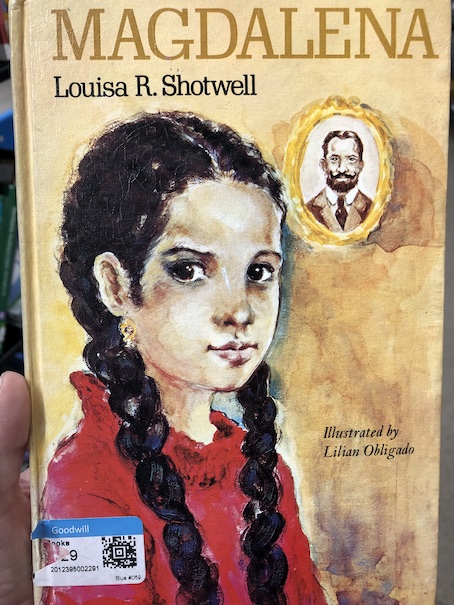
Magdalena

Magdalena is switching classes at school. She’s happy about it because she found her old class too chaotic. She thinks she will be happier in her new class. Her friend in her current class at school, a boy named Saul, tells her that she must be an IGC, an Intellectually Gifted Child, in order to get transferred to that class because that class only takes gifted children. However, she is told that she will also have to wait a little for them to give her a desk in the room. When months go by without her being told that there is a spot ready for her and she can make the switch, Saul thinks that they were probably lying to her about her being able to switch classes.

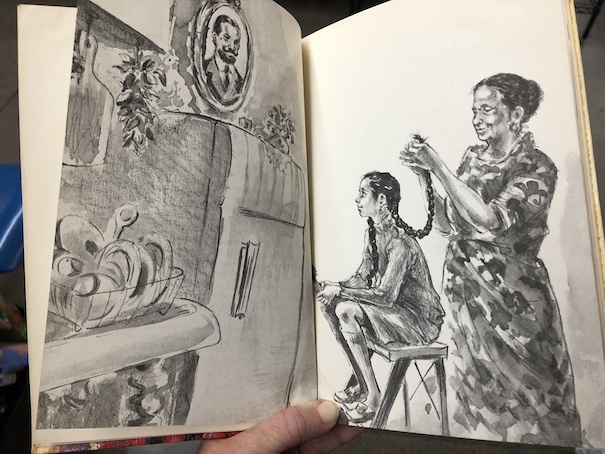
Finally, in January, she is able to switch to the new class, but right away, she runs into trouble with the class bullies. A boy named Andy and his friend start calling her “Miss Two-Ropes” because of her long braids, and the name sticks. Magdalena wishes that she didn’t have to wear her hair in braids, but her grandmother, Nani, insists on it. She loves Nani, who is from Puerto Rico and has looked after her for last two years, ever since her mother died when she was nine years old, but Nani has some old-fashioned ideas about how girls ought to be raised.

Magdalena’s father is a sailor, and he spends much of his time away at sea, so Magdalena and her grandmother are alone most of the time. Nani speaks Spanish to Magdalena at home because she thinks that’s proper for a Puerto Rican family like theirs, although Magdalena speaks English at school. She thinks that her grandmother probably knows more English than she pretends. Nani also keeps a portrait of Great-Grandfather Mendez, which she brought from Puerto Rico. Although he has been dead for years, the portrait always feels like a living person to Magdalena.

After some further teasing from the boys in her class, Magdalena decides to tell her grandmother that she doesn’t like her braids. Nani says that not unusual, that many children don’t like their braids, but they get over it. Magdalena doesn’t think she’s going to just get over it. Like a lot of kids, she would rather just look like everyone else so she won’t get teased, but Nani doesn’t approve of the short hairstyles that are popular among American girls at Magdalena’s school. She says that Magdalena’s braids are a mark of pride and a caring grandmother who brushes and braids her hair. She thinks the American girls wear their hair short because their mothers can’t be bothered to spend time on caring for long hair, and they don’t have grandmothers to nurture them. When Magdalena tells her that the boys at school are calling her names because of her braids, her grandmother decides that she should talk to the teacher about it. Magdalena thinks that having her grandmother talk to the teacher might be more embarrassing than having the boys call her names, so she persuades her grandmother to forget about it for now and let her handle it.

Then, Magdalena is called to the principal’s office at school. At first, Magdalena is upset because it sounds like she’s in trouble, and she can’t understand what she could have done to cause that. She is calmed a little when a black boy in the office, who is also waiting to talk to the principal, is nice to her. It turns out that Magdalena isn’t really in trouble. Instead, the principal wants to talk to her about one of her classmates, a girl named Daisy Gonzales, who is also transferring into her new class.

Madgalena is surprised because Daisy hasn’t struck her as a gifted child. Most of the other students call her “Spook” because she tends to lurk around the school and suddenly jump out at people to scare them, and she is known to frequently skip classes. The principal says that Daisy might be gifted, but it’s difficult to tell. The teachers think that she’s at least bright, but she’s an “under-achiever.” The principal explains that means that Daisy could do better at school than she does, but for some reason, she doesn’t seem motivated to do better. That’s why they’ve decided to transfer her to the class with the gifted students. They think that she isn’t being challenged enough in the class where she is. The teachers are also concerned that Daisy has no friends at school. They’ve noticed that the other girls at school seem to be afraid of Daisy, although they don’t seem to understand about Daisy’s “Spook” act. They do know that Daisy has behavioral problems and an unhappy home life. The reason why the principal is telling Magdalena about this is that she wants Magdalena to try to be Daisy’s friend when she transfers into her new class. The reason why she selected Magdalena to be Daisy’s new friend is because Daisy’s family is also Puerto Rican, like Magdalena’s family, so she thinks that the girls might understand each other better than their other classmates. The principal thinks that Daisy might settle down at school if she had a friend to help her feel more comfortable there. Magdalena isn’t comfortable with the idea of trying to be Spook’s friend because she also finds Daisy spooky, but the principal persuades her to try but not to let on that the principal asked her to do this.

Magdalena has no idea how to approach Daisy/Spook to be friends, since she’s not the easiest person to approach about anything. Then, Sue Ellen, the most popular girl in class tells Magdalena that she wants to be friends with her. She says that she’s been feeling empathy for her since the first day that she came to class and the boys started teasing her, and she felt it again when she got called to see the principal. She asks her what the principal wanted, and Magdalena explains that she asked her to do something, but it’s something really hard, and she isn’t supposed to talk about it. Sue Ellen offers to help her with whatever the principal’s task is. Magdalena thinks maybe making friends with Spook won’t be so bad if Sue Ellen helps, so she takes Sue Ellen into her confidence. Sue Ellen agrees with Magdalena that making friends with Spook would be hard because she’s so weird and spooky. Both girls admit that they’re a little afraid of her, but Sue Ellen agrees to try to be basically nice to Spook along with Magdalena and see what happens. Sue Ellen says that the principal ought to have more empathy for the students and see just how hard it would be to get along with someone like Spook.

Their first attempts at making friends with Spook are clumsy. Sue Ellen tries offering her advice, pointing out that she wore the wrong thing to the school assembly, but criticism and advice aren’t the best ice-breakers. Then, to Magdalena’s surprise, Spook approaches her in the school library, when she is trying to find a specific book for her grandmother. The school library doesn’t have the book she wants, but Spook says that she knows where to find it. However, she will only help Magdalena if she plays hooky and goes with her right now. Magdalena hesitates because she doesn’t really want to skip class and get in trouble, but Spook says that Magdalena will have to come with her because she’s “emotionally disturbed” and might do crazy things if she doesn’t get her way. Magdalena points out that school will end in only 20 minutes, and she asks Spook to wait for her. Spook makes her promise that she won’t change her mind and let her down in that time.

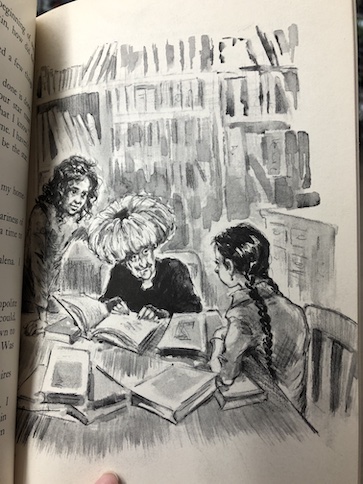
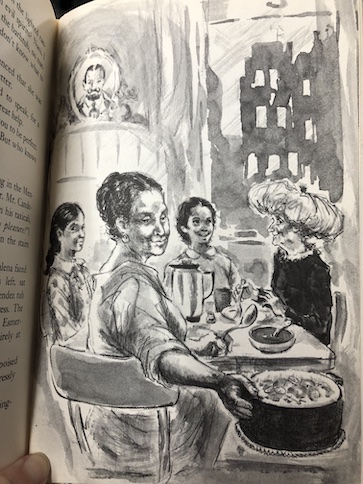
When Magdalena waits for Spook, she doesn’t show up at first, but Spook jumps out at her just when she’s giving up waiting. Spook says that she just wanted to see if Magdalena was serious about wanting to come with her. The place where Spook knows they can find the book turns out to be the Brooklyn Public Library. Along the way, Magdalena begins to learn more about Spook. The reason why she wasn’t dressed right this morning was that the sweater she was wearing was the only thing she had to wear that was clean. She skipped out during the school assembly to go home and see if her mother was back from the laundromat so she could put on something else. Also, Spook isn’t completely friendless. She is friends with a strange woman named Miss Lilley, who wears an unusual, large hat. When Daisy tells Miss Lilley that she got put into the class at school with the smart kids, Miss Lilley congratulates her and tells her that she knew she was smart. Daisy admits that she’s been trying not to let her teachers know that she’s smart because she knows that they will expect more of her and insist that she do all her homework. People don’t expect so much of kids who aren’t bright. There is method to Daisy’s madness. All of her weird and spooky acts are tools that she uses to get her, get out of things that she doesn’t want to do, cover up for problems that she has, and keep people she doesn’t like or doesn’t think would understand her at a distance.

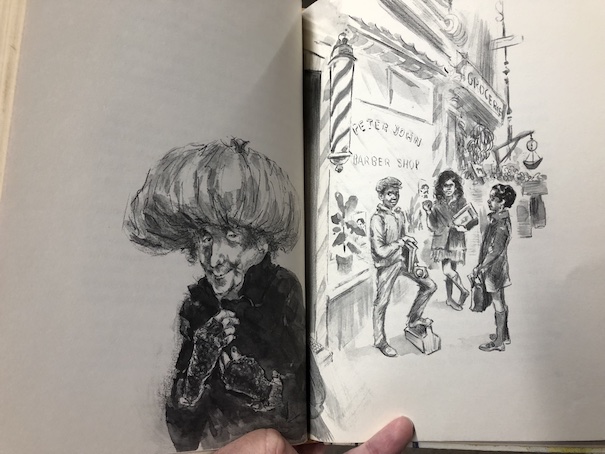
Daisy introduces Magdalena as one of the smart kids from her class, but Miss Lilley thinks that Magdalena’s manners aren’t very polite because she keeps staring. Magdalena has trouble getting over the large hat, which looks like a large pumpkin. Miss Lilley begins evaluating Magdalena’s appearance, and Magdalena comments about how she hates her braids, but her grandmother makes her wear them. Miss Lilley says that she understands that her grandmother likes the quaintness of the braids, but she knows how to deal with that. She also knows where to find a good barber. The black boy who was nice to Magdalena earlier, Samson Shivers, makes money after school by shining shoes outside the library, and when Miss Lilley asks him if he would be willing to lend them money for the haircut, he joins the others at the barber shop. Miss Lilley takes the kids to the barber shop, and Magdalena gets a haircut. Magdalena feels wonderfully free after he haircut, although she saves the braids as a souvenir and worries about what her grandmother will say when she gets home.

Nani is very upset when she sees Magdalena’s short hair and worries that Magdalena is rejecting her care for her and her Puerto Rican heritage. Magdalena says that’s not the case and explains about going to the library and meeting Miss Lilley. Magdalena’s grandmother thinks that she’s bewitched and says that she knows how to deal with that. She uses herbs on Magdalena to break the bewitchment.

Getting the haircut changes things for Magdalena. The boys stop teasing her, which is a relief. However, Sue Ellen is annoyed that Magdalena didn’t tell her that she was going to get her hair cut. Magdalena explains that it was a sudden decision and a possible bewitchment by Miss Lilley. Sue Ellen thinks that Spook is probably the one who bewitched Magdalena because she’s so spooky and that maybe Magdalena would rather be best friends with her. Magdalena says that’s not the case and that she doesn’t see why she can’t be friends with both girls. Sue Ellen still expects that Spook is going to do something to ruin the class, but Magdalena notices that Spook is becoming less spooky in their class. She stops skipping classes, does more of her homework, and cuts out some of her previous spooky behavior.

Samson, often called Sam, is a practical boy, and when Magdalena tells him how her grandmother thinks Miss Lilley is a witch and bewitched her, he says that she can’t be a witch. Sam sees her often because he shines shoes by the library, and he realizes that Miss Lilley is actually just a poor, old woman. She goes to the library all the time because she can’t afford proper heating for her apartment. She often has little to eat, and she partly survives off of candy that he gives her. Like Spook, she seems spooky because she looks odd and behaves oddly, but there are explanations for what she does that show that she’s actually unfortunate.

Magdalena’s grandmother meets Spook for the first time when Spook hangs out with Magdalena at her apartment after school. Nani isn’t home at the time, but the girls talk to each other about their lives and families. Magdalena gets to know more about Spook, and Spook admires the place where Magdalena lives. Spook’s family lives in a much poorer apartment, and it’s crowded with Spook’s younger siblings. Spook admires the nice bathtub that Magdalena and her grandmother have and says that she wishes they had one at her apartment. Part of the reason why she looks so strange is that she doesn’t get the opportunity to take baths often. Magdalena tells her that if she wants a bath, she can go ahead and take one. Nani arrives home before Spook is finished with her bath, but Nani stops her when she tries to get out and get her clothes. Nani can see how badly Spook needs some care, so she insists that she finish the bath, clean the tub, and let her shampoo her hair. When she’s done, Nani has Magdalena loan her some clean clothes, and the girls are amazed at the transformation.

After the bath incident, Spook avoids Magdalena for a while, and she can’t understand why, but it’s about Spook realizing what’s been lacking in her life and envying what Magdalena has: someone who really cares for her. She was so emotional when she looked at herself in the mirror that she spit at the image and then was embarrassed that she had done that. Nani surprisingly understands Spook’s behavior. She can see that Spook lacks impulse control and the ability to understand and manage her feelings. Nani comments that she’s angry with Spook’s mother because she can tell that the girl has been badly neglected. Having been a mother and grandmother herself, she knows exactly how to deal with this.

Meanwhile, Sam is correct about Miss Lilley. Miss Lilley is poor and not in very good health, but she also knows what Magdalena and Spook/Daisy need. She is eager to help the girls, but she also needs some help and attention herself. When Miss Lilley decides that it’s time to have a word with Nani about the needs of modern girls and her fears about her granddaughter becoming too American, a number of things get better.

The book is available to borrow and read for free online through Internet Archive.

The heart of this story is understanding and empathy. By the time it’s over, many of the characters come to a better understanding of each other and maybe themselves. Although Spook’s transformation is the most dramatic, the other characters are also changed after their experiences in the story.

Magdalena’s changes come with her admission to her grandmother that she really doesn’t like her braids and then with her decision to have her hair cut against her grandmothers wishes. She knew that her grandmother wouldn’t like it when she said that she didn’t want braids because her grandmother is a traditionalist, and she knew that Nani wouldn’t react well to the haircut. At first, it was easier for Magdalena to buy into the idea that Miss Lilley was a witch who bewitched her into doing it, but that’s not really the truth. It wasn’t even that Magdalena was getting her hair cut just because of the teasing. When Magdalena and Spook are talking about whether or not they truly understand the reasons why they do things, Magdalena acknowledges that she has reasons for the things she does, and the truth is that she got the haircut because she herself really hated wearing braids. If she had really loved her braids, she could have kept them in spite of the teasing, and she could have turned down the offer of a haircut, but she really wanted to change her hairstyle, and she just took advantage of the opportunity to do it.

Nani understands from the first time she meets Spook that she has not had nearly the level of care and attention that she has needed in life. Spook doesn’t even really understand all of the motivations she has for the things she does. Her behavior is odd partly because she acts on impulse, not fully thinking about the consequences or the affect her behavior has on others. She initially doesn’t have much self-awareness because she has not had caring adults in her life to teach her how to behave, how to understand her feelings, and how to control herself. Because she hasn’t really had any friends before, she hasn’t really had anyone to talk to about these things and help give her some perspective. When Spook and Magdalena talk about why she spit on the mirror, Spook says at first that she isn’t sure why she did it. As they continue to talk about reasons for doing things, though, Spook admits that she did it because, while she was stunned at how nice she looked, she quickly became upset because she didn’t think that nice look could last.

Nani is the nurturing type of person, and she quickly sees that Spook is in dire need of some nurturing and guidance. She also recognizes that Spook doesn’t have much confidence in herself. She is bright, but she has grown used to hiding it. She also thinks, because she doesn’t really understand her feelings or behavior, that is can never really control herself. She thinks that she will always be a “stinker” who does things that she shouldn’t and acts weird. Nani has a frank talk with her and tells her that she can be herself without being a “stinker”, and the first step is believing that she can. Even if she’s not in the habit of understanding and controlling herself, she can learn. People have different sides to their personalities and different ways of expressing themselves, and Spook can learn how to show the best sides of herself in the best possible ways.

Magdalena appreciates that Nani is understanding and helping Spook, but she also has a frank talk with her grandmother about why she doesn’t understand her own granddaughter as well. When Magdalena tries to tell her what she wants or doesn’t want, Nani contradicts her or ignores her feelings. Nani is understanding with Spook because she can tell that Spook is a disadvantaged child, but she doesn’t see her granddaughter the same way, so she doesn’t try to understand why Magdalena sometimes does things she doesn’t like. Nani admits that she wanted her granddaughter to be “perfect”, but maybe she doesn’t really know what “perfect” actually is. She wants the traditional ways for her granddaughter because she really thinks that’s what’s best, but even grandmother doesn’t always know what’s best.

Miss Lilley is concerned about the girls and offers them attention and support. When she goes to see Nani and open her eyes to her grandmother’s needs and the ways of modern girls, she collapses because of her bad health. Fortunately, Nani is a nurturing person, and she nurtures Miss Lilley, making sure that she gets the treatment she needs and even looking after her when she gets out of the hospital. Miss Lilley’s health improves, and the two of them become friends. Although they are both older ladies, they each admit that they have things to learn in their lives, and they can learn from each other. Nani helps her to make changes to her living arrangements so she will be healthier and more comfortable, and Miss Lilley helps her understand what modern American life has to offer for girls like Magdalena.

Samson is always a very understanding character because he is genuinely interested in people, and he meets many different types of people through his shoe-shining business. Although Sue Ellen is the first person who brings up the topic of empathy, she is really the one who understands it the least. I think her relatively narrow view of empathy is because of her relatively narrow life experiences. She feels some empathy for Magdalena because she sees Magdalena experiencing something she understands, but she doesn’t seem to know what to do when she encounters something she doesn’t understand. Admittedly, Spook’s spooky act is off-putting, partly by design and partly because Spook has issues she herself doesn’t know how to handle. However, because Sue Ellen only wants to stick to the familiar and understandable, she doesn’t notice when Spook begins to change and doesn’t see how some support from her could influence her for the better. Sue Ellen’s attempts at friendliness and helpfulness often involve offering some kind of criticism, like pointing out that Spook isn’t dressed right. Magdalena can tell that Sue Ellen is trying to be helpful, but she’s also kind of snippy and smug in the way she does it, and that gets on Magdalena’s nerves, too. Sue Ellen kind of fades out of the story toward the end, so we don’t know if she continues being friendly with Magdalena or not or if she ever recognizes Spook’s transformation.

There is also a subplot that I haven’t mentioned about the literary magazine that the girls’ class starts. Their teacher has some thought-provoking descriptions about what good writing is and does, and the girls’ choices of what to write about are based on their experiences and the changes in their lives.

The book doesn’t shy away from the harsh realities of life. Magdalena’s mother is dead, and her father is away most of the time, so she is being raised by her grandmother. Her father never even makes an appearance in the story. Miss Lilley is a poor and lonely old woman who needs help and friends. It is acknowledged that Spook is a neglected child, and she even tells Magdalena that her favorite brother died at age three because he was asthmatic, and they were living in bad conditions. We don’t know exactly how her family came to be living in such bad conditions, but Spook says that, if she wrote a story about her family, the teacher would think she had a filthy mind.

Since the story is about understanding other people, one could consider whether we might view Spook’s neglectful mother more sympathetically if we knew her past and what led her to the situation they’re now in, but we do not see Spook’s mother at any point in the story. I think it’s also important to note that understanding does not equal approval. You can know a person’s history and reasons for doing things and still not agree with them. Maybe Spook’s mother is another unfortunate soul who needs some help, but if she is, she doesn’t seem to be looking for that help. Her vulnerable children are suffering for it, and one has died. Empathy doesn’t mean saying that things are okay when they really aren’t, and this mother’s neglect of her children is not okay.

Cold Chills

Fourteen-year-old twins Ryan and Chris Taylor are on a ski trip in Colorado with their parents, their eight-year old sister Lucy, and their friend, Billy Maguire. Although Billy is a friend of both of the twins, he’s really closer to Chris because the two of them are interested in sports. Ryan is more of an intellectual than either of them, and they tease him about not being as good at sports as they are. When the three of them get together, Ryan often feels left out, although he argues with them that he can do decently well at physical activities; he just cares more about other things.

The ski resort where they will be staying is called Moosehead Lodge. It used to be a very exclusive resort, but it’s fallen on hard times in recent years. The reason why they’re going there is that the current owner is an old friend of Mr. Taylor’s from college, and he’s asked Mr. Taylor to write a travel article about the lodge for a magazine to attract new customers.

It turns out that Dede and Wendy, two girls who attend the same school as the boys, will also be staying there over winter break. The twins have crushes on the girls, but they’re also at the age where they still think girls are weird or likely to spoil their fun, so they have mixed feelings about the girls joining them on the ski trip. The boys consider trying to avoid the girls for the entire trip and make them wonder what happened to them, but Ryan thinks that sounds like something a little kid would do. Billy says that, if the twins are going to hang around with girls, he wants a girl for himself, too.

When they arrive at the lodge, the girls greet them right away, so the hiding scheme definitely won’t work. The girls are enthusiastic that there will be a lot of fun things for them all to do. The lodge includes several stores for the guests to shop in, which the girls and Mr. and Mrs. Taylor find intriguing. However, the boys think that the lodge looks haunted. With all the old-fashioned furniture and paintings, it reminds them of something from a movie.

At their first ski lesson, Chris brags that he doesn’t really even need lessons because he’s such an athlete. However, skiing doesn’t come as naturally to him as soccer does. In spite of his bragging, he is clumsy at his first attempts. He apologizes to the instructor, saying that he’s just eager to get going because he knows that they’ll only be staying there a short time. The instructor says that he understands but that the instructions he’s giving them are important for keeping them safe while they have fun.

When the boys return to the lodge, Mrs. Taylor is very upset because a pearl necklace that’s a family heirloom is missing! When Mr. Taylor and the boys go to the manager to report the loss of the necklace, they find out that other pieces of jewelry have been stolen from other guests. The manager has hesitated to contact the police about it because he’s been hoping that the jewelry was merely misplaced and would turn up. The lodge is suffering financially, and if they have a bad season, they might have to close down. Mr. Taylor likes the lodge and wants to help his old friend, but the thefts have to be cleared up for the lodge to continue functioning. The twins decide that they’re going to be the ones to find their mother’s necklace, bring the thief to justice, and save the ski lodge!

The book is available to borrow and read for free online through Internet Archive.

I liked this book better than the last book I read in the series. It’s more of a mystery than the last one, although there’s still plenty of excitement and adventure. Unlike the other book I read, where the boys know right away who the villains are, in this story, the boys have no idea who the thief is for much of the book. They have to investigate different suspects, and their first suspects turn out to be completely wrong. The boys undertake a deliberate investigation into their suspects, moving from person to person. There are enough potential suspects with apparent odd behavior to keep readers guessing along with the amateur detectives. A skiing accident and a blizzard and avalanche add excitement and adventure to the story.
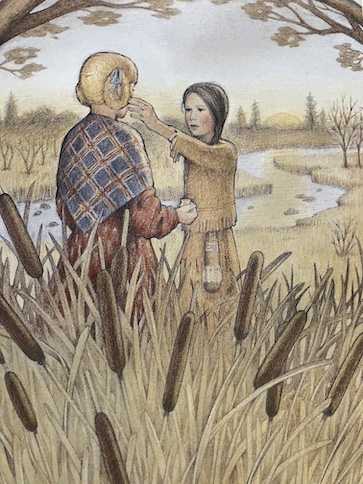
When the girls argue with the boys about one of their subjects, the boys say that girls would be more likely to fall in love with a jewel thief than to either be a jewel thief or catch one themselves. The kids turn their investigation into a contest, boys against girls, to see which of them can solve the mystery first. The competition between boys and girls gets carried over to the adults, and it even influenced some of my theories about the identity of the jewel thief. Part of what I suspected turned out to be true, but saying what it was would be a spoiler. 

The boys do solve the mystery before the girls, although the solution does disprove some of what the boys said earlier. Considering some of what they said, I would have liked to see more acknowledgement about that, but the book ends a little abruptly after the final solution is revealed. Overall, I liked the story, but I could see some room for improvement in the ending. Although I understand that part of the premise of this series is that the twins can sense each other’s thoughts, that doesn’t really enter into the story, either, which was also a disappointment.

The Secret of Grey Walls

Lone Pine Series

The Secret of Grey Walls by Malcolm Saville, 1947.

It’s shortly after Christmas, and Petronella (called “Peter” by her friends) is home from boarding school for the holidays. She has a strange dream about running through the woods with an unfamiliar girl and finding a house with gray walls, but she’s not sure where it is or what the dream means. She wakes up when there’s a fire in her dream.

Petronella and her father live by themselves in the countryside because her mother died when she was a baby. Her father misses her when she goes away to school, but he knows that it’s important for her to go, and although he would like to spend all of their holidays together, he also knows that it’s important for her to spend time with her friends.

When Petronella goes to visit her friends, the Mortons, Mr. and Mrs. Morton and their housekeeper, Agnes all receive news that changes the children’s plans for the remainder of their vacation. (This is after Mr. Morton is home from the war after serving in the RAF.) Mr. and Mrs. Morton have to go to London to see a lawyer about some business, although they’re vague about the reasons why. Agnes’s news is that her sister is sick and in the hospital. With all of the adults leaving the Mortons’ house at Witchend, Mr. and Mrs. Morton wonder who they can have looking after David and the twins until they return. They consider different people they can ask, but Agnes says that all of the children can come to the village of Clun with her. Her sister has a very big house, and she’s been worried about not having anyone to look after the house while she’s in the hospital. There will be plenty of room for all of them, and Agnes says that she would appreciate the company in that big, old place. The children can even invite the other members of the Lone Pine Club to join them.

At this point in the series, not all members of the Lone Pine Club have actually met each other. David invited Jon and Penny, a pair of cousins, to join the club while visiting the hotel that Jon’s mother, who is Penny’s aunt, owns in another town. This trip will be an opportunity for the whole club to get together and get to know each other. Jon and Penny are very excited about the trip, especially Penny, who is a talkative girl who enjoys meeting new people.

On the train to meet the others, Penny strikes up a conversation with a man named Alan Denton, who brought a dog onto the train. Denton recently left the Navy and is heading home to manage his family’s sheep farm near Clun. He is very surprised when Penny says that they are also going to Clun because it’s a very small town, and few people visit there during the winter. The old house where they will be staying is usually run as a boarding house for summer visitors, but there won’t be anyone else there during the winter. The old house is called Keep View because it has a view of a crumbling old castle. There isn’t much else left of the castle other than the old keep. The children are fascinated as Denton describes the castle and other points of interest in the area, like a circle of standing stones. He says that visitors sometimes dig for old flint arrowheads.

The other kids are going to Clun by bicycle, except for Peter, who is riding her pony, Sally. Along the way, the kids meet up with a caravan of gypsies they know from a previous book. (Yes, this is a mid-20th century British children’s mystery adventure story, so of course, there are gypsies. The book spells it “gipsies,” and they also call themselves “Romany.” In the case of this series, the Romany are friends of the kids, not suspicious characters, as in many other children’s books from around this time.) The kids tell the Romany where they are heading, and they say that they’ve just left Clun. Ordinarily, they like the area, but there’s been some trouble there lately. Someone is stealing sheep from some of the sheep farms. The Romany know that people are often suspicious of Romany, so they thought that they’d better leave the area before someone accuses them of being involved with the thefts. Before the kids leave the Romany, the Romany remind them about the special whistle that they gave to Peter, saying that if she blows it, any Romany who hears it will come to help.

Peter, meanwhile, has a disturbing encounter on her trip to meet the others. She meets some men whose truck has broken down. The men behave oddly, and although the truck says that it’s a furniture truck, Peter is sure that she hears the baaing of sheep inside.

The kids don’t start to put together pieces of what’s going on until they reunite in Clun. While they are getting to know each other and exploring the area, they suddenly meet up with Alan Denton, who is distraught because his sheep farm has been the latest victim of the sheep thefts. Peter mentions to the others about the strange truck with the sheep sounds, although Denton dismisses the idea that Peter might have encountered the sheep thieves on her way to Clun because he doesn’t think that the thieves would have been able to load all the sheep onto a truck without being noticed.

Meanwhile, a strange man called Mr. Cantor rents a room at Keep View from Agnes. The boarding house doesn’t usually get boarders in the winter, and the children had counted on having the house to themselves during their stay. Mr. Cantor says that he’s recovering from an illness and needs some peace and quiet, which is disappointing to the children because that means that they’ll either have to spend most of their time outside or being very careful not to disturb Mr. Cantor. Although the children like being outdoors, it is cold, and they know they can’t be outdoors all the time, and a houseful of children isn’t usually quiet. Mr. Cantor seems a little strange, and some of the kids get the feeling that he isn’t quite what he seems to be, but he knows a great deal about the history and landmarks of the area. He entertains the children with stories about local history and ancient burials, and they begin feeling better about him.

However, something happens that causes them to becomes suspicious of Mr. Cantor. After a visit to Mr. Denton’s sheep farm, the children get lost. They find a strange grey house and try to ask directions there. Nobody answers their knocks or calls even though the children are sure that someone is watching them from inside the house. Then, they realize that someone is also watching them from the woods. They briefly see this person leaving, and this person has a bicycle that rattles badly. When the children get back to Keep View, they realize that the bicycle they heard belongs to Mr. Cantor because it makes that same distinctive rattle. Was Mr. Cantor spying on them? Who was in the house, and why didn’t they want anyone to see them. Does any of this have something to do with the sheep thefts?

The book is available to borrow and read for free online through Internet Archive.

My Reaction

I’m new to this series of mid-20th century British mystery adventure books. This is the first book I’ve read, so I’m really getting to know them as some of them are getting to know each other. I was a little disappointed that this particular book seems to be set after WWII is over because I knew that the series started during the war and that the war was part of the story, but that does put this book contemporary to the time when it was written.

This story and the series in general does have a similar feel to other British children’s mystery adventure stories and series written around the same time, especially the Enid Blyton books, such as Enid Blyton’s Adventure Series and The Famous Five Series. Like the characters in the Enid Blyton books, the members of this friendship club attend boarding schools and have outdoorsy adventures on school holidays. The Romany appearing in this book is also a common element found in Enid Blyton books and other children’s books written around the same time. In all such books, there are stereotypical elements surrounding the Romany characters, although I think the Romany in this book were treated more kindly than the ones in Enid Blyton books. The use of the word “Romany” as well as “gipsy” is one element of understanding, but also the Romany characters in this book are friendly and helpful characters, not suspicious ones. There are people who are suspicious that the Romany are involved in the sheep thefts, but our heroes know that isn’t the case, defend them publicly, and help to expose the real thieves.
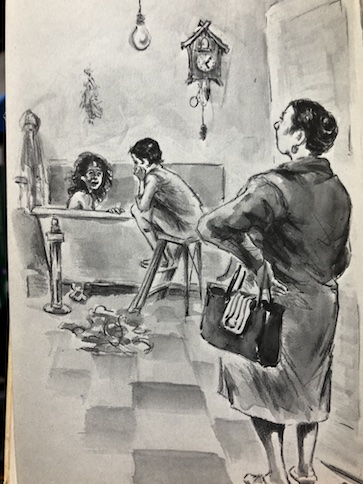
I really liked the addition of Mr. Cantor in the story. Like other kids’ mystery books of this type, there is more adventure in the story than mystery, but the appearance of Mr. Cantor adds that needed element of mysterious. For much of the story, it’s difficult to say what Mr. Cantor’s motives are and whose side he’s on. The kids have the feeling from the beginning that he’s not quite what he seems to be, but they find themselves having mixed feelings and debating back-and-forth about him as the story continues. When he’s nice to them and telling them stories about the history of the area, they decide that they like him and that they were silly to be suspicious before. Then, when he seems eager to agree with the authorities that the Romany are responsible for the sheep thefts, they look at him suspiciously again. There are some funny moments when the youngest members of the group, the twins Dickie and Mary, make friends with Mr. Cantor and try to distract him and keep an eye on him while the others do some investigating. The twins are irritated at being left behind by the older kids, but they do throw themselves into the roles of spies and put a lot of effort into making Mr. Cantor their special friend, guilting him into spending time with them. Mary gets Mr. Cantor to entertain them by telling them fairy stories and acts sweetly enthralled, while Mr. Cantor struggles to come up with story ideas to keep the kids happy, and Dickie thinks that the whole thing is stupid and little-kiddish.

I was a little surprised at the way characters in the book talked to each other at times, both children and adults, although I suppose I really shouldn’t have been. They use words that sound rough and insulting, like “stupid” and “ass” in very casual ways, both in describing themselves and each other. I’ve heard that before in British movies and television shows, but it always surprises me because it sounds so ill-mannered. Nobody in the book or in any of the shows I’ve seen seems to mind it, though. It’s just surprising when you hear someone who seems like they’re from the upper classes or who is supposed to have some of the refinements of a boarding school education throwing around words that sound rude and insulting with no thought about it.

There is a foreword at the beginning of the book that says Clun is a real town, but the author took some creative liberties with the landmarks in the story.

Gone Away

I haven’t found a copy with its dust jacket intact.

Gone Away by Ruth Tomalin, 1979.

Time flies?
Ah no.
Time stays.
We go.

Sundial motto from the beginning of Gone Away

Francie is an only child living on a farm called Goneaway Farm in Sussex in the 1930s. It’s a very old farm, and there’s a story about it that, hundreds of years before, another family once lived there, another couple with only one child. One day, this family went to a fair in another town, Alchester, and for reasons nobody understands, they never returned to this farm. The farm stood empty for a long time before it had a new owner. Because this old family went away with no explanation, the farm came to be called Goneaway. In spite of this strange story and the age of the farm, Francie has never felt that the farm was haunted or that there was anything sinister about it. Then, Francie finds herself staying in a real haunted house.

There are no illustrations in the book. It starts with this quote.

Because the farm where Francie lives with her parents is far away from local schools, Francie studies her lessons at home with her parents’ help, but she often gets distracted by the animals on the farm and doesn’t focus on her lessons. Francie’s great-aunts, Aunt Berta and Aunt Fanny, live in Scotland, but when they come to visit the farm, they see how Francie isn’t getting her schoolwork done. The aunts are also concerned at how isolated Francie’s life is. There are no other children living nearby to be friends with Francie, and they think that her life must be lonely. They talk to Francie’s parents about sending her to boarding school, but they say that they can’t afford it. They can’t even afford a car, which is why they can’t drive Francie to school in town. The aunts remind Francie’s mother that she used to board in a private house with a nice family so she could attend school when she was young. Boarding with a family wouldn’t cost as much as a fancy boarding school, and she could come home on weekends. Still, Francie’s parents are reluctant to send her away because they think she’s too young, and they’re not ready to part with her.

When the aunts leave after their visit and her parents don’t bring up the subject of school again for a while, Francie is relieved. She loves her life on the farm, and she doesn’t want to leave. Yet, she also finds herself oddly disappointed, too. She’s read stories about children at schools, and their adventures do sound exciting. She thinks it would be ideal if she could go to school during the day and come home afterward, like other children do, but that just won’t work with her family’s circumstances. Her parents’ attempts to find friends for her just aren’t working, either. Her parents start inviting other farm families to visit on Sundays, but Francie doesn’t get along with their children. The reasons why she doesn’t get along with them are largely because the other children don’t behave well, but these incidents convince Francie’s parents that maybe the aunts were right and that Francie could benefit from going to school and meeting a wider range of other children.

Her parents write to the high school in Alchester and inquire about registering Francie. They arrange for Francie to take entrance exams, but Francie has mixed feelings about it. On the one hand, the idea of boarding and going to school, with the knowledge that she will come home on the weekends, seems exciting, but on the other hand, she worries that the children at the school won’t be any more friendly than the children of the nearby farm families. Her mixed feelings continue through the day when she and her mother visit the school. At first, Francie thinks that maybe she’ll flunk the entrance exams on purpose so she won’t have to leave her farm. Then, after the initial tour of the school, Francie thinks that going there may be exciting after all, so maybe she’ll try to pass the exams. The exams are difficult, and she expects she’ll fail them after all because she really can’t do the work. Her parents tell her not to worry because, if she fails this year, she can always study more and try again next year. However, it turns out that she did pass. The arithmetic portion of the exam really was too difficult for her because the person giving her the exam accidentally gave her a higher level test instead of the basic entrance exam, but Francie did an excellent job on the writing portion of the test.

Since Francie will be attending the school in Alchester after all, she and her mother begin shopping for her school uniforms and other supplies. Francie is still worried about the prospect of boarding with strangers in town, and her mother isn’t sure how to find a house or family willing to take her. A boarding prospect turns up because Francie is too small and skinny for even the smallest available size of the school uniform, and she and her mother have to visit a professional tailor. The tailor, Mrs. Majendie, also has a few rooms that she rents out to boarders. Francie isn’t sure that she’ll like boarding with Mrs. Majendie at first because she and her house seem a bit grand, her dog seems oddly bored and unresponsive to Francie’s friendliness, and her other boarder is the headmistress of another school in town, the Chantry School. However, the available room is beautiful, with a four-poster bed and tapestries, and the room has a view of the nearby churchyard, where the children from the Chantry School are playing among tombstones in the old graveyard. Mrs. Majendie says that the Chantry School was once a chapel, and her own house was once an old inn. She also says that a new housekeeper will be moving in soon with her daughter, who will attend the Chantry School. It all seems like a fairy tale kind of place to Francie, and she is reassured that there will be another girl living in the house with her, so she tells her mother that she would like to board there.

When she actually starts school, it goes pretty well. The classes aren’t too hard, the subjects are interesting, and she gets along well with the other girls. There is an older girl called Trixie who likes to play pranks on the younger students, and some of the girls tease Francie about her height, but the older girl who is assigned to look after her, Verity, tells Francie not to take any notice of those girls. At first, Francie is able to use her bicycle to get from school to the train station, so she is able to go home every night, but then, as the days grow shorter, and it gets dark sooner, she can’t do that anymore, so she starts to board in town with Mrs. Majendie.

Her boarding experience turns out to be different from what she first thought, though. It turns out that the new housekeeper isn’t very friendly, and her daughter decided to stay with her grandmother instead of coming to town with her mother, so the house is lonelier than Francie had expected. The atmosphere is also different in the winter than in the summer, when Francie first saw her room. The room seems colder, darker, and a little more sinister in the winter, and in the evening, there aren’t any children playing in the churchyard outside. At night, she hears strange sounds, like a tapping and a wailing. When Trixie learns that the place where Francie is boarding is Falcon House, she implies that there’s something really wrong with the place, but Francie assumes it’s just another of Trixie’s tricks. Then, when other students try to get Trixie to shut up and remind her that they all promised not to talk about it in front of Francie, Francie realizes that there really is something weird about the house. She tries to get Verity to explain it to her, but Verity refuses, which just makes Francie angry and more scared. Now, she knows there is a real secret about the house, but she doesn’t know exactly what it is.

A strange man comes to visit Falcon House, and Francie sees that his card says he is Dr. D. Bone Fane from the Circle for Psychical Research. Francie doesn’t know what it means, so she asks some of the other girls at school if they know. One of them, Bryony, says that she’s met this man before. He’s a ghost-hunter from the United States, investigating supposedly haunted places. Bryony’s father teaches in the Abbey choir school, and this man has been pestering him about stories of a haunting there, although Bryony’s father thinks it’s all boring nonsense. From this information, Francie realizes that Dr. D. Bone Fane is interested in Falcon House because he thinks it’s haunted. She confronts Verity about it, and Verity admits that there are stories of hauntings at Falcon house. Nobody’s ever actually seen the ghost that haunts the house, only heard things, and the only people who have heard the ghost are children. According to the stories, Mrs. Majendie’s own children were the last children to be haunted by the ghost, and they were so scared of the house that they begged their mother to send them to boarding school so they could get away from it. Francie is the first child to live in the house since the Majendie children grew up. Francie realizes that this is why the housekeeper didn’t bring her own daughter to the house and why she seems uneasy about Francie’s presence in the house. Mrs. Majendie even gave her nightlights as a gift because she was expecting Francie to be frightened. The headmistress at Francie’s school told everyone not to talk about the ghost stories, not because she believes in them, but because she was afraid that Francie would believe them and get scared. Everyone but Francie has known about the ghost stories from the beginning, and they’ve all been waiting to see what she will experience in the house, if anything.

The more Francie thinks about it, the more she realizes that she sensed the presence of the ghost on her first visit to the house. Besides the noises she’s been hearing at night, the dog in the house reacted to something at the top of the stairs, as if an invisible hand was petting him. When Francie returns to Falcon House after visiting Verity, it’s a stormy night, and she’s terrified about what might be waiting for her at the top of the stairs. However, when she gets there, and she realizes that it’s just her, the dog, and the ghost, she suddenly realizes that the ghost isn’t a menacing presence. The dog likes it, and it seems a little teasing, but it doesn’t mean Francie any harm. Strangely, its presence begins to feel reassuring to Francie because she’s no longer alone in the house, the only child among adults. The ghost is a child, too. In fact, it’s the ghost of the child from Goneaway, the one who disappeared hundreds of years ago, along with its parents.

The more that Francie investigates, the more she comes to realize that the ghost needs her help. Helping the ghost means learning the truth about the family who once lived on the farm that Francie calls home.

This book was originally published in the UK. The book is available to borrow and read for free online through Internet Archive. There is a sequel to this book called Another Day.

My Reaction and Spoilers

This book fits well with the Dark Academia aesthetic, and it could also be considered Dark Cottagecore because of the farm and countryside themes. When Francie is on the farm, she describes the animals and plants in the countryside. Francie’s school isn’t a boarding school, but she does have to board in a spooky place to go there. There are many literary references throughout the story, and there’s a note in the beginning of the book about the poetry references. Francie reads The Story of the Amulet by E. Nesbit for fun, and her class at school reads Treasure Island. She uses stories she’s read to help her understand what is happening around her. When she makes friends with a girl named Geraldine at school, Geraldine also uses story references to explain what she thinks is happening with the ghost.

When Francie first begins to interact with the ghost, she is only able to sense its presence but not really see it. As the ghost begins to interact with her, it gradually begins becoming more visible. At first, Francie can’t even tell whether the ghost is a boy or a girl, only that it’s a child about her size. She wonders why the stories she’s heard about this child and its parents never mention whether the child is a boy or a girl or what its name and age were. She thinks it’s sad that so many little piece of history get lost.

What she eventually realizes is that the child and its parents were probably plague victims because they disappeared around the time that the plague came through this area in the Middle Ages. She thinks that they probably caught the plague when they came to town for the fair and were buried in one of the unmarked mass graves she’s heard about, and that’s why they were never able to return home. When she talks it over with Geraldine, Geraldine realizes that the children who have been able to see the ghost were all suffering from homesickness when they first arrived at Falcon House. The ghost is awakened by feelings of homesickness in other children because that’s what the ghost has been feeling the entire time. What it wants is to go home to the farm, and Francie has to find a way to help bring it home with her. There is a twist in the ghost story later that leaves Francie wondering how much of what she’s perceived about the ghost is her imagination and another girl, the housekeeper’s daughter, sneaking around the house. However, there really is a ghost, and Francie does figure out how how to help it. It comes home for Christmas with Francie.

During the story, Francie struggles with the difficulties of being away from home and going to school for the first time, and she also starts to consider what it’s going to mean for her future. She still thinks of herself as living at Goneaway Farm, but then, the wife of a farm hand refers to her as becoming a “visitor.” Francie feels uneasy about that because she knows that the woman’s son also went away for school and decided that he would rather do something other than farming, so he now lives somewhere else. Francie still thinks of the farm as her home, and it upsets her to think of the farm without her or her life without the farm in her future. But, is that really what she wants? Before her great-aunts raised the issues of school and friends, Francie was content with her life and didn’t realize that either of those things was something she was missing or might want. Now that she’s going to school in town, meeting new friends, and experiencing some independence to explore the town on her own, what else might she discover that she wants and never knew she could experience before? Will the new things she learns and wants to experience mean giving up her old life, which she still loves? These are all questions that people have as they’re growing up and pursuing an education.

Nobody really knows where life will lead them when they’re just starting out, and that can be scary, but at the same time, growing up does mean change. The changes that Francie experiences are ones that she would have experienced anyway, eventually. Her mother understands some of how Francie feels because she also boarded as a child so she could go to school, but at the same time, Francie realizes that her mother doesn’t understand everything that she’s going through because she isn’t there with her every day. Her mother doesn’t fully know what her classes or teachers are like or what the other people she meets and lives with at Falcon House are like. For the first time in Francie’s life, she and her mother are starting to live different lives, and there are some things that Francie must experience and make decisions about on her own.

The practice of children from rural areas boarding at a private house to attend a day school in town is a real part of history, both in the UK and in the US. I covered that earlier when I reviewed Sixteen and Away From Home, a book set in the 19th century Midwestern US, and The Secret School, when a teenage girl named Ida wants to go to high school in the 1920s. Anne Shirley did the same in Anne of Green Gables, which is set in 19th century Canada. This is what children from rural areas in different countries have had to do if they wanted more schooling than they could get in their area.

There is a scene in the story with some gyspies. The book calls them both “gypsies” and “travellers.” One of them tells Francie’s fortune, which gives her hints about what to do. There is also a scene where girls from Francie’s school put on a performance, and there is a dancing dragon and a student who is dressed as a “Chinese boy” for part of it. The “Chinese boy” costume is only mentioned briefly and not described in detail. It’s the sort of thing that is discouraged now in school, people dressing up as people from other races.

The Secret Language

The Secret Language by Ursula Nordstrom, 1960.

“Sooner or later everyone has to go away from home for the first time. Sometimes it happens when a person is young. Sometimes it happens when a person is old. But sooner or later it does happen to everyone. It happened to Victoria North when she was eight.”

Victoria North is attending boarding school for the first time at the Coburn Home School. Victoria is only eight years old, and this is her first time being away from home at all, so she is very nervous and shy. When she arrives at the school, she is met by an older girl named Ann, who shows her where her room is in the dormitory. Ann shares a room with Victoria and is supposed to show her around and tell her the rules, but she doesn’t really explain much. Victoria still feels lost and has trouble even finding the table where she is supposed to sit at dinner.

At dinner, one of the other girls, Martha Sherman, starts uses funny words, and she tells the other girls that they are part of a secret language that she made up. However, she refuses to tell anybody what they mean. Martha is moody and rude to the other girls at dinner, so the housemother sends her to her room before the meal is over.

Overcome with homesickness, Victoria cries at dinner and during the songs they have to sing afterward. No one has any patience with poor Victoria. Ann tells her that she’s being a crybaby. Other girls laugh at her when they see that she’s been crying. Victoria doesn’t know how she’ll be able to handle boarding school if every day is going to be like this!

The other girls in the dormitory say that Miss Mossman, the housemother, is strict. She blows her whistle at them and makes them line up for inspection every morning. Miss Blanchard, another teacher, is nicer, and she tries to reassure Victoria that things will get better when she gets to know the other students and makes some friends. However, nobody seems to want to be friends with Victoria. Nobody except Martha.

Martha is the only girl who seems interested in talking to Victoria. Martha doesn’t like Coburn Home School, either. More than anything, Martha wants to live at home and just go to an ordinary day school instead of being boarder. Victoria knows just how Martha feels! The other girls are surprised at how well Martha seems to get along with Victoria because Martha doesn’t usually want to be friendly with anyone.

The two of them start to talk about their homes and families. Martha’s father is an importer. She keeps saying that her parents are going to let her come home from boarding school and just go to day school, but it quickly becomes apparent that it isn’t likely. Victoria only has her mother, who works and sometimes needs to travel for work. She doesn’t even remember much about her father. Martha likes math, a subject which Victoria finds hard, but Martha says that she doesn’t reading, which is Victoria’s favorite subject. The two complement each other well.

Although Martha misses home, like Victoria does, and doesn’t really want to be a boarder, she is more experienced about boarding school life, and she helps Victoria to adjust to the school. Martha starts teaching Victoria about pieces of boarding school lore, like school rhymes and the traditions made up and passed down by students, and she also begins teaching her the secret language that she made up. There are only three words in Martha’s secret language, but Martha explains to Victoria what they mean, and the girls decide that they’ll make up more together. Martha becomes Victoria’s best friend all through the rest of her first year at boarding school.

Being friends with Martha makes boarding school feel better to Victoria. Martha still constantly talks about hating boarding school and how she definitely won’t come back next year, although Victoria realizes that’s just a wish of hers. Victoria also comes to realize that many other kids at the boarding school feel the same way. Even the ones who like the school admit that they’d really rather be at home with their parents. They daydream about just going to school during the day and coming straight home afterward, where they can just relax at home and eat what they want and not have to answer to whistles or line up for inspections. When Ann’s family decides to bring her home, Martha and Victoria ask Miss Mossman if they can share a room, and she agrees as long as the girls behave themselves.

Victoria is fascinated at the things that Martha knows about life at boarding school. Martha teaches her about “pie beds.” (I always heard it called “short-sheeting” when I was a kid, although I was never good at making beds the normal way in the first place, so I never fully grasped how to pull off the trick, and I didn’t go to summer camp or boarding school, where people typically did this anyway.) The girls argue about what costumes to wear to the school’s Halloween party, but the school’s handy man helps them make ice cream cone costumes that win a prize for the most original costume. The costumes are uncomfortable to wear, but Victoria is pleased and thinks that Martha should get the credit because the costume concept was her idea. Martha says that, next year, they’ll start planning their costumes earlier and come up with an even better idea. That’s the moment when Victoria realizes that Martha is no longer talking about how she’s definitely not coming back next year.

After the girls come back from Christmas vacation, Victoria is homesick again, but it turns out that their old, strict housemother has left to take care of her father, who is ill. Instead, they get a new housemother, Miss Denton, who is much nicer. She doesn’t blow whistles at the girls to wake them up. Victoria likes Miss Denton right away, and even the other girls in the house start calling her “Mother Carrie” as Miss Denton requests, even though the name strikes them all as silly at first. Martha finds Miss Denton to be overly sweet (“ick-en-spick” in the secret language), although she admits that she’s better than Miss Mossman.

Martha also finds herself liking Miss Blanchard, who teaches math. Miss Blanchard was nice to Victoria in the beginning, but Victoria can’t bring herself to like her much because she has so much trouble in math. Victoria has a fanciful imagination and likes to imagine that certain numbers are boys and others are girls, and Martha finds it frustrating because the idea doesn’t make sense to her, and Victoria doesn’t even follow an exact pattern, like odds vs. evens in her designation. Meanwhile, Victoria is confused by the math tricks that Miss Blanchard teaches Martha. Martha thinks they’re fun, but Victoria isn’t as good at math and has trouble following them.

The two girls find themselves arguing sometimes because of their different preferences, but they remain friends. It’s more that, now that they’re getting comfortable with each other and their school, more of their individual personalities are coming out. Victoria is also surprised to realize that, while she still frequently misses her mother, she no longer agrees with her mother about certain things. When her mother comes to visit the school, she worries about Victoria sleeping in the top bunk of their bunk bed, but Victoria herself loves it and has to assure her mother that she likes the top bunk. One thing that boarding school has done for Victoria is to give her a sense of independence and room to develop her own identity and preferences. She no longer has to get her mother’s permission for everything she does, as long as her housemother approves.

Victoria and Martha are both imaginative, and they begin enjoy their shared adventures at school. They try to hold a midnight feast in their room and search for hidden passages or secret compartments in the dormitory because Martha has heard or read that these things happen in boarding schools. Neither of those adventures goes as planned, but Miss Denton allows the girls to build a little play hut of their own with help from the school’s handy man. Miss Denton also gives the girls a little lockbox to keep some of their treasures in, and they hide it so they can have a buried treasure.

As the year comes to an end, Victoria knows that she’ll be coming back to boarding school next year, and the prospect doesn’t seem so bad as it did before. Martha isn’t sure whether she will or not, talking sometimes about what they’ll do next year but still hoping to live at home with her parents. But, if Martha doesn’t come back to school, it just wouldn’t be the same for Victoria!

The book is available to borrow and read for free online through Internet Archive.

My Reaction and Spoilers

One of the things I found interesting about this book is that it is set in the US. The iconic boarding school stories for children tend to be British stories, but the Coburn Home School is in New York state. The girls’ parents live in New York City.

Most of the story focuses on the girls’ relationship with each other and their growing sense of self-identity and confidence at their boarding school. They talk about classes they take and how they each feel about the other’s favorite subject, but they aren’t shown in classes themselves. The school is also a co-ed school, with both boys and girls, but the boys don’t enter into the story much because most of the action takes place around the girls’ dorm. The boys live in a different dorm. There is only one instance where a boy is shown talking to Victoria, with a hint that he might have a crush on Victoria, another new development in Victoria’s life at school. The little developments in the girls’ lives and attitudes through the school year and each little experience and adventure they have are the main focus of the story. These are the things that are helping the girls understand and develop their identities, self-confidence, and sense of independence.

Toward the end of the book, Miss Denton encourages the girls to think about all of the things they’ve learned this year, and not just the ones they’ve learned in class. The girls don’t fully understand and appreciate that Miss Denton is talking about personal growth and development, but they do consider things they’ve learned, like how to make beds, that midnight feasts aren’t as fun as they sound, and how Victoria learned not to be homesick. These are some of the little things that are part of their school experience and that are slowly making them more grown up and independent than they used to be.

Although Martha is a little older than Victoria and sometimes chides her for being babyish about some things (like putting a lose tooth under her pillow) or still homesick, the truth is that Martha has been just as homesick the entire time. Martha doesn’t appear to be as upset about boarding school as Victoria because she is not a new student in this book, like Victoria. She already went through her first year at boarding school before Victoria got there, so she no longer openly cries about being away from home. Still, the reason why she keeps talking about going home and living with her parents all the time is that she misses them. While the girls’ adventures during the school year and Victoria’s realizations about how boarding school gives her the opportunity to do things and be with people she wouldn’t at home make her feel better about coming back next year, Martha still feels uncertain about it. Martha has also come to love being friends with Victoria and even loves Miss Denton, but her feelings of homesickness leave her feeling torn about what she really wants.

There are hints that Martha will probably return to boarding school anyway, but Miss Denton reassures Victoria that she will be fine at boarding school even if Martha decides not to come next fall, reminding Victoria that she is now one of the “old girls” instead of a scared new one, like she used to be. Victoria also starts to feel that way herself. Martha will probably be back the next year to be with Victoria, Miss Denton, and Miss Blanchard, but readers can be reassured that, even if she doesn’t return, Victoria will be all right with her new sense of identity and independence. This first year at boarding school with Martha may be the beginning of a lifelong friendship or just one step to Victoria finding herself and building other friendships. Maybe it’s both. Victoria’s future life will be fine in general as she continues growing up and finding her way, learning to manage her life one step at a time.

There is a modern 21st century documentary about young children going to boarding school for the first time at 8 years old, What’s Life Like in a Private British Boarding School? | Leaving Home at 8 Years Old, on YouTube. The school in that documentary is British, but I was struck by the common feelings in the documentary and the book, even though they take place decades apart in different countries. There are just some parts of the human experience that last through the generations. The documentary also shows the parents’ side of the boarding school experience, the reasons why they choose to send their children to boarding school, and how they cope with their feelings about sending their children away and being separated from them.
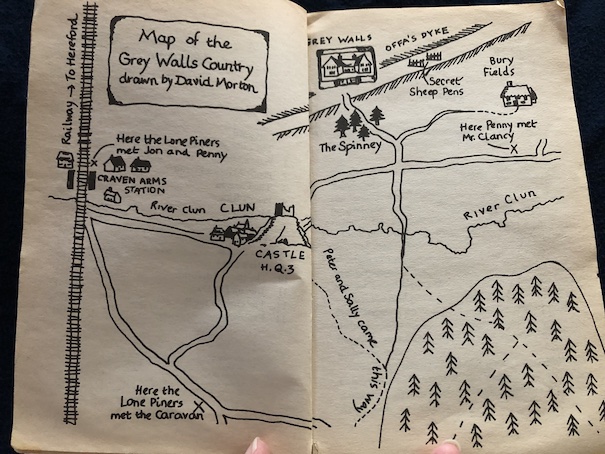
Boarding school isn’t always easy for parents in terms of emotions, and there are hints of that in The Secret Language. We never see Martha’s parents in the book, so we don’t know what’s going on with them, but Victoria’s mother fusses over Victoria when she gets the chance, and she talks about how great it would be if she could arrange things so that Victoria can be home with her all the time again, too. If Victoria’s mother wasn’t a working single mother who has to travel for work, she probably wouldn’t have sent her away to boarding school at all. Miss Denton is very in tune with people’s feelings, and I think that she’s aware of all the complexities in the lives of the girls and their parents. She does her best to look after the girls emotionally, and that’s part of her urging the girls to consider other people’s feelings, to be thoughtful about each other, and to think about the ways they’ve been changing inside as well as outside. I think that the universal nature of the girls’ and adults’ feelings in the book are a sign of the author’s emotional awareness, understanding of how different types of people feel.

Ursula Nordstrom, the author of the book, was actually a famous children’s book editor. She is credited with helping to transform mid-20th century children’s literature to have more of a focus on children’s feelings, experiences, and imagination instead of being morality tales, focused on what adults want children to know or understand. The Secret Language was the only children’s book that she wrote herself. This YouTube video explains about her life and career.