#10 The Mystery of the Silly Goose by Elspeth Campbell Murphy, 1996.
As soon as they arrive home from their trip to the powwow in the previous book, the cousins are approached by Timothy’s neighbor, the snobby 13-year-old Lyddie, with another mystery. While they were out of town, someone went around the neighborhood, stealing lawn ornaments. Lyddie is concerned because her grandmother has come to live with her and her parents, and her lawn geese were stolen. One of the geese was the mother goose with a silly-looking bonnet on her head, and the others were her goslings. Lyddie’s grandmother is rather attached to the geese because they were a present from someone.
The three cousins don’t really like Lyddie because she and her friends are usually unfriendly and too concerned with being “cool” all the time. However, they feel sorry for her grandmother and agree to take the case. To their surprise, most of the lawn ornaments are actually pretty easy to find. They were hidden in some obvious places around the neighborhood. The only ones that are difficult to find are the geese. Who hid the lawn ornaments and why?
The theme of this story is Proverbs 24:3-4, “It takes wisdom to have a good family. It takes understanding to make it strong. It takes knowledge to fill a home with rare and beautiful treasures.”
The book is available to borrow and read for free online through Internet Archive (multiple copies).
My Reaction
Part of the mystery has to do with image, but it also has to do with sentimental attachment. Lyddie is very obsessed with image because she and her friends try so hard to maintain their cool image. Although she calls in the cousins to find the missing lawn ornaments, she only does it because her grandmother takes the loss of the mother goose so hard. Lyddie doesn’t see why the goose is so important, although she knows that her grandmother is attached to it because it was a present from someone.
The situation changes when Lyddie’s grandmother reveals the full story behind the lawn geese and her own understanding of the situation. Lyddie cares for her grandmother, and she comes to see the geese in a new light once she understands why they matter to her grandmother. It’s not the value of the geese, and it’s not about how the geese look. It’s all about the person her grandmother associates with them. Fortunately, Lyddie’s grandmother is a very understanding woman, and when the lawn ornament thief explains the issue, they work things out to everyone’s satisfaction.
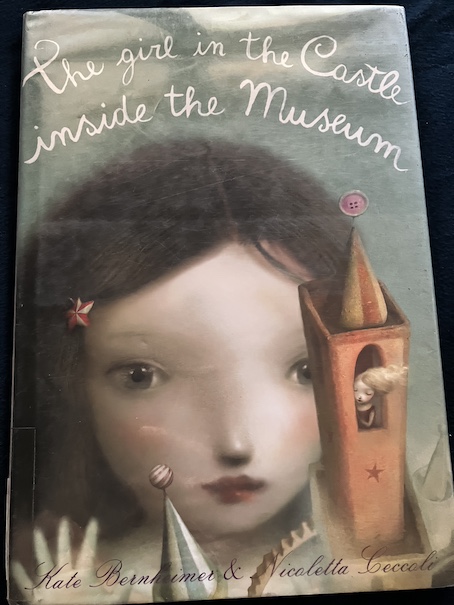
The Girl in the Castle Inside the Museum by Kate Bernheimer, pictures by Nicoletta Ceccoli, 2008.
In this story, there is a little girl who lives in a castle in a museum, inside a big, glass globe.
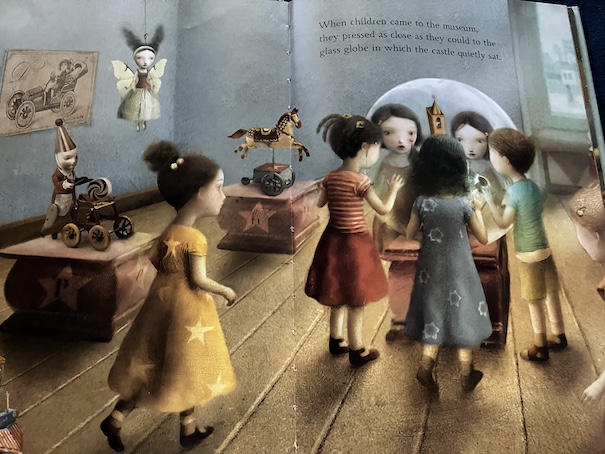
Children love to come to the museum and look at her in her castle. The girl also likes it when the children come to see her.
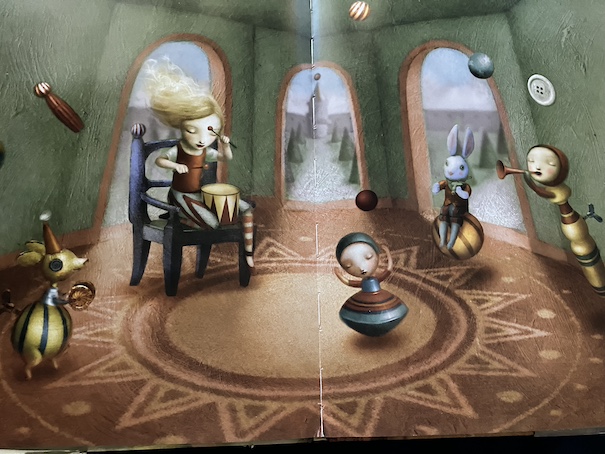
Although the girl in the castle has other creatures to play with and things she likes to do, like making music, she sometimes gets lonely when the museum closes, and all the children go home.
When the girl in the castle dreams, she dreams of the children who come to visit her at the museum, imagining their journeys to come see her.
When the children are visiting or when she’s dreaming about them, the girl isn’t lonely, but when she wakes up from a dream and there aren’t any children, she gets lonely again.
However, the girl gets an idea. If you, the reader, want to be her friend, you can give her your picture. When she looks at your picture, she won’t be lonely anymore!
My Reaction
I love the surreal, fantasy pictures in this book! We don’t know exactly what the girl is or why this tiny girl lives in a miniature castle in a museum. The book says that people claim “she’s lived there forever.” She is alive and has feelings, but she seems to be surrounded by fantasy creatures as companions in her castle rather than other people. She doesn’t seem to have parents or family. My theory is that she is a magical, living toy because the museum seems to be filled with other toys, the fantasy creatures in her castle seem to be toys with little wind-up keys in their backs, and the castle itself incorporates little toys and odd-and-ends, like buttons and marbles. However, the girl’s backstory is left up to the imagination of the readers.
This book breaks the fourth wall of the book, with the girl inviting readers to put their own pictures into the book and saying that the girl can see them through the book when they read it. Readers looking at the book keep the tiny girl company when she doesn’t have visitors to her museum. It’s not the first book that I’ve seen that uses the concept of readers keeping a book character company through their books. There is a book from the 1930s called The Tale of Corally Crothers, where a lonely girl with no brothers and sisters goes in search of a friend and finds you, the reader. (I haven’t found a copy of it myself, but you can see some pictures of this book on this site.) Books that involve the reader and invite the reader into their world are charming, and I found the fantasy elements of this particular book delightful!
This is the second book in the Aviary Hall Trilogy. Each of the books in the series could be read independently of each other, but this book in particular makes more sense if you have read both the first book, which is The Summer Birds, and the third book, Charlotte Sometimes before reading this one. People in this book directly reference events in The Summer Birds, something with Charlotte Sometimes does not. Although Charlotte Sometimes was written and published after this book, it actually takes place during the autumn before this story and it does inadvertently contain a spoiler for Charlotte Sometimes because Charlotte appears at the beginning of the book. It’s just my own preference that it’s better to read this book after Charlotte Sometimes because it makes Charlotte Sometimes more suspenseful. Like Charlotte Sometimes, this book also involves time travel, and the characters do some research on the subject of time and how it works.
At the beginning of the story, Emma Makepeace is upset because her older sister, Charlotte, will be leaving early for the new term at her boarding school after Christmas. At this point, Charlotte has already had her first term at boarding school (which is where and when Charlotte Sometimes takes place, although there are no references to the events of that story here), and she has been invited to visit one of her new friends from boarding school before they return to the school together. All through Charlotte’s first term at boarding school, Emma has been lonely without her and has been finding life at their home, Aviary Hall, increasingly difficult.
The girls are orphans (although the books never explain what happened to their parents) who live with their grandfather and his housekeeper. Between the two of them, Charlotte is the more serious and responsible and Emma is the more mischievous and thoughtless. Up to this point in their lives, Charlotte has acted the part of the caring older sister, trying to teach Emma to behave herself and covering for her when she doesn’t. Charlotte has realized that their grandfather has little patience for misbehaving children and that Emma pushes the limits, so she has frequently intervened and smoothed things over when Emma tries his patience.
Emma has often thought of Charlotte as a kind of spoilsport for trying to act grown-up and mature, but during Charlotte’s absence at boarding school during the previous term, Emma has suddenly come to see how much Charlotte has been helping her and saving her from the consequences of her own actions and the realities of their home life. Without Charlotte there to be the motherly big sister, providing some warmth and affection and acting as a buffer between Emma and the adults, the grandfather has become more impatient with Emma’s immaturity. Both he and the housekeeper have been more direct with Emma about her behavior and bad habits, and there’s no one there to shield Emma from it. Emma is lonely for Charlotte’s company and feels picked on by the adults, so when Charlotte cuts her time with Emma short after her first visit home to go visit one of her school friends, Emma is angry and resentful. Charlotte is tempted to back out of her friend’s invitation for Emma’s sake, but she feels like she can’t, and their grandfather tells her that she must go ahead with the visit.
Emma is in a state of emotional turmoil through most of the story, adjusting to Charlotte’s absence, the new expectations of the adults in her life for her to mature and improve her behavior, and her own resentment about these things. While all this is happening, something else strange happens. Emma begins having strange dreams about flying. They remind her of the children’s flying adventures from two years previously, as described in The Summer Birds. It has been so long since she last flew that she struggles to remember how in her dreams, and when she wakes up, her muscles feel sore from the effort. However, at first, she can’t remember what happened in her dreams.
At school, when the new term begins, Emma is made head girl because she is the eldest girl in the class. A boy called Bobby Fumpkins is made head boy because he is the eldest boy. Emma is embarrassed and uncomfortable about being the head of the class in partnership with Bobby. She hates Bobby because he is fat, awkward, and spoiled. Before his mother gave birth to Bobby’s younger sister, who is still a baby, she babied Bobby more than she really should have at this age. Their family also has their own tv set, something most of the other children’s families don’t have at this time, and which Bobby bragged about when they got it. For these reasons, most of the other children in the class don’t like Bobby, either, and they’ve teased him mercilessly for years. They think he’s a sissy and a baby because of his mother’s attention and because he’s milder-mannered than they are and never stands up to them. Because of his awkwardness, they like to call him Jemima Puddle-Duck after a character from a children’s book by Beatrix Potter. Bobby tells himself that his classmates mean all this teasing good-naturedly, but they don’t really. Emma is particularly adamant within herself that she genuinely hates Bobby.
However, like it or not, Emma’s life has become intertwined with Bobby’s. Their teacher expects the two of them to work together at school during the day, and at night, she gradually begins to realize that he is sharing in her same dream of flying. Other children at school tease Emma about being friends with Bobby, particularly one girl who really wants to cause trouble for Emma because, as the next eldest, she would be next in line for the head girl position herself. Emma denies being Bobby’s friend, partly because he still gets on her nerves and partly because she’s still lonely without Charlotte and is worried by being shunned by the other children at school. However, she gradually begins to feel guilty about the way she and others have been treating Bobby, and she begins to feel the impulse to try to be nicer to him.
As her relationship with Bobby improves, Emma begins remembering more of their shared dream, and the two of them talk about the dream together. Bobby was one of the children at school who shared in their flying adventures two years before, and the two of them discuss their past adventures with each other and how they compare to the dream they’re now having. There are a few things that they begin to notice that are different from their past flying adventures. One is that they both have the feeling that someone is watching them. It seems to be a stern or hostile presence, a pair of eyes that belong to some unknown person, but they don’t know who it is. They also begin to notice that it looks like plants are growing backward as they fly over the countryside. That is, grown plants seem to be returning to small plants and seeds. They gradually notice that the land seems to be going back in time. Eventually, they start seeing dinosaurs in their dreams, and it looks like they might be going back to the beginning of the world. What will happen to Emma and Bobby in their dream when they eventually reach the beginning of everything?
The book is available to borrow and read for free online through Internet Archive.
My Reaction and Spoilers
I’ve already explained my reasoning about the reading order of the books. The Summer Birds is the first book in the trilogy, and you really have to read it before you read this book because the characters directly reference events from that story. Actually, I thought that was a really interesting choice, to have Emma and Bobby talking openly with each other about the summer when they learned to fly. They just accept that event as a common event in their lives that they shared and that everyone who shared it with them openly acknowledges. Sometimes, in children’s fantasy stories, the characters later downplay magical events, feeling like they were dreams they had or games of pretend they played because they seem too strange to have really happened, but no, in this book, the characters all know what happened to them and just accept it as a part of their lives. I thought it was interesting that this book acts as a bridge between the theme of flying and the themed of time travel in Charlotte Sometimes, although I still think that Charlotte Sometimes keeps more of its suspense if you don’t know that Charlotte safely returns to her own time before you read it.
I still think that Charlotte Sometimes is the best book in the trilogy. It is the best known, and unlike this book, it can be read independently of the others in the trilogy. It doesn’t reference either of the other two books at all. There are no references to Charlotte having participated in any previous magical adventures in that story. That may be partly because she is among strangers at her new boarding school who wouldn’t know anything about her flying adventures, but even her private thoughts don’t give any hint to that. What I think that The Summer Birds and Emma in Winter add to Charlotte Sometimes are some further insights into Charlotte and Emma’s personalities and the relationship between them. I still think that Charlotte Sometimes is the best book in the trilogy. It is the best known, and unlike this book, it can be read independently of the others in the trilogy. It doesn’t reference either of the other two books at all. There are no references to Charlotte having participated in any previous magical adventures in that story. That may be partly because she is among strangers at her new boarding school who wouldn’t know anything about her flying adventures, but even her private thoughts don’t give any hint to that earlier adventure. What I think that The Summer Birds and Emma in Winter add to Charlotte Sometimes are some further insights into Charlotte and Emma’s personalities and the relationship between them. Emma in Winter also adds some thoughts about the nature of time and time travel, which add some further insights into Charlotte’s time travel experiences.
Emma and Bobby do some research about time in her grandfather’s study, a room where Emma is usually forbidden to go. One of the theories they find is that time moves in a coiled pattern, like a spring, and that the coils of the spring can be pushed together so different points on the coils can touch each other. This theory really relates better to Charlotte Sometimes than to Emma in Winter, but what is more relevant to this story is the idea that human thought can be the force that pushes the coils together and makes them touch. This is also a part of Charlotte Sometimes, and I explain in my review of that story about how Charlotte and Clare having many similarities and being in a similar state of mind as well as sharing the same physical space at different times allowed them to switch places with each other. However, the emphasis in Emma in Winter is Emma and Bobby realizing that their own thoughts and feelings influence their dreams and, therefore, their time travel.
This story is rather metaphysical and a little difficult to follow during the dream phases. I noticed that some other reviewers seemed confused about the point of the time traveling. I found it a little confusing, too, but it seems like this is a coming-of-age story, like the other books in the trilogy. The Summer Birds focused on Charlotte and how her more mature outlook helped the other children make an important decision that would alter their lives forever. Charlotte Sometimes raises the question about what defines a person’s identity and how a person’s identity can be tied to someone else’s even when they’re separate people. Emma in Winter focuses on emotional understanding.
Both Emma and Bobby are going through major changes in their lives, particularly ones that require them to become more mature than they once were. Bobby has been somewhat spoiled and coddled by his mother, but he’s no longer the center of attention at home, now that he has a little sister. At first, Bobby finds it hard to cope with his mother no longer giving him the attention she used to give him, but it does give him the opportunity to become more independent and mature. Emma despises Bobby for being babyish because he was spoiled and overprotected by his mother when he was younger, but the truth is that Emma is also babyish. She’s not accustomed to being accountable for her own behavior and bad habits because Charlotte usually takes responsibility for her and shields her from some of the reactions of the adults and other people.
When Charlotte goes away to boarding school, Emma is left on her own for the first time to deal with the consequences of her actions and other people’s reactions to them. It’s a bit of a shock for her at first, and she realizes that she hasn’t fully appreciated what Charlotte was doing for her for the whole time. She also comes to the disquieting realization that, even thought she feels like the adults are picking on her over her behavior, she doesn’t like the way she behaves, either. She comes to feel guilty about the way she treats Bobby, and when she draws some nasty pictures of her teacher, she is startled to realize how much she has hurt her teacher’s feelings and how badly she feels about doing that. For the first time in her life, Emma has to face her own behavior and see how her behavior truly affects other people. She is shocked and troubled when she realizes that she doesn’t like what she sees and it’s her own fault. Only Emma can decide how nice or how mean she is and who she really wants to be.
The children’s time traveling adventures that they have while dreaming lead them to explore their relationship with each other. Emma realizes that she has to be nice to Bobby and learn to get along with him for them to be able to function with each other in the dream. Their final dream together is confusing and rather surreal, but it also involves the two of them confronting aspects of themselves, their lives with other people, and their own behavior.
When they move all the way back in time as far as they can go, they’re confronted by a vision of their teacher, not as she actually is, but as Emma drew her in a mean drawing. Emma has to remind herself and tell the figure that it’s only a drawing she made; it’s not reality. They also see visions of other people in their lives and even of themselves at their worst and most frightening, but they have to hold on to the reality of themselves, as they are now, the people they’re becoming, not who they used to be or how other people see them. I took it to mean that neither of them can go backward in their lives anymore, to their old habits and who they were or how they were as younger children, but they have to accept the changes taking place in their lives and in themselves to return to the real world, their own time, and the lives they have ahead of them. They discover that the key to traveling through time is thinking, so they have to think themselves out of their time travel dreams, focusing on their real selves and the real lives, accepting and even loving themselves as they are. Change has been coming for both of them, but they have to make the decision to face it and embrace it and to let go of their past selves to move on in time and in their lives.
Halloween is approaching, and the Sherlock Street Detectives are talking about their costumes. David is going to be a bear, and he made his costume out of an old rug. Pedro is going to be a clown. Walter and Ann, who are twins, refuse to tell anyone what their costumes are because they want it to be a surprise.
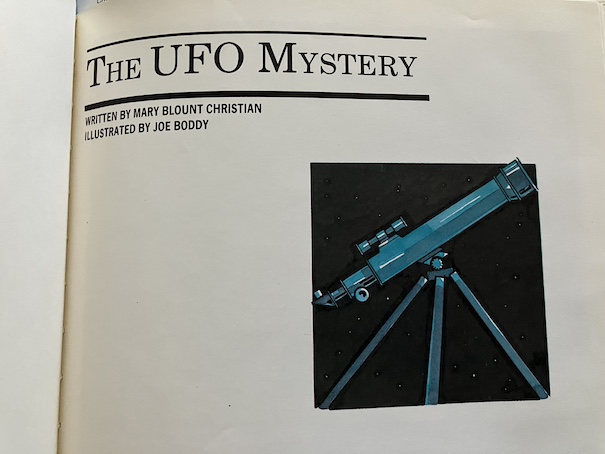
Then, David says that he has to go home because it’s dinnertime, and after dinner, he’s going to look for a comet with his telescope. Pedro says that he’s never used a telescope before and asks if he can look, too. David says he can, and Pedro says that he will come back to his house when it’s dark.
When David and Pedro meet to use the telescope, David shows Pedro how to use a star map to find the constellations. While Pedro is looking through the telescope, he thinks that he sees a UFO! At first, David doesn’t believe him. It’s too early to see the comet, so he thinks maybe Pedro saw a meteor. Pedro insists that it was a UFO, and David points out that UFO stands for Unidentified Flying Object. That means that anything that “unidentified” can be a UFO. Pedro can’t identify exactly what it was he saw, but that only means that he didn’t recognize the object. It doesn’t have to be an alien spacecraft, just some normal thing he didn’t recognize, like a meteor, a comet, or even just a firefly.
Since David’s dad works for NASA, Pedro says that they should ask him if it could have been a comet other than the one they were expecting to see. However, David’s dad confirms that there should only have been one comet that night and that the comet should have been in a different part of the sky. The boys talk about getting Walter and Ann to help them investigate, but then, they see some strange creatures in the bushes!
What did Pedro really see through the telescope, and could those weird creatures really be aliens?
The book is available to borrow and read for free online through Internet Archive.
My Reaction
This is fun mystery picture book! Figuring out what/who the aliens are is the easiest part of the mystery, since this is before Halloween and the twins were being mysterious about what their costumes are, although it might seem harder to young children. The answer to what Pedro thought he saw through the telescope is revealed first, although I wasn’t entirely sure what to think of it myself. At first, I thought that the “aliens” might have been throwing around some glowing toy or something, but they would have to have thrown it really high to get it in front of the telescope because the boys were using the telescope on the roof. There’s a perfectly logical explanation behind the phenomenon, and David figures it out by noting where the object was and it was moving. David’s father confirms David’s guess with a call to NASA.
One of the nice things about this simple mystery story is that it introduces some real concepts for stargazers and amateur astronomers. There is a vocabulary list and glossary in the back of the book.
This series also offers good representations for racial diversity. Racial issues don’t enter into the story. The kids are just a bunch of kids who happen to live in the same neighborhood and are friends and like to solve mysteries, but they are a mixed racial group, and that’s nice to see. David is black, Pedro is Hispanic, and the twins are white. The children’s races are not referred to in the text of the story, but they are shown in the pictures.
A couple of weeks before Halloween, Ernie decides to have a sleepover party for her friends. The kids enjoy scaring each other with ghost stories, and a thunderstorm adds to the spooky atmosphere.
Michael, in particular, keeps insisting that an old witch called Mrs. Maloney used to live in Ernie’s house with a bunch of cats. When spooky things happen during the course of the evening, Michael says that Mrs. Maloney and her cats have returned to haunt Ernie’s house. The kids try to stay up until midnight because ghosts are supposed to appear at midnight, but there’s no telling what they might actually see.
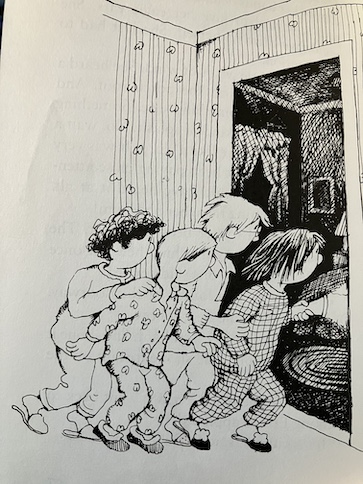
The kids fall asleep, but they wake up around midnight when they hear a crashing sound from the basement. Although they are afraid, they take their flashlights and go down to see what it is. Will they find a ghost?
The book is available to borrow and read for free online through Internet Archive.
My Reaction
This is one of those stories that has a pretty simple explanation, but the adventure seems bigger to the kids because their imaginations run away with them. I remember liking this series when I was a kid, and I think this is one of the books I read back then. I liked the creepy-cozy atmosphere of the story. Even though the kids have been scaring each other with ghost stories, they’re still just at a sleepover in an ordinary, safe house, and there’s nothing there that is harmful. It’s that kind of safe scariness that Halloween represents to young kids. They can enjoy the spookiness, knowing that there’s a logical explanation for everything. Adults and older kids will figure out pretty quickly what’s really going on.
#4 The Mystery of the Green Ghost by Robert Arthur, 1965.
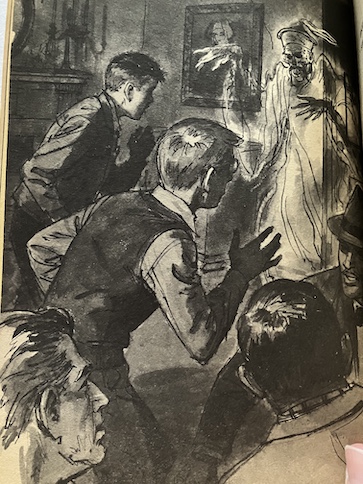
Bob and Pete are looking at an old, abandoned house that’s in the process of being torn down when they hear an unearthly scream from the house! There are stories that the old house is haunted, and the boys run away, only to be stopped by a group of local men, who ask them what’s going on. When the boys explain, the men talk about calling the police or going inside the house to investigate. The men decide to just go in and have a look around themselves, in case someone’s hurt and needs help right away. They tell the boys that they can leave because they will handle the situation, but the boys decide that they can’t leave without having a look themselves.
As they take a look around inside, they see the remains of the ornate wall paper and impressive features of the once-rich house, and the men talk about Mathias Green, who used to live in the house. At first, the searchers can’t find anything, but then, they spot a greenish figure on the stairs. Thinking that there’s some prankster in the house, the searchers go upstairs to confront the person, but they can’t find whoever it was. The boys suggest that they have a look at the dust on the floor and try to follow the person’s footprints, but the only footprints the searchers can find are their own. Could they have seen a ghost?
The searchers do notify the police about what they’ve seen in the house, but the police don’t take it too seriously … at first. However, they soon begin receiving other reports from various people around the city who claim to have seen a greenish, ghostly figure. Even then, the police might not have take the reports too seriously, except that a couple of officers on patrol witness a greenish, ghostly figure in the cemetery … at the burial site of Mathias Green, who died falling down the stairs in his house, 50 years before.
While Bob and Pete were at the house, Bob had his tape recorder with him, and he plays the recording of the scream they heard for their friend and fellow investigator, Jupiter. Jupiter is willing to believe it could be the scream of Mathias Green’s ghost, and the boys review the information they know about Mathias Green. Mathias Green was once the skipper of the ship, and he sailed to China. For reasons that nobody fully understands, he had to leave China suddenly, and the rumors were that Mathias’s wife was a Chinese princess and that Chinese nobles had a grudge against Mathias. Mathias brought his wife back to the United States with him, and they built their house in Rocky Beach after Mathias had a fight with his sister-in-law, and they moved away from San Francisco. They had some Chinese servants, but when Mathias was later found dead, apparently from an accidental fall down the stairs, the servants and his wife disappeared. People assumed that they left for fear that they would be blamed for Mathias’s death, and Mathias’s sister-in-law inherited the house. Recently, Mathias’s niece decided to sell the house to a developer, who is planning to tear it down and build more modern houses.
Local newspapers have picked up the stories about the green ghost and its apparent connection to the old Green mansion, and some of them have implied that the ghost is looking for a new place to haunt now that its house is being torn down. The Three Investigators have access to more information than most people because Bob’s father is one of the reporters covering the ghost incidents. The police chief tells them, off the record, that he witnessed the ghost himself, in the cemetery, and it looked like it disappeared by sinking down into Mathias’s grave. Then, the police chief learns that the workmen tearing down the house have discovered a hidden room. Bob’s father and the boys are allowed to come with him to see what the room contains.
The discovery is a shock. The hidden room contains an ornate coffin, holding the skeleton of Mathias’s Chinese bride, dressed in elaborate robes and with an unusual necklace of gray pearls, called ghost pearls. The story is that the reason why Mathias and his bride had to suddenly flee China was that Mathias reportedly stole the pearl necklace to give to his bride. When she died in Rocky Beach, he couldn’t bear to be parted from her, so he “buried” her secretly in his house, along with the necklace.
The discovery of Mathias’s wife’s hidden burial chamber doesn’t lay the ghost to rest, though. Bob and Pete get a phone call from Mathias’s niece, Lydia, asking them to visit her at the vineyard where she lives, to talk about what they witnessed at the house. She says that the ghost has actually appeared at her vineyard! Jupiter is not invited to the vineyard because he didn’t witness the appearance of the ghost with the others, but he couldn’t go anyway because he’s temporarily in charge of his uncle’s salvage yard while his uncle is out of town. He tells Bob and Pete to go ahead and meet with Lydia and let him know what they learn.
At the vineyard, Bob and Pete meet Lydia’s distant cousin, Harold, and Lydia’s great-nephew, Charles, who is actually the great-grandson of Mathias Green and the real heir to Mathias’s estate. Charles, who is called Chang, grew up in China, and they explain that he is descended from Mathias’s first wife, who died of an illness in China. After the death of his first wife, Mathias put his young son into an American missionary school in China and left him there as a boarding student. When he married his second wife and had to flee China, he left his son behind. His descendants remained in China since then, until it became unsafe for Americans or people of American descent in China. Then, Charles, who is an orphan and part Chinese (hence his nickname of Chang), was sent to live with Lydia in the United States. Until that point, he knew very little about his ancestors and his relatives in America. Technically, Mathias’s estate should have come to Chang’s side of the family when Mathias died, but they were living in China at that time and were not in touch with the rest of the family. Lydia says that Chang should even technically own the vineyard that she and Harold have built with the family’s money, but Chang doesn’t want to take it from them, so Lydia says that she is leaving it to Chang in her will. Chang is satisfied with this arrangement, but the family has debts, and if they don’t resolve them, they might lose the vineyard entirely.
Lydia believes that the green ghost is Mathias’s ghost, and he is haunting them because he’s angry with her for selling his old house to be torn down. The ghost has been scaring away workers at the vineyard, and if they can’t get the harvest processed, they won’t be able to keep the vineyard. However, Chang doesn’t believe that his great-grandfather would want to hurt his own family. Chang might be willing to believe that the ghost is an evil spirit, masquerading as his great-grandfather. That’s not the only possibility, though. There could be a human being with a motive for wanting to ruin the vineyard. Then again, there is the question of who really owns the ghost pearl necklace. If Mathias’s family owns the necklace, they could sell it to cover their debts, but it might really belong to the family of Mathias’s Chinese wife. Her family is more difficult to trace, but one person has stepped forward, claiming to be her heir. Then, someone attacks Harold and steals the necklace from him. Was the necklace always the ghost’s target, from the beginning? Meanwhile, back in Rocky Beach, Jupiter has a revelation. There was a dog present when Bob and Pete were searching the Green mansion with the men, and the dog … didn’t do anything. That might be the most important clue of all!
The book is available to borrow and read for free online through Internet Archive (multiple copies, including some in other languages).
My Reaction and Some Spoilers
I enjoyed the mystery and the reference to Sherlock Holmes about the dog that did nothing in the nighttime. In this story, Jupiter takes the dog’s non-reaction as a sign that there was no supernatural presence in the house because animals are supposed to react to the presence of ghosts. There is definitely a human behind all the spooky happenings, and I was partly right about who it was. However, the author threw in a complication by inserting another mysterious villain who kind of usurped the original plotter’s plot for his own purposes and partly distracts the characters from the original villain for part of the story.
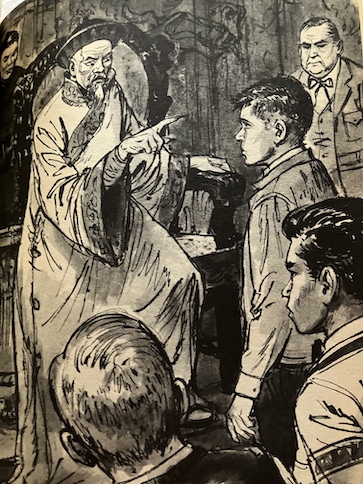
This added villain is a mysterious old man from China who claims that he’s 107 years old and that he wants the pearls because drinking dissolved ghost pearls is the key to immortality. This mysterious old man is wealthy, and he has bought up the family’s debts, meaning that he will get control of the vineyard, if they can’t pay their debts. However, he’s not really interested in the vineyard for its own sake. He just wants those pearls. Although he does some criminal things in the story, nothing much seems to happen to him at the end, and he works out a deal with Lydia, so she can keep the vineyard. It’s left open whether or not he truly ended up with the pearls or whether the pearls actually have properties for preserving someone’s life, but it seems that he truly believes it, and he has no other motivations for his part in the story.
This almost Fu Manchu style character, who uses hypnosis to control people, adds an element of exoticism to the story that I thought wasn’t really necessary. I liked the ghost mystery well enough with its original villain and without him, and I felt like the introduction of the extra villain sent the plot a little off the rails, but he does allow the story to end on a somewhat creepy and ambiguous note. We don’t entirely know who he is, and we never really find out what happens to him. We don’t know if he’s really as old as he says he is or if he continues much further in his quest to live forever. He just disappears after getting what he can of the pearls, presumably to go hunting for more elsewhere.
As far as I’ve been able to determine, the ghost pearls aren’t real, and the legend about them prolonging people’s lives isn’t real. However, there are legends and superstitions from around the world about pearls being associated with wisdom and longevity and having healing powers. Pearls can be dissolved in an acidic liquid and drunk by a human, as in the famous story about Cleopatra drinking a pearl in vinegar, which was supposed to be an aphrodisiac.
Getting back to the mystery, though, I did like the Scooby-Doo-like mystery, and I was satisfied by the original plot, and the villain’s methods and motives. I was looking at that character with suspicion for a number of reasons. Perhaps, if the part about the pearl necklace, the ancient man who drinks pearls, and Mathias’s bizarre room with his dead wife weren’t in the story, the solution would be too obvious, but overall, I enjoyed it. I also appreciated how Jupiter worked out some of the details of the first haunting by visiting the house and studying the scene while his friends were at the vineyard. He comes to some conclusions about how that first haunting occurred that Bob and Pete didn’t think about, and his solution also provides a reasonable answer to the question of why that group of men happened to show up outside the house on the evening the haunting happened, to witness it.
The Case of the Phantom Frog by E. W. Hildick, 1979.
Mrs. Kranz, an elderly sculptor, has been looking after her nephew’s 7-year-old son, Bela, because his parents were in a car accident and are still in the hospital. She consults the McGurk Organization because strange things have been happening since Bela came to live with her. At first, she is reluctant to say what is really bothering her. She was referred to the McGurk Organization by Willie’s mother, and she frames her request as hiring the kids to watch Bela while she’s working. McGurk turns down the offer, saying that the oldest members of the McGurk Organization are only 10 years old, not really old enough to babysit, and babysitting isn’t the kind of job they handle anyway. Wanda tries to refer Mrs. Kranz to a regular babysitter she knows, but Mrs. Kranz is strangely desperate and insists that she wants the McGurk Organization.
Because they’re reluctant to accept the job, Mrs. Kranz finally admits that there is a mystery connected to Bela. She starts by telling them that she’s afraid of frogs, like some people are really afraid of bugs or rats or other creatures. Ever since Bela came to stay with her, Mrs. Kranz has been hearing an unusually loud frog sound in her house, particularly in the evening, after Bela is in bed. Bela insists that he never hears it, but it’s giving Mrs. Kranz the creeps. She’s tried to search the house as best she can, but she can’t find the frog anywhere. It’s not the kind of thing that she can go to the police about, but it’s driving her crazy. The real reason why she wants the McGurk Organization to spend time with Bela is to see if they hear the frog, too, and if they can figure out where it is.
This time, McGurk is intrigued enough to accept the case, plus Mrs. Kranz offers them a larger fee for their services than they usually have. They consider the idea that Mrs. Kranz could be making up the story about the phantom frog she hears just to get them to accept her babysitting job, but they decide that isn’t likely, both because of the generous amount of money she’s paying them and because she seems genuinely frightened.
When they get to Mrs. Kranz’s house, it’s a big place that looks almost castle-like, and it’s surrounded by trees. Mrs. Kranz invites them in and introduces them to Bela. Bela was born in Hungary, where Mrs. Kranz was from originally. He doesn’t seem glad to meet the members of the McGurk Organization. In fact, he tries to ignore them and talk to them as little as he can. He doesn’t really want to talk to them about the frog when they ask him about it. He just says that maybe he’s heard a frog and that his aunt has frogs on the brain.
McGurk is annoyed with the kid, so he teases him about his name, saying that Bela sounds like a girl’s name. Bela defends his name, saying it’s Hungarian. Joey tries to defuse the situation, saying that Bela Lugosi was a famous actor in old horror movies, and he was also Hungarian. McGurk is intrigued by the mention of old horror movies because he loves them, and he starts asking Bela about whether there are things like vampires and werewolves in Hungary. Bela says that monsters are just stupid kid things. Brains is inclined to agree with Bela because there’s no scientific evidence that such things exist, and McGurk gets irritated with both of them.
When McGurk consults with the other members of the organization about Bela, he says that he thinks Bela is hiding something. His theory is that Bela is making the frog sounds himself to scare his aunt as a prank and that his hostility toward their presence and their questions is to cover up for what he’s doing. Wanda takes a different view because she thought that Bela seemed scared of something when they were talking to him, and she thinks that Bela is covering up his fear. Maybe he’s afraid of the frog or the frog sound and doesn’t want to admit it. Brains thinks that the sound could have some ordinary explanation, like sounds from the plumbing system that have been misidentified.
Aside from his hostility toward their questions, Bela seems like a well-behaved kid to watch. When it’s time for bed, he doesn’t argue with the older kids or make a lot of special requests or excuses to stay up later. In fact, he seems eager to go to bed. His only requests are that they leave the lights on and the window slightly open for air. As soon as Bela is in bed, the members of the McGurk Organization station themselves at strategic points around the house, waiting to see what they can hear and where it seems to be coming from.
They do hear the frog, and it sounds unnaturally loud, like it’s a monster frog! Most of them aren’t sure where the sound came from, but Brains is pretty sure that it came from Bela’s room. When they go inside, Bela seems like he’s asleep, and they don’t see a frog anywhere. They’re convinced that Bela is faking that he’s asleep, although Bela puts on an act like he was really asleep. McGurk knows that he must have been awake while they were out of the room because they left the light on for him, and when they first entered the room, the light was off. At some point, Bela must have gotten up and turned it off himself, although they don’t know why he would do that. For some reason, he also shut his window.
It seems pretty clear that Bela has something to do with the frog noise. The next night, they rig up a microphone in Bela’s room so they can monitor the sounds there. When they hear a loud frog sound, they hurry up to Bela’s room and find a frog sitting on his pillow .. and there is no sign of Bela! McGurk stuns the others when he makes the announcement that Bela is a werefrog! McGurk thinks that Bela has the transformation powers of a werewolf, but he’s turning into a frog instead of a wolf. They go to the kitchen, where McGurk finds some garlic, and when they return to Bela’s room, the frog is gone, and Bela is back in bed. Is Bela really a werefrog, or is there another explanation for what’s happening?
The book is available to borrow and read for free online through Internet Archive.
My Reaction
I remember reading this book when I was a kid, and I did a book report on it for school. I even did a little diorama about the story that looked like Bela’s bedroom, with a little frog made out of modeling clay. It was cute, but I can’t show it because I don’t have it anymore.
I found the story pleasantly creepy when I first read it as a kid. Even though I was sure that there must be some logical explanation for the phantom frog and Bela’s apparent transformations, I honestly wasn’t sure what it was at first. The mystery isn’t that complicated for an adult, but it’s creepy and mysterious for a child.
It sometimes seems to me that kids in the McGurk books are a little mean to each other and call each other names too much. I didn’t like it that McGurk was teasing Bela about his name in this book. However, it does serve a purpose in this story because the discussion of Bela’s name is what introduces the mention of Bela Lugosi and the idea that there might be a supernatural explanation for the phantom frog and that Bela might be a werefrog. Mrs. Kranz doesn’t suggest that idea to the kids when she first consults them about the frog. McGurk is the one who thinks of it because he’s really into old horror movies, and Bela being Hungarian, like Bela Lugosi, suggests a connection to the supernatural to him.
Not all the others are really as convinced as McGurk is, but they are creeped out by the phantom frog that appears and disappears and Bela’s odd behavior. Brains is the least convinced of everyone that there’s a supernatural explanation for the frog, reminding everyone that he invented an “invisible dog” in a previous book. He knows that it’s possible to create some pretty convincing illusions. He’s the one who convinces McGurk to investigate the possibility that Bela is faking everything somehow.
I like to take note of times when characters in books reference pieces of pop culture from the time when they were written. At one point, the kids in the story are watching a Peanuts special on tv, based on the characters from the comic strip. That comic strip was still being written and published at the time this book was written, and I remember watching Peanuts specials on tv myself as a little kid in the 1980s.
The Case of the Invisible Dog by E. W. Hildick, 1977.
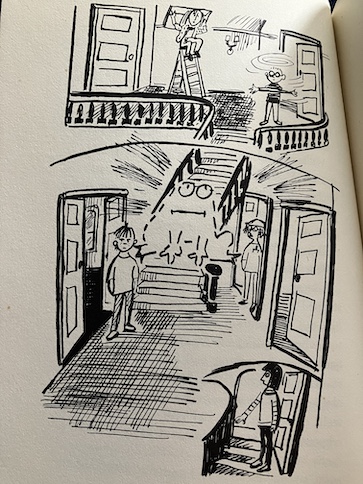
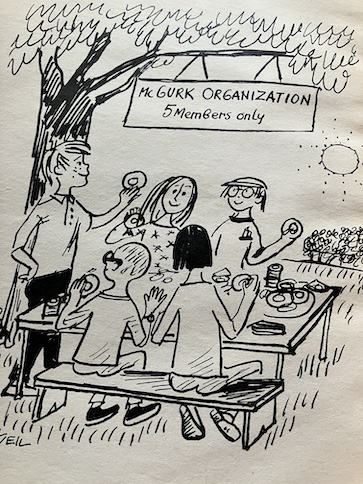
The members of the McGurk Organization are having their annual picnic in McGurk’s backyard when, suddenly, a doughnut leaps off the table and begins traveling through the bushes and grass. None of them can understand what’s happening because they can’t see anything that would cause the doughnut to move like that.
They go after the doughnut to see what happened, and they find Brains Bellingham, the nephew of Miss Bellingham, who lives next door. Brains has been staying with his aunt while his parents are out of town, and he always has a put-down for the members of the McGurk Organization. Brains is holding his aunt’s Yorkshire terrier, Dennis, and the missing doughnut, which has apparently been chewed by the dog. Brains apologizes for the dog ruining their “crummy” picnic, but he says that Dennis can’t resist doughnuts. However, that explanation doesn’t satisfy the McGurk Organization because none of them saw a dog carrying the doughnut, just the doughnut moving by itself. Brains makes an excuse about the dog being small and blending in with his surroundings, but the others can tell that he’s hiding something.
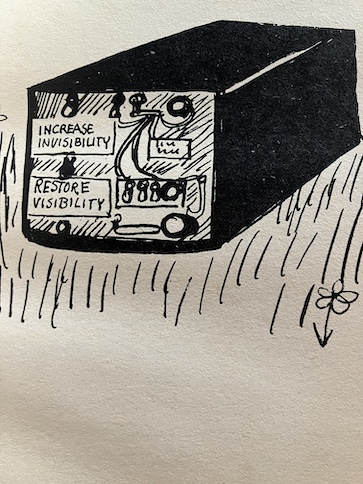
When Brains leaves for a moment because he says his aunt is calling him, they spot a strange black box in the grass. The box has dials and switches on it, and there are two labels: “Increase Invisibility” and “Restore Visibility.” Brains is known for building various inventions, so they know this is probably something he made, but does this device really make things invisible? Is that why they couldn’t see the dog when he stole the doughnut? They have a look inside the device, but since none of them is particularly good with electronics, they just know that it contains a bunch of wires and seems to be powered by batteries, and there is some kind of light inside the box. There are also doughnut crumbs inside the box.
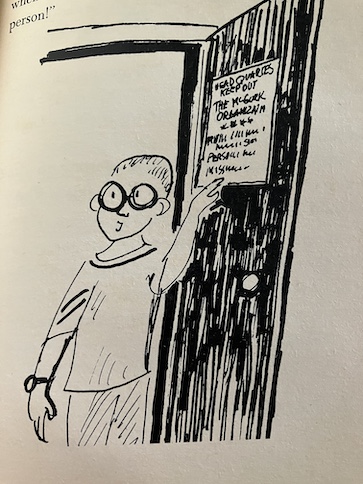
When Brains sees them messing with the box, he yells at them to stop snooping. Joey, the organization’s secretary, knows that part of Brains’s problem with the organization is that he’s jealous because he really wants to join. He’s hinted before that they need a laboratory man to help them with forensics. McGurk might have taken him up on the offer except that Brains was condescending and insulting in the way he made it, calling them “dummies.” He’s a little younger than the rest of them, too, so his condescending attitude makes him seem even more like an annoying little kid. McGurk tries to ask Brains about his strange device, but Brains just refuses to answer and takes the box and the dog away.
The members of the McGurk Organization return to their picnic, but they can’t stop wondering about Brains, his strange invisibility device, and how he accomplished the trick with the dog and the doughnut. Most of the organization members are pretty sure that there must be some kind of trick to it, but they can’t figure out how Brains did it. While they discuss it in their basement meeting room, they hear what sounds like the jingle of dog tags, and Willie, who has a very sensitive nose, says that he smells a dog. They search the basement and find a dog’s rubber bone. Then, Brains shows up, looking for Dennis. To their astonishment, Brains seems to pick up an invisible dog, who seems to be struggling and making dog noises, growling and jingling tags!
When the organization goes to confront Brains about what just happened, they find him with his strange box. The box appears empty on the inside, but they hear dog sounds from it. Brains operates the controls and opens the box again, and Dennis comes out! Brains claims that he invented the invisibility box by accident while he was trying to develop a treatment for getting rid of Dennis’s fleas and ticks using light rays. Brains says that there is a side effect where Dennis sometimes turns invisible at random times without Brains intentionally turning him invisible but that he’s working on the problem.
McGurk is thrilled at the possibility that Brains might be able to build a machine big enough to turn a person invisible, and he even offers Brains membership in the organization if he can do it. Brains says he could, but to everyone’s surprise, he turns down the membership offer. He says that he knows they don’t really want him in the organization; they just want his machine. It’s a little embarrassing, but it’s true.
The members of the McGurk organization consider ways that they could get Brains to change his mind. McGurk considers blackmail, but Wanda says that wouldn’t be right for a detective organization. Wanda thinks McGurk should apologize to Brains for the way he turned Brains away when he tried to join earlier, but McGurk can’t stand the idea of apologizing. Willie thinks they could offer to pay Brains, but they don’t really have anything they could pay him. They all ponder what would happen if they let word of Brains’s invention get out to the public or even the government.
Then, Brains comes to them, asking for help. He says that Dennis has turned invisible again, and he’s run off! Can the McGurk Organization find an invisible missing dog?
The book is available to borrow and read for free online through Internet Archive (multiple copies).
My Reaction
I didn’t read this book when I was a kid, although I read many others in the series. Because I didn’t read this book before, I didn’t really know the story of how Brains joined the McGurk Organization. There are some references to it in some of the later books in the series, so I knew that, when the other members of the organization first met Brains, they were investigating him for some trick he’d played on them. I was used to Brains being their friend, so it seemed odd to see him as the antagonist/suspect they are investigating in this book.
During the story, the members of the McGurk Organization are pretty sure from the beginning that Brains is playing some kind of trick, but they’re not sure how. He does manage to convince them temporarily that he has successfully developed an invisibility device, but McGurk soon realizes that something Brains has said contradicts what’s happened. Then, he and the others reexamine what happened to figure out how Brains staged his tricks. They’re a little mad at being tricked, so they pull one more trick on Brains to get even before they all forgive each other. Brains shouldn’t have called the others “dummies” or been condescending to them, and the others shouldn’t have been too quick to write him off just because he’s a year younger than they are. In the end, McGurk says that anybody who’s clever enough to work out a complicated trick like this one deserves to be a member of the organization, and they hold another picnic to celebrate their new member.
The Case of the Bicycle Bandit by James Preller, 2001.
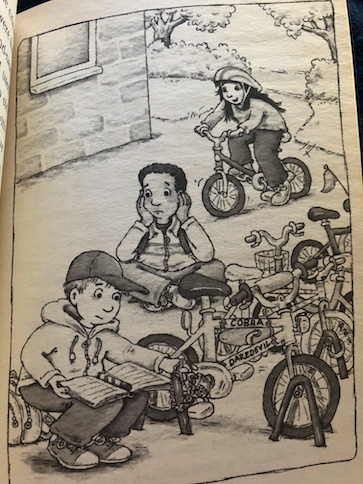
Jigsaw Jones and his friend, Ralphie, have to go to the library to get books for a book report at school. While they are at the library, somebody steals Ralphie’s bike!
First, it’s strange that Ralphie’s bike was stolen because Ralphie is sure that he locked it up using the same chain that he used to also lock up Jigsaw’s bike. How could someone take a bike that was chained up, and since the two bikes were chained together, why is Jigsaw’s bike still chained up, as if the lock was never opened?
Second, if someone could get the chain open to take one of the bikes, why did the thief take Ralphie’s bike? Jigsaw’s bike is new and in good condition, while Ralphie’s bike, which he calls “Old Rusty”, is old, beat-up, and always breaking in some way. Ralphie is fond of “Old Rusty”, which was a hand-me-down from his older brother, but if some stranger had a choice of stealing one of two bikes, wouldn’t it make more sense to take the one that’s in better condition?
Jigsaw Jones calls his friend, Mila, to help him investigate and find Ralphie’s missing bike, and they get some help from a classmate who is good at drawing portraits to interview witnesses and do sketches of suspects. Their most likely suspect is a skateboarder whose face nobody saw clearly. But, how did the skateboarder know how to open the lock on the bike chain, and why did he take only the old bike and lock up the newer one again?
The book is available to borrow and read for free online through Internet Archive (multiple copies).
My Reaction
Books in this series are easy, beginning chapter books with pictures that accompany the story. The mystery in this book is pretty simple, although it might seem more difficult to younger readers. I liked the way the characters reasoned it out, logically confronting the problem of how the thief opened the bike chain and why the thief took the older bike instead of the new one. I also enjoyed their use of an amateur sketch artist to find one of their suspects.
Even after Jigsaw does a stakeout and realizes who is responsible for taking the bike, he doesn’t seem to quite understand the motive until the thief explains it, although the motive was what I figured it was. Revealing the culprit in this book also includes a spoiler for an earlier book in the series.
I was amused when Jigsaw said that he charges a dollar a day for his detective services. At first, I thought that shows the inflation that’s happened since Encyclopedia Brown charged his clients a quarter. Then, Jigsaw checks out an Encyclopedia Brown book from the library, showing that Jigsaw is familiar with the books and also giving kind of a nod to an earlier boy detective who may have somewhat inspired this series. I always appreciate children’s books that reference other books.
It’s Pet Day at school, and twins Walter and Ann are bringing their dog, Watson, and their cat, Fuzz Face to school with them. Watson is really Walter’s dog, and Fuzz Face is Ann’s cat. The school bus is chaotic and noisy because the other children have their pets with them, too.
At school, each of the kids tells the rest of the class about their pet. When it’s time to go to lunch, the kids give their pets food and water and leave them in the classroom.
When they come back from lunch, a pair of hamsters are missing, and their owner, Tina, thinks that Fuzz Face might have eaten them. Ann points out that Fuzz Face couldn’t have eaten the hamsters because Fuzz Face was in his cage during lunch.
The kids figure that the hamsters are probably hiding somewhere in the room, and they ask Tina to tell them everything she knows about the hamsters so they can find them. They use what Tina tells them about the habits of hamsters to figure out where they are.
The book is available to borrow and read for free online through Internet Archive.
My Reaction
It’s a fun picture book mystery, but it’s also educational, like other books in the series. The information the kids give about their pets is true. Some of them say where their pets originally came from, like Pedro, who says that his pet parrot is a breed that comes from South America. Ann mentions that her cat takes vitamins and has to go to the vet sometimes, like people have to visit their own doctors. I liked how the characters use facts about the behavior of hamsters to figure out where the hamsters went.
I was a kid about the age of the characters at the time this book was published, although I don’t remember reading this book at the time. When I was in kindergarten, the year before the book was published, we had a special pet event in my class, but we didn’t do it like the class in this book. As I recall, different people brought in pets on different days so it was less chaotic and there was no chance of one pet eating another, which is a real risk. Also, all pets had to be in cages to keep them from running away or causing trouble, and they were never left unattended. My mother helped me bring our pet birds to class, and she took them home with her immediately afterward, so they weren’t left sitting around the classroom.
The book has a vocabulary list and glossary in the back.