Shadow in Hawthorn Bay

Shadow in Hawthorn Bay by Janet Lunn, 1986.

Mary (or “Mairi,” they spell it both ways) Urquhart and her cousin Duncan had always loved each other.  They were always close as children, feeling more like two parts of one person than separate people, and they always imagined that they would spend the rest of their lives together.  Then, Duncan’s parents, Mary’s Uncle Davie and Aunt Jean, decided that they wanted to travel to Canada, while Mary and her parents stayed at home in the Scottish Highlands.  Duncan hadn’t really wanted to go.  He was only eleven, and he promised Mary that when he was older, he would work hard to earn enough money to come back.  However, Duncan never came.  He only sent Mary a brief letter about the dark forest where he now lives.  Mary feels like the Duncan she knew is gone forever.

Four years later, in 1815, when Mary is fifteen, she has a strange feeling, like Duncan is calling to her from across the ocean.  All of her life, Mary has had a strange gift for seeing into the future or reading others’ minds.  The “gift of two sights,” people call it, but Mary doesn’t feel like it’s a gift.  It makes her uneasy, and she can’t control it.  She hears Duncan’s calls to her through her “gift,” but she is afraid because she doesn’t want to leave Scotland.  She wants Duncan to come to her.

However, she is unable to resist Duncan’s calls.  She asks her parents for help with money for her passage to Canada, but they tell her that she is wasting her time and that, even if they sold their family’s most precious heirloom to give her the money, there would not be enough for the return journey.  A family friend gives her the money instead, and although Mary doesn’t really want to accept it and doesn’t really want to go, she can’t help herself.

The journey to Canada is miserable, and when she finally arrives at the place where her aunt and uncle live, alone and without money, she learns something which she thought she had sensed during the journey: Duncan is dead.  Duncan committed suicide while Mary was still on the ship to Canada.  Mary has arrived too late.  To make matters worse, one of the family’s neighbors, Luke Anderson, tells her that her aunt and uncle gave up the idea of farming in Canada and have already begun the journey back to Scotland.  Mary has no money to follow them, and they have no idea that she’s now in Canada, alone.

Luke takes Mary to Mrs. Colliver, who tells Mary a little about her family and their life in Canada and why they decided to leave.  Mary is devastated by the loss of Duncan and tries to tell Mrs. Colliver about how she felt that Duncan had been calling out to her, but Mrs. Colliver tells her that she doesn’t believe in ghosts or things like that.  Although Mary knows that her “gift” is real and so are spirits, she learns that others in the community share Mrs. Colliver’s no-nonsense, disbelieving attitude toward such things.  Mary, in her despair, wants to rush straight back to Scotland, but Mrs. Colliver, with her practicality, points out that Mary can’t possibly get there without money.  She tells Mary that she can stay with her family, that she will give her room and board in exchange for help with chores and that she can earn extra money for weaving and spinning.  Mary is clumsy at household chores because she was always better with animals at home, but when Mrs. Colliver sees Mary’s skills with animals, she is appreciative.

Life is hard in the small farming community.  Mrs. Anderson, Luke’s mother, explains to Mary that most of the people who live there are refugees.  When they were young, their families moved there from the Thirteen Colonies that now make up the United States because they were Loyalists.  When the Revolution came, they couldn’t stay, and so had gone north to Canada, where they struggled to establish a new community for themselves with their small homesteads. During her time there, Mary witnesses the death of a baby and the hardships of this strange place, seeing why Duncan didn’t like it there.  They tell her that Duncan was a strange boy who would seem bright and happy one day, but black with depression the next, something Mary remembers in him even before he went to Canada. 

The people are kind and welcoming to Mary, although they find her a bit strange.  As Mary struggles to make a life for herself, hoping to earn enough money to return home, she slowly comes to appreciate Luke’s kindness and help.  She learns healing arts and the use of herbs from another woman in the community, developing new skills.  In helping others, she earns their appreciation and a place in their community.  Luke Anderson becomes very fond of Mary, but she still mourns for her lost Duncan.  In spite of his kindness, she doesn’t see how she can make this strange, hard, dark forest of Canada her home, where it doesn’t even seem like the spirits she believed in and that seemed to protect her when she lived in Scotland exist.

Mary is melancholy and feels like she doesn’t belong in Canada.  It distresses her that she can no longer feel Duncan’s presence . . . although she can oddly hear him calling to her sometimes.  Mary also unnerves people when she makes predictions that come true and speaks about ghosts and spirits.  When she almost gives in to her homesickness and depression and kills herself, lured to the spot where Duncan drowned himself by his ghostly calls to her, she finally sees Duncan’s death for what it really was and finds the courage to refuse to follow him down the dark path that he chose for himself and to fight for the life she has been building, the one she really wants to live.

The book is available to borrow and read for free online through Internet Archive.

My Reaction

This book is part of a loose trilogy, involving ancestors and descendants of the Anderson and Morrisay families.  All of the books take place in or near Hawthorn Bay in Canada, but at different time periods.  Some of the characters are psychic, like Mary, or have the ability to travel through time, like Susan in The Root Cellar, who is apparently Mary’s granddaughter.  The connection between Mary and Susan is never stated explicitly, but it’s implied by their last name, shared psychic abilities, and comments that a friend makes about Susan’s grandmother in The Root Cellar.  In this series, the characters from each of the books generally don’t appear in any of the others (except, perhaps, for Phoebe, who appears briefly in this book and is the main character in the third story).  Most of the time, you only know about the family connections by reading the books and taking note of the last names.  The books go backward in time as the series progresses, and the connection between the Anderson and Morrisay families is only obvious in The Root Cellar.

With the deaths that occur in the book, discussions of suicide, and the influence of Duncan’s selfish, malevolent spirit, this is not a book for young kids. I’d say that readers should be middle school level or older. There is also some implied sex and pregnancy out of wedlock when one of Luke’s brothers gets one of Mary’s friends pregnant. Her friend doesn’t give the details of what happened, but from what she says, it’s implied that Luke’s disreputable brother forced himself on the girl and that she went along with it because she didn’t know what else to do. The description of that incident is minimal, but older readers will understand what happened. There is a scandal in the community because of it, and the disreputable brother leaves rather than face the consequences of his actions.

Themes and Spoilers

I enjoyed the book for its references to Scottish folklore, which Mary believes in and seems to be in touch with through her “gift” and for Mary’s growing confidence in her abilities and more mature understanding of what her cousin was really like and what her relationship with him really was.  In some ways, I do feel sorry for Duncan because he seems to have been suffering from some kind of mental illness, possibly bipolar disorder or manic depression, which would explain how his moods could shift so abruptly and dramatically.  However, Duncan was also a selfish and controlling person.  Although Duncan’s death was sad, Mary realizes that his end was of his own making, and it’s not the future she wants for herself.  There are some disturbing scenes in the story.  Mary witnesses the deaths of others, including a baby, because it is a harsh environment, where people sometimes succumb to sickness or bad weather, although these deaths are not described in too much detail. 

There are also some frightening moments, like when Duncan’s ghost almost convinces Mary to kill herself and when he similarly lures a young boy, Luke’s younger brother, to the spot where he drowned and almost kills the boy because Mary finds the little boy comforting and Duncan doesn’t want her to be comfortable and happy.  In the beginning, readers see Duncan through Mary’s fondness for him, so the true darkness of his personality isn’t immediately apparent, although I had some misgivings about him from Mary’s first description of how they played together as children.  I didn’t like the way she described how he would tease her until she became angry or hurt and then he would sulk until she comforted him.  She says that wasn’t really fair, but to me, it was disturbing because I have seen that kind of selfish personality before, and it’s never a good sign.  It shows right from the first that Duncan doesn’t really care about Mary’s feelings.  He cares only about his own feelings, and he has no interest in changing his behavior out of consideration for her.  In fact, the very idea that he should consider her feelings seems somehow insulting to him, even though he supposedly loves her.  He just thinks that she needs to reassure him that everything he does is fine whether it is or not.  In his view, Mary is obviously wrong to feel hurt even when he tries to hurt her because he has more right to his feelings than she has to hers and he should be able to behave any way he wants with no consequences.  That’s what Mary’s first description of Duncan said to me.  As soon as I saw that, even though some might consider it just the actions of an immature child, I had some suspicions about him.

My suspicions were somewhat confirmed before Mary left home. Her mother told her that she didn’t think Duncan was worth chasing after, calling him sulky and thoughtless, but the full truth of that doesn’t strike Mary until she confronts his spirit where he died. Because people in Canada don’t like to talk about Duncan much, when Mary first hears about his death, it isn’t immediately clear that he killed himself or how.  At first, it’s just somewhat implied, but when Mary is almost lured to her death, she sees the full truth about Duncan. 

Mary comes to realize that, although everyone, including Duncan and herself, felt like the two of them were two parts of the same person, they really weren’t.  Mary sees that not only can she live without Duncan, she has been living without him for years.  She lived without him for a time in Scotland, and she’s been living without him in Canada, and she can continue to live without him wherever she chooses to live the rest of her life.  When she was younger, she had thought of Duncan as being the stronger of the two of them because he was not plagued by the same “gift” she was, but she realizes that she is actually the stronger of the two of them.  Duncan’s “love” for her had also always been a selfish one.  He couldn’t bring himself to work hard and return to Scotland for her sake, but he expected her to give up everything, even her own life, to join him in Canada and in death.

When Mary realizes all of this, Duncan’s spirit loses its hold over her, and she comes to see that the darkness in him was darker than the forests that had seemed so frightening to her before.  Free from the shadow of Duncan’s death and his selfish spirit, Mary is able to see the beauty of Canada and to be more open to the good people around her, forging a new future with a better man.

Twin Spell

This book was originally called Twin Spell but was renamed Double Spell in reprintings.

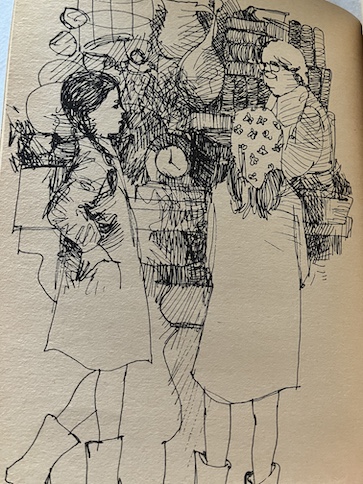
Elizabeth and Jane Hubbard, a set of twelve-year-old twins, can’t really explain what made them stop to look at the little wooden doll in the window of the antiques shop.  Ordinarily, they probably wouldn’t have noticed it at all, but something seemed to draw them to it while they were supposed to be going home to look after their little brother.  The woman in the shop wasn’t going to sell the doll to them, either, but for some reason, she said that she felt that she ought to do it because it seemed like the doll belonged with them.

Buying the old doll starts off a chain of mysterious events in the twins’ lives.  On impulse, still forgetting that they’re supposed to go home and baby-sit, the girls decide to visit their Aunt Alice and show her the doll.  Aunt Alice had been living in England, but she had recently moved back to Toronto to live in the girls’ grandmother’s old house.  Aunt Alice doesn’t know what to think of the doll, except that it might be worth something as an antique.  She shows the girls around their grandmother’s old house, but Elizabeth has a sudden fall down the stairs, breaking her leg.  Strangely, a week later, Aunt Alice suffers a similar accident, breaking her hip.

Because of her accident, Aunt Alice decides that the big old house is a bit much for her to handle, and she tells the twins’ parents that they can have it to live in instead.  With five children in the family, including the twins, they could really use the larger house, and the children are excited about going to live there.

The twins find themselves thinking of odd things, as if they were old memories.  They suggest taking a “sick basket” of goodies to their aunt, thinking that maybe their mother had done something like that for someone before or maybe they had dreamed something like it.  Their brothers can’t remember any such thing happening, and it would be pretty weird for both of the girls to have the same dream.

However, the children think that a basket of goodies for their aunt would be a good idea.  They put together some stuff from their kitchen and what they can buy with their money, and they decide to include a book that she can read while she’s recovering.  Unfortunately, the book they choose from their shelves turns out to be a rare copy of a book about the history of Toronto that their father was using for a research project, so they have to get it back.  They do, and Aunt Alice tells them that she enjoyed it and that she had forgotten that an uncle had written it.

As the family moves into Aunt Alice’s old house, the twins keep thinking that there is something strange about their doll, that it seems to be influencing them, giving them visions of the past.  Besides the “sick basket” dream they both had, they have visions of a house and a blonde girl in old-fashioned clothes.  They start to think that the doll, which they both have the impulse to call “Amelia,” might be magic or something.  Jane is the more sensible of the two, and she insists that there must be some other explanation, like imagination or coincidence.  Elizabeth, the dreamier twin, insists that it’s the influence of Amelia, that they’re somehow seeing Amelia’s memories of the past.

After the girls argue about the doll and the source of their odd visions, Jane starts ignoring Elizabeth.  Elizabeth continues thinking about what they’ve seen, and the blonde girl, who she is sure is called Hester and was the former owner of Amelia.  Eventually, Jane starts agreeing with Elizabeth about Hester being the doll’s former owner, but she is dubious when Elizabeth says that Amelia wants to find the house where she once lived with Hester.  Jane doesn’t know how the two of them can do that.

They ask their father for his advice, and he suggests that they start at the museum.  There, they learn by studying the styles of old clothes that Amelia is from the 1840s.  They find an area of town with houses similar to the one they’ve seen in their minds, where Amelia once lived, but they have trouble finding the exact house they’re looking for.

Jane becomes increasingly afraid, though.  More and more, she begins to feel like something is trying to take the doll away from them.  Something that is mean and doesn’t like her is in their attic.  Something like a ghost.  Jane has an awful feeling that something horrible is about to happen.

When the Jane looks at the history book her father has been reading, the one written by her great-great-uncle, Jane suddenly has a startling revelation. The house they have been seeking in actually their house, changed over the years by new additions. Amelia came from their house, and that is where she really belongs. Through the visions, they see an old tragedy in their family reenacted, a tragedy that puts Jane’s life in danger.

The book is available to read for free online through Internet Archive. There is no need to borrow this copy and no time limit; you can just read it in your browser.

The girls had made a mistake when they first started receiving their visions.  They had assumed that Hester was Amelia’s original owner, but she wasn’t.  The glimpses they got of Hester weren’t through the doll’s eyes, but those of the doll’s real former owner.  The doll was one of a set of two that originally belonged to another set of twins in the girls’ family, Anne and Melissa.  Hester was their cousin, and she was not a nice girl.  Both Jane and Elizabeth sensed it pretty early.  During an argument with Anne years before, Hester accidentally lit Anne’s dress on fire with a candle she was holding, causing Anne to die.  Hester hadn’t actually meant to harm Anne.  The whole thing was just an accident, but Hester’s guilt and Melissa’s anger and grief at her twin’s death had caused Hester’s spirit to linger in the house.  By learning the circumstances of Anne’s death and assuring Hester that they understand that she had not meant to kill her cousin, that it was all an accident, and that she couldn’t save Anne because she was just too frightened and didn’t know what to do, they help Hester’s spirit to finally rest and to reunite Amelia with her doll twin, which Hester had hidden years before.

The scene where the girls see Anne’s death is a little scary, but mostly sad.  Hester lived on after the incident, but it was not a happy life.  She ended up having to live in Anne and Melissa’s old room, where Anne died, because she never married and had to live with family.  Aunt Alice remembers knowing her as a young child, when Hester was a bitter old woman.  Perhaps if Hester hadn’t been carrying that guilt around for so many years, her life would have been much happier, although being a nice person had never particularly been her nature.  However, the twins’ acceptance of Hester’s tragedy and assurance that they understand and forgive her for what happened set her spirit at peace.

The genealogy in the story is a little confusing, partly because certain family names repeat through the generations, but there is a chart in the back of the book to help.  There are some other loose ends in the story which are also never completely clarified.  The girls admit that they will probably never know how the doll Amelia came to be in the antiques store, but it doesn’t particularly matter because Hester, Anne, Melissa, and Amelia all seem to be at peace now.

What Eric Knew

What Eric Knew by James Howe, 1985.

After his friend, Eric, moves away, thirteen-year-old Sebastian Barth receives strange messages from him, hinting at a mystery in the small college town of Pembroke. Eric always used to rope his friends into investigating things and having adventures, but before his family moved away, he started acting strangely and suffered an accident falling downstairs and breaking his leg.

Sebastian shares the notes with his best friend, David, and with Corrie, the new minister’s daughter. Corrie’s family has moved into the house where Eric used to live, near the church and graveyard. Eric’s notes seem to refer to a local legend about the ghost of a prominent woman, Susan Iris Siddons, who used to live in their town and supposedly searches for her lost wedding ring. Corrie thinks she sees this ghost in the graveyard. There is also something mysterious going on in the church, where the Siddons family still maintains a tradition of ringing the bell regularly at 9 o’clock in homage to their ancestors, Susan and her husband, Cornelius.

The dark secrets of the past mix with the troubles still surrounding the Siddons family. Can Sebastian and his friends solve the clues and learn what their friend Eric knew?

The book used to be available to borrow online through Internet Archive, but when I checked recently, it was no longer there.

My Reaction

The story leaves some things unresolved. The kids are never entirely sure how much Eric discovered before he moved, but they do learn that he recruited a couple of friends to help create the appearance of the ghost, possibly to draw attention to the real problem in modern times, which has nothing to do with the supernatural, although there is another troubling secret about the past that the kids uncover, too.

Both sets of problems do center around the prominent Siddons family and the pressures that the current family members, especially the younger generation, suffer as they try to keep up appearances and live up to images of their supposedly perfect relatives. The past secret explains one of the reasons why the Siddons family isn’t as perfect as they had always pretended to be and helps to put the “ghost” of Susan Siddons to rest. This is not a mystery story for very young children because of the dark and serious nature of the problems with the Siddons family. I would say the book would be best for ages 10 and up. The only question at the end is how much of these things Eric really knew.

The Halloween Tree

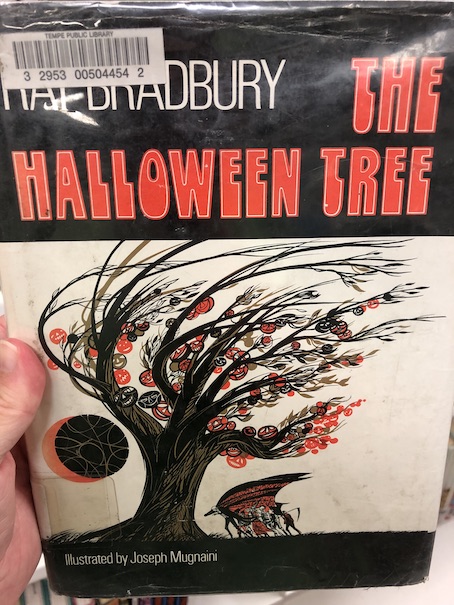
The Halloween Tree by Ray Bradbury, 1972.

A group of neighborhood boys want to go trick-or-treating on Halloween night, but they’re upset because it looks like a friend of their, Joe Pipkin, won’t be coming with them.  When they get to Pipkin’s house, he seems ill and is clutching his side.  His friends worry that he’s sick, but he valiantly reassures them that he’ll be fine.  He sends them on, telling them that he’ll catch up with them and that his costume will be great.  Specifically, he tells them to “head for the House” which is “the place of the Haunts.”

The house that Pipkin is talking about is the creepiest house in town.  It’s large, so large that it’s hard to tell how many rooms it has.  The boys knock on the creepy-looking door knocker on the front door, and a man answers the door.  When the boys say, “trick or treat,” the man says, “No treats.  Only—trick!”  Then, he slams the door without giving them anything.

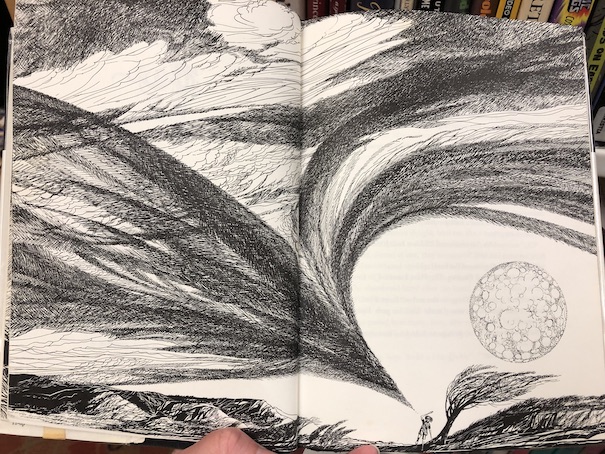
Not knowing what else to do, the boys walk around the side of the house and see a large tree, filled with jack o’lanterns.  This is the Halloween Tree.  The strange man they saw before rises up from a pile of leaves and scares the boys, giving them the “trick” that he promised them earlier.  He finally introduces himself as Carapace Clavicle Moundshroud.  He begins talking to them about the history of Halloween and asks them if they understand the real meanings behind the costumes they have chosen.  The boys admit that they really don’t know the meanings behind their costumes, and Moundshroud points off into the distance, calling it, “The Undiscovered Country.”  He says that out there likes the past and the history of Halloween and that the boys will learn the answers if they’re willing to go there.  The boys are interested, but they say that they can’t go anywhere without Pipkin, who promised that he would come.

Pipkin suddenly appears in the distance, by a dark ravine, holding a lit pumpkin.  He says that he doesn’t feel well, but he knew that he had to come.  Pipkin trips and falls, and the light in his pumpkin goes out.  From a distance, the others hear him calling for help.  Moundshroud says that something bad has happened.  Pipkin has been taken away to The Undiscovered Country by Death.  Moundshroud says that Pipkin may not be taken permanently but perhaps held for ransom and that, if they follow Pipkin to The Undiscovered Country, they might be able to get his soul back and save his life.

Moundshroud has the boys build a kite that somewhat resembles a pterodactyl, and they use it to travel into the far distant past.  The first place they arrive is Ancient Egypt, where the boys learn about mummies and how the Ancient Egyptians viewed the dead.  They see Pipkin as a mummy, being laid to rest in a sarcophagus, surrounded by hieroglyphs, telling the story of his life.  (Or, as Moundshroud says, “Or whoever Pipkin was this time around, this year, four thousand years ago,” hinting that Pipkin has been reincarnated before and what they are seeing during their journey are his past lives and deaths.)  Pipkin calls out to his friends for help.  Moundshroud tells the boys that they can’t save Pipkin now, but they’ll have a chance later.

They continue their journey through time and around the world, seeing glimpses of Halloweens past in Ancient Rome and the British Isles, where they learn about druids, Samhain, and witches.  Moundshroud describes how the Romans supplanted druidic practices with their own polytheistic religion until that was eventually replaced by Christianity.  All along, they can still hear Pipkin calling to them, and he seems to be carried off by a witch.  As they pursue him, Moundshroud teaches them the difference between fictional witches and real-life witches, which he characterizes as being more like wise women, who don’t really do magic.

From there, they go to Notre Dame to learn about gargoyles.  They continue to see Pipkin in different forms, even as a gargoyle on the cathedral.  Pipkin tells them that he’s not dead, but that he knows that part of him is in a hospital back home.

In Mexico, the boys experience Dia de los Muertos and learn about skeletons and a different kind of mummy from the ones they saw in Egypt.  They find Pipkin, held prisoner in the catacombs by the mummies, and Moundshroud tells the boys that the only way to save him is to make a bargain, both with him and with the dead: each boy must give one year from the end of their lives so that Pipkin may live.  It is a serious decision, for as Moundshroud says, they won’t miss that year now, being only about 11 or 12 years old, but none of them knows how long they will actually live.  Some of them who were destined to die at 55 would now only make it to 54, and as they reach the end of their lives, the year will seem that much more important to them.  Even those who live longer will still want every day they can possibly have.  However, each decides that he is willing to make the sacrifice because, without that sacrifice, Pipkin has no chance, and they can’t just let him die.

They make the bargain and are soon returned home.  When they go to Pipkin’s house to check on him, they are told that Pip is in the hospital because he had his appendix taken out, just in time to save his life.  At the end of the story, Tom (who is the leader of the boys through most of the story), wonders silently who Moundshroud really was, and he hears in his mind, “I think you know, boy, I think you know.”  Tom asks him if they will meet again, and Moundshroud says that he will come for Tom many years from now, confirming that Moundshroud was Death all along, which was why they had to make the bargain with him.

I saw the animated movie version of this story long before I read the book, and it really gave me the creeps!  Moundshroud is creepy because he is kind of two-faced.  On the one hand, he seems somewhat helpful in helping the boys to find Pipkin and teaching them about the history of Halloween, but on the other, he does not admit to the children that he is Death until the very end, that he is the very thing that they need to save Pipkin from, and that they can only do it by offering a sacrifice of years from their own lives. Although it does occur to me that Moundshroud may not be quite as two-faced as he seems because Pip’s illness and potential death may not have been planned by him but simply the fated situation for Pip, and Moundshroud might have just taken it upon himself to provide a way for Pip’s friends to save him in the least painful way. By not telling them that a sacrifice of part of their lives would be necessary until the very end, after they had come to a better understanding of life and death in the history of Halloween, he may have made the choice easier for them to make. Also, he never says exactly how much time they bought for Pip with their sacrifice. The implication is that Pip is now free from his early appointed death date and will now live a full life, similar to what his friends will have. The exchange does not seem to be an even one, a year for a year, with the children needing to decide how many years they will donate to Pip. Although the kids still don’t know at the end how many years each of them will live, it seems that none of the rest of them is in danger of dying in childhood, and they will all live for many more years.

I wouldn’t recommend this book for young children (it still gives me the creeps, and I’m in my 30s), but it is interesting how they take a journey through the origins of Halloween. The book and the movie were somewhat different, partly because there were more kids in the group in the book and partly because the group of kids in the movie also had a girl in a witch costume. In the book, the kid in the witch costume was also a boy.

Both the book and the animated movie are available online through Internet Archive.

Mystery of the Pirate’s Ghost

Mystery of the Pirate’s Ghost by Elizabeth Honness, 1966.

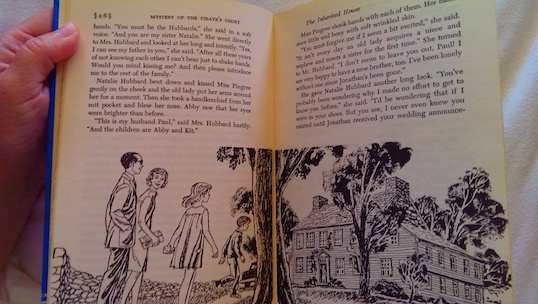
Abby and Kit Hubbard’s mother has just received a letter telling her than her half brother, Jonathan Pingree, has died and left her the old Pingree mansion.  He has left over bequests to other family members as well, and money to be held in trust for Abby and Kit.  It’s exciting news, and the family may move to live in the mansion they have inherited, although it partly depends on Mrs. Hubbard’s other relatives. 

Mrs. Hubbard, who was born Natalie Pingree, has never met her half-brother or half-sister.  They were her father’s children, from his first marriage.  She doesn’t know much about her father’s early life because he died when she was very young, and all that she knows about him is what her mother told her.  Apparently, her father’s first marriage was not a happy one.  He stayed in that marriage long enough for his first two children, Jonathan and Ann, to become teenagers.  Then, he made sure that his first wife and children were settled comfortably enough in the family home and left them to move to Philadelphia to start a new life by himself.  Sometime later, his first wife died and he married Natalie’s mother, who was much younger.  After his death, Natalie and her mother moved in with her mother’s sister, Aunt Sophie.  When Natalie got married, Aunt Sophie sent a wedding invitation to Johnathan and Ann, but they never came to the wedding or made any reply.  Natalie assumed that they felt uncomfortable about their father’s remarriage and didn’t want to see her, which is why she’s so surprised about Jonathan leaving the family home to her.  The only reason she can think of why he would do that is that neither he nor his sister ever married or had children of their own, so there was no one else to leave the house to.  Both of them were more than 30 years older than Natalie, and Ann is now an elderly woman, still living in the house.  Jonathan’s will has made provision for her as well, and the Hubbards go to see her at the Pingree mansion.

Mrs. Hubbard is pleasantly surprised that Ann is actually happy to see her.  Ann Pingree explains that the reason why she and Jonathan never replied to the wedding invitation was that, until that invitation arrived, neither of them had known that their father had another child, and they felt awkward about it.  However, Ann has been lonely since Jonathan’s death, being the last of the Pingrees, and she is glad to have Natalie and her husband and children with her and is eager to have them move into the mansion and live there. (Ann doesn’t live in the old mansion itself, but she does live nearby.)

Aunt Ann shows the family around the old mansion and explains more about its history and the history of the Pingree family. It turns out that the house, which has existed since Colonial times, although it has been burned, remodeled, and expanded over time. The house also has a number of secrets. Apparently, there used to be a tunnel running from the basement of the house to the beach that was used to bring in smuggled goods during the Colonial Era. There is also a hidden room behind a fireplace upstairs where the children of the family could hide during Indian attacks. (It doesn’t say how often that happened.) To the family’s surprise, Ann also tells them that the mansion is supposed to be haunted. The kids think it all sounds exciting, although Ann doesn’t explain much about the ghost the first time she mentions it. (Kit uses the phrase, “Honest Injun?” when asking Aunt Ann if she really means it when she says that the house is haunted. This isn’t a term that people use anymore because it isn’t considered appropriate.)

Mr. Hubbard is able to get his job transferred to a different branch of the company he works for, so the Hubbard family decides that they will move into the Pingree mansion. The kids like living by the beach, and their parents tell them that they can use the old ballroom of the house as a kind of rec room. Soon, they meet a couple of other children who live in cottages nearby, Chuck and Patty, and make friends with them. Chuck and Patty have already heard that the Pingree house is supposed to be haunted, although they’ve never seen anything really mysterious, just a light in the house once when they thought that the house was supposed to be empty.

The next time Aunt Ann comes to visit, the four children ask her to tell them about the ghost, and she tells them the story of the first Pingree to live at Pingree Point. This ancestor, also named Jonathan Pingree, built the original house in the late 1600s. He was a shipbuilder who owned several ships of his own, and he wanted to live near the sea. Later, he also became a privateer. When the kids call Jonathan a pirate, Aunt Anne agrees and explains that, unlike a pirate, Jonathan’s position as privateer was all perfectly legal because he had a Letter of Marque. (Yes, privateers operated within the law, but yes, they were also essentially pirates who raided other ships for their goods. In other words, they did the same things, but privateers did it with permission whereas ordinary pirates didn’t get permission. Historically, some privateers continued their pirating even after permission was revoked, so as Aunt Ann says, “the line between that and piracy was finely drawn.”) His son, Robert, was sailing on one of his father’s ships when it was taken by other pirates, and Robert was forced to join their crew. The family never saw Robert again and only found out what had happened from a fellow crew member who was set adrift and managed to make it back home. What happened to Robert is a mystery. His family didn’t know if he had really taken to the life of a pirate and couldn’t return home because he couldn’t face his family, if he had been killed in some fight, if he had been hung for piracy because he had gotten caught and couldn’t prove that he was forced into it. However, members of the family claimed that Robert’s spirit did return to the house and that he knocks at doors and windows, begging to be let back into his old home. Aunt Ann says that she’s never seen the ghost herself, but old houses can make all kinds of noises on windy nights, and that’s what she thinks the “ghost” is. As Chuck and Patty leave, they say, “we hope that old ghost doesn’t show up to frighten you.” Of course, we all know that it will because otherwise this book would have a different title.

One day, Kit is bored and starts playing around in the secret room, pretending that he’s hiding from American Indians. While Kit is in the secret room, he overhears the servants, John and his wife Essie, who have worked for the family for years, talking. Essie seems very upset and wants John not to do something that might risk their home and jobs, but John says that it’s too late and that they’re already “in it” and “can’t get out.” Kit tells Abby what he heard. That night, Abby hears banging and wailing during a storm and fears that it’s the ghost. Soon, other strange things happen, like a desk that mysteriously disappears and a cupboard that also mysteriously appears in its place. The children like John, and they don’t want to think badly of him, but he’s definitely doing something suspicious. One night, the children try to spy on him, and Abby once again hears the wailing and sees a mysterious, cloaked figure in the fog. Is it the ghost?

There are some interesting facets of this story that make it a little different from other children’s books of this type. For one thing, the children confide their concerns to their parents almost immediately, and the parents immediately believe them. In so many children’s mysteries, either the children decide to investigate mysterious events on their own before telling the parents or the parents disbelieve them, forcing the children to investigate on their own. It was kind of refreshing to see the family working together on this mystery. It actually makes the story seem more realistic to me because I can’t imagine that I would have been able to keep worries about mysterious things secret from my parents as a child, and they would have noticed if I was sneaking around, trying to investigate people, anyway. Abby and Kit do something dangerous by themselves before the story is over, but they also confide what they’ve done to their parents at the first opportunity and do not take the same foolish chance again.

The truth of John’s activities comes to light fairly quickly, although it takes a little longer for the family and the authorities to decide how to handle the situation. Investigating John brings to light some of the Pingree family secrets, and Abby and Kit soon discover the fate of Robert the pirate and the truth of his ghost. I’ll spoil the story a little and tell you that the ghost that Abby sees is apparently real, but it isn’t very scary. Once they learn the truth of what happened to Robert and see that his body gets a decent burial, the ghost appears to be at peace.

One thing that bothered me was the way that the characters talk about Native Americans in the book. It’s not the talk about Native American sometimes abducting children because I know that happened. It’s more how they picture that would happen. In the scene where Kit was hiding in the secret room, Kit imagines that the Indians were attracted to the house by the smell of his mother’s cooking and that he went into hiding while his mother fed them to avoid being abducted. As part of his scenario, he imagines that his mother would have wanted to “hold her nose against the Indian smell.” What? Where did that come from? There are all kinds of tropes about Native Americans in popular culture, from the “noble savage” image to that silly “Tonto talk” that actors did in old tv westerns, but since when are they supposed to smell bad? I’ve never seen characters in cheesy westerns hold their noses before, so what’s the deal? I tried Googling it to see if there’s a trope that I missed, but I couldn’t find anything about it. I’m very disappointed in you, Elizabeth Honness.

This book is currently available online through Internet Archive.

The Mystery of the Crimson Ghost

The Mystery of the Crimson Ghost by Phyllis Whitney, 1969.

Janey Oakes loves horses and wishes that she had one of her own.  Her family lives on Staten Island in New York, so they don’t have room to keep a horse.  The only horses that she has ridden are rented ones.  However, her parents are now considering moving to the countryside in northern New Jersey, where Janey’s Aunt Viv lives.  If they do, there will be room for Janey to keep a horse, so she is hopeful.

Janey’s parents take her to visit Aunt Viv during the summer, while they decide if they want to move.  Along the way, they stop to ask directions at a half-ruined house.  The people there, Mrs. Burley and her grandson Roger, aren’t too friendly, and when Janey thinks that she hears a horse there, they seem oddly resentful and say that she should ask her aunt about it.

Aunt Viv seems oddly evasive on the subject of horses when Janey asks, saying that she doesn’t ride anymore.  She does tell Janey more about the strange, half-ruined house.  It was once a hotel for people who came to take the spring waters.  However, it eventually lost its popularity and was partly destroyed in a fire.  Mrs. Burley’s husband died in the fire, but she has remained living in the part of the house that is still standing, raising a couple of grandsons there after the death of her younger son.  Her older son is a doctor in New York City.  Aunt Viv says that she used to be friends with the younger of the two grandsons, Denis, but that ended when she did something wrong and something bad happened which she doesn’t want to talk about.

Aunt Viv introduces Janey to a girl who lives nearby named Coral, in the hopes that they will be friends.  Coral isn’t interested in horses, but when Janey questions her about the Burleys, she confirms that they do have a horse called the Star of Sussex.  She takes Janey up to the Burleys’ house again (partly in the hopes of seeing the older Burley boy, Roger, who she has a crush on).  There, Denis and Roger each explain to Janey that their grandmother had hoped to train Star as a racing horse.  Star is an excellent horse and had a lot of potential for racing, but Denis allowed Aunt Viv to ride her one day, and the horse stepped in a woodchuck hole and injured her leg.  The leg has healed, and the horse is able to gallop, but she still limps and can’t run at the same speeds she used to, ending Mrs. Burley’s racing hopes.  Since then, Mrs. Burley has been very bitter, especially toward Aunt Viv.  She behaves strangely, driving people away, and is also angry toward Denis for allowing Aunt Viv to ride the horse in the first place.  It was just an accident, but she blames them both.  Roger realistically thinks that they should sell Star for breeding because she has a good bloodline, and Denis’s real interest lies with airplanes, which fascinate him in the same way that horses fascinate Janey.  Their differing interests seem to support what Aunt Viv says about how the family should move and that the boys would probably have a better life away from the old, ruined hotel and Mrs. Burley’s obsession with the past.

Coral also tells Janey about a ghost dog that supposedly appears on nights when a strange red light appears on the Burleys’ property.  Later, Janey hears the howling at night. Aunt Viv doesn’t think it’s a ghost.  She says that people have tried to talk to Mrs. Burley about her dog, but she denies having one and gets really angry with people for accusing her of having one.  Yet, the howling does seem to come from the Burleys’ property, and Denis even says that he’s seen the ghost dog, that it seems to be covered in flames.  He claims that it’s the ghost of his grandfather’s dog, who died in the fire years ago.  Aunt Viv thinks that Denis is just saying that to try to protect his grandmother and because he can’t handle what other people have come to believe about her: that she’s losing her mind.  Mrs. Burley’s behavior is undeniably odd, and she’s prone to sudden mood swings.  People are worried that she’ll drive newcomers away from the area and drive down property values, and they think that she might need professional help.

Janey doesn’t think that Mrs. Burley’s mind is gone as much as people believe.  When she sneaks over one day to visit Star, Mrs. Burley is angry but notes that she has a good manner with horses.  To Janey’s surprise, Mrs. Burley agrees to let Janey ride Star.  Denis almost ruins things by making Janey believe that Mrs. Burley has changed her mind about the invitation and also by not telling his grandmother that Janey asked to meet at a later time.  Janey isn’t sure why Denis seems to have a grudge against her, although it might have to do with his own guilt for allowing the horse to be ridden and injured in the first place; his own grandmother still seems to have a grudge against him for that.  Neither one of them tells Janey that Star has a particular trick for throwing riders, even though she had specifically asked if there was anything that she should know about the horse or if it had any tricks.  After she’s thrown by the horse, however, Janey gets back on and proves to both the Burleys and to Star that she’s not intimidated and not going to fall for the trick again.  (The Burleys have deep, personal hurts, but I wouldn’t call them nice people.  There are people who would probably view this is a test of Janey’s skills and her ability to stick with a challenge, but I think that their lies and deliberate deception when Janey was asking the right questions show only their immaturity.  It may not bother some readers as much as it did me, but I have a very low threshold of patience for such things, and the characters lost a lot of my sympathy right there.)

Mrs. Burley warms up to Janey after that and confides in her some of the reasons why she has been so unfriendly, trying to drive people away, and why the horse meant so much to her.  Years ago, she and her husband made quite a lot of money, raising racing horses.  Star is from the same bloodline as their original horses.  Mr. Burley lost quite a lot of their money on various business ventures that didn’t work out, even before the hotel fire that killed him, but for a long time, Mrs. Burley was always able to keep one horse from that bloodline, hoping to get at least one last racing horse.  Star is an excellent horse who really would have made a good racing horse, but Mrs. Burley’s hopes were destroyed when Star was injured.  Mrs. Burley thinks that she’s too old now to raise another, that she wouldn’t live to see any of Star’s offspring become racers.  Janey still thinks that Star has the potential to be a racer, but Mrs. Burley says that the effects of her injury won’t let her get the speed she once had.  Mrs. Burley resents outsiders hanging around because she fears their “interference” in her life, and the injury of Star while Aunt Viv was riding her seems to prove that her fears are justified.

Janey tries to talk to Mrs. Burley about the ghost dog, but she gets angry with Janey for believing the things that people have been saying about her.  Worse still, Roger tells her that Mrs. Burley will probably sell Star soon.  She needs money badly and has been refusing to let anybody help her, even her son in New York.  Her pride at her independence may be her undoing.  Now that Janey has ridden Star successfully, she can’t bear the thought that the horse might be sold and sent away.  If only she could unravel the mysteries surrounding the Burley family, the strange red light, and the ghost dog!

My Reaction and Spoiler

Toward the end of the story, one of the characters talks to Janey about Mrs. Burley’s attitude, saying that “it’s important in life to have something to fight for.  Something we care about and want.  I don’t mean fight for with our fists, but something to try for, struggle for.  Something we can do that uses whatever we are to win the fight.”  He means that people need a purpose in life, something like a cause to believe in or a way of life to pursue that is suited to their talents. Janey says that she doesn’t like struggles, but the person points out to her that everything in life that you want involves a struggle, including the horses Janey loves. Janey has focused mostly on the struggle of getting her parents to agree to let her have a horse and Mrs. Burley to agree to let her ride Star, but even if she ended up owning a horse, including Star, there would still be the struggle of caring for the horse, devoting time to keeping the horse happy and healthy. Janey might enjoy that kind of struggle because it appeals to her talents and interests, but it would still require time and sacrifice on her part. Mrs. Burley loves horses as much as Janey does, and she loves the area where she lives to the point where she can’t image living anywhere else. All of her efforts focus on allowing her to continue living in the place she loves, although she feels like her horse dreams are lost.

Much of the emphasis of the book is placed on Mrs. Burley’s determination to maintain her independence as part of the lifestyle she loves, but I wish that there was a little more emphasis on the methods that people use to get what they want in life because that is central to the secret of the “ghost.”  That the “ghost” isn’t really a ghost isn’t too much of a spoiler, but while people in the area think that Mrs. Burley is faking the ghost because she’s mentally unbalanced, the real culprit is someone who wants Mrs. Burley to leave because there’s something that he wants very badly and doesn’t think that he’ll get it otherwise.  Once his scheme is exposed, the others make sure that he doesn’t get what he wants because, after what he has done, he doesn’t deserve a reward.  However, I wish that they had explained a little more plainly that there were other ways of getting what he wanted besides the scheme he planned.  The culprit thinks that no one was listening to him and what he wanted, but from my perspective, what he wanted was simply a matter of time, and he wasn’t willing to wait.  His scheme would have ended with Mrs. Burley being declared mentally incompetent and being put away in a home, which is a cruel thing to do to someone.  The other characters tell him that, but I wanted someone to explain to him that harming others for his own benefit would make him no better than someone who robs a bank because they want money.  That is, crime and fraud are still wrong even if they succeed because the ends don’t justify the means.  In some ways, I think that Mrs. Burley was selfish, but she still didn’t deserve to be labeled as crazy, and even if people weren’t listening to the culprit and taking him seriously as much as they should, the scheme still wasn’t his only option. 

To say more would be to tell you who the culprit is, and it’s not as obvious as it might seem. It was one of my favorite suspects, but I changed my mind a few times, going back and forth between suspects up until the end. In the end, Mrs. Burley is prepared to forgive the culprit and start over again, and there are hints that he may get what he wants in the future if he behaves better.  Personally, I think he probably would have gotten it eventually, anyway, so his situation is relatively unchanged, although he is now under pressure to prove his behavior to everyone. 

As for Star, she does become Janey’s horse as a gift from the one person who is in a position to give the horse to her while making sure that Mrs. Burley gets the money she needs.  Because of Janey’s help in revealing the culprit to Mrs. Burley and because of her devotion to the horse, Mrs. Burley is fine with the arrangement.

The Court of the Stone Children

The Court of the Stone Children by Eleanor Cameron, 1973.

Nina and her parents have recently moved to San Francisco from Nevada.  Nina doesn’t like living in the city, but the move was necessary because her father has been ill and in need of a job.  Still, Nina misses her friends, and her parents don’t understand how difficult Nina has found it to make friends in their new home.

One of the most popular girls, Marion Charles, nicknamed Marnychuck, and her friends like to tease Nina at every opportunity. Nina doesn’t think that she even wants to try to be friends with them because hanging out at Marnychuck’s house would mean always having to be on her guard about every little thing she says, knowing that they would twist every innocent comment she makes into some sort of joke so they could laugh at her.  They could never be friends because there would be no way that Nina could ever open up to them about anything.  (Sadly, I know the type all too well.)  For example, one day, while the girls are walking home from school, they start talking about things they want to be when they grow up.  Nina says that she wants to be “something in a museum,” momentarily forgetting the word “curator”, until a boy nearby helpfully supplies the word. Of course, Marnychuck and her friends ignore the helpful word and just laugh about “something in a museum” as they walk away.

However, the boy who was listening turns out to be genuinely curious about why Nina wants to work in a museum, saying that it sounds like an unusual ambition.  Nina tells him that, until she had come to San Francisco, she’d never been in a big museum before, and she describes how the one in the park impressed her.  She used to work in a small one in her home town. The boy understands the way she feels and shares her love of the past.  He tells her about Mam’zelle Henry, a local woman who owns a private museum called the French Museum.

Nina visits the French Museum and loves the rooms with old-fashioned furniture.  They give her a strange feeling of timelessness, and before she knows it, she finds herself in a room with another young girl who says, “I knew you’d come.”  Nina isn’t sure who this mysterious girl is, but she asks her to come back another time.

When Nina returns to the museum the next day to return an umbrella that she borrowed from Mrs. Staynes, the registrar at the museum, she speaks to the girl again in the museum courtyard.  The courtyard is full of stone statues of children, and the girl tells Nina that when she was young, she used to wish that they would come to life.  The girl’s name is Dominique, although she says that people usually call her Domi. The two girls begin talking about their lives, although Domi oddly talks about her past in the present tense. Domi tells Nina about her emotionally-distant grandmother and her loving father, who was imprisoned and shot.  The news of Domi’s father being shot comes as a shock to Nina.  Domi tells Nina that, after her father was (“is”) imprisoned and shot, she had a dream about Nina in which her father said that Nina would help them.  Domi also says that the rooms at the museum are from her home in France, which was taken apart to be “modernized”and some of the pieces were sent to the museum. Nina finds Domi’s story confusing, but Domi says that they will talk more later.

Nina meets up with the boy who introduced her to the museum, whose name is Gil, at the cottage of Auguste, who lives on the museum property.  As she talks with the two of them and Mrs. Staynes, Mrs. Staynes brings up the subject of the ring that Nina saw Domi wearing and which also appears in a painting in the museum.  Earlier, Mrs. Staynes had told Nina that she couldn’t possibly have seen anyone wearing that ring, and Mrs. Staynes now explains that the reason why is that she owns the ring herself.  At first, Nina thinks that she must own a ring which is similar to Domi’s, since the two of them couldn’t have the same ring,but then, it turns out that the cat that Domi said was hers also belongs to Auguste.

The answer, as Nina discovers the next time she meets Dominique, is that Domi is a ghost.  Mrs. Staynes does own Domi’s ring now because Domi died a long time ago. Nina faints when Domi’s hand goes right through hers.  When Nina recovers, Domi is gone, and Mam’zelle Henry gives her a ride home.  The two of them bond as they discuss Nina’s ambition to become a curator.

Mam’zelle lets Nina borrow a journal that she found in the garden that belonged to Odile Chrysostome in 1802.  Odile was one of the names of the stone statues in the courtyard, according to Dominique, and Nina learns that the others are also named after members of the Chrysostome family.  The people at the museum say that they don’t know which of the statues is supposed to have which name, but thanks to Dominique, Nina does.

Gil becomes Nina’s first friend her own age, and he’s been working on a project involving time.  Someday, he wants to write a book about the concept of time. Time is important because Domi needs Nina’s help to resolve problems that occurred in the past.

Domi was young during the time of Napoleon.  Her mother had died in childbirth along with Domi’s younger sibling.  After her mother died, her grandmother moved into the house to oversee things and help care for Domi.  However, Domi’s father had protested some of Napoleon’s policies of conquest, and it led to his downfall.  One day, Domi discovered her father’s valet,Maurice, murdered in her father’s bedroom. She had thought that her father was there the night before, having returned from being away for a time, but he was nowhere to be found.  A short time later, her father was charged with conspiring against Napoleon and executed. Domi knows that her father was innocent of the charges, and she suspects that Maurice was killed because he knew something important, but she needs Nina’s help to find the missing pieces.  Domi knows that Mrs. Staynes is working on a book about her father’s life, and she doesn’t want the false accusations against him to be printed.

This book is available to borrow and read for free online through Internet Archive.

My Reaction and Spoilers

I thought that the book started out a little slowly.  It takes quite a while before Nina discovers that the boy’s name is Gil or learns anything about him, and it’s about halfway through the book before Nina learns that Domi is a ghost, although there are hints before it.  I knew that Domi was from the past, although I thought at first that she might be a time traveler of some kind.  Even after Nina learns that Domi is a ghost, it takes a while before Domi tells Nina her full story and what she really needs her to do.  The first part of the book dragged a little for me, and I was a little confused at first about why Odile’s diary was so important, but it turns out to contain the vital clues that Domi needs.  Domi’s father was with the Chrysostome family at the time that he supposedly murdered his valet and was conspiring against Napoleon. There is a piece of physical evidence that proves it, and finding it convinces Mrs. Staynes to change her book. 

One of Nina’s strengths is her power of imagination, and she helps Mrs. Staynes not only to see the truth about Domi’s father but to see him as a living, breathing person.  Before, Mrs. Staynes’ book was mostly facts with little sense of the feelings of the living people behind it, but Nina’s discoveries and imagination help breathe life into the work.  At the end of the book, the past remains unchanged (Domi’s life and that of her father are what they were before), but having the truth known gives Domi peace. Nina also makes peace with her new life in San Francisco, having discovered new opportunities and friends there as well as a nicer apartment for her family to live in.

Cam Jansen and the Ghostly Mystery

Cam Jansen

CJGhostlyMystery

Cam Jansen and the Ghostly Mystery by David A. Adler, 1996.

CJGhostlyMysteryGhostCam Jansen’s Aunt Molly takes her and her friend Eric to buy tickets for a Triceratops Pops concert.  Triceratops Pops is a singing group that dresses up like dinosaurs, and many of the fans buying tickets also wear dinosaur costumes.  While they’re standing in line, someone dressed as a ghost starts sneaking up behind people and scaring them by yelling, “Boo!”  At first, it seems like a mildly annoying prank, but then one old man standing nearby seems to have a heart attack when he is startled.

The guards standing near the ticket booth rush to help the man and call for an ambulance for him.  However, while they are distracted, the person in the ghost costume robs the woman selling tickets, taking all the ticket money and her own money from her purse.

Cam is convinced that the old man who collapsed was part of the thief’s plan and that his “heart attack” was just an act to distract the guards.  She noticed that he seemed to be wearing a wig to make himself look older.  But, there are two other clues that are important: the magazines that the man dropped when he fainted, and the fact that the ghost costume was found in the ladies’ restroom.  Once again, Cam helps the police with her amazing memory!

The book is currently available online through Internet Archive.

Jane-Emily

JaneEmily

Jane-Emily by Patricia Clapp, 1969.

Louisa is a young woman around the turn of the century.  She is only 18 years old and unmarried, but she is in love with a young man named Martin.  However, her parents think that she is becoming too serious about Martin too soon, so they insist that she spend the summer taking her young niece, Jane, to visit her other grandmother.  Jane has lived with her maternal grandparents, Louisa’s parents, since the death of her parents.  Louisa loves her niece, but she resents her parents changing her summer plans in order to keep her away from her boyfriend.

However, this is not just a love story but a ghost story.  Jane’s parents were killed in a strange buggy accident, which is why she lives with her grandparents and young aunt.  Her other grandmother has lived alone since the death of her son (Jane’s father) and her husband, some years earlier.  She had another child, a daughter named Emily, but Emily died young many years ago of a sudden illness.

As Louisa soon learns, Emily was a pretty and clever but seriously disturbed child.  Her father idolized her, coming to love her even more than he loved his wife.  He thought she was absolutely the most perfect child in the world and could never forbid her anything.  He gave her everything she ever asked for and refused to allow his wife to discipline her for any reason, even when she needed it.  It would be enough to spoil any child, but Emily was extremely callous, cold, and manipulating by nature.  Her father’s catering to her only fed her selfishness and ruthlessness.

Emily was known to resort to extreme measures to get her way, and in the end, it led to her death.  She fell in love with the son of the local doctor, deciding (without his consent) that they would get married one day.  However, he didn’t really care for her at all, seeing her extreme selfishness.  In a bid to get his attention and sympathy, Emily decided to make herself ill.  One cold night, she soaked her nightgown in water and deliberately sat by an open window.  Unfortunately, it worked too well, and she became so ill that she died.

However, Emily’s selfishness and determination to get her way seem to have lasted beyond the grave, and young Jane’s presence in her old house, in the very room that used to be Emily’s, seems to have awakened Emily’s wrathful spirit.  Jane becomes fascinated with the reflecting globe in the garden, which Emily declared was hers alone and that no one else could ever look into it.  Jane claims that she can see Emily’s face in the globe, but people don’t believe her at first. Jane bears a close resemblance to Emily, although the two of them are very different in character.  Jane seems to develop an unhealthy obsession with her dead aunt, and she seems to know things that only Emily could have told her.  Emily seems to be slowly taking over Jane.

Jane’s grandmother confides that she has believed that Emily caused the sudden deaths of her husband and son because they both died under unexplained circumstances and Emily could never let go of anything or anyone she thought belonged to her.  Now that Emily seems to be showing an interest in Jane, her grandmother begins to fear for her.

Meanwhile, Louisa is falling in love with Adam, the young man Emily had planned to marry and who is now a doctor himself.  Adam also loves her, wanting her to marry him.  However, Louisa has become convinced of Emily’s evil presence and the threat that she poses to young Jane.  When Emily forces Jane to go out in a freezing rain, making her become ill in the way she did before she died, Louisa must help Jane to fight for her life.

Emily’s presence centers around the gazing globe in the garden, and the only person who can end her evil influence and save Jane is her grandmother, who finally finds the courage to stand up to her daughter and tell her that there are some things that she can’t have.

The book is currently available online through Internet Archive.

My Reaction

Parts of the story feel a bit preachy on the subject of parents who spoil their children, but Emily and her family are presented as an extreme case of that.  At times, characters wonder what Emily would have been like if her father hadn’t constantly catered to her every whim and had given her the discipline she needed.  They all agree that she would have lived a longer life, as would other members of her family.  However, Emily was already a naturally selfish person and apparently incapable of empathy.  Her father’s worship of her was seriously unhealthy and, in a way, a reflection of his own selfishness; Emily represented all the qualities that he loved in her mother but she was a creation of his (well, you know, 50%, genetically speaking), making her infinitely more perfect and more worthy of his love than his own wife.  One of the other characters comments that his wife was the real victim in the end because her husband blamed her for their daughter’s early death (which was definitely Emily’s fault alone) and subjected her to years of guilt over it, rejecting all the love they had once had for each other.

The story ends happily but on a somewhat ambiguous note because Louisa realizes that there are many things that she doesn’t understand, and although Emily seems like she’s finally gone, the memory of her will haunt them all.