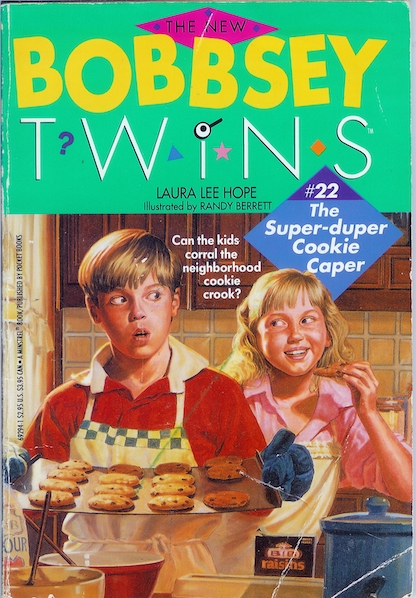
The Super-Duper Cookie Caper

The Bobbsey Twins

Bobbsey Twins Super-Duper Cookie Caper coverr

#22 The Super-Duper Cookie Caper by Laura Lee Hope (Stratemeyer Syndicate), 1991.

Before I begin, I’d like to acknowledge Sean Hagins, for supplying me with photos of this book! Usually, I take pictures of books myself, but I just couldn’t find a physical copy of this one. Sean is a big fan of the Bobbsey Twins, particularly the New Bobbsey Twins mysteries, and you can see some of his video reviews as well as videos about his photography work on his YouTube channel, SJHFoto. Thanks, Sean!

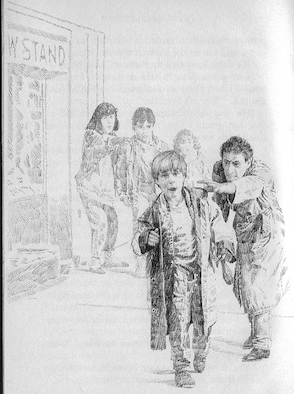
Freddie decides that he wants to get a new bike, and inspired by the school bake sale, he decides that he’ll make and sell cookies to raise the money. His grandmother makes really delicious oatmeal chocolate chip cookies that everybody loves, so he plans to make and sell them. He persuades his twin, Flossie, to help him by promising her part of the money from the cookie sales. Their parents approve of the plan, and their mother offers to help them because neither of them has much experience with cooking.

When Freddie and Flossie go to sell the cookies in the park, they’re pretty popular. Everyone loves the cookies, and Freddie boasts about his grandmother’s secret recipe. Their last customer is a man who gives them a dollar with some kind of white powder on it, and he doesn’t seem to think much of the cookies. Freddie doesn’t care because everyone else likes them, and they’re making money.

There are some complications to selling cookies. First, Flossie has a sweet tooth, and Freddie has to keep stopping her from eating their stock herself. Then, a boy at school, Brian, announces that he’s going to set up a rival business in the park, selling brownies. Freddie gets the idea of offering broken cookies as free samples and selling orders of cookies door-to-door.

Nan and Bert start helping with the cookie-baking, but things don’t always go well in the kitchen. There are times when they forget ingredients or let the cookies burn. Then, the children realize that the card with the recipe on it is missing! They search the kitchen and realize that there is a chocolate smudge on the kitchen window. It looks like someone reached through the window and stole the recipe!

There are a few logical suspects. It could be Brian, hoping to cash in on the success of the cookie-selling. It could be their old nemesis, local bully Danny Rugg, who stole their free samples earlier and generally likes to mess things up for the Bobbseys. Then again, there is the mysterious man who keeps showing up at the park. The Bobbsey Twins find out that he owns his own bakery. To find out who the recipe thief is, Freddie decides to invent a trap. He tells everyone that his grandmother has given him her other secret recipe for super-duper cookies that’s even better than the first one. Who will take the bait?

The book is available to borrow and read for free online through Internet Archive.

My Reaction

Sean and I were discussing earlier how later books in the New Bobbsey Twins series tended to focus more on the younger set of twins than the older Bobbsey twins and seem to involve lower-stakes mysteries. Earlier books in the series involved definite crimes, police matters, and strange phenomena. A stolen cookie recipe feels like much lower stakes. However, I thought this one was well-done for what it was. There are some definite suspects, enough to sow some doubt about who the recipe thief is. The actual thief is someone I suspected but not necessarily the most obvious suspect, and the thief’s motives do make logical sense, although I’m not sure (spoiler) any real adult would seriously consider that kind of business model. It sounds more like something a kid might do, and that’s partly what allows readers to doubt whether it’s a child or adult who took the recipe.

There is also a punchline to the story. There was one thing that I had guessed early on about the grandmother’s “secret recipe.” It’s not as “secret” as the kids think it is. I guessed that because, when I was a kid, one of my grandmothers always baked chocolate chip cookies. Those cookies were one of the highlights of going to her house. When we were little, my brother and I liked them so much that we guessed that she must have been a baker before she retired. When we were older, we found out that she’d actually been a bookkeeper and that her cookie recipe was just the Toll House recipe from the chocolate chip package. She made two versions, with and without nuts from the pecan tree in her backyard, but it was still the Toll House recipe. It’s a similar situation with the Bobbsey Twins’ grandmother’s secret recipe. The only thing the grandmother changed was the cooking time. Everyone just thought that the cookies were special because her grandchildren thought they were, and they convinced other people. Few things are as special as homemade cookies from your grandmother!

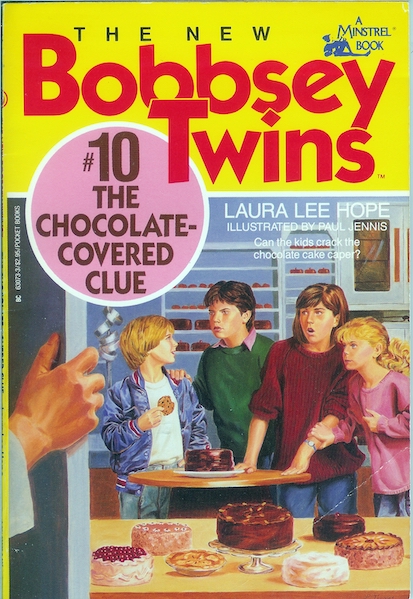
The Chocolate-Covered Clue

The Bobbsey Twins

#10 The Chocolate-Covered Clue by Laura Lee Hope (Stratemeyer Syndicate), 1989.

Before I begin, I’d like to acknowledge Sean Hagins, for supplying me with photos of this book! Usually, I take pictures of books myself, but I just couldn’t find a physical copy of this one. Sean is a big fan of the Bobbsey Twins, particularly the New Bobbsey Twins mysteries, and you can see some of his video reviews as well as videos about his photography work on his YouTube channel, SJHFoto. Thanks, Sean!

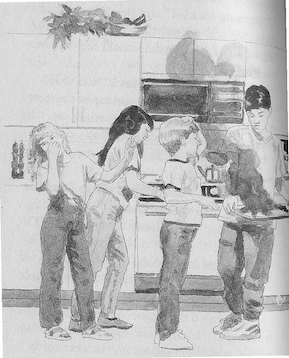
Flossie has made a new friend, Casey Baker, whose parents own Baker’s Bakery. They invite her to come for a tour of the bakery to see how they make everything. It means getting up very early on a school morning because the baking has to start very early. They need to have everything freshly baked by the time the bakery opens for customers. Although it’s difficult to get up that early, Flossie enjoys the tour, seeing the large electric mixers where they make the cake batter and the enormous oven where they can bake over 100 cookies at once.

While the Bakers are showing her everything, they all realize that they feel cold. Someone has left the door to the alley open. Nobody is around, so they assume that it must have just been left open by a deliveryman making an early delivery.

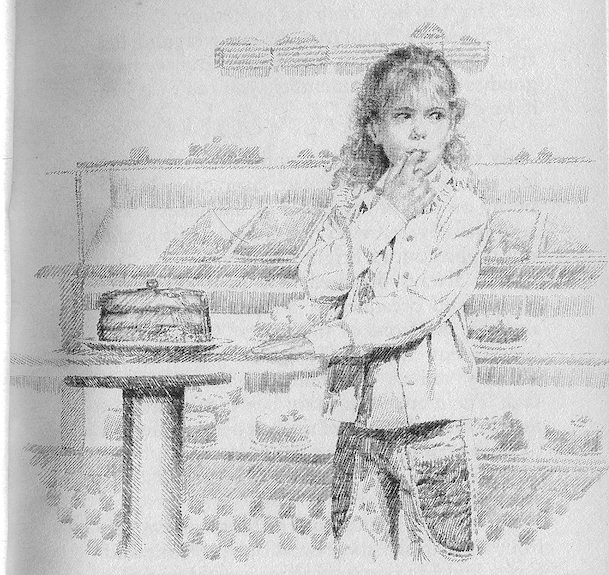
Later, while Flossie and Cassie are admiring a beautiful chocolate cake, something really strange happens. A masked man suddenly runs into the shop, grabs the cake, and runs away with it! Who could be so desperate for chocolate cake that they have to resort to theft? The Bobbsey Twins’ mother is covering a series of recent burglaries for the local newspaper, but this is the weirdest theft the kids have ever heard of.

It gets weirder as the day goes on. While Freddie and his mother are running errands, they stop at a diner, and the same masked man runs in and smashes the chocolate cake on the counter with his bare hands! Freddie tries to chase him, and the man throws cake at him. The cake that was smashed was also from Baker’s Bakery.

The Bobbsey Twins talk to Casey, and she tells them that someone stole their delivery list. From then on, this crazy cakenapper starts tracking down and stealing and smashing every chocolate cake Baker’s Bakery made that day – including the one that the Bobbseys had delivered to their house.

What’s behind all of this cake carnage and chocolate destruction? Does someone have a grudge against the Bakers or against chocolate-based desserts?

The book is available to borrow and read for free online through Internet Archive.

My Reaction and Spoilers

I really liked the premise of this mystery! It’s such a fun, crazy concept of someone going all over town, smashing cakes, apparently for no reason. It’s the sort of mystery that I sometimes call a “Bizarre Happenings” mystery. That’s a mystery where strange things happen that encourage the characters to investigate, but it’s not obvious what’s behind it all or what sort of crime is really being committed. An example from adult literature would be the Sherlock Holmes story, The Red-Headed League, where the characters know that someone has been deceived into joining a special club for red-headed men that doesn’t actually exist and paid to copy entries from the encyclopedia, but they’re not sure why at first. In the case of the Bobbsey Twins mystery, the characters know that someone is stealing and destroying chocolate cakes, which is a very bizarre form of theft, but they’re not sure why. Readers can guess from the beginning that this rash of cake thefts is related to a different crime.

Actually, the solution to the story is very similar to that of another Sherlock Holmes story, The Adventure of the Six Napoleons, where someone is stealing and smashing busts of Napoleon. It has nothing to do with Napoleon or the busts themselves. There is something hidden inside one of the busts that someone is desperate to find, but because the busts all look alike, they have to track down and smash them all to find the one they really want. It’s like that with the cakes. The destruction of the cakes has nothing to do with the Baker family, their business, or the cakes themselves. Someone came into the bakery, looking for a place to hide, and dropped something in the cake batter while it was being mixed. Because the batter in the massive mixer was made into multiple cakes, they can’t be sure which cake now contains what they want. They need to track down the right cake in a hurry, before someone else finds what they hid. What seems to be an oddball crime puts the Bobbsey Twins up against a dangerous criminal!

The Secret at Sleepaway Camp

The Bobbsey Twins

The Secret at Sleepaway Camp by Laura Lee Hope (Stratemeyer Syndicate), 1990.

Before I begin, I’d like to acknowledge Sean Hagins, for supplying me with photos of this book! Usually, I take pictures of books myself, but I just couldn’t find a physical copy of this one. Sean is a big fan of the Bobbsey Twins, particularly the New Bobbsey Twins mysteries, and you can see some of his video reviews as well as videos about his photography work on his YouTube channel, SJHFoto. Thanks, Sean!

The Bobbsey Twins are headed to Camp Evergreen this summer! Before they leave for camp, their mother, who is a part-time reporter for the local newspaper tells them that she was just covering a story about a baby polar bear who disappeared from the local zoo. Flossie is upset about it because she’s fond of the polar bear, Snowflake, and likes to see her when she goes to the zoo. Nobody knows exactly how Snowflake got out of her enclosure. All they know is that the gate was found open, and Snowflake was gone. Mrs. Bobbsey recommends that the kids forget about it for now and concentrate on having fun at camp.

Nan and Bert are going to be counselors’ helpers at camp, and all the kids are looking forward to activities like swimming, horseback riding, and archery. The only downside is that Danny Rugg, local bully and troublemaker, will also be there as a counselors’ helper. (Danny is a long-standing nemesis in the Bobbsey Twins series, from the original incarnation of the series. See The Bobbsey Twins of Lakeport.)

Strange things start happening at camp right from the moment that the Bobbsey Twins arrive. Tanya, the head counselor, tells them that, for some reason, all of the camp’s rowboats are leaking. When the kids investigate, they discover that someone has deliberately drilled holes in all of the boats.

The first thought that the Bobbsey Twins have is that Danny is responsible because he has a history of playing mean pranks, although he denies it. Danny does say that he doesn’t see why everyone else at camp should have fun while he’s miserable. His job as a counselors’ helper is working in the kitchen, and he hates it because it’s hot in there, and he thinks the cook is weird.

When Freddie goes to unpack in his cabin, he meets another boy named Ian. Ian is from the city and has never been to the countryside before. He’s a little nervous and homesick, and he says that the camp’s cook has told him that the camp is haunted. Freddie says that he’s sure there’s nothing to worry about and that they’ll have fun at camp.

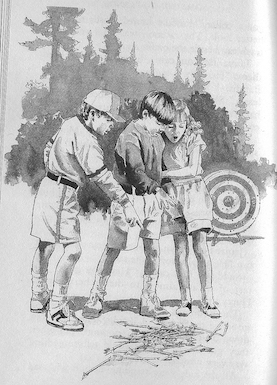
Arts and crafts goes fine, and the kids enjoy meeting the camp’s mascot, a tame raccoon named Bandit. Tanya explains that they found Bandit when he was just a baby and that the kids should never try to play with wild raccoons. However, when the kids arrive at the archery range, they discover that someone has snapped all the arrows in half! Because of the stories the camp cook has been telling everyone, some of the campers think that it’s the work of the camp’s ghost. The Bobbsey Twins still suspect Danny, and they offer their services to Tanya, to investigate and find out who’s really causing all the trouble at camp.

Danny isn’t the only suspect. Nan overhears the cook, Sal, telling the kids about a hungry, child-eating bear in the woods who is supposedly friends with the camp ghost. Does he just like scary stories, or does he have a special reason for wanting to frighten the kids at camp? Even Tanya seems to have something to hide, getting mysterious notes and meeting someone in secret.

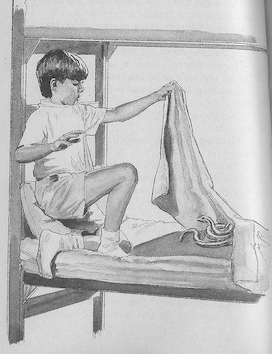
Soon, other strange things happen at camp. Someone puts a snake in Freddie’s bed, and the kids see strange lights in the woods at night. Then, someone steals all the ponies out of the corral and smashes the kids’ clay art projects. Some of the kids think that it’s the work of the ghost Sal has been talking about, but the Bobbsey Twins are sure that someone only wants them to think that. What are all the pranks and sabotage really about?

The book is available to borrow and read for free online through Internet Archive.

My Reaction

I was pretty sure I knew right away who was behind the camp sabotage, but this is one of those stories where there’s more than one person doing things that are unrelated. Danny eventually admits to playing some of the pranks, like the snake in Freddie’s bed, but not all of them. I was also wrong about who the main villain was. The missing polar bear at the beginning does figure into the mystery of the things happening at camp. I figured it would be important, but I didn’t guess how and why.

One of the clues the kids find is a lucky rabbit’s foot keychain. The kids comment that those used to be popular good luck charms, but not many people have them anymore. I have to admit that I had a pink one when I was a kid that I got from a novelty shop. I don’t think I realized at first that it was a real rabbit’s foot. I think I assumed that it was fake because I bought it in a place that sold magic tricks and costume props, so I figured it was imitation, like everything else. I figured it out eventually, and then, I didn’t feel quite so lucky about it. I’m sure that those keychains fell out of popularity because other people felt the same way I did about them, and they were concerned about animal cruelty. I believe it’s still possible to buy real and faux rabbit’s foot keychains, but it’s been a long time since I last saw them displayed at a store, so I think the kids were probably right about them not being as popular as they once were.

The Secret of the Sunken Treasure

The Bobbsey Twins

Bobbsey Twins The Secret of the Sunken Treasure cover

The Secret of the Sunken Treasure by Laura Lee Hope (Stratemeyer Syndicate), 1989.

Before I begin, I’d like to acknowledge Sean Hagins, for supplying me with photos of this book! Usually, I take pictures of books myself, but I just couldn’t find a physical copy of this one. Sean is a big fan of the Bobbsey Twins, particularly the New Bobbsey Twins mysteries, and you can see some of his video reviews as well as videos about his photography work on his YouTube channel, SJHFoto. Thanks, Sean!

The two sets of Bobbsey Twins and their parents are on vacation in Florida for a week. It’s just a fun family vacation, although Mrs. Bobbsey is hoping to write an article about a sunken treasure ship called the Granada. The Bobbsey Twins are intrigued at the idea of searching for sunken treasure, although nobody has detected a sign of the treasure since the ship sank in 1801. Dan Chester, he brother of a family friend, lives in the town where the Bobbseys are staying along with his 15-year-old daughter, Meg. Dan and Meg are divers, and they have been searching for the wreckage of the Granada, and they think they have a lead. The Bobbsey Twins are excited to think that they might be able to participate in the search for the treasure or be there when the Chesters find it!

However, when Dan and Meg pick them up at the airport, they have bad news. Although they were able to locate the wreckage of the Granada, they were delayed reaching shore to claim their find because their boat propeller broke, and someone else claimed the Granada before they could. Joe Lenox, the man who claimed the wreckage, runs an underwater salvaging company, and he’s tough competition for the Chesters because he can afford all the latest sonar equipment. It’s a heavy blow to Dan and Meg, losing such an important find when they were so close to claiming it. The only consolation is that everyone will be able to watch the old safe from the wreckage being hauled to the surface. The safe is supposed to contain the treasure the ship was carrying.

When Joe Lenox learns that Mrs. Bobbsey is an out-of-town reporter, he invites the entire Bobbsey family to come with him on his boat to see the treasure being recovered. They accept the invitation, although the kids feel a little funny about it because Joe is Dan and Meg’s competitor.

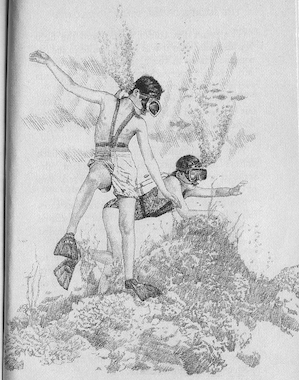
On the boat, Joe shows the Bobbseys his equipment and explains how everything works. (I grew up in Arizona and have never been diving, so I have very little context for understanding diving equipment. This part looks informative, but since this book was published decades ago, there may have been some changes in equipment since then. I wouldn’t know.) Flossie is hoping that, when the treasure is brought up, she will get the chance to try on the famous tiara that is supposed to be in the safe. However, everyone is in for a shock. When the divers go to recover the safe, they discover that someone has already managed to open it and remove the strongbox containing the treasure!

Now, Joe feels cheated out of a treasure he thought he had safely claimed, and he wants to know who’s responsible. The logical suspects would be Dan and Meg, who felt cheated out of their opportunity to claim the treasure first and who have the diving skills needed to reach the safe. A charm belonging to Meg is found in the safe, making Joe and the police believe that the Chesters are guilty. Although, there are also the other members of Joe’s crew to consider. They were the only other people who knew where the wreck was. Could any of them gone out to raid the wreck before the official salvage operation? Can the Bobbsey Twins find the real thieves?

The book is available to borrow and read for free online through Internet Archive.

My Reaction

I had a couple of favorite suspects early on in the story. The book establishes that it would have taken at least two people to deal with the safe, so I was looking for a pair of people. I was only partly right, though, because there’s another suspect who isn’t introduced until later in the book. The first person I suspected is guilty, but there were more people involved than I thought.

The book explains a little about how a person can lay claim to a sunken ship. The characters say that they have to fill out paperwork at the courthouse. There are laws regarding claiming a sunken ship and official procedures to follow. It’s not as simple as finders keepers. It does matter who found it, where they found it, and who the ship belonged to originally. There were also some changes to the laws around the time this book was written and published with the Abandoned Shipwreck Act of 1987. I’m not completely sure whether each Joe or Dan and Meg could have legally claimed the ship. It partly depends on whether or not it was within US territorial waters or outside the official three-mile limit, and it also depends on whether or not the ship was property of a foreign government which could lay claim to it. For the purposes of the story, we have to assume that Joe Lenox was able to successfully lay a claim to the ship and that Dan and Meg could have done so if they had reached the authorities first. What makes me doubt this is how it would have worked in real life is that the treasure on the ship belonged to a Spanish countess, which makes me think that it could be regarded as property of the Spanish government, but it would be difficult to determine that without additional information.

The Bobbsey Twins’ Adventure in the Country

Bobbsey Twins

The Bobbsey Twins’ Adventure in the Country by Laura Lee Hope,1907, 1961.

Before I explain the plot of this story, I have to explain that this is one of the early Bobbsey Twins books, originally published in the early 20th century, and like other Stratemeyer Syndicate books that were still in print during the mid-20th century, it was revised from its original form to update the language, culture, and technology in the story and, especially, to remove questionable racial terms and caricatures. The physical copy of the book I read as a kid was the revised version, and I didn’t know about the revisions until I was an adult. When I describe the plot at first, I’m talking about the revised version, but I’m also going to explain some of the differences between the original version and the revised version, so you can see what changed.

The two sets of Bobbsey Twins (Nan and Bert are the elder set of twins and Freddie and Flossie are the younger set) are enjoying their summer vacation at home when their mother receives an invitation for the family to visit the children’s aunt and uncle on their farm and to attend an auction that will be held somewhere nearby. The aunt says that there is something that will be sold at the auction that she thinks will interest the family, but the adults are keeping it as a surprise. The children are excited because they like visiting the farm, and they’ve never been to an auction before.

Mr. Bobbsey has to work at his lumber yard, so the children and their mother take the train to the farm ahead of him, accompanied by their cook/housekeeper, Dinah. (Dinah is black and is a recurring character in the series. The book refers to her as “colored.”) The train trip is a bit chaotic because they nearly forgot to bring their packed lunch, and then, Fred’s cat escapes from its carrier and is nearly left behind when they reach their destination. However, they do get there safely.

At the farm, the children enjoy seeing their cousin, Harry, and visiting all the animals. Freddie loses one of the calves when he tries to take it for a walk, like it’s a dog, and at first, the children fear that it fell in the river and drowned. Fortunately, someone from a nearby farm finds the calf and brings it home. These unrelated misadventures are just the beginning of the children’s summer because there is a mystery that seems to be unfolding at the farm.

On their first night at the farm, Flossie wakes up in the middle of the night because she hears someone playing the piano. She wakes Nan, and the two of them go downstairs, but by the time they get there, whoever was playing the piano is gone. At first, the children’s uncle thinks that it was just a dream, but Nan knows that it wasn’t because a piece of sheet music was knocked off the piano. Later, when they hear the piano at night again, there are smudges on the keys.

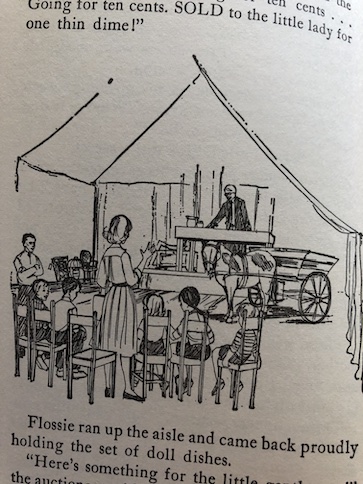
The auction is fun. The children each have a little money to buy something small for themselves, just for the experience of bidding on something at an auction. They all find something to buy, and some of the things they find are funny and eclectic. The mystery object that their mother is there to buy is a pony and cart. A neighbor of the aunt and uncle had a pony and cart that his grandchildren used, but they’ve moved away, and the Bobbseys have decided to buy it for their children. The twins’ aunt and uncle are willing to keep them at their farm because they can’t have a pony in the city, and their cousin can use them when the twins aren’t there. The children love the pony, and they have fun with him and the cart with some other kids. However, when they return to the farm after they auction, they discover that the family’s prize bull has been stolen!

The story is somewhat episodic, but there is a thread of mystery that runs through the whole book as the children try to find the missing bull. There’s a boy from New York City who was lost from a group heading to a nearby Fresh Air Camp (part of a charity that has existed since the 19th century to provide poor city children with enriching summer experiences in the countryside – I referred to it before in another vintage children’s book, Ruth Fielding at Sunrise Farm) who witnessed the theft but didn’t realize that the men he saw didn’t own the bull. There’s a Fourth of July celebration and a picnic with other kids, including a local bully. There is some real danger, where Flossie falls over the edge of a cliff and has to be rescued, and the family has to evacuate the farm temporarily when they fear that a nearby dam might break after a fierce storm. Along the way, the Bobbsey twins gather pieces of information that help them find the missing bull.

The book is available to borrow and read for free online through Internet Archive (multiple copies). The original edition of the book is public domain and available online through Project Gutenberg.

My Reaction

The Mystery

The mysteries in the story are pretty simple. The story is pretty episodic, and the nighttime piano-playing is unrelated to the theft of the bull. The reasons for that are partly related to the way the book was written in the original version. Originally, the book was more of a general collection of stories about how the Bobbsey Twins spend their summer on their aunt and uncle’s farm and have little adventures there, and it wasn’t really a mystery story. One of the features of Stratemeyer Syndicate books is that chapters are always supposed to end on cliffhangers to keep the stories exciting and encourage children to keep reading. That format lends itself well to the mystery genre, which is why some Stratemeyer series that originally started as more general fiction or adventure gradually evolved into mysteries, but some of the early books, like this one, kind of end up being somewhere between mystery and general fiction and read almost like collections of shorter, interrelated stories.

The theft of the bull didn’t occur at all in the original story, but there was a thread through the book about the piano playing at night. In both the new and the old versions, they eventually find out why, but there are different explanations between the versions. In both versions, the nighttime piano player is an animal, not a human.

Original Version vs. Revised

Like other Stratemeyer Syndicate books that were in print in the mid-20th century, the early Bobbsey Twins books were revised and reprinted around the time of the Civil Rights Movement, both to update the technology and slang in the stories and to remove inappropriate racial language. The 1960s edition of the book uses the word “colored” to refer to the housekeeper/cook who works for the Bobbsey family and her husband, which was an acceptable term in the early and mid-20th century (as in The National Association for the Advancement of Colored People, or NAACP), but the word “black” became the common accepted informal, generic term and “African American” became the accepted formal, specific term post-Civil Rights Movement because people were trying to distance themselves from racial words that, while they were not meant to be derogatory, had some emotional baggage attached to them. In the case of this particular book, the changes from the original version to the version I have include making Dinah more intelligent and eliminating the use of stereotypical black people speech. In the original book, even though she’s an adult, Dinah seems childlike in her reactions to things and seems to need the children to explain things to her, like the scale they see at the train station. When she speaks, her speech is spelled out with a strong accent (ex. “dat chile” instead of “that child”), and she throws out phrases like, “Lan’ o’ massy!” In the revised version, she acts and speaks more like the other adults.

Something else that changed from the original version is how much emphasis there was on poor people vs. upper middle class people, like the Bobbseys. The older version of the story emphasizes more how poor the kid from the Fresh Air Camp is and how charitable the Bobbseys are toward him. There are also other instances of charity toward the poor, like when Nan lends another girl a dress because they need to wear white dresses for the Fourth of July celebration, and the other girl doesn’t have a white dress. The book is careful to mention that nobody else knows that the other girl was borrowing a dress from Nan, with the implication that it would have been embarrassing or a mark of shame for people to know that it was a borrowed dress instead of one of her own. Things like this appear in many vintage children’s books from the 19th century and early 20th century, but it’s not something you find much in modern modern books, at least not described like that. Even when I was a middle-class kid in the late 20th century, it wouldn’t be assumed that a kid would necessarily have certain types of clothes for a special occasion or that their family would be able to just quickly buy something new for one-time use. It was also normal for people to borrow things from friends, even just on whims, so borrowing a dress for one-time use for a special occasion wouldn’t have been regarded as either an act of charity or anything to cause embarrassment, if other people just happened to know about it.

Even though there are things in the stories that were changed to make the stories contemporary with the time of the revisions, the 1960s, there are still aspects of the stories that would be out-of-date culturally by 21st century standards. One of those issues relates to how the adults in the story handle the children. One of the adults in the story tries to resolve the bully situation by letting Bert physically fight the boy who was picking on him, telling both the boys to wrestle with each other to settle their differences and get it all out of their systems. This is not advice that most modern adults would give to kids, and one good reason for not giving that advice is that it doesn’t work, not even in this book. First of all, the kid being bullied might not be the winner of the wrestling match in real life, and no kid should be forced to fight physically just because some bully wants to beat them up. In the book, Bert wins the wrestling match because he’s had wrestling classes before, but as the case would probably be in real life as well, it resolves nothing. The bully is resentful about losing the fight and continues to bully him and play mean tricks on the other kids. The bully episodes are basically there just to add conflict and excitement to the story, and they don’t do much more than that.

I was a little surprised that they left in the part from the original story where the kids put on their own circus, and they have an act they call the “Sacred Calf of India.” In the revised version, Nan wears an improvised sari for this act, and they teach the calf to do a trick. Animals doing cute little tricks are just fine, but adding in the exoticism seems in poor taste. I suppose that they left this part in the revised version because it’s not trying to be insulting to people from India, more that the kids are trying to play on the concept of circus acts and snake charmers, but it is another example of something that you find sometimes in vintage books but wouldn’t be likely to find in modern ones.

Ruth Fielding and the Gypsies

Ruth Fielding

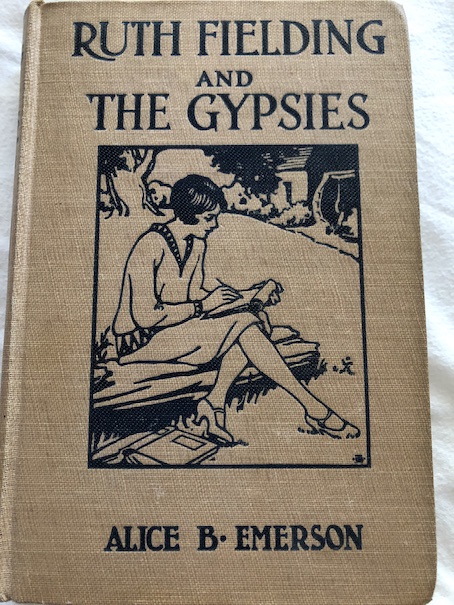
Ruth Fielding and the Gypsies; Or, The Missing Pearl Necklace by Alice B. Emerson (Stratemeyer Syndicate), 1915.

Just as a quick note before I begin to describe the plot of this book, this book is part of the Ruth Fielding series, an early Stratemeyer Syndicate, before they started writing some of their more popular and best-known series, like the Hardy Boys and Nancy Drew. Some books in early Stratemeyer Syndicate series are awkward because they use racial terms that polite people would not use now. During the mid-20th century, around the time of the Civil Rights Movement, the Stratemeyer Syndicate revised the books it had in print, updating the technology and slang terms in the stories to be more modern and removing or altering some questionable racial terms and attitudes. Unfortunately, the Ruth Fielding series had already ended by that time, and these books were not among those that were revised and updated. I’ve explained this before on the pages for some the Stratemeyer Syndicate book series and individual book reviews, but I have to explain it again here because some people might object to the word “gypsy.” I know that’s not really the correct or polite way to refer to the Romany or “Travelers”, as they’re sometimes called, but it can’t be helped here because the Stratemeyer Syndicate put it right in the title. This is one of those books where I just can’t avoid it, and it’s all through the book. Some of the attitudes and stereotypes around the characters are also likely to be objectionable, but I’ll address that further in my reaction section.

The Ruth Fielding series is interesting because it was kind of a precursor to Nancy Drew, with a similar type of heroine, but one that, unlike Nancy Drew, grew up, went through school, and had a career during the course of the series. There are some aspects of this series and the development of the characters that I think were better done in this series than in the Nancy Drew series. There are also times when the books are surprisingly thoughtful about the conditions of life and society in the early 20th century, when they were written, and this book and the next one begin to mark a turning point in the main character’s life. Ruth is a poor girl, and before her education is over, she will have to seriously consider her career options, which is something you don’t see much in the Stratemeyer Syndicate series that are still in print because those characters never age. The characters in the earlier series did, which is why those series ended. There are some things in the series that I don’t like, like the racial terms and attitudes and when the stories are more adventure than mystery because I really prefer mystery, but this is what the books are like. In these reviews, I’m just explaining what the books and characters are like. On the bright side, if you don’t like what the books are like, you can consider that I read and reviewed them, so you don’t have to. You can find out what they’re like from my reviews and save yourself some time.

The Plot

Ruth Fielding is with her Uncle Jabez in a boat on the river near the Red Mill where they live when the boat overturns. Uncle Jabez falls out and hits his head. He almost drowns, but Ruth holds his head above water. She can’t pull him out of the river by herself, but she calls for help and attracts the attention of a passing gypsy boy. The gypsy boy, called Roberto, pulls Uncle Jabez out of the water.

Uncle Jabez is grateful, but the incident brings back an earlier argument about whether boys are more useful than girls. Uncle Jabez argues that boys are more useful than girls because they are stronger and can do heavier work, and he thinks that his near-drowning proves that. Of course, Ruth, Aunt Alvira, and Ruth’s friend Mercy are all offended by that assessment. Aunt Alvira points out that the boy who helped Uncle Jabez wouldn’t have been able to do that if Ruth hadn’t already been holding his head above water and calling for help. Ruth says that not all work is heavy work. Uncle Jabez says that girls are costly because they need money for education, and they’re not likely to have careers afterward, like men do. Ruth says that the reason why she wants an education is so that she can have a career and support herself.

Ruth knows that a poor orphan like her is lucky that she can attend boarding school with her friends. Her friend, Helen, is from a wealthy family, who is willing to fund her education in anything she wants to study, whether it eventually produces money or not, but Ruth doesn’t have that luxury. Eventually, she will have to get a job of some kind. Aunt Alvira says that, when she was young, most girls got a basic education and then got married, which is probably what Uncle Jabez is expecting Ruth to do. However, Aunt Alvira knows that modern girls have more ambitions. (Keep in mind that this story is set around 1915, contemporary to the time when it was written.) Ruth’s music teacher at school thinks that Ruth has a promising voice, and she wonders if she can train as a singer, although that’s not the kind of thing that her uncle would think of as something useful.

Before returning to boarding school with her friends, Ruth goes on a car trip with Helen and Helen’s twin brother, Tom. It turns out to be an unexpectedly eventful trip. Not long after setting out on the trip, they meet up with Roberto again and begin talking with him. The others ask Roberto about being a gypsy and if he wouldn’t prefer a more settled life with a regular job. Roberto says that, while he could work as a farmhand easily enough, few people would hire him for other jobs because he’s a gypsy, and people don’t trust gypsies. Besides, he sees little use in such a life. Tom says that he could afford better food and better clothes if he had a better job. Roberto says that he does well enough traveling around with his family, taking odd jobs, and helping his uncle at horse trades. He tells the others a little about his family and his life with them. After he leaves, Tom makes jokes about the rumors of gypsies kidnapping people.

Further down the road, Tom accidentally hits a lamb in the road with his car. The lamb is still alive, but its leg is broken. The farmer is angry, says that the lamb is useless now, and demands that Tom pay for the lamb. The price he demands is about twice as high as it should have been, but Tom pays it anyway to avoid further trouble. Then, they learn that the farmer, who doesn’t want to be bothered nursing the lamb until it heals, plans to simply kill it and feed it to his dogs. The girls are upset about the poor little lamb, and they plead for its life. Ruth is sure that the lamb can be healed. The farmer says that the lamb is his to do with as he pleases, but Helen points out that the lamb isn’t his anymore because Tom just paid for it. The farmer protests, but they take the lamb anyway. At first, Tom says that he doesn’t know what else to do with the lamb except take it to a butcher, but the girls persuade him to let them keep the lamb and try to help it.

Later, there is a storm, and the group seeks shelter in an old, empty house. The girls go inside while Tom parks their car in an old shed. The girls find the house spooky and wonder if it could be haunted. In some books, investigating a haunting in an old, abandoned house like this would be the main mystery, but in this one, it’s just one episode that gives them a clue to something else. While the girls are exploring the upstairs rooms and Tom is still outside, two strange men enter the house. The girls don’t let the men know they’re there. They’re not sure of who the men are or what their intentions are, so they listen to their conversation. They can’t understand everything the men say because half of their conversation is in an unfamiliar language, but from what the girls understand, they have either committed a theft or are going to be involved in one. The girls don’t want the men to find them or Tom, so they scare them out of the house by spooking some bats, which take flight and frighten the men away.

All of this would be exciting enough, but as they all travel further, Tom’s car breaks down. Tom leaves the girls and sets out on foot to get some help. The girls wait at the car for him, but it starts getting dark, and they start to get worried. A group of gypsies passes by with their wagons, and although Ruth isn’t sure it’s a good idea, Helen asks the gypsies if they can give her and Ruth a ride to her parents’ house. The gypsies ask the girls some questions, and then, they agree that the girls can come with them. Helen leaves a note for her brother that they’ve gone with the gypsies, but when she isn’t looking, one of the gypsies takes the note and destroys it.

It turns out that Ruth’s concerns about the gypsies were justified. The leader of this gypsy band is an elderly woman, who the girls recognize from Roberto’s stories as his grandmother, although Roberto is not currently among the group. The grandmother is a greedy woman, and she has realized from the girls’ car that at least one of them is from a wealthy family. To her, that means that they have relatives who would be able to pay a ransom for the girls. The girls become captives of the gypsies. The old woman also has an ability to hypnotize people with her eyes, and Helen seems particularly susceptible to it. During the night, while spying on the old woman, Ruth also learns that she is involved with the thieves they saw in the empty house.

The girls try to escape from the gypsies, and Helen gets away, but Ruth is caught. The old woman makes Ruth disguise herself as one of the gypsies so no one will notice her among the others. Can Ruth find a way to escape, or will Tom, Helen, or Roberto manage to help her?

This book is now in the public domain and available to borrow and read for free online through Project Gutenberg.

My Reaction and Spoilers

The Mystery/Adventure

The story covers not only Ruth’s adventures but the adventures of Ruth’s friends while she is captive, including Tom’s encounter with a suspicious farm couple and Helen’s frightening experience on a whitewater river. In the end, Roberto does help Ruth to escape. By the time Ruth returns to her friends and is able to tell her story to the authorities, the gypsies are well out of the area.

However, there is still something that bothers Ruth. She knows that Roberto’s grandmother had a valuable pearl necklace in her possession, apparently the spoils of the theft that the men in the empty house were talking about. Ruth wonders who they robbed and where the necklace came from. At first, it seemed like this plot line was going to be left hanging, but when Ruth returns to boarding school with her friends, she gets the answer. A new student is joining the school, Nettie Parsons, and she is the daughter of a multi-millionaire who made his money in sugar. She is the one who was robbed of the pearl necklace, which really belongs to her aunt, and there is a $5,000 reward for its return. $5,000 would be a pretty decent reward even in the 2020s, but it went much further in the 1910s. Ruth realizes that she knows who has that pearl necklace, and if she can get it back for Nettie, she would not only be doing a good turn for a classmate but getting the much-needed reward for herself. $5,000 would be enough to give Ruth some monetary independence and could fund her continued education.

Like other early Stratemeyer Syndicate books, the story is more adventure than mystery, although there are some mystery elements. Ruth gets some of the clues to the theft that the gypsies committed, but it’s more by coincidence than investigation that she discovers who the pearl necklace belongs to. Ruth does get the reward in the end, which allows her to finish at Briarwood Hall and go on to college in later books. However, while the old woman was apprehended with the necklace on Ruth’s information, I think it’s important to note that Ruth does not chase her down and apprehend her herself. Ruth is still at boarding school when others do that on her behalf, and she is then summoned to identify the apprehended suspect. On the one hand, this would never happen that way in a modern, 21st century book. In modern books, the girl heroines are much more active and would insist on catching the bad guys themselves. On the other hand, I have to admit that the way the book did it would actually be the more likely way this situation would play out in the real world, with the boarding school kid just providing information and being kept at boarding school while others apprehend the criminals. I think if the book was rewritten in the 21st century, Ruth would be more active in catching the criminals and retrieving the necklace, but there is some realism in the way the book actually ends.

Ruth’s career ambitions are not resolved in this story but are addressed more directly in the next book in the series.

Stereotypes and Racial Attitudes

I was curious about the notion that gypsies kidnap people because I’ve read about that in other books, and I wondered where that idea came from. According to an article that I found, it seems to come partly from traveling gypsies being used as scapegoats for missing or murdered children (like in old movies, where the small-town sheriff is anxious to blame a “drifter” for a crime) or as “bogeymen” in stories parents told to scare their children into not wandering away from home and also partly from people noticing children among traveling Romany groups who did not seem to resemble the people raising them, particularly if the children seemed to be lighter-skinned or have lighter hair or eyes than the adults. The reasons for the children not looking like the adults have been proven in modern times to be because the children were either adopted or were simply biological children who didn’t look like their parents through quirks of genetics, which sometimes happens. Light-colored eyes and light-colored hair are recessive traits, while dark eyes and dark hair tend to be more dominant traits, but even a dark-eyed, dark-haired person can carry the recessive genes for light hair and eyes, and those recessive traits can come out in the next generation. Basically, the children resemble previous generations in the same family, such as grandparents or great-grandparents, and if observers could see all the generations of the family together, it would be more clear how the traits were handed down to the children. (People also used to think that it was impossible for two blue-eyed parents to have a brown-eyed child, but that also happens sometimes because genetics can be complicated, eye color can be influenced by combinations of multiple genes together, and genetic mutations sometimes take place.) Basically, some people overreact when they see a child who doesn’t match the adults they’re with and start imagining kidnapping, but often, there are other, logical explanations, and being too quick to scream “kidnap!” causes problems. Some people do this to families who have had interracial adoptions. Personally, my brain would be more likely to consider possible divorces or previous relationships or possible affairs or maybe that the adult was actually a hired caretaker rather than a parent to be the next most-likely explanations after adoption for children who don’t look like parents, and I wouldn’t be eager to publicly ask questions about the sexual or reproductive history of total strangers. Unless the child appeared to be in immediate physical danger or was screaming, “Help!” or “This isn’t my daddy!” or something similar, I would be unlikely to interfere. “If you see something, say something” can be helpful, but it also helps if what you see is the big picture.

I also noticed that the gypsies in the story are described as being non-white people because they have darker skin, and even Ruth seems to dislike them and be suspicious of them for that alone. Granted, these particular people are actually criminals in the story who kidnap Ruth and Helen, but Ruth was thinking that just from looking at them. While I would have understood Ruth being reluctant to trust them because they’re strangers and because they know from the men in the empty house that there are thieves in the area, it’s their darker skin that bothers Ruth first. When Ruth first meets Roberto’s grandmother, Ruth thinks that the gypsy woman is too dark and strange/foreign to be trustworthy, and she later hates that her gypsy disguise involves bare feet and her skin dyed darker. She is ashamed of the way she looks in that disguise and thinks that she would be embarrassed for Tom to see her looking like one of the gypsies. Ruth’s prejudices bothered me more than if another character had done it because, while the older Stratemeyer Syndicate books do have inappropriate racial language and attitudes, the characters who are outright racists are typically the ones the stories show to be unfriendly antagonists or outright villains. From what I’ve seen so far, it’s rare for a friendly main character to be outright disparaging of racial appearances even if they have stereotypical notions about other people.

It’s really an irony that Ruth has prejudices against non-white people because the beginning of the story involves an argument with her uncle about his prejudices about girls. If this book had been written, or at least revised, during the 21st century, the rest of the story would have involved overturning both sets of prejudices. In the book as it is, nobody’s prejudices seem to be proven wrong.

Uncle Jabez’s assertions about girls’ usefulness go largely unchallenged. The girls are kidnapped when they’re by themselves, after Tom leaves them alone. Ruth copes decently with her captivity by helping Helen escape, but she needs help to escape herself, and men apprehend the criminals in the end, not Ruth herself. If Ruth’s uncle has any rethinks about the relative usefulness of boys and girls, he doesn’t mention it, and he isn’t presented with any strong evidence in favor of girls. Ruth is just content that she got the reward money for the return of the necklace, so she isn’t solely dependent on miserly Uncle Jabez’s grudgingly-given support.

There are no prejudices about gypsies proven wrong in the story. While I’m sure that most real-world Romany are not kidnappers, the gypsies in the books are criminals and kidnappers. Roberto is fond of his family and their traveling lifestyle, but at the end of the book, he accepts a new job as a gardener at Ruth’s school. He cuts his hair more like mainstream American styles of the time, and he starts wearing more mainstream American clothes. Ruth notes that his skin is still darker, but she is happy about these other changes. It is revealed that Roberto’s family came from Bohemia (a region now part of the Czech Republic) about ten years before, and his grandmother will now be deported back there, but Roberto wants to stay in the United States. He Americanizes his name and starts having people call him Robert. That’s quite a conversion from his attitudes much earlier in the book. Granted, having relatives arrested for theft and kidnapping can have an effect on a person, but from his earlier descriptions of his grandmother, I’m pretty sure that these sort of situations are not new to Roberto’s grandmother and the rest of their group. Maybe getting caught is new, but there is an implication that his greedy grandmother has done shady things before for the sake of money. But, part of the happy ending of this story is that Roberto gets assimilated into mainstream American society and becomes less ethnic, which is bound to leave a bad taste in the mouths of modern Americans.

So, Did I Like the Book?

I liked parts of it. As I pointed out, there are things in this book that are highly problematic for modern people, and I think the book as it is would be more suitable to adults who are interested in nostalgic children’s literature or the evolution of children’s literature. However, there are parts of the book I did find interesting, and I can see ways in which the book could be rewritten to make it both more exciting and more acceptable to modern people. For example, I really liked the part with the empty house where they overheard the thieves talking and the way the girls scared the thieves with the bats. If I were rewriting the story, I would extend that scene and leave out the part with the lamb, which didn’t contribute much to the rest of the story.

Of course, I would just have the criminals be part of a random criminal gang, not Romany. (How common were traveling caravans in the early 20th century anyway? I’ve never seen even one in real life. Was that really a common thing at one point so that it ended up in so many children’s books? From what I’ve read about Romany populations and migrations in the United States, some of the stereotypes about them had some basis in fact, like that some of them occasionally resorted to stealing to survive, but were exaggerated in the press for the sake of sensationalism, so I’m thinking that the prevalence of gypsy caravans and fortune tellers were probably also greatly exaggerated in literature.) I picture the criminal gang organized with the two guys who hide out in the old house being the thieves, and the others being a seemingly-ordinary and pleasant-looking couple who act as the fences of their stolen goods. Then, the girls could hitch a ride from this nice-looking couple after their car breaks down. At first, they wouldn’t know there was a connection between the “nice” couple and the thieves, but they would later accidentally see the couple talking with the thieves and the thieves handing over their goods. The girls would get caught spying on them, so the criminals would kidnap them because the girls now know too much.

Later, after the girls get away from the criminals, Ruth could find out that the necklace they saw being handed over wasn’t among the thieves’ belongings when the police caught up with them. Thinking about the place where the thieves were caught and something she may have heard them say, she could then realize that the thieves doubled back on their trail after the girls escaped from them, returning to their hideout in the abandoned house to hide the necklace because they still don’t know that the girls were in the house when they were talking there before. Then, Ruth could sneak away from her boarding school for a day to go back to the house and look for the necklace, finding it in a clever secret hiding place. I think that arrangement of events would make Ruth more active in solving the mystery, better justifying her acceptance of the reward at the end.
The Mystery of the Creep-Show Crooks

The Three Investigators

The Mystery of the Creep-Show Crooks by M. V. Carey, 1985.

The Three Investigators are at the beach when Bob finds a plastic tote bag that appears to belong to a girl. Trying to figure out who the bag belongs to, the boys look through it to see if there’s some kind of identification. They find a teddy bear, a copy of People magazine, a self-help book about achieving success, some makeup, and a pair of earrings, but nothing with the owner’s name on it. When Jupiter takes a closer look at the book, he realizes that it’s a library book from the Fresno Public Library. The boys decide to contact the library, tell them that they found the book, and ask how to contact the person who checked it out. However, this simple attempt to return lost property turns into a much bigger mystery.

The librarian in Fresno gives the boys’ phone number to a frantic woman looking for her missing daughter, Lucille Anderson. Sixteen-year-old Lucille apparently ran away to Hollywood to try being an actress. Her parents are worried, the police haven’t been much help, and the boys’ inquiry about the tote bag and library book is the first lead they’ve had to Lucille’s location. Since the Three Investigators are all about solving mysteries, they immediately decide to search for Lucille themselves.

The self-help book immediately offers a few clues. The premise of the book is that anyone can become successful at whatever they want to achieve by imagining that they’re already successful. This is actually a real theory that I’ve heard of before, after a fashion. In real life, the theory is that you will also adopt the positive habits of the successful person you envision yourself to be, therefore promoting positive change in your life. (“If your habits don’t line up with your dream, then you need to either change your habits or change your dream.”) The self-help book in this story doesn’t seem to go into those details, though. Judging by the pawn tickets that Lucille has used as bookmarks, it’s not going very well for her.

Mr. and Mrs. Anderson come to Jupiter’s uncle’s salvage yard to meet the boys and collect Lucille’s bag. The Andersons bring along pictures of Lucille, and they talk to the local chief of police. There isn’t much the police can do, and runaways of Lucille’s type are unfortunately all too common. However, the police chief vouches for the boys’ reputations as amateur investigators, so the Andersons agree to let the boys try to find Lucille.

The boys’ first move is to check out all of the pawn tickets. They discover that, at each place where Lucille pawned something, she used a different name, the name of an actress who is already famous. Lucille has also been using makeup to change her appearance. The boys spot her at a pizza place, but because of her disguise, she gets away from them before they fully recognize her. They talk to some other people at the pizza place who know her under the name Arianne Ardis. At first, Lucille’s new friends are reluctant to say much about her to strangers, but the boys explain that her parents are frantic and need to know where she is. Lucille’s friends tell them where Lucille has been living.

It turns out that Lucille is being helped by a kind woman named Mrs. Fowler. Mrs. Fowler owns a large house, and she sometimes takes in teenagers like Lucille and gives them a place to stay and some work to do while they’re getting themselves established in life. Mrs. Fowler met Lucille at the hair salon where Lucille works part time. Now, Lucille is doing some house-sitting and helping Mrs. Fowler’s housekeeper while Mrs. Fowler is on a trip to Europe. Lucille says that it gives her some security and time to take acting classes and look for acting work. It’s a pretty cushy position for a teenage runaway. When the boys convince her to call her parents and bring her parents to see her, Lucille is angry and says that she doesn’t want to go back home with them because she is actually getting somewhere with her life and acting career.

Lucille tells them that she’s been offered a leading role in a new horror movie called Dracula, Mon Amour. It’s supposed to be a sequel to the classic Dracula. It sounds cheesy, and her parents are understandably skeptical. Lucille’s father doubts whether this movie offer is legitimate, and he recruits the Three Investigators again to research this film company and the movie producer to find out whether they’re even real filmmakers.

It doesn’t take the boys long to determine that the supposed producer isn’t who he claims to be. He’s assumed someone else’s identity, and when the Three Investigators meet with the real producer, he says that the phony is probably out to take advantage of this girl in some way. He says that there are some real weirdos out there and tells the boys to warn the young actress to back away from this supposed movie offer. However, when they go to tell Lucille what they’ve learned, they discover that she’s missing and may have been kidnapped! Why would phony movie producers kidnap a teenage runaway/wannabe actress? To make matters worse, the Three Investigators start to suspect that this horror movie crew might have something to do with a series of robberies committed around town by people dressed as horror movie creatures.

The book is available to borrow and read for free online through Internet Archive.

My Reaction

For part of the mystery, while the characters are pondering the real identity of the movie producers and Lucille’s whereabouts, I found myself wondering why Lucille left her tote bag of stuff on the beach. I wouldn’t have expected a teenage runaway, who has few personal possessions and probably can’t afford to replace any she loses, to be so careless with her things. At first, I wondered if this was an oversight or plot hole in the story, but it’s not. Lucille’s tote bag and its contents are key to the mystery. They’re the reason why the criminals are interested in Lucille. In a way, this story reminds me of the movie Charade with Cary Grant and Audrey Hepburn. In both stories, there is a bag full of seemingly innocent contents, but someone wants something in the bag very badly. The challenge is to figure out what they want and what its significance is.

There are also a couple of twists about the crimes being committed. The main criminals aren’t doing all of the things everyone suspects them of doing, and there is another criminal involved because there is another crime that isn’t discovered until the end.
The Mystery of the Sinister Scarecrow

The Three Investigators

#29 The Mystery of the Sinister Scarecrow by M. V. Carey, 1979.

Jupiter Jones is going on a buying trip with Hans and Conrad, the men who work for his uncle’s salvage yard, to see someone who had some things to sell to his uncle. Jupiter’s friends, Bob and Pete, go with them, but they’re all stranded when their truck blows a tire. They look around for a place where they can call the salvage yard to explain their situation and get help, and they see a large house with a cornfield nearby.

However as Jupiter approaches the house to ask to use the phone, he is suddenly tackled by a man with a jagged rock in his hand! Hans comes to his defense, and the man is surprised and sorry when he realizes that he’s just tackled a boy. It turns out that the man is nearsighted and has lost his glasses on the ground. He starts to explain that he thought that he was tackling a scarecrow, and then, he suddenly stops and says that he’s been having trouble with trespassers. Jupiter asks him what meant when he talked about the scarecrow, but the man dodges the question. Instead, he asks them why they’re there, and they explain about wanting to use the phone.

The man invites them into the house to use the phone. The man isn’t really a farmer. His name is Dr. Wooley, and he’s an entomologist who’s working on a book. He’s studying army ants, which are carnivorous. He shows them the colony he’s studying, but the sight of all those ants just encourages them to finish their call and leave fast.

However, Jupiter is still intrigued about why Dr. Wooley seemed to attack him because he thought he was a walking scarecrow. He persuades Bob and Pete to return to the area with him to investigate. When they stop in a cafe, a man there hears them talking about the scarecrow, and he says that he’s seen the walking scarecrow himself. He works in the area, doing security for a nearby museum. The boys ask him for details about his sighting of the walking scarecrow, and he says that he saw it near the Radford house, which is where the boys met Dr. Wooley.

When they go to the place where the man saw the scarecrow, they meet a woman named Leticia. Leticia asks them what they’re doing, and they explain about looking into a sighting of a walking scarecrow. Suddenly, Leticia gets very excited. She has seen the scarecrow herself, but no one will believe her. She asks the boys if they will come to the house and explain to Mrs. Chumley that she really did see a walking scarecrow.

Leticia Radford is a jet-setting heiress who lives in the mansion by the cornfield. Mrs. Chumley has been with her family a long time as a secretary and housekeeper, but she’s been confined to a wheelchair for years after being in a car accident. Leticia spends most of her time traveling in Europe, but she returns home periodically, usually after one of her disastrous romances. She has phobias of both insects and scarecrows. Actually, her fear of scarecrows is related to her fear of insects and other creepy-crawly things. Leticia explains that, when she was a child, a scarecrow fell on her when she visited a pumpkin patch one Halloween, and when it broke apart, it had spiders in it, so she always associates scarecrows with bugs. Until the boys explain that other people have seen the walking scarecrow, Mrs. Chumley had thought that Leticia had imagined it.

Leticia blames Dr. Wooley for the walking scarecrow because he made a scarecrow after he moved into the cottage on the estate property to do his research on the ants. Dr. Wooley makes her nervous because she associates him with both bugs and scarecrows. Leticia says that the scarecrow seems to be targeting her because it has shown up multiple times, seemingly looking for her, and once, it hid in her car and threw bugs on her.

While the boys are in Leticia’s mansion, explaining to the other people in the house that Leticia hasn’t imagined the scarecrow, Dr. Wooley shows up, angrily accusing the boys of faking their car trouble the day before just to get into his lab. Dr. Wooley says that someone dressed as a scarecrow entered his lab, hit him on the head, and stole a jar of some of the ants he’s been studying. It doesn’t take them long to figure out where the ants went because Leticia finds them in her bedroom, along with the jar from Dr. Wooley’s lab.

It’s obvious that someone is purposely trying to frighten Leticia by dressing as a scarecrow and tormenting her with bugs, the two things guaranteed to terrify her. The boys are surprised when Dr. Wooley is the one who hires them to find the person tormenting Leticia. Dr. Wooley says that he isn’t responsible for frightening Leticia, but he can see that it all looks bad for him because he was the one who made a scarecrow and the ants in Leticia’s room were his ants. He doesn’t want his professional reputation ruined, and he also feels sorry for Leticia. Leticia can’t figure out why anyone would target her because she’s never been a threat to anyone, but she may be more of a threat to someone than she knows.

My Reaction

The combination of a mystery involving scarecrows and insects and someone who is afraid of both scarecrows and insects is a little strange, but I thought the author did a good job of explaining how the two are related in this story. Leticia’s two fears are connected because she thinks of scarecrows as being homes for bugs.

One of my questions during the mystery was wondering whether someone is trying to convince Leticia that she is crazy (“gaslighting” her, like in the movie of the same name) or just trying to drive her away from the house. I had a couple of theories about what could be going on. Some of what I considered turned out to be right, but someone I suspected turned out to be completely innocent.

At first, I also wondered if there would be an unexpected romance between Leticia and Dr. Wooley because the story establishes that they are both single, and there are points when they hang out together when they don’t have to. However, the story doesn’t end with any clear romance. Leticia is still afraid of insects at the end, which would make romance with an entomologist awkward. She does allow Dr. Wooley to continue his work on her property, though. The boys also notice that Leticia seems to branching out and finding new interests at home rather than running off to Europe again, so that might represent some new developments in her character and a possible turning point in her life.

The Mystery of the Mummy’s Curse

The Boxcar Children

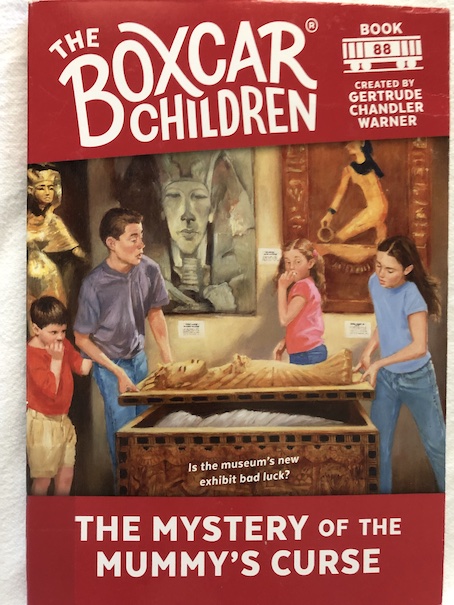
The Mystery of the Mummy’s Curse by Gertrude Chandler Warner, 2002.

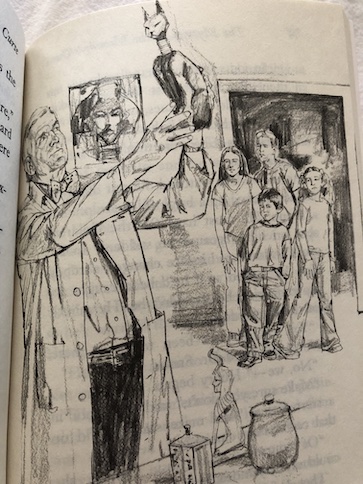
The Alden children are at the museum to get a sneak preview of the new Egyptian exhibit because the man in charge of the exhibit is the son of one of their grandfather’s friends.  When he shows them the mummy that will be the centerpiece of the exhibit, one of his assistants accidentally falls off a stepladder and breaks her ankle.  The museum personnel joke that it’s the “mummy’s curse,” although they quickly reassure the children that they don’t believe in curses.

With the opening of the exhibit coming soon, there’s a lot of work to do, including cleaning up the exhibit hall where it will be set up.  Losing the assistant has left the museum short-handed, so the Aldens volunteer to help with the cleaning and setting up.

However, the children notice other odd things about the exhibit when they’re helping to clean up.  They hear strange noises, as if someone were creeping around the off-limits areas where the artifacts are being stored and the exhibit getting set up.  Then, some of the artifacts that they noticed when they were first introduced to the exhibit disappear.  When they check to see what else is missing, they realize that some of the artifacts they’ve seen aren’t even listed on the official roster.  Jessie tries making her own list of artifacts in the exhibit, since the master list isn’t reliable, but someone steals it.

Who is stealing from the Egyptian exhibit?

The book is available to borrow and read for free online through Internet Archive.

My Reaction

I enjoyed the mystery. I was pretty sure that I knew early on who was responsible for the thefts, but mysteries involving museums, mummies, and stolen artifacts are my cup of tea!

I did think, as I was reading this, that few museums would let random kids help set up an exhibit like this, including valuable artifacts, even if most of what they were doing is just cleaning up. In the story, the eldest of the Alden children is 14, and I’ve done enough volunteer work to know that there are age limits and training requirements for certain volunteer tasks. There are really only two reasons why kids like the Aldens would be doing this. One, the requirements of the story: having the kids help set up an exhibit of Egyptian artifacts is exciting, something that plenty of kids would find fascinating, and it allows them to be in the right place to notice the thefts. Two, Grandfather Alden is rich: if the children’s grandfather wasn’t rich and well-connected, the Aldens wouldn’t be doing most of what they do in the stories. The second reason isn’t as charming as the first, and it never occurred to me when I was younger that the Aldens are actually very privileged to be in the position to do the things they do and meet the people they meet, but they are.

I wouldn’t say that the knowledge spoils the story for me, but it did make me stop and think. Sometimes, when adults, especially older adults, look back on books like the Boxcar children series, they talk about how independent the kids in these stories are and how willing to work, but the truth is that, in most of the stories, the kids’ grandfather sets them up with the opportunities for volunteer work or independence that the children have. The kids didn’t get this volunteer position because it’s an extension of special classes any of them are taking in history or archaeology or because they’ve done lower-level volunteer work for the museum before, working their way up, or because they applied for the position. They got it because of someone their grandfather knows. The Alden children are still willing to take advantage of opportunities that come their way and work hard at them and learn whatever they can, but when you think about it, it’s not quite the same as people who have to prove themselves and their merits first just to get the opportunity to do the same thing. So, I enjoy the story for the fun and mystery, but thinking about it now, as an adult who has done volunteer work for museums as well, I’m not quite so impressed with the way other, older adults compare the characters to real kids of non-rich, non-connected parents.

There are still volunteer opportunities for youths who want to get involved in museum work, but most of them require the kids to be older teens. One of the reasons for the age requirements is that there can be liability issues if someone gets hurt on the job, but people who hire volunteers also want to know about the skills the volunteers have, what kind of training they’ve had or need, and how much they can alreay do unsupervised. Rules can vary by location and position, but in the places I’ve been, kids under 14 are usually required to be supervised by an adult, 18 or over. Often, teens who do those sorts of jobs have already proved their skills or worked their way up in some way, applying for volunteer jobs and discussing their skills, taking related classes, being part of museum programs for younger children before, and/or volunteering in tandem with a parent first. The same is true of other places where I’ve volunteered, like animal shelters. So, the kids who seem more independent are that way because the adults in their lives took them through the preparation and training first and helped them connect with people who could take them further. This is a fun mystery story, but just understand that real children often aren’t like kids in mystery adventure books because they are real people in the real world, where circumstances are different from the ones in fiction. Real life has rules and regulations, and not everybody has a rich grandfather or family friends who are willing to treat them as special exceptions to the rules. If you want to see the kids around you get involved in a cause like this and gain some skills, the best way to go about it is to get involved yourself, both with the cause and with the lives of the kids, and give them the training and knowledge they need to go further on their own. Things like this don’t just happen on their own.

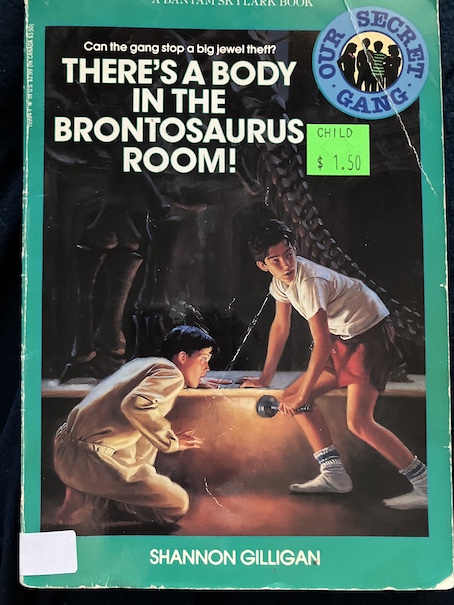
There’s a Body in the Brontosaurus Room!

Our Secret Gang

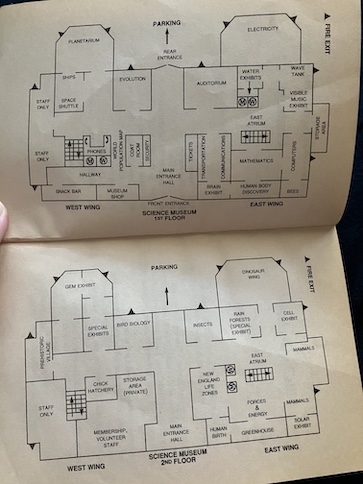
This is the last book in the Our Secret Gang series. This story takes place in a museum, and at the beginning of the book, there are maps of the interior of the museum, which help in keeping track of the action. Members of the detective gang in the story take turns narrating different books, and this one is narrated by Davey.

The fifth and sixth grade classes at the kids’ elementary school are having a camp-in at the Museum of Science in Boston. When the kids are getting on the school bus, Tim notices that a teacher is reading a copy of a newspaper with an article that says the police have received a tip that there will be a jewel robbery at the museum they’re visiting because there is a visiting exhibition of valuable gems. The kids think that they may have found the next case for their detective gang, and they’re glad that they brought some of their equipment with, like their walkie-talkies.

When they stop for dinner at a pizza place, they learn that students from Longmeadow Middle School will be joining them for the camp-in at the museum. By coincidence, Jeanine knows one of the boys from Longmeadow, Jeremy, because she takes horseback riding lessons from his mother. Jeremy ends up joining the others for dinner. Even though Davey rolls his eyes at his little sister’s jokes that Jeanine is his girlfriend, he feel unexpectedly jealous at the way Jeanine blushes around Jeremy.

While they’re having dinner, Tim notices a boy who is all by himself and crying. Jeremy says that he’s a new boy at his school named Matthew. Kids have been trying to make friends with Matthew, but Matthew never seems interested.

As they’re getting ready to leave, Jeanine makes plans to meet up with Jeremy and hang out at the museum. Davey gets angry because he wants the whole gang to investigate their possible mystery, and he doesn’t want Jeremy being forced on the group. Davey and Jeanine have an argument about his jealousy, and Jeanine separates from the group at the museum to hang out with Jeremy. Davey worries that this will split up Our Secret Gang or at least that they’ll lose Jeanine.

To make matters worse, Davey sees Mr. Berrar, the headmaster of the special school for science and mathematics that his parents and school principal wanted him to attend, at the museum because he is one of the museum trustees. Davey’s secret is that he is a genius at mathematics, and his parents and school principal wanted to send him to a special high school, skipping multiple grades, even though he didn’t feel ready to do that. Davey managed to persuade his parents that he would be happier remaining in a normal school with his friends, but he dreads other kids finding out and teasing him for being a nerd.

While Davey and the other kids are looking at the gem exhibit and talking about the security features they’ve noticed, still considering whether someone could be planning to rob the museum, Davey spots Jeremy in an area that’s marked “Private-Museum Staff Only.” What is he doing, sneaking around an off-limits area?

The rest of the detective gang, minus Jeanine, solves a small mystery for a girl from another school who lost her retainer, Lorraine. It only earns them $3 in detective fees, but Davey decides to hang out with Lorraine for a while and see if Jeanine gets jealous of them like he was of Jeanine and Jeremy, which she does. Davey thinks it’s only fair that Jeanine feel some of what he’s been feeling, and since she’s been giving him the cold shoulder and not helping with the detective activities of the group or joining her friends in looking at the exhibits, she deserves it.

Just as all the students are getting ready for bed, a girl starts screaming that there’s a body in the brontosaurus room! She says that it was lying right underneath the dinosaur, but when everyone rushes to look, it’s gone. Then, Matthew apparently has an attack of appendicitis and is taken away in an ambulance. Something about the ambulance strikes the kids have peculiar, but they have trouble thinking what it is at first. By the time they realize what was wrong, things have already started happening in the museum. The guards are missing, and security devices have been turned off. It seems that the robbery rumors were true. What can the kids do to stop it?

The book is available to borrow and read for free online through Internet Archive.

I first read this book as a kid, and one of the things I liked about it most was the title. I still think about when I’m at a museum with dinosaur exhibits. I never went on one of those camp-ins at a museum when I was a kid, but it’s something that I would have liked, especially if there was a mystery involved!

The romantic bickering in the story is juvenile, but I remember similar incidents from when I was about the age of the kids in the story. Some adults still do things like the kids in the book do, like seeming to flirt with someone else to make a partner jealous and get their attention. It’s never a good idea. It just adds another person to an already-complicated and highly emotional situation without resolving whatever was behind the initial problem.

As an adult, I thought that Jeanine was a little thoughtless and rude for ditching her friends to hang out with a guy she seems to have a crush on. When you already have plans with a group of people, suddenly tossing them aside to make plans with someone else and ignore them is rude. However, Davey’s jealousy and possessiveness is also inappropriate, and his behavior is part of the reason why Jeanine broke off from her usual group instead of just having her other friend join them. If Davey had either allowed Jeanine’s friend to join their activities or simply told Jeanine that he was hurt that she seemed to be abandoning the group and their latest project to pay attention to this other guy, his behavior would have been more reasonable. Part of the problem with simply inviting a new member on short notice is the secret nature of the group. To invite Jeremy to join them, the whole group would really have to agree on it, and that’s difficult in the public setting of the story. I think Jeanine should be a little more aware of the awkwardness of the situation because she knows why their group and its activities are secret, but it still doesn’t excuse Davey’s behavior. A large part of the problem is that Davey hasn’t given much thought to his real feelings about Jeanine, and he’s having trouble coping with the realization that he feels more strongly about her than he’s been willing to admit. The two of them sort things out when they have an honest talk with each other about their feelings.

One of the things that I particularly remembered about this book was the controversy over whether the brontosaurus is really an apatosaurus. Some of the thinking about the brontosaurus has changed in recent years.