Jessamy

Jessamy by Barbara Sleigh, 1967.

I couldn’t find a copy with its dust jacket intact.

Jessamy is a British orphan who is being raised by her two aunts, Millicent and Maggie. The two aunts aren’t really raising her together, though. Jessamy lives with Aunt Millicent during the school year, and she goes to stay with Aunt Maggie during school holidays. Truth be told, Aunt Millicent (her mother’s sister) and Aunt Maggie (her father’s sister) don’t really like each other, and they have different priorities and goals for Jessamy’s future. Aunt Millicent is doing her best to help Jessamy be pretty and popular, making sure that she wears a retainer to straighten her teeth and only allowing her to associate with “nice” children (apparently meaning ones from “good” families in the sense of social connections, who mostly don’t like Jessamy – Jessamy is usually not allowed to play with the children she actually likes and who like her). On the other hand, Aunt Maggie doesn’t care about beauty or popularity and just wants Jessamy to be well-behaved. Jessamy is confident that she is disappointing both of her aunts in all of these qualities. Her aunts are fond of her, but they are also occupied with their own lives. Aunt Millicent has her work, and Aunt Maggie has two children of her own, so Jessamy really has only half of their attention at any particular time.

However, Jessamy’s usual bouncing between her aunts is interrupted one summer when Aunt Maggie’s children, Jessamy’s older cousins Muriel and Edgar, catch whooping cough. Jessamy hasn’t had whooping cough herself, so she wouldn’t have any immunity. Rather than bring Jessamy into the household and have her end up sick, too, Aunt Maggie realizes that she has to find another place for her to stay until the other children are better. Jessamy can’t go back to Aunt Millicent because Aunt Millicent is leaving on a business trip, so Aunt Maggie arranges for Jessamy to stay with Miss Brindle, who is the caretaker of a large old house known to locals as Posset Place.

Miss Brindle is an older woman and is not used to spending time with children. Although Jessamy doesn’t really get along with her cousins, she isn’t sure if she’s going to like staying with Miss Brindle. However, Miss Brindle isn’t bad. She isn’t fond of Muriel or Edgar, either, and she says right up front that she’s glad that Jessamy seems different from her cousins. She also says that she’s going to treat Jessamy like an adult because she doesn’t know much about children, which suits Jessamy fine.

Miss Brindle tells Jessamy a little about the history of the old house. Posset Place was built in 1885 by a man named Nathaniel Parkinson, who made his money from producing a cough syrup called Parkinson’s Expectorant Posset. The house is largely empty now, except for the housekeeper’s quarters, where Miss Brindle now lives. Miss Brindle spends her time making sure the rooms are kept clean and well-aired.

Miss Brindle lets Jessamy explore the house a little before supper, and in particular, Jessamy is fascinated by the empty nursery. She finds herself imagining the children who used to live there and the toys and books the nursery once held. Then, she notices markings on the wall where the children’s heights were recorded, and she sees that one of the children was also named Jessamy. She tries to ask Miss Brindle about it, but Miss Brindle isn’t aware that there were any names written on the nursery wall.

During the night, Jessamy wakes up, still thinking about seeing her own name written on the wall of the nursery. She could have been mistaken, but it bothers her to the point where she feels like she has to go look at it again. Taking her flashlight, she goes upstairs again to look at the names. However, this time, the nursery is not empty, like it was before. There are clothes hanging on the wooden pegs on the wall and a line of shoes on the floor. When she checks the old measuring marks, she sees that there are fewer marks than she remembered before, but one of the names is definitely Jessamy, and the year next to that name is 1914. Jessamy lives in 1966 (contemporary with when the book was written), but the day in 1914 is the same day that she came to stay with Miss Brindle – July 23rd.

Then, to Jessamy’s surprise, she suddenly realizes that she is holding a lit candle instead of her flashlight. At first, Jessamy thinks that she must be dreaming, but then, an angry young woman comes and tells her that she should be in bed because she’s ill, not running around with a candle. The woman threatens to tell her aunt about this. When the woman lights her lamp, Jessamy sees that the nursery is now fully furnished.

It seems that Jessamy has gone back in time to 1914 and has been mistaken for the Jessamy who lived in the house in the past. The woman, who is Miss Matchett, the parlor maid, says that the other children named in the height markings – Marcus, Fanny, and Kitto – are all asleep and that it’s nearly midnight. The Jessamy of the past is the niece of the cook-housekeeper, which is why she is allowed to be with the children of the house. Jessamy’s head hurts, and she realizes that there is suddenly a bandage around it. Miss Matchett says that she fell out of a mulberry tree.

Jessamy realizes that the housemaid is only awake at this late hour and fully dressed because she had just returned from slipping out of the house secretly. When she points it out, Miss Matchett admits that she sneaked out to see her gentleman friend, and she says that if Jessamy doesn’t tell on her for doing that, she won’t tell her aunt that she was out of bed. Jessamy agrees, and Miss Matchett leads her back to her bed in the housekeeper’s quarters.

When Jessamy wakes up in the morning, she expects to find that everything that happened in the nursery during the night was a dream, but it isn’t. The room is the same one Miss Brindle gave her in the housekeeper’s quarters, but the bed and furnishings of the room are different. Jessamy is woken by a woman she’s never met before, not Miss Brindle.

This woman is the past Jessamy’s aunt, who tells her that she has had approval to stay on as the cook-housekeeper for the Parkinson family with Jessamy living with her. Not every household would accept a housekeeper with a young niece to raise, but as Nathaniel Parkinson himself says, the Parkinsons are not an ordinary family. Nathaniel Parkinson is a self-made man, from a humble background in spite of his current fortune, so he doesn’t put on airs, like other men of his current class. His granddaughter, Miss Cecily, at first disapproves of Jessamy, thinking that she might be too “common” (like the friends Jessamy’s Aunt Millicent disapproves of) and that she might not be a good influence on the children of the house, her younger siblings, who she is helping to raise. However, past Jessamy’s aunt defends her, and Nathaniel Parkinson says that she might actually be good for other children. He thinks Fanny has been acting too fine, and Kit could use the company of another child his age.

Jessamy is happy when she learns that past Jessamy has made friends with the Parkinson children and has really become part of the household. She is told that Fanny still thinks of her as being just the niece of a servant, but Kit (aka Kitto) is her special friend. Jessamy also likes this 1914 aunt better than her 1966 aunts because she seems nicer and more her kind of person. The realization that this is not a dream but that she has really traveled back in time is worrying, but Jessamy tells herself that she will somehow find her way back to her own time and that she should enjoy 1914 as much as she can while she can.

From the housemaid, Sarah, Jessamy learns that the Parkinson children live with their grandfather because their parents were killed in a carriage accident. Miss Cecily, the oldest girl in the family, takes care of her younger siblings and tries to manage the household while her oldest brother is away at Oxford. Miss Cecily is still learning about the running of a household, so past Jessamy’s aunt, Mrs. Rumbold, has to help her.

Jessamy also learns that she fell out of a tree house that she and Kit built together and that Fanny, who was also in the tree house at the time, was particularly upset by her accident. Fanny confesses to Jessamy that the reason she fell was because she pushed her. She hadn’t meant to push her out of the tree house or for her to fall, but the two of them were having an argument at the time. Fanny felt guilty about her getting hurt, but she’s still angry that Jessamy will be staying on at the house. She thinks that her grandfather and older sister decided to let her and her aunt stay partly because they felt badly about her getting hurt. Although Fanny is grateful that Jessamy didn’t tell on her for causing her accident, she still isn’t happy that Jessamy will be living with them. Fanny does put on airs, but she openly admits that she does it because everyone seems to be against her. Girls at school teasingly cough around her all the time because her grandfather made his money with his cough syrup, and since Jesssamy came, she feels like her brothers always side with Jessamy instead of her. Fanny has been in trouble before for bad behavior, and her brothers know that their grandfather has said if she does it again, he’ll send her to boarding school. Jessamy thinks that the idea of boarding school sounds exciting, but her brothers say that Fanny would hate it.

In spite of the drama with Fanny, Jessamy enjoys her time in 1914 and the other people there. She has the feeling that something important happened in 1914, and she remembers what it was when Nathaniel Parkinson and Kit talk about the possibility of war with Germany. Jessamy realizes that the coming war is going to be World War I and that it is going to start soon. Harry, the oldest boy in the Parkinson family, is back from Oxford, and he talks about how exciting it would be to be a soldier if there is a war, but Nathaniel Parkinson isn’t excited, understanding more about the nature of war than his grandchildren. Harry’s grandfather wants him to finish college, but Harry is in debt and wants to take his future into his own hands. Harry runs away, and at the same time, a valuable antique book belonging to his grandfather disappears. Jessamy doesn’t like to think that the pleasant young man stole his grandfather’s book, but what other explanation is there?

Just when Jessamy is getting caught up in the events in the Parkinson household and is concerned about the future of the past Jessamy and her aunt, Jessamy finds herself once again in 1966. Is it still possible for her to return to 1914 or learn what happened to the people she’s grown so fond of? Jessamy also begins to wonder who is the current owner of this old house and Mrs. Brindle’s employer? Learning the answers to those questions also explains a few things about Jessamy’s own family and past and gives her the one thing she really wants most.

The book is available to borrow and read for free online through Internet Archive (multiple copies).

My Reaction and Spoilers

This story is a combination of fantasy and mystery, a combination that I always like. In some ways, this story reminds me of Charlotte Sometimes because the time switching takes place between similar eras, but there are some notable differences between the two books. Charlotte Sometimes took place at a boarding school, and Charlotte went back in time to the end of WWI, not the beginning. There was also no mystery plot in Charlotte Sometimes beyond Charlotte trying to figure out how and why she is switching places with a girl in the past. Also, in Charlotte Sometimes, it isn’t clear whether Charlotte influenced or changed anything in the past, but Jessamy definitely does. The modern Jessamy had to be the one to solve the mystery because she has access to information that the past Jessamy didn’t have.

In the past, Jessamy begins investigating the mysterious theft of the valuable book. Although she knows that Harry isn’t the type to steal from his grandfather, it takes a second visit back in time for her to discover who the real thief is and to clear Harry’s name. Unfortunately, she is unable to actually find the stolen book in the past to return it to its first owner. It is through a new friend that she makes in 1966 that she learns what really happened to the book and is able to return it to the current owner of the house … an old friend of hers from 1914.

Along the way, Jessamy also learns a few things about the history of her own family. She realizes at the beginning of the story that Jessamy is an unusual name, which is why she is surprised that the girl in the past is also called Jessamy. It turns out that Jessamy is a name that is passed down through her family. She is not a direct descendant of the past Jessamy, as I first suspected, but the past Jessamy is a relative of hers. She also comes to understand that her family used to be more grand, but during the past, they fell on hard times. This is also important to the story because class differences figure into the plot.

Everyone in 1914 is concerned about class differences, but in different ways. Nathaniel Parkinson is actually the least concerned with class because he has actually shifted to a higher class during his lifetime, making him aware that people from different classes are really just people, only in different circumstances. His granddaughters are more class conscious, although both of them also soften on that after getting to know Jessamy better. Even the servants are also class conscious, with some of the servants putting on airs because they’re above other types of servants.

Something that surprised me in the story is the realization, toward the end of the book, that class differences are partly the reason why Aunt Millicent and Aunt Maggie don’t get along. Aunt Millicent’s efforts to make Jessamy more pretty and popular and have her be friends with certain people are social-climbing efforts, partly because Aunt Millicent is aware of their family’s past and wants the family to climb up from their humbled circumstances. Aunt Maggie’s disapproval of Aunt Millicent seems to come somewhat from her disapproval of Millicent’s efforts at social-climbing or trying to act like she’s more grand than she actually is. It isn’t stated explicitly, but it is heavily implied. We don’t meet Millicent in the book, but from her description, I suspect that she disapproves of Aunt Maggie because she thinks of her as being too “common.” From the characters’ descriptions of Maggie’s children, it seems like people who don’t like them think of them as being “common” or uncreative, indicating that this branch of Jessamy’s family is rather prosaic, being typical in a rather dull way.

The objective reality is probably that Jessamy’s two aunts are not very far apart in their social status, but they have different attitudes toward their social status. Aunt Maggie doesn’t care much about it. She fits in well where she is, she doesn’t care about moving up in society, and she just focuses on the children behaving well within their social status. Aunt Millicent, however, has a high opinion of who she is and where the family ought to be in society, and she is focused on moving up. Jessamy doesn’t really fit with either of her aunts’ philosophies of life. What she really wants is the chance to make real friends and fit in somewhere with people who like her and who like the sort of things she likes. She gets the opportunity at the end of the story when the current owner of the old house becomes her benefactor and arranges for her to attend boarding school, which she has said is something that she’s always wanted to do. At boarding school, Jessamy will be out from under the direct supervision of both of her aunts and will have the opportunity to develop independently and make new friends who suit her, rather than her aunts.

Even Fanny finds boarding school beneficial. We don’t know exactly how her life ended up in the 1960s, but when Fanny realizes that she’s caused problems for the past Jessamy in more ways than one and that she needs to admit the truth to her grandfather and older sister, her character develops for the better. She begins to develop empathy and compassion for the past Jessamy, looking beyond feeling sorry for herself to feeling something for another person she has directly harmed, and she reforms her character. She accepts the consequences for her actions, even though she was afraid to do so before, and it leads her to better things because the consequences are not as bad as she thought and actually help her. Although she was initially afraid of being sent away from her family, when her grandfather decides that she needs the discipline and sends her to boarding school, she discovers that she actually likes it. Going to boarding school allows her to get away from the girls who were bullying her at her local school and make new friends, and she develops some self-confidence from the experience, turning into a young lady who helps her older sister in her volunteer work for the war effort.

One final thought I had is that every time I’ve ever read a book with a sickness like whooping cough in it, I feel like it really dates the book. I know this book does have a specific date by design, and I know people still catch whooping cough in the 21st century if they haven’t been vaccinated (get your tetanus shot – in the US, the tetanus shot includes the whooping cough vaccine), but to me, this type of illness feels like a time travel back to my parents’ youths by itself. My parents and their siblings had whooping cough when they were young, but I’m almost 40 years old and have never seen a case of it myself.
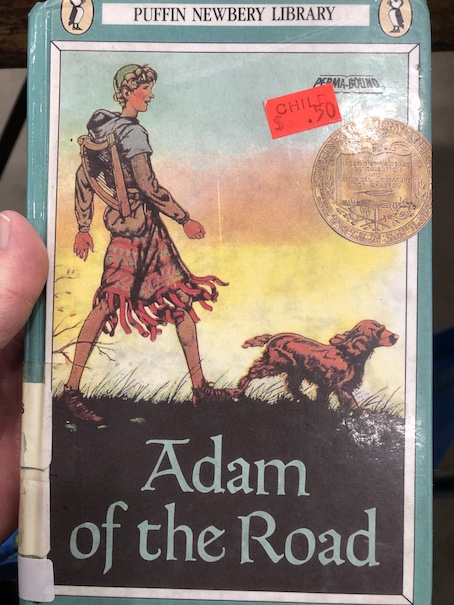
Adam of the Road

Adam of the Road by Elizabeth Janet Gray Vining, illustrated by Robert Lawson, 1942.

The story takes place in England in 1294. It’s summer, and eleven-year-old Adam Quartermayne is waiting for his father, Roger the minstrel, to come see him at the dormitory where he’s been living while he’s going to school at the Abbey of St. Alban. Roger Quartermayne has been in France, attending a minstrels’ school, where he has been learning new songs and stories. More than anything, Adam wants to go on the road with his father, traveling from town to town, playing their musical instruments.

Roger is a higher class of minstrel than most, truly skilled in his art, welcome even in noble manor houses and castles, and well-paid for his performances. Roger plays a viol, while Adam can play the harp. Adam practices his playing while at school and tells stories to the other students. Although his teachers would prefer that he spent his story-telling time talking about the saints, they allow him to entertain the other boys as long as his stories are tasteful and not rude or mocking. Adam’s father has impressed on him that a minstrel’s job is not to tell his own feelings but to choose entertainment that suits the mood of his audience, whether it’s happy or sad. (In other words, they know how to read a room, and a good minstrel can make the audience feel like he’s saying what’s on the minds of the listeners.)

Adam’s closest companions at school are his best friend, Perkin, and his dog, Nick. Since Nick isn’t allowed in the dormitory, Adam pays for him to board with a woman in town. He and Perkin go to visit Nick when they can. Adam has taught Nick to do entertaining tricks, as befits a minstrel’s dog.

When Adam’s father comes, he tells Adam that he has taken a position with Sir Edmund de Lisle and is now traveling with his party. Roger invites Adam to join him on their journey to London, and Adam eager accepts. His only regret at leaving the school is that Perkin cannot come with them, but Perkin says that they’ll see each other again. Perkin’s father is a ploughman (this video, from Crow’s Eye Productions, explains a little about the life of a ploughman and how they dressed), and he says that, if they pass through the village where he lives, they can stop and visit his parents and the parson who sent him to the abbey school.

The open road is like home to minstrels like Roger and Adam. They spend their journey entertaining Sir Edmund’s party with stories. Adam develops a crush on Sir Edmund’s pretty niece, Margery, although her brother, Hugh, is an annoying snob. Adam’s first efforts to join his father in playing music are awkward and embarrassing, but Roger says he will improve. Adam is also lonely without Perkin to talk to. There are other boys at Sir Edmund’s manor house, but they all ignore him. They become friendlier when Adam takes the advice of a friendly squire to lend them his horse for their jousting practice when Hugh’s horse is lame. At first, Hugh thinks that a minstrel like Adam wouldn’t know anything about martial arts, but Adam demonstrates that he has also had some training, causing Hugh to give him more respect. From then on, he is able to join the other boys in their games.

At the wedding of Sir Edmund’s daughter, Emilie, Adam has the chance to see many other minstrels and entertainers of various kinds. Although both Adam and his father are richly rewarded for their performance, Roger gambles away his share of the money playing dice with the other minstrels. He tells Adam to keep his own money close to him and not to hand it over to him, even if he asks for it. Roger recognizes that he has a gambling problem and can’t be trusted with money. Worse still, he gambled away their horse, too. It’s upsetting to Adam because they had never had a horse before, and he was fond of it. He also knows that Hugh was fond of that horse. Roger is embarrassed about what he has done, and Hugh worries that Jankin, the man who won the horse, will ride him to death because he doesn’t know how to take care of horses.

Although they are still in the employ of Sir Edmund, he will not be needing them for a while, now that the wedding of his daughter is over. Roger and Adam go on the road again, although they are supposed to return to Sir Edmund’s manor after traveling their route. In London, they meet up with Jankin again, and he tries to get Roger to gamble with him again for ownership of Adam’s dog, but Roger refuses, saying he doesn’t want to play anymore and the dog belongs to his son. However, when they happen to be staying at the same inn later, Jankin steals Adam’s dog!

Roger and Adam hurry after Jankin to get Nick back, asking people they meet on the road which way he went with their dog. They almost catch up to him at a ferry, but he gets on the boat and it leaves before they can reach it. Not wanting to wait for the ferry to return and desperate to reach his dog, Nick jumps in the water and tries to swim after the ferry, but he is still unable to catch up. When he climbs out of the river, he is alone and too tired to continue the pursuit anymore. He is separated from his father, but he still has his harp, thanks to a kind woman who helped him. What is he going to do? Will he ever find his dog or father again?

The book is a Newbery Medal winner. It is available to borrow and read for free online through Internet Archive (multiple copies).

My Reaction and Spoilers

The story offers a ground-level view of Medieval society. Through his travels, Adam mixes with children and adults from various levels of society. Adam begins at a monastery school, taught by monks. Then, he joins his father, working for a noble family and living at their manor, where Adam becomes friends with noble boys training to be knights. They meet other minstrels, and when they travel on the road, they also meet traveling pilgrims, stay at inns and speak to the innkeepers. When Adam is on his own, he briefly stays with a ferryman and his wife, travels with a merchant, is robbed by highwaymen and has to get help from local law enforcement, gets information from a shepherd, attends a large fair with people of all kinds, and toward the end of the book, spends time with Perkin and his family, helping his father with ploughing. Along the way, Adam learns many things about people and different members of society, including how girls are treated differently from boys, even in noble families and what common people think about the king and parliament and how they make laws.

During the course of the story, Adam and his father also discuss some of the philosophy behind their own profession. It begins with Adam’s reflection on what his father said about choosing his selections of songs and stories to appeal to his audience because his job is to please others, not merely himself. However, when Adam briefly joins up with some poorer minstrels, he comes to understand that it’s not just a matter of giving people what they want. A better minstrel not only gives people material they like but which appeals to the better sides of their personalities, elevating them to their highest versions of themselves, instead of just catering to everyone’s lower tastes. Understanding other people and their lives and tastes are critical to the job of being an entertainer. Adam also learns a little about the use of humor and how it can benefit both himself and others when used well. At one point, when Adam is recovering from an incident that was embarrassing to him, he makes a joke about it that amuses a new friend, and when his new friend laughs, Adam realizes that he feels better about the embarrassing incident. His use of humor softens his feelings of embarrassment and also provides a useful tool for entertaining and bonding with someone else. The story compares it to an oyster turning an irritant into a pearl that is both less irritating to the oyster and something beautiful for someone else. Although Adam goes through genuinely terrible circumstances through his travels, the experience shapes his views of life and the type of minstrel he wants to be.

I was genuinely worried about the animals in the story because I find it stressful to read about animal cruelty. Fortunately, both the horse and dog survive their experiences with Jankin, and Adam is reunited with his father and Nick.

I enjoyed the pieces of real Medieval songs that appear throughout the story, like Sumer is I-cumen In (You can hear the song in this YouTube video. This one explains what the Old English words mean. It’s about the beauties of nature and lively animals at the beginning of summer, apparently with a confusing line about farting billy goats.) and an old version of London Bridge is Falling Down, which also includes an explanation of the story behind the the song.

As another piece of trivia, Jankin is actually a Medieval nickname for John. In Medieval times, it was common to get new nicknames for certain common names by changing just one letter or sound in the name and/or adding “-kin” to the end of a name as a diminutive, like we might add a “-y” for Johnny. In fact, the name Jack that is used as a nickname for John comes from this earlier nickname – John to Jan to Jankin to Jackin to Jack. We get other nicknames that don’t completely resemble the original name from this same method of creating new nicknames, like the nickname Peggy for Margaret – Margaret to Maggie to Meggy to Peggy.

The Mystery of the Disappearing Cat

Five Find-Outers

The Mystery of the Disappearing Cat by Enid Blyton, 1944, 1966.

Bets is happy that her brother, Pip, is coming home from boarding school, and he’s bringing his friends to visit. Now that the children are reunited, Bets and the others hope that they will find another mystery to solve! The others ask Bets if anything interesting has happened since they were home last, and she says not very much, although someone has moved into the empty house next door. The new neighbor is Lady Candling, who keeps Siamese cats.

The boy who helps the gardener, Luke, is nice and allows the children to visit and see the cats. Lady Candling says that the Siamese cats are valuable prize-winning cats. She keeps them in a large cage most of the time for safety, but Miss Harmer, the housekeeper, takes one out to show the children. Unfortunately, one boy, Fatty, owns a Scottie dog named Buster, and Buster comes into the garden looking for him. Buster frightens the cat and chases her! The cat claws Buster after he chases her into the bushes, and they manage to get Buster under control, but they have trouble finding the cat. Miss Harmer is upset that her cat is lost, and Bets goes to search for the cat.

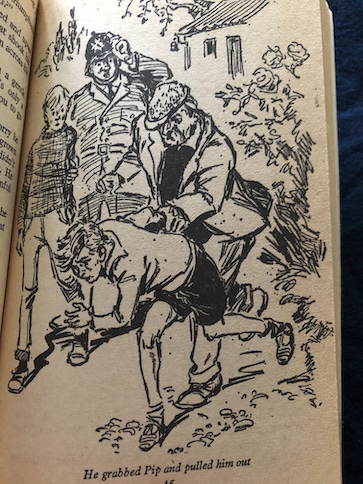
While Bets is looking for the cat, the gardener, Mr. Tupping comes to find out what the fuss is about. Mr. Tupping is a violent and short-tempered man. (They also emphasize that he has a hooked nose, which I think is probably a stereotype. Enid Blyton’s books often contain derogatory racial stereotypes, although later printings have been revised to remove them.) Mr. Tupping hates children and animals, and he grabs Buster and locks him up, threatening to beat him later. The children try to help Buster, but he chases them out of the garden. Bets is left behind, but she locates the missing cat, and Luke helps to free Buster and get Bets out of the garden without Mr. Tupping seeing her. However, Mr. Tupping threatens Luke with dire consequences if he ever lets the children into the garden again.

This is just the beginning of their troubles with Mr. Tupping. When Mr. Tupping finds out that Bets has visited Luke again, he storms into Bets’s own little garden, rips her strawberry plants out of the ground, burns them, and yells at her. Bets is afraid to report him to the adults because she’s afraid that Luke will get in more trouble with Mr. Tupping. Luke is a poor orphan who lives with his stepfather, and he desperately needs the job, which is the only reason why he continues to work with the nasty Mr. Tupping. Mr. Tupping is also friends with the local policeman, and the children know that the local policeman resents them for solving a mystery before he did, so they’re sure that he will side with Mr. Tupping, no matter what they say about him.

Then, Lady Candling’s prize cat, Dark Queen, disappears, and Luke is blamed for stealing her! The children are sure that Luke is being framed for the cat-napping, but the evidence is against him. Pip and Bets’s own mother saw the cat in its cage when she went to tea with Lady Candling, and Luke was working in a garden bed nearby. Even Luke says that no one else went near the cage between then and the time when the cat disappeared. When a wooden whistle Luke made is found in the cats’ cage, the children are sure that it was planted to frame Luke, but how can they prove it? Then, the cat reappears, and later disappears again! What is going on?

The book is available to borrow and read for free online through Internet Archive (multiple copies).

My Reaction and Spoilers

I found this story frustrating because all of the adults in the story are so oblivious to Mr. Tupping’s violence and aggression. He is actively abusive to the children and animals, but nobody seems to notice or even inquire about signs of trouble. Bets’s mother never seems to notice that all of her daughter’s strawberry plants have suddenly disappeared from her garden and never asks her daughter what happened. Mr. Tupping is able to just march onto the family’s property and abuse an 8-year-old girl with complete impunity, and her mother never notices a thing. (Of course, if I were the girl in question, I would have done what I used to do when I was picked on as a kid – take a deep breath, throw back my head, and scream continuously until help arrives. I figured out at a young age that if you scream from your diaphragm, you can get extra volume and keep the scream going for longer without straining your throat, and it’s difficult for the adults to ignore. You can’t scream like that at every inconvenience or people will start to ignore it, but it’s definitely an attention-getter if you use it when it really counts! Just let Mr. Tupping explain his presence and actions when the adults come to find out why their daughter is screaming like she’s being murdered!)

Mr. Tupping is a very obvious villain. He’s also the first person on the scene each time the cat disappears, the one who strategically assigns Luke to work near the cats’ cages just before the prize cat disappears each time, and the keeper of the key to the cats’ cages when Miss Harmer is away, which she is each time the prize cat disappears. Yet, even though he has means (the key), motive (he hates the kids and animals and wants to get rid of Luke), and opportunity (always the first person in the cats’ cages whenever the cat disappears and the one person who controls where Luke is working), all of the adults immediately look at Luke as the thief, never even questioning Mr. Tupping. An adult would be more likely than a kid to know where to sell a prize-winning cat (heck, as a an adult, I wouldn’t even know where to deal in black market animals), but nope, all of the adults first think a kid did it, like kids have those kinds of criminal connections to the prize cat black market. It drove me completely crazy!

It’s worse because Mr. Tupping is friends with the local policeman and gets favoritism because of it. When the kids consult their friend who is a police inspector, he finds out that Mr. Tupping has a police record for being involved in a dog-napping case (surprise, surprise), which establishes his criminal history and connections to people who deal in stolen animals. I was disgusted that the local policeman never looked into his background himself, but I felt a little better when the inspector reprimands him for making friends with a criminal and overlooking evidence that implicated him and trying to prevent the children from bringing evidence and concerns to light. The local policeman is embarrassed, but at that point, I felt like he deserved to be.

The villain was obvious, but what saved this mystery was that he actually used a clever trick to confuse the time when he actually took the cat. I knew from the beginning who the cat thief was, so the real mystery for me was how he got the cat out of its cage without people seeing him. It turns out that Mr. Tupping takes the cat earlier in the day than everyone thought the cat was stolen. The Siamese cats look very much alike, but the one that was stolen had a marking that was different from the others. With a bit of paint, Mr. Tupping makes a different cat look like the missing one for most of the afternoon, quickly using a bit of turpentine to remove the paint at a strategic moment to make it seem like the cat disappeared at a time when Luke was near the cats’ cages.

Five Go Off in a Caravan

The Famous Five

Five Go Off in a Caravan by Enid Blyton, 1946.

The children (Julian, Dick, Ann, George) and their dog, Timmy, are all looking forward to the summer holidays.  They’re not sure what they want to do, but they think that it would be more fun to go somewhere without the adults instead of going home, but they can’t think of anywhere they can go without adults.  They doze off in the sun while talking about it, but Timmy wakes them when a circus procession passes by.

The children are fascinated by the circus and call to a boy traveling with them, Nobby, asking him where they’re going to be performing.  Nobby says that the circus is on a break, and they’re going to be spending some time at a lake that allows them to camp there with their animals.

As the children watch the caravans of the circus going by, they think that it would be great if they could hire a caravan (horse-drawn travel trailer) and travel in it themselves.  They have a horse, Dobby, who could pull one.  The children ask their mother if they can hire a caravan, and she says that she’ll have to talk to their father about it.  It turns out that their father needs to go up north for part of the summer and wants their mother to come with them, so he thinks that it’s alright if the children want to take a caravan and camp out while they’re away.  The parents decide that the children will need to hire two caravans and borrow an extra horse because they don’t think one caravan will be enough for the four children and their dog, and they insist that the children sent them a message every day to tell them where they are and how they’re doing.

As the children discuss their plans in more detail, they decide that it will be fun to go to the lake where the circus is and get to know Nobby better.  Nobby lives with his uncle, who is the chief clown of the circus, and the children didn’t like what they saw of him before because he didn’t seem jolly at all, but they think it would be fun to be friends with Nobby and get another look at the circus animals. 

The children are eager to get started, but their parents make them pack and plan properly.  When the caravans arrive, the girls choose the red one, and the boys get the green one.  The girls take the new horse, Trotter, and the boys take Dobby for their caravan.  The adults give the children a map of places where they’re allowed to camp.  On their way to the lake, the children camp on farms that allow caravans.

When the children arrive at the lake, Nobby is glad to see them, and he introduces them to his chimpanzee, Pongo, and his terriers, Barker and Growler.  Nobby is friendly, but his Uncle Dan (called Tiger Dan) and Lou the acrobat are rough and unfriendly and don’t want the kids around.  When the children camp near the circus that night, Tiger Dan and Lou try to run them out of the campgrounds, but the children send their dog after them.  The campgrounds are public property, and there isn’t any reason why the children can’t be there.  The children think that Tiger Dan and Lou stumbled on their campsite by accident when they were trying to have some kind of secret meeting.

The next day, the children decide to go camp in the hills, as they had already planned because they know it will be cooler in the hills.  Lou takes an interest in where the children are going, but they don’t want to tell him much because they don’t want Lou and Tiger Dan coming after them to harass them again.  They find a nice place to camp up in the hills on some land belonging to a pleasant farmer and his wife, who also provide the children with food.

However, it isn’t long before Tiger Dan and Lou locate the children’s campsite and try to talk them out of camping at that spot also.  Nobby doesn’t know why Tiger Dan and Lou are up in the hills anyway.  The circus people have been buying some of their food from the farmer, but Nobby says that it’s always the women who go to the farm to buy things, not the men.  It seems like Tiger Dan and Lou are up to something suspicious, but the children don’t know what.

Then, suddenly, the men seem to change their views of the children, encouraging Nobby to be friends with them and to bring the children to visit the circus camp.  The children are suspicious and leave Timmy to guard their caravans while they visit the circus camp, just in case the men try to mess with their camp while they’re gone.  When they return to their own camp, the children discover that the men have tried to poison Timmy with tainted meat!  Fortunately, Timmy didn’t eat the meat, but unfortunately, one of Nobby’s dogs eats some and is violently ill.  The children aren’t sure whether the little dog will survive or not, and they don’t know why the bad men want to get rid of them so badly that they would try to kill their dog.  Whatever’s going on is serious, and they need to get to the bottom of it!

The book is available to borrow and read for free online through Internet Archive (multiple copies).

My Reaction

Traveling without parental supervision is the stuff of vintage children’s books and the dreams of children from every era! The kids in the Famous Five series have far more independence that modern children have, and in fact, the authorities might be concerned about children their age traveling without their parents. Actually, I would think that few adults even at the time of the writing of this book would even consider letting their children travel alone like that. That’s part of the appeal of this type of story, children being able to do things that real children never do.

I didn’t like the part about the dog being poisoned because I always hate it when bad things happen to animals in stories, but don’t worry! Nobby’s dog is fine in the end!

Mystery at Kittiwake Bay

Mystery at Kittiwake Bay by Joyce A. Stengel, 2001.

Cassie Hartt has only recently moved to Kittiwake Bay, Maine with her mother and brother following her parents’ divorce. Her mother is a nurse, and she has found a job at the local hospital, which is actually 30 miles away from the little town where they were able to find a house. Because of her mother’s long commute, Cassie will need to look after her 7-year-old brother, Danny. Soon after arriving, she meets a nice boy named Marc Nolan, who is a little older than she is and loves boats, and a girl name Liz Painter, who likes photography and walks her cat on a leash. Liz is the one who introduces Cassie and Danny to the Beachcombers Club, which is a group for kids Danny’s age who like to go swimming and camping and the kids who hang out at the Sand Shack coffee shop. Marc is one of the Sand Shack kids, and so is a boy named Ryan Jerrick, who is Liz’s crush. Cassie is glad to be making friends and starting to get settled into her new home, but soon, there are complications.

One evening, on her way home from the grocery store with her dog, Sam (short for Samson), Cassie sees some mysterious figures sneaking around in the dark. She doesn’t know who they are, but the way they’re sneaking around worries her. She later learns that there have been robberies in the area.

Cassie develops a fascination for the large house that she saw on a cliff near the ocean, and Marc and Ryan tell her that’s a senior citizens’ residence called Waterview Manor. Both of them work there part time. Liz says that the house wasn’t always a senior citizens’ residence and that there are a lot of weird stories about the place. It was built by a rich man before the Civil War, but it became property of the town in the 1950s. One of the stories about the place is that it was once part of the Underground Railroad helping escaped slaves. The boys say that a woman named Mrs. Wentworth says that her grandfather was one of the people helping escaped slaves. There’s also a story about Captain Kidd hiding his treasure somewhere around the old house, although Ryan doesn’t believe any of these stories. He thinks Mrs. Wentworth just tells tall tales. Cassie thinks that she might like to volunteer at the house, like the boys did before they started working there as employees. If her little brother joins the Beachcombers Club, she’ll have some free time for volunteer work.

When Cassie goes to Waterview Manor to sign up, she witnesses an argument between Ryan and Mrs. Wentworth, who is confined to a wheelchair. Ryan was being disrespectful because Mrs. Wentworth was telling one of her stories about the history of the town that Ryan thinks is outlandish, and Mrs. Wentworth was telling him off. Ryan doesn’t actually like working at Waterview, but he has to keep his job because he needs the money. Cassie thinks he’s arrogant. Ryan has no patience for the fetching and carrying he has to do for the older people, and he thinks that Mrs. Wentworth’s mind is going. Cassie thinks that Mrs. Wentworth sounds like she still has her faculties and is sympathetic when Mrs. Wentworth laments about not being able to do things she used to do because her hands and feet won’t obey her anymore. Mrs. Wentworth is physically feeble these days, but she knows what she’s talking about when it comes to local history.

After she signs up to volunteer, Cassie can’t resist a peek into the forbidden East Wing of the house, and she meets Marc there. They both admit that they’re curious about the stories of treasure in the house. Unlike Ryan, Marc believes Mrs. Wentworth’s stories, and Cassie can’t wait to hear more!

Mrs. Wentworth used to be a history teacher, and she does know more about local history than Ryan gives her credit. She tells Cassie how her grandfather used to be a conductor on the Underground Railroad and how his friend, Mr. Palmer, who was the original owner of Waterview Manor, was a stationmaster, which meant that he hosted and hid the escaping slaves that Mrs. Wentworth’s grandfather conducted to him. Mrs. Wentworth’s grandfather told her about a secret room where they used to hide people and a secret tunnel that would take them to the landing site for the boat that would smuggle the runaways to Canada. When Cassie asks her about the story about Captain Kidd hiding his treasure somewhere in the area, Mrs. Wentworth said that her grandfather always believed he did, although Captain Kidd was much older than both her grandfather and the Manor. She explains a little about the life story of Captain Kidd and how it seems that most of his treasure was never found.

However, they soon have a more modern mystery on their hands. Whoever has been stealing things in the area recently seems to have started taking things from Waterview Manor. First, an expensive chess set belonging to one of residents disappears. Then, some jewelry and a coin collection disappear. Then, someone steals Mrs. Wentworth’s beloved lavaliere necklace, a special present from her late husband. For someone to both know about the residents’ valuables and to have access to them, the thief must be somebody working at the Manor! Who, could it be? Is it grumpy Ryan, who needs money? Is it John, another employee, who often acts a little strange? Could it even be helpful Marc, who seems nice but is often lurking around areas where both he and Cassie aren’t supposed to be? Or is it someone else Cassie wouldn’t even think to suspect?

The mysteries of the past start mingling with the mysteries of the present. Cassie sees signal lights from the tower of the old house that remind her of of the signals Mrs. Wentworth said the Underground Railroad used. Is someone now using them for a different purpose?

The book is available to borrow and read for free online through Internet Archive.

My Reaction

The Underground Railroad is a popular subject in US children’s books. There is something compelling about people sneaking around on clandestine missions and hiding in secret rooms and secrets passages, and since these things were used in the real life Underground Railroad, they make convenient devices for US children’s books with some historical flavor. The former Underground Railroad secret passage in Waterview Manor does play a role in this story. Someone is using it for a new purpose, just like they’re using signals from the tower.

The purpose of the Underground Railroad secret tunnel in the story is also to show that Mrs. Wentworth knows what she’s taking about when she tells her stories about local history. Ryan tries to discount her stories because some of them sound a little far-fetched and dramatic and because he thinks scornfully of the old people he serves in his job. Ryan has a negative attitude and looks at the elderly as being senile and demanding. Cassie feels differently because she has more empathy and, perhaps, because her mother is a nurse, which may make her more aware of the human condition and more comfortable helping other people. She seems to understand what Mrs. Wentworth means when she talks about finding it frustrating that she can’t do things she used to do, and she says that she agrees with Mrs. Wentworth when she says that she likes keeping her hair long even though a nurse at the Manor says it would be easier to care for if she cut it shorter. The nurse is probably thinking that short hair would be easier on those who might have to help Mrs. Wentworth wash and brush it, but Cassie understands when Mrs. Wentworth explains why she likes her hair long. Cassie thinks the people who live at Waterview Manor are interesting, and she admits to her mother that she likes to pretend that they’re her grandparents. She is fascinated by Mrs. Wentworth’s stories, and because she and Marc believe what she says, they are able to get to the bottom of the mysteries surrounding the Manor.

I was pretty sure I knew who at least one of the thieves was, and I was also pretty sure I knew why. I was correct in my first guess, but there were enough red herrings along the way to give me some doubts, so there was plenty of suspense in the story. One of them wasn’t fully aware of what he was getting involved with at first, but he does bear responsibility for what he did even after he knew.

This book also deals with the subject of divorce and how it affects families and children. Books like this were once rare, but they have been very common staples of children’s literature since the late 20th century, reflecting changes in American society and a growing willingness to discuss difficult topics with children. Moving to a new state and starting over after the divorce wasn’t easy for Cassie, her mother, and her brother. Cassie quickly becomes interested in the history of her new town, and it doesn’t take her long to find some new friends and a volunteer activity to keep her occupied. However, other aspects of the changes in her life and family will take longer to get used to. Her mother has to work long hours with a long commute, so Cassie frequently has to be responsible for her younger brother when he’s not at activities of his own, and her mother often isn’t home for Cassie to discuss things with her.

There is also some tension between Cassie and her brother because the divorce has changed their relationship with each other. Because Cassie has become more of a caregiver to Danny because her mother has to work, she has to make arrangements for Danny before she can do anything on her own, which sometimes makes things awkward for her. Danny also becomes jealous because Cassie does have more ability to do things on her own than he does and because she makes friends and settles into their new town more easily than he does.

One part of this book that I hated was when Danny intentionally left Sam outside alone to spite Cassie, and Sam is poisoned by one of the villains and nearly dies. Cassie is very upset with Danny because of this incident, understandably so, but I didn’t like it that the other characters were pressuring her to be okay with Danny and forgive him too quickly. They do this because Danny is young, they think that he left the dog out by accident, and Danny feels really badly about almost getting the dog killed. Cassie knows, although Danny doesn’t initially admit it, that Danny left the dog outside on purpose. That purposefulness maliciousness is not a thing that I think should be too easily forgiven, especially not because someone just “feels bad.” Let’s insist on a little empathy here, Danny. Cassie feels bad because you almost got her dog killed. Sam really feels bad because he’s the one who almost died! Maybe your feelings shouldn’t be given first priority here, since you were the one who caused the harm. Sam is a dependent animal. Under no circumstances should animal abuse be excused, and leaving a dependent animal outside alone to be lost, hit by a car, or yes, harmed by some other malicious person is abusive. Danny should not be given a pass for malicious behavior or animal abuse just because he “feels bad.”

Giving people that type of excuse for malice and abuse just encourages more of it in real life because the person finds that there are no consequences for their actions and it gets them the forgiveness and attention they want, so they keep doing it. It’s a dangerous thing to allow. The story makes it clear that Danny was acting out on bad feelings that he already had about the divorce and feeling neglected by both his mother and Cassie, but I think it’s important to make it clear to him that, even if he’s “feeling bad”, that does not give him the right to hurt other people or animals. Nobody has the right to hurt others just because they’ve got mixed-up feelings. I hate it that the other characters don’t seem to feel that way.

The story ends happily when Danny tries to make it up to Cassie by investigating the situation and Cassie rescues him from the bad guys. They have a heart-to-heart talk that makes Cassie realize how important Danny is to her and that she has to make time for paying attention to him and supporting him more during this difficult time. Still, I feel very strongly that the story and the other characters should emphasize to Danny that causing hurt because you feel hurt is wrong and damaging to relationships. The way the other characters tried to make Cassie feel bad about the situation also really felt like gaslighting. She had a real and serious reason for being angry with her brother, and it just made me really angry when they acted like she was the bad one because Danny was “feeling bad” and she wanted him to be accountable for his actions. He knew what he was doing, and he should have known it was dangerous to Sam, even if he didn’t know that someone was going to deliberately try to kill the dog.

I know that Danny has some emotional issues that need to be addressed, but I’m saying that he also has some behavior issues that also need to be addressed. There are helpful ways to deal with emotions and destructive ways to deal with emotions. Danny is not too young to understand the consequences of his actions and to accept them. I don’t think that learning that it can take awhile to regain trust after betraying someone’s trust is also an unbearable lesson. In fact, I’d call it a life skill. If it helps him to develop more empathy and consider other people and the consequences of his actions before he lashes out, it is worth it.

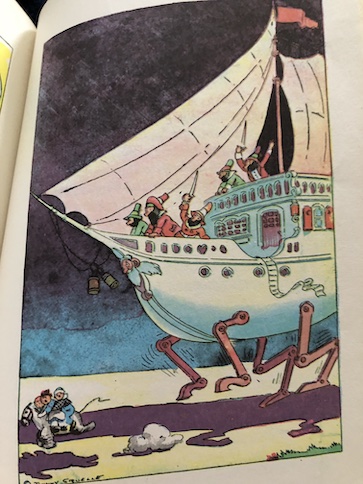
Raggedy Ann and Andy and the Camel with the Wrinkled Knees

Raggedy Ann and Andy and the Camel with the Wrinkled Knees by Johnny Gruelle, 1924.

This book is part of the original Raggedy Ann series by its creator, Johnny Gruelle. Unlike earlier books in the series, this book is a single long adventure rather than a collection of short stories.

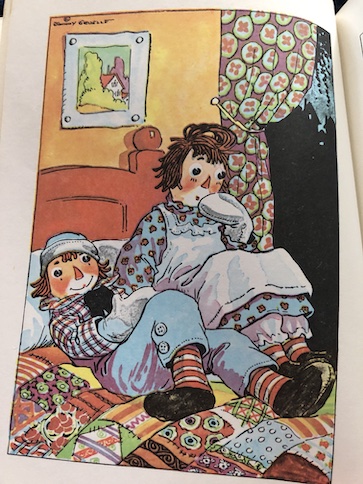
Raggedy Ann and Andy are lying in their doll bed in Marcella’s playhouse one night when they see a strange man sneaking up to the big house. They see him reach through a window, steal something, and run away. Wondering what just happened, they run to the house and talk the other dolls. The other dolls say that the thief just stole the French doll!

Raggedy Ann and Andy try to follow the man to rescue the French doll, but they can’t catch up to him because he flew away! As they try to figure out what to do, a fairy comes along. They explain the situation to the fairy, and the fairy says that they can fly if Granny Balloon Spider weaves a balloon for them. So, they go to Granny Balloon Spider weaves them a silken balloon, and they sail away into the air.

When Raggedy Ann and Andy decide it’s time for them to get off the balloon, they grab hold of a tree limb and untie the silken strings that have them tied to the balloon. When they jump down from the tree, they meet an old stuffed camel with wrinkled knees. They explain their situation to the camel, and the camel says that the man who took the French doll sounds like the one who kidnapped him from his owner, a small boy. The camel escaped from the man, but he thinks he could find him again, except that it was dark when he ran away, so he could find his way better if he couldn’t see.

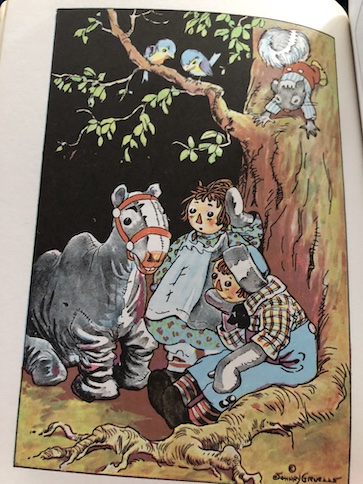
Raggedy Ann and Andy tie a handkerchief around the camel’s eyes and climb on his back. At first, the camel just goes around in circles, but Raggedy Ann and Andy realize that he needs to run backward to retrace his steps, and then, they start getting somewhere.

Along the way, they meet a girl named Jenny who is trapped in a patch of snap dragons. The snap dragons won’t let her go. When they try to help her, Raggedy Ann and Andy get trapped by the snap dragons, too. They don’t know what to do until a tired old horse comes and rescues them.

Jenny explains that she was searching for her brother, Jan, who was kidnapped by a magical creature called a Loonie. The tired old horse says that he knows where Jan is now, so they decide to rescue Jan before continuing their quest to find the French doll.

The Tired Old Horse leads them to the tree where the Loonie lives, and the Camel recognizes it as the place that he escaped from. They discover that the Camel as the ability to get inside the magical tree when he’s blindfolded, and he carries the others inside. From there, they find a trap door that leads to Loonie Land.

In Loonie Land, they are captured and brought before the king of the Loonies, who is a very silly king. The king insists that they won’t let Jan go until they answer three riddles. The riddles are very silly and make little sense, but Raggedy Ann and Andy figure out that the king doesn’t know the answers himself, so as long as they give him some kind of answer, they will be answering the riddles. The king is astonished that they are able to come up with answers and tries to insist that he has to ask them three more riddles, but Raggedy Ann and Andy insist that they’ve fulfilled the bargain already and that they’re going to take Jan. Raggedy Andy tweaks the king’s nose, and the king summons his looniest knight to fight them.

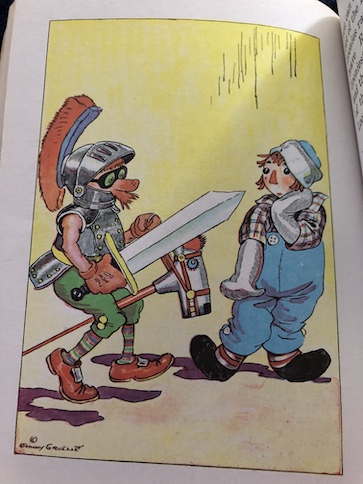
The looniest knight comes riding up on a hobby horse, but he’s afraid of Raggedy Andy and pretends that his hobby horse is acting up and that it has thrown him off. Since Raggedy Andy has “vanquished” the looniest knight, the king decides that they can take Jan and go.

With Jan rescued, they are able to resume their quest to find the French doll. Going further, they meet Winnie the Witch. The witch says that the man with the French doll bought some magic medicine from her, but he gave her a lead dime. Since he cheated her, the witch says that the magic medicine she made for him won’t work. The tired old horse asks if she has some medicine that will make him less tired. When he has her medicine, he becomes more energetic.

When they ask the witch how to find the man with the doll, she has them close their eyes and count to ten. When they open their eyes, they find themselves outside the tent of the man who took the doll. It turns out that Babette, the French doll, was kidnapped by pirates! Getting away from them is also going to be difficult because the pirates have a jumping house boat!

The book is available to borrow and read for free online through Internet Archive (multiple copies – including an audiobook). The LibriVox audiobook is also available on YouTube.

My Reaction and Spoilers

This story is cute, and I’m sure that it would be amusing for young children. Actually, I found it amusing as an adult because there are some silly jokes in the book that adults can enjoy, like how Raggedy Andy keeps talking while trying to tell the camel that he shouldn’t talk because Raggedy Ann is trying to think. At one point, the camel also gets confused about why the French doll is French when she has a china head. (Ha, ha. Groan!) One of my favorite parts was the part with the king of the Looneys and his nonsense.

The ending is also pretty silly. The tired old horse convinces the pirates to reform by offering them lollipops. It turns out that the pirates are actually a bunch of girls in disguise! These girls apparently had a deprived childhood, but they always liked to read stories about pirates and pretend that they were pirates. When they had a chance, they bought this magical jumping ship and started playing out their pirate fantasies, trying to get all the things that they didn’t have when they were younger, which is why they’ve stolen toys and are easily bribable with candy.

The story has a happy ending where the pirates help Raggedy Ann, Raggedy Andy, and the French doll get home. They reunite Jenny and Jan with their parents, and it turns out that the camel once belonged to Jan’s father. Jan’s father is happy to see his old toy and gives the camel to Jan.

Greenwitch

The Dark is Rising Sequence

Greenwitch by Susan Cooper, 1974.

This is the third book in The Dark is Rising Sequence, and it brings together the two sets of characters who have already been established in the series: the three Drew children from the first book and Will Stanton and the Old Ones from the second book.

The story begins with the theft of the grail that the Drew children found in the first book with their Great-Uncle Merry, otherwise known as Merriman Lyon. The grail was stolen from the museum where it was being studied, and Merry wasn’t there because he was supposedly on an extended trip to Greece. However, when word of the theft spreads, Merry comes back to see the children. He is the only person other than the children who know that the thieves who took the grail were not ordinary thieves but agents of the Dark, the forces of evil. Merry say that he believes that they took the grail because it will lead them to something else that they’re seeking. He says that he will need the children’s help again and asks them to trust him. There will be danger, but he promises them protection. The children agree and accept Merry’s invitation to spend their holidays in Cornwall with him again.

Meanwhile, Will Stanton is bored because his older brothers and sister are off doing other things. Even though he is secretly one of the Old Ones and has great powers, he is also still the youngest in his family and feels left out of things that his older siblings are able to do. Then, a mysterious stranger arrives and introduces himself as Will’s Uncle Bill. Will was named after Bill, who is one of his father’s brothers and has been living in the United States for as long as Will can remember. Will’s parents are glad to see Bill, and Bill offers to take Will with him on a trip to Cornwall because a friend of his who is also staying there will have a couple of nephews about Will’s age staying with him. Will is eager to go, and his parents agree to let him.

Of course, the friend that Uncle Bill is talking about is Uncle Merry, and the nephews are Simon and Barney Drew, along with their sister Jane. At first, the Drew boys don’t like Will much because they think he’s going to interfere in their mission with their Uncle Merry, not knowing yet that Will has special powers and is directly involved in the fight against the Dark as their ally.

Shortly after they arrive in the village where the Drew children stayed in the first book, Will and Uncle Merry mention a pagan ceremony that is still being practiced in the area called the Greenwitch. Uncle Merry says that Jane may watch it, but not the boys because only women are allowed to attend the ritual. However, the dog Rufus that the children befriended on their last visit is kidnapped, and they are given the warning that the captain who owns him had better stay away from the Greenwitch if he wants him back. Unbeknownst to the children, the captain, who is the man who owns the house where they stayed last time, is another of the Old Ones.

Still, Mrs. Penhallow, the wife of a fisherman they met in the first book, invites Jane to come with her to see the Greenwitch being made. Jane doesn’t know what that means at first, but she goes to the ceremony anyway. Jane watches the local women weaving branches together to make a strange figure. It makes Jane uneasy because it doesn’t seem human but it has a kind of power. The women tell her that few people can sense its power but that people make wishes on it before tossing the Greenwitch into the sea for luck. Jane is given the opportunity to make a wish herself, and she finds herself wishing that the Greenwitch could be happy because she senses a loneliness about the figure. She feels a little silly for that wish after she realizes that she could have wished to find the grail again instead. One of the women there approves of the sentiment of Jane’s wish although she notes that it’s also a dangerous one because it’s difficult to know what might make someone happy. Some people find happiness in dark or dangerous things, but in this case, it might be a very good wish.

However, the forces of darkness are also targeting Barney. Barney has recently been developing artistic skills, like the children’s mother, and an artist who serves the Dark steals one of his drawings to gain control over him. The Dark needs Barney, at least for a short period, because he can do something that none of them can; Barney can look into the grail and tell them what he sees.

The book is available to borrow and read for free online through Internet Archive (multiple copies).

My Reaction

There are even more pagan references in this story than in the previous two. The Greenwitch is a fictional ceremony, but it seems like it’s based on or inspired by a kind of folk magic. It might be that the local women who make the Greenwitch are meant to represent a coven performing magic. I’m not going to go too deep into the history pre-Christian traditions because this isn’t a real ritual that I can trace and the history of neo-paganism is complicated. If you’re curious, I recommend watching this documentary about the life of Gerald Gardner, the founder of Wicca. I don’t really believe in Wicca myself, but I think Gerald Gardner is a delightful eccentric and fun to hear about. (Just don’t show the documentary to kids without watching it yourself. There are a couple of things in there that night not be suitable for young kids.)

It’s not all focused on the folklore of the British Isles, though. At one point in the story, the characters seek the help of Tethys, a figure from Greek mythology. The Greenwitch is meant as a tribute to her, so she has power over it, and the characters need something from the Greenwitch. This story introduces the idea that, although the stories are about the struggle between good and evil, Light and Dark, there are also some powerful, ancient forces that are not part of this struggle, including Tethys and the Greenwitch. These forces are neutral, and their neutrality requires that they neither help nor hinder either side in the struggle. Tethys and the Greewitch are among those neutral forces.

Part of this story also involves characters doing things they shouldn’t because they don’t have all of the information they really need to make better decisions. Ignorance and half-knowledge are annoying parts of stories like this, plot devices to allow characters to get into dangerous situations. It all works out for the best in the end, though.

The Christmas Tree Mystery

The Christmas Tree Mystery by Wylly Folk St. John, 1969.

A couple of days before Christmas, twelve-year-old Beth comes running to her 10-year-old sister Maggie, saying that she’s in trouble and needs her help. Beth doesn’t know whether Maggie can help at all, but she thinks she’s done something wrong and needs somebody to listen to her. Someone stole the family’s Christmas tree ornaments the day before, and Beth saw someone running out of their backyard right after the theft. She was sure that the person she saw was Pete Abel, and that’s what she told everyone. However, the girls’ older stepbrother, Trace, says that it couldn’t have been Pete. Beth thinks that it would be awful if she’s leapt to the wrong conclusion and wrongly accused Pete of theft, but then again, she can’t be sure that Trace is right, either. Trace says that Pete was somewhere else at the time, but he doesn’t want to say where because, for some reason, that might also get Pete in trouble. Beth doesn’t know whether to believe him or not.

The kids are part of a blended family that has only been together for less than a year, so the children are still getting used to each other and their new stepparents. Beth likes their new little stepsister, Pip, but teenage Trace is harder to get used to. Trace is frequently angry, and much of his anger comes from his mother’s death. Beth knows sort of how Trace feels because her father died three years ago. She knows what it’s like to miss a parent, and try to keep their memory alive. Even though Beth doesn’t think of her stepfather, Champ, as being her father, she tries to be fair toward him and accept that he’s doing his best to take care of them. Sometimes, she wishes she could talk about it all with Trace, but Trace has made it clear that he doesn’t want to talk. Trace doesn’t like to talk about his mother and gets angry when anyone else even mentions her.

Beth thinks that Pete was the thief because the boy she saw running away was wearing a jacket like the one Pete has and has the same color hair. However, she didn’t actually see his face, and Maggie points out that other kids have similar jackets. Also, they found an old handkerchief of the house with the initial ‘Z’, and that wouldn’t belong to Pete. Beth has to admit that she may have been mistaken about who she saw. However, she can’t think of anybody whose name begins with ‘Z’, either. She worries that if she was wrong to say it was Pete that she saw she may have broken one of the Ten Commandments because she was bearing false witness. All that Beth can think of to make things right is apologize to Pete for being too quick to accuse him and try to find the thief herself, but she needs Maggie’s help to do that.

Why anybody would steal Christmas ornaments right off a tree is also a mystery. Some of the ornaments that belonged to Champ had some value and could possibly be sold for money, but most did not. The thing that Beth misses the most is the little angel that she had made for the top of the tree years ago. Its only value is sentimental, and Beth worries that a thief might just throw it away if he didn’t think it was worth anything. Also, if Trace is so sure that Pete is innocent, why can’t he explain where Pete really was when the theft occurred? Trace is sneaking around and seems to have secrets of his own. Then, after the family gets some new ornaments and decorates the tree again, the ornament thief strikes again! The new set of ornaments disappears, but strangely, the thief brings back Beth’s angel and puts it on top of the tree. If it had just been a poor kid, desperate for some Christmas decorations, they should have been satisfied with the first set. Is anybody so desperate for ornaments that they would take two sets, or is it just someone who doesn’t want this family to have any? And why did the thief return the angel?

The book is available to borrow and read for free online through Internet Archive (multiple copies).

My Reaction and Spoilers

The idea of somebody stealing Christmas ornaments sounds like a whimsical mystery for the holiday, but even though I’ve read books by this author before, I forgot that Wylly Folk St. John can bring in some of the darker sides of life. Much of this story centers around getting ready for Christmas, but there are some truly serious issues in the story. This is a book that would be better for older children. For someone looking for someone for younger children or a lighter mystery for Christmas, something from the Three Cousins Detective Club series would be better. (See my list of Christmas Books for other ideas.) It’s an interesting story, and I enjoyed the book, but I wouldn’t call the mood light.

The ways this new blended family learns to get along with each other and Trace learns to cope with his grief at the loss of his mother are major themes in the book. The parents try to be conscientious of the children’s feelings, making joint decisions and rules for the children as “The Establishment” of the house so none of the children feel like a stepparent is discriminating against them. The reason why the stepfather is called Champ is because he’s a chess champion, and Beth knows that her mother gave him that nickname so the girls wouldn’t feel awkward, wondering whether to call him by his name or refer to him as their dad. Beth is grateful for the nickname because, although she likes and appreciates Champ as a person, she does feel awkward about calling anybody else “dad” while she still remembers her deceased father. Trace calls his stepmother Aunt Mary for similar reasons, and Beth understands that. What she doesn’t understand is why Trace insists on wearing the old clothes that were the last ones his mother bought for him, even though they no longer fit him. Aunt Mary has bought him some nice new clothes that would fit him better, but he won’t wear them, and he even insists on washing his clothes himself, without her help. Beth asks her mother about that, but she says it doesn’t bother her because, if Trace is willing to help with the laundry, that’s less for her to do. Beth says that they ought to just donate all of Trace’s old clothes so someone else who can actually wear them can have them, but her mother doesn’t want to be too quick to do that because she doesn’t want to upset Trace. I can understand that because Trace is still growing, and it won’t be much longer before he won’t be able to wear those old clothes anymore anyway. The day that he can’t pull one of those old shirts over his head or put on old pants without splitting them will be the day he’ll be ready to get rid of them. Time moves on, and eventually, Trace won’t be able to help himself from moving on with it, and I think Aunt Mary understands that.

Part of the secret about Trace and his grief is that his mother isn’t actually dead, although he keeps telling people that she is. The truth is that his parents are divorced and his mother left the state and has gone to live in Oklahoma with her relatives. At first, Beth’s mother doesn’t even know that Trace has been telling the girls that his mother died, but when Beth tells her mother that’s what Trace said, her mother tells her the truth. She doesn’t want to explain the full circumstances behind why Champ divorced Phyllis and why she left, but she says that she can understand why Trace might find it easier to tell himself and others that she’s dead instead of accepting the truth. There is an implication that Phyllis did something that Beth’s mother describes as something Trace would see as “disgraceful” (I had guessed that probably meant that she had an extramarital affair, but that’s not it) that lead to the divorce. So, Trace is actually feeling torn between losing his mother and learning to live without her and his anger at her for what she did. He both loves and hates his mother, and that’s why he finds it easier to think of her as dead and gone and refuse to talk about her any further than deal with these painful, conflicting emotions. Beth’s mother also indicates that Phyllis was emotionally unstable, saying that the atmosphere in the household wasn’t healthy for Trace and his little sister because Phyllis “kept them all stirred up emotionally all the time”, and that’s why she didn’t get custody of the children and isn’t allowed to see them now. It turns out that there was a lot more to it than that, and that figures into the solution to the mystery.

When I was reviewing an earlier book from the 1950s by a different author about children coping with grief and a new blended family, Mystery of the Green Cat, I talked about how books from the 1950s and earlier tended to focus on the deaths of parents when explaining why children lived in households with stepparents and step-siblings and how books from the 1960s and later started to focus more on the issue of divorce. This book kind of combines aspects of both of those types of stories. Beth understands the grief of a parent dying, and Trace has to come to terms with his parents’ divorce, which is a different kind of loss, although it’s still a loss. As I explained in my review of that earlier book, in some ways, divorce can be even more difficult for children to understand than death. Both are traumatic, but divorce involves not just loss but also abandonment (a parents who dies can’t help it that they’re no longer there, but it feels like a parent who is still living somehow could, that it’s their choice to leave their children and live apart from them, which leads to feelings of rejection) and the complicated reasons why people get divorced, including infidelity and emotional abuse. In this case, it also involves drug abuse.

I was partly right about the solution to the mystery. I guessed pretty quickly who the real thief was, but there’s something else I didn’t understand right away because I didn’t know until later in the book that Trace’s mother was still alive. Before the end of the book, Trace and Beth and everyone else has to confront the full reality of Phyllis’s problems. They get some surprising help from Pete, who has been keeping an eye on things and has more knowledge of the dark sides of life than the other children do. (Whether his father ever had a problem similar to Phyllis’s is unknown, but it seems that at least some of the people his father used to work with did, so it might be another explanation for Pete’s family’s situation.) Because Pete has seen people in a similar situation before and knows what to do. I had to agree with what Beth said that much of this trouble could have been avoided if Champ had been more direct with Trace before about his mother’s condition, but Beth’s mother says that sometimes children don’t believe things until they see them themselves. Champ was apparently trying to protect his children from Phyllis before, but because Trace had never seen his mother at her worst, he didn’t understand what was really happening with her. There is frightening part at the end where the children have to deal with a dangerous situation, but it all works out. Trace comes to accept the reality of his mother’s condition and that things will never be the same again, but he comes to appreciate the stepsisters who came to his rescue and brought help when he needed it.

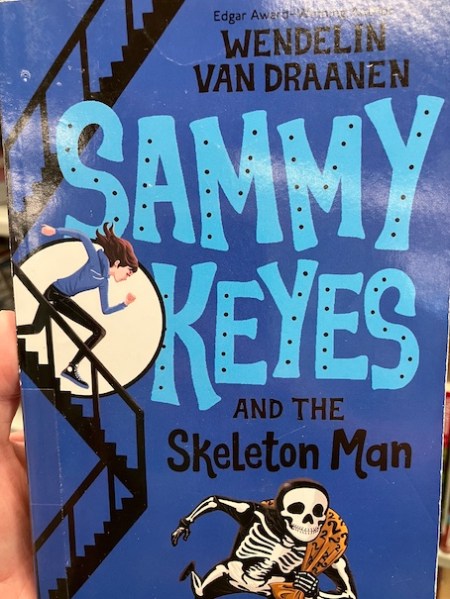
Sammy Keyes and the Skeleton Man

Sammy Keyes

Sammy Keyes decides that she wants to go trick-or-treating even though her grandmother thinks that she’s getting too old to do it. She’s still living secretly in her grandmother’s apartment in an apartment building that’s intended only for seniors, so she jumps at the chance to go out with friends on Halloween night. Dot (real name Margaret/Maggie), a new girl at school, invites her and Marissa to come over to her house to get ready before going out trick-or-treating, which works well for Sammy.

As Dot’s house, Dot is painting herself yellow as part of her bee costume. Sammy is going to color herself green so she can be a marsh monster (something she made up, but it sounds like a swamp monster from old movies). When Marissa comes, she brings Sammy a green sweater that she borrowed from her mother that would be good for a marsh monster costume, and the other girls help Marissa wrap herself in toilet paper for her mummy costume. As the girls set off to trick-or-treat, Sammy gets the idea to go by the old Bush House. The Bush House isn’t haunted, but it is a creepy place and there are stories about the crazy Bush Man who supposedly lives there and will jump out of the tangled bushes that surround the house and kill people. Sammy’s grandmother says that the stories are just stories and the old man who lives in the house is just a lonely old man, but Sammy thinks that it would be thrilling to visit the house and see it up close on Halloween.

As the girls approach the house, they almost collide with someone in a skeleton costume who’s running away. He looks bigger than the girls are, and he’s carrying a pillowcase that looks pretty full. The girls are startled, but Sammy is determined to go up to the Bush House and just knock on the door once for the experience of it. What Sammy sees when she knocks on the door is even more startling.

The door of the house just swings open, and there’s a pile of newspapers on the floor inside that are on fire. Sammy calls out to see if there’s anybody in the house. There’s no answer, so Sammy rushes inside and manages to put out the fire by smothering it with her marsh monster sweater. As the girls are about to leave, Sammy sees someone in a Frankenstein costume in a chair, and they scream and run outside. Then, Sammy realizes that the Frankenstein mask was on sideways, and it’s not easy to breathe in a sideways mask, when the nose and mouth holes don’t line up, so she decides that she has to go back and see if the person wearing the costume is really alright. It’s definitely a human in a costume, and not a dummy. When Sammy removes the mask, she at first fears that the person in the costume is dead because he’s so still, but it turns out that the person under the mask is the Bush Man. He’s tied up, has a head injury, and is barely conscious. He begs the girls for help. The Bush Man is having trouble talking, so after the girls untie him, he writes a message down on paper, asking the girls to go next door and call the police. He also wants to know if the girls saw the skeleton man.

The Bush Man’s real name is Chauncy LeBard, and the reason he can’t talk is that he’s had surgery on his throat because of smoking-related throat cancer. He needs a device held up to his throat to really speak in an electronic voice (an electrolarynx, I’ve seen one used before). While Dot and Marissa run next door and call the police, Sammy stays in the house with him. When the police come, Sammy uncomfortably recognizes the police officer who knows her from the previous book in the series, Officer Borsch. Last time, she and Marissa told him that Sammy is Marissa’s foster sister so they wouldn’t have to reveal where Sammy is actually living. Dot is confused when Marissa refers to Sammy as her “sister”, but she doesn’t give them away.

Mr. LeBard explains that the man in the skeleton costume had forced his way into the house and tied him up, but he doesn’t know who the man is or why he did it. The girls can’t fully describe the man because he was wearing a full-body costume, although they agree that he seemed like a full adult, not just a tall teen. It seems like the skeleton man was a thief because Mr. LeBard’s wallet and a pair of candlesticks are missing.

After the night’s adventures are over, Sammy winds up spending the night at the house of an elderly friend, Hudson Graham, because her grandmother’s nosy neighbor is awake, trying to find proof that Sammy is illegally living with her grandmother in their apartment building. Hudson agrees to let Sammy stay with him, and it turns out that he’s also an old friend of Chauncy LeBard. Mr. LeBard used to be a political science professor at the local college, and Hudson was one of his students. The two of them liked to get together and have political debates. Then, Mr. LeBard’s mother died, leaving him her estate. The local rumors say that’s when Mr. LeBard went crazy and became the Bush Man. The reality is that he developed health problems because of his smoking and didn’t want his old friends to know. Chauncy also has a brother, who was disinherited by their mother because she disapproved of his wife, but nobody knows why the mother didn’t like her.

Sammy can’t forget about what happened with Chauncy LeBard, even if she wants to. She at least has to go back to the Bush House to get Marissa’s mother’s sweater, which turns out to be worth a lot more than either of them thought. Marissa tells her that, even though her mother never wears that old green sweater, she did notice that it was gone and was upset because it turns out that it was a designer sweater that she bought for $500. Sammy is horrified because, having put out a fire with that sweater, she’s pretty sure that it’s done for, and if she has to come up with $500 to replace it, so is she! When Sammy goes to see Chauncy about the sweater, she starts learning more about him and how his inheritance from his mother turned out to be more of a curse than a blessing. Sammy also starts to wonder whether theft was really the motive for what happened on Halloween. If Chauncy didn’t have that hole in his throat from his surgery, the sideways mask might have smothered him. Did the skeleton man want Chauncy dead?

The mystery of the skeleton man and the ruined $500 sweater aren’t Sammy only problems, though. At school, there’s a nasty rumor going around that Sammy has been calling a boy name Jared, trying to get him away from his girlfriend, Amber. Amber is angry with Sammy, and Sammy’s school nemesis, Heather, has been gleefully making sure that everyone in school knows about it in order to embarrass her as much as possible. Sammy knows that she has never called or even spoken to Jared in her life and doesn’t care about him, but it’s not easy to convince everyone else of that. So who really has been calling Jared? Sammy is sure that it’s really Heather, pretending to be her and saying embarrassing things to get her in trouble. It would certainly be in character for Heather to do that. The rumors are get so out of hand even in a day that one of Sammy’s teachers even suggests that maybe she should talk to a school counselor about her issues with Jared so it won’t affect her schoolwork.

Because the characters are middle school kids, Sammy decides that the best way to get evidence that Heather is her phone imposter is to crash her Halloween party. With everyone in costume and the whole class from school invited (except for Sammy, of course), Sammy, Marissa, and Dot are pretty sure that Sammy can sneak in with them, posing as Dot’s cousin “Nikki.” What could possibly go wrong?

The book is available to borrow and read for free online through Internet Archive (multiple copies).

There are characters in the Sammy Keyes series who smoke, which was becoming uncommon in children’s books in general when I was young in the 1980s and 1990s because adults didn’t want to set a bad example for children. In the last book, the fortune teller character smoked, and it kind of surprised me, but it seems that the series follows the unspoken rule for children’s books that include smoking, that the only characters who do it are either villains or oddballs, not cool people to be imitated. This book confronts the issue of smoking more directly, with Chauncy LeBard’s throat cancer. Mean girl Heather also turns out to be a secret smoker who bribes one of her friends to spy on Sammy and her friends by giving her cigarettes. Sammy later finds out that Chauncy’s mother was also a smoker who died of lung cancer. Between Chauncy’s throat cancer and his mother’s death, the story helps illustrate the hard realities of long-term smoking. Chauncy seems to be living in reduced circumstances, without heat or electricity in his house. My first thought was that his mother’s medical expenses and subsequent funeral and Chauncy’s surgery drained his funds. Medical expenses have wiped out people’s savings before in the US, and I remember that one of the stories they told us to discourage smoking when I was in school years ago was about a woman who was forced to sell her family’s heirlooms to cover her cancer treatment. When Sammy meets Chauncy’s brother, Douglas, she finds out that Douglas was trying to get his mother and brother to quit smoking, but neither of them would, and that’s part of the reason for the family rift. Douglas says that if Chauncy has suffered health problems and blown through the family’s money, it’s really his own fault. It’s true that Chauncy should have taken the hint and quit smoking a long time ago, and he might have spared himself a lot of pain and misery if he had, but it turns out that he didn’t sell the family heirlooms to pay for his medical expenses. There was something in his house that was worth a great deal of money, something that Chauncy couldn’t bear to part with even to improve his own living situation because of the sentimental value. The thief is one of the few people who understood what Chauncy had and how to take it without him even noticing that it was gone right away. In a way, what the thief really stole is as much of a mystery for most of the book as who the thief was. The skeleton man turned out to be one of the people I suspected, but not my first suspect, so I was actually in suspense for most of the book.

As for the side plot with Heather calling Jared as Sammy: Oh, criminy! This is one of those ridiculous tween problems that seems so impossibly complicated when you’re in middle school but pretty dumb when you’re not. I appreciate that the math teacher is concerned when Sammy seems distracted in class and her work suffers, but I have trouble believing that an adult teacher would really be interested in rumors about who at school is calling who. I can’t remember any of my teachers ever caring about that stuff because adults usually know that rumors are wrong and that this kind of school drama passes faster if you don’t feed it. I don’t recall any massive rumor campaigns getting the attention of teachers when I was a kid, and I can’t imagine any of my old teachers giving rumors much weight or interest. I think my teachers would have just told us to stop being drama queens, focus on our work, and save the gossip for after school. A few of the more outspoken and direct communicators on the faculty would have flat out told us that gossip isn’t worth anything, that most of it is wrong anyway (that was actually the subject of a play I was in at school once), and that everyone will have gotten bored of whatever it is and moved on in a week or two because nothing we were talking about was really that earth-shaking and we all had the attention spans of chihuahuas on a sugar rush.

If I had to say something to these kids about this situation, I might just tell Sammy not to go calling people who don’t want to speak to her (if I were to assume that she was doing that) because it’s just going to annoy everyone. As for Amber, it’s not really her business to control either her boyfriend or the person calling him, whoever it is. Her decision is whether or not she’s satisfied with how Jared is responding to the situation and if she wants to still be his girlfriend when he acts that way. I’d make it a point to tell Jared, as the center of this drama, that if he doesn’t want to talk to somebody on the phone, he should just hang up without saying anything. You don’t need to stay on the line with someone who’s bothering you. With today’s caller IDs and cell phones that identify everyone who calls, it’s even easier because you don’t have to pick up the phone in the first place if you recognize a number you don’t want to answer. I can’t remember if they had those in the late 1990s, or if that was more an early 2000s development, but I know we definitely had answering machines, and I knew people who would just let the machine answer most of the time, only picking up if they recognized the voice leaving a message. Either way, just because someone calls you doesn’t mean that you have to take the call. On the other hand, if Jared likes being called by a girl other than his girlfriend, it might be time for him to rethink his relationship and decide what he really wants. That seems to be where Jared is. The book describes him as not being too bright and going on an ego trip from whoever keeps calling him. Actually, if I were one of the teachers, the people I’d really want to talk to the most would be Jared’s parents because I think they’d have more power to stop the situation than anybody, no matter who the caller was. Jared’s a kid who still lives at home, so his parents could answer the phone first and find out who wants to talk to him or let the machine record a message that could be used as proof against a prankster who’s bothering him if it gets excessive. Most child pranksters would give up if they called a few times and only got the boy’s parents, especially if the parents sound annoyed or angry when they answer. If Jared’s family got the call on a landline (probable for the 1990s), an annoyed parent could also *69 to last-call return the prankster’s number or look it up on their phone bill if they want to confront the prank caller or talk to the prankster’s parents. It’s annoying to deal with a prank calling kid but not really that hard. I didn’t have access to my parents’ phone bill as a kid, but everyone knew how to *69. Of course, if people in the book handled the situation sensibly, the book would probably be less exciting, and we wouldn’t get the payoff of seeing Sammy get the best of Heather.

There are some laughs when Sammy finds a clever way to record Heather making one of her calls and play the recording for the whole school. It was the sort of victory moment that I would have loved when I was about twelve. However, Sammy’s secret life living in her grandmother’s apartment complicates any problems that Sammy has with the authorities and school administration. After she turns Heather into a public spectacle during a school assembly, the vice principal insists that Sammy’s mother attend a parent-teacher conference. Since Sammy’s mother isn’t available, her grandmother has to attend instead, risking the exposure of their secret.

There is a little more insight into Heather when Sammy sees what Heather’s home and mother are like, but understanding doesn’t equal approval. Heather’s life isn’t perfect, and she lets slip at her party that her mother is a 40-year-old who dresses really inappropriately and flirts with much younger men, possibly including some of her daughter’s teenage classmates. She doesn’t appear to know about Heather’s smoking habit or the truth about any of the other things Heather does. Knowing that her mother is odd and may have really inappropriate taste in men/boys doesn’t make Heather any more likeable, though. At the end of the book, Heather’s outbursts in front of the vice principal may lead to the school insisting on counseling for Heather, which is a hopeful sign, but since Heather remains a bully mean girl for the rest of the series, it’s not that hopeful. You can lead a person to professional help, but you can’t make them internalize it and make use of it.

For me, one of the best parts of this book was the further development of the relationship between Sammy and her grandmother and Hudson Graham. There are hints that Hudson is romantically interested in Sammy’s grandmother, and he treats Sammy like his granddaughter. He seems to be in on the secret of Sammy living with her grandmother and is one of Sammy’s best protections against getting caught. He willingly aids and abets Sammy’s investigations, giving her knowledge and guidance whenever she needs it, and at the end of the book, he gives Sammy and her grandmother a ride to the parent teacher conference.

The ending of the story sets up the beginning of the third book in the series with Sammy being given the assignment of completing some volunteer hours to make up for the disruption that she caused at school.

The Case of the Waltzing Mouse

Brains Benton

The Case of the Waltzing Mouse by by George Wyatt (Charles Spain Verral), 1961.

The Crestwood Garden Club holds an animal show to raise money for their Community Camp Fund. Brains and Jimmy enjoy seeing all of Professor Gustave’s animals, but they become concerned when a seal knocks over a creel where its fish are stored, and they see that there is a large amount of cash concealed inside. Professor Gustave says that he carries that much cash with him because he is always traveling from town to town with his animal show and can’t depend on a single bank for his money.

Brains still seems concerned about the money and the way it’s concealed, but Jimmy is hoping that Brains won’t find a mystery that will disrupt their vacation plans. Every year, they spend a few weeks at a lakeside cabin that their families rent, and all Jimmy wants to do is go swimming and fishing.

However, while Jimmy’s older sister, Ann, is driving the boys to the cabin, they come upon the professor’s trailer of animals. The animals are very upset, and the professor is nowhere to be seen. After searching the area, they find the professor, and he tells them that he was attacked by a couple of men. One of them is a guy called Blackie, who used to work for the professor, but the professor fired him because he mistreated the animals. The men were trying to take the creel with the money in it, but the professor threw it into the bushes, and they didn’t find it.

It turns out that the professor is also going to be staying at a cabin by the lake for awhile. They help him to get settled there with his animals, but Brains is still concerned that the men will be back for the professor’s money. The concern is justified because the men later attack the professor while he’s in a boat on the lake, and the creel is lost overboard. The professor is very upset, not just because the money is now at the bottom of the lake but because the money actually doesn’t belong to him. The professor says that it really belongs to someone else, although he doesn’t say who.

Brains realizes that they can get the creel back because a policeman friend of theirs is also staying at the lake and has offered to teach the boys how to skin dive. Jimmy has wanted to learn to dive and is willing to dive for the creel. Unfortunately, the situation is complicated when the men kidnap the professor for ransom, saying that they’ll let him go if the boys bring them the money.

My Reaction

There were parts of this book that I didn’t really care for. I’ve noticed that the Brains Benton books sometimes include stereotypical attitudes of boys looking down on girls or discounting their abilities. Near the beginning of the book, Jimmy’s sister Ann is trying to get the boys to hurry getting ready to go to the cabin, but Brains wants some extra time to take care of a new device that he’s just gotten. Jimmy says, “But, after all, she is a girl, and girls and women just don’t understand how it is when a fellow gets interested in something highly scientific and technical.” No, Jimmy, I don’t think that’s the issue. It’s not about not understanding how someone can find science interesting; Ann’s just in a hurry to get going. She would probably be just an impatient if you were taking extra time to pick out a different shirt or get your hair combed just right. Granted, some of Jimmy’s comments are tongue-in-cheek. When Ann later tells them to stay out of trouble because she knows that they’ve gotten into trouble with their detective business before, Jimmy mentally lists the dangerous situations they’ve been in while denying that they were really that bad. “Women! Always exaggerating!”

The mystery wasn’t too bad. We do know who the villain is from the beginning, so like the other books that I’ve read in this series, it’s more of a “howdunit” than a “whodunit.” Readers get to watch Brains and Jimmy figure out how to rescue the professor and save his money. There is one other element of the story that is more of a mystery than the professor’s kidnapping. The professor says that the money isn’t really his, and the boys see a mysterious girl talking to Blackie. Is she the one who really owns the money, and if so, what is the relationship between her and the professor?