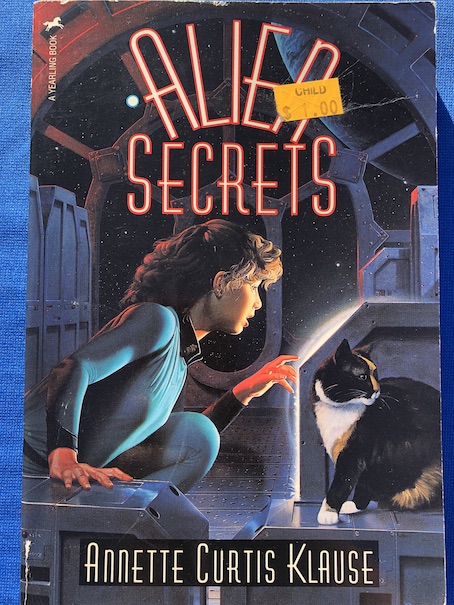
Alien Secrets

Alien Secrets by Annette Klause, 1993.

Robin Goodfellow, nicknamed Puck (her parents were fond of Shakespeare), is a human girl from Earth in the future.  When the story begins, she has been kicked out of boarding school on Earth and is traveling by space ship to join her parents, who are scientists who have been working on another planet.  They left Robin with her grandmother on Earth, who enrolled her in an English boarding school in order to give her some discipline and some friends her own age, but she was expelled for failing her classes (not to mention throwing a fit and burning her books when she discovered that she had failed).  Puck dreads what her parents will say when she arrives on the planet where they are now living because they had always hoped that Puck would also become a scientist and work with them, but this journey will change Puck’s life.

Before the ship she will be traveling on leaves Earth, Robin witnesses a man attacking someone else, possibly killing him.  Robin does not report the attack because she doesn’t know whether or not the other person was killed, and she doesn’t think that anyone will believe her anyway.  She witnessed this attack while sneaking around a place where she wasn’t supposed to be, and she is being sent to her parents in disgrace after being expelled, so she doesn’t sound like a very credible witness.  However, the man in the fight, Mizzer Cubuk (“Mizzer” is how they say “Mister” in the book), turns out to be traveling on the same ship as Puck.  All Puck can think of to do is to try to avoid him on the ship and hope that he didn’t get a very good look at her after she ran away from his fight.

To Puck’s surprise, the captain of the ship she is traveling on, Captain Cat Biko, asks her if she could make friends with an alien who is also traveling on the ship.  The alien is one of the Shoowa, who were enslaved by another group of aliens called the Grakk.  Now, he is free and finally traveling home to Aurora, the same planet where Puck is going.  The captain feels sorry for him and thinks that he might appreciate a friend and that he might find a human child less intimidating than an adult.

Later, Puck and other passengers are woken out of their sleep by the sounds of wailing and moaning.  One of the women on board, Leesa, says that she saw something that looked like a ghost that walked straight through her. Other people, who didn’t see or hear it, assume that it was nightmares or imagination, but Puck knows that it wasn’t.  One of the crew members, Michael, tells Puck that there have been rumors that the ship is haunted and that other people have seen and heard strange things.

Strange things are happening on the ship, and some of the passengers seem to be hiding something. Who can Puck trust, and who isn’t who they seem to be?

The alien who is traveling on board the ship understands Puck’s feeling of failure.  The alien, called Hush, says that he carries shame because he lost something important, something that his people were counting on him to take home to their planet.  Puck and Hush discuss how people from Earth had fought the Grakk and sought to learn about Grakk technology from Shoowa slaves who were freed after the war.  Even the ship they are now traveling on was once a Grakk ship.  The Earth people kept delaying sending the slaves home because they wanted to pump them for more information and because they were trying to decide if they could really trust them more than the Grakk.  After negotiating with the Earth people about returning home, the Earth people agreed, with some provisions.  They arranged for some of the Shoowa to stay on the Grakk home planet, still working with humans.  Some of them would travel on ships with Earth people, and some others could go home to their own planet.  Hush is the first one to head home, and he was entrusted carrying home an important symbol of his people that his family had protected for generations: a statue that represents a child because children are the future and a source of freedom, according to an ancient Shoowa prophecy. Unfortunately, the statue was stolen from Hush before he could return it to its rightful home. He reported the theft to the Earth security personnel at the station, but they didn’t take him seriously. They thought that he probably just lost it by accident.

The haunting is real in this book.  On a tour of the ship, Puck learns that the ship’s navigator has also seen the ghost aliens.  One of the characteristics of a ship’s navigator is the ability to see hyperspace, something that not everyone has the ability to do, although even scientists in Puck’s future time don’t seem to know why some people can do that and others can’t.  Slowly, it becomes evident that people who are able to see hyperspace are also able to see the ghosts.

On the journey to Aurora, Puck also learns that she is one of the rare people who are able to see hyperspace, giving her a possible future in navigating a space ship, something that she would really enjoy learning.  When she arrives at Aurora and is greeted by her parents, who have missed her while they were apart, Puck also comes to realize that her parents will always love her, even in spite of failing her classes. Even Hush’s people tell him that, although they are happy to have the statue back, his safe arrival was always the most important thing, and they wanted him to come home, whether he successfully brought the statue or not. Both Hush and Puck come to realize that their families will always love and value them even with their imperfections and failings.  With parents who love her and a new vision of the future ahead of her, Puck is ready to make a new life on Aurora.

The book is available to borrow and read for free online through Internet Archive.

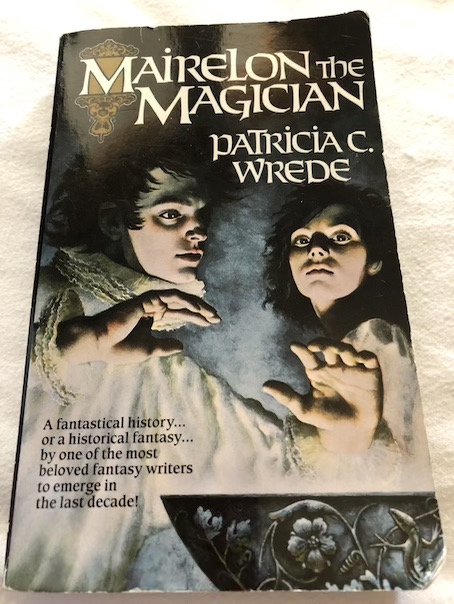
Mairelon the Magician

Mairelon the Magician by Patricia C. Wrede, 1991.

This young adult book takes place in an alternate history version of Regency England.  In this world, magic is a normal and accepted part of society.  “Wizard” is an accepted profession, and there is even a Royal College of Wizards dedicated to magic.  Not everyone can be a wizard because not everyone has the ability to use magic.  It is a skill that people are either born with or born without, similar to people who have an innate talent for art or music, compared to people who are born tone-deaf or color-blind.

In this early 19th century world, there is a teenage girl, Kim, who lives on the streets and survives by her own wits, taking whatever jobs she can and committing a little petty thievery whenever she needs to.  She has spent most of her life dressing like a boy and pretending that she is one because life on the streets is even more precarious for a girl.  For a time, she was part of a gang of child thieves run by a woman call Mother Tibb.  As far back as Kim can remember, Mother Tibb was the only one who took care of her as a child.  Kim has no memory of her parents or any knowledge about what happened to them.  She doesn’t even have a last name.  However, before the story begins, Mother Tibb was caught and hanged for her crimes.  Some of the other child thieves were apprehended and put in prison or exiled to Australia, but Kim managed to escape.  Since then, she has been on her own.  So far, she has managed to avoid being pressured in to joining up with other gangs or turning to prostitution to survive, but the fear of that haunts her. Her future is uncertain.

At the beginning of the book, Kim is hired to sneak into the wagon of a traveling magician who is performing in the market and to see what he keeps among his belongings.  The man who hired her doesn’t want her to take anything, but he is particularly eager to see if the magician has a particular silver bowl in possession.  It’s a strange request, but the money that the man offers Kim is too good to pass up.

However, the magician, who calls himself Mairelon, isn’t quite what he seems.  He is not just an ordinary traveling entertainer using some sleight of hand to amuse people in the market.  Kim discovers that he can do real magic as she searches his wagon and is knocked unconscious by a real magical spell that Mairelon uses to protect his belongings.

When Kim wakes up, Mairelon and his servant, called Hunch, have tied her up.  Unlike Hunch, Mairelon has also realized that Kim is actually a girl, not a boy.  The two of them question Kim about why she sneaked into the wagon, and she tells them the truth about being hired to do it.  When she describes the man who hired her, it seems that Mairelon recognizes the description.  The part about the silver bowl also unnerves him.

Surprisingly, Mairelon makes Kim an offer to come with him and Hunch when they leave London.  He is fascinated by Kim’s skills in picking locks, even the lock on the booby-trapped trunk that knocked her unconscious, and he thinks that Kim might be useful to him and Hunch, perhaps helping with the magic act.  In return, he offers to teach Kim some of his magic tricks.  Hunch is dubious about Kim because she has obviously been a thief, and Kim also isn’t sure what to make of Mairelon.  She knows that he’s hiding something, but she isn’t sure what.  No one with real magical abilities like him would ordinarily be making a living with simple magic tricks in the market. 

However, Kim does accept the offer because she’s been worried about one of the major criminals in the area, Dan Laverham, who has been showing too much interest in recruiting her. He is heavily involved with a number of criminal activities, and he knows that Kim is a skilled lock pick.  If he found out that she was a girl, he would probably also press her into prostitution. Dan Laverham would be a good reason to get out of London for a while.  Also, Kim realizes that if she learns a few magic tricks from Mairelon, she might be able to set herself up as an entertainer and make an honest living, safe no matter who finds out that she’s female.  Besides, Kim realizes that if she’s not satisfied with the situation, she could always run away later.

Before leaving London with Mairelon, she returns to the man who hired her, at Mairelon’s suggestion, and tells him that she didn’t see a silver bowl in Mairelon’s wagon (which is true because she was knocked unconscious and didn’t see anything in the trunk).  The man is angry, but Mairelon, who followed her in disguise, helps to create a distraction so that she can get away from the man.  They leave London in the middle of the night because Mairelon says that he was spotted by someone who recognized him when he went out to get magic ingredients.

On the journey, Kim gradually gets to know Mairelon and his situation.  The silver bowl, which Mairelon does have, is actually part of a set of magical objects which, when used together, can compel people to tell the truth without interfering with their ability to answer questions intelligently.  Mairelon’s real name is Richard Merrill, and he is, or was, part of the Royal College of Wizards.  Years earlier, the Royal College of Wizards was analyzing this particular set of magical objects and the unique spell that they control, when they were suddenly stolen, and Merrill was framed for the theft.  At the time, Merrill was unable to prove his innocence (at least not without sounding as if he had done something inappropriate with a lady, which he also did not do – they were just together at the time of the theft because she was helping him and another friend with a magical experiment), but he was also recruited by his friend in the government to be a spy against the French, so the story of his supposed theft gave him a plausible reason for wanting to leave the country.  In the time since then, he and his friend have continued to look into the matter of the theft, and they have made some progress in tracking down the other pieces of the magical set.  At the time that Kim met him, he was on his way to the next piece of the set, a silver platter.

To their surprise, however, they soon discover that someone has been making copies of the platter.  The copies are not magical, but they do confuse the issue.  Who is making the copies and why would they want copies, since they do not have the powers that the original has?  As Kim and Mairelon investigate, they crash a house party at a lavish country estate and spy on a meeting of a rather inept society of druids.  All the while, they are getting closer and closer to finding the original thief.

I loved the combination of mystery, fantasy, history, and humor in this book!  It’s one of my all-time favorites.  It has a happy ending with Mairelon’s name cleared and the thief caught.  They also discover that Kim has the ability to use magic, and Mairelon offers to take her on as his apprentice, saving her from the streets forever.  There is a sequel to this book called Magician’s Ward, about Kim’s life and adventures as Mairelon’s student.  The hints of romance in this book are also much stronger in the next one.  There are only two books in this series, which is disappointing because the characters are so much fun, and I think that there is a lot more room for their development.  By the end of the next book, Kim’s future is looking more certain, but her past is still murky.  Originally, I had expected that there would be secrets revealed about Kim’s past because of her ability to use magic, possibly something that was passed on to her by her parents.  However, by the end of the second book, Kim still doesn’t know who her parents were/are, and it doesn’t look like there’s any chance that she will ever know.  Perhaps it doesn’t really matter. Sometimes, secrets are more tantalizing when you imagine the answers than when you actually find out.

The book is currently available online through Internet Archive.

Mystery of the Pirate’s Ghost

Mystery of the Pirate’s Ghost by Elizabeth Honness, 1966.

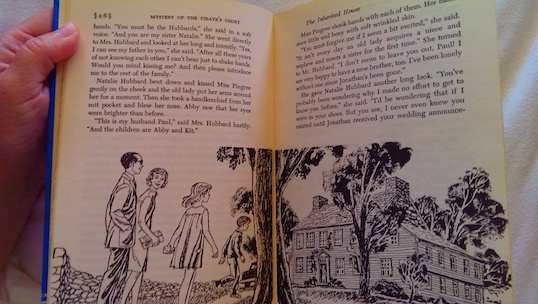
Abby and Kit Hubbard’s mother has just received a letter telling her than her half brother, Jonathan Pingree, has died and left her the old Pingree mansion.  He has left over bequests to other family members as well, and money to be held in trust for Abby and Kit.  It’s exciting news, and the family may move to live in the mansion they have inherited, although it partly depends on Mrs. Hubbard’s other relatives. 

Mrs. Hubbard, who was born Natalie Pingree, has never met her half-brother or half-sister.  They were her father’s children, from his first marriage.  She doesn’t know much about her father’s early life because he died when she was very young, and all that she knows about him is what her mother told her.  Apparently, her father’s first marriage was not a happy one.  He stayed in that marriage long enough for his first two children, Jonathan and Ann, to become teenagers.  Then, he made sure that his first wife and children were settled comfortably enough in the family home and left them to move to Philadelphia to start a new life by himself.  Sometime later, his first wife died and he married Natalie’s mother, who was much younger.  After his death, Natalie and her mother moved in with her mother’s sister, Aunt Sophie.  When Natalie got married, Aunt Sophie sent a wedding invitation to Johnathan and Ann, but they never came to the wedding or made any reply.  Natalie assumed that they felt uncomfortable about their father’s remarriage and didn’t want to see her, which is why she’s so surprised about Jonathan leaving the family home to her.  The only reason she can think of why he would do that is that neither he nor his sister ever married or had children of their own, so there was no one else to leave the house to.  Both of them were more than 30 years older than Natalie, and Ann is now an elderly woman, still living in the house.  Jonathan’s will has made provision for her as well, and the Hubbards go to see her at the Pingree mansion.

Mrs. Hubbard is pleasantly surprised that Ann is actually happy to see her.  Ann Pingree explains that the reason why she and Jonathan never replied to the wedding invitation was that, until that invitation arrived, neither of them had known that their father had another child, and they felt awkward about it.  However, Ann has been lonely since Jonathan’s death, being the last of the Pingrees, and she is glad to have Natalie and her husband and children with her and is eager to have them move into the mansion and live there. (Ann doesn’t live in the old mansion itself, but she does live nearby.)

Aunt Ann shows the family around the old mansion and explains more about its history and the history of the Pingree family. It turns out that the house, which has existed since Colonial times, although it has been burned, remodeled, and expanded over time. The house also has a number of secrets. Apparently, there used to be a tunnel running from the basement of the house to the beach that was used to bring in smuggled goods during the Colonial Era. There is also a hidden room behind a fireplace upstairs where the children of the family could hide during Indian attacks. (It doesn’t say how often that happened.) To the family’s surprise, Ann also tells them that the mansion is supposed to be haunted. The kids think it all sounds exciting, although Ann doesn’t explain much about the ghost the first time she mentions it. (Kit uses the phrase, “Honest Injun?” when asking Aunt Ann if she really means it when she says that the house is haunted. This isn’t a term that people use anymore because it isn’t considered appropriate.)

Mr. Hubbard is able to get his job transferred to a different branch of the company he works for, so the Hubbard family decides that they will move into the Pingree mansion. The kids like living by the beach, and their parents tell them that they can use the old ballroom of the house as a kind of rec room. Soon, they meet a couple of other children who live in cottages nearby, Chuck and Patty, and make friends with them. Chuck and Patty have already heard that the Pingree house is supposed to be haunted, although they’ve never seen anything really mysterious, just a light in the house once when they thought that the house was supposed to be empty.

The next time Aunt Ann comes to visit, the four children ask her to tell them about the ghost, and she tells them the story of the first Pingree to live at Pingree Point. This ancestor, also named Jonathan Pingree, built the original house in the late 1600s. He was a shipbuilder who owned several ships of his own, and he wanted to live near the sea. Later, he also became a privateer. When the kids call Jonathan a pirate, Aunt Anne agrees and explains that, unlike a pirate, Jonathan’s position as privateer was all perfectly legal because he had a Letter of Marque. (Yes, privateers operated within the law, but yes, they were also essentially pirates who raided other ships for their goods. In other words, they did the same things, but privateers did it with permission whereas ordinary pirates didn’t get permission. Historically, some privateers continued their pirating even after permission was revoked, so as Aunt Ann says, “the line between that and piracy was finely drawn.”) His son, Robert, was sailing on one of his father’s ships when it was taken by other pirates, and Robert was forced to join their crew. The family never saw Robert again and only found out what had happened from a fellow crew member who was set adrift and managed to make it back home. What happened to Robert is a mystery. His family didn’t know if he had really taken to the life of a pirate and couldn’t return home because he couldn’t face his family, if he had been killed in some fight, if he had been hung for piracy because he had gotten caught and couldn’t prove that he was forced into it. However, members of the family claimed that Robert’s spirit did return to the house and that he knocks at doors and windows, begging to be let back into his old home. Aunt Ann says that she’s never seen the ghost herself, but old houses can make all kinds of noises on windy nights, and that’s what she thinks the “ghost” is. As Chuck and Patty leave, they say, “we hope that old ghost doesn’t show up to frighten you.” Of course, we all know that it will because otherwise this book would have a different title.

One day, Kit is bored and starts playing around in the secret room, pretending that he’s hiding from American Indians. While Kit is in the secret room, he overhears the servants, John and his wife Essie, who have worked for the family for years, talking. Essie seems very upset and wants John not to do something that might risk their home and jobs, but John says that it’s too late and that they’re already “in it” and “can’t get out.” Kit tells Abby what he heard. That night, Abby hears banging and wailing during a storm and fears that it’s the ghost. Soon, other strange things happen, like a desk that mysteriously disappears and a cupboard that also mysteriously appears in its place. The children like John, and they don’t want to think badly of him, but he’s definitely doing something suspicious. One night, the children try to spy on him, and Abby once again hears the wailing and sees a mysterious, cloaked figure in the fog. Is it the ghost?

There are some interesting facets of this story that make it a little different from other children’s books of this type. For one thing, the children confide their concerns to their parents almost immediately, and the parents immediately believe them. In so many children’s mysteries, either the children decide to investigate mysterious events on their own before telling the parents or the parents disbelieve them, forcing the children to investigate on their own. It was kind of refreshing to see the family working together on this mystery. It actually makes the story seem more realistic to me because I can’t imagine that I would have been able to keep worries about mysterious things secret from my parents as a child, and they would have noticed if I was sneaking around, trying to investigate people, anyway. Abby and Kit do something dangerous by themselves before the story is over, but they also confide what they’ve done to their parents at the first opportunity and do not take the same foolish chance again.

The truth of John’s activities comes to light fairly quickly, although it takes a little longer for the family and the authorities to decide how to handle the situation. Investigating John brings to light some of the Pingree family secrets, and Abby and Kit soon discover the fate of Robert the pirate and the truth of his ghost. I’ll spoil the story a little and tell you that the ghost that Abby sees is apparently real, but it isn’t very scary. Once they learn the truth of what happened to Robert and see that his body gets a decent burial, the ghost appears to be at peace.

One thing that bothered me was the way that the characters talk about Native Americans in the book. It’s not the talk about Native American sometimes abducting children because I know that happened. It’s more how they picture that would happen. In the scene where Kit was hiding in the secret room, Kit imagines that the Indians were attracted to the house by the smell of his mother’s cooking and that he went into hiding while his mother fed them to avoid being abducted. As part of his scenario, he imagines that his mother would have wanted to “hold her nose against the Indian smell.” What? Where did that come from? There are all kinds of tropes about Native Americans in popular culture, from the “noble savage” image to that silly “Tonto talk” that actors did in old tv westerns, but since when are they supposed to smell bad? I’ve never seen characters in cheesy westerns hold their noses before, so what’s the deal? I tried Googling it to see if there’s a trope that I missed, but I couldn’t find anything about it. I’m very disappointed in you, Elizabeth Honness.

This book is currently available online through Internet Archive.

Lauren’s Treasure

Sleepover Friends

#8 Lauren’s Treasure by Susan Saunders, 1988.

The Sleepover Friends have volunteered to take part in an archaeological dig on the site of an old mansion, which is also on land where a Native American tribe once lived.  Other students from their school and a school in a nearby town will also be taking part.  Stephanie isn’t sure that she’s going to like being part of the dig because she doesn’t really like getting her hands dirty and she thinks it would be gross if they uncovered the bones of dead people during the dig.  The others are more excited about the dig, but at first, it doesn’t turn out as well as expected for Lauren.

First, Lauren’s hair is weird on the day of the dig because the other girls tried to give her a perm at a sleepover and it didn’t go well.  Then, she attracts some unexpected attention from Walter, a new neighbor of Stephanie’s.  Walter is in the fourth grade, but only because he skipped a couple of grades to get there.  He’s only eight years old, but he’s something of a child genius.  He’s not really a bad kid, but when he starts following Lauren around and acts like he’s got a crush on her, Lauren is embarrassed because he’s so much younger than she is.

Then Lauren makes an exciting discovery on the dig: a carved rabbit charm.  The archaeologist in charge of the dig is excited because its presence, along with some yellow paint, means that they’ve found a Native American burial spot.  She takes the younger children off the dig and has her grad students continue searching for the grave itself.  Lauren is pleased at being the one to make an exciting find, but the charm mysteriously disappears at the dig.

The archaeologist thinks that, most likely, the charm fell out of the tray Lauren was using to collect things on the dig when everyone started pushing to get a look at the spot where it was found.  She says that she and the grad students will keep an eye out for it as they continue the dig.  For Lauren, it just seems like another piece of bad luck in her bad luck streak.

Walter continues paying too much attention to Lauren at school, and later, writes an anonymous note, asking her to meet him at a local pizza place.  At first, Lauren thinks that the note was writing by Jenny Carlin, a rival at school, because of a series of pranks they were playing on each other earlier.  When Jenny denies being responsible for the note, Lauren goes to the pizza place and sees Walter.  Unfortunately, Jenny and her friend Angela show up there, too, curious to see who was meeting Lauren, and they tease her and Walter.  Lauren is embarrassed at having a kid so much younger than she is (genius or not) chasing after her, and she hates the teasing that she gets at school about it, but she’s not quite sure what to do about it, other than ignoring Walter as best she can.  However, Walter is actually the key to solving the mystery of what happened to the rabbit charm.

You might guess at this point that Walter was the one who took the charm in the first place.  I thought it was pretty obvious myself.  Walter wasn’t trying to cause trouble.  He explains to Lauren that he was trying to get her attention, and his first plan was to pretend that he found the missing charm after a search so that he could look like a hero to her.  He just never got the chance to give it back because he got interrupted, and then Lauren started avoiding him because of the teasing.  It all works out for the best because Lauren gives the charm back to the archaeologist, who doesn’t press her too closely about where she found it, and Walter gets a crush on a different girl who is a little closer to his age. 

Getting a crush on someone who either doesn’t feel the same way or just isn’t available is a normal part of life (if it wasn’t, it wouldn’t appear so often in tv shows, movies, and books – people find this type of situation relatable), and so is being the subject of a crush from someone you don’t love or find unsuitable (again, that’s why this situation comes up often in fiction – it happens often enough in real life that people understand the feeling).  When it comes to getting boyfriends or girlfriends, one of the people involved has to be the first to stick their neck out and say that they’re interested, and there’s no guarantee that the feelings will be returned.  It’s not easy, but this is a part of how relationships start.  When the feelings aren’t returned, which is bound to happen from time to time, there’s always some awkwardness.  The first person is usually disappointed, and there might be a struggle for the other person as they try to find a way to turn the other person down without hurting their feelings.  The situation in this book is especially awkward because precocious young Walter is so young, and it’s likely a first crush for him.  Lauren has also never had to deal with a situation like this before and isn’t quite sure how do handle it. 

In a way, having Walter simply lose interest in Lauren feels a little like a cop-out for the situation so neither of them really has to confront the situation directly, but there are a couple of things that Walter has come to realize by the end of the story that may be useful.  One good point is that there are limits on the things people should be allowed to do to get someone’s attention and start a relationship with him.  When Walter was just trying to strike up a conversation with Lauren or be helpful to her at the dig, it wasn’t bad.  It didn’t get Lauren’s approval for him, but it wasn’t because his behavior was bad (more about this later because it’s important).  The bad part came when he stole the charm to get her attention.  When Walter’s mother later finds out about his theft of the charm, she grounds him and makes him give the charm back and confess to Lauren what he did.  Learning that life has limits and that some behaviors don’t get you the kind of attention you’re really looking for is a good life lesson.  Some people do come on too strongly when they’re seeking attention, and I’m not just talking about kids who aren’t experienced enough to know how to behave; even adults don’t always know the best way to approach romantic relationships or understand others’ limits and boundaries regarding them.  I’m no relationship expert, but I think that the solution is partly developing a kind of situational awareness and an ability to empathize with other people and read their reactions.

Before the story is over, Walter learns more about reading other people’s reactions and understanding how his actions fit into the larger situation from someone else’s viewpoint.  At first, Walter doesn’t seem to sense Lauren’s discomfort, and her friends criticize him for not taking a hint.  Lauren felt a little awkward about his helpfulness at the dig not because it was a bad thing (he was really trying to be nice and there was nothing objectionable about what he said or did until he took the charm – I want you to understand that she wasn’t rejecting him for being a nice guy or anything like that) but because she had reservations about getting too involved with someone so much younger than herself, and she felt like his attention put her in an awkward position.  Walter is a genius, but he is still physically and socially about three years behind the other kids in the story, and at first, he can’t see why that would create awkwardness in a romantic relationship, especially for kids who are only just starting to get old enough to be interested in romance.  The difficulty for Lauren and the reason why she was so irritable with the situation was that she found it difficult to tell a younger kid who was being so nice to her that she didn’t welcome his attentions when he wasn’t doing anything really wrong and didn’t want to hurt his feelings.  As I said, an awkward situation.  Sometimes, even a person who is trying to be nice can unintentionally create awkwardness if they don’t understand the other person’s circumstances, and that’s something that adults do as well as children.  This is basically what’s at the heart of a situation where “nice guys” get rejected or “friend-zoned.” It’s not about the “nice guy” doing anything wrong so much as a case of the wrong relationship at the wrong time with someone who isn’t quite as compatible with them as they thought.  

In a romantic relationship, both of the people involved have to agree to it equally, one isn’t enough.  When Jenny and her friend start teasing Lauren and Walter after the incident at the pizza place, Walter comes to see why a relationship with him would make things awkward for Lauren because of their age difference and the reactions of the other kids.  If they were in their 20s or 30s, an age difference of two or three years wouldn’t mean anything, but for where they are in their lives now, as kids in elementary school, it means a lot.  At the end of the story, Walter’s new love interest is a little closer to his age, making less of a problem, and he has developed enough social awareness to use his age difference to get a little revenge on Jenny for her teasing by publicly asking her about meeting him at the pizza place later, as if she were interested in dating him.  Walter could have been hurt and insulted about being rejected and teased because of his age (and it would have been understandable), but he has realized that, under the circumstances, it would be better to move on and find someone who is more suitable for him and who might be more open to a relationship with him.  In the end, he feels good enough about the situation to use his age for the joke on Jenny, and his other classmates approve of his humor and the well-deserved jab at Jenny’s teasing.

The one thing that I really wish they had added to the story would be for Lauren to learn how to gracefully turn down an offer of a relationship when she isn’t interested because I think that would be an important life lesson for her and for young readers. Socially awkward situations occur in life, but there are ways of handling them to minimize the embarrassment for everyone involved. In the story, Lauren’s main tactic is trying to ignore Walter and hope that he’ll take it as a hint until he finds someone else, and in real life, that’s not good enough. I’m not sure what she would have said if Jenny and her friend hadn’t interrupted her and Walter at the pizza place, but I would hope that it would have been something like, “I appreciate the help you gave me at the dig, Walter, and you seem pretty nice, but I just don’t think that we have enough in common. I think that there is too much of an age difference between us, and I’m not interested in that kind of relationship.” The rejection still might sting, but some simple honesty would at least be more respectful than ignoring him and hoping that he’ll take that as a hint.

I read this book years ago when I was a kid, although there was only one part that really stayed with me, and for a long time, I thought that I was remembering the incident from one of the Baby-Sitters’ Club books.  The scene that stuck in my memory was from the sleepover at the beginning of the book.  The girls were angry at Jenny for some mean comments that she made, so they requested a song on the radio called “You’re a Jerk” by the Lurkers and dedicated it to her.  When they made the request, they told the radio station that they were “well-meaning friends” instead of giving their names, and the radio DJ made a joke about it when he played the song.  It was this incident that started off the series of pranks that Jenny and the girls play on each other throughout the book.  I think part of the reason this scene stuck with me was the “well-meaning friends” phrase and part of it was because I had always wondered if the song they requested was a real song.  I don’t think it is because I can’t find it on the Internet. The Lurkers are a real band, but I can’t find anything about that song. If that song actually exists and someone can find a video of it, let me know, and I’ll link to it!

The book is currently available online through Internet Archive.
The Yellow House Mystery

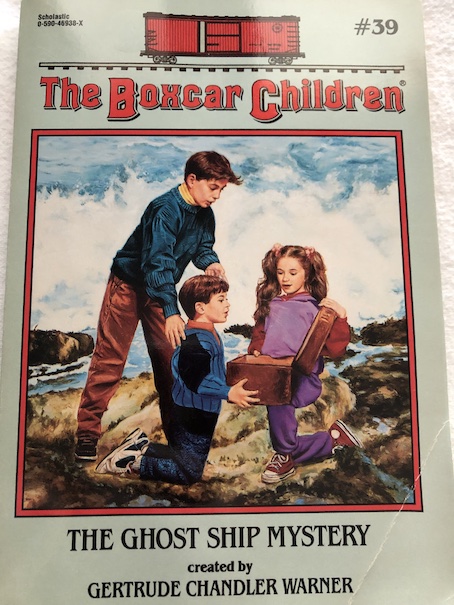
The Yellow House Mystery by Gertrude Chandler Warner, 1953, 1981.

This story in the Boxcar Children series picks up the following spring after the previous book.  The children’s cousin, Joe, is arranging for the excavation of the cave where the children found their Native American artifacts.  They’ve decided to use dynamite to blast open the roof of the cave to make excavation easier (I’m not sure if this is really the best way to get at artifacts that were sheltered safely for years in their cacve and were easily being dug up by children in their current situation, but okay), and although he had told the children that they couldn’t be there for the blasting, he’s changed his mind.  He’s even going to let seven-year-old Benny be the one to push down the handle that will set off the blast.  (Because this is one of the early books in the series, the children are aging from the first book in the series – Henry is sixteen years old, Jessie is now fourteen, and Violet is twelve.)

One of the people who will be working on the excavation is Alice, an old school friend of Joe’s.  Everyone can tell that Joe is in love with her, and soon, he proposes to her.  They get married and decide to spend their honeymoon camping out in the barn on the island, just like the children did the previous summer.

However, the children have started to wonder what the story is about the old yellow house on the island.  For some reason, it makes their grandfather sad, and he doesn’t like to talk about it.  Eventually, their grandfather tells them that their housekeeper, Mrs. McGregor, used to live in that house with her husband, Bill.  Bill used to take care of Mr. Alden’s father’s race horses.  He was a nice man, but weak-willed.  His brother, Sam, and his brother’s disreputable friends were often able to persuade Bill to do things that would get him into trouble, and Bill was never able to stand up to them.  One day, he vanished mysteriously from that house, and neither his wife nor the Aldens have any idea what happened to him.  There are only two clues about the reason for Bill’s disappearance.  One is money that Bill was supposed to give to Mr. Alden’s father for the sale of two horses that he managed on his behalf.  Mr. Alden assumes that Bill’s brother did something with the money and that Bill probably left because he was afraid to face Mr. Alden without the it.  Sam died soon after Bill disappeared, so they were unable to ask him about what he knew.  The other odd thing that happened before Bill disappeared was that Mrs. McGregor heard strange sounds in the night.  When she went to investigate, her husband was apparently just reading a newspaper, and he claimed that the noise was nothing unusual.  But, what was Bill really doing?

The kids want to investigate Bill McGregor’s mysterious disappearance, and their grandfather and Joe and Alice enter the house with them to have a look for more clues.  In a hiding place behind one of the fireplace bricks, they find a letter from Sam to Bill about the money from the horse sale.  Sam promised Bill that he would be able to pay him back more than the money he owed and tells Bill to meet him at a house in Maine near Bear Trail.  The kids persuade their grandfather to let them to go Maine with Joe and Alice over the summer to try to find the house on Bear Trail so they can find out what happened to Bill.  The trip will involve camping, hiking, and canoeing, but they’re up to the challenge!

Joe is familiar with Bear Trail because he used to work as a trail guide when he was in his teens.  They are also joined by another trail guide, Mr. Hill, and have adventures that include a storm and a real bear.  However, the real answers to the mystery lie at the Old Village at the end of the trail.

The book is available to borrow and read for free online through Internet Archive. There are multiple copies of the book. In order to check out a book through Internet Archive, you need to sign up for an account. The account is free, and you read the books in your browser.

My Reaction

In a number of ways, this book is more adventure than mystery.  It doesn’t take long for the kids to realize discover Bill McGregor’s new identity.  However, what happened to the money is more of a puzzle.  Even Bill has been unable to find where his brother hid it years ago.  Benny discovers it by accident while watching a toad. 

One thing that had made me uncomfortable was how long Bill had stayed away from his wife.  When the kids confront him about his real identity, it turns out that Sam’s disreputable friends had lied to him, telling him that his wife had died shortly after he disappeared.  He is overjoyed to discover that she is still alive, and she is glad to see him when he finally returns home.

Max, the Bad-Talking Parrot

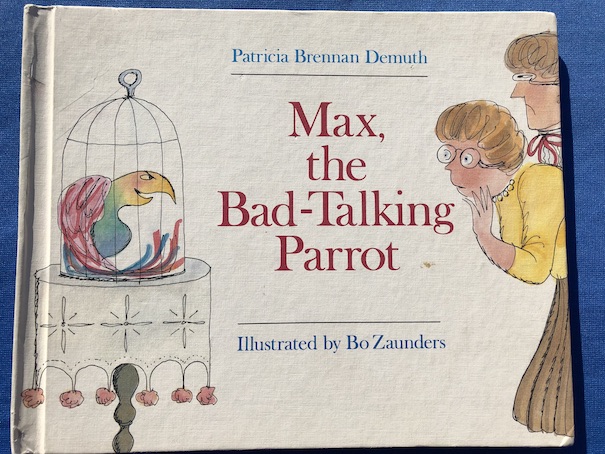
Max, the Bad-Talking Parrot by Patricia Brennan Demuth, illustrated by Bo Zaunders, 1986.

Don’t worry, Max’s “bad” talk isn’t really that bad.

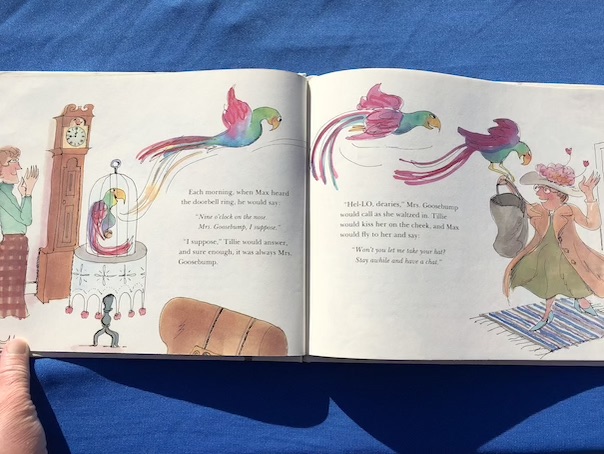
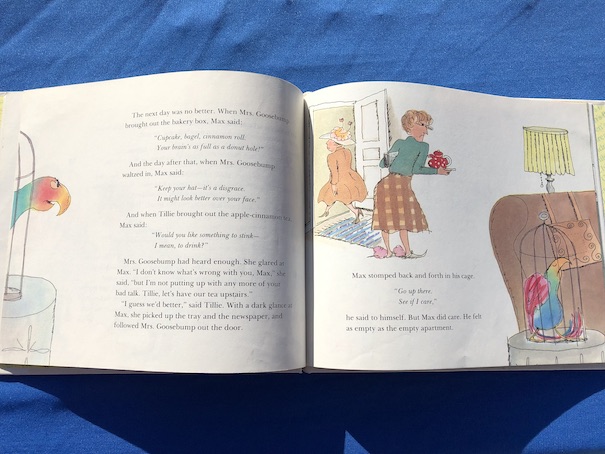
Max is a parrot who belongs to a woman named Tillie.  They live in a house that has been made into two apartments.  The woman who lives in the apartment above them is Mrs. Goosebump.  Mrs. Goosebump is Tillie’s friend, and Max likes her, too.

Because Mrs. Goosebump works the night shift in a toll booth, she always comes to see Tillie and Max in the morning, when her shift is over.  Max always greets her with one of his rhymes.  Everything Max says is a rhyme.

However, one day, as Max is dozing on Mrs. Goosebump’s shoulder during one of her visits, he thinks that he hears her calling him an ugly bird.  Max gets upset and returns to his cage, not ever saying goodbye to Mrs. Goosebump when she leaves.  He feels badly about the insult, and when Mrs. Goosebump visits later, he only gives her insulting rhymes, like, “Cupcake, bagel, cinnamon roll, Your brain’s as full as a donut hole!”

Mrs. Goosebump and Tillie have no idea why he’s so angry. The only thing that they can think to do is ignore him.

Later that night, a burglar breaks into Tillie’s apartment and starts stealing some of her things, including Max!  Max is scared, but by coincidence, the burglar stops to pay at Mrs. Goosebump’s tollbooth.  When Max recites some of his rhymes for her, she recognizes one of his usual rhymes and calls the police.

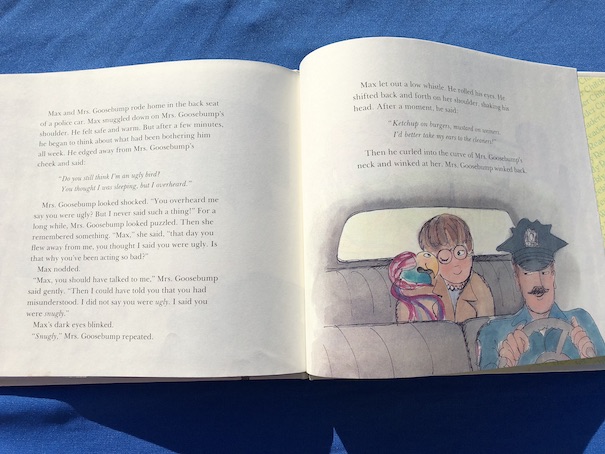
After Max is rescued, he finally tells Mrs. Goosebump why he was so angry, and Mrs. Goosebump explains that she actually said that he was “snugly”, not ugly.  With the misunderstanding cleared up, the two of them become friends again.  Max is also considered a hero for alerting Mrs. Goosebump about the robber.

When I was a kid, I thought that Max’s rhymes were funny, and the scene with the robber at the tollbooth is funny because Max tricks Mrs. Goosebump into believing that the burglar is insulting her before he says the rhyme that Mrs. Goosebump recognizes.  The book is also a good lesson about the importance of talking to people about what you’re feeling in order to clear up misunderstandings.

The Mystery of King Karfu

The Mystery of King Karfu by Doug Cushman, 1996.

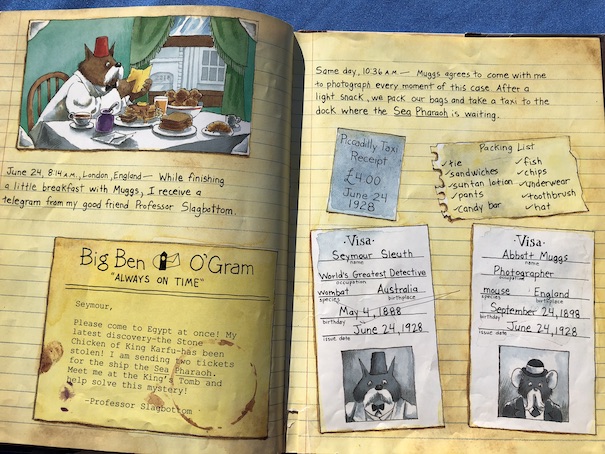
Seymour Sleuth, an Australian wombat living in London, introduces himself as “the greatest detective in the world.”  His friend, Abbott Muggs, a mouse, is a photographer who assists him in his cases and documents them.  When the story begins, Seymour receives a telegram from his friend Professor Slagbottom, who is working on an archaeological site in Egypt.  Someone has stolen one of their finds, the Stone Chicken of King Karfu, and he needs Seymour’s help to find it!  Seymour and Muggs head for Egypt!

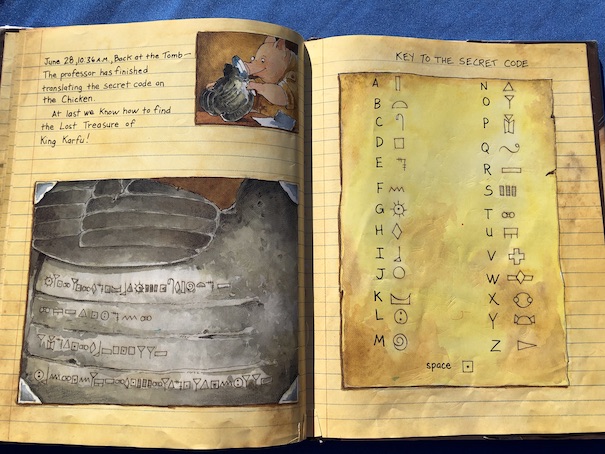
King Karfu was a wealthy pharaoh and a wonderful cook, and the Stone Chicken may provide clues about the Lost Treasure of King Karfu, the nature of which is unknown.  When they reach the dig in Egypt, Professor Slagbottom explains that he was researching a message in code on the outside of the Chicken when it was stolen.  The suspects are the other people on the dig, who may be trying to steal King Karfu’s Treasure.

Seymour interviews the suspects one at a time and considers their connection to clues found at the scene of the crime.  As an adult, I figured out who the culprit was pretty quickly, but for the benefit of child readers, Seymour provides notes about the clues and suspects to help them understand the connections. The pictures in the story also provide important clues.  After Professor Slagbottom’s decoder is stolen, Seymour realizes who the thief is.

After they get the Stone Chicken back, readers can use the decoder provided to solve the code and learn where the Treasure is.  It turns out that the Treasure is actually a recipe, written in the same substitution code – for peanut butter and jelly sandwiches!

I always like mysteries that involve codes and puzzles, and this cute animal mystery would be fun and challenging for young kids.  With the key provided, it would be a good introduction to substitution codes for kids who have never seen them.  There is one other book with Seymour Sleuth, The Mystery of the Monkey’s Maze.  The author, Doug Cushman, is also the author of the Aunt Eater Mysteries.

The book is currently available online through Internet Archive.
The Snowy Day Mystery

Cam Jansen

CJSnowyDayMystery

The Snowy Day Mystery by David A. Adler, 2004.

One snowy day, Cam Jansen and her friends are on the school bus outside of their school.  Because of the snow, a lot of parents have decided to drive their kids to school, and with all the extra cars, it’s difficult for the bus driver to pull up and let the kids out.  Cam and her friend, Eric, pass the time while they’re waiting with a memory game.

Their game proves useful later, when one of their teachers discovers that someone has stolen three computers from one of the classrooms.  There are footprints in the snow outside the classroom window, but the window was locked from the inside after the theft.  Whoever took the computers must have actually entered the school and passed them to someone outside.  But, computers are big and heavy.  How did they get them away without anyone seeing them?

Cam and Eric begin to investigate, and Danny, a classmate with a habit of telling really bad jokes, tags along.  Part of the solution to the mystery has to do with all of the extra cars in front of the school that morning.  The thieves’ car would have blended in with all of the others, except that they were doing something that none of the other cars were doing, something that Cam realizes that no car would have had a reason to do.  Cam saw the thieves leave herself and is later able to describe the car to the police, but the unusual thing about it doesn’t occur to her until she thinks about where the thieves parked their car.

The book is currently available online through Internet Archive.
Cranberry Halloween

CranberryHalloween

Cranberry Halloween by Wende and Harry Devlin, 1982.

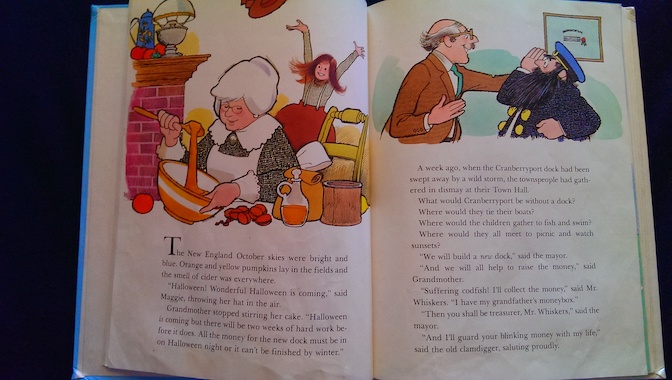
The citizens of Cranberryport need to raise money to build a new dock after theirs was destroyed in a storm. Almost everyone in town volunteers to help, and Mr. Whiskers volunteers to keep the money they raise in his grandfather’s old moneybox.

CranberryHalloweenRaisingMoney

Mr. Grape, a rather cranky old man, not only refuses to donate money to the cause but he insists that it is a mistake to trust Mr. Whiskers with the money because he is a sloppy and careless person. However, Maggie’s grandmother speaks up for Mr. Whiskers, and he gets the job of treasurer for the fund.

CranberryHalloweenSpookyHouse

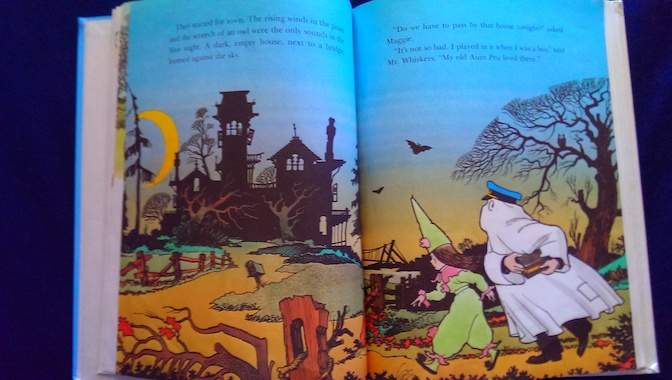
On Halloween night, Mr. Whiskers and young Maggie make their way to the town party, where Mr. Whiskers will present the money for the dock at the town hall.  As they pass by the spooky old house where Mr. Whiskers’s aunt used to live, two men in pirate costumes try to steal the money from them.

CranberryHalloweenPirates

Mr. Whiskers and Maggie hide in the spooky old house, but the pirates are still waiting for them outside. What are they going to do?

CranberryHalloweenTrapped

Mr. Whiskers uses his memories of the old house to find a way out, and it isn’t long before they uncover the villain who put the pirates up to the attempted theft.

The book includes a recipe for Cranberry Dessert in the back.

CranberryHalloweenRecipe