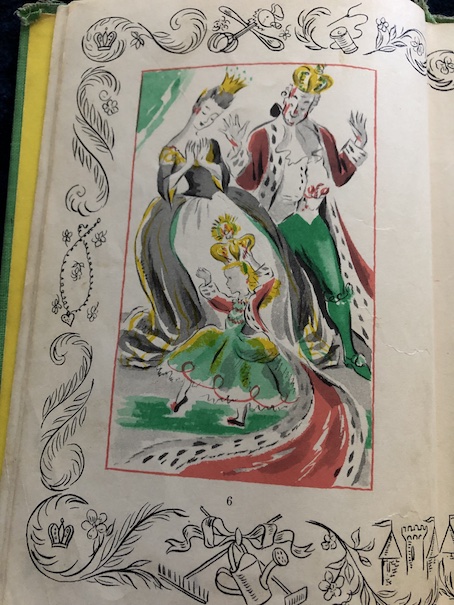
The Plain Princess by Phyllis McGinley, 1945.
I would dearly love to see this book in print again! It’s a charming modern fairy tale about a young princess who learns what beauty and happiness really mean.
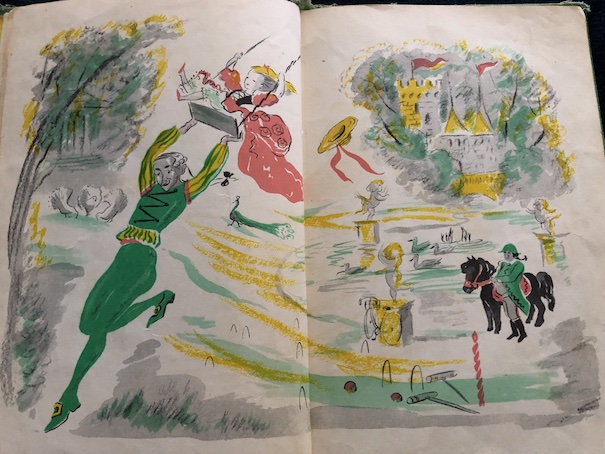
Esmeralda is the only child of the king and queen, and she has just about everything that a girl could want. The author paints a pretty picture of Esmeralda’s charmed life at the castle and all of the beautiful things she has.
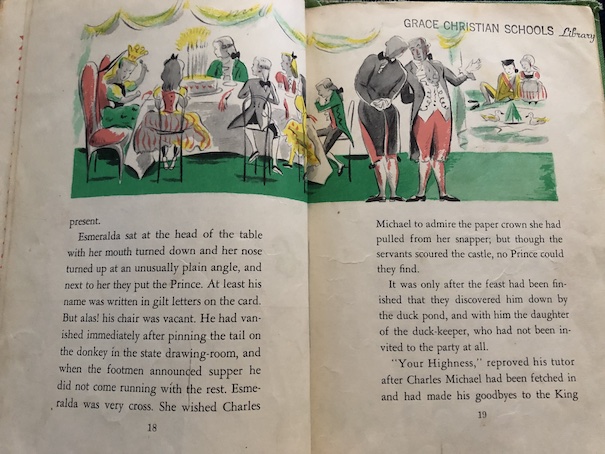
However, Esmeralda has one serious problem: she is plain. In her kingdom, in order for a girl to be considered beautiful, her nose must turn down, her mouth must turn up, and her eyes must have a twinkle in them. Esmeralda’s appearance is exactly the opposite. It is a serious problem because her plainness causes people to lose respect for her, and the prince that she is betrothed to refuses to take much of an interest in her.

Although her parents consult the finest physicians and wizards available, none of them can provide any solutions for Esmeralda’s condition. It is only after the king places an advertisement in the newspaper that a widow, Dame Goodwit, with five daughters of her own comes to the castle and offers a solution. However, she insists that Esmeralda must come and live with her family for nine months. At first, Esmeralda is distressed at leaving her home and living in much simpler circumstances that she is accustomed to, but the reasons soon become as plain as the princess herself.

As Esmeralda interacts with and becomes friends with Dame Goodwit’s daughters, Annabelle, Christabelle, Dulcibelle, Floribelle, and Echo, she comes to see herself and her old life at the castle differently. At Dame Goodwit’s, she is expected to take care of herself and her belongings by herself, for the first time in her life. She is given chores to do and becomes responsible for herself in ways that she never was before. She also comes to see that, even though Dame Goodwit’s daughters are not princesses, in many ways, they are more knowledgeable and accomplished than she is, able to do many things that Esmeralda has never even tried before. Little by little, Esmeralda learns and tries new things, even coming to enjoy her time with the family and becoming especially fond of little Echo, the youngest girl. Her new experiences change her, her behavior, her attitudes, and eventually, even the way she looks.
The book is available to borrow and read for free online through Internet Archive.
My Reaction
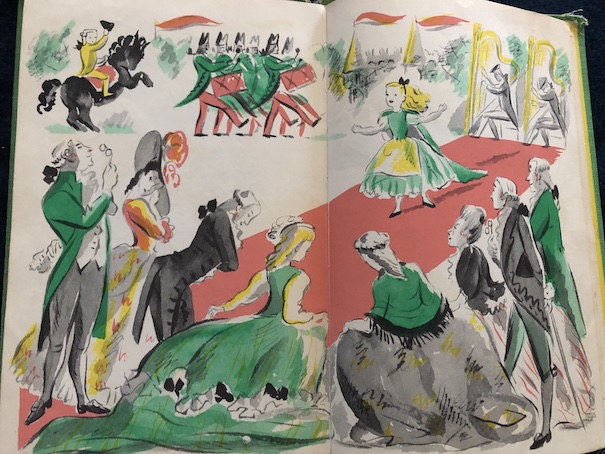
In spite of the fairy tale atmosphere, there isn’t really any magic in the story, as the widow herself points out. The real magic of the story is in the lessons that Esmeralda learns: that beauty and change come from within and that the way we see ourselves and those around us is important. For those who might be concerned at the emphasis on “beauty” and “plainness”, it soon becomes apparent that the outward signs of beauty really stand for positive character traits: humility, pride in one’s own talents and accomplishments, and unselfish caring for other people. The book also has some very pretty illustrations, some of which are wide scenes taking up two pages. It’s a beautiful book and a beautiful story for any young girl.
I don’t think that the book was ever made into a movie, but there are multiple versions that are stage plays (the link is to a video clip from a stage version of the story), including some that are musical. I have seen a script for one of them that has added religious themes that weren’t in the original book, but the site has since been removed. I’m sure that the script still exists, I’m just not sure where to find it now. Some of the narrator’s and characters’ dialog was taken directly from the original book, but the religious parts were added. As I recall, it implied that the princess’s personality changes came through the grace of God or developed as her religious side also developed, but I can’t remember now exactly how they said it. I think it may have included some Biblical quotes related to the personality traits the princess acquires. At one point, it was the only script that I could find available for free online. There are other play versions that are available for purchase elsewhere, such as Dramatic Publishing and Steele Spring Stage Rights.
 Jestress's Forgotten Books and Stories
I loved this book growing up and had this exact copy with those gorgeous illustrations.
LikeLiked by 1 person
I got my copy at a used book sale when I was little, and I read it over and over as a kid!
LikeLike