
Molly’s Pilgrim by Barbara Cohen, 1983.
Molly has been unhappy since her family moved to the smaller town of Winter Hill, New Jersey so that her father could get a better job. In New York City, there were other Jewish girls like her, and she didn’t feel so strange and out-of-place. The Winter Hollow girls don’t understand her at all and don’t like her. Molly’s family fled Russia to escape persecution, and they’ve only been living in America for about a year. Molly still has a Yiddish accent and doesn’t quite speak proper English yet. Molly is constantly teased about the way she talks and her unfamiliarity with American habits.
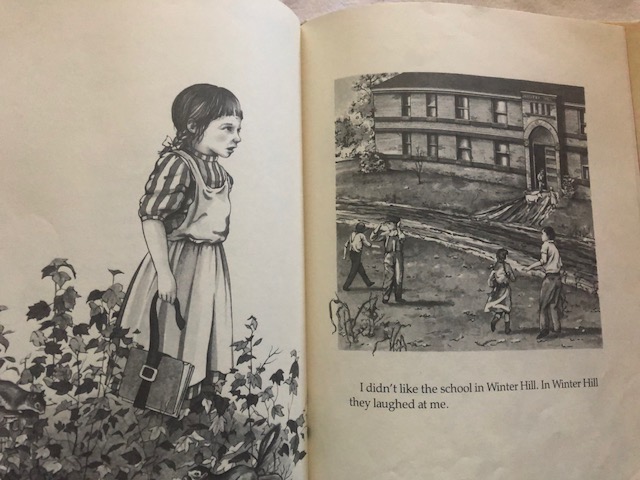
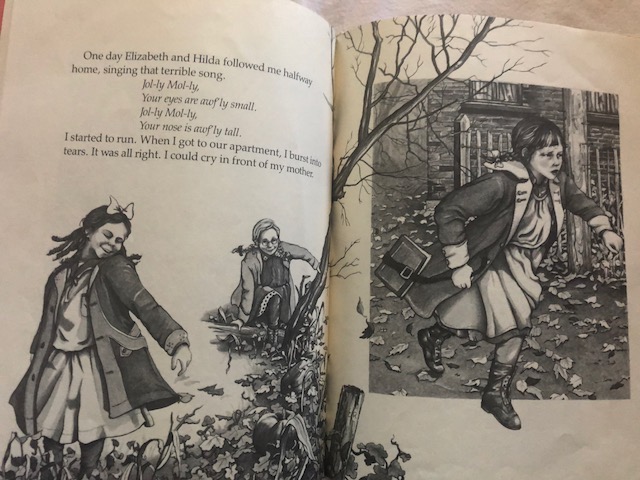
One girl in particular, Elizabeth, makes up rhymes to make fun of Molly, even following her home from school like a creepy stalker, to continue singing them at her. The other girls follow Elizabeth’s lead because they kind of admire her and because she is always giving them candy.
Then, one day, the girls’ teacher begins teaching them about Thanksgiving. Of course, Elizabeth makes a big deal about the fact that Molly has never heard about Thanksgiving before. But, Molly finds the story about the pilgrims interesting. The teacher says that for their Thanksgiving activity, instead of making paper turkeys like they usually do, the children are going to make clothespin dolls to look like American Indians and pilgrims, so they can create a scene like the first Thanksgiving.

When Molly gets home and explains the assignment to her mother, she has to tell her mother what a “pilgrim” is. She explains it by saying that they were people who came from across the ocean in search of religious freedom. Her mother understands that and offers to help Molly with the doll.
However, when Molly sees what her mother has done with the doll, she is worried. The doll is beautiful, but her mother has dressed the doll in the clothes of a Russian refugee, like Molly’s family, not in the traditional Puritan garb of the pilgrims. At first, Molly is sure that she’ll be teased more than ever at school when she shows up with a doll wearing the wrong clothes and that people will think that she’s stupid for not understanding how pilgrims dressed.

But, Molly’s mother is correct in pointing out that their family are modern pilgrims, coming to America for the same reasons that the original pilgrims did. Molly does get some teasing from Elizabeth (that’s not a surprise, since it’s Elizabeth, after all), but when the teacher asks Molly about the meaning of her doll, it leads everyone to a better understanding, both of the holiday and where Molly and her family fit in with their new country and its history.


Molly’s teacher points out that the holiday of Thanksgiving wasn’t entirely an original idea that the pilgrims invented all by themselves but that they took their inspiration from a much older Jewish tradition from the Old Testament. Human beings do not exist in a vacuum, and we all regularly take ideas that we’re exposed to and build on them in our own lives. Although Puritans were generally known for their belief in religious “purity” (hence, their name) and noted for their intolerance to different religions and beliefs, they also strongly believed in education, which frequently involves taking past ideas and knowledge and applying them toward new situations. Their Thanksgiving celebration was just an example of that, an older idea that they used for their own purpose, adapted to the lives of the people who adopted the tradition. It was their celebration, but not their sole intellectual property.
The book is currently available online through Internet Archive (multiple copies).
There is also a sequel to this book called Make a Wish, Molly, in which Molly learns about birthday parties in the United States.
My Reaction and Additional Information
The book doesn’t mention it, but the word “pilgrim” itself is also much older than the early Puritan colonists in America. Before the development of the America colonies, it referred to any religious traveler on their way to a holy place, and many people still use it in that sense. A person on a pilgrimage could be just about anyone from anywhere going to anywhere else as long as the journey has spiritual significance. The Puritan colonists used that term for themselves to emphasize the reasons why they were seeking new homes in a new land. For them, it was a kind of pilgrimage to a place where they could start again. Molly’s family came to America in search of religious freedom, just as the Puritans did. Their journeys weren’t quite the same, but they shared a common purpose and ended up in the same place (more or less).
By showing the links between Molly and her family and the pilgrims, Molly’s mother and her teacher help the other students to understand that Molly really does fit in, that her being there makes sense, and that she has a place in their class and in their celebration of Thanksgiving.
This story was also made into a short film. I remember seeing it in school when I was a kid in the early 1990s. I checked on YouTube, and there are trailers posted for this film. One thing that I hadn’t remembered from when I was a kid was that the time period of the book was earlier than the film. In the film, the characters are shown to be contemporary with the time the film was made, but the style of dress of the girls in the book’s pictures and the things that Molly’s mother says about why the family left Russia indicate that the book probably takes place during the late 19th century or early 20th century, possibly around the same time as the events in the famous play/movie Fiddler on the Roof.
As a side note, if you’re wondering why the girl is named Molly, which doesn’t sound particularly Russian, Molly is typically a nickname for Mary and other, similar-sounding, related names. Molly’s mother also calls her Malkeleh, which may be her original name or perhaps another variant, if her original name was Malka, as another reviewer suggests.
In spite of the warning on that last site I linked to about reading a book with your child that may be covered in class, I say to go ahead and read it anyway. It’s hard to say what books may or may not be used in classes by individual teachers, and if your child’s teacher doesn’t happen to use this one, it’s still a good story. Perhaps just warn your child not to say something that would spoil the ending for their classmates who haven’t read it yet.
 Jestress's Forgotten Books and Stories
One thought on “Molly’s Pilgrim”