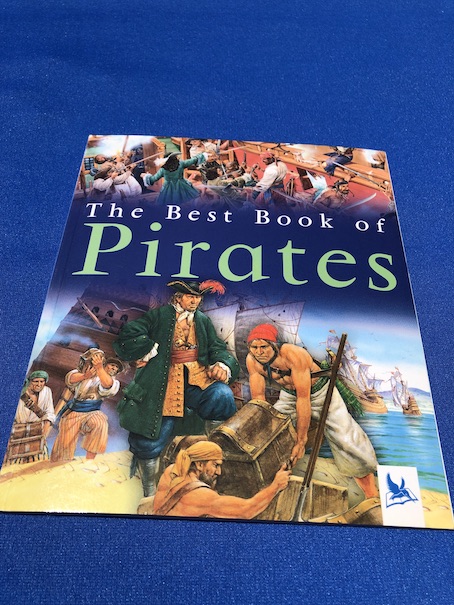
The Best Book of Pirates by Barnaby Howard, 2002, 2006.
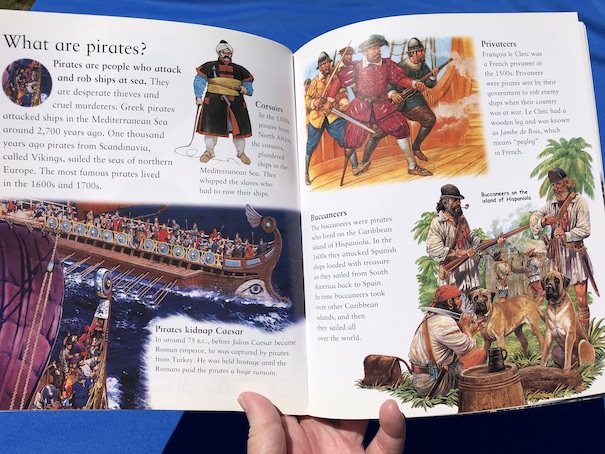
This is an easy and informative non-fiction picture book about pirates. Rather than focusing on any particular time period or geographic area, the book gives a broad overview. In the beginning, it explains a little about different groups of pirates through history, including Vikings, Corsairs, Buccaneers, and Privateers. There is also a brief explanation of the Pirate Round, a sea route often taken by pirates during the late 17th century and into the 18th century. The route led from North America and the Caribbean to Africa, circling the coast of South Africa to Madagascar and on to the Middle East and India. (If you’ve seen the movie Cutthroat Island, the crew will basically be taking this route when the movie ends, heading from the Caribbean to Madagascar.)
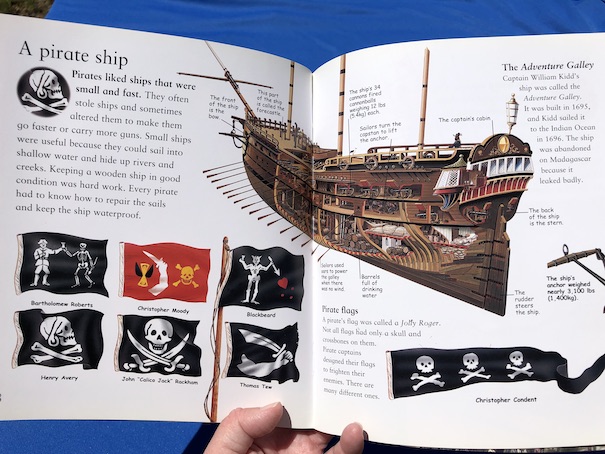
There is a diagram of a pirate ship from the late 17th century, showing what it would have looked like on the inside, and there are also examples of Jolly Roger flags, which were designed by individual pirates as personal identification, typically including skulls and skeletons to frighten their victims. There is also some general information about what life would be like on board a pirate ship and the types of weapons they might have.
Then, the book begins to focus more on groups of pirates that operated in specific geographical areas and some of the more famous pirates from history. The Barbary pirates (also called Barbary corsairs) were Muslims who raided Christian ships along the coast of North Africa and the Mediterranean during the 1500s. Among the most famous Barbary pirates were a pair of brothers called Barbarossa (“Red Beard”). Sometimes, European and American pirate ships that went to Africa to find gold and ivory also entered the slave trade.

In the section about the Spanish Main, it explains how privateers and pirates raided Spanish ships taking Aztec treasures from Mexico to Spain. Buccaneers were specifically pirates who raided ships in the Caribbean. Their name came from the type of fires they used when cooking meat (boucan or buccan).

There were also Asian pirates who raided the coasts of China and the Philippines and areas around the Indian Ocean. Chinese pirates and Dayak pirates from Borneo were powerful in the region until the 1840s, when the British Navy destroyed many of their ships.
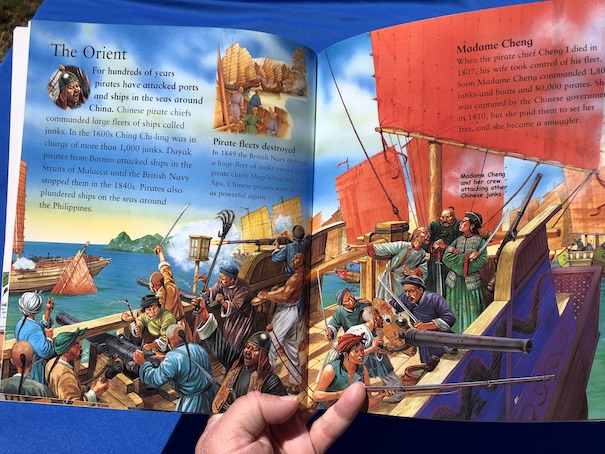
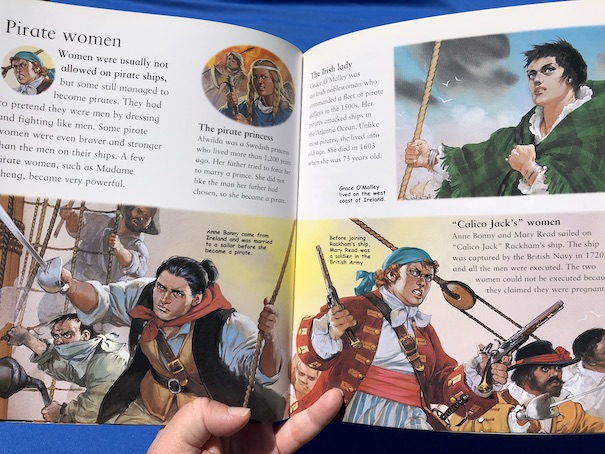
There is a section in the book specifically about female pirates. Mary Read and Anne Bonny, who sailed with “Calico Jack” Rackham, were famous. Grace O’Malley was a famous Irish pirate who was also an Irish noblewoman. Madame Cheng was a Chinese pirate who took over her husband’s fleet after his death (but because this is a children’s book, it doesn’t mention her previous career). Alwilda was a Medieval Swedish princess who turned pirate after her father tried to make her marry a man she did not want to marry (although her story may only be legend).
The book also talks about the famous stories of pirates burying treasure, although it says that pirates would usually spend their money quickly, sell items for money they could spend, or gamble it all away.
At the end of the book, there is a short section about modern pirates and how their goals and tools of the trade have changed.
The book isn’t very long, but I think that it provides a good, general overview of the subject of pirates throughout history, and the pictures are fascinating and detailed.
The book is currently available online through Internet Archive.
 Jestress's Forgotten Books and Stories