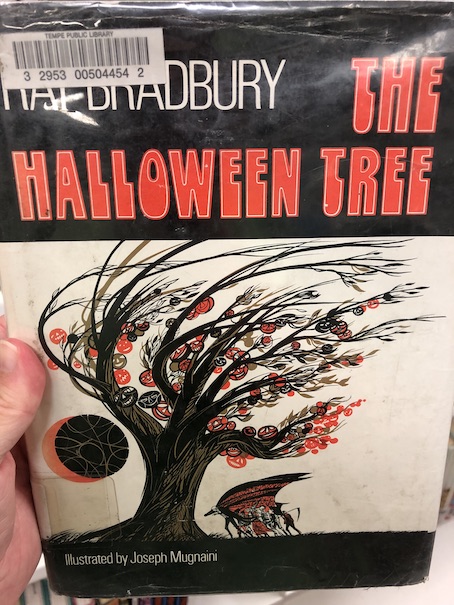
The Halloween Tree by Ray Bradbury, 1972.
A group of neighborhood boys want to go trick-or-treating on Halloween night, but they’re upset because it looks like a friend of their, Joe Pipkin, won’t be coming with them. When they get to Pipkin’s house, he seems ill and is clutching his side. His friends worry that he’s sick, but he valiantly reassures them that he’ll be fine. He sends them on, telling them that he’ll catch up with them and that his costume will be great. Specifically, he tells them to “head for the House” which is “the place of the Haunts.”
The house that Pipkin is talking about is the creepiest house in town. It’s large, so large that it’s hard to tell how many rooms it has. The boys knock on the creepy-looking door knocker on the front door, and a man answers the door. When the boys say, “trick or treat,” the man says, “No treats. Only—trick!” Then, he slams the door without giving them anything.
Not knowing what else to do, the boys walk around the side of the house and see a large tree, filled with jack o’lanterns. This is the Halloween Tree. The strange man they saw before rises up from a pile of leaves and scares the boys, giving them the “trick” that he promised them earlier. He finally introduces himself as Carapace Clavicle Moundshroud. He begins talking to them about the history of Halloween and asks them if they understand the real meanings behind the costumes they have chosen. The boys admit that they really don’t know the meanings behind their costumes, and Moundshroud points off into the distance, calling it, “The Undiscovered Country.” He says that out there likes the past and the history of Halloween and that the boys will learn the answers if they’re willing to go there. The boys are interested, but they say that they can’t go anywhere without Pipkin, who promised that he would come.
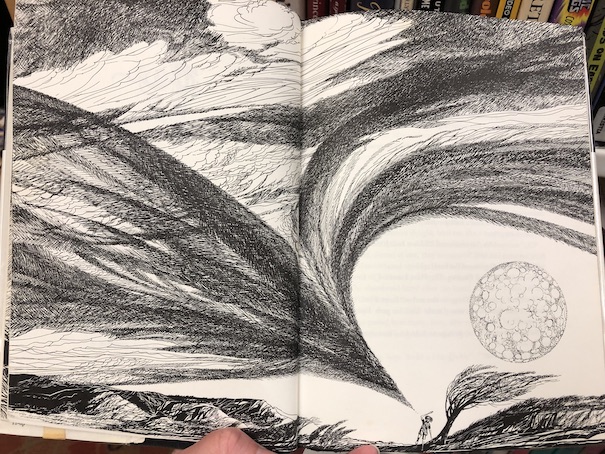
Pipkin suddenly appears in the distance, by a dark ravine, holding a lit pumpkin. He says that he doesn’t feel well, but he knew that he had to come. Pipkin trips and falls, and the light in his pumpkin goes out. From a distance, the others hear him calling for help. Moundshroud says that something bad has happened. Pipkin has been taken away to The Undiscovered Country by Death. Moundshroud says that Pipkin may not be taken permanently but perhaps held for ransom and that, if they follow Pipkin to The Undiscovered Country, they might be able to get his soul back and save his life.

Moundshroud has the boys build a kite that somewhat resembles a pterodactyl, and they use it to travel into the far distant past. The first place they arrive is Ancient Egypt, where the boys learn about mummies and how the Ancient Egyptians viewed the dead. They see Pipkin as a mummy, being laid to rest in a sarcophagus, surrounded by hieroglyphs, telling the story of his life. (Or, as Moundshroud says, “Or whoever Pipkin was this time around, this year, four thousand years ago,” hinting that Pipkin has been reincarnated before and what they are seeing during their journey are his past lives and deaths.) Pipkin calls out to his friends for help. Moundshroud tells the boys that they can’t save Pipkin now, but they’ll have a chance later.
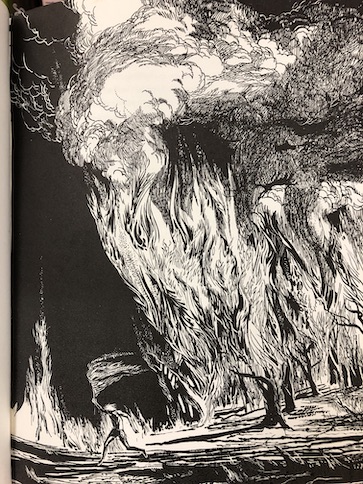
They continue their journey through time and around the world, seeing glimpses of Halloweens past in Ancient Rome and the British Isles, where they learn about druids, Samhain, and witches. Moundshroud describes how the Romans supplanted druidic practices with their own polytheistic religion until that was eventually replaced by Christianity. All along, they can still hear Pipkin calling to them, and he seems to be carried off by a witch. As they pursue him, Moundshroud teaches them the difference between fictional witches and real-life witches, which he characterizes as being more like wise women, who don’t really do magic.
From there, they go to Notre Dame to learn about gargoyles. They continue to see Pipkin in different forms, even as a gargoyle on the cathedral. Pipkin tells them that he’s not dead, but that he knows that part of him is in a hospital back home.

In Mexico, the boys experience Dia de los Muertos and learn about skeletons and a different kind of mummy from the ones they saw in Egypt. They find Pipkin, held prisoner in the catacombs by the mummies, and Moundshroud tells the boys that the only way to save him is to make a bargain, both with him and with the dead: each boy must give one year from the end of their lives so that Pipkin may live. It is a serious decision, for as Moundshroud says, they won’t miss that year now, being only about 11 or 12 years old, but none of them knows how long they will actually live. Some of them who were destined to die at 55 would now only make it to 54, and as they reach the end of their lives, the year will seem that much more important to them. Even those who live longer will still want every day they can possibly have. However, each decides that he is willing to make the sacrifice because, without that sacrifice, Pipkin has no chance, and they can’t just let him die.

They make the bargain and are soon returned home. When they go to Pipkin’s house to check on him, they are told that Pip is in the hospital because he had his appendix taken out, just in time to save his life. At the end of the story, Tom (who is the leader of the boys through most of the story), wonders silently who Moundshroud really was, and he hears in his mind, “I think you know, boy, I think you know.” Tom asks him if they will meet again, and Moundshroud says that he will come for Tom many years from now, confirming that Moundshroud was Death all along, which was why they had to make the bargain with him.
I saw the animated movie version of this story long before I read the book, and it really gave me the creeps! Moundshroud is creepy because he is kind of two-faced. On the one hand, he seems somewhat helpful in helping the boys to find Pipkin and teaching them about the history of Halloween, but on the other, he does not admit to the children that he is Death until the very end, that he is the very thing that they need to save Pipkin from, and that they can only do it by offering a sacrifice of years from their own lives. Although it does occur to me that Moundshroud may not be quite as two-faced as he seems because Pip’s illness and potential death may not have been planned by him but simply the fated situation for Pip, and Moundshroud might have just taken it upon himself to provide a way for Pip’s friends to save him in the least painful way. By not telling them that a sacrifice of part of their lives would be necessary until the very end, after they had come to a better understanding of life and death in the history of Halloween, he may have made the choice easier for them to make. Also, he never says exactly how much time they bought for Pip with their sacrifice. The implication is that Pip is now free from his early appointed death date and will now live a full life, similar to what his friends will have. The exchange does not seem to be an even one, a year for a year, with the children needing to decide how many years they will donate to Pip. Although the kids still don’t know at the end how many years each of them will live, it seems that none of the rest of them is in danger of dying in childhood, and they will all live for many more years.
I wouldn’t recommend this book for young children (it still gives me the creeps, and I’m in my 30s), but it is interesting how they take a journey through the origins of Halloween. The book and the movie were somewhat different, partly because there were more kids in the group in the book and partly because the group of kids in the movie also had a girl in a witch costume. In the book, the kid in the witch costume was also a boy.
Both the book and the animated movie are available online through Internet Archive.
 Jestress's Forgotten Books and Stories