
Mother Goose Rhymes, illustrated by Eulalie, 1950-1953.
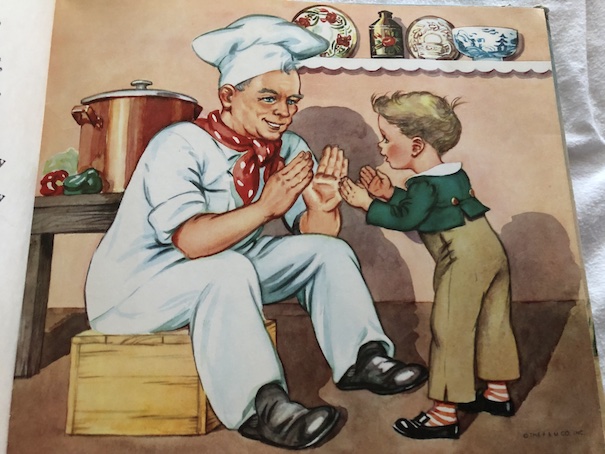
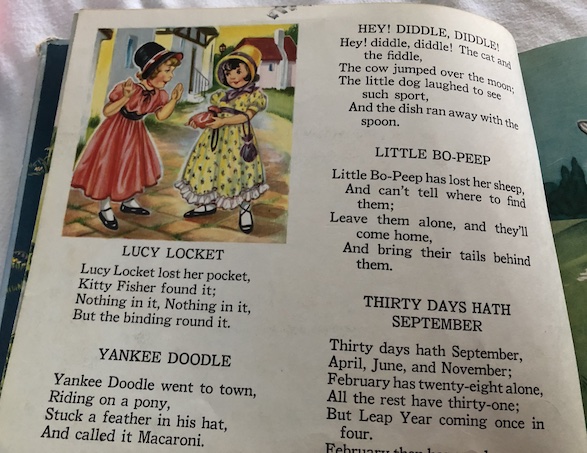
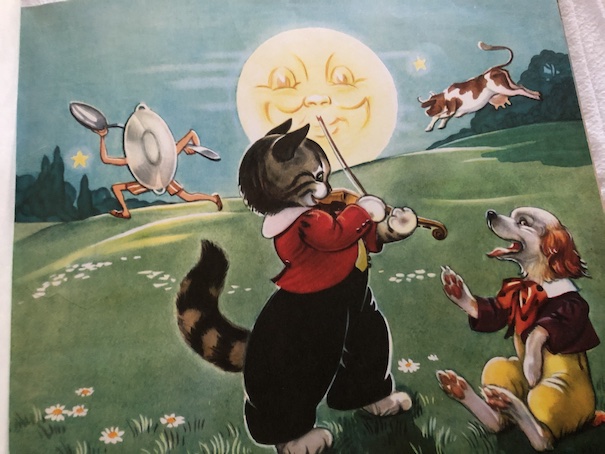
This was one of my first books of rhymes and poems as a child. We’ve had this book for as long as I can remember. I always loved the illustrations in the book, which are realistic in style, and like the illustrations in old Kate Greenaway books from the late 19th century, showing children in clothes that would be appropriate for the early 19th century, with high waists and short jackets. I suspect that Kate Greenaway’s work may have been some of the inspiration for the illustrations in this book. Some of the illustrations are small ones that appear in corners of the pages, surrounded by the text of the rhymes. Other illustrations take up a full page. All of them are full color illustrations.
People can recite popular nursery rhymes like Mary Had a Little Lamb, Old Mother Hubbard, Little Bo-Peep, and Lucy Locket from memory because many of us heard and memorized them early in life. But, since we’re on the subject, who is/was Mother Goose and what are these rhymes about really?

Mother Goose rhyme books don’t really have an author because the rhymes are short little folk poems with no known original author. When an “author” is credited for a collection, they are credited as being “collectors” of the rhymes included, not as the original creators of those rhymes. The first person to collect and describe folk and fairy tales as being “Mother Goose” stories was the French author and folk tale collector Charles Perrault. In 1697, he published a collection of stories called Stories or Tales from Past Times, with Morals or Mother Goose Tales. It isn’t completely clear how many of the stories in this book were completely Perrault’s own creation, based on common themes often found in folk and fairy tales, and how many were stories he collected from other sources and modified to fit his style and purpose. The stories included in this original Mother Goose book included many fairy tales that are now childhood classics, like Cinderella, The Sleeping Beauty, Puss in Boots, Little Red Riding Hood, and the scary Bluebeard. This collection of stories was not meant for children. The stories were intended for adults because fairy tales were in fashion among the aristocratic literary circles in Paris at the time the book was published. The exact reasons why Perrault decided to use the imaginary “Mother Goose” as the supposed source of these stories or even who “Mother Goose” once was are uncertain. American legend sometimes cites “Mother Goose” as being the wife of Isaac Goose and the mother Elizabeth Goose, who lived in Boston in the 17th century and told stories and sang songs to her (a story referenced in The Only True Mother Goose Melodies published in Boston in 1833), but it’s unlikely that Perrault was referencing her. A more likely theory is that “Mother Goose” was a reference to a somewhat forgotten figure of French folklore who would have been more familiar to people living in the late 17th century who studied folk and fairy tales. There was a French legend from the Middle Ages about a queen who told stories that amazed children and was sometimes called “goose-footed”, and possibly, this story or a similar figure from French history or legend became known as “Mother Goose.”

In the 18th century, Perrault’s book was translated into English, and English authors began putting together their own “Mother Goose” books that included English nursery rhymes. The book that shifted the association of “Mother Goose” from stories to rhymes was Mother Goose’s Melody, or, Sonnets for the Cradle, a collection of English nursery rhymes published by John Newbery, a famous English publisher of children’s literature in the 18th century who was nicknamed “The Father of Children’s Literature” and who would later become the namesake of the Newbery Medal for excellence in American children’s literature. Mother Goose’s Melody popularized the association of “Mother Goose” with children’s nursery rhymes in both England and America, and ever since, it has been used in the title of collections of nursery rhymes. Many of the popular Mother Goose rhymes are centuries-old ones from England, although some later classics, like Mary Had a Little Lamb, were added to American books of nursery rhymes in the 19th century.
But, what do these rhymes mean, or do they mean anything? Are they just nonsense rhymes for children about things like a cow jumping over the moon or a boy and girl falling down the hill, or is there some additional meaning behind these rhymes that have kept them in the public consciousness for so many centuries? The exact origins as well as the original authors of many old nursery rhymes have been lost to time, but there are indications that various nursery rhymes may have begun as folk songs or rhymes referencing current events that were happening at the time they were originally composed. Although they sound like harmless and innocent nonsense, people who heard them at the time when they were first composed would have recognized references or pieces of dark humor about real events or scandals that were public knowledge. In modern times, there is some debate about the exact meaning behind some of these rhymes because, while the references in the rhymes may have seemed clever and humorous to people at the time of their creation, they are too esoteric for modern people, who are centuries removed from the events they were referencing. For generations, people passed on the rhymes to their children but not the explanations of their meaning, so most were simply forgotten. However, there are articles that you can about The history lessons that may be hidden in nursery rhymes and The Dark Side of Nursery Rhymes, which discuss what we know about the creation of these nursery rhymes and theories about their original meanings. Sometimes, there are multiple theories about certain rhymes because there just isn’t enough evidence to firmly settle on one, and also, it’s possible that rhymes could be inspired and shaped by more than one event or source.
This particular book of Mother Goose Rhymes is available to borrow and read for free online through Internet Archive. However, there are also many other books of Mother Goose rhymes available through Internet Archive and Project Gutenberg, including Perrault’s Tales of Mother Goose.
 Jestress's Forgotten Books and Stories
My older sister was born in 1950, she had a similar book. I am the youngest of five children. This book was passed down to all of us kids. My daughter is having her own baby in June . I would like to find a copy of it but I don’t know when it was published or who the illustratrated it. This book had all of the Nursery Rhymes and stories in it as well. The Three Little Pigs, Little Red Riding Hood, Goldie Locks and the Tree Bears, etc… My sister says this isn’t the one we had , she said it was close. I would know it if I saw it. Any ideas? I would like to purchase it if possible. Thank you for your time , Mary Jane Fuller.
LikeLike
Hi! I’m glad you’re enjoying the blog. This particular book contains only rhymes, no stories, but there are other collections that have both rhymes and stories. In particular, could it have been one of the Wonder-Story Books? They were printed in multiple volumes and editions during the mid-20th century, the illustrations have some similar quality to the ones in this book, and they contain sections of fairy tales/folk tales and often a section at the back with rhymes and poems. Books in this series are available to read online through Internet Archive (you have to sign up for an account to borrow/read books, but it’s free).
LikeLike
I found a couple of other books that are similar for sale on Etsy and Abe Books. Do either of these look familiar?
https://www.abebooks.com/Fairy-tales-nursery-rhymes-BIRN-brothers/31311223394/bd?gQT=1
https://www.etsy.com/listing/1704994257/vintage-1950s-childrens-fairytales-and?gpla=1&gao=1&&gQT=1
LikeLike