
Bells by Elizabeth Starr Hill, illustrated by Shelly Sacks, 1970.
I love books about oddball topics, so a children’s picture book about the history of bells was irresistibly intriguing.
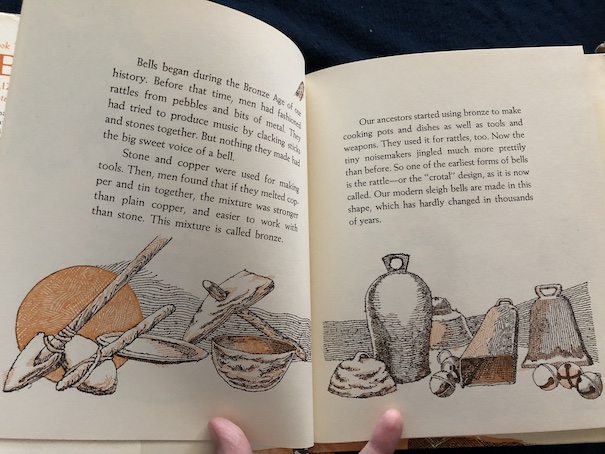
The book begins with the origins of bells in the Bronze Age. People had made rattles of various kinds before the Bronze Age, but after they learned to make bronze, an alloy of copper and tin, they discovered that they could make metal rattles with a much prettier sound. These metal rattles/early bells were made in the “crotal” design, which is the same shape as today’s jingle bells or sleigh bells. Other shapes of bells, like gongs and the classic bell shape may have been inspired when people realized that pleasant sounds could be made by banging bronze utensils against bronze dishes and bowls.
Bells have been used for thousands of years and have served many purposes. The oldest bell that has been found (at the time the book was written) was over 3000 years old and came from the area near Babylon. King Solomon of Israel used to have bells to frighten away birds from the roof of his temple. The Spartans were able to infiltrate a walled town in Macedonia because the sentry wore a bell on his uniform that helped them to keep track of where he was, but in other instances, nets with bells attached to them were used to warn of the presence of enemies. Bells have also been frequently used in religious services.

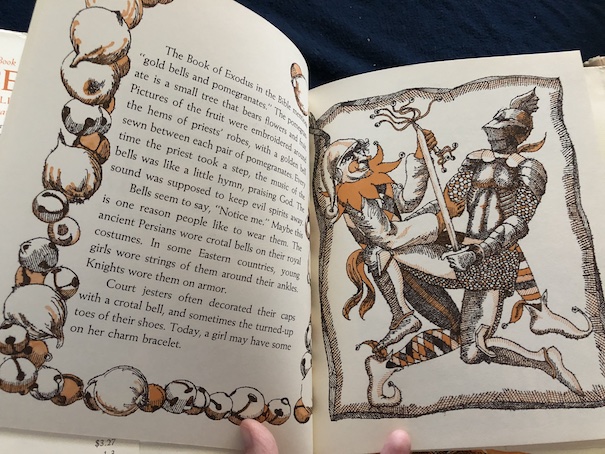
Sometimes, people wear bells to call attention to themselves. The classic jester’s cap with crotal bells (jingle bells) attached to it is meant to be attention-getting.
Bells can be made of many different materials, from different types of metal bells to glass bells to clay bells. There are even wooden ones, although they make more of a clunking sound than a ringing. People used to make bells by hammering pieces of metal into shape, but then they developed ways to cast bells in molds, which is how bells are made today.

There are many superstitions that have been attached both to the making of bells and their use. The book describes the Bilbie family, who famously made bells in Medieval England. The Bilbies were superstitious and consulted astrologers to determine the best times to make their bells. They also always rang bells for the first time on full moons. Various people have believed that ringing bells frightens away demons and witches.
The parts about superstitions and legends are my favorites. In particular, there is a legend in England about a town that was completely buried during an earthquake. The people in the town always rang their church bells at Christmas, and the legend is that if you go to a particular spot and put your ear against the ground, you’ll still hear them ringing the bells. However, the book says that there’s actually a scientific explanation behind the phenomenon. People who have put their ears to the ground at that spot have heard bells ringing, but they’re actually the bells from a nearby town, not one underground. The ground actually conducts sound very well, even better than sound waves moving through the air, so a person standing upright might not hear the bells ringing from another town, but someone who put their ear to the ground could hear the conducted sound vibrations. It’s not unlike the phenomena experienced by people who put their ears to the rails on railroad tracks to listen for the train. There are also stories of people having heard the approach of herds of animals, like buffalo, coming toward them in this way. The book doesn’t mention it, but “keep an ear to the ground” is actually an expression for watching and listening for signs of things that are going to happen because people noticed that vibrations in the ground could be indications of something coming toward them.

The book also describes some famous bells, like the Liberty Bell, Big Ben (Big Ben is actually the name of the bell in the clock tower, not the clock tower itself, although people informally think of the clock tower as Big Ben) and Tsar Kolokol, the largest bell in the world.
There are also a few nursery rhymes that mention bells (although the book doesn’t give any background information about the rhymes) and some information about change-ringing and carillons.
The book annoyed me a little in the way it kind of jumps around, telling some history, then some legends, then some more history, and then more legends. It’s a very easy read, and the information is interesting, but it’s a big disjointed. It sometimes feels more like a list of facts and short stories than one cohesive story. It might help if there were headings or chapter divisions in the book to organize the information, but there aren’t.
The book is available to borrow and read for free online through Internet Archive.
 Jestress's Forgotten Books and Stories
One thought on “Bells”