Eyewitness

Ancient Egypt by George Hart, 1990.
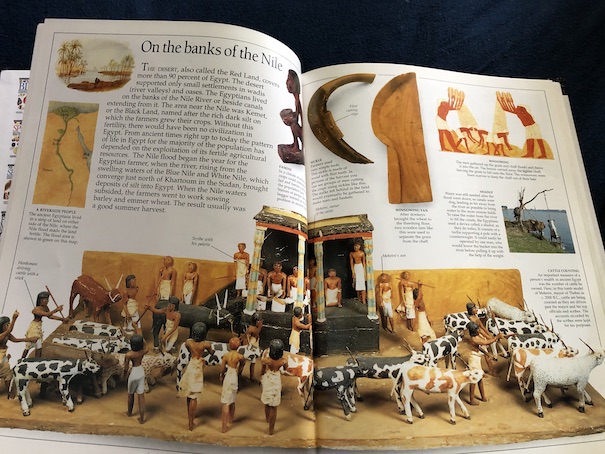
I love the way this book, like others in the Eyewitness series, shows photographs of artifacts so readers can not only read about how people lived but see the objects that they used. Each photograph in the book has a caption to explain what it is.

The book begins with an explanation about the origins of Ancient Egyptian civilization thousands of years ago, before there were pharaohs. Then, it explains about the geography of Egypt and the Nile and how the Nile floods and fertile lands along the river made Egyptian civilization possible.
The book then explains the concept of the Egyptian king as a “pharaoh.” The title of “pharaoh” comes from an Ancient Egyptian word meaning “great house”, referring to the palace where the king lived, so the king was the one who lived in the “great house.” However, the pharaoh was more than just the an important man living in a palace; he was also regarded as being a god. Most Egyptian rulers were male, although queens also sometimes ruled and were also regarded as divine. The book shows pictures of statues depicting pharaohs and explains a little more about some of the most famous pharaohs and queens. Then, it goes on to discuss life in the royal court.

Of course, no book about Ancient Egypt is complete without a discussion of mummies and tombs. Much of what we know about Ancient Egypt comes from what the Ancient Egyptians left in their tombs because Ancient Egyptians believed in life after death. They developed methods of preserving their bodies after death, and they stocked their tombs with things that they wanted to have with them in the next life. The book explains the embalming process, what pyramids and royal tombs were like, who the Egyptian gods and goddesses were, and what Egyptians believed about the journey to the afterlife.

I liked how the book not only explains different types of gods and goddesses in Ancient Egypt but also the roles of priests and temples in Egyptian society, types of religious rituals, and the role of religion and magical rituals in Ancient Egyptian medicine.

As the book covers a wide variety of different topics in Egyptian society, including scribes and writing, weaponry, and trading. I particularly like the parts focusing on daily life, like what Egyptian homes were like and some of the tools and details of different trades, like carpentry. The book has details about foods Ancient Egyptians ate, what music and dancing were like, and types of clothing and jewelry they had.

One of my favorite sections in the book is about toys and games in Ancient Egypt. We don’t know all of the details of games that were played in Ancient Egypt, but we do know that they had board games because they were found in tombs. Children’s toys were whimsical and included moving parts. Some of the games children played are similar to ones that children play today, like versions of leapfrog and tug-of-war and spinning tops.

The book is available to borrow and read for free online through Internet Archive (multiple copies, including some in different languages)
 Jestress's Forgotten Books and Stories
I used to love looking through those Eyewitness books. Each page is packed with photos and text, yet the layout isn’t overwhelming. Instead, it’s inviting to jump from one image to another and discover information about them.
LikeLiked by 1 person
Me too! I especially love the pictures in the historical Eyewitness books. They show you what tools and everyday objects from the past really looked like, and it helps draw you into the daily lives of people in other periods of history. A picture really is worth a thousand words, and the Eyewitness books are full of them!
I wish more historical nonfiction books for adults would include pictures. There are times when something can be “said” much better with a picture than with a wordy description.
LikeLike