Ruth Fielding
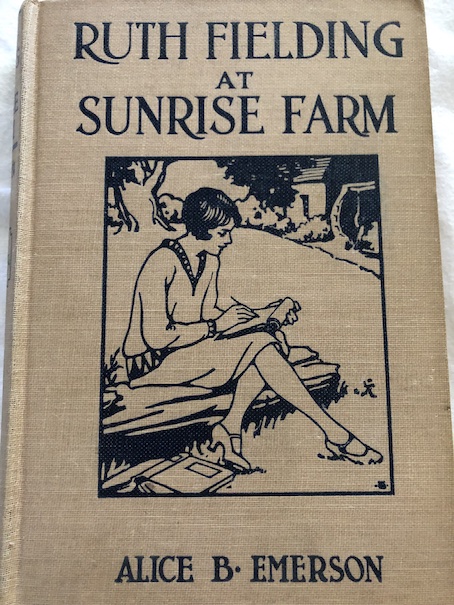
Ruth Fielding at Sunrise Farm or What Became of the Baby Orphans by Alice B. Emerson (Stratemeyer Syndicate), 1915.
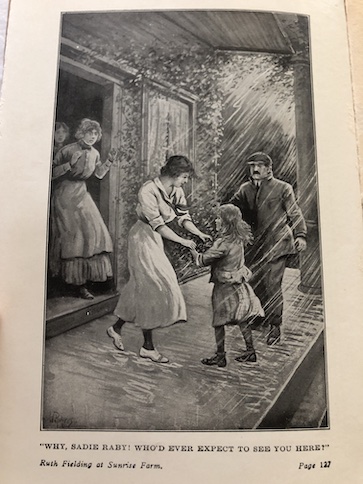
When the story begins, Ruth and her friends are at boarding school, and they are having a secret night meeting of their club, the Sweetbriars, to initiate some new members. Their initiation ceremony includes the story about the statue with the harp in the fountain that the girls were told during a scary initiation to another club in an earlier book, but the Sweetbriars are against tormenting and hazing new members. Instead of the scary ceremony, their initiation ceremony involves marching around the fountain while chanting a rhyme about the statue. There is supposed to be a mild prank of splashing the new members as if the fountain did it, but that’s as much hazing as the Sweetbriars will allow.
However, their ceremony is interrupted when one of the girls who is already a member of the club starts screaming. When everyone runs to see what happened, the girl who was supposed to do the splashing of the new members is all wet and says that someone pushed her into the fountain. She doesn’t know who did it, but she saw someone run away afterward. Ruth catches this mysterious lurker, and it turns out to be a younger girl who doesn’t belong to their school at all. The girl says that she had just been at the fountain, getting a drink of water. She says her name is Raby and that she ran away from some people called Perkins, who beat her. Ruth isn’t able to get much of Raby’s story that night, but she can tell that the girl is in trouble, so she says that if Raby will meet her the next morning, she can give her some money and help her.
The next day, Ruth’s friend, Madge Steele, invites Ruth and the other girls to spend part of the summer at a farm that her family bought near Darrowtown, where Ruth used to live with her parents before they died. The farm is called Sunrise Farm, and this trip is also meant to be a graduation party for Madge. Madge is older than the other girls, a senior at Briarwood, so these are her last few months at the school.
Ruth slips away from the others to bring some food to Raby, and she learns more about the girl’s plight. Raby explains that she’s an orphan. Raby is her last name, and her first name is Sadie. She was at an orphanage with her two younger brothers, a set of twins called Willie and Dickie. However, kids are only kept at the orphanage until about age 12, when they are put to work. Sadie is about 12 1/2 years old, and she was separated from her brothers when they were taken in by another family and she was sent to work for the Perkins family. The Perkins family acted kind in front of the adults at the orphanage, but they started treating her badly as soon as they got her to their home. Ruth is very much aware that she is also an orphan, and if it hadn’t been for her uncle and her friends, she would never have been able to go to a school like Briarwood and might have ended up in a situation very much like Sadie’s.
Ruth gets to see for herself what Mr. Perkins is like. While the girls are talking, he enters the school grounds to find her. Sadie runs away and hides, and Mr. Perkins grabs hold of Ruth. He has a whip with him, and he whips Ruth across the knees, demanding that she tell him where the runaway girl is. Mr. Perkins is interrupted by a stage driver, Mr. Dolliver, who sees what’s happening and yells at Mr. Perkins to leave Ruth alone and not to bother any of the girls at the school. Mr. Perkins claims that he didn’t know Ruth was a student, and Mr. Dolliver makes Mr. Perkins leave. When he’s gone, Ruth explains the situation with Sadie to Mr. Dolliver. Mr. Dolliver tells her that it’s against the law to help runaways. Ruth asks if that means that Sadie will be sent back to the Perkins family if she’s caught, and Mr. Dolliver says that’s probably the case: “Ye see, Sim Perkins an’ his wife air folks ye can’t really go agin’—not much. Sim owns a good farm, an’ pays his taxes, an’ ain’t a bad neighbor. But they’ve had trouble before naow with orphans. But before, ’twas boys.” Ruth says she hopes that the boy orphans also ran away from the Perkins family, and Mr. Dolliver says, “Wal—they did, by golly!” (Oh, surprise, surprise.)
Ruth begs Mr. Dolliver not to turn Sadie in if he sees her, and Mr. Dolliver says that his plan is to not see her, and he advises Ruth to do the same. Ruth tries leaving some food out for Sadie again, but she doesn’t return to the school. She hasn’t been returned to the Perkins family, either. Ruth is glad that she’s not with the abusive Perkins family, but she’s still worried about where Sadie went and what she’s going to do. As the school year comes to an end, Ruth gets a letter from Aunt Alvirah saying that her Uncle Jabez is willing to let her go to Sunrise Farm with her friends during the summer. Aunt Alvirah has hired a “tramping girl that came by” to help with the work around the Red Mill, so Ruth will be free for a relaxing visit. Ruth later learns that the “tramping girl” was Sadie, but Sadie has moved on to find work elsewhere by the time Ruth gets home from boarding school. Ruth hears stories about her from other people who employed her or helped her, and her best friend’s brother, Tom, says that he paid for her to get a ride on a train to a town called Campton.
Soon, it’s time for Ruth and her friends to go to Darrowtown and meet at Sunrise Farm. It’s an emotional journey for Ruth because she has bittersweet memories of Darrowtown from when she lived there with her parents, when they died, and the period when she was an orphan there, before she went to live with her great uncle. While she’s there, she stops to visit with Miss Pettis, a seamstress who looked after her before she went to live with Uncle Jabez. Miss Pettis is happy to see her, and the two of them spend some time catching up on what’s been happening to everyone since Ruth left Darrowtown.
When they all get to Sunrise Farm, Madge’s father is annoyed because he’s discovered that their neighbors, the Caslons, are having a bunch of “fresh air children” coming in the summer. (“Fresh air children” are children who come from the city, usually from unfortunate backgrounds, to experience the fresh air and wholesome activities of the countryside. There are still programs that do this, including the Fresh Air Fund in New York. In fact, I think that might be the program that the Caslons are supposed to be participating in as a volunteer host family during the story because it existed in this time period, and the series is generally set somewhere on the East Coast.) Mr. Steele thinks that the Caslons are bringing in a bunch of children to make noise and annoy him personally, but Madge says that she’s heard that they take in children like this every summer. Madge’s parents see this as a personal inconvenience to them. Ruth knows that Mr. Steele is a wealthy businessman who has always lived in the city. He doesn’t know much about the countryside, doesn’t understand the people who live there, and has little patience for any of it. When he bought Sunrise Farm, he did it with the idea of being kind of a gentleman farmer, but it’s starting to become obvious that he has little idea of what that means.
It turns out that Sadie’s little brothers are among the group of orphans who are visiting the Caslons this summer, and Sadie soon shows up, looking for them. At first, Mr. Steele thinks he should call the orphanage when Sadie shows up at Sunrise Farm, but after she rescues his young son from a runaway horse, Mr. Steele is grateful and decides not to. Instead, he plays host to Sadie and her brothers at Sunrise Farm. Then, they learn that a lawyer has been looking for the Raby family because they have inherited some property in Canada. When the Raby twins and some of the other “fresh air” boys run away and get lost on a prank, Mr. Steele and Mr. Caslon join together to find them and get a new respect for each other.
This book is now in the public domain and available to borrow and read for free online through Project Gutenberg.
My Reaction and Spoilers
This is one of the books in the series that is really more adventure than mystery. There are some moments of slight mystery, when Ruth wonders where Sadie is or where her brothers are, but those are cleared up pretty quickly, just by chance, without Ruth having to go out of her way to investigate. The Raby children’s unexpected inheritance is quite a convenient coincidence, but it still leaves the children’s custody to be decided. At first, I thought that they might stay with the childless Caslons, but Mr. Steele, having been won over by the children, agrees to look after them and manage their inheritance until they’re old enough to manage it themselves. It feels a little classist that rich Mr. Steele gets the children and manages their inheritance, but by the end of the book, the Steeles are getting along better with the Caslons, so I suppose they’ll be seeing each other on a regular basis. The Caslons will also probably continue to invite “fresh air” kids from the city to visit their farm.
I really appreciated the part in this book where Ruth gets emotional about returning to the town where she used to live with her parents before they died. Orphans are common in children’s literature, partly because their orphaned status can be a reason for leaving home and finding adventure. However, I’ve noticed that many children’s series don’t dwell on the loss of the parents for long after it occurs and the adventure starts. Even when a child grieves for the loss of a parent, that grieving doesn’t show up much in sequels in a series as the story focuses more on the orphan’s adventures and new friends, like they kind of got over it. The Boxcar Children, for example, rarely mention their parents at all, and their cause of death isn’t even described in the main series (except for the oldest edition of the first book, which has a really dark first chapter). Ruth Fielding, as a character, was kind of a precursor to Nancy Drew in the Stratemeyer Syndicate, and Nancy Drew also lost her mother, but she never really talks about it. Ruth is usually a pretty happy person, even in difficult circumstances, but I like this acknowledgement that she still feels something from the loss of her parents. Even though she tries to keep cheerful and busy, there are times when she can still get sad about their loss. It’s like that in real life. Even when someone has had a long time to get accustomed to a loss, they can still have moments when they think about it and feel sad. This is the type of character development that I like in the Ruth Fielding series that doesn’t appear much in other vintage children’s series.
This book also addresses the fact that, as orphans go, Ruth has been more fortunate than some. Ruth’s uncle isn’t rich, and he’s kind of a miser, but he still takes care of her, gives her a place to live, and makes sure that she gets an education. Uncle Jabez sometimes says that he doesn’t know what good a fancy education will do for Ruth and that other girls like her stay home to help with chores or go out and get jobs. However, Ruth’s friends are getting an education, so Uncle Jabez decided in earlier books that Ruth should go to the same school and not be left out. Ruth comes to see how other people look at orphans. People accept Ruth because she lives with her uncle and goes to school with girls from better-off families, but would they all look at her the same way if she’d been forced to grow up like Sadie?
Mr. Steele is rather self-centered, thinking only of his convenience in everything. He sees the presence of the young orphans next door as some kind of personal affront to him because he thinks they’re just there to cause noise and mess and make trouble for him. Madge and her mother don’t like that kind of talk, but Madge’s brother echoes everything his father says. Even some of the other guests at Sunrise Farm express similar sentiments about how troublesome the young orphans are or must be, even for the Caslons: “Just think of troubling one’s self with a parcel of ill-bred children like those orphanage kids.” However, when the young people talk to the Caslons, they learn that the Caslons love having the orphans visit them every year. While Mr. Steele tells himself (and anyone who will listen) that the Caslons have only decided to do this out of spite for him, they’ve actually been hosting orphans for years, long before they ever met the Steeles, and it has nothing to do with the Steeles. Their own two children died very young, and they find joy and fulfillment in helping to take care of other children. They know that kids cause a certain amount of noise, mess, and chaos, but they feel like the inconveniences are worth it because they truly enjoy the children and have fun with them.
There is also a theme in the story about neighbors, what makes somebody a good neighbor or a bad neighbor. Mr. Steele thinks that the Caslons are bad neighbors from the beginning, both because they invite the orphans to join them for the summer, which Mr. Steele thinks is going to cause him some kind of personal inconvenience, and because the Caslons refuse to sell their farm to him when he decides that he wants to buy them out, like he’s entitled to their farm and they’re somehow “bad” for not letting him have it when he wants it. From my perspective, Mr. Steele is the bad neighbor because he’s the one who comes in without knowing the things that people in this area do, and he expects everyone to change their plans even sell out to him just on his say-so. Mr. Steele wants everything to be about him, even when it takes place on someone else’s property, and it bothers him that other people’s property belong to them and not to him. It seems to me that various characters in the story rate their neighbors not on how their neighbors behave or what they actually do but on how they happen to feel themselves at that particular moment. Mr. Steele seems to be in a mindset where I would expect that anything a neighbor did on his own property would be some kind affront to him because what he really wants is the neighbor’s property itself. It feels to him like his neighbor is doing things to him because, in his mind, the neighbor’s property is already his, even though it’s not, so the neighbor is already committing a trespass just because they are on their own land and doing what they’ve always done there, which Mr. Steele doesn’t own outside of his own mind. Fortunately, Mr. Steele’s experiences with the Raby children and his acknowledgement that Mr. Caslon is more experienced with this area and better able to find the lost children than he is humble him a little and get him to take a different view of both the Caslons and the “fresh air” children.
Some of the characters seem to have poor priorities when it comes to figuring out who makes the best neighbors, and I think maybe they should take some of their neighbors’ actions under realistic consideration. I don’t know what Mr. Dolliver means when he says that Mr. Perkins “ain’t a bad neighbor.” That’s definitely not the impression I’m getting. When someone storms onto someone else’s property in a full rage and starts randomly grabbing and whipping a girl he’s never seen before, it’s not just a red flag anymore. A red flag would be a warning of potential danger, and this is full-on, uncontrolled physical violence in action in front of a witness! Ruth’s skin is described as having red welts from the whip! If this is part of Mr. Dolliver’s definition of a neighbor who “ain’t bad”, just how does he define a bad one? Honestly, where are the limits? It seems like the only thing Mr. Perkins has going for him is money from his “good farm” and “taxes”, which makes me think maybe the locals are easily bought off. As long as this neighbor seems to be contributing money (through direct or indirect means, through taxes) and there is the option to ignore his behavior, the local people seem content to ignore the behavior and accept the money.
From what Mr. Dolliver says about Mr. Perkins’s problems with other orphans before, his physical violence is repeated behavior. By Mr. Dolliver’s admission, the Perkins family has never had a different result with any orphan they’ve had in their custody. Each time, they mistreat the orphan and the orphan runs away in desperation, unable to return to the orphanage that’s supposed to be caring for them because the adults there seem to think that it’s more important to not say “no” to the Perkins family than to ensure the physical safety of children. I’m pretty sure they’re getting money for this, because otherwise, why in the name of all that is truly good, holy, and sane, would anybody ever let him have access to any other orphans after he’s already gone through multiple orphans in this fashion already? To very loosely quote Oscar Wilde, to lose one might be considered unfortunate, to lose two begins to look like careless, and to lose three or more brings everyone involved in the process into question. Insanity is doing the same thing over and over and expecting a different result each time. How many minors is the orphanage prepared to sacrifice to the Perkins family before they decide it’s enough, and at what point will it dawn on them that the Perkins family is the common element to the disappearance of all of the previous orphans?
I’m just going to say it: Mr. Perkins is a dangerous weirdo. He’s unsafe with vulnerable children or really anyone who gets in the way when he’s angry and is not in a position of authority or able to fight back. I’m sure his neighbors are either being bribed or they’re all in deep denial about it and that’s why they end up being complicit in the continuance and repetition of orphan abuse. I know that, as a character, Mr. Perkins is deliberately set up as a villain and an obstacle in the story to be escaped or overcome, but he’s such an over-the-top violent character, running around with a whip that he uses on total strangers, it just brings the orphanage, the neighbors, and everybody in the community who still calls this wacko a basically decent neighbor into question.
 Jestress's Forgotten Books and Stories
One thought on “Ruth Fielding at Sunrise Farm”