
The Big Book of Real Trains by Elizabeth Cameron, illustrated by George J. Zaffo, 1949, 1953, 1963.
This is a vintage children’s nonfiction book that’s all about trains! It was reprinted and had its copyright renewed many times, which is why I give multiple dates for the book. My edition was the 1973 printing. The pictures are detailed, and they alternate between color and black-and-white.

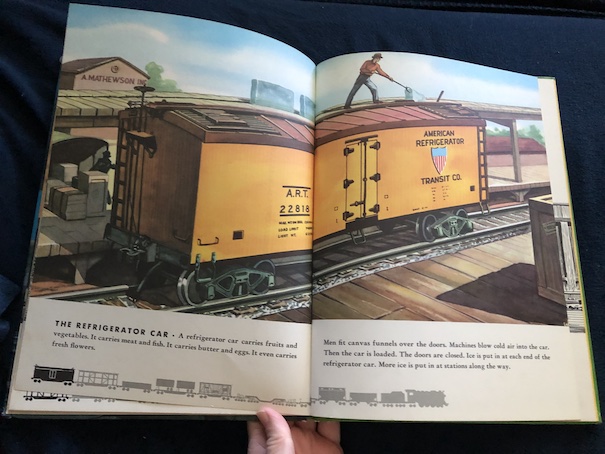
I thought it was interesting that the first half of the book devotes a page to explaining each specific type of train car and its purpose, so kids can learn to recognize them on sight. If you look at the bottom of each of those pages, you’ll see how they’re slowly building a complete train, from locomotive to caboose, with each new car.
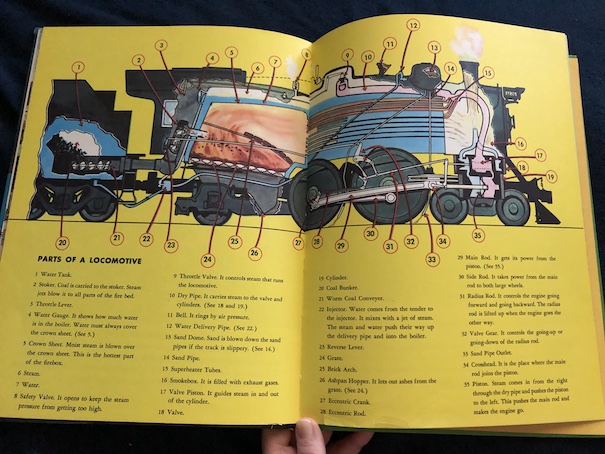
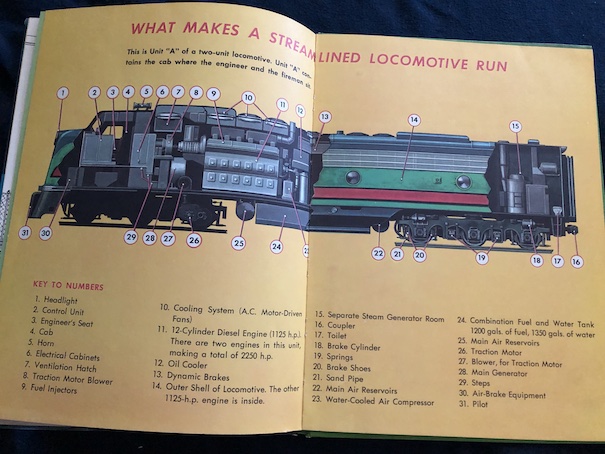
There is a special page that shows the inside of a locomotive to explain each of its parts and how it functions, and there is another picture that shows the parts of a streamlined locomotive.
After the book explains each of the basic train cars, it explains the classification yard, where freight cars are assembled into trains.


I particularly liked the sections of the book that explain the signals railway personal use and all of the types of personnel who work on trains. The signals are old-fashioned manual signals, but it’s still interesting, especially if someone might be writing a story that takes place in the past on a train. Some of the jobs might also be different on modern trains, but I liked how they pointed out just how many types of people who might be working on a train. The book refers to these workers as “men”, which sounds a little old-fashioned, but I noticed that the tiny figures representing different jobs had different skin colors, even for higher-ranking jobs on the train, which is very good for a vintage book. The illustrator made an effort to show diversity! Overall, I thought their explanations were pretty good.

The book is available to borrow and read for free online through Internet Archive, although the copy is listed under an alternate title, The Book of Classic Trains.
 Jestress's Forgotten Books and Stories
One thought on “The Big Book of Real Trains”