Polka Dot Private Eye

The Mystery of the Blue Ring by Patricia Reilly Giff, 1987.

When Dawn Bosco first joined Ms. Rooney’s class at Polk Street School, she stole Emily Arrow’s toy unicorn. Now, that incident has come back to haunt her. When the book begins, her theft of Emily’s unicorn was just weeks ago. Now, she and Emily are starting to be friends, although their friendship is a bit shaky.
At school, the teachers are talking about vegetables because it’s Good Vegetable Day. Everything is geared around vegetables all day, and the art teacher has the children make sculptures of vegetables out of clay. Dawn is bored because she’s been reading a mystery book, and she’d rather be finding mysteries and learning to be a detective than making silly vegetables out of clay.
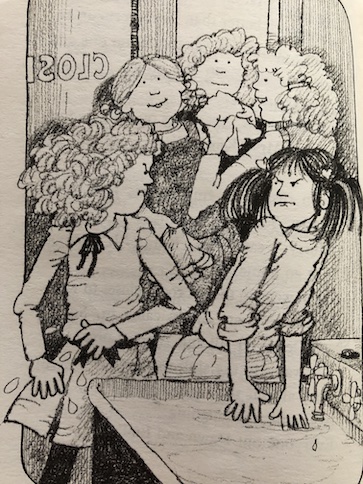
Dawn gets irritated with Emily when she says that she’ll make a cucumber, which is what Dawn was going to make because it’s easy. The teacher won’t let Dawn make a cucumber because Emily already claimed that idea, so Dawn has to make a carrot instead. (Not that much different in shape, really, except one end is more narrow.) However, she still resents Emily for using the cucumber idea first.
As the girls push against each other by the sink, cleaning up from using the clay, Dawn spots a ring next to the sink. Later, Emily says that her ring is missing. It’s a special ring with a blue stone that she got for her birthday. Dawn is pleased that she’s found a mystery to solve. Remembering that she saw a ring next to the sink in the art room, Dawn proudly goes back to the art room to see if she can find the ring and return victorious. However, the ring isn’t there when she checks.
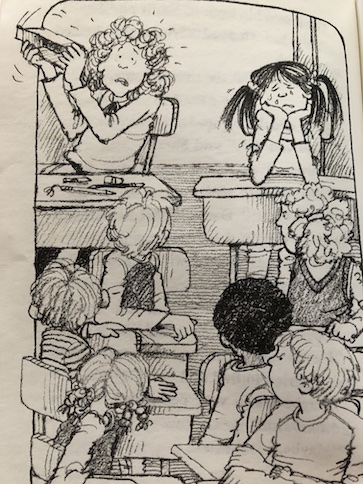
Then, suspicion turns to Dawn herself. After all, everyone knows that Dawn stole Emily’s unicorn before. Instead of being the hero detective, Dawn is turning into the main suspect in this crime. Now, she really needs to find the ring to clear her name!
Dawn’s grandmother, Noni, gave her a special detective kit for her birthday. Dawn uses it to turn into The Polka Dot Private Eye to hunt down Emily’s ring.
The book is available to borrow online through Internet Archive.
My Reaction

I liked the way the series returned to the subject of Dawn’s theft and used it to spark a spin-off mystery series. This is the first of the Polka Dot Private Eye books. In this series, Dawn becomes a more likeable character than she was when she first appeared in Fish Face, and she gets a little comeuppance for her earlier, unpunished theft of Emily’s toy unicorn in the form of her classmates’ suspicion of her. When I read this book for the first time when I was a kid, I hadn’t read the book where Dawn was first introduced, Fish Face, so I didn’t really understand the relationship between Dawn and Emily and how Dawn took Emily’s toy unicorn. We never really find out in either book exactly why Dawn took the unicorn, although in this book, she thinks of herself as having “borrowed” it instead of having stolen it.
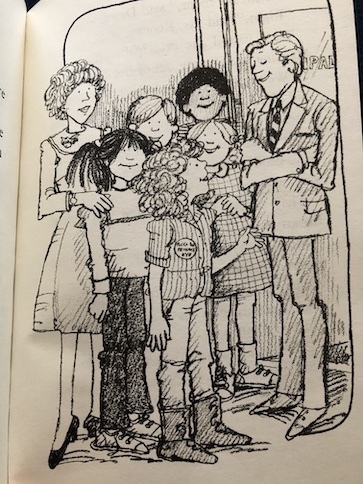
Reading Fish Face isn’t necessary to understand the basic story in this book, but after having read it, I appreciate Dawn’s position in this book a little better. By now, everyone knows what Dawn did, and although Dawn thinks of “weeks ago” as a long time ago, it’s not really that long, and it’s still fresh in everyone’s mind. Dawn is still a relatively new kid in class, and one of the few things everyone knows about her is that she has a history of taking things that don’t belong to her. It is a logical conclusion that Dawn might have helped herself to another of Emily’s belongings when everyone knows that she’s done it before. As my grandfather used to say, it’s easier to keep a good reputation than to redeem a bad one, but Dawn works at it and learns that she likes being a detective and that she has a talent for figuring things out. After Dawn figures out where Emily’s ring is, the two of them become better friends. Solving the mystery also makes Dawn a class hero and begins to establish Dawn’s reputation as a person who likes to solve mysteries and crimes rather than commit them.
This book gets bonus points from me for mentioning jelly sandals. Jelly shoes were a regular part of my childhood in the 1980s and early 1990s, and I’ve seen some of them return again in the early 2000s, probably partly because people my age now have children, and they’re nostalgic for some of the things from their childhoods. Jelly shoes (or “jellies,” as we called them) are sandals and sandal-like shoes made from flexible plastic in different colors, some clear or with sparkles inside. They were cheap when I was a kid, and I used to get a new pair or two when the weather turned warm. Eventually, they wear out, and the plastic bits snap. I’d wear them around my backyard with my toes sticking out the front as they started breaking, and I started growing out of them. By the time they were too broken to use anymore, my toes were usually beyond the bottom of the shoes, and I was always kind of proud of that because it was a sign that I’d grown over the summer. It wasn’t much of a loss when the shoes wore out because they’d be too small for me at that point anyway, so we’d throw them away, and I’d wear more solid shoes when the weather turned cold. Jellies, flip-flops, and cheap canvas shoes were a major part of what I wore when I was young and growing out of shoes fairly quickly. They were all inexpensive, and while they didn’t last very long, they lasted about as long as they needed to before I needed the next size and weren’t much to lose when I was rough on them.
 Jestress's Forgotten Books and Stories