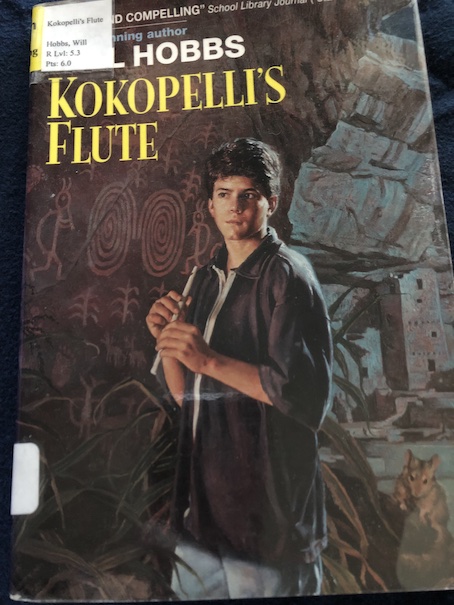
Kokopelli’s Flute by Will Hobbs, 1995.
Tepary Jones, called Tep for short, has always been fascinated by the ancient cliff dwelling known as Picture House. One night, he goes there with his dog, Dusty, because he think it would be a great place to watch a lunar eclipse. However, he and Dusty aren’t there alone. Tep witnesses a couple of looters illegally digging for valuable artifacts. The looters uncover the burial of a medicine man and begin taking some of the things he had buried with him. They damage the site before they leave, but Tep discovers that they have left behind an unusual artifact, a small flute made of polished bone. When Tep picks up the flute, he feels compelled to play it. Not wanting to leave the flute behind in case the looters return, Tep takes it home with him.
That night, Tep has a strange dream that he turned into a packrat, like one of the literal packrats he saw up at Picture House. However, he soon realizes that this was not just a dream. Ever since he played the flute, he finds himself turning into the animal he saw the first time he did so. Tep returns the flute to the body of the medicine man and reports the looting to the authorities, hoping that, once the body is respectfully reburied, whatever magic or curse is afflicting him will end. Unfortunately, it doesn’t.
Tep still finds himself turning to the packrat at night, having uncontrollable urges to go out and explore and find food, and it’s dangerous because animal predators and even his own parents are after him. Rodents in the house are a serious concern because they can carry hantavirus, which causes dangerous respiratory infections in humans. After his mother catches sight of him in packrat form, Tep’s parents start setting out traps. His dog, Dusty, seems to know him even when he’s a rodent and helps to protect him, but Tep knows that he’s going to have to stop this transformation somehow, before either his parents catch him or a predator eats him!
Tep’s parents are academics and researchers who study ancient agriculture and cultivate varieties of seeds on their farm that require little water to grow. To buy himself time from his parents’ efforts to catch the packrat, Tep makes the argument that the packrat is a part of the ecosystem and that it might be performing an important role in the environment, like birds that help propagate seeds by eating them and then depositing them in new places. Tep brings up the fact that there are some seeds that really need to be processed in a bird’s digestive system before they can grow. It’s a thoughtful argument, but the looming threat of hantavirus in their community still means concern about the presence of rodents. Hantavirus is serious, even fatal, and people in their community have already fallen victim to it.
Tep returns to Picture House to try to find the flute again to break whatever spell is affecting him, but he can’t find it. He only hears what he thinks is the sound of someone playing the flute, and he’s not sure if he really hears it or if he’s imagining it. Then, a stranger comes to the farm, a man who appears to be a humpbacked Native American or possibly someone from Mexico or Central America. He calls himself Cricket, and Tep’s family thinks that he’s probably just another migrant worker. Tep shows Cricket around the farm and explains the different types of seeds they cultivate and how they can be used to keep particular varieties of plants alive for their drought-resistant or pest-resistant qualities. Cricket doesn’t say much, but he seems to approve of the idea of cultivating more varieties of seeds. When he helps Tepary to plant seeds, Tep notices that he uses a planting stick, like Native Americans traditionally did.
Of course, Cricket is no ordinary farm worker. Tepary notices his unusual ability with plants and animals, and one night, Cricket speaks with Tepary while he’s in his packrat form. Cricket knows more of what’s been happening than anyone because he is one of the legendary figures from Native American folklore known as Kokopelli. Kokopelli was a legendary humpbacked flute player known for bringing seeds to people, and Cricket says that he still visits people like Tep’s family, who are interested in the past, who cultivate the land, and who keep seeds alive. Tep appeals to him for help with his transformations, and Cricket says he will help, if he can, although he notes that Tep seems to have been managing well. Cricket says that Tep can use the flute to reverse his condition, but only if he knows the right notes to play on it. If he plays the wrong notes, he could change into something else and make his condition worse. The clues to the notes are contained in the pictures on the walls of Picture House.
Tep manages to use his animal form to play a trick on Coyote in the tradition of old trickster tales and to rescue his dog from the looters. Then, Tep’s mother contracts hantavirus. Cricket says that ancient people also suffered from the disease, and they used an herb to cure it. Nobody grows that particular herb anymore, but there should still be some contained in the medicine bundle buried with the old medicine man at Picture House. To save his mother and break the spell on him, Tep must return there to find the medicine man’s bundle and the flute.
The book is available to borrow and read for free online through Internet Archive (multiple copies).
My Reaction
I vaguely remember having read this book when I was a kid, around the time when it was first published in the 1990s. It stuck in my mind because it takes place in the Southwestern United States, where I grew up, and it was also the first time that I had heard about hantavirus, which is a serious concern in real life. I couldn’t remember exactly how the book ended, though.
Reading it as an adult, I understand more about the parents’ work and the commentary about interrelated aspects of the ecosystem than I did as a kid. I understood some aspects of environmentalism and ecosystems as a kid because those were topics that we discussed in science classes at school in the 1990s, but admittedly, science wasn’t my best subject, and I’ve had more time to grasp certain concepts since then.
There are agricultural researchers in real life who do what Tep’s parents are doing, trying to cultivate seeds for drought-resistant crops, which are important in places like the area where I live, that are very dry for much of the year, and are becoming even more important due to climate change. That type of research takes time to cultivate generations of plants and to propagate seeds with desirable qualities. Modern researchers also take information and inspiration from past agricultural practices to enhance modern techniques (paleoethnobotany or archaeobotany). When Tep is talking to Cricket, he explains why it’s important to keep growing a different varieties of crops because some varieties are more resistant to different types of problems that others, like drought-resistant crops or pest-resistant crops. One of the dangers of huge, corporate farms is that they produce too few varieties of particular types of crops, focusing on the most popular ones, leaving them vulnerable to being almost completely wiped out by particular disasters. People need to keep growing older and less popular varieties of crops to keep the plant varieties alive and keep producing seeds for new generations so agriculture as a whole will have those varieties to draw on for the plant qualities they need to cope with changes in the environment and/or particular plant diseases.
One of the reasons why I liked this book is that it references the legend of Kokopelli. Because I grew up in the Southwestern United States, I grew up seeing images of Kokopelli along with other Southwestern Native American symbols. Kokopelli is often used as a decorative image in Southwestern art, although not everyone who has or uses the decoration knows the legends behind it. Kokopelli is described in somewhat different ways in different stories, but he is generally a fertility figure who travels from village to village, bringing changes to the seasons and promoting good harvests. He is also a trickster figure and represents human fertility. In some stories, human women get pregnant everywhere he visits, including by Kokopelli himself, an aspect of the character that does not appear in this particular book because it’s not kid-friendly. There is a theory that the legends might be based on traveling Aztec merchants who arrived seasonally, carrying sacks of seeds and other goods to trade on their backs, giving them that hunched appearance.
The book frequently uses the word “Indian” instead of Native American. It seems to be meant in an informal way rather than a disrespectful one, although I found it irritating because it can be a bit confusing. When Tep uses it in relation to the Native American ruins nearby, context tells readers that he means “Native American”, but when he uses it when he talks about places around the world that use the seeds his family produces, it becomes more confusing. At one point, he uses the word “Indian” and then talks about an order his parents have received from Pakistan, so did Tep mean Native Americans or people from India the country in that context? I heard the word “Indian” used a lot in relation to Native Americans when I was growing up, and sometimes, I even have the urge to use it out of old habits, but I don’t really like using that word anymore. It’s not so bad if you say “American Indian”, but just saying “Indian” by itself is often confusing. I generally agree with the modern convention of saying “Native American” or using the name of a specific tribe, if you know the name to use, both because it sounds more respectful and because it really makes a difference in the clarity of the sentence. It’s just not as effective if someone immediately has to ask, “Wait a minute, do you mean ‘American Indian’ or ‘Indian from India’?”, and when it’s in writing, there isn’t even a live person there to ask.
 Jestress's Forgotten Books and Stories