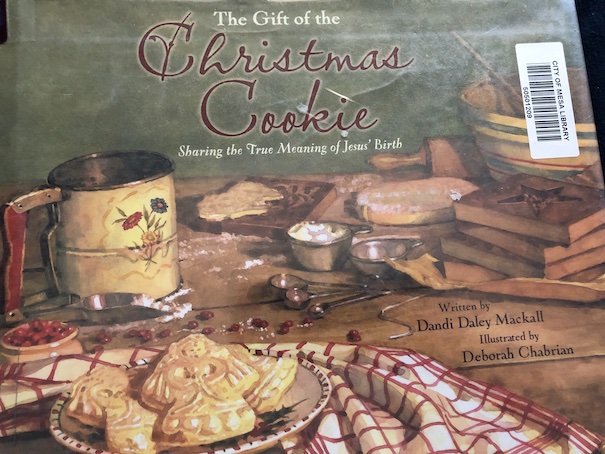
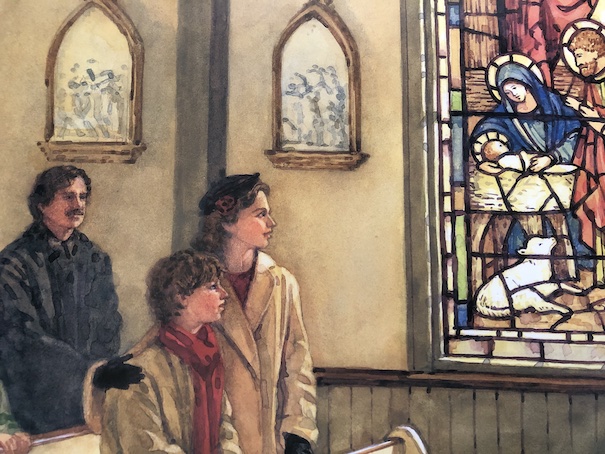
The Gift of the Christmas Cookie by Dandi Daley Mackall, illustrated by Deborah Chabrian, 2008.
This is a sweet Christmas story that discusses the meaning of Christmas along with the history of Christmas cookies.

The story doesn’t provide a year, but it seems to be implied that it takes place during the Great Depression because Jack’s father is described as hopping a freight train to find work and send money home. Since then, Jack and his mother have lived alone, saving every penny that Jack’s father sends to them.
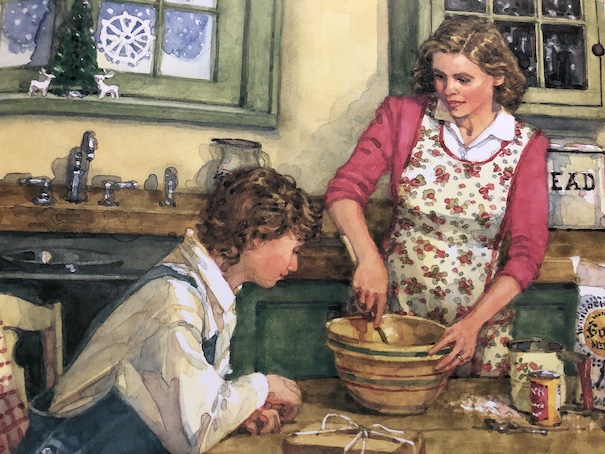
Then, before Christmas, Jack arrives home to find his mother making cookies. Jack is thrilled at the idea of having a rare treat, but his mother says that the cookies are for the needy at church. It’s disappointing because Jack has been feeling rather needy himself.
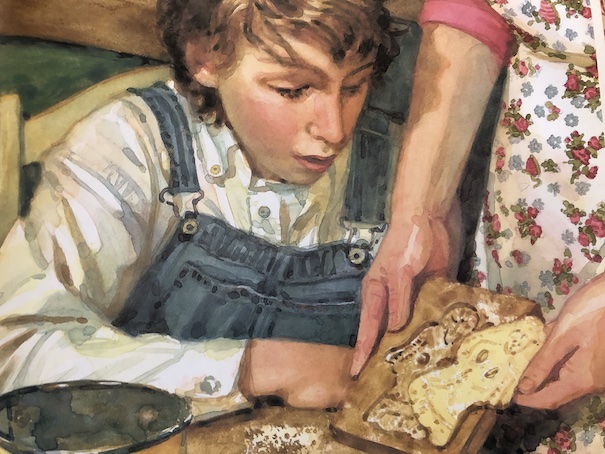
Then, his mother shows him the wooden cookie board molds that they will use. They are big with elaborate carvings of Christmas symbols. Making the cookies is labor-intensive, and Jack wonders why they’re working so hard to make such elaborate cookies that people will just eat anyway.
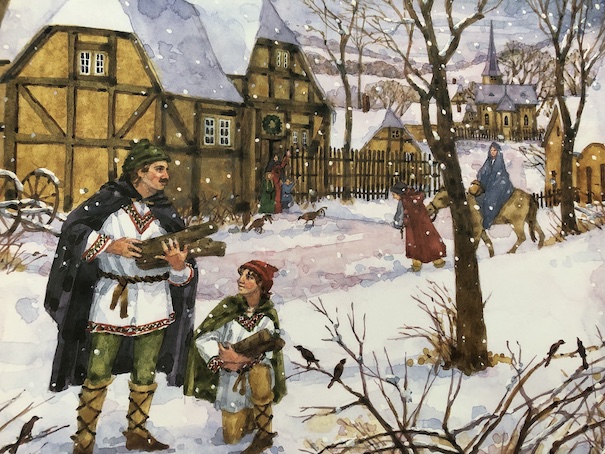
Jack’s mother tells him a story that takes place in the “Old Country” of their ancestors during the Middle Ages. (It’s in Germany, although Germany didn’t exist as the single country it is today back then.) Times were very hard, and people couldn’t afford much, but one family wanted to do something special for their neighbors for Christmas. The father of the family was a woodcarver, so he considered carving Nativity figures, but his wife said that many people were hungry, so it would be better to bake something they could eat. The woodcarver made wooden molds in the shapes of figures associated with Jesus’s birth, and his wife made the sweet dough to put in them, and they made cookies to share with their neighbors.

Jack’s mother saves one cookie from their batch in the shape of an angel for Jack so he can have a treat, but when a hungry man comes beginning for something to eat, Jack considers his own father, who might be traveling and hungry.

Jack is inspired to share his special Christmas cookie with someone who might need it more than he does and to pass on the story that goes with it.
My Reaction
I like stories that include some history, and I enjoyed this story about the origins of Christmas cookies and a lesson in generosity, giving to someone else as he hopes other people will be generous with his father. The invention of Christmas cookies can’t be traced back to any particular family, like the story in the book tells it, and Christmas cookies might have actually originated in Medieval monasteries because the monks would have had greater access to the sugar and spices needed than most people. However, the general concept of Christmas cookies made with molds is accurate. There is a brief note in the back of the book about the cookie boards or springerle molds that come from the Schwabian region of Germany, Switzerland, and Austria and how these molded cookies have had religious shapes since the Middle Ages. The book also notes that some cookie molds take the form of specially-carved rolling pins rather than the flat boards shown in the book, and this was the type of cookie mold that my grandmother used to use. When she made molded cookies, they were anise-flavored, which is traditional and tastes like licorice, although I prefer to make ginger cookies with my cookie mold rolling pin. The book includes a simple recipe for cookies that you can use with cookie molds or cookie cutters, and it uses the traditional anise flavoring.
 Jestress's Forgotten Books and Stories
Fascinating! 🙂 The illustrations are beautiful. 🙂
LikeLiked by 1 person