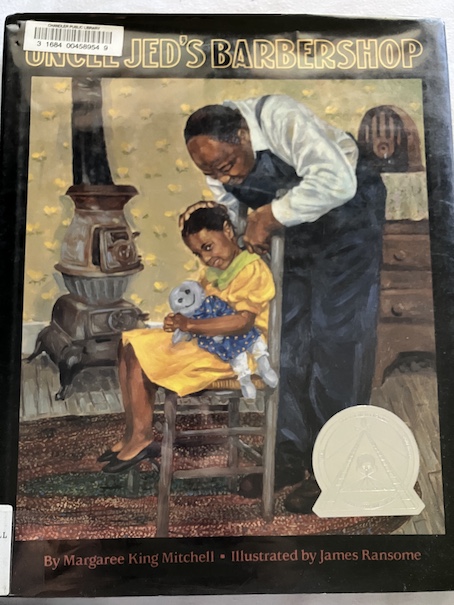
Uncle Jed’s Barbershop by Margaree King Mitchell, illustrated by James Ransome, 1993.
Sarah-Jean remembers her grandfather’s brother, Uncle Jed, and how he would travel to people’s houses to cut their hair during the 1920s and 1930s. He’s the only black barber in their area, so he cuts everybody’s hair in the black community. What he really wants is to own his own barbershop, with proper barbers’ chairs and equipment, but times are tough, and helping out his family means delaying his dream shop.
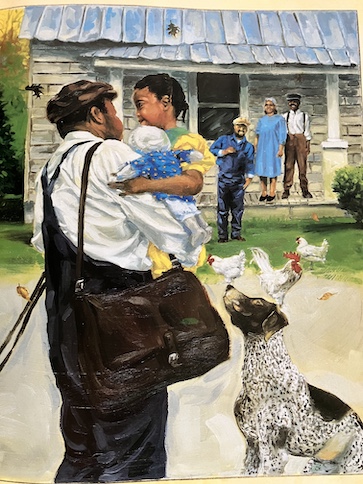
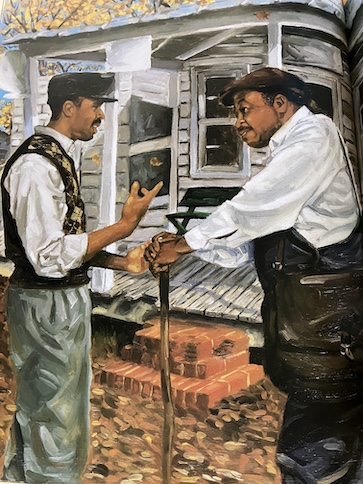
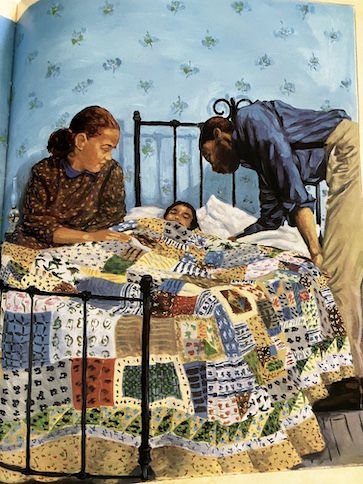
Everybody is poor in their town, so many people think Uncle Jed will never be able to get enough money to open a shop. However, even though things are tough and money is tight, Uncle Jed is willing to help out when he can. When little Sarah Jane develops a serious illness and needs an operation, Uncle Jed gives her father the money they need for her operation, saving her life.
Later, Uncle Jed loses his savings when the bank fails during the Great Depression, so he has to start saving all over again. Even though he has it hard during the Great Depression, Uncle Jed still helps other people, sometimes cutting hair for customers who can’t afford to pay him because they’re even worse off. He takes payment in whatever form they can offer, like garden vegetables or eggs.
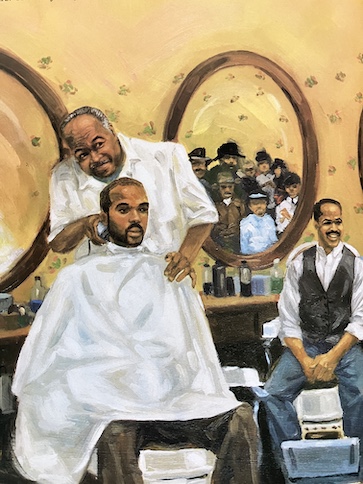
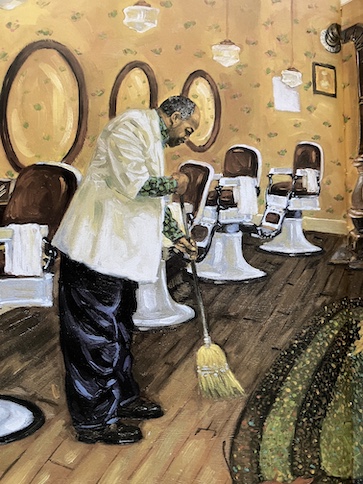
Eventually, things improve, and Uncle Jed is able to afford his barbershop, and everybody comes to the opening. He acquired his shop toward the end of his life, so he doesn’t have it for long before his death, but he was still happy because he accomplished his goal and did something people didn’t think he’d be able to accomplish.
The book received the Coretta Scott King Award.
My Reaction
I thought it was a nice story. The ending seemed a little sad, that Uncle Jed didn’t live very long after finally acquiring his shop, but the book has an optimistic tone. Although Uncle Jed accomplished his life goal toward the end of his life, he did get to accomplish it and enjoy it before he died. It’s less important how long he got to enjoy it than the fact that he did enjoy it.
It took a long time for Uncle Jed to accomplish his goal of having his own barbershop, but I think it’s important to note that he had a pretty good life along the way. Even though he lost his savings in a bank failure, he had steady work through the Great Depression, and he was also able to help friends and relatives when they needed it. He had good relationships with his family and neighbors because of his helpfulness and generosity, and everybody shows up to congratulate him when he finally opens his shop.
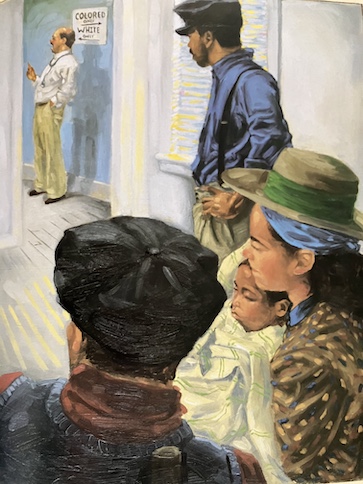
This story takes place in the South during times of segregation, which enters the story when Sarah Jane is ill and needs to go to the hospital. Although her condition is serious, not only is her family sent to a segregated waiting room, they also have to wait until all the white patients are tended to before the doctor will even see them. The doctor also insists upon payment before performing the operation she desperately needs, the implication being that the doctor will let her die if he doesn’t get paid up front to save her. Before anybody think that this is an exaggeration, that a doctor would refuse to treat a sick child or save her life because of her race, even during the Jim Crow era South, no, it’s not an exaggeration at all. It was routine:
“It’s absolutely incredible how little organized resistance there was,” says Theodore Marmor, emeritus professor of public policy at Yale University and a key health policy adviser during the Johnson administration.
Before the passage of Medicare and Medicaid, Smith says, the healthcare system was tightly segregated. Hospitals in the South complied with Jim Crow laws, excluding blacks from hospitals reserved for whites or providing basement accommodations for them.
“There were a lot of black communities in the South that had basically no access to hospitals,” says Smith. “Most of the black births in Mississippi were at home. The infant and maternal mortality rates were hugely different for blacks and whites because of that.”
The surgeon who developed the practice of blood storage and blood transfusions, Charles Drew, was also an African American who lived in the early to mid-20th century. He died relatively young of serious injuries from a car accident in North Carolina. There was a popular rumor, which was repeated on an episode of the tv show MASH, that he would have survived if he hadn’t been refused treatment at the hospital because he was African American. The reality is that doctors did try to save him, but his injuries were simply too serious for him to be saved. However, the rumor developed and persisted because the reality also is that hospitals of this time were known to turn away black patients. They had done it to others, so it was completely credible that they could have also done that to Dr. Charles Drew, even if they didn’t do it in this particular case. The fact that this rumor was completely believable and consistent with the practices of Jim Crow hospitals is an indication of their general behavior and conditions. With that in mind, it is also believable and credible that the doctor in the story would have refused to see a seriously ill black child until all white patients were seen and also that he would have refused her life-saving treatment until being paid.
However, rather than lamenting about the prejudices and inequities of this time period, the story focuses on Uncle Jed as one of the good people. The doctor and hospital in the story are not only prejudiced, but their behavior also contrasts with Uncle Jed, who is willing to put off payment or accept lesser or alternate forms of payment for people who need his services but are too poor to pay. The emphasis of the story isn’t on how bad other people or circumstances were so much as how Uncle Jed made things better for everyone as best he could. It meant some sacrifices on his part, putting off his own goals and dreams, but Uncle Jed enjoyed a good life and good relationships with other people along the way and accomplished his goals in the end.
I also enjoyed the pictures in this story, showing the old-fashioned country and small town life in the early 20th century. The illustrator also did the illustrations for Aunt Flossie’s Hats (And Crab Cakes Later).
 Jestress's Forgotten Books and Stories