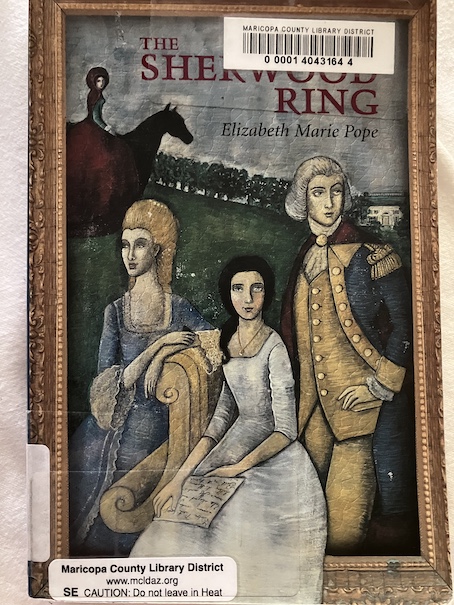
The Sherwood Ring by Elizabeth Marie Pope, 1958.
When Peggy Grahame’s father dies, she goes to live with her Uncle Enos in upstate New York, at their ancestral home, which goes by the whimsical name Rest-and-Be-Thankful. The family has lived there since the family arrived in America, fleeing their old home in Scotland after their support for Bonnie Prince Charlie failed. Uncle Enos loves history and tends to live in the past of their old home. Peggy’s father has sarcastically
said that Uncle Enos keeps “a pack of ghosts” at the old home and dedicates his life to making them feel comfortable by never changing anything there. Although, before he dies, he admits that the place is actually haunted, after a fashion, although neither he nor Enos has ever seen the ghosts themselves. Knowing that he is about to die, he sends word to Enos that Peggy is coming, and he says that Peggy will understand what
he means about the ghosts when she gets there. He also says that Peggy will largely be looking after herself at the house because Enos is too preoccupied with studying history to take much notice of her.
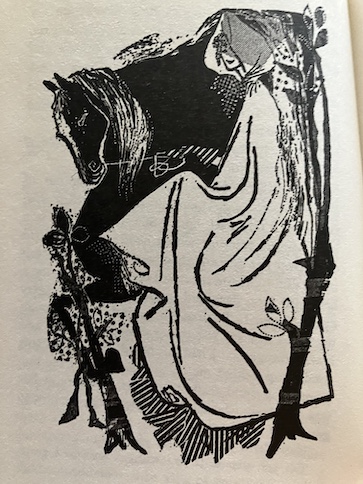
After the reaches New York, Peggy has to ask for additional directions to her uncle’s house. She meets a young man from England, Pat Thorne, who’s in the United States on a scholarship, doing some historical research. Strangely, when he came in pursuit of the papers he had hoped to find, his cousin Mildred denies their existence, although he’s sure that they actually do exist. He suspects that Mildred is covering it up for some reason because a picture that he remembers his cousin had is mysteriously missing. He has now come to the region where Uncle Enos lives in search of additional historical material, and he is hoping to see Uncle Enos himself because he’s the local authority on the region’s history. He has heard that Uncle Enos welcomes young scholars, but he’s been having trouble getting in touch with him. He gives Peggy a ride to Rest-and-Be-
Thankful, although they have car trouble on the way.
However, when they arrive at Rest-and-Be-Thankful, Uncle Enos is strangely angry that Pat Thorne is there. He says that he has nothing to say to Pat and that he doesn’t want Peggy associating with him. Both Peggy and Pat insist that Uncle Enos explain why he’s so angry, but he refuses to explain anything. He only wants Pat to leave the house. Pat replies to Uncle Enos that he will leave but that he will also be seeing Peggy again,
no matter what Enos says. Peggy can tell that Enos is distressed at the idea of Pat hanging around, but there’s a second shock for Peggy as she begins settling into the house. She sees a picture of one of her ancestors, a girl called Barbara, and she realizes that this girl looks exactly like a girl on a horse who she met before she met Pat and who directed her to talk to him. Peggy wonders if she’s seen her first ghost.
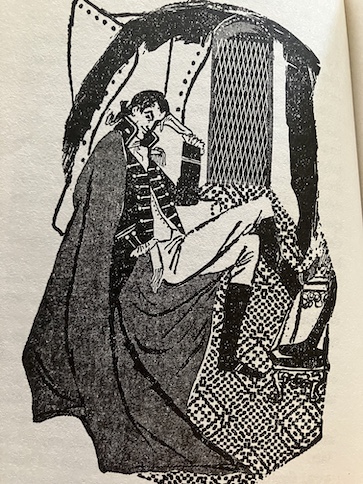
It’s some time before Peggy hears from Pat again, and she meets her second ghost one day when she’s fuming about Pat not coming to speak to her or get in touch with her and saying that she’ll “show him.” A young man in a continental army uniform is suddenly sitting in an armchair near her, and Peggy recognizes him from his portrait as Richard, the brother of Barbara. Richard tells Peggy about his life during the American Revolution and how personal pride got him into an embarrassing and dangerous situation.
He had been given a special mission by George Washington to apprehend a man called Peaceable Sherwood, who was leading a gang of people who were sabotaging the Revolutionaries’ war efforts. To his surprise, Richard received a letter from Peaceable Sherwood himself while he was staying with some neighbors. The letter was sealed with a seal from Sherwood’s signet ring, and it told Richard that he was aware that Richard was looking for him, promising that Sherwood and his men would make things interesting for him. Sherwood proved an elusive person to find. Eventually, Richard discovered evidence that pointed to a place where Sherwood would be waiting to meet some of his gang. He admits that he should have gone for reinforcements, but he was so eager to prove himself by capturing Sherwood as quickly as possible, so he confronted Sherwood alone. There was a fight in which he was almost killed, and he had to admit his humiliating mistake to the young woman he loved.
Ghostly Richard says that he’s telling this story to Peggy as a warning to her about hot-headed pride. He doesn’t know the young man Peggy was talking about, but he says that hot-headed pride also kept him and the girl he loved, Eleanor Shipley, from admitting their real feelings for each other for some time, until his humiliation at the hands of Sherwood caused them both to drop their pride. Peggy is touched by the story,
and she asks Richard what eventually happened with Sherwood, if he ever caught him. Richard refuses to answer and disappears. Later, when Peggy begins delving more into her family’s past and her uncle’s collection of heirlooms, Eleanor Shipley appears to her and continues the story of Richard and
Sherwood.
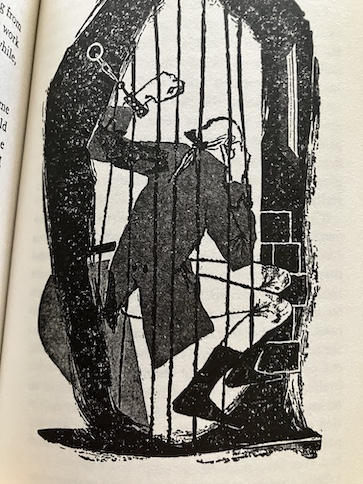
As Peggy tries to settle in to life at Rest-and-Be-Thankful with Uncle Enos and to learn what it is he has against Pat Thorne, ghosts of the past continue to appear to her, all connected to the events of the American Revolution. Eleanor explains her budding relationship with Richard, and Barbara appears again to tell her how she and Richard were both captured by Sherwood and his men at Rest-and-Be-Thankful but managed to escape and Sherwood. Sherwood was going to be executed, but while Peggy is given the dull task of serving punch at her uncle’s Fourth of July ball, the ghost of Peaceable Sherwood himself shows up to tell the story of his escape and how he decided that the only woman he could marry was Barbara. Even though they were on opposite sides of the war, he’d never known a girl as clever and resourceful as she was. Even though Barbara initially says that she has no intention of marrying Sherwood, she also appreciates his cleverness, and she had tried to intervene to prevent him from being executed when he was in prison and can’t bring herself to turn him in when he escapes. Sherwood tells Barbara that the men in his family are known for their stubbornness and that it’s actually the motto on their family crest that they always get what they want, so he’s already making plans for their future wedding.
Not long after the Fourth of July ball, Uncle Enos falls seriously ill. The doctor says that it’s a virus, but he can tell that there’s something wrong with him because the treatments he’s giving Uncle Enos aren’t working as well as they should. Uncle Enos has made himself ill before by bottling up his emotions, and everyone who knows him can tell that there’s something on his mind that’s seriously troubling him, something he doesn’t want to say. However, Uncle Enos cannot get better until he finally admits what’s troubling him and deals with it. It’s his stubborn personal pride that’s getting in the way. Peggy is sure that the problem is about the conflict between him and Pat Thorne. It also possibly has to do with the story of Sherwood and the events that took place at Rest-and-Be-Thankful during the Revolutionary War.
When Barbara appears to Peggy one more time to finish the story of Sherwood and Peggy calls Pat to come to Rest-and-Be-Thankful, many things are cleared up. Sometimes, ghosts call on the living to right the wrongs of the past, but sometimes, ghosts of the past are concerned about loved ones who are still alive and help them to right the wrongs of the present.
The book is available to borrow and read for free online through Internet Archive.
My Reaction and Some Spoilers
I was curious about this book for some time because it has ghosts and visions of the past. It has similar themes to other books I’ve read, and I enjoyed The Perilous Gard, which is by the same author.
Partway through, I was a little hesitant to finish the book because I liked the characters of the past, and I didn’t want to see anything horrible happen to them. Because they are all dead and because of Uncle Enos’s animosity over something that happened in the past, I was bracing myself for something tragic to happen to one or more of the characters in the story. I thought, at first, that maybe Sherwood actually killed Richard at some point, maybe before he could marry Eleanor. Then, I thought maybe Barbara and Sherwood turned into a kind of Romeo and Juliet romantic tragedy because they’re on opposite sides. Fortunately, none of that happened in the story.
The best part of this, for me, is that the people from past (spoilers) all survived the Revolutionary War, and they apparently lived normal lives after that. Richard and Eleanor are married during the course of the story of past events, and Barbara tells Peggy that she did marry Sherwood after the war, when there was no more conflict of interest between them. Unlike many other ghost stories, the ghosts of the past in this story aren’t there to ask their living relatives to make things right for them. They don’t have any unresolved problems themselves; they are there to provide comfort and support to Peggy. They know that Peggy hasn’t had much attention or affection from her relatives. Her father didn’t pay much attention to her, and her uncle is too wrapped up in his historical research to pay much attention to her. Peggy needs some attention and information from her family to figure out what’s going on with Uncle Enos and how to help him as well as herself. The ghosts say that they cannot give her all the answers, but what the ghosts tell her gives her the clues she needs to work out the rest herself. Peggy also comes to see that some of her ancestors can relate to things that have happened to her, from the deaths of parents to dealing with disagreeable relatives to falling for someone that her family might not approve of. It helps her to see that she’s not alone, and her experiences help her to understand some of theirs.
I didn’t expect to hear any part of the Revolutionary War story from Peaceable Sherwood’s perspective, but when he showed up as a ghost to tell his part of the story, it helped me see that the story might have a happy ending after all, with no tragedies left for the historical characters. Although Sherwood is an antagonist to the other characters for much of the story, he reveals that what he’s doing isn’t entirely of his will. In some ways, he is a “poor little rich boy” – someone who comes from wealth but hasn’t had much affection or close relationships in his life and is stuck in some unfortunate circumstances. He comes from a wealthy family in England, but he was orphaned at a young age and put under the guardianship of an uncle who didn’t like him. It was his uncle who got him a commission in the army, and he did that mainly to get rid of him rather than for Sherwood’s personal advancement in life. Sherwood’s been doing the best he can with the position he’s given, and he and Richard both understand and accept that their respective roles put themselves at opposition to each other. They have to alternately fight each other and defend themselves from each other, but they also respect each other because they are somewhat similar to each other and pretty equal in their skills and intelligence. There are times when either of them could have killed the other, but they don’t because they are gentlemen and behave honorably, and they also have some fondness for each other. When Barbara starts to get to know Sherwood and his history more, she also begins to feel some fondness for Sherwood and finds him charming. Personally, I would have been put off by a grown man saying that he always gets what he wants because that sounds so bratty, but Barbara later explains that Sherwood usually gets what he wants because of his cleverness and determination in pursuing what means the most to him, not just pure entitlement.
When I first started reading the book, I had some suspicions about how Pat Thorne is connected to the Grahames and to Peaceable Sherwood, but the answer and type of problem that he represents to Uncle Enos were a little unexpected. The connection was somewhat what I expected, but it goes deeper than that, and the problem between them is very much a modern one, made by the living members of the family, not one left over from a past tragedy. It’s not an insurmountable problem, either. It’s not a family feud but a kind of misunderstanding that got out of hand, leaving Enos torn about how to handle it. He did something he probably shouldn’t have because someone else did something that she really shouldn’t have. Enos apparently was acting in good faith, but admitting the facts of the matter would mean giving up something that has meaning for him and historical significance. Now, he’s torn between wanting to deny what he did and what he’s got and wanting to make things right. Once Peggy and Pat compare notes, the matter becomes clear. Things work out very well between Pat and Peggy at the end, and they seem to understand each other very well, partly because of Peggy’s knowledge of the past and partly because Pat himself is very perceptive about what Peggy’s life has been like. He knows that things have been hard for Peggy because of how her father and uncle have been. She hasn’t had much attention or affection, but he’s determined to provide that for her. Pat completes the story of Peaceable Sherwood and brings it full circle. Pat doesn’t hold back about his own circumstances and the kind of life he expects to live with his future wife, but both he and Peggy are sure thinks will work out for them. Even though his family doesn’t have the money they once did, they still have a tendency to get what they set their hearts on.

